Micromeritics
1
2
Outline
 Particle size and size distribution
 Particle shape and surface area
 Methods for determining particle size and size distribution
 Properties of particles
 Derived properties of particles (densities, porosity, packing
arrangement, flowability)
3
Introduction
Micromeritics
 It is the science and technology of small particles;
……….deals with fundamental and derived properties of individual
and collection of particles.
 Micromeritics deals with:
Particle size and size distribution
 Methods of determining particle size
Particle shape and surface area
4
Introduction…
 In the field of pharmacy, micromeritics has become an important area of
study because it influences a large number of parameters;
 Research and development
 Manufacturing of dosage forms such as;
 Suspension to be reconstituted
 Tablet
 Capsule
5
Introduction…
 Study of properties of particle has many application in pharmacy;
Physical properties of powder are dependent on particle size and size
distribution
Flow properties of the powder
Release and dissolution
Absorption and drug action
Physical stability and dose uniformity
6
Fundamental properties of collection of particles
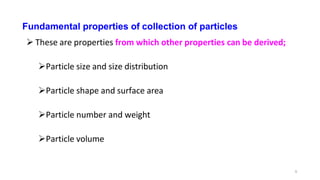
 These are properties from which other properties can be derived;
Particle size and size distribution
Particle shape and surface area
Particle number and weight
Particle volume
7
Particle size and size distribution
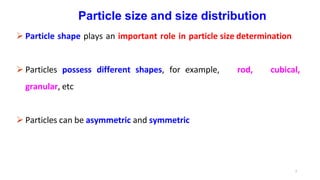
 Particle shape plays an important role in particle size determination
 Particles possess different shapes, for example, rod, cubical,
granular, etc
 Particles can be asymmetric and symmetric
Particle size and size distribution…
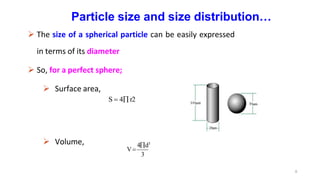
 The size of a spherical particle can be easily expressed
in terms of its diameter
 So, for a perfect sphere;
 Surface area,
S  4 r2
 Volume,
3
4d3
V
8
9
Particle size and size distribution…
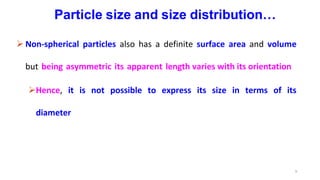
 Non-spherical particles also has a definite surface area and volume
but being asymmetric its apparent length varies with its orientation
Hence, it is not possible to express its size in terms of its
diameter
10
Particle size and size
distribution…
 Various equivalent diameters have been developed to relate the size of such
particles to that of a sphere with identical surface area, volume or
sedimentation rate.
 Surface diameter (ds)……the diameter of a sphere having the same surface
area as that of the asymmetric particles in question.
 Volume diameter (dv)…….the diameter of a sphere having the same
volume as that of the asymmetric particles in question.
11
Particle size and size
distribution…
 Projected diameter (dp)…….the diameter of a sphere having the same observed
area as that of the asymmetric particles in question
 Usually determined using microscopic techniques
 Stock diameter (dst)…… the diameter of a sphere with the same density as the
asymmetric particles in question and which undergoes sedimentation at the
same rate as the asymmetric particles in a given fluid
dst is usually determined using sedimentation methods
12
Particle size and size distribution…
 Any collection of particles is polydisperse
 Mixture of particles with varying size and shape
 Thus, we need an estimate of the size range present and the
number or weight fraction of each particle size.
This is particle size distribution
From this the average particle size of the collection of particles
can be derived.
13
Particle size
distribution
 The purpose of particle size measurement is to determine the
percentage frequency of distribution of particle sizes.
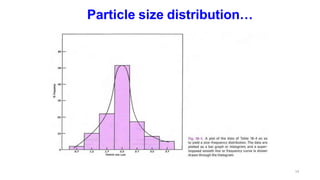
 Data may be presented as a bar graph or histogram of the frequency
as function of particle size.
 Size distribution data are commonly presented graphically
because a graph permits easy visualization of the mean and skewness
of distribution.
Particle size distribution…
14
15
Particle size distribution…
 The normal distribution shown in figure Fig 18.1, is not commonly
found in pharmaceutical powders, which are frequently
processed by milling or precipitation
 The size distribution of milled materials is usually skewed with the
number of particles increasing with decreasing size.
16
Methods of particles Size Determination
 Particle-size analysis methods;
 Microscopic
 Sieving technique
 Sedimentation
 Coulter counter
17
Microscop
y
 The microscope eyepiece is fitted with a micrometer by which the size of the
particles may be estimated.
The effective size range for analyzing particles is about 0.25 to 100 µm.
Procedure
Dilute suspension of the particles whose size are to be determined is
prepared in a liquid in which it is insoluble.
A drop of suspension is placed on the slide
The eyepiece of the microscope is fitted with micrometer
Microscopy
…
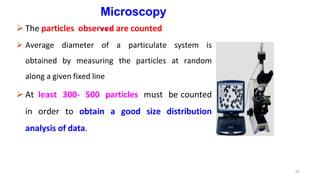
 The particles observed are counted
 Average diameter of a particulate system is
obtained by measuring the particles at random
along a given fixed line
 At least 300- 500 particles must be counted
in order to obtain a good size distribution
analysis of data.
18
19
Microscopy
…
Advantages
 Providing a direct visual representation of the particles
 Requires an extremely small amount of sample
 Needs no calibration by other methods
 The equipment is relatively inexpensive to acquire and maintain
 It can provide details about shape, crystal habit, and homogeneity
within the sample in addition to size
 Agglomerate can be detected
Disadvantages
 The measured diameter of the particles represents two dimensions only
 Slow and tedious process
20
Sievin
g
 Uses nests of standard sieves stacked one over the other.
 Involves mechanical shaker.
 The particles on each sieve sizes are collected and weighed.
 Useful for coarse particles (>50m)
21
Sieving
…
In determining particle size by this method;
 A nest of sieves with the coarsest on top is placed on the shaker, and the
powder sample of known weight is placed on the top of the sieve & shaken for a
definite period of time.
 The powder is classified as having passed through one sieve and being retained
on the adjacent finer sieve.
Mass collected on each sieve is weighed
Percentage of sample, collected on each sieve
Cumulative percentage of sample retained on each sieve
22
Sieving..
.
Disadvantage
 Aggregation- due to electrostatic charge or moisture
actual size is not determined
 Attrition- size reduction
 Sieve loading and duration of mechanical shaking can influence the
results
23
Sedimentation
 Andreason pipette is used for particle size distribution
determination.
 The particle size in sub-sieve range can be obtained by
gravity sedimentation as expressed in Stokes’s law (0.8 to
300µm).
Sedimentation…
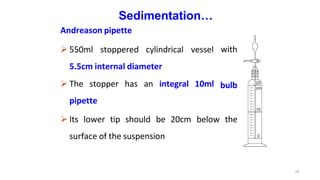
Andreason pipette
 550ml stoppered cylindrical vessel
5.5cm internal diameter
 The stopper has an integral 10ml
pipette
with
bulb
 Its lower tip should be 20cm below the
surface of the suspension
24
25
Sedimentation…
 1 or 2% suspension of the powder is placed in the vessel up to 550ml
mark.
 Shaked for uniform distribution of the particles within the medium
 10ml sample is drawn at various time interval
 The samples are evaporated and weighed
Sedimentation…
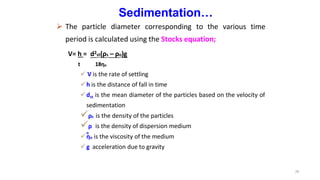
 The particle diameter corresponding to the various time
period is calculated using the Stocks equation;
V= h = d2st(ρs – ρo)g
t 18ηo
 V is the rate of settling
h is the distance of fall in time
dst is the mean diameter of the particles based on the velocity of
sedimentation
26
ρs
ρ
o
is the density of the particles
is the density of dispersion medium
ηo is the viscosity of the medium
g acceleration due to gravity
27
Sedimentation…
Advantage
The apparatus is inexpensive and the technique is simple
The results obtained are precise provided the technique is adequately
standardized
Disadvantages
Method is laborious
Very small particles cannot be determined accuratelynsince their settling is
unduly prolonged
Derived properties of Particles
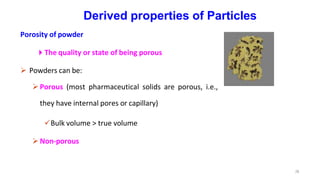
Porosity of powder
The quality or state of being porous
 Powders can be:
Porous (most pharmaceutical solids are porous, i.e.,
they have internal pores or capillary)
Bulk volume > true volume
Non-porous
28
29
Derived properties of
Particles…
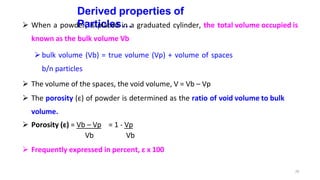
 When a powder, is placed in a graduated cylinder, the total volume occupied is
known as the bulk volume Vb
bulk volume (Vb) = true volume (Vp) + volume of spaces
b/n particles
 The volume of the spaces, the void volume, V = Vb – Vp
 The porosity (ε) of powder is determined as the ratio of void volume to bulk
volume.
 Porosity (ε) = Vb – Vp = 1 - Vp
Vb Vb
 Frequently expressed in percent, ε x 100
30
Derived properties of
Particles…
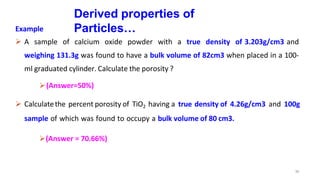
Example
 A sample of calcium oxide powder with a true density of 3.203g/cm3 and
weighing 131.3g was found to have a bulk volume of 82cm3 when placed in a 100-
ml graduated cylinder. Calculate the porosity ?
(Answer=50%)
 Calculatethe percent porosity of TiO2 having a true density of 4.26g/cm3 and 100g
sample of which was found to occupy a bulk volume of 80 cm3.
(Answer = 70.66%)
Derived properties of
Particles…
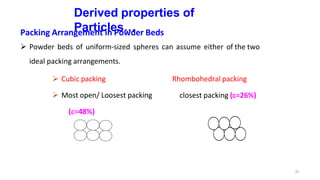
Packing Arrangement in Powder Beds
 Powder beds of uniform-sized spheres can assume either of the two
ideal packing arrangements.
 Cubic packing
 Most open/ Loosest packing
(=48%)
Rhombohedral packing
closest packing (=26%)
31
32
Derived properties of
Particles…
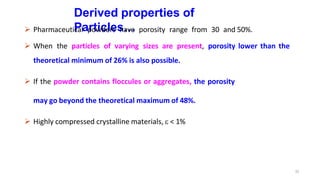
 Pharmaceutical powders have porosity range from 30 and 50%.
 When the particles of varying sizes are present, porosity lower than the
theoretical minimum of 26% is also possible.
 If the powder contains floccules or aggregates, the porosity
may go beyond the theoretical maximum of 48%.
 Highly compressed crystalline materials,  < 1%
33
Derived properties of
Particles…
Densities of particles
 Density is defined as weight per unit volume (W/V).
A) True density: the true density, or absolute density, of a sample excludes
the volume of the pores and voids within the sample.
 Methods;
Liquid displacement method
Gas displacement method
Derived properties of
Particles…
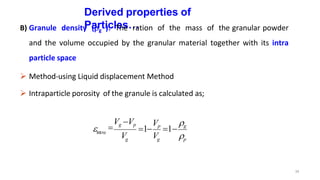
B) Granule density (g ): The ration of the mass of the granular powder
and the volume occupied by the granular material together with its intra
particle space
 Method-using Liquid displacement Method
 Intraparticle porosity of the granule is calculated as;
g p
34
g

Vg Vp
intra
V
V 
1
Vp
1
g

35
Derived properties of
Particles…
C)Bulk density (b): It is the ratio of the mass of the powder and its
bulk volume
Includes the volume of all of the pores within the sample.
Depends on particle size distribution, particle shape and the
packaging arrangement
 Weighed quantity of the powder material is introduced into a
graduated measuring cylinder and is tapped mechanically or
manually till a constant volume is obtained.
Derived properties of Particles…
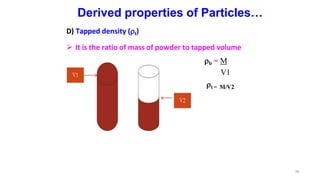
D) Tapped density (t)
 It is the ratio of mass of powder to tapped volume
b = M
V1
t = M/V2
36
37
Derived properties of
Particles…
Bulkiness = Specific bulk volume
The reciprocal of bulk density
 Bulkiness usually increases with a decrease in particle size.
 However, in a mixture of particles with different sizes, the bulkiness may
get reduced.
 It is a useful property to be considered while choosing a suitable
container for packaging or during filling of drug powders in to capsules.
38
Derived properties of
Particles…
Flow properties of powders
 Powders may be free-flowing or cohesive (“sticky”).
 Important parameter to be considered in the production of
pharmaceutical dosage forms.
Example:
 Dies filling during tableting
 Capsules filling
 directly depend on the flow properties of the powder
39
Derived properties of Particles…
Flow properties of powders depends on;
 Cohesiveness or stickiness between particles due to presence of Van der Waals,
surface tension and electrostatic forces.
 Cohesiveness of particles has been found to depend upon a number of factors.
 Particle size and shape….very fine particles tend to be more cohesive due
to their large surface area
 Density or porosity of the powders……dense materials tend to be less cohesive
than lighter ones
 The presence of adsorbed materials on the powder surface
 Moisture increase cohesiveness of particles
40
Derived properties of
Particles…
Many common manufacturing problems are attributed to powder flow;
 Uneven powder flow
 Excess entrapped air within powders → capping or lamination.
 Increase particle’s friction with die wall causing lubrication problems, and
 Increase dust contamination risks during powder transfer.
 Non-uniformity of dose
 Non-uniformity (segregation) in blending
Assessment of flow properties of powders
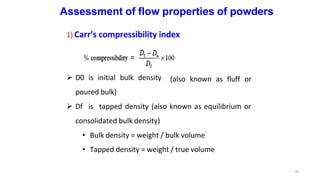
1) Carr’s compressibility index
 D0 is initial bulk density
poured bulk)
41
(also known as fluff or
 Df is tapped density (also known as equilibrium or
consolidated bulk density)
• Bulk density = weight / bulk volume
• Tapped density = weight / true volume
Assessment of flow properties of powders…
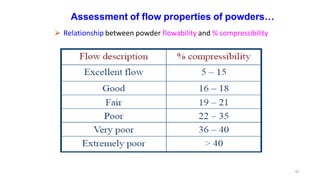
 Relationship between powder flowability and % compressibility
42
Assessment of flow properties of
powders…
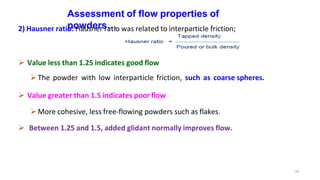
2) Hausner ratio: Hausner ratio was related to interparticle friction;
 Value less than 1.25 indicates good flow
The powder with low interparticle friction, such as coarse spheres.
 Value greater than 1.5 indicates poor flow
More cohesive, less free-flowing powders such as flakes.
 Between 1.25 and 1.5, added glidant normally improves flow.
43
Assessment of flow properties of
powders…
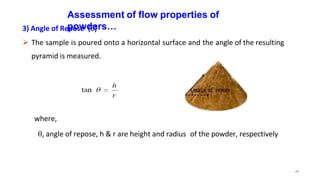
3) Angle of Repose ()
 The sample is poured onto a horizontal surface and the angle of the resulting
pyramid is measured.
where,
, angle of repose, h & r are height and radius of the powder, respectively
44
45
Assessment of flow properties of powders…
 Angle of repose is a function of the surface roughness.
The rougher and more irregular the surface of particles, the
more the angle of repose
As the particles become less and less spherical, the angle of
repose increases while the bulk density and flowability decreases.
46
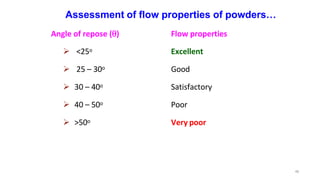
Assessment of flow properties of powders…
Angle of repose () Flow properties
 <25o Excellent
 25 – 30o Good
 30 – 40o Satisfactory
 40 – 50o Poor
 >50o Very poor
47
Improvement of flow properties
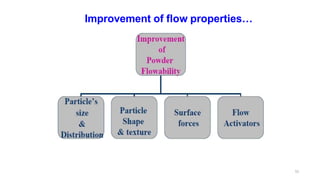
Alteration of Particle’s size & Distribution
 Coarse particles are more preferred than fine ones as they are less
cohesive.
 Altering the size distribution,
By removing a proportion of the fine particle fraction or
By increasing the proportion of coarser particles, such as occurs in
granulation.
48
Improvement of flow properties…
Alteration of Particle Shape & texture
 Generally, more spherical particles have better flow properties than
more irregular particles.
 Spherical particles are obtained by spray drying, or by temperature cycling
crystallization.
 Particle's texture;
 Particles with very rough surfaces will be more cohesive and have a
greater tendency to interlock than smooth surfaced particles
49
Improvement of flow properties…
Alteration of Surface Forces
 Reduction of electrostatic charges can improve powder flowability.
Can be reduced by altering process conditions to reduce frictional
contacts
 The moisture content of particles is also of importance to powder
flowability, as adsorbed surface moisture films tend to increase bulk density
and reduce porosity
 If hygroscopic, stored and processed under low-humidity conditions.
50
Improvement of flow properties…
Formulation additives ( Flow activators)
 Flow activators are commonly referred as glidants.
 Flow activators improve the flowability of powders by reducing
adhesion and cohesion.
e.g. talc, maize starch and magnesium stearate
Improvement of flow properties…
51
52

3. Micromeritics.pptxu has a sensitivity to

  • 1.
  • 2.
    2 Outline  Particle sizeand size distribution  Particle shape and surface area  Methods for determining particle size and size distribution  Properties of particles  Derived properties of particles (densities, porosity, packing arrangement, flowability)
  • 3.
    3 Introduction Micromeritics  It isthe science and technology of small particles; ……….deals with fundamental and derived properties of individual and collection of particles.  Micromeritics deals with: Particle size and size distribution  Methods of determining particle size Particle shape and surface area
  • 4.
    4 Introduction…  In thefield of pharmacy, micromeritics has become an important area of study because it influences a large number of parameters;  Research and development  Manufacturing of dosage forms such as;  Suspension to be reconstituted  Tablet  Capsule
  • 5.
    5 Introduction…  Study ofproperties of particle has many application in pharmacy; Physical properties of powder are dependent on particle size and size distribution Flow properties of the powder Release and dissolution Absorption and drug action Physical stability and dose uniformity
  • 6.
    6 Fundamental properties ofcollection of particles  These are properties from which other properties can be derived; Particle size and size distribution Particle shape and surface area Particle number and weight Particle volume
  • 7.
    7 Particle size andsize distribution  Particle shape plays an important role in particle size determination  Particles possess different shapes, for example, rod, cubical, granular, etc  Particles can be asymmetric and symmetric
  • 8.
    Particle size andsize distribution…  The size of a spherical particle can be easily expressed in terms of its diameter  So, for a perfect sphere;  Surface area, S  4 r2  Volume, 3 4d3 V 8
  • 9.
    9 Particle size andsize distribution…  Non-spherical particles also has a definite surface area and volume but being asymmetric its apparent length varies with its orientation Hence, it is not possible to express its size in terms of its diameter
  • 10.
    10 Particle size andsize distribution…  Various equivalent diameters have been developed to relate the size of such particles to that of a sphere with identical surface area, volume or sedimentation rate.  Surface diameter (ds)……the diameter of a sphere having the same surface area as that of the asymmetric particles in question.  Volume diameter (dv)…….the diameter of a sphere having the same volume as that of the asymmetric particles in question.
  • 11.
    11 Particle size andsize distribution…  Projected diameter (dp)…….the diameter of a sphere having the same observed area as that of the asymmetric particles in question  Usually determined using microscopic techniques  Stock diameter (dst)…… the diameter of a sphere with the same density as the asymmetric particles in question and which undergoes sedimentation at the same rate as the asymmetric particles in a given fluid dst is usually determined using sedimentation methods
  • 12.
    12 Particle size andsize distribution…  Any collection of particles is polydisperse  Mixture of particles with varying size and shape  Thus, we need an estimate of the size range present and the number or weight fraction of each particle size. This is particle size distribution From this the average particle size of the collection of particles can be derived.
  • 13.
    13 Particle size distribution  Thepurpose of particle size measurement is to determine the percentage frequency of distribution of particle sizes.  Data may be presented as a bar graph or histogram of the frequency as function of particle size.  Size distribution data are commonly presented graphically because a graph permits easy visualization of the mean and skewness of distribution.
  • 14.
  • 15.
    15 Particle size distribution… The normal distribution shown in figure Fig 18.1, is not commonly found in pharmaceutical powders, which are frequently processed by milling or precipitation  The size distribution of milled materials is usually skewed with the number of particles increasing with decreasing size.
  • 16.
    16 Methods of particlesSize Determination  Particle-size analysis methods;  Microscopic  Sieving technique  Sedimentation  Coulter counter
  • 17.
    17 Microscop y  The microscopeeyepiece is fitted with a micrometer by which the size of the particles may be estimated. The effective size range for analyzing particles is about 0.25 to 100 µm. Procedure Dilute suspension of the particles whose size are to be determined is prepared in a liquid in which it is insoluble. A drop of suspension is placed on the slide The eyepiece of the microscope is fitted with micrometer
  • 18.
    Microscopy …  The particlesobserved are counted  Average diameter of a particulate system is obtained by measuring the particles at random along a given fixed line  At least 300- 500 particles must be counted in order to obtain a good size distribution analysis of data. 18
  • 19.
    19 Microscopy … Advantages  Providing adirect visual representation of the particles  Requires an extremely small amount of sample  Needs no calibration by other methods  The equipment is relatively inexpensive to acquire and maintain  It can provide details about shape, crystal habit, and homogeneity within the sample in addition to size  Agglomerate can be detected Disadvantages  The measured diameter of the particles represents two dimensions only  Slow and tedious process
  • 20.
    20 Sievin g  Uses nestsof standard sieves stacked one over the other.  Involves mechanical shaker.  The particles on each sieve sizes are collected and weighed.  Useful for coarse particles (>50m)
  • 21.
    21 Sieving … In determining particlesize by this method;  A nest of sieves with the coarsest on top is placed on the shaker, and the powder sample of known weight is placed on the top of the sieve & shaken for a definite period of time.  The powder is classified as having passed through one sieve and being retained on the adjacent finer sieve. Mass collected on each sieve is weighed Percentage of sample, collected on each sieve Cumulative percentage of sample retained on each sieve
  • 22.
    22 Sieving.. . Disadvantage  Aggregation- dueto electrostatic charge or moisture actual size is not determined  Attrition- size reduction  Sieve loading and duration of mechanical shaking can influence the results
  • 23.
    23 Sedimentation  Andreason pipetteis used for particle size distribution determination.  The particle size in sub-sieve range can be obtained by gravity sedimentation as expressed in Stokes’s law (0.8 to 300µm).
  • 24.
    Sedimentation… Andreason pipette  550mlstoppered cylindrical vessel 5.5cm internal diameter  The stopper has an integral 10ml pipette with bulb  Its lower tip should be 20cm below the surface of the suspension 24
  • 25.
    25 Sedimentation…  1 or2% suspension of the powder is placed in the vessel up to 550ml mark.  Shaked for uniform distribution of the particles within the medium  10ml sample is drawn at various time interval  The samples are evaporated and weighed
  • 26.
    Sedimentation…  The particlediameter corresponding to the various time period is calculated using the Stocks equation; V= h = d2st(ρs – ρo)g t 18ηo  V is the rate of settling h is the distance of fall in time dst is the mean diameter of the particles based on the velocity of sedimentation 26 ρs ρ o is the density of the particles is the density of dispersion medium ηo is the viscosity of the medium g acceleration due to gravity
  • 27.
    27 Sedimentation… Advantage The apparatus isinexpensive and the technique is simple The results obtained are precise provided the technique is adequately standardized Disadvantages Method is laborious Very small particles cannot be determined accuratelynsince their settling is unduly prolonged
  • 28.
    Derived properties ofParticles Porosity of powder The quality or state of being porous  Powders can be: Porous (most pharmaceutical solids are porous, i.e., they have internal pores or capillary) Bulk volume > true volume Non-porous 28
  • 29.
    29 Derived properties of Particles… When a powder, is placed in a graduated cylinder, the total volume occupied is known as the bulk volume Vb bulk volume (Vb) = true volume (Vp) + volume of spaces b/n particles  The volume of the spaces, the void volume, V = Vb – Vp  The porosity (ε) of powder is determined as the ratio of void volume to bulk volume.  Porosity (ε) = Vb – Vp = 1 - Vp Vb Vb  Frequently expressed in percent, ε x 100
  • 30.
    30 Derived properties of Particles… Example A sample of calcium oxide powder with a true density of 3.203g/cm3 and weighing 131.3g was found to have a bulk volume of 82cm3 when placed in a 100- ml graduated cylinder. Calculate the porosity ? (Answer=50%)  Calculatethe percent porosity of TiO2 having a true density of 4.26g/cm3 and 100g sample of which was found to occupy a bulk volume of 80 cm3. (Answer = 70.66%)
  • 31.
    Derived properties of Particles… PackingArrangement in Powder Beds  Powder beds of uniform-sized spheres can assume either of the two ideal packing arrangements.  Cubic packing  Most open/ Loosest packing (=48%) Rhombohedral packing closest packing (=26%) 31
  • 32.
    32 Derived properties of Particles… Pharmaceutical powders have porosity range from 30 and 50%.  When the particles of varying sizes are present, porosity lower than the theoretical minimum of 26% is also possible.  If the powder contains floccules or aggregates, the porosity may go beyond the theoretical maximum of 48%.  Highly compressed crystalline materials,  < 1%
  • 33.
    33 Derived properties of Particles… Densitiesof particles  Density is defined as weight per unit volume (W/V). A) True density: the true density, or absolute density, of a sample excludes the volume of the pores and voids within the sample.  Methods; Liquid displacement method Gas displacement method
  • 34.
    Derived properties of Particles… B)Granule density (g ): The ration of the mass of the granular powder and the volume occupied by the granular material together with its intra particle space  Method-using Liquid displacement Method  Intraparticle porosity of the granule is calculated as; g p 34 g  Vg Vp intra V V  1 Vp 1 g 
  • 35.
    35 Derived properties of Particles… C)Bulkdensity (b): It is the ratio of the mass of the powder and its bulk volume Includes the volume of all of the pores within the sample. Depends on particle size distribution, particle shape and the packaging arrangement  Weighed quantity of the powder material is introduced into a graduated measuring cylinder and is tapped mechanically or manually till a constant volume is obtained.
  • 36.
    Derived properties ofParticles… D) Tapped density (t)  It is the ratio of mass of powder to tapped volume b = M V1 t = M/V2 36
  • 37.
    37 Derived properties of Particles… Bulkiness= Specific bulk volume The reciprocal of bulk density  Bulkiness usually increases with a decrease in particle size.  However, in a mixture of particles with different sizes, the bulkiness may get reduced.  It is a useful property to be considered while choosing a suitable container for packaging or during filling of drug powders in to capsules.
  • 38.
    38 Derived properties of Particles… Flowproperties of powders  Powders may be free-flowing or cohesive (“sticky”).  Important parameter to be considered in the production of pharmaceutical dosage forms. Example:  Dies filling during tableting  Capsules filling  directly depend on the flow properties of the powder
  • 39.
    39 Derived properties ofParticles… Flow properties of powders depends on;  Cohesiveness or stickiness between particles due to presence of Van der Waals, surface tension and electrostatic forces.  Cohesiveness of particles has been found to depend upon a number of factors.  Particle size and shape….very fine particles tend to be more cohesive due to their large surface area  Density or porosity of the powders……dense materials tend to be less cohesive than lighter ones  The presence of adsorbed materials on the powder surface  Moisture increase cohesiveness of particles
  • 40.
    40 Derived properties of Particles… Manycommon manufacturing problems are attributed to powder flow;  Uneven powder flow  Excess entrapped air within powders → capping or lamination.  Increase particle’s friction with die wall causing lubrication problems, and  Increase dust contamination risks during powder transfer.  Non-uniformity of dose  Non-uniformity (segregation) in blending
  • 41.
    Assessment of flowproperties of powders 1) Carr’s compressibility index  D0 is initial bulk density poured bulk) 41 (also known as fluff or  Df is tapped density (also known as equilibrium or consolidated bulk density) • Bulk density = weight / bulk volume • Tapped density = weight / true volume
  • 42.
    Assessment of flowproperties of powders…  Relationship between powder flowability and % compressibility 42
  • 43.
    Assessment of flowproperties of powders… 2) Hausner ratio: Hausner ratio was related to interparticle friction;  Value less than 1.25 indicates good flow The powder with low interparticle friction, such as coarse spheres.  Value greater than 1.5 indicates poor flow More cohesive, less free-flowing powders such as flakes.  Between 1.25 and 1.5, added glidant normally improves flow. 43
  • 44.
    Assessment of flowproperties of powders… 3) Angle of Repose ()  The sample is poured onto a horizontal surface and the angle of the resulting pyramid is measured. where, , angle of repose, h & r are height and radius of the powder, respectively 44
  • 45.
    45 Assessment of flowproperties of powders…  Angle of repose is a function of the surface roughness. The rougher and more irregular the surface of particles, the more the angle of repose As the particles become less and less spherical, the angle of repose increases while the bulk density and flowability decreases.
  • 46.
    46 Assessment of flowproperties of powders… Angle of repose () Flow properties  <25o Excellent  25 – 30o Good  30 – 40o Satisfactory  40 – 50o Poor  >50o Very poor
  • 47.
    47 Improvement of flowproperties Alteration of Particle’s size & Distribution  Coarse particles are more preferred than fine ones as they are less cohesive.  Altering the size distribution, By removing a proportion of the fine particle fraction or By increasing the proportion of coarser particles, such as occurs in granulation.
  • 48.
    48 Improvement of flowproperties… Alteration of Particle Shape & texture  Generally, more spherical particles have better flow properties than more irregular particles.  Spherical particles are obtained by spray drying, or by temperature cycling crystallization.  Particle's texture;  Particles with very rough surfaces will be more cohesive and have a greater tendency to interlock than smooth surfaced particles
  • 49.
    49 Improvement of flowproperties… Alteration of Surface Forces  Reduction of electrostatic charges can improve powder flowability. Can be reduced by altering process conditions to reduce frictional contacts  The moisture content of particles is also of importance to powder flowability, as adsorbed surface moisture films tend to increase bulk density and reduce porosity  If hygroscopic, stored and processed under low-humidity conditions.
  • 50.
    50 Improvement of flowproperties… Formulation additives ( Flow activators)  Flow activators are commonly referred as glidants.  Flow activators improve the flowability of powders by reducing adhesion and cohesion. e.g. talc, maize starch and magnesium stearate
  • 51.
    Improvement of flowproperties… 51
  • 52.