Hot Melt Extrusion
   Technology

       Kurt Kortokrax
   Sales Account Manager
   Thermo Fisher Scientific
Agenda


           1           Introduction and Review of Extrusion


           2           Pharmaceutical Grade Extrusion Systems


           3           HME as a Beneficial Technology


           4           Summary and Discussion


2/58   1   2   3   4
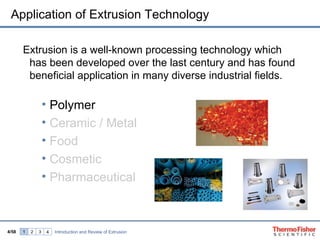
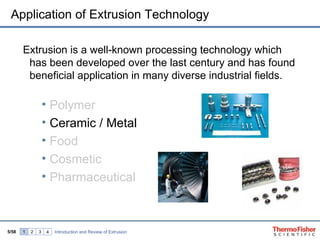
Application of Extrusion Technology

       Extrusion is a well-known processing technology which
        has been developed over the last century and has found
        beneficial application in many diverse industrial fields.

                   • Polymer
                   • Ceramic / Metal
                   • Food
                   • Cosmetic
                   • Pharmaceutical


3/58   1   2   3   4   Introduction and Review of Extrusion
Application of Extrusion Technology

       Extrusion is a well-known processing technology which
        has been developed over the last century and has found
        beneficial application in many diverse industrial fields.

                   • Polymer
                   • Ceramic / Metal
                   • Food
                   • Cosmetic
                   • Pharmaceutical


4/58   1   2   3   4   Introduction and Review of Extrusion
Application of Extrusion Technology

       Extrusion is a well-known processing technology which
        has been developed over the last century and has found
        beneficial application in many diverse industrial fields.

                   • Polymer
                   • Ceramic / Metal
                   • Food
                   • Cosmetic
                   • Pharmaceutical


5/58   1   2   3   4   Introduction and Review of Extrusion
Application of Extrusion Technology

       Extrusion is a well-known processing technology which
        has been developed over the last century and has found
        beneficial application in many diverse industrial fields.

                   • Polymer
                   • Ceramic / Metal
                   • Food
                   • Cosmetic
                   • Pharmaceutical


6/58   1   2   3   4   Introduction and Review of Extrusion
Application of Extrusion Technology

       Extrusion is a well-known processing technology which
        has been developed over the last century and has found
        beneficial application in many diverse industrial fields.

                   • Polymer                                   Troglitazone® (Parke Davis)*

                   • Ceramic / Metal                           Kaletra® Meltrex® (Abbott)
                                                               NuvaRing® (Oragnon)
                   • Food                                      Implanon® (Schering-Plough)
                   • Cosmetic                                  Zoladex® (AstraZeneca)
                   • Pharmaceutical                            Ozurdex® (Allergan)
                                                              …

                                                              * Removed from market in March of 2000


7/58   1   2   3   4   Introduction and Review of Extrusion
Types of Extrusion Systems


       Extrusion is a process which is used to create new materials
        with desirable properties by manipulating additive ingredients
        through a number of staged unit operations and forcing the
        product through a defined die geometry.


                Ram                                   Single Screw   Twin Screw

8/58    1   2   3   4   Introduction and Review of Extrusion
Hot Melt Extrusion is Extrusion Compounding

       Two or more ingredients which have been combined in defined
        proportions, distinguishable from their original state in that the
        characteristics of the whole is unique from that of the original
        constituents.
       • Mechanical Properties
             • tensile strength, bending strength, hardness, fracture toughness
       • Physical Properties
             • color, odor, density, melting/freezing/boiling point, glass transition, solubility
       • Electrical Properties
             • electrical resistance, dielectric constant
       • Chemical Properties
             • flammability, biodegradability
       • Thermal Properties
             • thermal conductivity, specific heat, thermal shock resistance


9/58   1   2   3   4   HME as a Beneficial Technology
Types of Extrusion Compounding Systems


                                                             • Design
                                                                • Conical
                                                                • Parallel
                                                             • Screw Rotation
                                                                • Co-Rotating
 Twin Screw Classifications                                     • Counter-Rotating
                                                             • Degree of Contact
                                                                • Co/Counter Intermeshing
                                                                • Counter Non-
                                                                  Intermeshing


10/58 1   2   3   4   Introduction and Review of Extrusion
Extrusion Detail


    Extrusion is a process which is used to create new materials
     with desirable properties by manipulating additive ingredients
     through a number of staged unit operations…

    Dosing – Metering – Melting – Mixing – Venting – Pumping – Forming – …


11/58   1   2   3   4   Introduction and Review of Extrusion
Extrusion Detail - Dosing


    Extrusion is a process which is used to create new materials
     with desirable properties by manipulating additive ingredients
     through a number of staged unit operations.

    Dosing – Metering – Melting – Mixing – Venting – Pumping – Forming – …


12/58   1   2   3   4   Introduction and Review of Extrusion
Extrusion Detail - Dosing
                • Type of Feeding System
                        •   Single Screw (pellet, flake, granule, powder)
                        •   Twin Screw (powder, …)
                        •   Liquid Injection (fluid, solution, …)
                        •   Piston (paste, rubber, …)
                        •   Forcefeeder / Stuffer (downstream)

                • Design of Feeding System
                        • Volumetric
                               •   Operate at Constant Screw Speed to delivery a Constant Volume per
                                   Unit Time
                               •   Accuracy +/- 2% of Set Point
                               •   Mass Flow can be Subject to Variation due to Material Density, Refilling
                                   Stages, Batch Variation/Homogeneity, etc.
                        • Gravimetric
                               •   Automatic Adjustment of Feeder Speed based upon Feedback of
                                   Incorporated Load Cell
                               •   Accuracy +/- 0.5% of Set Point

                • Control in Feeding of a Twin Screw Extruder is Critical!

13/58   1   2   3   4   Introduction and Review of Extrusion
Extrusion Detail - Metering


    Extrusion is a process which is used to create new materials
     with desirable properties by manipulating additive ingredients
     through a number of staged unit operations.

    Dosing – Metering – Melting – Mixing – Venting – Pumping – Forming – …


14/58   1   2   3   4   Introduction and Review of Extrusion
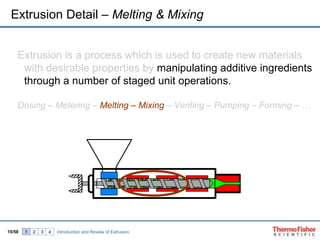
Extrusion Detail – Melting & Mixing


    Extrusion is a process which is used to create new materials
     with desirable properties by manipulating additive ingredients
     through a number of staged unit operations.

    Dosing – Metering – Melting – Mixing – Venting – Pumping – Forming – …


15/58   1   2   3   4   Introduction and Review of Extrusion
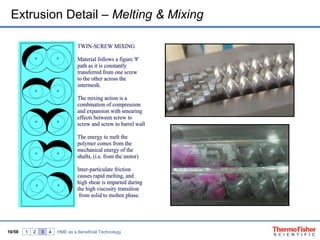
Extrusion Detail – Melting & Mixing


16/58   1   2   3   4   HME as a Beneficial Technology
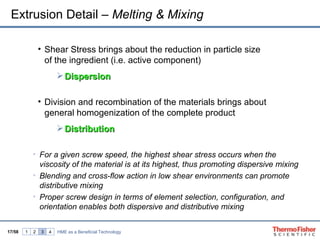
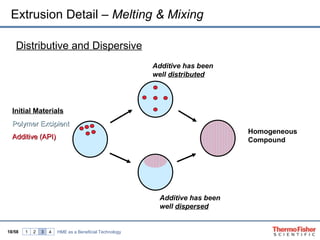
Extrusion Detail – Melting & Mixing

                • Shear Stress brings about the reduction in particle size
                  of the ingredient (i.e. active component)
                         Dispersion

                • Division and recombination of the materials brings about
                  general homogenization of the complete product
                         Distribution

            • For a given screw speed, the highest shear stress occurs when the
              viscosity of the material is at its highest, thus promoting dispersive mixing
            • Blending and cross-flow action in low shear environments can promote
              distributive mixing
            • Proper screw design in terms of element selection, configuration, and
              orientation enables both dispersive and distributive mixing


17/58   1   2   3   4   HME as a Beneficial Technology
Extrusion Detail – Melting & Mixing

   Distributive and Dispersive
                                                         Additive has been
                                                         well distributed


  Initial Materials
  Polymer Excipient
                                                                              Homogeneous
  Additive (API)                                                              Compound


                                                          Additive has been
                                                          well dispersed


18/58   1   2   3   4   HME as a Beneficial Technology
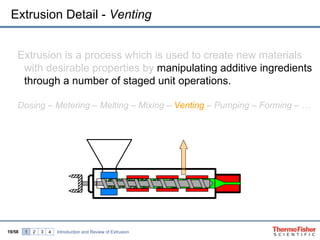
Extrusion Detail - Venting


    Extrusion is a process which is used to create new materials
     with desirable properties by manipulating additive ingredients
     through a number of staged unit operations.

    Dosing – Metering – Melting – Mixing – Venting – Pumping – Forming – …


19/58   1   2   3   4   Introduction and Review of Extrusion
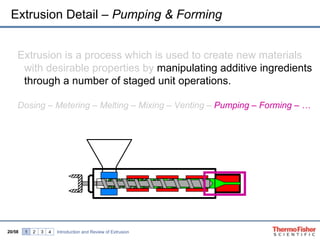
Extrusion Detail – Pumping & Forming


    Extrusion is a process which is used to create new materials
     with desirable properties by manipulating additive ingredients
     through a number of staged unit operations.

    Dosing – Metering – Melting – Mixing – Venting – Pumping – Forming – …


20/58   1   2   3   4   Introduction and Review of Extrusion
Standard or Pharmaceutical Grade?


21/58   1   2   3   4   Pharmaceutical Grade Extrusion Systems
Standard or Pharmaceutical Grade?


                          Parallel Co-Rotating Twin Screw Extrusion Systems
                          • Barrel Diameter – 16 mm
                          • Barrel Length – 25:1 L/D
                          • Typical Output – 0.5 – 5.0 kg/hr
                          • Modular Clamshell Barrel, Modular Screw Design
                          •…

22/58   1   2   3   4   Pharmaceutical Grade Extrusion Systems
Where are the differences?


23/58   1   2   3   4   Pharmaceutical Grade Extrusion Systems
Specialized Materials of Construction, Design


   • Stainless Steel Shrouding
   • Smooth Edges / Minimal
   Contamination Points
   • Non-Painted Surfaces
   • Sealed Access Panels
   • Touchscreen Controls
   • Pressurized Internal
   Compartments
   • Spray-Down Capability


24/58   1   2   3   4   Pharmaceutical Grade Extrusion Systems
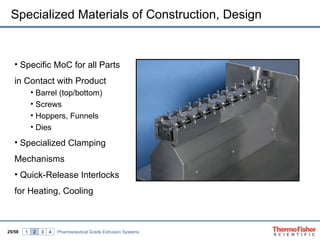
Specialized Materials of Construction, Design


   • Specific MoC for all Parts
   in Contact with Product
            • Barrel (top/bottom)
            • Screws
            • Hoppers, Funnels
            • Dies
   • Specialized Clamping
   Mechanisms
   • Quick-Release Interlocks
   for Heating, Cooling


25/58   1   2   3   4   Pharmaceutical Grade Extrusion Systems
Disassembly – Accessibility to all Wetted Components


26/58   1   2   3   4   Pharmaceutical Grade Extrusion Systems
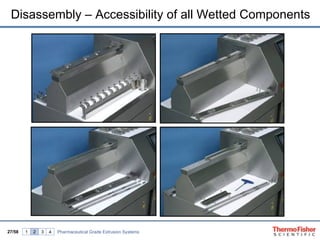
Disassembly – Accessibility of all Wetted Components


27/58   1   2   3   4   Pharmaceutical Grade Extrusion Systems
Disassembly – Accessibility to all Wetted Components


28/58   1   2   3   4   Pharmaceutical Grade Extrusion Systems
Disassembly – Accessibility to all Wetted Components


29/58   1   2   3   4   Pharmaceutical Grade Extrusion Systems
Mobility and Scale


30/58   1   2   3   4   Pharmaceutical Grade Extrusion Systems
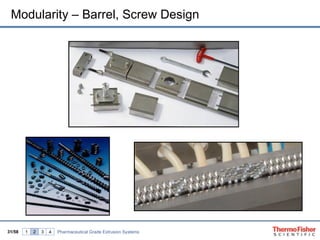
Modularity – Barrel, Screw Design


31/58   1   2   3   4   Pharmaceutical Grade Extrusion Systems
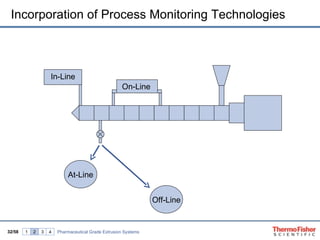
Incorporation of Process Monitoring Technologies


                    In-Line
                                                      On-Line


                            At-Line


                                                                 Off-Line


32/58   1   2   3   4   Pharmaceutical Grade Extrusion Systems
Post Extrusion Handling – Air Cooling (Conveyor)


33/58   1   2   3   4   Pharmaceutical Grade Extrusion Systems
Post Extrusion Handling – Pelletizing


34/58   1   2   3   4   Pharmaceutical Grade Extrusion Systems
Post Extrusion Handling – Chill Roll, Flaker


35/58   1   2   3   4   Pharmaceutical Grade Extrusion Systems
Why Melt Extrusion?

       Challenges
                   Solubility Enhancement
                        − Biopharmaceutical Classification System, Class II & IV
                   Bioavailability Enhancement
                   Specific Release Characteristics
       Benefits
                   Mechanical Shear Energy
                         No Curing or Drying due to Solvent Free Process
                         High Distributive / Dispersive Mixing Capability
                   Stabilization of API in Defined Form
                        − Solid Suspensions - A / C , A / A ; Solid Solution – A / A
                   Continuous Process
                        − Lower Batch to Batch Variation
                   Process Monitoring Capabilities
                   Creation of Unique Dosage Concepts / Delivery Methods

36/58 1   2   3    4   HME as a Beneficial Technology
Hot Melt Extrusion Parameters

        Optimize Formulation                              Optimize Process
                • Excipient Ingredients                      • Extrusion System
                        •   Polymeric Binders                    •   System Scale
                        •   Plasticizers and Lubricants          •   Length-to-Diameter Ratio
                        •   Glidants                             •   Barrel Configuration
                        •   Fillers and Dilutents                •   Screw Configuration
                        •   Disintigrants                        •   Extrudate Forming Devices
                        •   Antioxidants                         •   Post-Extrusion Ancillaries
                        •   etc.                             • Ingredient Introduction
                • Active Pharmaceutical                          • Sequence of Addition
                  Ingredients                                    • Rate of Addition
                                                             • Process Conditions
                                                                 • Screw Speed
                                                                 • Temperature Profile
                                                             • Monitoring Technology
                                                                 • On / In / At / Off - Line


37/58   1   2   3   4   HME as a Beneficial Technology
Extrusion System – System Scale

    Chemistry           Medicinal           Kilogram, Lab     Process Chemistry          Production Site   Production Site


    Process             10 g                1 - 5 kg          5 – 50 kg                  100 - 500 kg      500 kg
    Batch               (or less)

    Process             10 g                0.5 – 2.5 kg/hr   0.5 – 2.5 , 5 – 50 kg/hr   5 - 50 kg/hr      5 – 50, 25 – 100
    Outputs             (or less)                                                                          kg/hr

    System              Micro –             16 mm HME         16, 24 mm HME              24 mm HME         24, 36 mm HME
                        Compounder


38/58   1   2   3   4   HME as a Beneficial Technology
Extrusion System – System Scale

    Chemistry           Medicinal           Kilogram, Lab     Process Chemistry          Production Site   Production Site


    Process             10 g                1 - 5 kg          5 – 50 kg                  100 - 500 kg      500 kg
    Batch               (or less)

    Process             10 g                0.5 – 2.5 kg/hr   0.5 – 2.5 , 5 – 50 kg/hr   5 - 50 kg/hr      5 – 50, 25 – 100
    Outputs             (or less)                                                                          kg/hr

    System              Micro –             16 mm HME         16, 24 mm HME              24 mm HME         24, 36 mm HME
                        Compounder


39/58   1   2   3   4   HME as a Beneficial Technology
Extrusion System – System Scale

    Chemistry           Medicinal           Kilogram, Lab     Process Chemistry          Production Site   Production
                                                                                                           Site

    Process             10 g                1 - 5 kg          5 – 50 kg                  100 - 500 kg      500 kg
    Batch               (or less)

    Process             10 g                0.5 – 2.5 kg/hr   0.5 – 2.5 , 5 – 50 kg/hr   5 - 50 kg/hr      5 – 50, 25 –
    Outputs             (or less)                                                                          100 kg/hr

    System              Micro –             16 mm HME         16, 24 mm HME              24 mm HME         24, 36 mm
                        Compounder                                                                         HME


40/58   1   2   3   4   HME as a Beneficial Technology
Extrusion System – Length-to-Diameter Ratio


41/58   1   2   3   4   HME as a Beneficial Technology
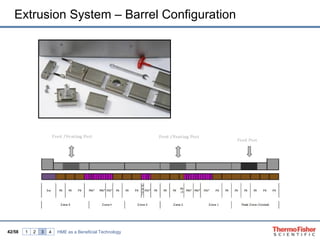
Extrusion System – Barrel Configuration


42/58   1   2   3   4   HME as a Beneficial Technology
Extrusion System – Barrel Configuration


                    16mm TSE, Single Feed at              24mm TSE, Feed at Main
                            Main                          with Downstream Vertical
                                                         Stuffer Feeder and Peristaltic
                                                                 Liquid Injection


43/58   1   2   3   4   HME as a Beneficial Technology
Extrusion System – Screw Configuration


44/58   1   2   3   4   HME as a Beneficial Technology
Extrusion System – Basic Screw Elements


                                                • Conveying Elements
                                                         Feeding
                                                         Pumping, Pressurization
                                                         Blending


                                                • Mixing Elements
                                                         Blending
                                                         Dispersive Mixing
                                                         Distributive Mixing


                                                • Special Elements
                                                         Zoning – Material and Temperature
                                                         Restrictive Elements
                                                         Increase Residence Time


45/58   1   2   3   4   HME as a Beneficial Technology
Extrusion System – Forming Devices and Ancillaries

                                                          Granules
                                                          Pellets
                                                          Spheres
                                                          Powders
                                                          Tablets
                                                          Films
                                                          Sheets
                                                          Tubing
                                                          Plugs
                                                          Implants
                                                          Devices
                                                         …


46/58   1   2   3   4   HME as a Beneficial Technology
Ingredient Introduction - Processing Example

        • Polymer Excipient & API at Primary Feed
        • Low Temperature Application


47/58   1   2   3   4   HME as a Beneficial Technology
Ingredient Introduction - Processing Example

        • Polymer Excipient at Primary Feed, API Introduced
          Downstream
        • Thermally Sensitive API


48/58   1   2   3   4   HME as a Beneficial Technology
Ingredient Introduction - Processing Example

        •   Polymer Excipient 1 at Primary Feed along with Plasticizer
        •   Polymer Excipient 2 Introduced Downstream
        •   API Introduced Downstream
        •   Vacuum Venting Applied


49/58   1   2   3   4   HME as a Beneficial Technology
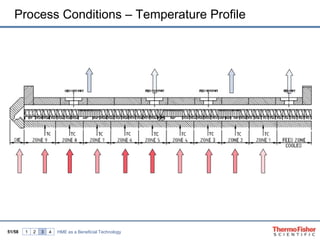
Process Conditions – Temperature Profile


50/58   1   2   3   4   HME as a Beneficial Technology
Process Conditions – Temperature Profile


51/58   1   2   3   4   HME as a Beneficial Technology
Monitoring Technology (PAT)

            • Off-Line
                    • A measurement with a sample which has been removed from the
                    process stream; analysis is not local to process stream.

            • At-Line
                    • A measurement with a sample which has been removed from the
                    process stream for analysis; analysis is local to process stream.

            • On-Line
                    • A measurement where the sample is diverted from the process
                    stream, analyzed, and possibly returned to the process stream.

            • In-Line
                    • A measurement where the sample is not removed from the process
                    stream; analysis can be invasive or noninvasive.


        * Source: Food and Drug Administration. ‘Guidance for Industry PAT...’. 9. (generalized)


52/58   1   2   3    4   HME as a Beneficial Technology
Beneficial Properties of Twin Screw Extruders

        Twin Screw Extruders are “Sanitary” Systems *
        • Self-Wiping Screw Design
            The selection of TSE type and screw orientation can ensure that material is
            continuously exchanged on metal surfaces of the extruder to avoid stagnation.

        • Materials of Construction Compliant with FDA Regulations
            “… Equipment shall be constructed so that surfaces that contact components, in-
            process materials, or drug products shall not be reactive, additive, or absorptive so as
            to alter the safety, identity, strength, quality, or purity of the drug product…” **

        • Unique Modifications from Standard “Plastics” Systems
            Complete access to all components in contact with product; removable screws and
            barrel ‘liners’ for thorough and simplistic cleaning of contact components; ability to
            dedicate parts to process; etc…


        * Source: Ghebre-Sellassie I, Martin C. Pharmaceutical Extrusion Technology. Marcel Dekker 2003; 69-71
        ** Source: Food and Drug Administration. Code of federal regulations. 21 CFR Parts 210 and 211. Fed Regist 1993


53/58   1    2   3   4   HME as a Beneficial Technology
Beneficial Properties of Twin Screw Extruders

        Twin Screw Extruders are Continuous Systems *
        • Continuous Process Run to Job Completion
            The TSE facilitates continuous manufacture of a product; the quantity produced in the
            run is specific as per the application requirement.

        • Promotion of Process Stability and Reproducibility
            A continuous, uninterrupted process has less risk of being influenced by external,
            uncontrollable factors (transition between batch / unit operations, cleanliness
            between batch runs, …)

        • Systems Available to Match Capacity Requirements
            A wide range of TSE systems are available to match the capacity requirement for the
            application – from 10 grams/hr to 100 kg/hr (for example).


        * Source: Ghebre-Sellassie I, Martin C. Pharmaceutical Extrusion Technology. Marcel Dekker 2003; 69-71


54/58   1    2   3   4   HME as a Beneficial Technology
Beneficial Properties of Twin Screw Extruders

        Twin Screw Extruders Process “Small Masses” of Material *
        • Mass of Material is Contained by Screw Geometries, Barrel Walls
            Within a TSE small quantities of material are continually being acted upon within each
            stage of the extrusion process. This intimate interaction with smaller, localized
            quantities promotes the capacity to effect the material more efficiently and quickly when
            compared with large mass, batch mixing vessels. In addition, the smaller localized
            quantities of material provide an increase in exposed surface area to the screws and
            barrel walls in comparison with exposed area in large batch vessels - the increased
            surface area will result in improved heat transfer and tighter temperature control.
        • Reduction of Risk in Production / Process Failure
            A smaller inventory of in-process material allows for rapid reaction to production
            instability or failure. Through continuous monitoring of the extrusion process and
            additionally the implementation of Process Analytical Technologies (PAT), detrimental
            situations can be recognized and remedied quickly and with minimal time and material
            loss.


        * Source: Ghebre-Sellassie I, Martin C. Pharmaceutical Extrusion Technology. Marcel Dekker 2003; 69-71


55/58   1    2   3   4   HME as a Beneficial Technology
Beneficial Properties of Twin Screw Extruders

        Twin Screw Extruders Perform Multiple Unit Operations
        • Multiple Unit Operations can be Performed
            Through application-specific design selection of the TSE – including size, barrel
            length, barrel configuration, and screw configuration – a number of unit operations
            can be sequenced as necessary to perform many of the manufacturing steps
            required for the product.

            Dosing – Blending – Melting – Mixing – Venting – Pumping – Drying – …


        • TSE’s are Designed for Flexibility, Modularity
            Borrowing from their traditional existence in Polymer and Food applications, many
            TSE’s have been designed specifically to allow for modification (unit operations
            added, existing operations expanded) to improve upon the process. This feature is
            inherent with modular barrel and screw designs.


56/58   1    2   3   4   HME as a Beneficial Technology
Concluding Remarks

        • Extrusion is a well-established processing technology which
          has found beneficial application in many diverse fields.
        • The objective in extrusion is to modify input ingredients to
          create a product with desirable properties (material, final
          form).
        • Extrusion combines multiple unit operations in a continuous,
          uninterrupted process.
        • Twin Screw Extruders are very modular and adaptive,
          allowing for application-specific process design.
        • Twin Screw Extruders offer many beneficial properties which
          lend specifically towards pharmaceutical processing and
          manufacturing.


57/58   1   2   3   4   Summary and DIscussion
Thank you all for your attention.


                                                    Questions?

                                                      Kurt Kortokrax
                                                  Sales Account Manager
                                                  Material Characterization
                                                 Thermo Fisher Scientific
                                                 Chemical Analysis Division

                                                    tel. (817) 444-7848
                                                    cell (817) 694-0027
                                             Kurt.kortokrax@thermofisher.com
                                                   www.thermo.com/mc


58/58   1   2   3   4   Summary and DIscussion

Hot Melt Extrusion Technology

  • 1.
    Hot Melt Extrusion Technology Kurt Kortokrax Sales Account Manager Thermo Fisher Scientific
  • 2.
    Agenda 1 Introduction and Review of Extrusion 2 Pharmaceutical Grade Extrusion Systems 3 HME as a Beneficial Technology 4 Summary and Discussion 2/58 1 2 3 4
  • 3.
    Application of ExtrusionTechnology Extrusion is a well-known processing technology which has been developed over the last century and has found beneficial application in many diverse industrial fields. • Polymer • Ceramic / Metal • Food • Cosmetic • Pharmaceutical 3/58 1 2 3 4 Introduction and Review of Extrusion
  • 4.
    Application of ExtrusionTechnology Extrusion is a well-known processing technology which has been developed over the last century and has found beneficial application in many diverse industrial fields. • Polymer • Ceramic / Metal • Food • Cosmetic • Pharmaceutical 4/58 1 2 3 4 Introduction and Review of Extrusion
  • 5.
    Application of ExtrusionTechnology Extrusion is a well-known processing technology which has been developed over the last century and has found beneficial application in many diverse industrial fields. • Polymer • Ceramic / Metal • Food • Cosmetic • Pharmaceutical 5/58 1 2 3 4 Introduction and Review of Extrusion
  • 6.
    Application of ExtrusionTechnology Extrusion is a well-known processing technology which has been developed over the last century and has found beneficial application in many diverse industrial fields. • Polymer • Ceramic / Metal • Food • Cosmetic • Pharmaceutical 6/58 1 2 3 4 Introduction and Review of Extrusion
  • 7.
    Application of ExtrusionTechnology Extrusion is a well-known processing technology which has been developed over the last century and has found beneficial application in many diverse industrial fields. • Polymer  Troglitazone® (Parke Davis)* • Ceramic / Metal  Kaletra® Meltrex® (Abbott)  NuvaRing® (Oragnon) • Food  Implanon® (Schering-Plough) • Cosmetic  Zoladex® (AstraZeneca) • Pharmaceutical  Ozurdex® (Allergan) … * Removed from market in March of 2000 7/58 1 2 3 4 Introduction and Review of Extrusion
  • 8.
    Types of ExtrusionSystems Extrusion is a process which is used to create new materials with desirable properties by manipulating additive ingredients through a number of staged unit operations and forcing the product through a defined die geometry. Ram Single Screw Twin Screw 8/58 1 2 3 4 Introduction and Review of Extrusion
  • 9.
    Hot Melt Extrusionis Extrusion Compounding Two or more ingredients which have been combined in defined proportions, distinguishable from their original state in that the characteristics of the whole is unique from that of the original constituents. • Mechanical Properties • tensile strength, bending strength, hardness, fracture toughness • Physical Properties • color, odor, density, melting/freezing/boiling point, glass transition, solubility • Electrical Properties • electrical resistance, dielectric constant • Chemical Properties • flammability, biodegradability • Thermal Properties • thermal conductivity, specific heat, thermal shock resistance 9/58 1 2 3 4 HME as a Beneficial Technology
  • 10.
    Types of ExtrusionCompounding Systems • Design • Conical • Parallel • Screw Rotation • Co-Rotating Twin Screw Classifications • Counter-Rotating • Degree of Contact • Co/Counter Intermeshing • Counter Non- Intermeshing 10/58 1 2 3 4 Introduction and Review of Extrusion
  • 11.
    Extrusion Detail Extrusion is a process which is used to create new materials with desirable properties by manipulating additive ingredients through a number of staged unit operations… Dosing – Metering – Melting – Mixing – Venting – Pumping – Forming – … 11/58 1 2 3 4 Introduction and Review of Extrusion
  • 12.
    Extrusion Detail -Dosing Extrusion is a process which is used to create new materials with desirable properties by manipulating additive ingredients through a number of staged unit operations. Dosing – Metering – Melting – Mixing – Venting – Pumping – Forming – … 12/58 1 2 3 4 Introduction and Review of Extrusion
  • 13.
    Extrusion Detail -Dosing • Type of Feeding System • Single Screw (pellet, flake, granule, powder) • Twin Screw (powder, …) • Liquid Injection (fluid, solution, …) • Piston (paste, rubber, …) • Forcefeeder / Stuffer (downstream) • Design of Feeding System • Volumetric • Operate at Constant Screw Speed to delivery a Constant Volume per Unit Time • Accuracy +/- 2% of Set Point • Mass Flow can be Subject to Variation due to Material Density, Refilling Stages, Batch Variation/Homogeneity, etc. • Gravimetric • Automatic Adjustment of Feeder Speed based upon Feedback of Incorporated Load Cell • Accuracy +/- 0.5% of Set Point • Control in Feeding of a Twin Screw Extruder is Critical! 13/58 1 2 3 4 Introduction and Review of Extrusion
  • 14.
    Extrusion Detail -Metering Extrusion is a process which is used to create new materials with desirable properties by manipulating additive ingredients through a number of staged unit operations. Dosing – Metering – Melting – Mixing – Venting – Pumping – Forming – … 14/58 1 2 3 4 Introduction and Review of Extrusion
  • 15.
    Extrusion Detail –Melting & Mixing Extrusion is a process which is used to create new materials with desirable properties by manipulating additive ingredients through a number of staged unit operations. Dosing – Metering – Melting – Mixing – Venting – Pumping – Forming – … 15/58 1 2 3 4 Introduction and Review of Extrusion
  • 16.
    Extrusion Detail –Melting & Mixing 16/58 1 2 3 4 HME as a Beneficial Technology
  • 17.
    Extrusion Detail –Melting & Mixing • Shear Stress brings about the reduction in particle size of the ingredient (i.e. active component)  Dispersion • Division and recombination of the materials brings about general homogenization of the complete product  Distribution • For a given screw speed, the highest shear stress occurs when the viscosity of the material is at its highest, thus promoting dispersive mixing • Blending and cross-flow action in low shear environments can promote distributive mixing • Proper screw design in terms of element selection, configuration, and orientation enables both dispersive and distributive mixing 17/58 1 2 3 4 HME as a Beneficial Technology
  • 18.
    Extrusion Detail –Melting & Mixing Distributive and Dispersive Additive has been well distributed Initial Materials Polymer Excipient Homogeneous Additive (API) Compound Additive has been well dispersed 18/58 1 2 3 4 HME as a Beneficial Technology
  • 19.
    Extrusion Detail -Venting Extrusion is a process which is used to create new materials with desirable properties by manipulating additive ingredients through a number of staged unit operations. Dosing – Metering – Melting – Mixing – Venting – Pumping – Forming – … 19/58 1 2 3 4 Introduction and Review of Extrusion
  • 20.
    Extrusion Detail –Pumping & Forming Extrusion is a process which is used to create new materials with desirable properties by manipulating additive ingredients through a number of staged unit operations. Dosing – Metering – Melting – Mixing – Venting – Pumping – Forming – … 20/58 1 2 3 4 Introduction and Review of Extrusion
  • 21.
    Standard or PharmaceuticalGrade? 21/58 1 2 3 4 Pharmaceutical Grade Extrusion Systems
  • 22.
    Standard or PharmaceuticalGrade? Parallel Co-Rotating Twin Screw Extrusion Systems • Barrel Diameter – 16 mm • Barrel Length – 25:1 L/D • Typical Output – 0.5 – 5.0 kg/hr • Modular Clamshell Barrel, Modular Screw Design •… 22/58 1 2 3 4 Pharmaceutical Grade Extrusion Systems
  • 23.
    Where are thedifferences? 23/58 1 2 3 4 Pharmaceutical Grade Extrusion Systems
  • 24.
    Specialized Materials ofConstruction, Design • Stainless Steel Shrouding • Smooth Edges / Minimal Contamination Points • Non-Painted Surfaces • Sealed Access Panels • Touchscreen Controls • Pressurized Internal Compartments • Spray-Down Capability 24/58 1 2 3 4 Pharmaceutical Grade Extrusion Systems
  • 25.
    Specialized Materials ofConstruction, Design • Specific MoC for all Parts in Contact with Product • Barrel (top/bottom) • Screws • Hoppers, Funnels • Dies • Specialized Clamping Mechanisms • Quick-Release Interlocks for Heating, Cooling 25/58 1 2 3 4 Pharmaceutical Grade Extrusion Systems
  • 26.
    Disassembly – Accessibilityto all Wetted Components 26/58 1 2 3 4 Pharmaceutical Grade Extrusion Systems
  • 27.
    Disassembly – Accessibilityof all Wetted Components 27/58 1 2 3 4 Pharmaceutical Grade Extrusion Systems
  • 28.
    Disassembly – Accessibilityto all Wetted Components 28/58 1 2 3 4 Pharmaceutical Grade Extrusion Systems
  • 29.
    Disassembly – Accessibilityto all Wetted Components 29/58 1 2 3 4 Pharmaceutical Grade Extrusion Systems
  • 30.
    Mobility and Scale 30/58 1 2 3 4 Pharmaceutical Grade Extrusion Systems
  • 31.
    Modularity – Barrel,Screw Design 31/58 1 2 3 4 Pharmaceutical Grade Extrusion Systems
  • 32.
    Incorporation of ProcessMonitoring Technologies In-Line On-Line At-Line Off-Line 32/58 1 2 3 4 Pharmaceutical Grade Extrusion Systems
  • 33.
    Post Extrusion Handling– Air Cooling (Conveyor) 33/58 1 2 3 4 Pharmaceutical Grade Extrusion Systems
  • 34.
    Post Extrusion Handling– Pelletizing 34/58 1 2 3 4 Pharmaceutical Grade Extrusion Systems
  • 35.
    Post Extrusion Handling– Chill Roll, Flaker 35/58 1 2 3 4 Pharmaceutical Grade Extrusion Systems
  • 36.
    Why Melt Extrusion?  Challenges  Solubility Enhancement − Biopharmaceutical Classification System, Class II & IV  Bioavailability Enhancement  Specific Release Characteristics  Benefits  Mechanical Shear Energy  No Curing or Drying due to Solvent Free Process  High Distributive / Dispersive Mixing Capability  Stabilization of API in Defined Form − Solid Suspensions - A / C , A / A ; Solid Solution – A / A  Continuous Process − Lower Batch to Batch Variation  Process Monitoring Capabilities  Creation of Unique Dosage Concepts / Delivery Methods 36/58 1 2 3 4 HME as a Beneficial Technology
  • 37.
    Hot Melt ExtrusionParameters Optimize Formulation Optimize Process • Excipient Ingredients • Extrusion System • Polymeric Binders • System Scale • Plasticizers and Lubricants • Length-to-Diameter Ratio • Glidants • Barrel Configuration • Fillers and Dilutents • Screw Configuration • Disintigrants • Extrudate Forming Devices • Antioxidants • Post-Extrusion Ancillaries • etc. • Ingredient Introduction • Active Pharmaceutical • Sequence of Addition Ingredients • Rate of Addition • Process Conditions • Screw Speed • Temperature Profile • Monitoring Technology • On / In / At / Off - Line 37/58 1 2 3 4 HME as a Beneficial Technology
  • 38.
    Extrusion System –System Scale Chemistry Medicinal Kilogram, Lab Process Chemistry Production Site Production Site Process 10 g 1 - 5 kg 5 – 50 kg 100 - 500 kg 500 kg Batch (or less) Process 10 g 0.5 – 2.5 kg/hr 0.5 – 2.5 , 5 – 50 kg/hr 5 - 50 kg/hr 5 – 50, 25 – 100 Outputs (or less) kg/hr System Micro – 16 mm HME 16, 24 mm HME 24 mm HME 24, 36 mm HME Compounder 38/58 1 2 3 4 HME as a Beneficial Technology
  • 39.
    Extrusion System –System Scale Chemistry Medicinal Kilogram, Lab Process Chemistry Production Site Production Site Process 10 g 1 - 5 kg 5 – 50 kg 100 - 500 kg 500 kg Batch (or less) Process 10 g 0.5 – 2.5 kg/hr 0.5 – 2.5 , 5 – 50 kg/hr 5 - 50 kg/hr 5 – 50, 25 – 100 Outputs (or less) kg/hr System Micro – 16 mm HME 16, 24 mm HME 24 mm HME 24, 36 mm HME Compounder 39/58 1 2 3 4 HME as a Beneficial Technology
  • 40.
    Extrusion System –System Scale Chemistry Medicinal Kilogram, Lab Process Chemistry Production Site Production Site Process 10 g 1 - 5 kg 5 – 50 kg 100 - 500 kg 500 kg Batch (or less) Process 10 g 0.5 – 2.5 kg/hr 0.5 – 2.5 , 5 – 50 kg/hr 5 - 50 kg/hr 5 – 50, 25 – Outputs (or less) 100 kg/hr System Micro – 16 mm HME 16, 24 mm HME 24 mm HME 24, 36 mm Compounder HME 40/58 1 2 3 4 HME as a Beneficial Technology
  • 41.
    Extrusion System –Length-to-Diameter Ratio 41/58 1 2 3 4 HME as a Beneficial Technology
  • 42.
    Extrusion System –Barrel Configuration 42/58 1 2 3 4 HME as a Beneficial Technology
  • 43.
    Extrusion System –Barrel Configuration 16mm TSE, Single Feed at 24mm TSE, Feed at Main Main with Downstream Vertical Stuffer Feeder and Peristaltic Liquid Injection 43/58 1 2 3 4 HME as a Beneficial Technology
  • 44.
    Extrusion System –Screw Configuration 44/58 1 2 3 4 HME as a Beneficial Technology
  • 45.
    Extrusion System –Basic Screw Elements • Conveying Elements Feeding Pumping, Pressurization Blending • Mixing Elements Blending Dispersive Mixing Distributive Mixing • Special Elements Zoning – Material and Temperature Restrictive Elements Increase Residence Time 45/58 1 2 3 4 HME as a Beneficial Technology
  • 46.
    Extrusion System –Forming Devices and Ancillaries  Granules  Pellets  Spheres  Powders  Tablets  Films  Sheets  Tubing  Plugs  Implants  Devices … 46/58 1 2 3 4 HME as a Beneficial Technology
  • 47.
    Ingredient Introduction -Processing Example • Polymer Excipient & API at Primary Feed • Low Temperature Application 47/58 1 2 3 4 HME as a Beneficial Technology
  • 48.
    Ingredient Introduction -Processing Example • Polymer Excipient at Primary Feed, API Introduced Downstream • Thermally Sensitive API 48/58 1 2 3 4 HME as a Beneficial Technology
  • 49.
    Ingredient Introduction -Processing Example • Polymer Excipient 1 at Primary Feed along with Plasticizer • Polymer Excipient 2 Introduced Downstream • API Introduced Downstream • Vacuum Venting Applied 49/58 1 2 3 4 HME as a Beneficial Technology
  • 50.
    Process Conditions –Temperature Profile 50/58 1 2 3 4 HME as a Beneficial Technology
  • 51.
    Process Conditions –Temperature Profile 51/58 1 2 3 4 HME as a Beneficial Technology
  • 52.
    Monitoring Technology (PAT) • Off-Line • A measurement with a sample which has been removed from the process stream; analysis is not local to process stream. • At-Line • A measurement with a sample which has been removed from the process stream for analysis; analysis is local to process stream. • On-Line • A measurement where the sample is diverted from the process stream, analyzed, and possibly returned to the process stream. • In-Line • A measurement where the sample is not removed from the process stream; analysis can be invasive or noninvasive. * Source: Food and Drug Administration. ‘Guidance for Industry PAT...’. 9. (generalized) 52/58 1 2 3 4 HME as a Beneficial Technology
  • 53.
    Beneficial Properties ofTwin Screw Extruders Twin Screw Extruders are “Sanitary” Systems * • Self-Wiping Screw Design The selection of TSE type and screw orientation can ensure that material is continuously exchanged on metal surfaces of the extruder to avoid stagnation. • Materials of Construction Compliant with FDA Regulations “… Equipment shall be constructed so that surfaces that contact components, in- process materials, or drug products shall not be reactive, additive, or absorptive so as to alter the safety, identity, strength, quality, or purity of the drug product…” ** • Unique Modifications from Standard “Plastics” Systems Complete access to all components in contact with product; removable screws and barrel ‘liners’ for thorough and simplistic cleaning of contact components; ability to dedicate parts to process; etc… * Source: Ghebre-Sellassie I, Martin C. Pharmaceutical Extrusion Technology. Marcel Dekker 2003; 69-71 ** Source: Food and Drug Administration. Code of federal regulations. 21 CFR Parts 210 and 211. Fed Regist 1993 53/58 1 2 3 4 HME as a Beneficial Technology
  • 54.
    Beneficial Properties ofTwin Screw Extruders Twin Screw Extruders are Continuous Systems * • Continuous Process Run to Job Completion The TSE facilitates continuous manufacture of a product; the quantity produced in the run is specific as per the application requirement. • Promotion of Process Stability and Reproducibility A continuous, uninterrupted process has less risk of being influenced by external, uncontrollable factors (transition between batch / unit operations, cleanliness between batch runs, …) • Systems Available to Match Capacity Requirements A wide range of TSE systems are available to match the capacity requirement for the application – from 10 grams/hr to 100 kg/hr (for example). * Source: Ghebre-Sellassie I, Martin C. Pharmaceutical Extrusion Technology. Marcel Dekker 2003; 69-71 54/58 1 2 3 4 HME as a Beneficial Technology
  • 55.
    Beneficial Properties ofTwin Screw Extruders Twin Screw Extruders Process “Small Masses” of Material * • Mass of Material is Contained by Screw Geometries, Barrel Walls Within a TSE small quantities of material are continually being acted upon within each stage of the extrusion process. This intimate interaction with smaller, localized quantities promotes the capacity to effect the material more efficiently and quickly when compared with large mass, batch mixing vessels. In addition, the smaller localized quantities of material provide an increase in exposed surface area to the screws and barrel walls in comparison with exposed area in large batch vessels - the increased surface area will result in improved heat transfer and tighter temperature control. • Reduction of Risk in Production / Process Failure A smaller inventory of in-process material allows for rapid reaction to production instability or failure. Through continuous monitoring of the extrusion process and additionally the implementation of Process Analytical Technologies (PAT), detrimental situations can be recognized and remedied quickly and with minimal time and material loss. * Source: Ghebre-Sellassie I, Martin C. Pharmaceutical Extrusion Technology. Marcel Dekker 2003; 69-71 55/58 1 2 3 4 HME as a Beneficial Technology
  • 56.
    Beneficial Properties ofTwin Screw Extruders Twin Screw Extruders Perform Multiple Unit Operations • Multiple Unit Operations can be Performed Through application-specific design selection of the TSE – including size, barrel length, barrel configuration, and screw configuration – a number of unit operations can be sequenced as necessary to perform many of the manufacturing steps required for the product. Dosing – Blending – Melting – Mixing – Venting – Pumping – Drying – … • TSE’s are Designed for Flexibility, Modularity Borrowing from their traditional existence in Polymer and Food applications, many TSE’s have been designed specifically to allow for modification (unit operations added, existing operations expanded) to improve upon the process. This feature is inherent with modular barrel and screw designs. 56/58 1 2 3 4 HME as a Beneficial Technology
  • 57.
    Concluding Remarks • Extrusion is a well-established processing technology which has found beneficial application in many diverse fields. • The objective in extrusion is to modify input ingredients to create a product with desirable properties (material, final form). • Extrusion combines multiple unit operations in a continuous, uninterrupted process. • Twin Screw Extruders are very modular and adaptive, allowing for application-specific process design. • Twin Screw Extruders offer many beneficial properties which lend specifically towards pharmaceutical processing and manufacturing. 57/58 1 2 3 4 Summary and DIscussion
  • 58.
    Thank you allfor your attention. Questions? Kurt Kortokrax Sales Account Manager Material Characterization Thermo Fisher Scientific Chemical Analysis Division tel. (817) 444-7848 cell (817) 694-0027 Kurt.kortokrax@thermofisher.com www.thermo.com/mc 58/58 1 2 3 4 Summary and DIscussion