1
– Debian –
an Open Source {Project,OS,Community}
Thomas Goirand <zigo@debian.org>
Debian Developer
4th
quarter 2010
prepared for FOSSASIA, Ho Chi Minh City, Vietnam
Slides © 2010 Thomas Goirand <zigo@debian,org>
© 2009 Stefano Zacchiroli<zack@debian.org>
© 2008-2009 Steve McIntyre <93sam@debian.org>
Released under GPL v2 at http://git.upsilon.cc/cgi-bin/gitweb.cgi?p=talks/2009-hackmeeting.git
Creator:GNU Ghostscript 510 (epswrite)
CreationDate:1999/12/10 21:22:37
LanguageLevel:2
2
Agenda
● What is Debian?
● Project structure
● Processes & decision making
● Derivatives – Debian as a base
● How people get involved
3
History
● Project founded in 1993 by Ian Murdock
● Named after DEBra and IAN Murdock
● The first major distribution developed
“openly in the spirit of Linux and GNU”
● Early work sponsored by the GNU project
4
Debian Project Leaders
● Ian Murdock (1993 – 1996)
● Bruce Perens (1996 – 1997)
● Ian Jackson (1997 – 1998)
● Wichert Akkerman (1999 – 2001)
● Ben Collins (2001 – 2002)
● Bdale Garbee (2002 – 2003)
● Martin Michlmayr (2003 - 2005)
● Branden Robinson (2005 - 2006)
● Anthony Towns (2006 – 2007)
● Sam Hocevar (2007-2008)
● Steve McIntyre (2008-2010)
● Stefano Zacchiroli (2010-present)
5
Debian – the Project
● Common goal
Create the best, free operating system
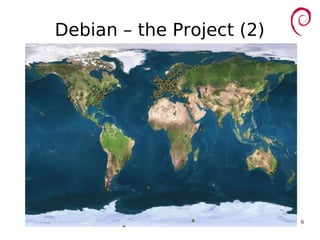
● About 1,000 volunteer developers
spread all over the world
– Large numbers in North America & Europe
– Smaller numbers in Australia & Asia
– Growing Latin American development
community
● Thousands more contributors
– Bug report, documentation, translation, ...
6
Debian – the Project (2)
7
Debian – the OS
● Completely Free
Software
– Debian Free
Software
Guidelines
● Support for 12
different hw
architectures
– Alpha, amd64, arm,
armel, hppa, i386,
ia64, mips, mipsel,
powerpc, s390, sparc
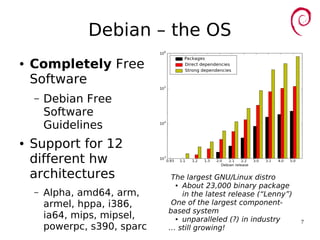
The largest GNU/Linux distro
● About 23,000 binary package
in the latest release (“Lenny”)
One of the largest component-
based system
● unparalleled (?) in industry
… still growing!
8
Debian – the Community
● Open development
– We don't hide problems
● Large amounts of communication
– Mailing lists, web sites and IRC channels
● Large number of active users
– Users help each other, contribute packages,
become developers
9
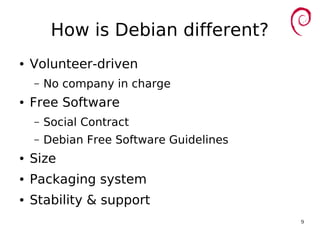
How is Debian different?
● Volunteer-driven
– No company in charge
● Free Software
– Social Contract
– Debian Free Software Guidelines
● Size
● Packaging system
● Stability & support
10
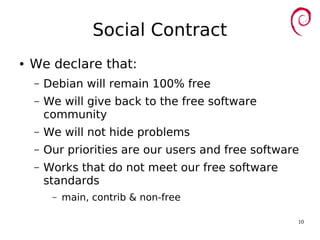
Social Contract
● We declare that:
– Debian will remain 100% free
– We will give back to the free software
community
– We will not hide problems
– Our priorities are our users and free software
– Works that do not meet our free software
standards
– main, contrib & non-free
11
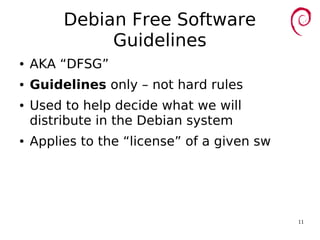
Debian Free Software
Guidelines
● AKA “DFSG”
● Guidelines only – not hard rules
● Used to help decide what we will
distribute in the Debian system
● Applies to the “license” of a given sw
12
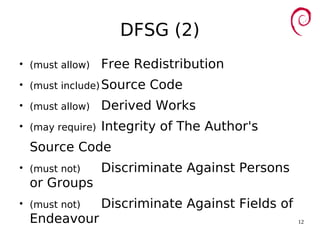
DFSG (2)
●
(must allow) Free Redistribution
●
(must include)Source Code
●
(must allow) Derived Works
●
(may require) Integrity of The Author's
Source Code
●
(must not) Discriminate Against Persons
or Groups
●
(must not) Discriminate Against Fields of
Endeavour
13
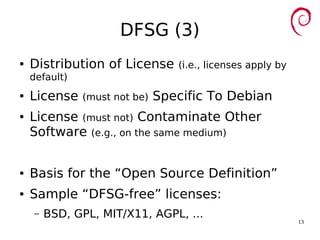
DFSG (3)
● Distribution of License (i.e., licenses apply by
default)
● License (must not be) Specific To Debian
● License (must not) Contaminate Other
Software (e.g., on the same medium)
● Basis for the “Open Source Definition”
● Sample “DFSG-free” licenses:
– BSD, GPL, MIT/X11, AGPL, ...
14
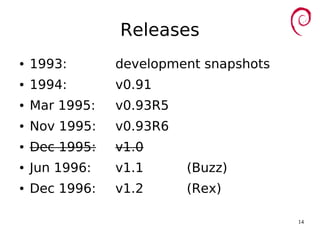
Releases
● 1993: development snapshots
● 1994: v0.91
● Mar 1995: v0.93R5
● Nov 1995: v0.93R6
● Dec 1995: v1.0
● Jun 1996: v1.1 (Buzz)
● Dec 1996: v1.2 (Rex)
15
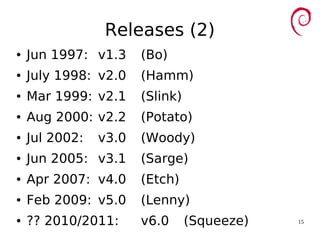
Releases (2)
● Jun 1997: v1.3 (Bo)
● July 1998: v2.0 (Hamm)
● Mar 1999: v2.1 (Slink)
● Aug 2000: v2.2 (Potato)
● Jul 2002: v3.0 (Woody)
● Jun 2005: v3.1 (Sarge)
● Apr 2007: v4.0 (Etch)
● Feb 2009: v5.0 (Lenny)
● ?? 2010/2011: v6.0 (Squeeze)
16
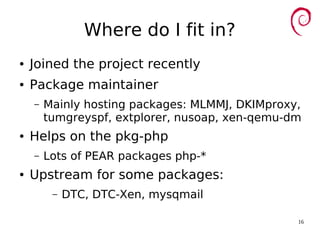
Where do I fit in?
● Joined the project recently
● Package maintainer
– Mainly hosting packages: MLMMJ, DKIMproxy,
tumgreyspf, extplorer, nusoap, xen-qemu-dm
● Helps on the pkg-php
– Lots of PEAR packages php-*
● Upstream for some packages:
– DTC, DTC-Xen, mysqmail
17
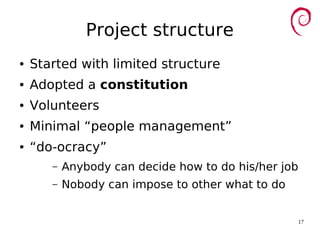
Project structure
● Started with limited structure
● Adopted a constitution
● Volunteers
● Minimal “people management”
● “do-ocracy”
– Anybody can decide how to do his/her job
– Nobody can impose to other what to do
18
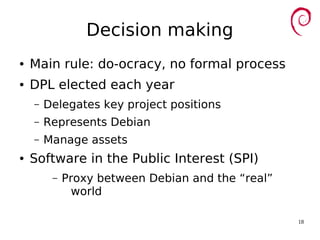
Decision making
● Main rule: do-ocracy, no formal process
● DPL elected each year
– Delegates key project positions
– Represents Debian
– Manage assets
● Software in the Public Interest (SPI)
– Proxy between Debian and the “real”
world
19
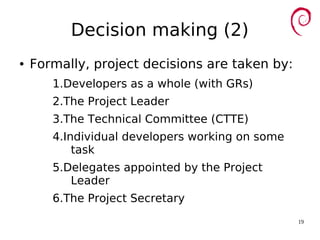
Decision making (2)
● Formally, project decisions are taken by:
1.Developers as a whole (with GRs)
2.The Project Leader
3.The Technical Committee (CTTE)
4.Individual developers working on some
task
5.Delegates appointed by the Project
Leader
6.The Project Secretary
20
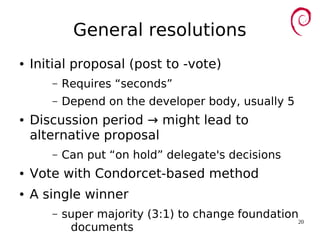
General resolutions
● Initial proposal (post to -vote)
– Requires “seconds”
– Depend on the developer body, usually 5
● Discussion period → might lead to
alternative proposal
– Can put “on hold” delegate's decisions
● Vote with Condorcet-based method
● A single winner
– super majority (3:1) to change foundation
documents
21
Various teams
● Teams grow as jobs get bigger
● Some teams are “formal” entities (DPL
delegates), most are not
● Examples:
– ftpmaster
– packaging teams for intertwined packages
– debian-installer
– debian-cd
– release team
22
Process: from Chaos...
● A thousand Debian developers
● Thousands of packages (30k for Squeeze)
● Many thousand bugs
● Millions of users
23
... to Stability
● Debian policy
● Quality checking of packages
● Testing (^2)
● Release team coordination
24
Policy
● Comprehensive list of requirements for
packages:
– What goes in a package, and where
– How to start & stop system services
– Interactions with other packages
● e.g.: inter-package relationships
– Configuration files
– Upgrades
– etc.
25
Quality checking
● Lintian
– Run by maintainer to check for packaging
mistakes after packages are built
– Simple framework; new tests are added
easily
– Automation work ongoing
● piuparts
– Tests how well packages will upgrade from
one version/release to the next
26
Testing – in Packages
● Developers run their own tests before
upload
● Build-time test harnesses
● Other developers and users report bugs
● Bugs (hopefully!) are fixed, new uploads
made
27
Testing – as a Distribution
● Uploads go to “unstable” distribution
● After some time without bugs, packages
migrate to “testing”
● Archive maintenance scripts check for
distribution “consistency”
● Testing should be (almost) ready to
release as “stable” at any point
● CUT: Constantly Usable Testing
28
Release team
● Constantly monitor the state of the
testing distribution
● Co-ordinate uploads with package
maintainers to make transitions smooth
● Track large groups of packages as they
work through the system (e.g. KDE,
GNOME)
● Responsible for deciding release goals
and release dates
29
Security team
● Work with maintainers where possible
● Security updates for “oldstable”
● Security updates for stable
● Security updates for testing
● Coordination with other distributions
● security.debian.org, DSAs
30
Stable point releases
● Organised by the stable release team
● Made every few months
● Collect together:
– Current security updates
– Highly-tested package updates to fix other
serious bugs
● Update the archive
– rebuild CDs, DVDs etc.
31
Collaboration
● Many different source code control
systems in use; choice of which is made
by the developers
– CVS, Subversion, Git, BZR, Darcs, ...
● Discussions via mailing lists
● IRC for realtime discussion
● Real-life meetings becoming more
common
– DebConf, Extremadura, FOSDEM
32
Alioth
● Sourceforge-like system
– Source code, mailing lists, web space, ...
● Used for collaborating on Debian work
– Projects like debian-installer, debian-cd
– Packaging work
● Also hosts a number of non-Debian
projects
33
Derivatives
● Not just a distro, can be a base
● LOTS of derived distributions:
– Ubuntu
– Linspire/Xandros
– Skolelinux
– Lliurex
– LiMux
– many more
34
Derivatives (2)
● Why?
– Licensing assurances
– Solid, stable base system
– Reduce effort
● How?
– Take existing packages and add extras
– Rebuild packages where desired
● No problem – everybody wins!
35
Commercial
● Debian is free – how do people make
money?
– Support, solutions
● Work with various companies
– Large: HP, Google, Sun, Nokia
– Small: Credativ, Univention, hands.com
● Local government
● Education
● Universities and research institutes
36
Working with Debian
● Technical collaboration
– Help work on the features you need
● Sponsorship
– Hosting, hardware, Debconf
● Experts in the field
– Developers employed all over the industry
37
Getting involved
● Test, report (and ideally fix!) bugs
● Translation
● Documentation
● Help with packages
● Sponsoring
● New Maintainer Process
38
Want to know more?
● http://www.debian.org
● mailing lists
● IRC (debian-* channels on irc.debian.org)
● ask me or other DDs at FOSSASIA!

Debian general presentation

  • 1.
    1 – Debian – anOpen Source {Project,OS,Community} Thomas Goirand <zigo@debian.org> Debian Developer 4th quarter 2010 prepared for FOSSASIA, Ho Chi Minh City, Vietnam Slides © 2010 Thomas Goirand <zigo@debian,org> © 2009 Stefano Zacchiroli<zack@debian.org> © 2008-2009 Steve McIntyre <93sam@debian.org> Released under GPL v2 at http://git.upsilon.cc/cgi-bin/gitweb.cgi?p=talks/2009-hackmeeting.git Creator:GNU Ghostscript 510 (epswrite) CreationDate:1999/12/10 21:22:37 LanguageLevel:2
  • 2.
    2 Agenda ● What isDebian? ● Project structure ● Processes & decision making ● Derivatives – Debian as a base ● How people get involved
  • 3.
    3 History ● Project foundedin 1993 by Ian Murdock ● Named after DEBra and IAN Murdock ● The first major distribution developed “openly in the spirit of Linux and GNU” ● Early work sponsored by the GNU project
  • 4.
    4 Debian Project Leaders ●Ian Murdock (1993 – 1996) ● Bruce Perens (1996 – 1997) ● Ian Jackson (1997 – 1998) ● Wichert Akkerman (1999 – 2001) ● Ben Collins (2001 – 2002) ● Bdale Garbee (2002 – 2003) ● Martin Michlmayr (2003 - 2005) ● Branden Robinson (2005 - 2006) ● Anthony Towns (2006 – 2007) ● Sam Hocevar (2007-2008) ● Steve McIntyre (2008-2010) ● Stefano Zacchiroli (2010-present)
  • 5.
    5 Debian – theProject ● Common goal Create the best, free operating system ● About 1,000 volunteer developers spread all over the world – Large numbers in North America & Europe – Smaller numbers in Australia & Asia – Growing Latin American development community ● Thousands more contributors – Bug report, documentation, translation, ...
  • 6.
    6 Debian – theProject (2)
  • 7.
    7 Debian – theOS ● Completely Free Software – Debian Free Software Guidelines ● Support for 12 different hw architectures – Alpha, amd64, arm, armel, hppa, i386, ia64, mips, mipsel, powerpc, s390, sparc The largest GNU/Linux distro ● About 23,000 binary package in the latest release (“Lenny”) One of the largest component- based system ● unparalleled (?) in industry … still growing!
  • 8.
    8 Debian – theCommunity ● Open development – We don't hide problems ● Large amounts of communication – Mailing lists, web sites and IRC channels ● Large number of active users – Users help each other, contribute packages, become developers
  • 9.
    9 How is Debiandifferent? ● Volunteer-driven – No company in charge ● Free Software – Social Contract – Debian Free Software Guidelines ● Size ● Packaging system ● Stability & support
  • 10.
    10 Social Contract ● Wedeclare that: – Debian will remain 100% free – We will give back to the free software community – We will not hide problems – Our priorities are our users and free software – Works that do not meet our free software standards – main, contrib & non-free
  • 11.
    11 Debian Free Software Guidelines ●AKA “DFSG” ● Guidelines only – not hard rules ● Used to help decide what we will distribute in the Debian system ● Applies to the “license” of a given sw
  • 12.
    12 DFSG (2) ● (must allow)Free Redistribution ● (must include)Source Code ● (must allow) Derived Works ● (may require) Integrity of The Author's Source Code ● (must not) Discriminate Against Persons or Groups ● (must not) Discriminate Against Fields of Endeavour
  • 13.
    13 DFSG (3) ● Distributionof License (i.e., licenses apply by default) ● License (must not be) Specific To Debian ● License (must not) Contaminate Other Software (e.g., on the same medium) ● Basis for the “Open Source Definition” ● Sample “DFSG-free” licenses: – BSD, GPL, MIT/X11, AGPL, ...
  • 14.
    14 Releases ● 1993: developmentsnapshots ● 1994: v0.91 ● Mar 1995: v0.93R5 ● Nov 1995: v0.93R6 ● Dec 1995: v1.0 ● Jun 1996: v1.1 (Buzz) ● Dec 1996: v1.2 (Rex)
  • 15.
    15 Releases (2) ● Jun1997: v1.3 (Bo) ● July 1998: v2.0 (Hamm) ● Mar 1999: v2.1 (Slink) ● Aug 2000: v2.2 (Potato) ● Jul 2002: v3.0 (Woody) ● Jun 2005: v3.1 (Sarge) ● Apr 2007: v4.0 (Etch) ● Feb 2009: v5.0 (Lenny) ● ?? 2010/2011: v6.0 (Squeeze)
  • 16.
    16 Where do Ifit in? ● Joined the project recently ● Package maintainer – Mainly hosting packages: MLMMJ, DKIMproxy, tumgreyspf, extplorer, nusoap, xen-qemu-dm ● Helps on the pkg-php – Lots of PEAR packages php-* ● Upstream for some packages: – DTC, DTC-Xen, mysqmail
  • 17.
    17 Project structure ● Startedwith limited structure ● Adopted a constitution ● Volunteers ● Minimal “people management” ● “do-ocracy” – Anybody can decide how to do his/her job – Nobody can impose to other what to do
  • 18.
    18 Decision making ● Mainrule: do-ocracy, no formal process ● DPL elected each year – Delegates key project positions – Represents Debian – Manage assets ● Software in the Public Interest (SPI) – Proxy between Debian and the “real” world
  • 19.
    19 Decision making (2) ●Formally, project decisions are taken by: 1.Developers as a whole (with GRs) 2.The Project Leader 3.The Technical Committee (CTTE) 4.Individual developers working on some task 5.Delegates appointed by the Project Leader 6.The Project Secretary
  • 20.
    20 General resolutions ● Initialproposal (post to -vote) – Requires “seconds” – Depend on the developer body, usually 5 ● Discussion period → might lead to alternative proposal – Can put “on hold” delegate's decisions ● Vote with Condorcet-based method ● A single winner – super majority (3:1) to change foundation documents
  • 21.
    21 Various teams ● Teamsgrow as jobs get bigger ● Some teams are “formal” entities (DPL delegates), most are not ● Examples: – ftpmaster – packaging teams for intertwined packages – debian-installer – debian-cd – release team
  • 22.
    22 Process: from Chaos... ●A thousand Debian developers ● Thousands of packages (30k for Squeeze) ● Many thousand bugs ● Millions of users
  • 23.
    23 ... to Stability ●Debian policy ● Quality checking of packages ● Testing (^2) ● Release team coordination
  • 24.
    24 Policy ● Comprehensive listof requirements for packages: – What goes in a package, and where – How to start & stop system services – Interactions with other packages ● e.g.: inter-package relationships – Configuration files – Upgrades – etc.
  • 25.
    25 Quality checking ● Lintian –Run by maintainer to check for packaging mistakes after packages are built – Simple framework; new tests are added easily – Automation work ongoing ● piuparts – Tests how well packages will upgrade from one version/release to the next
  • 26.
    26 Testing – inPackages ● Developers run their own tests before upload ● Build-time test harnesses ● Other developers and users report bugs ● Bugs (hopefully!) are fixed, new uploads made
  • 27.
    27 Testing – asa Distribution ● Uploads go to “unstable” distribution ● After some time without bugs, packages migrate to “testing” ● Archive maintenance scripts check for distribution “consistency” ● Testing should be (almost) ready to release as “stable” at any point ● CUT: Constantly Usable Testing
  • 28.
    28 Release team ● Constantlymonitor the state of the testing distribution ● Co-ordinate uploads with package maintainers to make transitions smooth ● Track large groups of packages as they work through the system (e.g. KDE, GNOME) ● Responsible for deciding release goals and release dates
  • 29.
    29 Security team ● Workwith maintainers where possible ● Security updates for “oldstable” ● Security updates for stable ● Security updates for testing ● Coordination with other distributions ● security.debian.org, DSAs
  • 30.
    30 Stable point releases ●Organised by the stable release team ● Made every few months ● Collect together: – Current security updates – Highly-tested package updates to fix other serious bugs ● Update the archive – rebuild CDs, DVDs etc.
  • 31.
    31 Collaboration ● Many differentsource code control systems in use; choice of which is made by the developers – CVS, Subversion, Git, BZR, Darcs, ... ● Discussions via mailing lists ● IRC for realtime discussion ● Real-life meetings becoming more common – DebConf, Extremadura, FOSDEM
  • 32.
    32 Alioth ● Sourceforge-like system –Source code, mailing lists, web space, ... ● Used for collaborating on Debian work – Projects like debian-installer, debian-cd – Packaging work ● Also hosts a number of non-Debian projects
  • 33.
    33 Derivatives ● Not justa distro, can be a base ● LOTS of derived distributions: – Ubuntu – Linspire/Xandros – Skolelinux – Lliurex – LiMux – many more
  • 34.
    34 Derivatives (2) ● Why? –Licensing assurances – Solid, stable base system – Reduce effort ● How? – Take existing packages and add extras – Rebuild packages where desired ● No problem – everybody wins!
  • 35.
    35 Commercial ● Debian isfree – how do people make money? – Support, solutions ● Work with various companies – Large: HP, Google, Sun, Nokia – Small: Credativ, Univention, hands.com ● Local government ● Education ● Universities and research institutes
  • 36.
    36 Working with Debian ●Technical collaboration – Help work on the features you need ● Sponsorship – Hosting, hardware, Debconf ● Experts in the field – Developers employed all over the industry
  • 37.
    37 Getting involved ● Test,report (and ideally fix!) bugs ● Translation ● Documentation ● Help with packages ● Sponsoring ● New Maintainer Process
  • 38.
    38 Want to knowmore? ● http://www.debian.org ● mailing lists ● IRC (debian-* channels on irc.debian.org) ● ask me or other DDs at FOSSASIA!