Algorithm Analysis
1
Algorithm
2
• An algorithm is a set of instructions to be followed to
solve a problem.
– There can be more than one solution (more than one
algorithm) to solve a given problem.
– An algorithm can be implemented using different
programming languages on different platforms.
• An algorithm must be correct. It should correctly solve
the problem.
– e.g. For sorting, this means even if (1) the input is already
sorted, or (2) it contains repeated elements.
• Once we have a correct algorithm for a problem, we
have to determine the efficiency of that algorithm.
3
Algorithmic Performance
There are two aspects of algorithmic performance:
• Time
• Instructions take time.
• How fast does the algorithm perform?
• What affects its runtime?
• Space
• Data structures take space
• What kind of data structures can be used?
• How does choice of data structure affect the runtime?
 We will focus on time:
– How to estimate the time required for an algorithm
– How to reduce the time required
4
Analysis of Algorithms
• Analysis of Algorithms is the area of computer science that
provides tools to analyze the efficiency of different methods of
solutions.
• How do we compare the time efficiency of two algorithms that
solve the same problem?
Naïve Approach: implement these algorithms in a programming
language (C++), and run them to compare their time
requirements. Comparing the programs (instead of algorithms)
has difficulties.
5
Analysis of Algorithms
• When we analyze algorithms, we should employ
mathematical techniques that analyze algorithms
independently of specific
implementations, computers, or data.
• To analyze algorithms:
– First, we start to count the number of significant
operations in a particular solution to assess its
efficiency.
– Then, we will express the efficiency of algorithms
using growth functions.
6
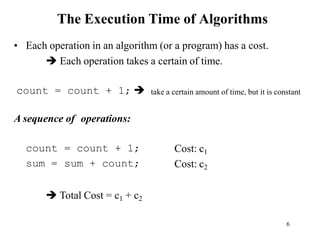
The Execution Time of Algorithms
• Each operation in an algorithm (or a program) has a cost.
 Each operation takes a certain of time.
count = count + 1;  take a certain amount of time, but it is constant
A sequence of operations:
count = count + 1; Cost: c1
sum = sum + count; Cost: c2
 Total Cost = c1 + c2
7
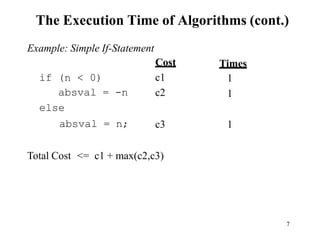
The Execution Time of Algorithms (cont.)
Example: Simple If-Statement
Cost
c1
c2
Times
1
1
if (n < 0)
absval = -n
else
absval = n; c3 1
Total Cost <= c1 + max(c2,c3)
8
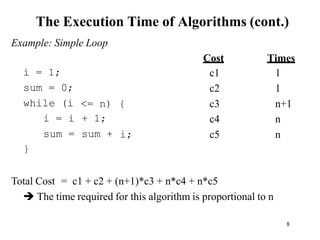
The Execution Time of Algorithms (cont.)
Example: Simple Loop
Cost Times
i = 1; c1 1
sum = 0;
while (i <= n) {
c2
c3
1
n+1
i = i
sum =
+ 1;
sum + i;
c4
c5
n
n
}
Total Cost = c1 + c2 + (n+1)*c3 + n*c4 + n*c5
 The time required for this algorithm is proportional to n
9
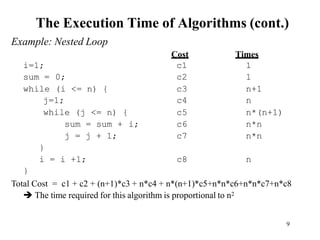
The Execution Time of Algorithms (cont.)
Example: Nested Loop
Cost Times
i=1; c1 1
sum = 0; c2 1
while (i <= n) { c3 n+1
j=1; c4 n
while (j <= n) { c5 n*(n+1)
sum = sum + i; c6 n*n
j = j + 1; c7 n*n
}
i = i +1; c8 n
}
Total Cost = c1 + c2 + (n+1)*c3 + n*c4 + n*(n+1)*c5+n*n*c6+n*n*c7+n*c8
 The time required for this algorithm is proportional to n2
10
Algorithm Growth Rates
• We measure an algorithm’s time requirement as a function of the
problem size.
– Problem size depends on the application: e.g. number of elements in a list for a
sorting algorithm, the number disks for towers of hanoi.
• So, for instance, we say that (if the problem size is n)
– Algorithm A requires 5*n2 time units to solve a problem of size n.
– Algorithm B requires 7*n time units to solve a problem of size n.
• The most important thing to learn is how quickly the algorithm’s
time requirement grows as a function of the problem size.
– Algorithm A requires time proportional to n2.
– Algorithm B requires time proportional to n.
• An algorithm’s proportional time requirement is known as
growth rate.
• We can compare the efficiency of two algorithms by comparing
their growth rates.
Algorithm Growth Rates (cont.)
Time requirements as a function
of the problem size n
11
12
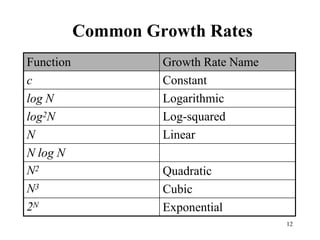
Common Growth Rates
Function Growth Rate Name
c Constant
log N Logarithmic
log2N Log-squared
N Linear
N log N
N2 Quadratic
N3 Cubic
2N Exponential
Figure 6.1
Running times for small inputs
13
Figure 6.2
Running times for moderate inputs
14
15
Order-of-Magnitude Analysis and Big O
Notation
• If Algorithm A requires time proportional to f(n), Algorithm A is
said to be order f(n), and it is denoted as O(f(n)).
• The function f(n) is called the algorithm’s growth-rate
function.
• Since the capital O is used in the notation, this notation is called
the Big O notation.
• If Algorithm A requires time proportional to n2, it is O(n2).
• If Algorithm A requires time proportional to n, it is O(n).
16
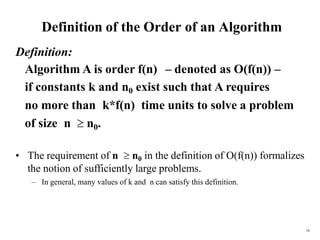
Definition of the Order of an Algorithm
Definition:
Algorithm A is order f(n) – denoted as O(f(n)) –
if constants k and n0 exist such that A requires
no more than k*f(n) time units to solve a problem
of size n  n0.
• The requirement of n  n0 in the definition of O(f(n)) formalizes
the notion of sufficiently large problems.
– In general, many values of k and n can satisfy this definition.
17
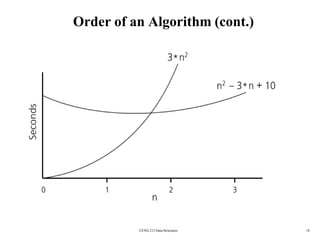
Order of an Algorithm
• If an algorithm requires n2–3*n+10 seconds to solve a problem
size n. If constants k and n0 exist such that
k*n2 > n2–3*n+10 for all n  n0 .
the algorithm is order n2 (In fact, k is 3 and n0 is 2)
3*n2 > n2–3*n+10 for all n  2 .
Thus, the algorithm requires no more than k*n2 time units for n 
n0 ,
So it is O(n2)
Order of an Algorithm (cont.)
CENG 213 Data Structures 18
A Comparison of Growth-Rate Functions
19
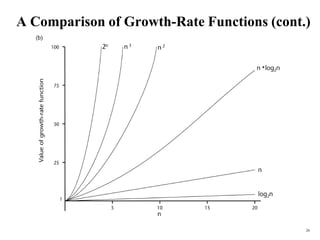
A Comparison of Growth-Rate Functions (cont.)
20
21
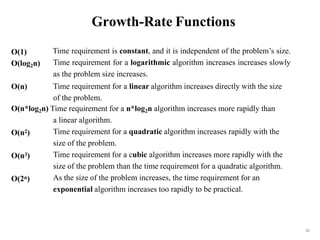
Growth-Rate Functions
O(1)
O(log2n)
Time requirement is constant, and it is independent of the problem’s size.
Time requirement for a logarithmic algorithm increases increases slowly
as the problem size increases.
Time requirement for a linear algorithm increases directly with the size
of the problem.
O(n)
O(n*log2n) Time requirement for a n*log2n algorithm increases more rapidly than
a linear algorithm.
O(n2) Time requirement for a quadratic algorithm increases rapidly with the
size of the problem.
Time requirement for a cubic algorithm increases more rapidly with the
size of the problem than the time requirement for a quadratic algorithm.
As the size of the problem increases, the time requirement for an
exponential algorithm increases too rapidly to be practical.
O(n3)
O(2n)
22
Growth-Rate Functions
• If an algorithm takes 1 second to run with the problem size
8, what is the time requirement (approximately) for that algorithm
with the problem size 16?
• If its order is:
O(1)  T(n) = 1 second
O(log2n)  T(n) = (1*log216) / log28 = 4/3 seconds
O(n)  T(n) = (1*16) / 8 = 2 seconds
O(n*log2n)  T(n) = (1*16*log216) / 8*log28 = 8/3 seconds
O(n2)  T(n) = (1*162) / 82 = 4 seconds
O(n3)  T(n) = (1*163) / 83 = 8 seconds
O(2n)  T(n) = (1*216) / 28 = 28 seconds = 256 seconds
CENG 213 Data Structures 23
Properties of Growth-Rate Functions
1. We can ignore low-order terms in an algorithm’s growth-rate
function.
– If an algorithm is O(n3+4n2+3n), it is also O(n3).
– We only use the higher-order term as algorithm’s growth-rate function.
2. We can ignore a multiplicative constant in the higher-order term
of an algorithm’s growth-rate function.
– If an algorithm is O(5n3), it is also O(n3).
3. O(f(n)) + O(g(n)) = O(f(n)+g(n))
– We can combine growth-rate functions.
– If an algorithm is O(n3) + O(4n), it is also O(n3 +4n2)  So, it is O(n3).
– Similar rules hold for multiplication.
24
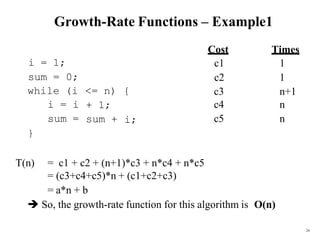
Growth-Rate Functions – Example1
Cost Times
i = 1; c1 1
sum = 0; c2 1
while (i
i = i
sum =
<= n)
+ 1;
sum +
{
i;
c3
c4
c5
n+1
n
n
}
T(n) = c1 + c2 + (n+1)*c3 + n*c4 + n*c5
= (c3+c4+c5)*n + (c1+c2+c3)
= a*n + b
 So, the growth-rate function for this algorithm is O(n)
25
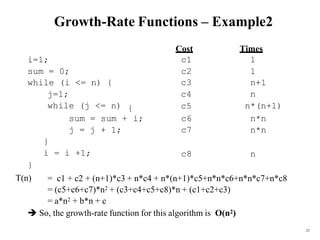
Growth-Rate Functions – Example2
Cost Times
i=1; c1 1
sum = 0;
while (i <= n) {
j=1;
while (j <= n) {
c2
c3
c4
c5
1
n+1
n
n*(n+1)
sum = sum +
j = j + 1;
}
i = i +1;
i; c6
c7
c8
n*n
n*n
n
}
T(n) = c1 + c2 + (n+1)*c3 + n*c4 + n*(n+1)*c5+n*n*c6+n*n*c7+n*c8
= (c5+c6+c7)*n2 + (c3+c4+c5+c8)*n + (c1+c2+c3)
= a*n2 + b*n + c
 So, the growth-rate function for this algorithm is O(n2)
26
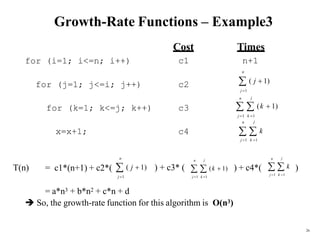
Growth-Rate Functions – Example3
Cost
c1
Times
n+1
n
 ( j  1)
j 1
for (i=1; i<=n; i++)
for (j=1; j<=i; j++) c2
for (k=1; k<=j; k++) c3
x=x+1; c4
T(n)
n
= c1*(n+1) + c2*(  ( j  1)
j 1
n j
) + c3* (   (k  1)
j 1 k 1
) + c4*( )
= a*n3 + b*n2 + c*n + d
 So, the growth-rate function for this algorithm is O(n3)
n j
  (k  1)
j 1 k 1
n j
  k
j 1 k 1
n j
  k
j 1 k 1
CENG 213 Data Structures 27
How much better is O(log2n)?
n O(log2n)
16 4
64 6
256 8
1024 (1KB) 10
16,384 14
131,072 17
262,144 18
524,288 19
1,048,576 (1MB) 20
1,073,741,824 (1GB) 30

algorithmanalysis and effciency.pptx

  • 1.
  • 2.
    Algorithm 2 • An algorithmis a set of instructions to be followed to solve a problem. – There can be more than one solution (more than one algorithm) to solve a given problem. – An algorithm can be implemented using different programming languages on different platforms. • An algorithm must be correct. It should correctly solve the problem. – e.g. For sorting, this means even if (1) the input is already sorted, or (2) it contains repeated elements. • Once we have a correct algorithm for a problem, we have to determine the efficiency of that algorithm.
  • 3.
    3 Algorithmic Performance There aretwo aspects of algorithmic performance: • Time • Instructions take time. • How fast does the algorithm perform? • What affects its runtime? • Space • Data structures take space • What kind of data structures can be used? • How does choice of data structure affect the runtime?  We will focus on time: – How to estimate the time required for an algorithm – How to reduce the time required
  • 4.
    4 Analysis of Algorithms •Analysis of Algorithms is the area of computer science that provides tools to analyze the efficiency of different methods of solutions. • How do we compare the time efficiency of two algorithms that solve the same problem? Naïve Approach: implement these algorithms in a programming language (C++), and run them to compare their time requirements. Comparing the programs (instead of algorithms) has difficulties.
  • 5.
    5 Analysis of Algorithms •When we analyze algorithms, we should employ mathematical techniques that analyze algorithms independently of specific implementations, computers, or data. • To analyze algorithms: – First, we start to count the number of significant operations in a particular solution to assess its efficiency. – Then, we will express the efficiency of algorithms using growth functions.
  • 6.
    6 The Execution Timeof Algorithms • Each operation in an algorithm (or a program) has a cost.  Each operation takes a certain of time. count = count + 1;  take a certain amount of time, but it is constant A sequence of operations: count = count + 1; Cost: c1 sum = sum + count; Cost: c2  Total Cost = c1 + c2
  • 7.
    7 The Execution Timeof Algorithms (cont.) Example: Simple If-Statement Cost c1 c2 Times 1 1 if (n < 0) absval = -n else absval = n; c3 1 Total Cost <= c1 + max(c2,c3)
  • 8.
    8 The Execution Timeof Algorithms (cont.) Example: Simple Loop Cost Times i = 1; c1 1 sum = 0; while (i <= n) { c2 c3 1 n+1 i = i sum = + 1; sum + i; c4 c5 n n } Total Cost = c1 + c2 + (n+1)*c3 + n*c4 + n*c5  The time required for this algorithm is proportional to n
  • 9.
    9 The Execution Timeof Algorithms (cont.) Example: Nested Loop Cost Times i=1; c1 1 sum = 0; c2 1 while (i <= n) { c3 n+1 j=1; c4 n while (j <= n) { c5 n*(n+1) sum = sum + i; c6 n*n j = j + 1; c7 n*n } i = i +1; c8 n } Total Cost = c1 + c2 + (n+1)*c3 + n*c4 + n*(n+1)*c5+n*n*c6+n*n*c7+n*c8  The time required for this algorithm is proportional to n2
  • 10.
    10 Algorithm Growth Rates •We measure an algorithm’s time requirement as a function of the problem size. – Problem size depends on the application: e.g. number of elements in a list for a sorting algorithm, the number disks for towers of hanoi. • So, for instance, we say that (if the problem size is n) – Algorithm A requires 5*n2 time units to solve a problem of size n. – Algorithm B requires 7*n time units to solve a problem of size n. • The most important thing to learn is how quickly the algorithm’s time requirement grows as a function of the problem size. – Algorithm A requires time proportional to n2. – Algorithm B requires time proportional to n. • An algorithm’s proportional time requirement is known as growth rate. • We can compare the efficiency of two algorithms by comparing their growth rates.
  • 11.
    Algorithm Growth Rates(cont.) Time requirements as a function of the problem size n 11
  • 12.
    12 Common Growth Rates FunctionGrowth Rate Name c Constant log N Logarithmic log2N Log-squared N Linear N log N N2 Quadratic N3 Cubic 2N Exponential
  • 13.
    Figure 6.1 Running timesfor small inputs 13
  • 14.
    Figure 6.2 Running timesfor moderate inputs 14
  • 15.
    15 Order-of-Magnitude Analysis andBig O Notation • If Algorithm A requires time proportional to f(n), Algorithm A is said to be order f(n), and it is denoted as O(f(n)). • The function f(n) is called the algorithm’s growth-rate function. • Since the capital O is used in the notation, this notation is called the Big O notation. • If Algorithm A requires time proportional to n2, it is O(n2). • If Algorithm A requires time proportional to n, it is O(n).
  • 16.
    16 Definition of theOrder of an Algorithm Definition: Algorithm A is order f(n) – denoted as O(f(n)) – if constants k and n0 exist such that A requires no more than k*f(n) time units to solve a problem of size n  n0. • The requirement of n  n0 in the definition of O(f(n)) formalizes the notion of sufficiently large problems. – In general, many values of k and n can satisfy this definition.
  • 17.
    17 Order of anAlgorithm • If an algorithm requires n2–3*n+10 seconds to solve a problem size n. If constants k and n0 exist such that k*n2 > n2–3*n+10 for all n  n0 . the algorithm is order n2 (In fact, k is 3 and n0 is 2) 3*n2 > n2–3*n+10 for all n  2 . Thus, the algorithm requires no more than k*n2 time units for n  n0 , So it is O(n2)
  • 18.
    Order of anAlgorithm (cont.) CENG 213 Data Structures 18
  • 19.
    A Comparison ofGrowth-Rate Functions 19
  • 20.
    A Comparison ofGrowth-Rate Functions (cont.) 20
  • 21.
    21 Growth-Rate Functions O(1) O(log2n) Time requirementis constant, and it is independent of the problem’s size. Time requirement for a logarithmic algorithm increases increases slowly as the problem size increases. Time requirement for a linear algorithm increases directly with the size of the problem. O(n) O(n*log2n) Time requirement for a n*log2n algorithm increases more rapidly than a linear algorithm. O(n2) Time requirement for a quadratic algorithm increases rapidly with the size of the problem. Time requirement for a cubic algorithm increases more rapidly with the size of the problem than the time requirement for a quadratic algorithm. As the size of the problem increases, the time requirement for an exponential algorithm increases too rapidly to be practical. O(n3) O(2n)
  • 22.
    22 Growth-Rate Functions • Ifan algorithm takes 1 second to run with the problem size 8, what is the time requirement (approximately) for that algorithm with the problem size 16? • If its order is: O(1)  T(n) = 1 second O(log2n)  T(n) = (1*log216) / log28 = 4/3 seconds O(n)  T(n) = (1*16) / 8 = 2 seconds O(n*log2n)  T(n) = (1*16*log216) / 8*log28 = 8/3 seconds O(n2)  T(n) = (1*162) / 82 = 4 seconds O(n3)  T(n) = (1*163) / 83 = 8 seconds O(2n)  T(n) = (1*216) / 28 = 28 seconds = 256 seconds
  • 23.
    CENG 213 DataStructures 23 Properties of Growth-Rate Functions 1. We can ignore low-order terms in an algorithm’s growth-rate function. – If an algorithm is O(n3+4n2+3n), it is also O(n3). – We only use the higher-order term as algorithm’s growth-rate function. 2. We can ignore a multiplicative constant in the higher-order term of an algorithm’s growth-rate function. – If an algorithm is O(5n3), it is also O(n3). 3. O(f(n)) + O(g(n)) = O(f(n)+g(n)) – We can combine growth-rate functions. – If an algorithm is O(n3) + O(4n), it is also O(n3 +4n2)  So, it is O(n3). – Similar rules hold for multiplication.
  • 24.
    24 Growth-Rate Functions –Example1 Cost Times i = 1; c1 1 sum = 0; c2 1 while (i i = i sum = <= n) + 1; sum + { i; c3 c4 c5 n+1 n n } T(n) = c1 + c2 + (n+1)*c3 + n*c4 + n*c5 = (c3+c4+c5)*n + (c1+c2+c3) = a*n + b  So, the growth-rate function for this algorithm is O(n)
  • 25.
    25 Growth-Rate Functions –Example2 Cost Times i=1; c1 1 sum = 0; while (i <= n) { j=1; while (j <= n) { c2 c3 c4 c5 1 n+1 n n*(n+1) sum = sum + j = j + 1; } i = i +1; i; c6 c7 c8 n*n n*n n } T(n) = c1 + c2 + (n+1)*c3 + n*c4 + n*(n+1)*c5+n*n*c6+n*n*c7+n*c8 = (c5+c6+c7)*n2 + (c3+c4+c5+c8)*n + (c1+c2+c3) = a*n2 + b*n + c  So, the growth-rate function for this algorithm is O(n2)
  • 26.
    26 Growth-Rate Functions –Example3 Cost c1 Times n+1 n  ( j  1) j 1 for (i=1; i<=n; i++) for (j=1; j<=i; j++) c2 for (k=1; k<=j; k++) c3 x=x+1; c4 T(n) n = c1*(n+1) + c2*(  ( j  1) j 1 n j ) + c3* (   (k  1) j 1 k 1 ) + c4*( ) = a*n3 + b*n2 + c*n + d  So, the growth-rate function for this algorithm is O(n3) n j   (k  1) j 1 k 1 n j   k j 1 k 1 n j   k j 1 k 1
  • 27.
    CENG 213 DataStructures 27 How much better is O(log2n)? n O(log2n) 16 4 64 6 256 8 1024 (1KB) 10 16,384 14 131,072 17 262,144 18 524,288 19 1,048,576 (1MB) 20 1,073,741,824 (1GB) 30