PARKINSON’S
DISEASE
PRESENTED BY :
Ms. Yashaswini Hiremath
2nd
year B.Sc. Nursing
BBC College of Nursing Gangavathi
SUPERVISED BY:
Mr. George.D. Honnalli M.Sc.[N]
HOD, Dept of Medical Surgical Nursing
BBC College of Nursing Gangavathi
WHY IT IS CALLED AS PARKINSON’S
DISEASE????
?
?
INTRODUCTION:
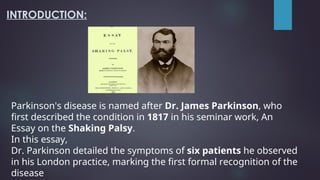
Parkinson's disease is named after Dr. James Parkinson, who
first described the condition in 1817 in his seminar work, An
Essay on the Shaking Palsy.
In this essay,
Dr. Parkinson detailed the symptoms of six patients he observed
in his London practice, marking the first formal recognition of the
disease
DEFINITION:
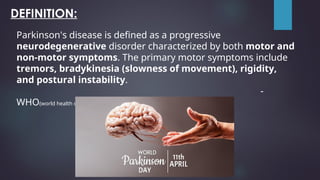
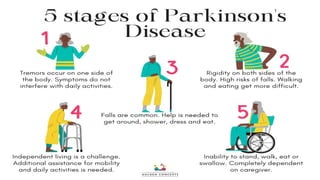
Parkinson's disease is defined as a progressive
neurodegenerative disorder characterized by both motor and
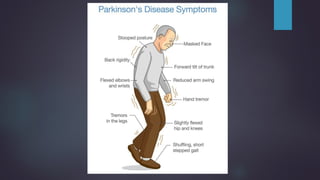
non-motor symptoms. The primary motor symptoms include
tremors, bradykinesia (slowness of movement), rigidity,
and postural instability.
-
WHO(world health organization)
INCIDENCE:
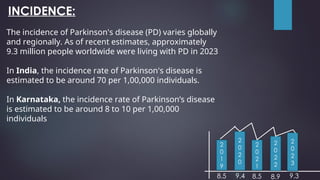
The incidence of Parkinson's disease (PD) varies globally
and regionally. As of recent estimates, approximately
9.3 million people worldwide were living with PD in 2023
In India, the incidence rate of Parkinson's disease is
estimated to be around 70 per 1,00,000 individuals.
In Karnataka, the incidence rate of Parkinson’s disease
is estimated to be around 8 to 10 per 1,00,000
individuals
2
0
1
9
2
0
2
0
2
0
2
1
2
0
2
2
8.5 9.4 8.5 8.9
2
0
2
3
9.3
ETIOLOGY:
1. Loss of Dopamine Neurons: Dopamine-producing neurons in the brain are
lost.
2. Alpha-Synuclein Aggregation: Abnormal alpha-synuclein protein forms Lewy
bodies.
3. Genetic Mutations: Certain genetic mutations can cause Parkinson's disease.
{SNCA, LRRK, PINK1,DJ-1,PRKN}
4. Neuroinflammation: Chronic inflammation in the brain damages neurons.
5. Oxidative Stress: Free radicals damage brain cells due to oxidative stress.
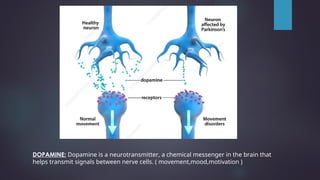
DOPAMINE: Dopamine is a neurotransmitter, a chemical messenger in the brain that
helps transmit signals between nerve cells. ( movement,mood,motivation )
RISK FACTORS:
Age: Over 60 years old
Genetics: Family history
Gender: More common in men
Environmental Factors: Exposure to
toxins[pesticides]
Head Injury: Previous severe head trauma
Other Conditions: Associated conditions like
depression
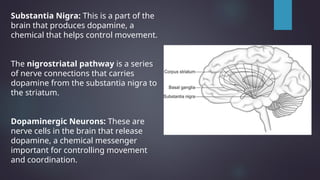
Substantia Nigra: This is a part of the
brain that produces dopamine, a
chemical that helps control movement.
The nigrostriatal pathway is a series
of nerve connections that carries
dopamine from the substantia nigra to
the striatum.
Dopaminergic Neurons: These are
nerve cells in the brain that release
dopamine, a chemical messenger
important for controlling movement
and coordination.
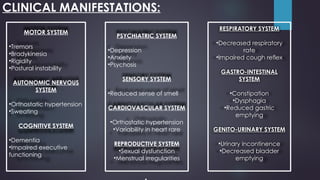
CLINICAL MANIFESTATIONS:
MOTOR SYSTEM
•Tremors
•Bradykinesia
•Rigidity
•Postural instability
AUTONOMIC NERVOUS
SYSTEM
•Orthostatic hypertension
•Sweating
COGNITIVE SYSTEM
•Dementia
•Impaired executive
functioning
PSYCHIATRIC SYSTEM
•Depression
•Anxiety
•Psychosis
SENSORY SYSTEM
•Reduced sense of smell
CARDIOVASCULAR SYSTEM
•Orthostatic hypertension
•Variability in heart rare
REPRODUCTIVE SYSTEM
•Sexual dysfunction
•Menstrual irregularities
RESPIRATORY SYSTEM
•Decreased respiratory
rate
•Impaired cough reflex
GASTRO-INTESTINAL
SYSTEM
•Constipation
•Dysphagia
•Reduced gastric
emptying
GENITO-URINARY SYSTEM
•Urinary incontinence
•Decreased bladder
emptying
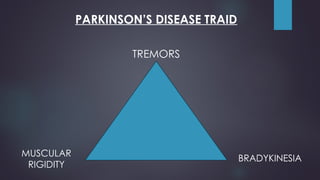
PARKINSON’S DISEASE TRAID
TREMORS
BRADYKINESIA
MUSCULAR
RIGIDITY
DIAGNOSTIC EVALUATIONS:
• Medical history
• Physical examination
• Neurological assessment
• Positron Emission Tomography[PET] scan
• Dopamine transporter [DaT] scan
• Mental Status Examination
•Cranial Nerve Assessment
• Glasgow Coma Scale
• Sensory System Assessment
• Motor System Assessment
• Coordination and Gait
• Reflex Testing
Neurological assessment
Positron Emission Tomography
NOTE:
DOPA: DOPA in a PET scan it is a
radiotracer, used to visualize
dopamine synthesis and
metabolism in the brain
CFT: CFT [carbomethoxy
fluorophenyl tropane] in PET scans
is a radiotracer that binds to
dopamine transporters to image
and study the dopaminergic
system.
DaT scan :
A DaT Scan examines the integrity of the dopamine system by
scanning the brain after injection of a dye
[IODINE-123/I-123LOFLUPANE]
through the vein and watching it bind to the neurons that secrete
dopamine.
MANAGEMENT:
PHARMACOLOGICAL MANAGEMEMNT
•Anti-parkinsonian medications : Levodopa + carbidopa.
•Dopamine Agonists: Bromocriptine mesylate and Pergolide .
•Monoamine Oxidase B inhibitor: selegiline[Eldepryl] and Rasagiline[Azilect].
•Catechol O-methyltransferase inhibitor: Tolcapone and Entacapone.
•Anti- cholinergics : Benztropine [Cogentin] , Trihexyphenidyl, Cycrimine
Procyclidine.
•Glutamate blocking drugs: Amantadine.
NON - PHARMACOLOGICAL MANAGEMEMNT
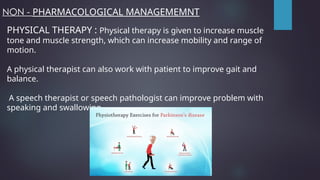
PHYSICAL THERAPY : Physical therapy is given to increase muscle
tone and muscle strength, which can increase mobility and range of
motion.
A physical therapist can also work with patient to improve gait and
balance.
A speech therapist or speech pathologist can improve problem with
speaking and swallowing
SURGICAL MANAGEMENT:
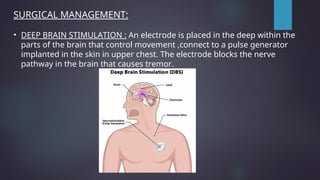
• DEEP BRAIN STIMULATION : An electrode is placed in the deep within the
parts of the brain that control movement ,connect to a pulse generator
implanted in the skin in upper chest. The electrode blocks the nerve
pathway in the brain that causes tremor.
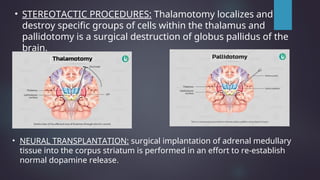
• STEREOTACTIC PROCEDURES: Thalamotomy localizes and
destroy specific groups of cells within the thalamus and
pallidotomy is a surgical destruction of globus pallidus of the
brain.
• NEURAL TRANSPLANTATION: surgical implantation of adrenal medullary
tissue into the corpus striatum is performed in an effort to re-establish
normal dopamine release.
THANK YOU

PARKINSON’S DISEASE.ppt .

  • 1.
    PARKINSON’S DISEASE PRESENTED BY : Ms.Yashaswini Hiremath 2nd year B.Sc. Nursing BBC College of Nursing Gangavathi SUPERVISED BY: Mr. George.D. Honnalli M.Sc.[N] HOD, Dept of Medical Surgical Nursing BBC College of Nursing Gangavathi
  • 2.
    WHY IT ISCALLED AS PARKINSON’S DISEASE???? ? ?
  • 3.
    INTRODUCTION: Parkinson's disease isnamed after Dr. James Parkinson, who first described the condition in 1817 in his seminar work, An Essay on the Shaking Palsy. In this essay, Dr. Parkinson detailed the symptoms of six patients he observed in his London practice, marking the first formal recognition of the disease
  • 4.
    DEFINITION: Parkinson's disease isdefined as a progressive neurodegenerative disorder characterized by both motor and non-motor symptoms. The primary motor symptoms include tremors, bradykinesia (slowness of movement), rigidity, and postural instability. - WHO(world health organization)
  • 5.
    INCIDENCE: The incidence ofParkinson's disease (PD) varies globally and regionally. As of recent estimates, approximately 9.3 million people worldwide were living with PD in 2023 In India, the incidence rate of Parkinson's disease is estimated to be around 70 per 1,00,000 individuals. In Karnataka, the incidence rate of Parkinson’s disease is estimated to be around 8 to 10 per 1,00,000 individuals 2 0 1 9 2 0 2 0 2 0 2 1 2 0 2 2 8.5 9.4 8.5 8.9 2 0 2 3 9.3
  • 6.
    ETIOLOGY: 1. Loss ofDopamine Neurons: Dopamine-producing neurons in the brain are lost. 2. Alpha-Synuclein Aggregation: Abnormal alpha-synuclein protein forms Lewy bodies. 3. Genetic Mutations: Certain genetic mutations can cause Parkinson's disease. {SNCA, LRRK, PINK1,DJ-1,PRKN} 4. Neuroinflammation: Chronic inflammation in the brain damages neurons. 5. Oxidative Stress: Free radicals damage brain cells due to oxidative stress.
  • 7.
    DOPAMINE: Dopamine isa neurotransmitter, a chemical messenger in the brain that helps transmit signals between nerve cells. ( movement,mood,motivation )
  • 8.
    RISK FACTORS: Age: Over60 years old Genetics: Family history Gender: More common in men Environmental Factors: Exposure to toxins[pesticides] Head Injury: Previous severe head trauma Other Conditions: Associated conditions like depression
  • 11.
    Substantia Nigra: Thisis a part of the brain that produces dopamine, a chemical that helps control movement. The nigrostriatal pathway is a series of nerve connections that carries dopamine from the substantia nigra to the striatum. Dopaminergic Neurons: These are nerve cells in the brain that release dopamine, a chemical messenger important for controlling movement and coordination.
  • 12.
    CLINICAL MANIFESTATIONS: MOTOR SYSTEM •Tremors •Bradykinesia •Rigidity •Posturalinstability AUTONOMIC NERVOUS SYSTEM •Orthostatic hypertension •Sweating COGNITIVE SYSTEM •Dementia •Impaired executive functioning PSYCHIATRIC SYSTEM •Depression •Anxiety •Psychosis SENSORY SYSTEM •Reduced sense of smell CARDIOVASCULAR SYSTEM •Orthostatic hypertension •Variability in heart rare REPRODUCTIVE SYSTEM •Sexual dysfunction •Menstrual irregularities RESPIRATORY SYSTEM •Decreased respiratory rate •Impaired cough reflex GASTRO-INTESTINAL SYSTEM •Constipation •Dysphagia •Reduced gastric emptying GENITO-URINARY SYSTEM •Urinary incontinence •Decreased bladder emptying
  • 13.
  • 16.
    DIAGNOSTIC EVALUATIONS: • Medicalhistory • Physical examination • Neurological assessment • Positron Emission Tomography[PET] scan • Dopamine transporter [DaT] scan
  • 17.
    • Mental StatusExamination •Cranial Nerve Assessment • Glasgow Coma Scale • Sensory System Assessment • Motor System Assessment • Coordination and Gait • Reflex Testing Neurological assessment
  • 18.
    Positron Emission Tomography NOTE: DOPA:DOPA in a PET scan it is a radiotracer, used to visualize dopamine synthesis and metabolism in the brain CFT: CFT [carbomethoxy fluorophenyl tropane] in PET scans is a radiotracer that binds to dopamine transporters to image and study the dopaminergic system.
  • 19.
    DaT scan : ADaT Scan examines the integrity of the dopamine system by scanning the brain after injection of a dye [IODINE-123/I-123LOFLUPANE] through the vein and watching it bind to the neurons that secrete dopamine.
  • 20.
    MANAGEMENT: PHARMACOLOGICAL MANAGEMEMNT •Anti-parkinsonian medications: Levodopa + carbidopa. •Dopamine Agonists: Bromocriptine mesylate and Pergolide . •Monoamine Oxidase B inhibitor: selegiline[Eldepryl] and Rasagiline[Azilect]. •Catechol O-methyltransferase inhibitor: Tolcapone and Entacapone. •Anti- cholinergics : Benztropine [Cogentin] , Trihexyphenidyl, Cycrimine Procyclidine. •Glutamate blocking drugs: Amantadine.
  • 21.
    NON - PHARMACOLOGICALMANAGEMEMNT PHYSICAL THERAPY : Physical therapy is given to increase muscle tone and muscle strength, which can increase mobility and range of motion. A physical therapist can also work with patient to improve gait and balance. A speech therapist or speech pathologist can improve problem with speaking and swallowing
  • 22.
    SURGICAL MANAGEMENT: • DEEPBRAIN STIMULATION : An electrode is placed in the deep within the parts of the brain that control movement ,connect to a pulse generator implanted in the skin in upper chest. The electrode blocks the nerve pathway in the brain that causes tremor.
  • 23.
    • STEREOTACTIC PROCEDURES:Thalamotomy localizes and destroy specific groups of cells within the thalamus and pallidotomy is a surgical destruction of globus pallidus of the brain. • NEURAL TRANSPLANTATION: surgical implantation of adrenal medullary tissue into the corpus striatum is performed in an effort to re-establish normal dopamine release.
  • 24.