

MOBILITY AIDS:
Presented by:
Priyanka bhusal
INTRODUCTION:
• The applicances or devices ,which are useful for
mobility as well as stability purpose of an
individual who cant work independently called
as mobility or walking aids.
Indications:
• Pain
• Muscle weakness
• Balancing problems
• Fractures
• Joint diseases
• Injured or inflamed
limb
FUNCTION OF MOBILITY AIDS:
• Improve balance
• Give proprioception
• Decrease pain
• Reduce weight bearing on injured or inflamed
structures
• Compensate for weak muscles
• Scan the immediate environment
SELECTION:
• Stability of the patient
• Strength of upper and lower limbs
• Co-ordination of upper and lower limbs
• Required degree of relief from weight bearing.
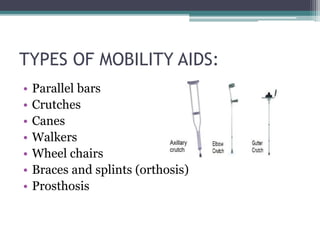
TYPES OF MOBILITY AIDS:
• Parallel bars
• Crutches
• Canes
• Walkers
• Wheel chairs
• Braces and splints (orthosis)
• Prosthosis
1) PARALLEL BARS:
• These are rigid, made of wood or metal.
• Support the patient through the length of the bars ,
• Enables the patient to concentrate on the lower
limbs,
• A full length mirror is placed at one for visual
proprioception ,
• Height of the bar should be at the level of greater
trochanter,
• Elbows should be flexed between 25 to 30 degrees,
• Hands should be placed on the bar 6 inches infront
of the patient.
PARALLEL BAR
USES:
• Parallel bars are used to help people to regain
their strength, balance, rom, and independence.
• These are also used for co ordination exercises,
task oriented exercise for the neurological
patients.
• These are also used for ambulation exercises to
improve patient ability to walk independently.
• The training typically begins on parallel bars and
then progress to crutches, walkers and canes.
2) CRUTCHES:
• Crutches are used mostly to relieve the weight
bearing
• 3 types of crutches are available
• 1.Axillary crutch
• 2.Elbow crutch
• 3.Gutter crutch
AXILLARY CRUTCH:
• Axillary crutch provides the maximum stability
and support to the patient than any other
crutches.
• It gives more than 80% of the stability to the
patient.
• This crutches are recommended to the patient’s
who are having marked instability.
• It is made of aluminium, steel, wood.
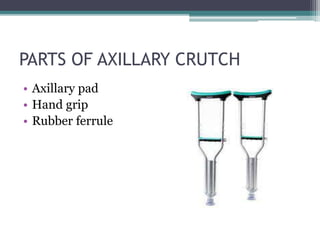
PARTS OF AXILLARY CRUTCH
• Axillary pad
• Hand grip
• Rubber ferrule
AXILLARY PAD:
• It is situated in the top portion of the crutch.
• It should be placed 5cm below the axilla, if not
pad compress in the axilla cause neuropraxia of
the axillary nerve, radial nerve, or brachial
plexus.
• Axillary pad is made up of metal and is covered
by the cushion materials to avoid the damage to
the lateral aspect of the chest wall.
• The axillary pad is placed laterally to provide
lateral stability.
HAND GRIP:
• It is made up of plastic material, and sometimes
covered by cushion material.
• Hand grip normally comes around the greater
trochantric area of the person using it.
• It has the adjustable screws or clips to adjust the
height.
• Some crutches have the adjustable hand grip
buttons.
RUBBER FERRULE:
• It is situated in the lower end of the crutch.
• This rubber tip provides more grip for the
patient while walking in the normal/slippery
surface.
MEASUREMENT OF CRUTCH:
• Before giving crutch to the patient, it should be
measured perfectly because, lengthier crutch
may cause compression over the axilla, which
leads to neuropraxia.
• Sometimes if it is small, the patients’s gait
pattern may change or it may cause some other
complication like back ache.
CRUTCH MEASUREMENT:
SHOES OFF SHOES ON
LYING LYING
STANDING STANDING
SHOES OFF:
• Supine lying:- has to be measured from the apex
of the axilla to the medial malleolus. This is the
accurate measurement
• Standing:- two inches below the axilla to the two
inches lateral and six inches anterior to the foot
when the patient is standing
SHOES ON:
• Supine lying:- this type of measurement is taken
with the patient wearing shoes. The
measurement taken from 5 cm below the apex of
axilla to the 20 cm lateral to the heel of the shoe.
This is not accurate method of measuring crutch
length
• Standing:- same like shoes off method taken in
standing position
HANDGRIP MEASUREMENT:
• The measurement taken from the 5 cm below the
apex of the axilla to the ulnar styloid process in
the elbow in 20° – 30° flexed position
ELBOW CRUTCHES:
• It gives less stability (60%) than the axillary
crutch.
• Elbow crutches are recommended to the patient
with minimal instability in walking.
• It is made up of aluminium, metal, or plastic.
PARTS OF ELBOW CRUTCHES:
• Fore arm cuff
• Single upright
• Hand piece
• Rubber ferrule
• Fore arm cuff:- It is made up of metals and is
coated by plastic or cushion materials, placed
just below the elbow joint.
• Single upright:- It has proximal and distal
adjustable press clips.
• Proximal one to adjust the height of the fore arm
cuff and the distal one to adjust the height of the
crutches.
ELBOW CRUTCH MEASUREMENT:
The measurement taken from the ulnar styloid
process with the elbow in 20° - 30° flexion to the
20 cm lateral to the heel or the heel of the shoe
GUTTER CRUTCH:
• It is similar to the elbow crutch, having extra
with a padded fore arm support.
• These are mainly used for rheumatoid hand or
fracture of wrist/hand, who require some form
of support but cannot take weight through
hands, wrist, elbows because of deformity
and/or pain.
PARTS OF GUTTER CRUTCH:
• Fore arm supporting pad with strap
• Single upright
• Hand piece
• Rubber ferrule
MEASUREMENT:
• Lying:- the measurement taken from the point of
flexed elbow to 20 cm lateral to the heel (shoes
on)
• Standing:- the measurement taken from the
elbow to the floor
CANES:
• Canes are ambulatory assistive devices used for
improving postural stability.
• It is generally prescribed for the people with
moderate mobility impairment.
• It is typically used when minimal stability is
needed.
• Cane in the day to day life are called as walking
sticks.
• These are made up of wood, metal, or
aluminium.
TYPES:
• 1.Standard canes
• 2.Standard adjustable canes
• 3.Standard adjustable offset canes
• 4.Tripod canes
• 5.Quadripod canes
PARTS OF CANES:
• Hand grip
• Adjustable clips
• Rubber ferrule
TRIPODS AND QUADRIPODS:
• It has the 4 or 3 leg with the rubber tip and it
gives the broader base, because of this the BOS
will be more.
• Available in offset and also in standard models.
• Gives more stability than the other varieties.
QUADRIPODS
• This is more useful for neurological cases like
hemiplegia, and in some lower limb injuries.
• Height adjustable screws are also available.
• It is difficulty carry on the stairs if the base is
broader.
TRIPODS
WALKERS:
• Walkers are useful in non-weight bearing,
partial weight bearing, and full weight bearing
gait pattern. It gives more stability as it has
boarder base. Since the COG falls within the
BOS, it gives anterior as well as lateral stability.
• The walker is having is having two anterior and
two lateral bars, the horizontal bar connects all
the vertical bars in the three sides, and one side
is kept open.
TYPES:
• Rigid walking frame
• Foldable walker
• Gutter walker
• Reciprocal walker
• rollator
ADVANTAGE:
• Stability
• Security
• Light and adjustable
• DISADVANTAGES:
• Difficulty to use on stairs
• Difficulty through door step or entrance
WHEELCHAIR:
• This is one of the variety of mobility aids
• The patient who has both the lower limbs non
functioning or partially functioning has to be
recommended for the wheel chair
• It is the secondary house for the patient, because
he has to spend more time with it
WHEELCHAIR:
• It may be modified depending on the condition
of the patient .
• It gives 100% stability to the patient.
• Normally, wheel chairs are recommended for
paraplegic, quadriplegic, muscular dystrophy,
spinal cord injuries, and fracture conditions.
• It provides physical and as well as mental
support
mobility aids.pptx
mobility aids.pptx

mobility aids.pptx

  • 1.
  • 2.
    INTRODUCTION: • The applicancesor devices ,which are useful for mobility as well as stability purpose of an individual who cant work independently called as mobility or walking aids.
  • 3.
    Indications: • Pain • Muscleweakness • Balancing problems • Fractures • Joint diseases • Injured or inflamed limb
  • 4.
    FUNCTION OF MOBILITYAIDS: • Improve balance • Give proprioception • Decrease pain • Reduce weight bearing on injured or inflamed structures • Compensate for weak muscles • Scan the immediate environment
  • 5.
    SELECTION: • Stability ofthe patient • Strength of upper and lower limbs • Co-ordination of upper and lower limbs • Required degree of relief from weight bearing.
  • 6.
    TYPES OF MOBILITYAIDS: • Parallel bars • Crutches • Canes • Walkers • Wheel chairs • Braces and splints (orthosis) • Prosthosis
  • 7.
    1) PARALLEL BARS: •These are rigid, made of wood or metal. • Support the patient through the length of the bars , • Enables the patient to concentrate on the lower limbs, • A full length mirror is placed at one for visual proprioception , • Height of the bar should be at the level of greater trochanter, • Elbows should be flexed between 25 to 30 degrees, • Hands should be placed on the bar 6 inches infront of the patient.
  • 8.
  • 9.
    USES: • Parallel barsare used to help people to regain their strength, balance, rom, and independence. • These are also used for co ordination exercises, task oriented exercise for the neurological patients. • These are also used for ambulation exercises to improve patient ability to walk independently. • The training typically begins on parallel bars and then progress to crutches, walkers and canes.
  • 10.
    2) CRUTCHES: • Crutchesare used mostly to relieve the weight bearing • 3 types of crutches are available • 1.Axillary crutch • 2.Elbow crutch • 3.Gutter crutch
  • 11.
    AXILLARY CRUTCH: • Axillarycrutch provides the maximum stability and support to the patient than any other crutches. • It gives more than 80% of the stability to the patient. • This crutches are recommended to the patient’s who are having marked instability. • It is made of aluminium, steel, wood.
  • 12.
    PARTS OF AXILLARYCRUTCH • Axillary pad • Hand grip • Rubber ferrule
  • 13.
    AXILLARY PAD: • Itis situated in the top portion of the crutch. • It should be placed 5cm below the axilla, if not pad compress in the axilla cause neuropraxia of the axillary nerve, radial nerve, or brachial plexus. • Axillary pad is made up of metal and is covered by the cushion materials to avoid the damage to the lateral aspect of the chest wall. • The axillary pad is placed laterally to provide lateral stability.
  • 14.
    HAND GRIP: • Itis made up of plastic material, and sometimes covered by cushion material. • Hand grip normally comes around the greater trochantric area of the person using it. • It has the adjustable screws or clips to adjust the height. • Some crutches have the adjustable hand grip buttons.
  • 15.
    RUBBER FERRULE: • Itis situated in the lower end of the crutch. • This rubber tip provides more grip for the patient while walking in the normal/slippery surface.
  • 16.
    MEASUREMENT OF CRUTCH: •Before giving crutch to the patient, it should be measured perfectly because, lengthier crutch may cause compression over the axilla, which leads to neuropraxia. • Sometimes if it is small, the patients’s gait pattern may change or it may cause some other complication like back ache.
  • 17.
    CRUTCH MEASUREMENT: SHOES OFFSHOES ON LYING LYING STANDING STANDING
  • 18.
    SHOES OFF: • Supinelying:- has to be measured from the apex of the axilla to the medial malleolus. This is the accurate measurement • Standing:- two inches below the axilla to the two inches lateral and six inches anterior to the foot when the patient is standing
  • 19.
    SHOES ON: • Supinelying:- this type of measurement is taken with the patient wearing shoes. The measurement taken from 5 cm below the apex of axilla to the 20 cm lateral to the heel of the shoe. This is not accurate method of measuring crutch length • Standing:- same like shoes off method taken in standing position
  • 20.
    HANDGRIP MEASUREMENT: • Themeasurement taken from the 5 cm below the apex of the axilla to the ulnar styloid process in the elbow in 20° – 30° flexed position
  • 21.
    ELBOW CRUTCHES: • Itgives less stability (60%) than the axillary crutch. • Elbow crutches are recommended to the patient with minimal instability in walking. • It is made up of aluminium, metal, or plastic.
  • 22.
    PARTS OF ELBOWCRUTCHES: • Fore arm cuff • Single upright • Hand piece • Rubber ferrule
  • 23.
    • Fore armcuff:- It is made up of metals and is coated by plastic or cushion materials, placed just below the elbow joint. • Single upright:- It has proximal and distal adjustable press clips. • Proximal one to adjust the height of the fore arm cuff and the distal one to adjust the height of the crutches.
  • 24.
    ELBOW CRUTCH MEASUREMENT: Themeasurement taken from the ulnar styloid process with the elbow in 20° - 30° flexion to the 20 cm lateral to the heel or the heel of the shoe
  • 25.
    GUTTER CRUTCH: • Itis similar to the elbow crutch, having extra with a padded fore arm support. • These are mainly used for rheumatoid hand or fracture of wrist/hand, who require some form of support but cannot take weight through hands, wrist, elbows because of deformity and/or pain.
  • 26.
    PARTS OF GUTTERCRUTCH: • Fore arm supporting pad with strap • Single upright • Hand piece • Rubber ferrule
  • 27.
    MEASUREMENT: • Lying:- themeasurement taken from the point of flexed elbow to 20 cm lateral to the heel (shoes on) • Standing:- the measurement taken from the elbow to the floor
  • 28.
    CANES: • Canes areambulatory assistive devices used for improving postural stability. • It is generally prescribed for the people with moderate mobility impairment. • It is typically used when minimal stability is needed. • Cane in the day to day life are called as walking sticks. • These are made up of wood, metal, or aluminium.
  • 29.
    TYPES: • 1.Standard canes •2.Standard adjustable canes • 3.Standard adjustable offset canes • 4.Tripod canes • 5.Quadripod canes
  • 30.
    PARTS OF CANES: •Hand grip • Adjustable clips • Rubber ferrule
  • 31.
    TRIPODS AND QUADRIPODS: •It has the 4 or 3 leg with the rubber tip and it gives the broader base, because of this the BOS will be more. • Available in offset and also in standard models. • Gives more stability than the other varieties. QUADRIPODS
  • 32.
    • This ismore useful for neurological cases like hemiplegia, and in some lower limb injuries. • Height adjustable screws are also available. • It is difficulty carry on the stairs if the base is broader. TRIPODS
  • 33.
    WALKERS: • Walkers areuseful in non-weight bearing, partial weight bearing, and full weight bearing gait pattern. It gives more stability as it has boarder base. Since the COG falls within the BOS, it gives anterior as well as lateral stability. • The walker is having is having two anterior and two lateral bars, the horizontal bar connects all the vertical bars in the three sides, and one side is kept open.
  • 34.
    TYPES: • Rigid walkingframe • Foldable walker • Gutter walker • Reciprocal walker • rollator
  • 35.
    ADVANTAGE: • Stability • Security •Light and adjustable • DISADVANTAGES: • Difficulty to use on stairs • Difficulty through door step or entrance
  • 36.
    WHEELCHAIR: • This isone of the variety of mobility aids • The patient who has both the lower limbs non functioning or partially functioning has to be recommended for the wheel chair • It is the secondary house for the patient, because he has to spend more time with it
  • 37.
    WHEELCHAIR: • It maybe modified depending on the condition of the patient . • It gives 100% stability to the patient. • Normally, wheel chairs are recommended for paraplegic, quadriplegic, muscular dystrophy, spinal cord injuries, and fracture conditions. • It provides physical and as well as mental support