Parkinson's Disease
N u r s i n g E d u c a t i o n
Presented by; , M.Sc. Nursing, 1st
Contents
0 1 . D E F I N I T I O N
0 2 . I N C I D E N C E
0 3 . E T I O L O G Y
0 4 . P A T H O P H Y S I O L O G Y
0 5 . C L I N I C A L M A N I F E S T A T I O N
0 6 . D I A G N O S T I C E V A L U A T I O N
0 7 . M A N A G E M E N T
0 8 . C O M P L I C A T I O N S
DEFINITION
01
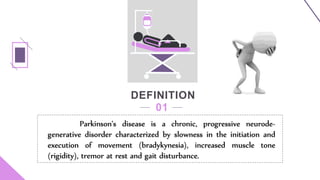
Parkinson's disease is a chronic, progressive neurode-
generative disorder characterized by slowness in the initiation and
execution of movement (bradykynesia), increased muscle tone
(rigidity), tremor at rest and gait disturbance.
02 INCIDENCE
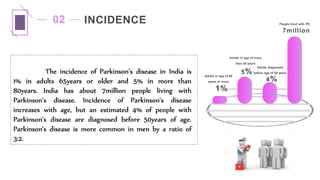
The incidence of Parkinson's disease in India is
1% in adults 65years or older and 5% in more than
80years. India has about 7million people living with
Parkinson's disease. Incidence of Parkinson's disease
increases with age, but an estimated 4% of people with
Parkinson's disease are diagnosed before 50years of age.
Parkinson's disease is more common in men by a ratio of
3:2.
5%
4%
1%
Adults in age of more
than 80 years
Adults diagnosed
before age of 50 years
7million
Adults in age of 65
years or more
People lived with PD
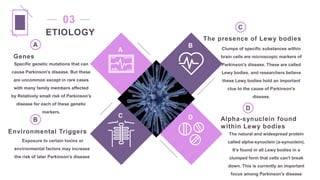
Genes
Specific genetic mutations that can
cause Parkinson's disease. But these
are uncommon except in rare cases
with many family members affected
by Relatively small risk of Parkinson's
disease for each of these genetic
markers.
Environmental Triggers
Exposure to certain toxins or
environmental factors may increase
the risk of later Parkinson's disease
The presence of Lewy bodies
Clumps of specific substances within
brain cells are microscopic markers of
Parkinson's disease. These are called
Lewy bodies, and researchers believe
these Lewy bodies hold an important
clue to the cause of Parkinson's
disease.
Alpha-synuclein found
within Lewy bodies
The natural and widespread protein
called alpha-synuclein (a-synuclein).
It's found in all Lewy bodies in a
clumped form that cells can't break
down. This is currently an important
focus among Parkinson's disease
A
B
D
C
A
B
C
D
ETIOLOGY
03
Cont....
The other risks of Parkinson's disease by
exposure to herbicides, pesticides, industrial chemicals
and wood pulp mills, rural residence.
Secondary factors are due to
exposure to the variety of chemicals include
carbon monoxide and mangenese. Also the
drug induced parkinsonism are
metoclopramide, reserpine, methyldopa,
lithium, haloperidol.
PATHOPHYSIOLOGY
04
1.Tremor
A tremor, or shaking, usually
begins in a limb, often your
hand or fingers.
4.Impaired posture and
balance
Posture may become stooped,
or may have balance problems.
5.Loss of automatic
movements
Decreased ability to perform unconscious
movements, including blinking, smiling or
swinging your arms when you walk.
6.Speech & Writing
changes
Speaks softly, quickly, slur or hesitate
before talking & hard to write, and
your writing may appear small
3.Rigid muscles
Muscle stiffness may occur in
any part of the body. The stiff
muscles can be painful and
limits range of motion
2.Slowed movement
(bradykinesia)
Parkinson's disease may slow
your movement, making simple
tasks difficult and time-
consuming.
CLINICAL
MANIFESTATION
05
Cont.....
Cont....
Nostalgia took me to the depths of past.
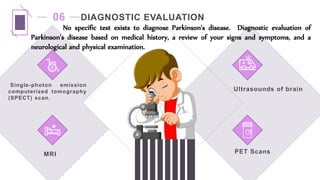
DIAGNOSTIC EVALUATION
Single-photon emission
computerized tomography
(SPECT) scan.
MRI
Ultrasounds of brain
PET Scans
06
No specific test exists to diagnose Parkinson's disease. Diagnostic evaluation of
Parkinson's disease based on medical history, a review of your signs and symptoms, and a
neurological and physical examination.
Cont....
ADD YOUR TITLE
MEDICAL MANAGEMENT
07
MANAGEMENT
Medications may helps to manage problems with
walking, movement and tremor. These medications increase
or substitute for dopamine. People with Parkinson's disease
have low brain dopamine concentrations. However, dopamine
can't be given directly, as it can't enters the brain. Patients
may have significant improvement of your symptoms after
beginning Parkinson's disease treatment. Over time, however,
the benefits of drugs frequently diminish or become less
consistent.
Cont....
Carbidopa-
levodopa
Entacapone (Comtan) is
the primary medication
mildly prolongs the
effect of levodopa
therapy by blocking an
enzyme that breaks
down dopamine
It is a natural
chemical that
passes into your
brain and is
converted to
dopamine
It help control the
tremor associated
with Parkinson's
disease. Several
anticholinergic
medications like
benztropine
(Cogentin) or
trihexyphenidyl.
Amantadine alone to
provide short-term
relief of symptoms of
mild, early-stage
Parkinson's disease. It
given with carbidopa-
levodopa therapy
during the later stages
to control involuntary
movements (dyskinesia)
Catechol O-
methyltransfe
rase (COMT)
inhibitors
Anticholinergics Amantadine
SURGICAL MANAGEMENT
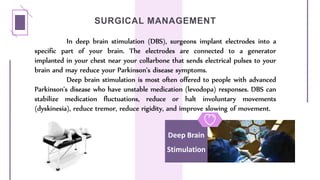
Deep Brain
Stimulation
In deep brain stimulation (DBS), surgeons implant electrodes into a
specific part of your brain. The electrodes are connected to a generator
implanted in your chest near your collarbone that sends electrical pulses to your
brain and may reduce your Parkinson's disease symptoms.
Deep brain stimulation is most often offered to people with advanced
Parkinson's disease who have unstable medication (levodopa) responses. DBS can
stabilize medication fluctuations, reduce or halt involuntary movements
(dyskinesia), reduce tremor, reduce rigidity, and improve slowing of movement.
Cont....
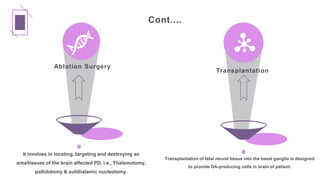
It involves in locating, targeting and destroying an
area/tissues of the brain affected PD. i.e., Thalamotomy,
pallidotomy & subthalamic nucleotomy.
Transplantation of fetal neural tissue into the basal ganglia is designed
to provide DA-producing cells in brain of patient.
Ablation Surgery
Transplantation
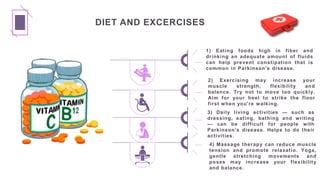
DIET AND EXCERCISES
1) Eating foods high in fiber and
drinking an adequate amount of fluids
can help prevent constipation that is
common in Parkinson's disease.
2) Exercising may increase your
muscle strength, flexibility and
balance. Try not to move too quickly.
Aim for your heel to strike the floor
first when you're walking.
3) Daily living activities — such as
dressing, eating, bathing and writing
— can be difficult for people with
Parkinson's disease. Helps to do their
activities.
4) Massage therapy can reduce muscle
tension and promote relaxatio. Yoga,
gentle stretching movements and
poses may increase your flexibility
and balance.
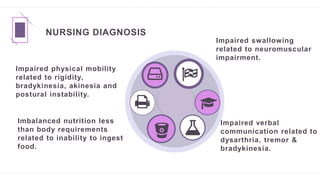
NURSING DIAGNOSIS
Impaired physical mobility
related to rigidity,
bradykinesia, akinesia and
postural instability.
Imbalanced nutrition less
than body requirements
related to inability to ingest
food.
Impaired swallowing
related to neuromuscular
impairment.
Impaired verbal
communication related to
dysarthria, tremor &
bradykinesia.
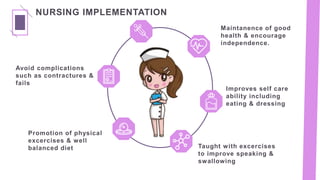
Promotion of physical
excercises & well
balanced diet Taught with excercises
to improve speaking &
swallowing
Improves self care
ability including
eating & dressing
Avoid complications
such as contractures &
fails
Maintanence of good
health & encourage
independence.
NURSING IMPLEMENTATION
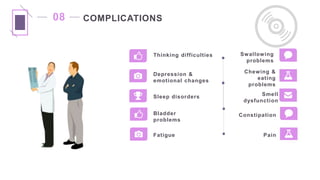
COMPLICATIONS
Bladder
problems
Fatigue Pain
Constipation
08
Thinking difficulties
Depression &
emotional changes
Sleep disorders Smell
dysfunction
Chewing &
eating
problems
Swallowing
problems
Parkinson's disease Seminar Presentation

Parkinson's disease Seminar Presentation

  • 1.
    Parkinson's Disease N ur s i n g E d u c a t i o n Presented by; , M.Sc. Nursing, 1st
  • 2.
    Contents 0 1 .D E F I N I T I O N 0 2 . I N C I D E N C E 0 3 . E T I O L O G Y 0 4 . P A T H O P H Y S I O L O G Y 0 5 . C L I N I C A L M A N I F E S T A T I O N 0 6 . D I A G N O S T I C E V A L U A T I O N 0 7 . M A N A G E M E N T 0 8 . C O M P L I C A T I O N S
  • 3.
    DEFINITION 01 Parkinson's disease isa chronic, progressive neurode- generative disorder characterized by slowness in the initiation and execution of movement (bradykynesia), increased muscle tone (rigidity), tremor at rest and gait disturbance.
  • 4.
    02 INCIDENCE The incidenceof Parkinson's disease in India is 1% in adults 65years or older and 5% in more than 80years. India has about 7million people living with Parkinson's disease. Incidence of Parkinson's disease increases with age, but an estimated 4% of people with Parkinson's disease are diagnosed before 50years of age. Parkinson's disease is more common in men by a ratio of 3:2. 5% 4% 1% Adults in age of more than 80 years Adults diagnosed before age of 50 years 7million Adults in age of 65 years or more People lived with PD
  • 5.
    Genes Specific genetic mutationsthat can cause Parkinson's disease. But these are uncommon except in rare cases with many family members affected by Relatively small risk of Parkinson's disease for each of these genetic markers. Environmental Triggers Exposure to certain toxins or environmental factors may increase the risk of later Parkinson's disease The presence of Lewy bodies Clumps of specific substances within brain cells are microscopic markers of Parkinson's disease. These are called Lewy bodies, and researchers believe these Lewy bodies hold an important clue to the cause of Parkinson's disease. Alpha-synuclein found within Lewy bodies The natural and widespread protein called alpha-synuclein (a-synuclein). It's found in all Lewy bodies in a clumped form that cells can't break down. This is currently an important focus among Parkinson's disease A B D C A B C D ETIOLOGY 03
  • 6.
    Cont.... The other risksof Parkinson's disease by exposure to herbicides, pesticides, industrial chemicals and wood pulp mills, rural residence. Secondary factors are due to exposure to the variety of chemicals include carbon monoxide and mangenese. Also the drug induced parkinsonism are metoclopramide, reserpine, methyldopa, lithium, haloperidol.
  • 7.
  • 8.
    1.Tremor A tremor, orshaking, usually begins in a limb, often your hand or fingers. 4.Impaired posture and balance Posture may become stooped, or may have balance problems. 5.Loss of automatic movements Decreased ability to perform unconscious movements, including blinking, smiling or swinging your arms when you walk. 6.Speech & Writing changes Speaks softly, quickly, slur or hesitate before talking & hard to write, and your writing may appear small 3.Rigid muscles Muscle stiffness may occur in any part of the body. The stiff muscles can be painful and limits range of motion 2.Slowed movement (bradykinesia) Parkinson's disease may slow your movement, making simple tasks difficult and time- consuming. CLINICAL MANIFESTATION 05
  • 9.
  • 10.
    Cont.... Nostalgia took meto the depths of past.
  • 11.
    DIAGNOSTIC EVALUATION Single-photon emission computerizedtomography (SPECT) scan. MRI Ultrasounds of brain PET Scans 06 No specific test exists to diagnose Parkinson's disease. Diagnostic evaluation of Parkinson's disease based on medical history, a review of your signs and symptoms, and a neurological and physical examination.
  • 12.
  • 13.
    MEDICAL MANAGEMENT 07 MANAGEMENT Medications mayhelps to manage problems with walking, movement and tremor. These medications increase or substitute for dopamine. People with Parkinson's disease have low brain dopamine concentrations. However, dopamine can't be given directly, as it can't enters the brain. Patients may have significant improvement of your symptoms after beginning Parkinson's disease treatment. Over time, however, the benefits of drugs frequently diminish or become less consistent.
  • 14.
    Cont.... Carbidopa- levodopa Entacapone (Comtan) is theprimary medication mildly prolongs the effect of levodopa therapy by blocking an enzyme that breaks down dopamine It is a natural chemical that passes into your brain and is converted to dopamine It help control the tremor associated with Parkinson's disease. Several anticholinergic medications like benztropine (Cogentin) or trihexyphenidyl. Amantadine alone to provide short-term relief of symptoms of mild, early-stage Parkinson's disease. It given with carbidopa- levodopa therapy during the later stages to control involuntary movements (dyskinesia) Catechol O- methyltransfe rase (COMT) inhibitors Anticholinergics Amantadine
  • 15.
    SURGICAL MANAGEMENT Deep Brain Stimulation Indeep brain stimulation (DBS), surgeons implant electrodes into a specific part of your brain. The electrodes are connected to a generator implanted in your chest near your collarbone that sends electrical pulses to your brain and may reduce your Parkinson's disease symptoms. Deep brain stimulation is most often offered to people with advanced Parkinson's disease who have unstable medication (levodopa) responses. DBS can stabilize medication fluctuations, reduce or halt involuntary movements (dyskinesia), reduce tremor, reduce rigidity, and improve slowing of movement.
  • 16.
    Cont.... It involves inlocating, targeting and destroying an area/tissues of the brain affected PD. i.e., Thalamotomy, pallidotomy & subthalamic nucleotomy. Transplantation of fetal neural tissue into the basal ganglia is designed to provide DA-producing cells in brain of patient. Ablation Surgery Transplantation
  • 17.
    DIET AND EXCERCISES 1)Eating foods high in fiber and drinking an adequate amount of fluids can help prevent constipation that is common in Parkinson's disease. 2) Exercising may increase your muscle strength, flexibility and balance. Try not to move too quickly. Aim for your heel to strike the floor first when you're walking. 3) Daily living activities — such as dressing, eating, bathing and writing — can be difficult for people with Parkinson's disease. Helps to do their activities. 4) Massage therapy can reduce muscle tension and promote relaxatio. Yoga, gentle stretching movements and poses may increase your flexibility and balance.
  • 18.
    NURSING DIAGNOSIS Impaired physicalmobility related to rigidity, bradykinesia, akinesia and postural instability. Imbalanced nutrition less than body requirements related to inability to ingest food. Impaired swallowing related to neuromuscular impairment. Impaired verbal communication related to dysarthria, tremor & bradykinesia.
  • 19.
    Promotion of physical excercises& well balanced diet Taught with excercises to improve speaking & swallowing Improves self care ability including eating & dressing Avoid complications such as contractures & fails Maintanence of good health & encourage independence. NURSING IMPLEMENTATION
  • 20.
    COMPLICATIONS Bladder problems Fatigue Pain Constipation 08 Thinking difficulties Depression& emotional changes Sleep disorders Smell dysfunction Chewing & eating problems Swallowing problems