QUALITY MANAGEMENT
Course Incharge, Mr.S.Dinu Raj.,Asst.Prof / MBA
Presented By, Mr.R.Santosh.,MBA 2nd Year
DEPARTMENT OF MANAGEMENT STUDIES
Periyar Nagar, Vallam Thanjavur - 613 403, Tamil Nadu
Phone: +91 - 4362 - 264600, Fax: +91- 4362 - 264660
Email: headmba@pmu.edu, Web: www. pmu.edu
M A S T E R O F B U S I N E S S A D M I N I S T R A T I O N
D A T E O F P R E S E N T A T I O N – 2 4 / 0 7 / 2 0 1 8
------ PARETO DIAGRAM ------
CONTENT
2
 Seven basic tools of quality
 Introduction to Pareto Diagram
 Pareto Principle
 Where to apply Pareto Principle?
 Pareto Diagram Appearance with Example
 Steps in Construction of Pareto Diagram
 Pareto Diagram in Work Life
 Case Analysis
 Conclusion
SEVEN BASIC
TOOLS OF QUALITY
 The Seven Basic Tools of Quality is a designation given to a fixed
set of graphical techniques identified as being most helpful in
troubleshooting issues related to quality.
1. The Pareto charts
2. The Cause-and-Effect diagram
3. The Check Sheet
4. The Flow Chart
5. The Histogram
6. The Scatter Diagram
7. The Control Chart
INTRODUCTION
 Named after Italian economist and sociologist Vilfredo Pareto
(1848-1923) - an Italian economist. Was promoted by “Dr.Josep
Juran”.
 Pareto charts are useful for separating “Vital few means
essential/important” from the “Trivial many means unimportant”.
 Pareto charts are important because they can help an organization
decide where to focus limited resources.
 On a Pareto chart, data are arrayed along an X-axis and a Y-axis.
INTRODUCTION
 Setting priorities is one of the main management functions of an
organization.
 If the managers do not prioritize their tasks and organizational
objectives, the organization will head towards the wrong direction
and eventually collapse.
 Therefore, management is required to prioritize their tasks and
focus on the priority items that will have a high impact on the
organization.
PARETO
PRINCIPLE
 Pareto charts are created based on the Pareto principle.
 The principle suggests that when a number of factors affect a
situation, fewer factors will be accountable for the most of the
affect.
 This is almost the same as 80/20 theory that you may have heard
of.
 It says that 80% of the impact is made by 20% of causes.
WHERE TO APPLY
PARETO PRINCIPLE?
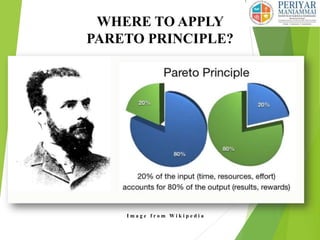
 Doing 20% of work generates advantage of 80% of entire job.
 In terms of quality improvement, large majority of problems
(80%) are created by a few key causes (20%).
I m a g e f r o m W i k i p e d i a
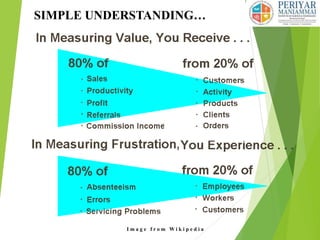
SIMPLE UNDERSTANDING…
I m a g e f r o m W i k i p e d i a
PARETO CHART
APPEARANCE
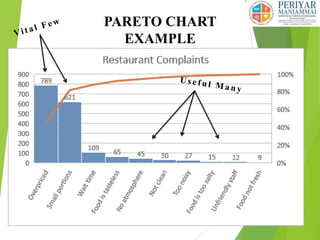
 A Pareto Chart is a series of bars whose heights reflect the
frequency or impact of problems.
 The bars are arranged in descending order of height from left to
right.
 Bars on left are relatively more important than the bars on the
right
 Separates the vital from the trivial
PARETO CHART
EXAMPLE
STEPS IN
CONSTRUCTION OF PARETO CHART
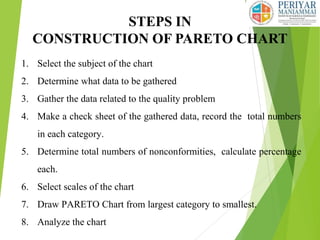
1. Select the subject of the chart
2. Determine what data to be gathered
3. Gather the data related to the quality problem
4. Make a check sheet of the gathered data, record the total numbers
in each category.
5. Determine total numbers of nonconformities, calculate percentage
each.
6. Select scales of the chart
7. Draw PARETO Chart from largest category to smallest.
8. Analyze the chart
PARETO PRINCIPLE
IN WORK-LIFE
1. Problem Solving
2. To-Do List of the day
3. Relationship
I m a g e f ro m Wi k i p e d i a
(i) PROBLEM SOLVING
 Pareto Analysis can really help in identifying the most critical
problem to solve as well as the level of criticality.
 Identify and list problems and their causes.
I m a g e f ro m Wi k i p e d i a
(ii) TO-DO LIST
 Estimate a value % in terms of goal achievement or satisfaction
against each of your tasks for the day – email, customer calls,
reports, specific tasks.
 What 20% of the tasks listed contribute to 80% of the goals you
seek to achieve?
 Concentrate on these tasks first in your most productive period of
the day.
I m a g e f ro m
Wi k i p e d i a
(iii) RELATIONSHIPS
 20% of the people you know give you 80% of your joy and
support.
 Observe your friends, office colleagues and social circle.
 Compare that to the amount of stress or joy you are getting in
return.
I m a g e f ro m Wi k i p e d i a
CASE STUDY
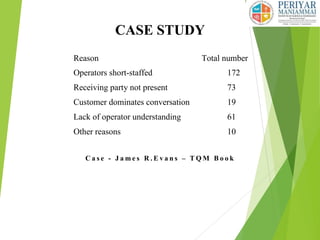
Reason Total number
Operators short-staffed 172
Receiving party not present 73
Customer dominates conversation 19
Lack of operator understanding 61
Other reasons 10
Discussion Questions
C a s e - J a m e s R . E v a n s – T Q M B o o k
CASE - ANALYSIS
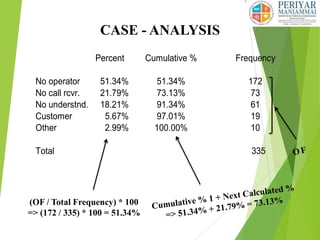
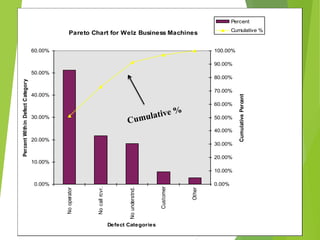
Percent Cumulative % Frequency
No operator 51.34% 51.34% 172
No call rcvr. 21.79% 73.13% 73
No understnd. 18.21% 91.34% 61
Customer 5.67% 97.01% 19
Other 2.99% 100.00% 10
Total 335
(OF / Total Frequency) * 100
=> (172 / 335) * 100 = 51.34%
(iii) RELATIONSHIPSPareto Chart for Welz Business Machines
0.00%
10.00%
20.00%
30.00%
40.00%
50.00%
60.00%
Nooperator
Nocallrcvr.
Nounderstnd.
Customer
Other
Defect Categories
PercentWithinDefectCategory
0.00%
10.00%
20.00%
30.00%
40.00%
50.00%
60.00%
70.00%
80.00%
90.00%
100.00%
CumulativePercent
Percent
Cumulative %
CONCLUSION
 Breaks a big problem down into smaller pieces
 Identifies the most significant factors
 Shows where to focus efforts & allows better use of limited
resources.
 Helps to separate the few major problems from the many possible
problems.
Q & A
San

San

  • 1.
    QUALITY MANAGEMENT Course Incharge,Mr.S.Dinu Raj.,Asst.Prof / MBA Presented By, Mr.R.Santosh.,MBA 2nd Year DEPARTMENT OF MANAGEMENT STUDIES Periyar Nagar, Vallam Thanjavur - 613 403, Tamil Nadu Phone: +91 - 4362 - 264600, Fax: +91- 4362 - 264660 Email: headmba@pmu.edu, Web: www. pmu.edu M A S T E R O F B U S I N E S S A D M I N I S T R A T I O N D A T E O F P R E S E N T A T I O N – 2 4 / 0 7 / 2 0 1 8 ------ PARETO DIAGRAM ------
  • 2.
    CONTENT 2  Seven basictools of quality  Introduction to Pareto Diagram  Pareto Principle  Where to apply Pareto Principle?  Pareto Diagram Appearance with Example  Steps in Construction of Pareto Diagram  Pareto Diagram in Work Life  Case Analysis  Conclusion
  • 3.
    SEVEN BASIC TOOLS OFQUALITY  The Seven Basic Tools of Quality is a designation given to a fixed set of graphical techniques identified as being most helpful in troubleshooting issues related to quality. 1. The Pareto charts 2. The Cause-and-Effect diagram 3. The Check Sheet 4. The Flow Chart 5. The Histogram 6. The Scatter Diagram 7. The Control Chart
  • 4.
    INTRODUCTION  Named afterItalian economist and sociologist Vilfredo Pareto (1848-1923) - an Italian economist. Was promoted by “Dr.Josep Juran”.  Pareto charts are useful for separating “Vital few means essential/important” from the “Trivial many means unimportant”.  Pareto charts are important because they can help an organization decide where to focus limited resources.  On a Pareto chart, data are arrayed along an X-axis and a Y-axis.
  • 5.
    INTRODUCTION  Setting prioritiesis one of the main management functions of an organization.  If the managers do not prioritize their tasks and organizational objectives, the organization will head towards the wrong direction and eventually collapse.  Therefore, management is required to prioritize their tasks and focus on the priority items that will have a high impact on the organization.
  • 6.
    PARETO PRINCIPLE  Pareto chartsare created based on the Pareto principle.  The principle suggests that when a number of factors affect a situation, fewer factors will be accountable for the most of the affect.  This is almost the same as 80/20 theory that you may have heard of.  It says that 80% of the impact is made by 20% of causes.
  • 7.
    WHERE TO APPLY PARETOPRINCIPLE?  Doing 20% of work generates advantage of 80% of entire job.  In terms of quality improvement, large majority of problems (80%) are created by a few key causes (20%). I m a g e f r o m W i k i p e d i a
  • 8.
    SIMPLE UNDERSTANDING… I ma g e f r o m W i k i p e d i a
  • 9.
    PARETO CHART APPEARANCE  APareto Chart is a series of bars whose heights reflect the frequency or impact of problems.  The bars are arranged in descending order of height from left to right.  Bars on left are relatively more important than the bars on the right  Separates the vital from the trivial
  • 10.
  • 11.
    STEPS IN CONSTRUCTION OFPARETO CHART 1. Select the subject of the chart 2. Determine what data to be gathered 3. Gather the data related to the quality problem 4. Make a check sheet of the gathered data, record the total numbers in each category. 5. Determine total numbers of nonconformities, calculate percentage each. 6. Select scales of the chart 7. Draw PARETO Chart from largest category to smallest. 8. Analyze the chart
  • 12.
    PARETO PRINCIPLE IN WORK-LIFE 1.Problem Solving 2. To-Do List of the day 3. Relationship I m a g e f ro m Wi k i p e d i a
  • 13.
    (i) PROBLEM SOLVING Pareto Analysis can really help in identifying the most critical problem to solve as well as the level of criticality.  Identify and list problems and their causes. I m a g e f ro m Wi k i p e d i a
  • 14.
    (ii) TO-DO LIST Estimate a value % in terms of goal achievement or satisfaction against each of your tasks for the day – email, customer calls, reports, specific tasks.  What 20% of the tasks listed contribute to 80% of the goals you seek to achieve?  Concentrate on these tasks first in your most productive period of the day. I m a g e f ro m Wi k i p e d i a
  • 15.
    (iii) RELATIONSHIPS  20%of the people you know give you 80% of your joy and support.  Observe your friends, office colleagues and social circle.  Compare that to the amount of stress or joy you are getting in return. I m a g e f ro m Wi k i p e d i a
  • 16.
    CASE STUDY Reason Totalnumber Operators short-staffed 172 Receiving party not present 73 Customer dominates conversation 19 Lack of operator understanding 61 Other reasons 10 Discussion Questions C a s e - J a m e s R . E v a n s – T Q M B o o k
  • 17.
    CASE - ANALYSIS PercentCumulative % Frequency No operator 51.34% 51.34% 172 No call rcvr. 21.79% 73.13% 73 No understnd. 18.21% 91.34% 61 Customer 5.67% 97.01% 19 Other 2.99% 100.00% 10 Total 335 (OF / Total Frequency) * 100 => (172 / 335) * 100 = 51.34%
  • 18.
    (iii) RELATIONSHIPSPareto Chartfor Welz Business Machines 0.00% 10.00% 20.00% 30.00% 40.00% 50.00% 60.00% Nooperator Nocallrcvr. Nounderstnd. Customer Other Defect Categories PercentWithinDefectCategory 0.00% 10.00% 20.00% 30.00% 40.00% 50.00% 60.00% 70.00% 80.00% 90.00% 100.00% CumulativePercent Percent Cumulative %
  • 19.
    CONCLUSION  Breaks abig problem down into smaller pieces  Identifies the most significant factors  Shows where to focus efforts & allows better use of limited resources.  Helps to separate the few major problems from the many possible problems.
  • 20.