LANDING GEAR FAILURE ANALYSIS
ENGR6441
Presented by:-
ROHIT KATARYA 6306160
HARPREET SINGH SHEKON 1707175
HASSAN ALSHAHRANI 4626524
SUBMITTED TO
DR. MAMADOU SY
ABSTRACT
o In this project we have done research on the possible failures
on the landing gear, and the overall structure and components
of the gear are analyzed.
 The materials used to construct gear components are of great
importance and are selected as per the properties. The main
eight components of landing gear are: locks, retraction
system, breaks, wheels, steering, struts and links.
 We discussed about the Ductile and Brittle Failure , Stress
Corrosion Cracking, Stress Rupture, Fatigue Cracking
Failure, Dynamic Failure, Landing gear spring failure and
Wheel failure.
INTRODUCTION
The objective of project is to investigate and analyze the
possible failures of different components and systems of the
landing gear with their consequences and solutions.
The assignment of project is to perform a detailed systematic
study of several types of internal defects which makes the
landing gear to fail.
In case of mechanical failures, there are 12 types of failures :
excessive deflection, thermal
shock, impact, creep, relaxation, brittle fracture, ductile
fracture, wear, spring failure, corrosion, stress corrosion
cracking, and various type of fatigue.
Materials are degraded by environmental corrosion
processes, and such processes can also be influenced by load in
the mechanisms of environmental stress cracking and stress
corrosion cracking
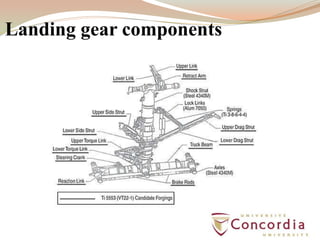
Landing gear components
Materials of landing gear
 The materials used for these components of landing gear are composed of
mainly high strength steels, titanium, aluminum and magnesium.
High strength steel
-High strength steel have high strength and stiffness.
-High strength to volume ratio is the main factor which makes it important
for the landing gear.
Titanium
-The titanium has high strength and low density used as for weight saving
-The main titanium alloy is Ti-5Al- 5V-5Mo-3Cr, which is used in the main
components of landing gear.
Aluminum
-Modern aircraft consists of approximately 70 % of aluminum alloys. It has
relatively low cost, light in weight, and can be heat treated to strength level
-Aluminum 7075 is used for the landing gear in helicopters because it is
strong, with a strength comparable to many steels, and has good fatigue
strength
Failure Mechanisms of Landing gear
 Fatigue Cracking Failure
 Usually aircrafts and military experience serious damages and the fatigue.
 Equations used for analyzing:
 (1)Paris equation:
da/dN=C(∆K)n
(2) Forman equation:
da/dN = C[(∆K)]n/[(1-R) Kcr-∆K]
(3)Walker Equation:
Effective Stress= (1-R) m x Maximum Stress
Stress Corrosion Cracking
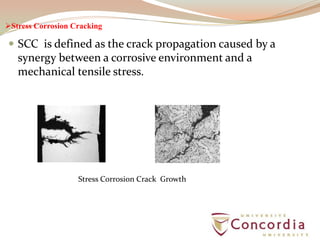
 SCC is defined as the crack propagation caused by a
synergy between a corrosive environment and a
mechanical tensile stress.
Stress Corrosion Crack Growth
Dynamic Failure
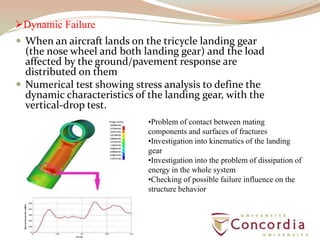
 When an aircraft lands on the tricycle landing gear
(the nose wheel and both landing gear) and the load
affected by the ground/pavement response are
distributed on them
 Numerical test showing stress analysis to define the
dynamic characteristics of the landing gear, with the
vertical-drop test.
•Problem of contact between mating
components and surfaces of fractures
•Investigation into kinematics of the landing
gear
•Investigation into the problem of dissipation of
energy in the whole system
•Checking of possible failure influence on the
structure behavior
. Landing gear spring failure
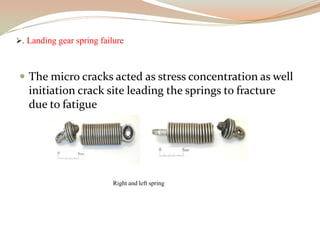
 The micro cracks acted as stress concentration as well
initiation crack site leading the springs to fracture
due to fatigue
Right and left spring
Wheel failure
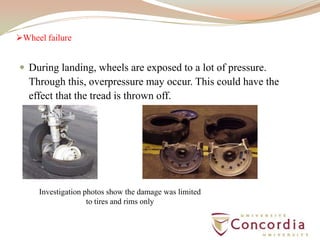
 During landing, wheels are exposed to a lot of pressure.
Through this, overpressure may occur. This could have the
effect that the tread is thrown off.
Investigation photos show the damage was limited
to tires and rims only
Safety, Testing improvement
Technique in Landing gear
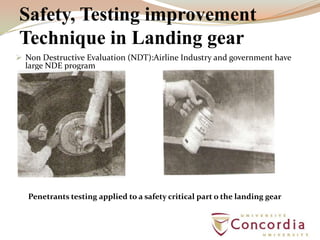
 Non Destructive Evaluation (NDT):Airline Industry and government have
large NDE program
Penetrants testing applied to a safety critical part o the landing gear
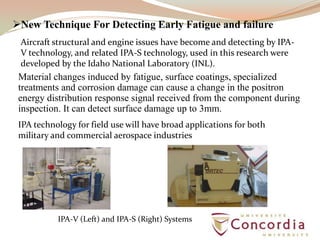
New Technique For Detecting Early Fatigue and failure
Material changes induced by fatigue, surface coatings, specialized
treatments and corrosion damage can cause a change in the positron
energy distribution response signal received from the component during
inspection. It can detect surface damage up to 3mm.
IPA technology for field use will have broad applications for both
military and commercial aerospace industries
Aircraft structural and engine issues have become and detecting by IPA-
V technology, and related IPA-S technology, used in this research were
developed by the Idaho National Laboratory (INL).
IPA-V (Left) and IPA-S (Right) Systems
Noise Reduction
 As engines become quieter, landing gear is now making a dominating
component of noise in large commercial aircraft.
 European co-financed research project Silencer is trying to create low noise
landing gear design.
 Desires 10db reduction in landing gear noise by 2020, has only dropped 3db
so far.
Gear up landing prevention system
 NTSB reports that the majority of gear up landings is due to equipment
malfunctions.
 Gear up landing prevention systems will disengage autopilot and alarm at a
preset safety altitude if every piece of landing gear is not extended and
locked.
 It can be disengaged if a belly landing is the only option.
 Composites
 Composites will be integrated into gear because they are stronger and
cheaper than the current used high strength steels and titanium.
Improvement In Landing Gear
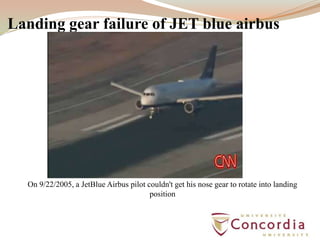
Landing gear failure of JET blue airbus
On 9/22/2005, a JetBlue Airbus pilot couldn't get his nose gear to rotate into landing
position
Testing of Airbus 380 Landing
gear in lab.
REFERENCES
 [1] http://www.seawindpilots.com/landing_gear.htm
 [2] http://www.tms.org/pubs/journals/JOM/1005/boyer-1005.html
 [3] http://www.bucanada.ca/blanking_hss.htm
 [4] http://www.materialsengineer.com/CA-Creep-Stress-Rupture.htm
 [5] F.C. Campbell: “Manufacturing Technology for Aerospace Structural
Materials,” First Edition, Elsevier ltd, Chapter 4, pg 125-168, 2006
 [6] http://en.wikipedia.org/wiki/7075_aluminium_alloy
 [7] http://www.substech.com/dokuwiki/doku.php?id=fracture_toughness
 [8] http://www.materialsengineer.com/CA-ductbrit.htm
 [9]http://www.sv.vt.edu/classes/MSE2094_NoteBook/97ClassProj/exper/b
allard/www/ballard.html
 [10] http://www.lambdatechs.com/publications/all-technical-papers.html
 [11] Handbook of Case Histories in Failure Analysis, Vol. 1 and 2, Esaklul Ed.
 [12] ASM Handbook, Vol.12, Fractography, ASM International, Materials
Park, 1992
 [13] Handbook of case histories in failure analysis, Volume 2By
KhlefaAlarbeEsaklul, ASM International, Page no. 13

 [14] Aviation safety investigations & reports, , Boeing B747-300 aircraft, JA 8184 at Sydney Aero.
Investigation Number:200502400.
[15]http://www.atsb.gov.au/publications/investigation_reports/2005/aair/aair200502400.aspx”
 [16] . V. Horak, “Advanced Landing Gear Fatigue Test Method,” in LMS conference Europe,
Prague, 23-26 march, 2006.
 [17]. W. Krason and J. Malachwoski, “Effort Analysis of the Landing Gear With Possible Flow During
Touchdown,” International Journal of mechanics, issue 1, volume 2, 2008.
 [18].FAR–23: Airworthiness Standards, Normal, Utility, Acrobatic and Commuter Category Airplanes,
1966.
 [19] .J.O. Hallquist, LS-Dyna. Theoretical manual. California Livermore Software Technology
Corporation, 2005.
 [20]ASM Handbook, Vol. 11, Failure Analysis and Prevention, ASM International, Materials Park,
1992
 [21] Currey, Norman S. Aircraft landing gear design : principles and practices American Institute of
Aeronautics and Astronautics, 1988
 [22]https://intra.techniek.hva.nl/AVI/0708/Jaar2/VLS5_21/Studiemateriaal/VLS_LandingGear.pdf
 [23] Moir, I., and Seabridge, A., Aircraft Systems: Mechanical, Electrical, and Avionics Subsystems
Integration, AIAA Education Series, AIAA, Reston, VA,2001.
 [24] Hoblit, F. M., Loads on Aircraft: Concepts and Applications, AIAA Education Series, AIAA,
Washington, DC, 1988.
 [25] http://www.mts.com/en/products/application/aerospace/components/landing-gear/index.htm
 [26] Shultz, Peter. and Lynn K. G., “Interaction of Positron Beams with Surfaces, Thin Films, and
Interfaces,” Reviewsof Modern Physics, Vol. 60, No. 3 July 1988
 [27] New Techniques for Detecting Early Fatigue Damage Accumulation in Aircraft Structural
Components, Curtis A. Ride out, Scott J. Ritchie, Positron Systems, Inc.,411 S. Fifth St., Boise, ID
83702”
 [28] BOEING’S SAFETY ASSESSMENT PROCESSES FOR COMMERCIAL.”Jeff Hasson
 Boeing Commercial Airplane Group:.” David CrottyScitor Corporation AIRPLANE DESIGNS
Thank you
Any Question??

Landing gear Failure analysis of an aircraft

  • 1.
    LANDING GEAR FAILUREANALYSIS ENGR6441 Presented by:- ROHIT KATARYA 6306160 HARPREET SINGH SHEKON 1707175 HASSAN ALSHAHRANI 4626524 SUBMITTED TO DR. MAMADOU SY
  • 2.
    ABSTRACT o In thisproject we have done research on the possible failures on the landing gear, and the overall structure and components of the gear are analyzed.  The materials used to construct gear components are of great importance and are selected as per the properties. The main eight components of landing gear are: locks, retraction system, breaks, wheels, steering, struts and links.  We discussed about the Ductile and Brittle Failure , Stress Corrosion Cracking, Stress Rupture, Fatigue Cracking Failure, Dynamic Failure, Landing gear spring failure and Wheel failure.
  • 3.
    INTRODUCTION The objective ofproject is to investigate and analyze the possible failures of different components and systems of the landing gear with their consequences and solutions. The assignment of project is to perform a detailed systematic study of several types of internal defects which makes the landing gear to fail. In case of mechanical failures, there are 12 types of failures : excessive deflection, thermal shock, impact, creep, relaxation, brittle fracture, ductile fracture, wear, spring failure, corrosion, stress corrosion cracking, and various type of fatigue. Materials are degraded by environmental corrosion processes, and such processes can also be influenced by load in the mechanisms of environmental stress cracking and stress corrosion cracking
  • 4.
  • 5.
    Materials of landinggear  The materials used for these components of landing gear are composed of mainly high strength steels, titanium, aluminum and magnesium. High strength steel -High strength steel have high strength and stiffness. -High strength to volume ratio is the main factor which makes it important for the landing gear. Titanium -The titanium has high strength and low density used as for weight saving -The main titanium alloy is Ti-5Al- 5V-5Mo-3Cr, which is used in the main components of landing gear. Aluminum -Modern aircraft consists of approximately 70 % of aluminum alloys. It has relatively low cost, light in weight, and can be heat treated to strength level -Aluminum 7075 is used for the landing gear in helicopters because it is strong, with a strength comparable to many steels, and has good fatigue strength
  • 6.
    Failure Mechanisms ofLanding gear  Fatigue Cracking Failure  Usually aircrafts and military experience serious damages and the fatigue.  Equations used for analyzing:  (1)Paris equation: da/dN=C(∆K)n (2) Forman equation: da/dN = C[(∆K)]n/[(1-R) Kcr-∆K] (3)Walker Equation: Effective Stress= (1-R) m x Maximum Stress
  • 7.
    Stress Corrosion Cracking SCC is defined as the crack propagation caused by a synergy between a corrosive environment and a mechanical tensile stress. Stress Corrosion Crack Growth
  • 8.
    Dynamic Failure  Whenan aircraft lands on the tricycle landing gear (the nose wheel and both landing gear) and the load affected by the ground/pavement response are distributed on them  Numerical test showing stress analysis to define the dynamic characteristics of the landing gear, with the vertical-drop test. •Problem of contact between mating components and surfaces of fractures •Investigation into kinematics of the landing gear •Investigation into the problem of dissipation of energy in the whole system •Checking of possible failure influence on the structure behavior
  • 9.
    . Landing gearspring failure  The micro cracks acted as stress concentration as well initiation crack site leading the springs to fracture due to fatigue Right and left spring
  • 10.
    Wheel failure  Duringlanding, wheels are exposed to a lot of pressure. Through this, overpressure may occur. This could have the effect that the tread is thrown off. Investigation photos show the damage was limited to tires and rims only
  • 11.
    Safety, Testing improvement Techniquein Landing gear  Non Destructive Evaluation (NDT):Airline Industry and government have large NDE program Penetrants testing applied to a safety critical part o the landing gear
  • 12.
    New Technique ForDetecting Early Fatigue and failure Material changes induced by fatigue, surface coatings, specialized treatments and corrosion damage can cause a change in the positron energy distribution response signal received from the component during inspection. It can detect surface damage up to 3mm. IPA technology for field use will have broad applications for both military and commercial aerospace industries Aircraft structural and engine issues have become and detecting by IPA- V technology, and related IPA-S technology, used in this research were developed by the Idaho National Laboratory (INL). IPA-V (Left) and IPA-S (Right) Systems
  • 13.
    Noise Reduction  Asengines become quieter, landing gear is now making a dominating component of noise in large commercial aircraft.  European co-financed research project Silencer is trying to create low noise landing gear design.  Desires 10db reduction in landing gear noise by 2020, has only dropped 3db so far. Gear up landing prevention system  NTSB reports that the majority of gear up landings is due to equipment malfunctions.  Gear up landing prevention systems will disengage autopilot and alarm at a preset safety altitude if every piece of landing gear is not extended and locked.  It can be disengaged if a belly landing is the only option.  Composites  Composites will be integrated into gear because they are stronger and cheaper than the current used high strength steels and titanium. Improvement In Landing Gear
  • 14.
    Landing gear failureof JET blue airbus On 9/22/2005, a JetBlue Airbus pilot couldn't get his nose gear to rotate into landing position
  • 15.
    Testing of Airbus380 Landing gear in lab.
  • 16.
    REFERENCES  [1] http://www.seawindpilots.com/landing_gear.htm [2] http://www.tms.org/pubs/journals/JOM/1005/boyer-1005.html  [3] http://www.bucanada.ca/blanking_hss.htm  [4] http://www.materialsengineer.com/CA-Creep-Stress-Rupture.htm  [5] F.C. Campbell: “Manufacturing Technology for Aerospace Structural Materials,” First Edition, Elsevier ltd, Chapter 4, pg 125-168, 2006  [6] http://en.wikipedia.org/wiki/7075_aluminium_alloy  [7] http://www.substech.com/dokuwiki/doku.php?id=fracture_toughness  [8] http://www.materialsengineer.com/CA-ductbrit.htm  [9]http://www.sv.vt.edu/classes/MSE2094_NoteBook/97ClassProj/exper/b allard/www/ballard.html  [10] http://www.lambdatechs.com/publications/all-technical-papers.html  [11] Handbook of Case Histories in Failure Analysis, Vol. 1 and 2, Esaklul Ed.  [12] ASM Handbook, Vol.12, Fractography, ASM International, Materials Park, 1992  [13] Handbook of case histories in failure analysis, Volume 2By KhlefaAlarbeEsaklul, ASM International, Page no. 13 
  • 17.
     [14] Aviationsafety investigations & reports, , Boeing B747-300 aircraft, JA 8184 at Sydney Aero. Investigation Number:200502400. [15]http://www.atsb.gov.au/publications/investigation_reports/2005/aair/aair200502400.aspx”  [16] . V. Horak, “Advanced Landing Gear Fatigue Test Method,” in LMS conference Europe, Prague, 23-26 march, 2006.  [17]. W. Krason and J. Malachwoski, “Effort Analysis of the Landing Gear With Possible Flow During Touchdown,” International Journal of mechanics, issue 1, volume 2, 2008.  [18].FAR–23: Airworthiness Standards, Normal, Utility, Acrobatic and Commuter Category Airplanes, 1966.  [19] .J.O. Hallquist, LS-Dyna. Theoretical manual. California Livermore Software Technology Corporation, 2005.  [20]ASM Handbook, Vol. 11, Failure Analysis and Prevention, ASM International, Materials Park, 1992  [21] Currey, Norman S. Aircraft landing gear design : principles and practices American Institute of Aeronautics and Astronautics, 1988  [22]https://intra.techniek.hva.nl/AVI/0708/Jaar2/VLS5_21/Studiemateriaal/VLS_LandingGear.pdf  [23] Moir, I., and Seabridge, A., Aircraft Systems: Mechanical, Electrical, and Avionics Subsystems Integration, AIAA Education Series, AIAA, Reston, VA,2001.  [24] Hoblit, F. M., Loads on Aircraft: Concepts and Applications, AIAA Education Series, AIAA, Washington, DC, 1988.  [25] http://www.mts.com/en/products/application/aerospace/components/landing-gear/index.htm  [26] Shultz, Peter. and Lynn K. G., “Interaction of Positron Beams with Surfaces, Thin Films, and Interfaces,” Reviewsof Modern Physics, Vol. 60, No. 3 July 1988  [27] New Techniques for Detecting Early Fatigue Damage Accumulation in Aircraft Structural Components, Curtis A. Ride out, Scott J. Ritchie, Positron Systems, Inc.,411 S. Fifth St., Boise, ID 83702”  [28] BOEING’S SAFETY ASSESSMENT PROCESSES FOR COMMERCIAL.”Jeff Hasson  Boeing Commercial Airplane Group:.” David CrottyScitor Corporation AIRPLANE DESIGNS
  • 18.