Parallel Computing
Mohamed Zahran (aka Z)
mzahran@cs.nyu.edu
http://www.mzahran.com
CSCI-UA.0480-003
Lecture 4: Parallel Software: Basics
The burden is on software
• From now on…
– In shared memory programs:
• Start a single process and fork threads.
• Threads carry out tasks.
– In distributed memory programs:
• Start multiple processes.
• Processes carry out tasks.
SPMD – single program multiple data
• A SPMD programs consists of a single
executable forked into different
processes/threads, that can behave as
if it were multiple different programs
through the use of conditional branches.
if (I’m thread/process i)
do this;
else
do that;
Writing Parallel Programs
double x[n], y[n];
…
for (i = 0; i < n; i++)
x[i] += y[i];
1. Divide the work among the
processes/threads
(a) so each process/thread
gets roughly the same
amount of work
(b) and communication is
minimized.
2. Arrange for the processes/threads to synchronize
if needed.
3. Arrange for communication among processes/threads.
Shared Memory Systems
Shared Memory
• Dynamic threads: Master thread waits
for work, forks new threads, and when
threads are done, they terminate
+ Efficient use of resources
- thread creation and termination is time
consuming
• Static threads: Pool of threads created
and are allocated work, but do not
terminate until cleanup.
+ Better performance
- potential waste of system resources
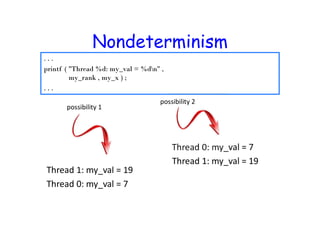
Nondeterminism
. . .
printf ( "Thread %d: my_val = %dn" ,
my_rank , my_x ) ;
. . .
Thread 0: my_val = 7
Thread 1: my_val = 19
Thread 0: my_val = 7
possibility 1
possibility 2
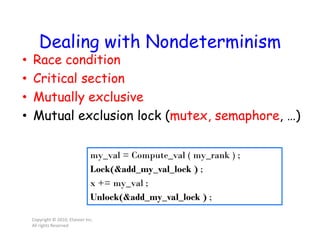
Dealing with Nondeterminism
• Race condition
• Critical section
• Mutually exclusive
• Mutual exclusion lock (mutex, semaphore, …)
Copyright © 2010, Elsevier Inc.
All rights Reserved
my_val = Compute_val ( my_rank ) ;
Lock(&add_my_val_lock ) ;
x += my_val ;
Unlock(&add_my_val_lock ) ;
Important!!
What is the relationship between cache
coherence and nondeterminism?
Isn’t cache coherence enough
to ensure determinism?
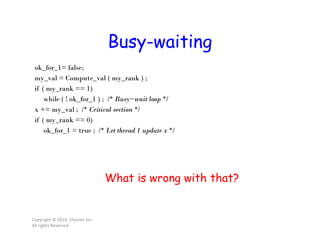
Busy-waiting
Copyright © 2010, Elsevier Inc.
All rights Reserved
ok_for_1= false;
my_val = Compute_val ( my_rank ) ;
if ( my_rank == 1)
while ( ! ok_for_1 ) ; /* Busy−wait loop */
x += my_val ; /* Critical section */
if ( my_rank == 0)
ok_for_1 = true ; /* Let thread 1 update x */
What is wrong with that?
Distributed Memory Systems
Distributed Memory:
message-passing
Copyright © 2010, Elsevier Inc.
All rights Reserved
char message [100] ;
. . .
my_rank = Get_rank();
i f ( my_rank == 1) {
sprintf ( message , "Greetings from process 1" ) ;
Send ( message , MSG_CHAR , 100 , 0 ) ; // send a msg of 100 char to process 0
} else if ( my_rank == 0) {
Receive ( message , MSG_CHAR , 100 , 1 ) ;
printf ( "Process 0 > Received: %sn" , message ) ;
}
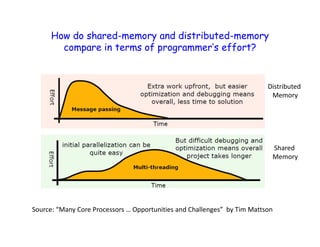
Distributed
Memory
Shared
Memory
Source: “Many Core Processors … Opportunities and Challenges” by Tim Mattson
How do shared-memory and distributed-memory
compare in terms of programmer’s effort?
We want to write a parallel
program … Now what?
• We have a serial program.
– How to parallelize it?
• We know that we need to divide work,
ensure load balancing, manage
synchronization, and reduce
communication!  Nice! How to do that?
• Unfortunately: there is no mechanical
process.
• Ian Foster has some nice framework.
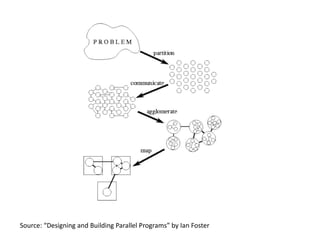
Foster’s methodology
(The PCAM Methodology)
1. Partitioning: divide the computation to
be performed and the data operated on
by the computation into small tasks.
The focus here should be on
identifying tasks that can be executed
in parallel.
This step brings out the parallelism in
the algorithm
Copyright © 2010, Elsevier Inc.
All rights Reserved
2. Communication: determine what
communication needs to be carried out
among the tasks identified in the
previous step.
Copyright © 2010, Elsevier Inc.
All rights Reserved
Foster’s methodology
(The PCAM Methodology)
3. Agglomeration or aggregation: combine
tasks and communications identified in
the first step into larger tasks.
For example, if task A must be
executed before task B can be
executed, it may make sense to
aggregate them into a single composite
task.
Copyright © 2010, Elsevier Inc.
All rights Reserved
Foster’s methodology
(The PCAM Methodology)
4. Mapping: assign the composite tasks
identified in the previous step to
processes/threads.
This should be done so that
communication is minimized, and each
process/thread gets roughly the same
amount of work.
Copyright © 2010, Elsevier Inc.
All rights Reserved
Foster’s methodology
(The PCAM Methodology)
Source: “Designing and Building Parallel Programs” by Ian Foster
When you partition your problem:
A checklist
• Does your partition define at least an order of magnitude more tasks
than there are processors in your target computer? If not, you have
little flexibility in subsequent design stages.
• Does your partition avoid redundant computation and storage
requirements? If not, the resulting algorithm may not be scalable to
deal with large problems.
• Are tasks of comparable size? If not, you may face load balancing
issues later.
• Does the number of tasks scale with problem size? Ideally, an increase
in problem size should increase the number of tasks rather than the
size of individual tasks.
• Have you identified several alternative partitions?
Example - histogram
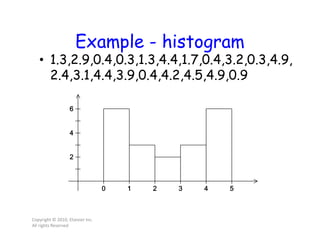
• 1.3,2.9,0.4,0.3,1.3,4.4,1.7,0.4,3.2,0.3,4.9,
2.4,3.1,4.4,3.9,0.4,4.2,4.5,4.9,0.9
Copyright © 2010, Elsevier Inc.
All rights Reserved
Serial program - input
1. The number of measurements: data_count
2. An array of data_count floats: data
3. The minimum value for the bin containing
the smallest values: min_meas
4. The maximum value for the bin containing
the largest values: max_meas
5. The number of bins: bin_count
Copyright © 2010, Elsevier Inc.
All rights Reserved
• Data[0] = 1.3
• Data[1] = 2.9
• Data[2] = 0.4
• Data[3] = 0.3
• Data[4] = 1.3
• Data[5] = 4.4
• Data[6] = 1.7
• Data[7] = 0.4
• Data[8] = 3.2
• Data[9] = 0.3
• Data[10] = 4.9
• Data[11] = 2.4
• Data[12] = 3.1
• Data[13] = 4.4
• Data[14] = 3.9,
• Data[15] = 0.4
• Data[16] = 4.2
• Data[17] = 4.5
• Data[18] = 4.9
• Data[19] = 0.9
data_count = 20
• Data[0] = 1.3
• Data[1] = 2.9
• Data[2] = 0.4
• Data[3] = 0.3
• Data[4] = 1.3
• Data[5] = 4.4
• Data[6] = 1.7
• Data[7] = 0.4
• Data[8] = 3.2
• Data[9] = 0.3
• Data[10] = 4.9
• Data[11] = 2.4
• Data[12] = 3.1
• Data[13] = 4.4
• Data[14] = 3.9,
• Data[15] = 0.4
• Data[16] = 4.2
• Data[17] = 4.5
• Data[18] = 4.9
• Data[19] = 0.9
data_count = 20
min_meas = 0.3
max_meas = 4.9
bin_count = 5
Serial program - output
1. bin_maxes : an array of bin_count
floats  store the upper bound of
each bin
2. bin_counts : an array of bin_count ints
 stores the number of elements in
each bin
Copyright © 2010, Elsevier Inc.
All rights Reserved
• Data[0] = 1.3
• Data[1] = 2.9
• Data[2] = 0.4
• Data[3] = 0.3
• Data[4] = 1.3
• Data[5] = 4.4
• Data[6] = 1.7
• Data[7] = 0.4
• Data[8] = 3.2
• Data[9] = 0.3
• Data[10] = 4.9
• Data[11] = 2.4
• Data[12] = 3.1
• Data[13] = 4.4
• Data[14] = 3.9,
• Data[15] = 0.4
• Data[16] = 4.2
• Data[17] = 4.5
• Data[18] = 4.9
• Data[19] = 0.9
bin_maxes[0] = 0.9
bin_maxes[1] = 1.7
bin_maxes[2] = 2.9
bin_maxes[3] = 3.9
bin_maxes[4] = 4.9
bin_counts[0] = 6
bin_counts[1] = 3
bin_counts[2] = 2
bin_counts[3] = 3
bin_counts[4] = 6
Serial Program
int bin = 0;
for( i = 0; i < data_count; i++){
bin = find_bin(data[i], …);
bin_counts[bin]++;
}
First two stages of Foster’s
Methodology
Copyright © 2010, Elsevier Inc.
All rights Reserved
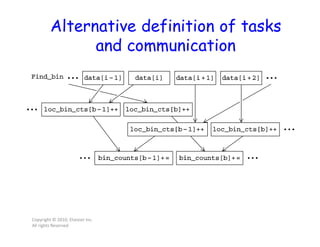
Find_bin returns the bin that data[i] belongs to.
Alternative definition of tasks
and communication
Copyright © 2010, Elsevier Inc.
All rights Reserved
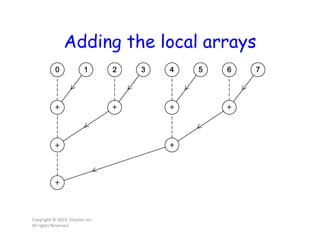
Adding the local arrays
Copyright © 2010, Elsevier Inc.
All rights Reserved
Conclusions
• Parallel software
– We focus on software for homogeneous MIMD
systems, consisting of a single program that
obtains parallelism by branching.
– Later we will look at GPUs
• Parallel Program Design
– Partition
– Determine communication
– Aggregate (if needed)
– Map
Powered by TCPDF (www.tcpdf.org)Powered by TCPDF (www.tcpdf.org)

Parallel Computing - Lec 4

  • 1.
    Parallel Computing Mohamed Zahran(aka Z) mzahran@cs.nyu.edu http://www.mzahran.com CSCI-UA.0480-003 Lecture 4: Parallel Software: Basics
  • 2.
    The burden ison software • From now on… – In shared memory programs: • Start a single process and fork threads. • Threads carry out tasks. – In distributed memory programs: • Start multiple processes. • Processes carry out tasks.
  • 3.
    SPMD – singleprogram multiple data • A SPMD programs consists of a single executable forked into different processes/threads, that can behave as if it were multiple different programs through the use of conditional branches. if (I’m thread/process i) do this; else do that;
  • 4.
    Writing Parallel Programs doublex[n], y[n]; … for (i = 0; i < n; i++) x[i] += y[i]; 1. Divide the work among the processes/threads (a) so each process/thread gets roughly the same amount of work (b) and communication is minimized. 2. Arrange for the processes/threads to synchronize if needed. 3. Arrange for communication among processes/threads.
  • 5.
  • 6.
    Shared Memory • Dynamicthreads: Master thread waits for work, forks new threads, and when threads are done, they terminate + Efficient use of resources - thread creation and termination is time consuming • Static threads: Pool of threads created and are allocated work, but do not terminate until cleanup. + Better performance - potential waste of system resources
  • 7.
    Nondeterminism . . . printf( "Thread %d: my_val = %dn" , my_rank , my_x ) ; . . . Thread 0: my_val = 7 Thread 1: my_val = 19 Thread 1: my_val = 19 Thread 0: my_val = 7 possibility 1 possibility 2
  • 8.
    Dealing with Nondeterminism •Race condition • Critical section • Mutually exclusive • Mutual exclusion lock (mutex, semaphore, …) Copyright © 2010, Elsevier Inc. All rights Reserved my_val = Compute_val ( my_rank ) ; Lock(&add_my_val_lock ) ; x += my_val ; Unlock(&add_my_val_lock ) ;
  • 9.
    Important!! What is therelationship between cache coherence and nondeterminism? Isn’t cache coherence enough to ensure determinism?
  • 10.
    Busy-waiting Copyright © 2010,Elsevier Inc. All rights Reserved ok_for_1= false; my_val = Compute_val ( my_rank ) ; if ( my_rank == 1) while ( ! ok_for_1 ) ; /* Busy−wait loop */ x += my_val ; /* Critical section */ if ( my_rank == 0) ok_for_1 = true ; /* Let thread 1 update x */ What is wrong with that?
  • 11.
  • 12.
    Distributed Memory: message-passing Copyright ©2010, Elsevier Inc. All rights Reserved char message [100] ; . . . my_rank = Get_rank(); i f ( my_rank == 1) { sprintf ( message , "Greetings from process 1" ) ; Send ( message , MSG_CHAR , 100 , 0 ) ; // send a msg of 100 char to process 0 } else if ( my_rank == 0) { Receive ( message , MSG_CHAR , 100 , 1 ) ; printf ( "Process 0 > Received: %sn" , message ) ; }
  • 13.
    Distributed Memory Shared Memory Source: “Many CoreProcessors … Opportunities and Challenges” by Tim Mattson How do shared-memory and distributed-memory compare in terms of programmer’s effort?
  • 14.
    We want towrite a parallel program … Now what? • We have a serial program. – How to parallelize it? • We know that we need to divide work, ensure load balancing, manage synchronization, and reduce communication!  Nice! How to do that? • Unfortunately: there is no mechanical process. • Ian Foster has some nice framework.
  • 15.
    Foster’s methodology (The PCAMMethodology) 1. Partitioning: divide the computation to be performed and the data operated on by the computation into small tasks. The focus here should be on identifying tasks that can be executed in parallel. This step brings out the parallelism in the algorithm Copyright © 2010, Elsevier Inc. All rights Reserved
  • 16.
    2. Communication: determinewhat communication needs to be carried out among the tasks identified in the previous step. Copyright © 2010, Elsevier Inc. All rights Reserved Foster’s methodology (The PCAM Methodology)
  • 17.
    3. Agglomeration oraggregation: combine tasks and communications identified in the first step into larger tasks. For example, if task A must be executed before task B can be executed, it may make sense to aggregate them into a single composite task. Copyright © 2010, Elsevier Inc. All rights Reserved Foster’s methodology (The PCAM Methodology)
  • 18.
    4. Mapping: assignthe composite tasks identified in the previous step to processes/threads. This should be done so that communication is minimized, and each process/thread gets roughly the same amount of work. Copyright © 2010, Elsevier Inc. All rights Reserved Foster’s methodology (The PCAM Methodology)
  • 19.
    Source: “Designing andBuilding Parallel Programs” by Ian Foster
  • 20.
    When you partitionyour problem: A checklist • Does your partition define at least an order of magnitude more tasks than there are processors in your target computer? If not, you have little flexibility in subsequent design stages. • Does your partition avoid redundant computation and storage requirements? If not, the resulting algorithm may not be scalable to deal with large problems. • Are tasks of comparable size? If not, you may face load balancing issues later. • Does the number of tasks scale with problem size? Ideally, an increase in problem size should increase the number of tasks rather than the size of individual tasks. • Have you identified several alternative partitions?
  • 21.
    Example - histogram •1.3,2.9,0.4,0.3,1.3,4.4,1.7,0.4,3.2,0.3,4.9, 2.4,3.1,4.4,3.9,0.4,4.2,4.5,4.9,0.9 Copyright © 2010, Elsevier Inc. All rights Reserved
  • 22.
    Serial program -input 1. The number of measurements: data_count 2. An array of data_count floats: data 3. The minimum value for the bin containing the smallest values: min_meas 4. The maximum value for the bin containing the largest values: max_meas 5. The number of bins: bin_count Copyright © 2010, Elsevier Inc. All rights Reserved
  • 23.
    • Data[0] =1.3 • Data[1] = 2.9 • Data[2] = 0.4 • Data[3] = 0.3 • Data[4] = 1.3 • Data[5] = 4.4 • Data[6] = 1.7 • Data[7] = 0.4 • Data[8] = 3.2 • Data[9] = 0.3 • Data[10] = 4.9 • Data[11] = 2.4 • Data[12] = 3.1 • Data[13] = 4.4 • Data[14] = 3.9, • Data[15] = 0.4 • Data[16] = 4.2 • Data[17] = 4.5 • Data[18] = 4.9 • Data[19] = 0.9 data_count = 20
  • 24.
    • Data[0] =1.3 • Data[1] = 2.9 • Data[2] = 0.4 • Data[3] = 0.3 • Data[4] = 1.3 • Data[5] = 4.4 • Data[6] = 1.7 • Data[7] = 0.4 • Data[8] = 3.2 • Data[9] = 0.3 • Data[10] = 4.9 • Data[11] = 2.4 • Data[12] = 3.1 • Data[13] = 4.4 • Data[14] = 3.9, • Data[15] = 0.4 • Data[16] = 4.2 • Data[17] = 4.5 • Data[18] = 4.9 • Data[19] = 0.9 data_count = 20 min_meas = 0.3 max_meas = 4.9 bin_count = 5
  • 25.
    Serial program -output 1. bin_maxes : an array of bin_count floats  store the upper bound of each bin 2. bin_counts : an array of bin_count ints  stores the number of elements in each bin Copyright © 2010, Elsevier Inc. All rights Reserved
  • 26.
    • Data[0] =1.3 • Data[1] = 2.9 • Data[2] = 0.4 • Data[3] = 0.3 • Data[4] = 1.3 • Data[5] = 4.4 • Data[6] = 1.7 • Data[7] = 0.4 • Data[8] = 3.2 • Data[9] = 0.3 • Data[10] = 4.9 • Data[11] = 2.4 • Data[12] = 3.1 • Data[13] = 4.4 • Data[14] = 3.9, • Data[15] = 0.4 • Data[16] = 4.2 • Data[17] = 4.5 • Data[18] = 4.9 • Data[19] = 0.9 bin_maxes[0] = 0.9 bin_maxes[1] = 1.7 bin_maxes[2] = 2.9 bin_maxes[3] = 3.9 bin_maxes[4] = 4.9 bin_counts[0] = 6 bin_counts[1] = 3 bin_counts[2] = 2 bin_counts[3] = 3 bin_counts[4] = 6
  • 27.
    Serial Program int bin= 0; for( i = 0; i < data_count; i++){ bin = find_bin(data[i], …); bin_counts[bin]++; }
  • 28.
    First two stagesof Foster’s Methodology Copyright © 2010, Elsevier Inc. All rights Reserved Find_bin returns the bin that data[i] belongs to.
  • 29.
    Alternative definition oftasks and communication Copyright © 2010, Elsevier Inc. All rights Reserved
  • 30.
    Adding the localarrays Copyright © 2010, Elsevier Inc. All rights Reserved
  • 31.
    Conclusions • Parallel software –We focus on software for homogeneous MIMD systems, consisting of a single program that obtains parallelism by branching. – Later we will look at GPUs • Parallel Program Design – Partition – Determine communication – Aggregate (if needed) – Map Powered by TCPDF (www.tcpdf.org)Powered by TCPDF (www.tcpdf.org)