Interpreting machine
learning models
or how to turn a random forest into a white box
Ando Saabas
About me
• Senior applied scientist at Microsoft,
• Using ML and statistics to improve call quality in Skype
• Various projects on user engagement modelling, Skype user graph analysis,
call reliability modelling, traffic shaping detection
• Blogging on data science and ML @ http://blog.datadive.net/
Machine learning and model interpretation
• Machine learning studies algorithms that learn from data and make
predictions
• Learning algorithms are about correlations in the data
• In contrast, in data science and data mining, understanding causality
is essential
• Applying domain knowledge requires understanding and interpreting
models
Usefulness of model interpretation
• Often, we need to understand individual predictions a model is
making.
For example a model may
• Recommend a treatment for a patient or estimate a disease to be
likely. The doctor needs to understand the reasoning.
• Classify a user as a scammer, but the user disputes it. The fraud
analyst needs to understand why the model made the classification.
• Predict that a video call will be graded poorly by the user. The
engineer needs to understand why this type of call was considered
problematic.
Usefulness of model interpretation cont.
• Understanding differences on a dataset level.
• Why is a new software release receiving poorer feedback from customers
when compared to the previous one?
• Why are grain yields in one region higher than the other?
• Debugging models. A model that worked earlier is giving unexpected
results on newer data.
Algorithmic transparency
• Algorithmic transparency becoming a requirement in many fields
• French Conseil d’Etat (State Council’s) recommendation in „Digital
technology and fundamental rights“(2014) : Impose to algorithm-
based decisions a transparency requirement, on personal data used
by the algorithm, and the general reasoning it followed.
• Federal Trade Commission (FTC) Chair Edith Ramirez: The agency is
concerned about ‘algorithmic transparency /../’ (Oct 2015).
FTC Office of Technology Research and Investigation started in March
2015 to tackle algorithmic transparency among other issues
Interpretable models
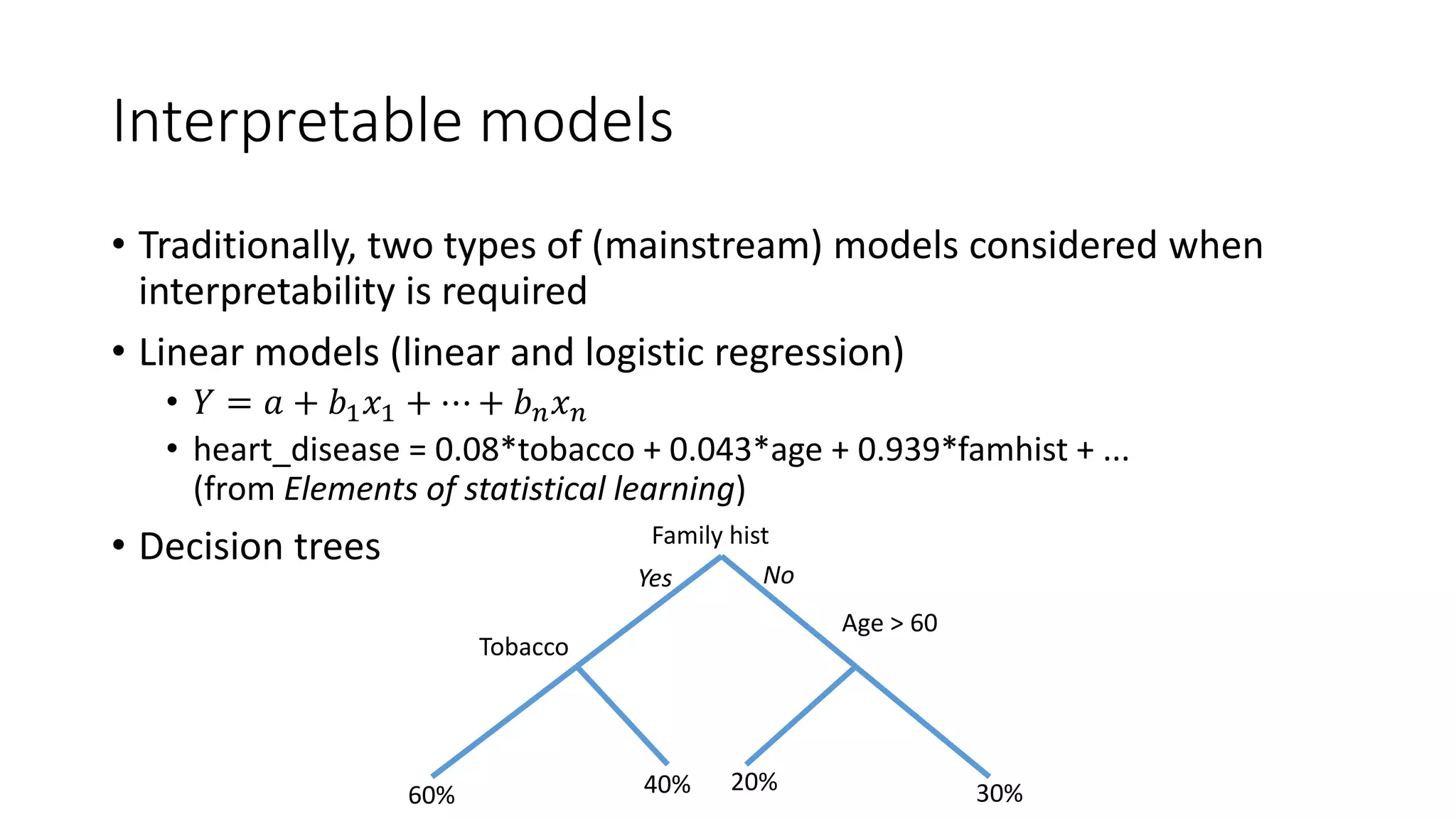
• Traditionally, two types of (mainstream) models considered when
interpretability is required
• Linear models (linear and logistic regression)
• 𝑌 = 𝑎 + 𝑏1 𝑥1 + ⋯ + 𝑏 𝑛 𝑥 𝑛
• heart_disease = 0.08*tobacco + 0.043*age + 0.939*famhist + ...
(from Elements of statistical learning)
• Decision trees Family hist
Tobacco
Age > 60
Yes No
60% 20%40% 30%
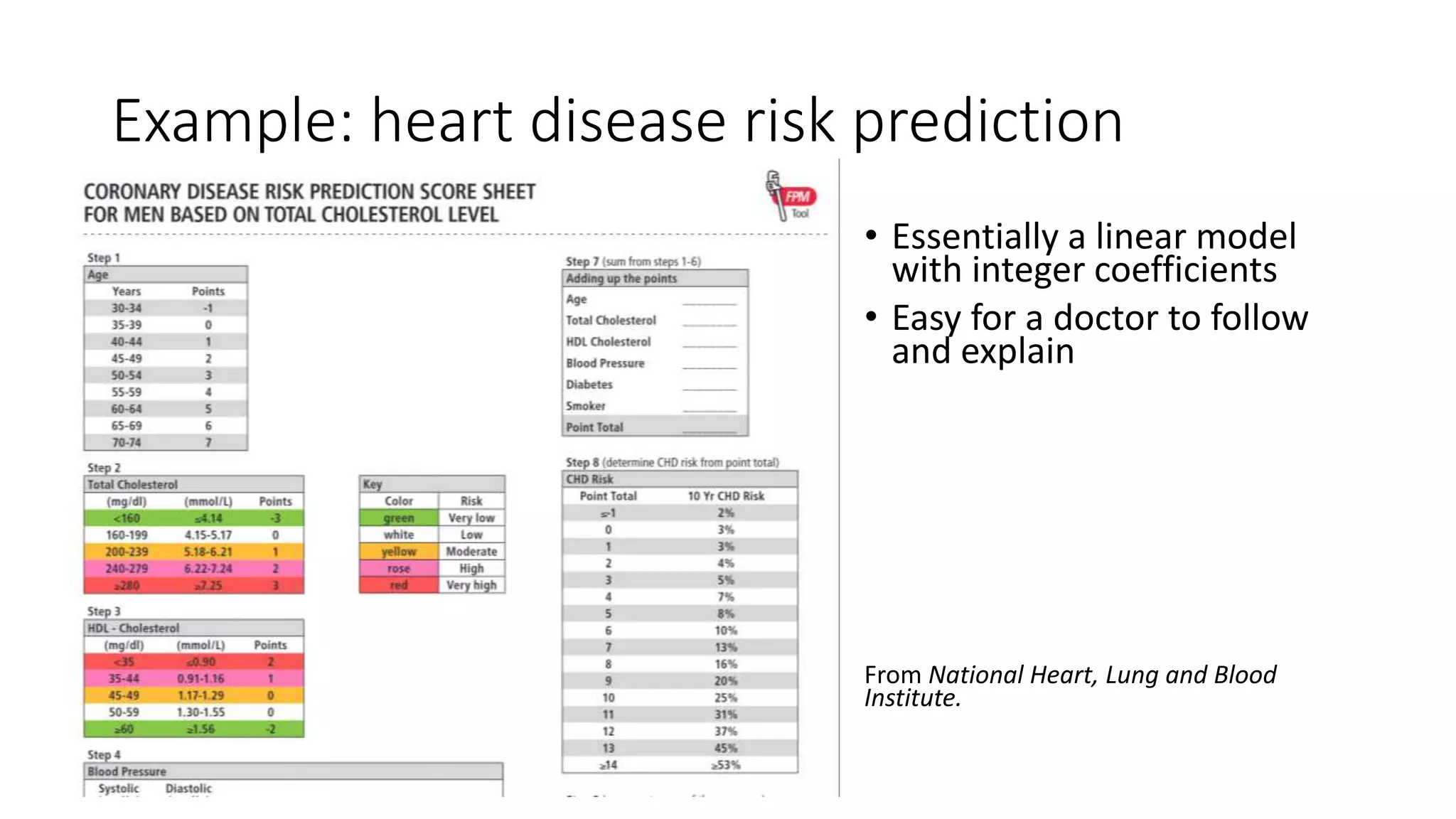
Example: heart disease risk prediction
• Essentially a linear model
with integer coefficients
• Easy for a doctor to follow
and explain
From National Heart, Lung and Blood
Institute.
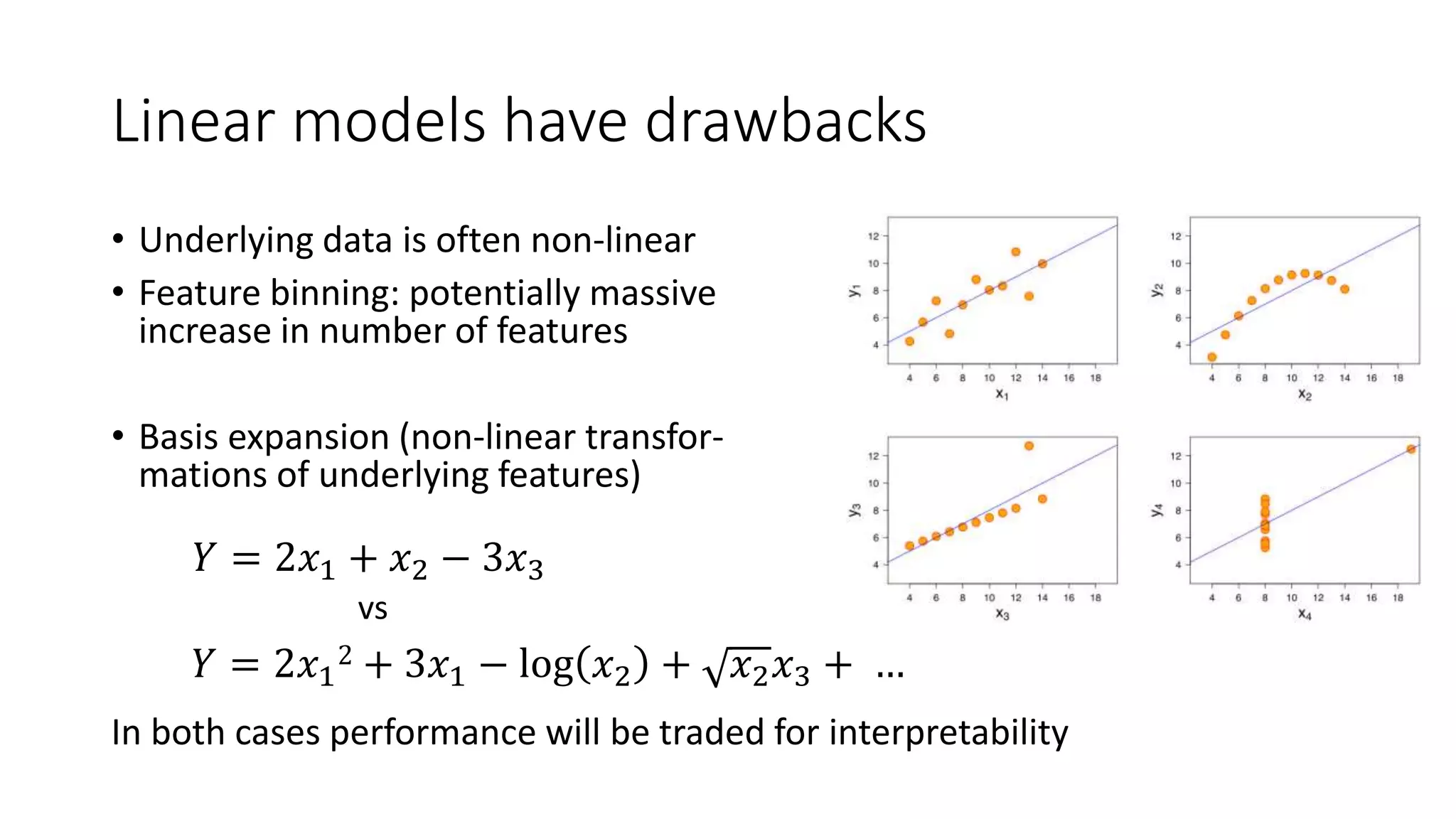
Linear models have drawbacks
• Underlying data is often non-linear
• Feature binning: potentially massive
increase in number of features
• Basis expansion (non-linear transfor-
mations of underlying features)
In both cases performance will be traded for interpretability
𝑌 = 2𝑥1 + 𝑥2 − 3𝑥3
𝑌 = 2𝑥1
2 + 3𝑥1 − log 𝑥2 + 𝑥2 𝑥3 + …
vs
Decision trees
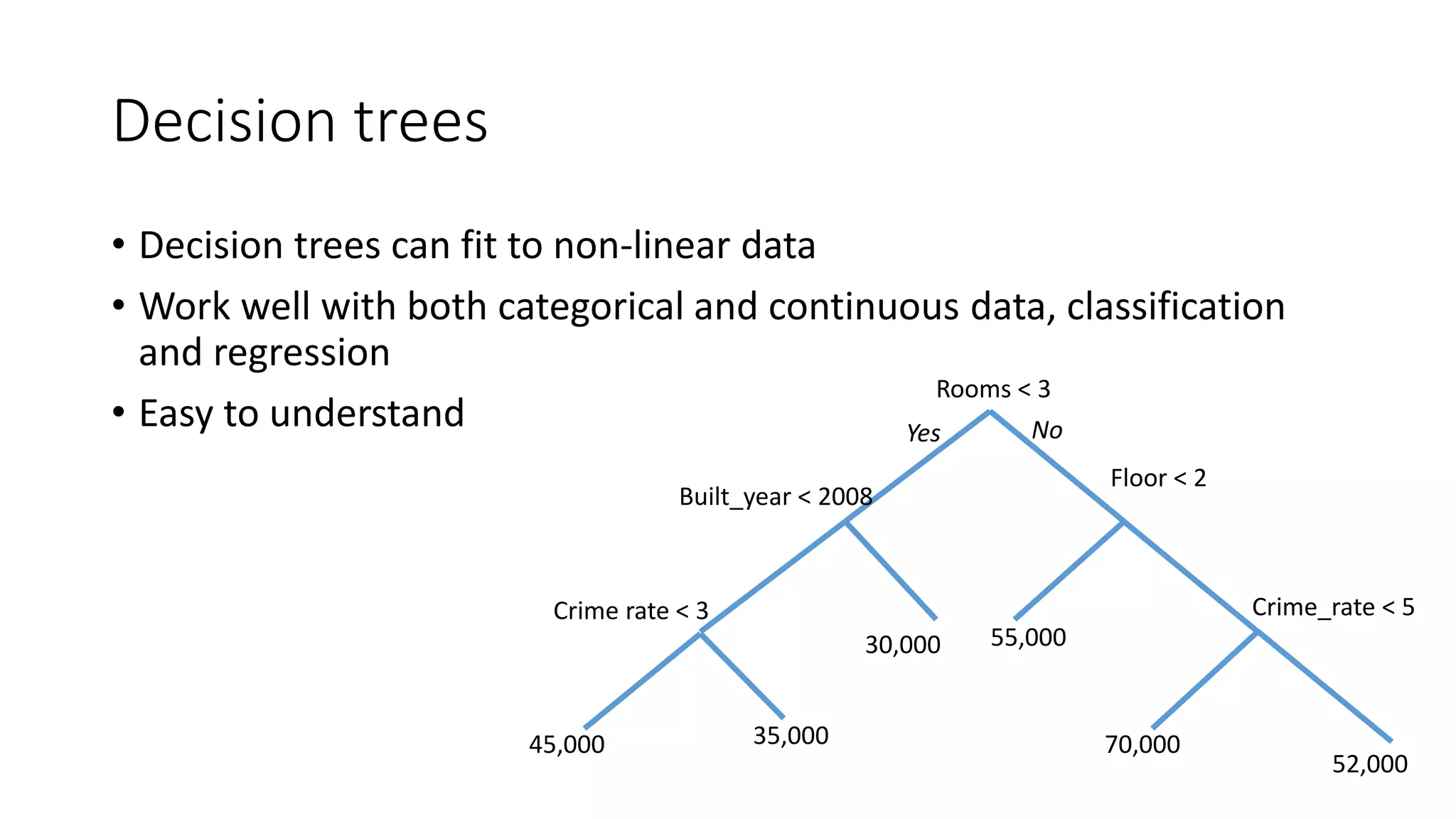
• Decision trees can fit to non-linear data
• Work well with both categorical and continuous data, classification
and regression
• Easy to understand
Rooms < 3
Built_year < 2008
Crime rate < 3
35,00045,000
Floor < 2
55,00030,000
70,000
52,000
Crime_rate < 5
Yes No
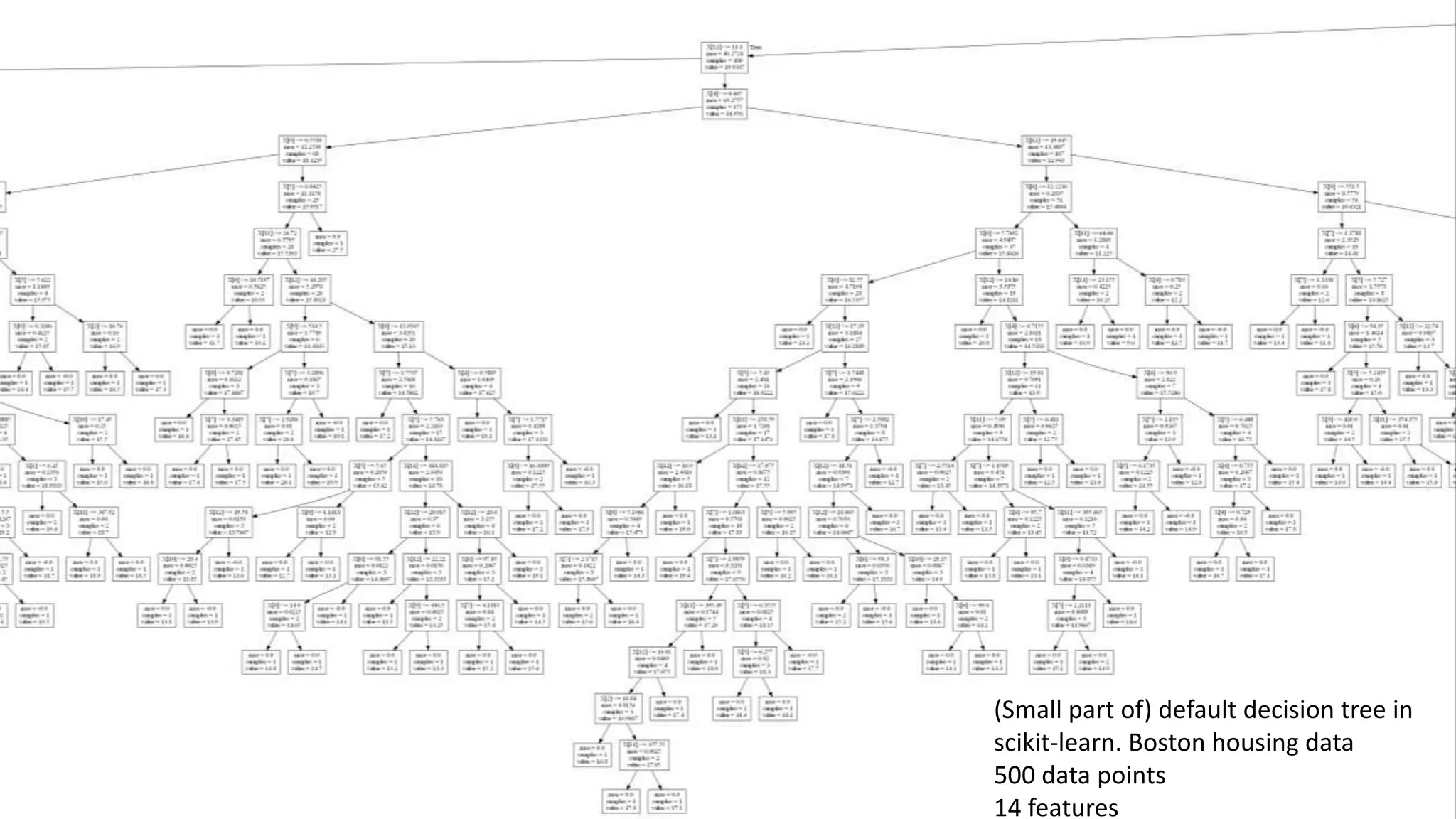
(Small part of) default decision tree in
scikit-learn. Boston housing data
500 data points
14 features
Decision trees
• Decision trees are understandable only when they are (very) small
• Tree of depth n has up 2n leaves and 2n -1 internal nodes. With depth 20, a
tree can have up to 1048576 leaves
• Previous slide had <200 nodes
• Additionally decision trees are high variance method – low
generalization, tend to overfit
Random forests
• Can learn non-linear relationships in the data well
• Robust to outliers
• Can deal with both continuous and categorical data
• Require very little input preparation (see previous three points)
• Fast to train and test, trivially parallelizable
• High accuracy even with minimal meta-optimization
• Considered to be a black box that is difficult or impossible to interpret
Random forests as a black box
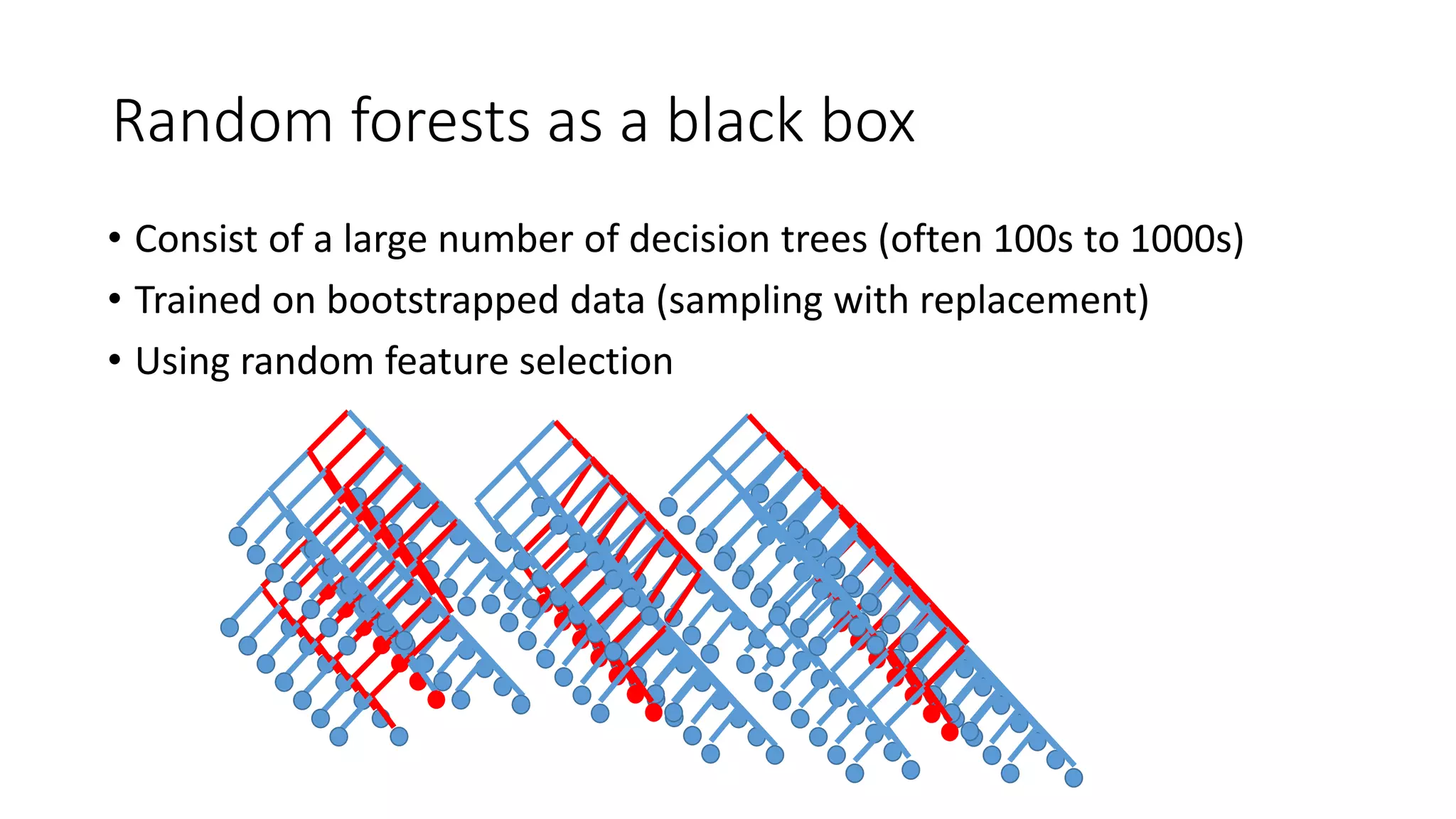
• Consist of a large number of decision trees (often 100s to 1000s)
• Trained on bootstrapped data (sampling with replacement)
• Using random feature selection
Random forests as a black box
• "Black box models such as random forests can't quantify the impact of each
predictor to the predictions of the complex model“, in PRICAI 2014: Trends
in Artificial Intelligence
• Unfortunately, the random forest algorithm is a black box when it comes to
evaluating the impact of a single feature on the overall performance. In
Advances in Natural Language Processing 2014
• “(Random forest model) is close to a black box in the sense that it uses 810
features /../ reduction in the number of features would allow an operator
to study individual decisions to have a rough idea how the global decision
could have been made”. In Advances in Data Mining: Applications and
Theoretical Aspects: 2014
Understanding the model vs the predictions
• Keep in mind, we want to understand why a particular decision was
made. Not necessarily every detail of the full model
• As an analogy, we don’t need to understand how a brain works to
understand why a person made a particular a decision: simple
explanation can be sufficient
• Ultimately, as ML models get more complex and powerful, hoping to
understand the models themselves is doomed to failure
• We should strive to make models explain their decisions
Turning the black box into a white box
• In fact, random forest predictions can be explained and interpreted,
by decomposing predictions into mathematically exact feature
contributions
• Independently of the
• number of features
• number of trees
• depth of the trees
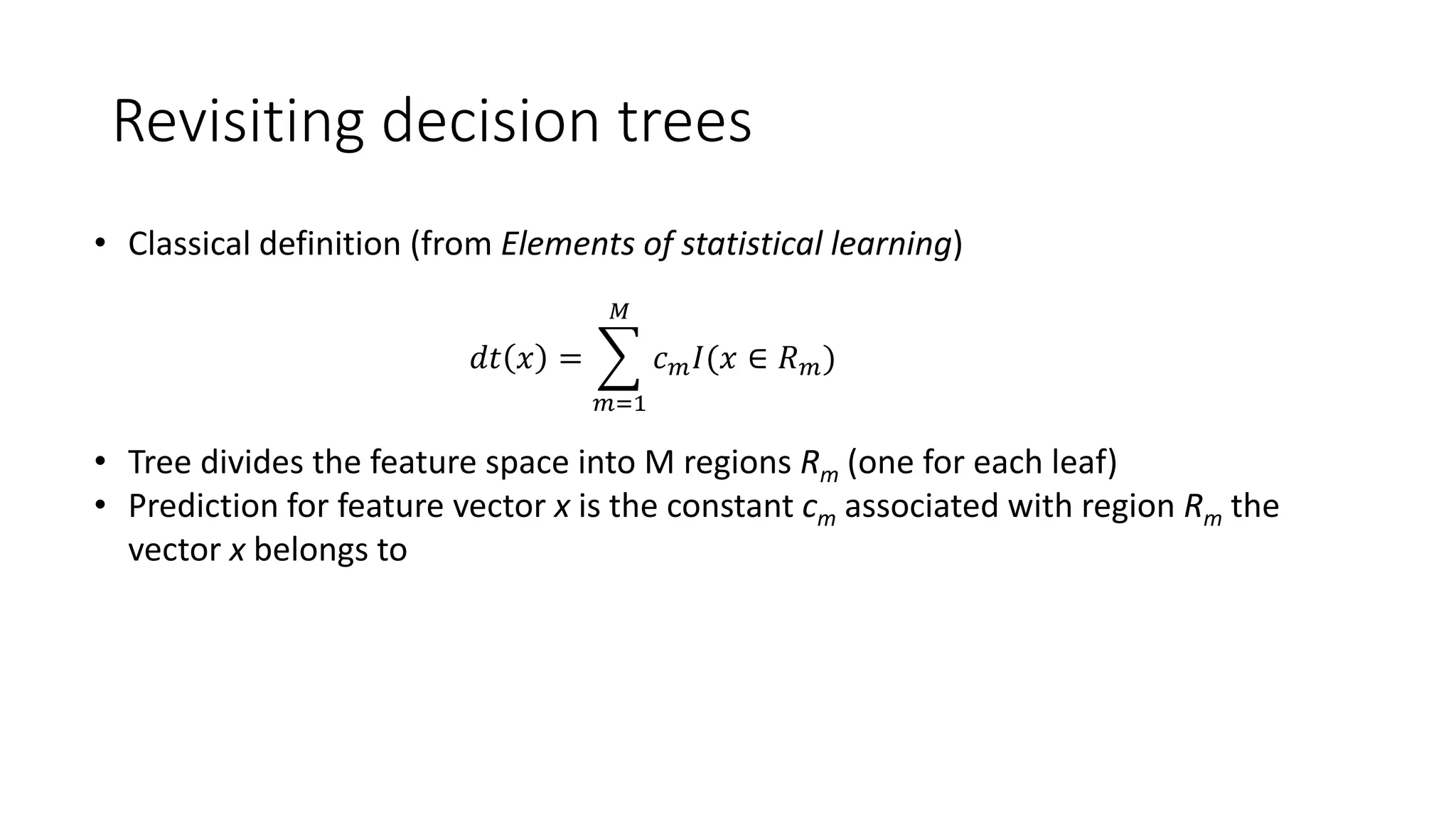
• Classical definition (from Elements of statistical learning)
• Tree divides the feature space into M regions Rm (one for each leaf)
• Prediction for feature vector x is the constant cm associated with region Rm the
vector x belongs to
𝑑𝑡 𝑥 =
𝑚=1
𝑀
𝑐 𝑚 𝐼(𝑥 ∈ 𝑅 𝑚)
Revisiting decision trees
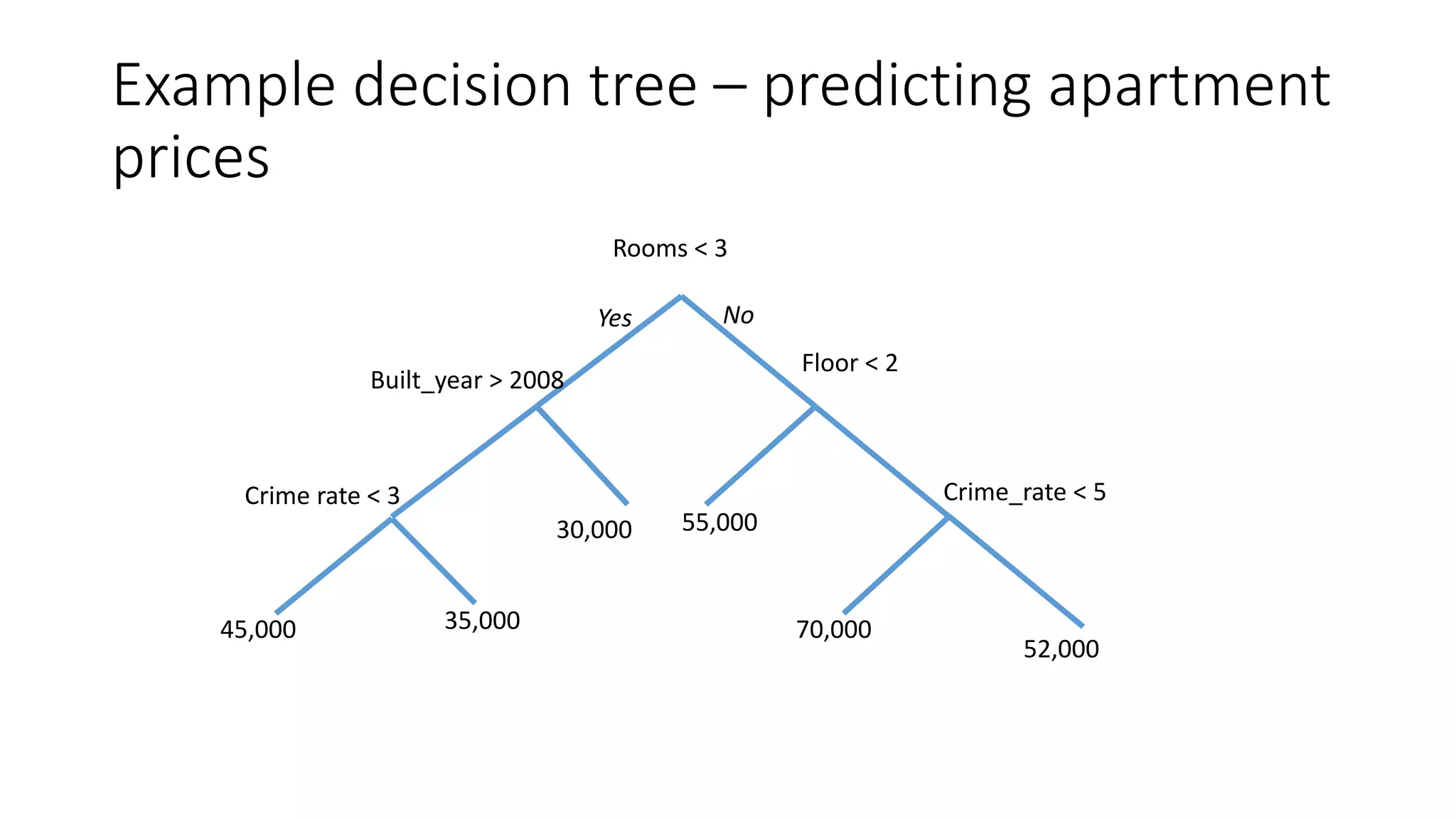
Example decision tree – predicting apartment
prices
Rooms < 3
Crime rate < 3
35,00045,000
Floor < 2
55,00030,000
70,000
52,000
Crime_rate < 5
Yes No
Built_year > 2008
Estimating apartment prices
Assume an apartment [2 rooms; Built in 2010; Neighborhood crime rate: 5]
We walk the tree to obtain the price
Rooms < 3
Floor < 2
55,00030,000
70,000
52,000
Crime_rate < 5
Yes No
Crime rate < 3
35,00045,000
Built_year > 2008
Estimating apartment prices
[2 rooms; Built in 2010; Neighborhood crime rate: 5]
Rooms < 3
Floor < 2
55,00030,000
70,000
52,000
Crime_rate < 5
Yes No
Built_year > 2008
Crime rate < 3
35,00045,000
Estimating apartment prices
[2 rooms; Built in 2010; Neighborhood crime rate: 5]
Rooms < 3
Floor < 2
55,00030,000
70,000
52,000
Crime_rate < 5
Yes No
Built_year > 2008
Crime rate < 3
35,00045,000
Estimating apartment prices
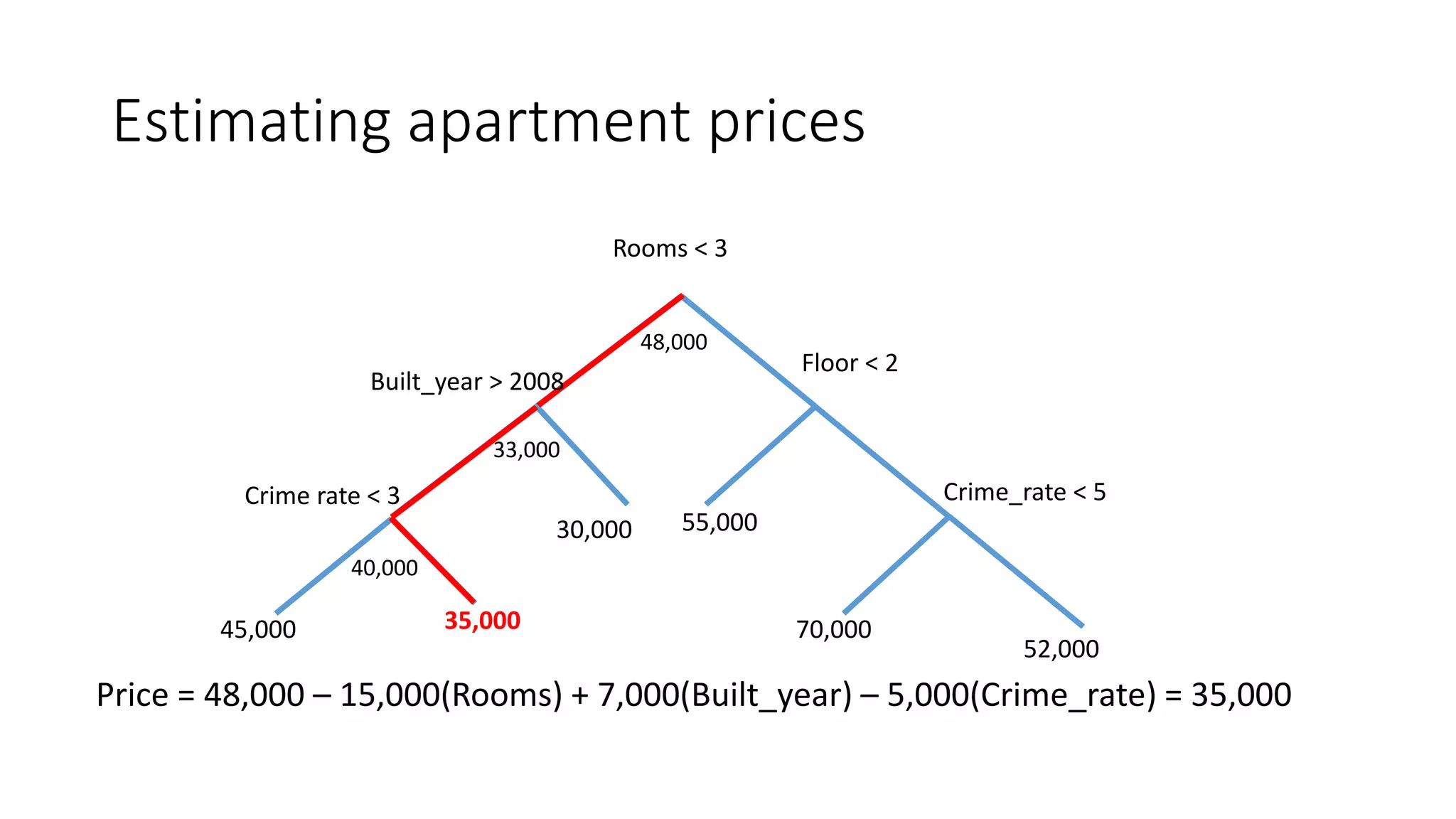
Prediction: 35,000 Path taken: Rooms < 3, Built_year > 2008, Crime_rate < 3
[2 rooms; Built in 2010; Neighborhood crime rate: 5]
Rooms < 3
Floor < 2
55,00030,000
70,000
52,000
Crime_rate < 5Crime rate < 3
35,00045,000
Yes No
Built_year > 2008
Operational view
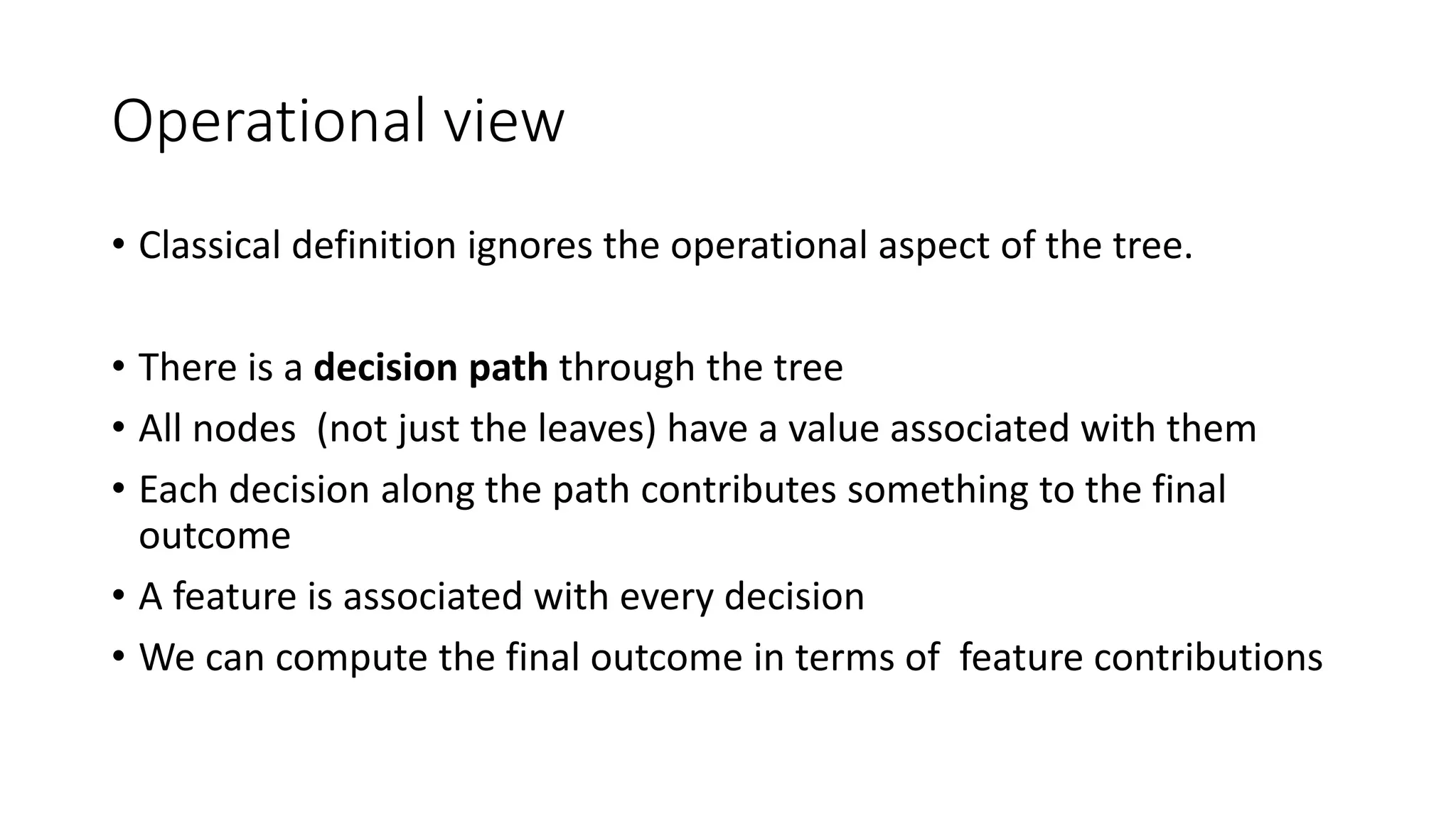
• Classical definition ignores the operational aspect of the tree.
• There is a decision path through the tree
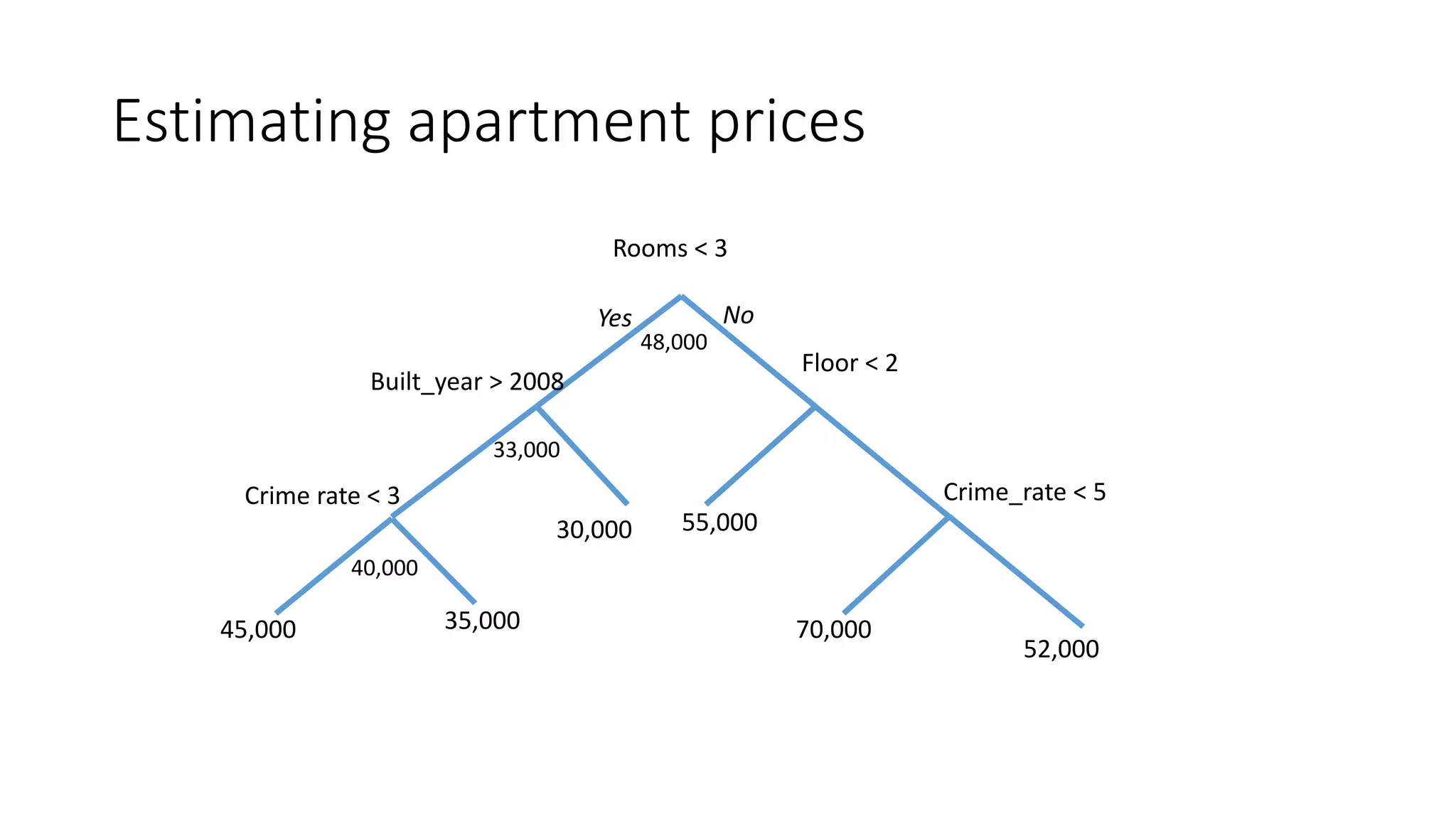
• All nodes (not just the leaves) have a value associated with them
• Each decision along the path contributes something to the final
outcome
• A feature is associated with every decision
• We can compute the final outcome in terms of feature contributions
Estimating apartment prices
Rooms < 3
Floor < 2
55,00030,000
70,000
52,000
Crime_rate < 5
Yes No
Built_year > 2008
Crime rate < 3
35,00045,000
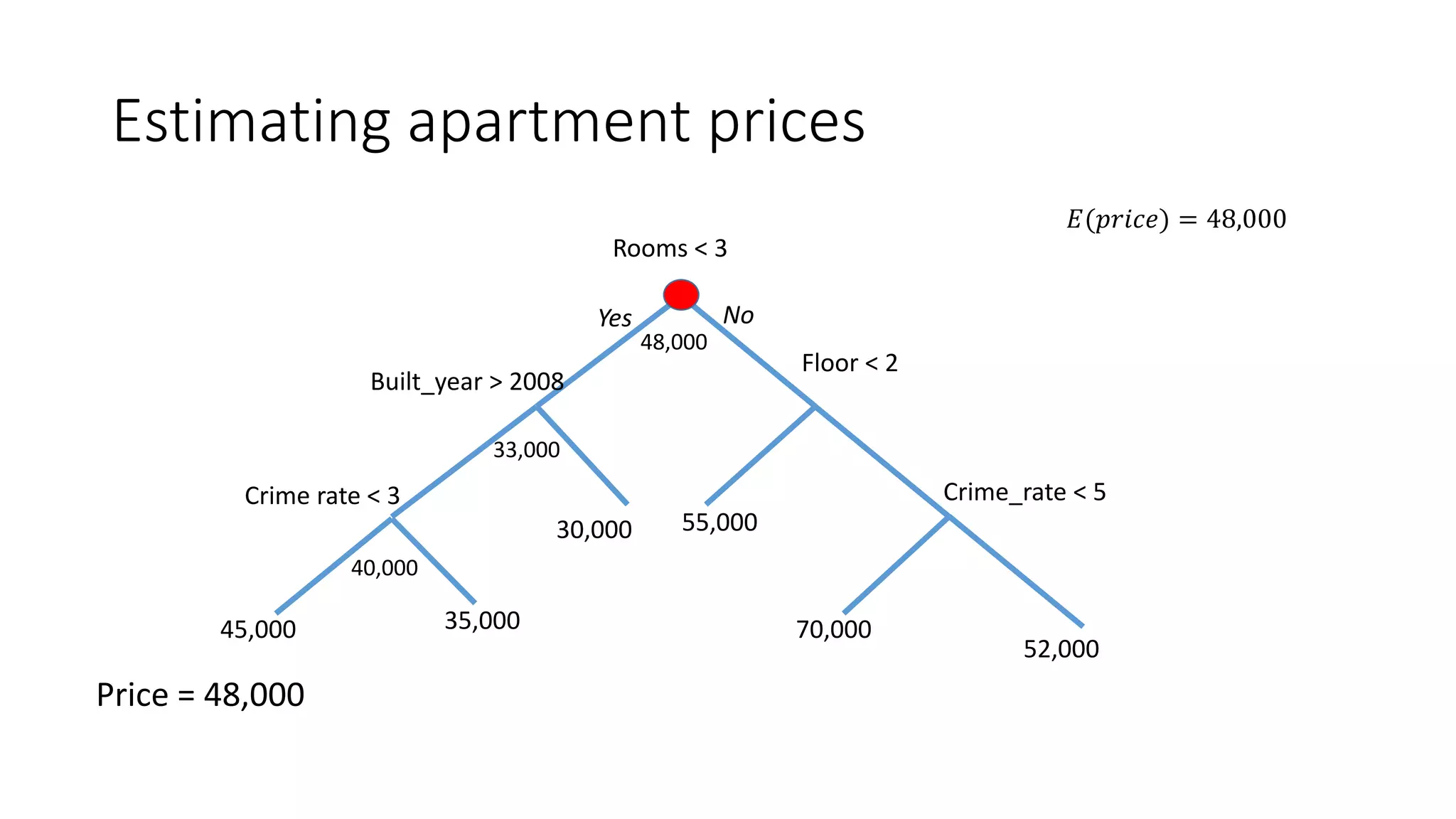
48,000
33,000
40,000
Estimating apartment prices
Price = 48,000
Rooms < 3
Floor < 2
55,00030,000
70,000
52,000
Crime_rate < 5
Yes No
Built_year > 2008
Crime rate < 3
35,00045,000
48,000
33,000
40,000
𝐸(𝑝𝑟𝑖𝑐𝑒) = 48,000
Estimating apartment prices
[2 rooms]
Rooms < 3
Floor < 2
55,00030,000
70,000
52,000
Crime_rate < 5
Yes No
Built_year > 2008
Crime rate < 3
35,00045,000
48,000
33,000
40,000
Price = 48,000 – 15,000(Rooms)
𝐸(𝑝𝑟𝑖𝑐𝑒|𝑟𝑜𝑜𝑚𝑠 < 3) = 33,000
Estimating apartment prices
Rooms < 3
Floor < 2
55,00030,000
70,000
52,000
Crime_rate < 5
Yes No
Built_year > 2008
Crime rate < 3
35,00045,000
48,000
33,000
40,000
Price = 48,000 – 15,000(Rooms) + 7,000(Built_year)
[Built 2010]
Estimating apartment prices
Rooms < 3
Floor < 2
55,00030,000
70,000
52,000
Crime_rate < 5
Built_year > 2008
Crime rate < 3
35,00045,000
48,000
33,000
40,000
Price = 48,000 – 15,000(Rooms) + 7,000(Built_year) – 5,000(Crime_rate)
[Crime rate 5]
Estimating apartment prices
Rooms < 3
Floor < 2
55,00030,000
70,000
52,000
Crime_rate < 5
Built_year > 2008
Crime rate < 3
35,00045,000
48,000
33,000
40,000
Price = 48,000 – 15,000(Rooms) + 7,000(Built_year) – 5,000(Crime_rate) = 35,000
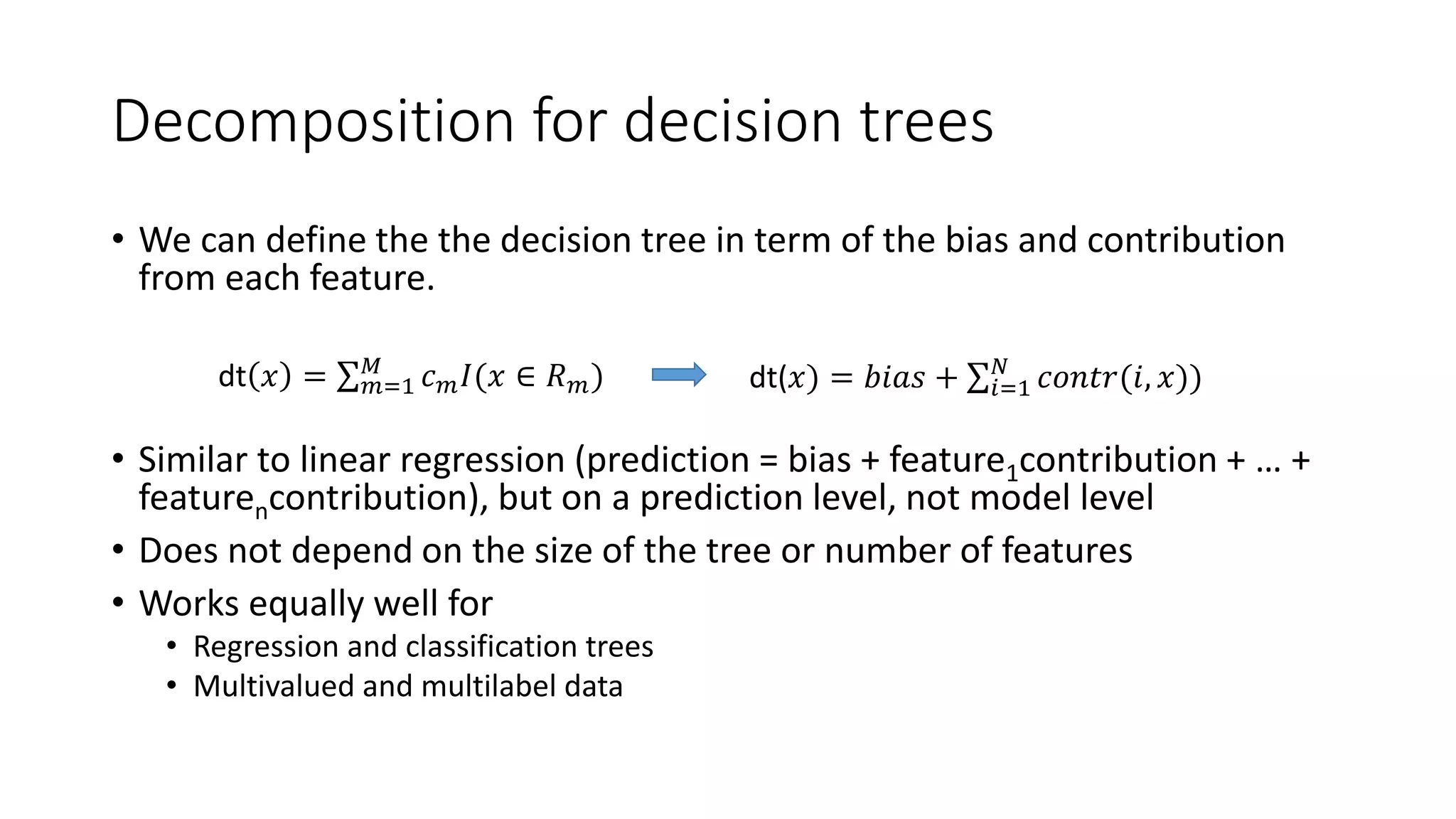
• We can define the the decision tree in term of the bias and contribution
from each feature.
• Similar to linear regression (prediction = bias + feature1contribution + … +
featurencontribution), but on a prediction level, not model level
• Does not depend on the size of the tree or number of features
• Works equally well for
• Regression and classification trees
• Multivalued and multilabel data
Decomposition for decision trees
dt(𝑥) = 𝑏𝑖𝑎𝑠 + 𝑖=1
𝑁
𝑐𝑜𝑛𝑡𝑟(𝑖, 𝑥))dt 𝑥 = 𝑚=1
𝑀
𝑐 𝑚 𝐼(𝑥 ∈ 𝑅 𝑚)
Deeper inspections
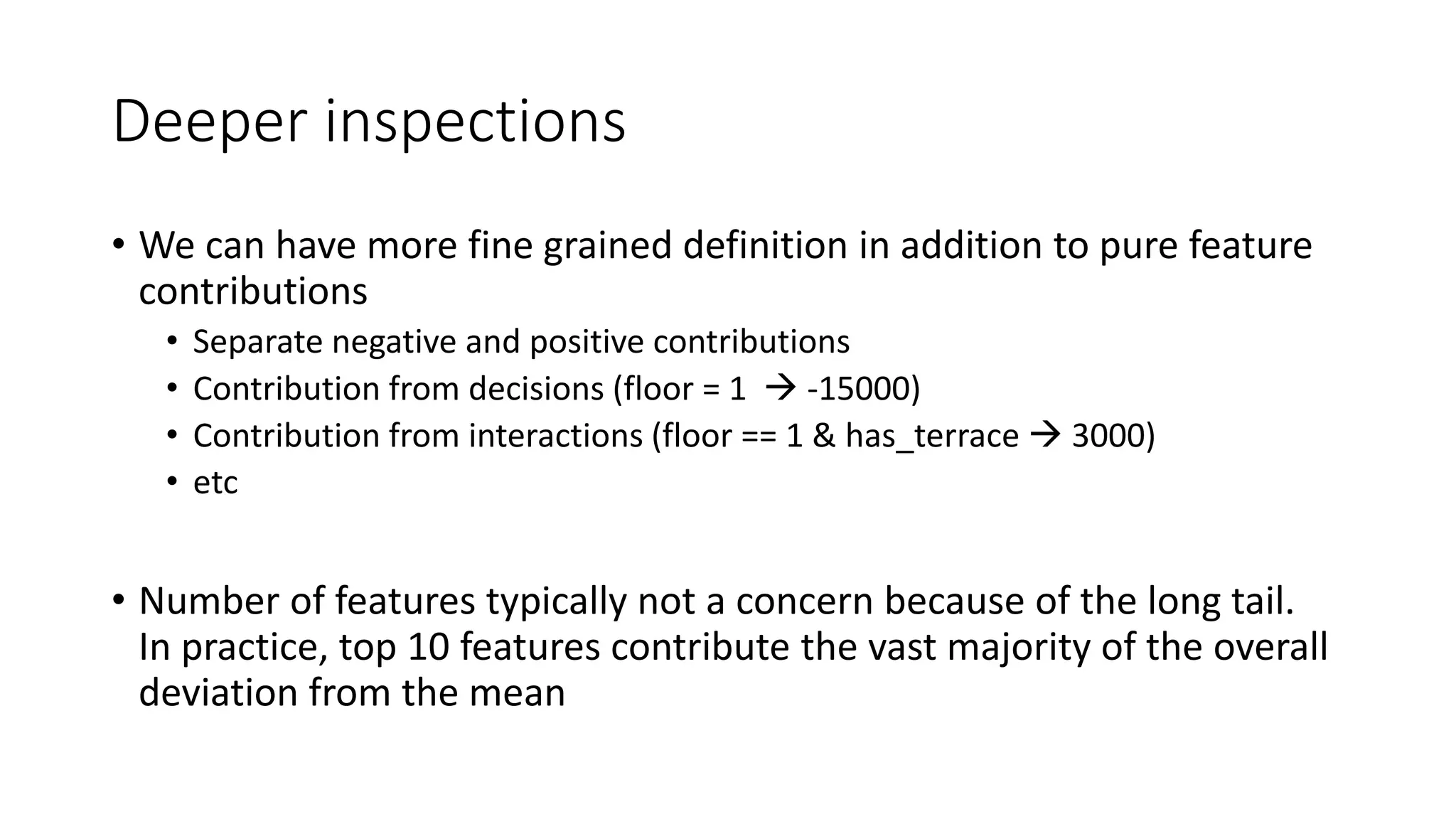
• We can have more fine grained definition in addition to pure feature
contributions
• Separate negative and positive contributions
• Contribution from decisions (floor = 1  -15000)
• Contribution from interactions (floor == 1 & has_terrace  3000)
• etc
• Number of features typically not a concern because of the long tail.
In practice, top 10 features contribute the vast majority of the overall
deviation from the mean
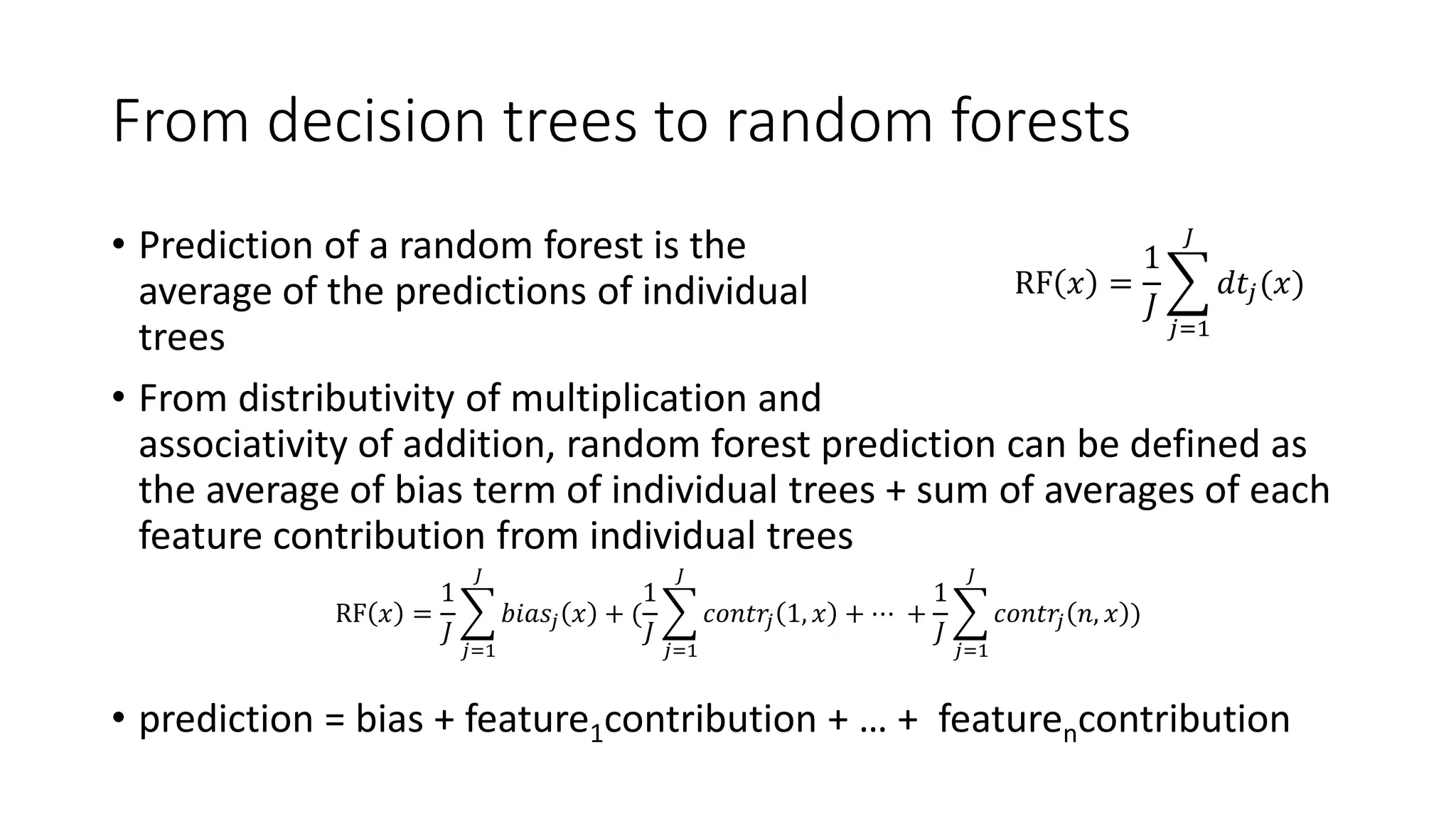
From decision trees to random forests
• Prediction of a random forest is the
average of the predictions of individual
trees
• From distributivity of multiplication and
associativity of addition, random forest prediction can be defined as
the average of bias term of individual trees + sum of averages of each
feature contribution from individual trees
• prediction = bias + feature1contribution + … + featurencontribution
RF 𝑥 =
1
𝐽
𝑗=1
𝐽
𝑑𝑡𝑗(𝑥)
RF 𝑥 =
1
𝐽
𝑗=1
𝐽
𝑏𝑖𝑎𝑠𝑗 𝑥 + (
1
𝐽
𝑗=1
𝐽
𝑐𝑜𝑛𝑡𝑟𝑗 1, 𝑥 + ⋯ +
1
𝐽
𝑗=1
𝐽
𝑐𝑜𝑛𝑡𝑟𝑗 𝑛, 𝑥 )
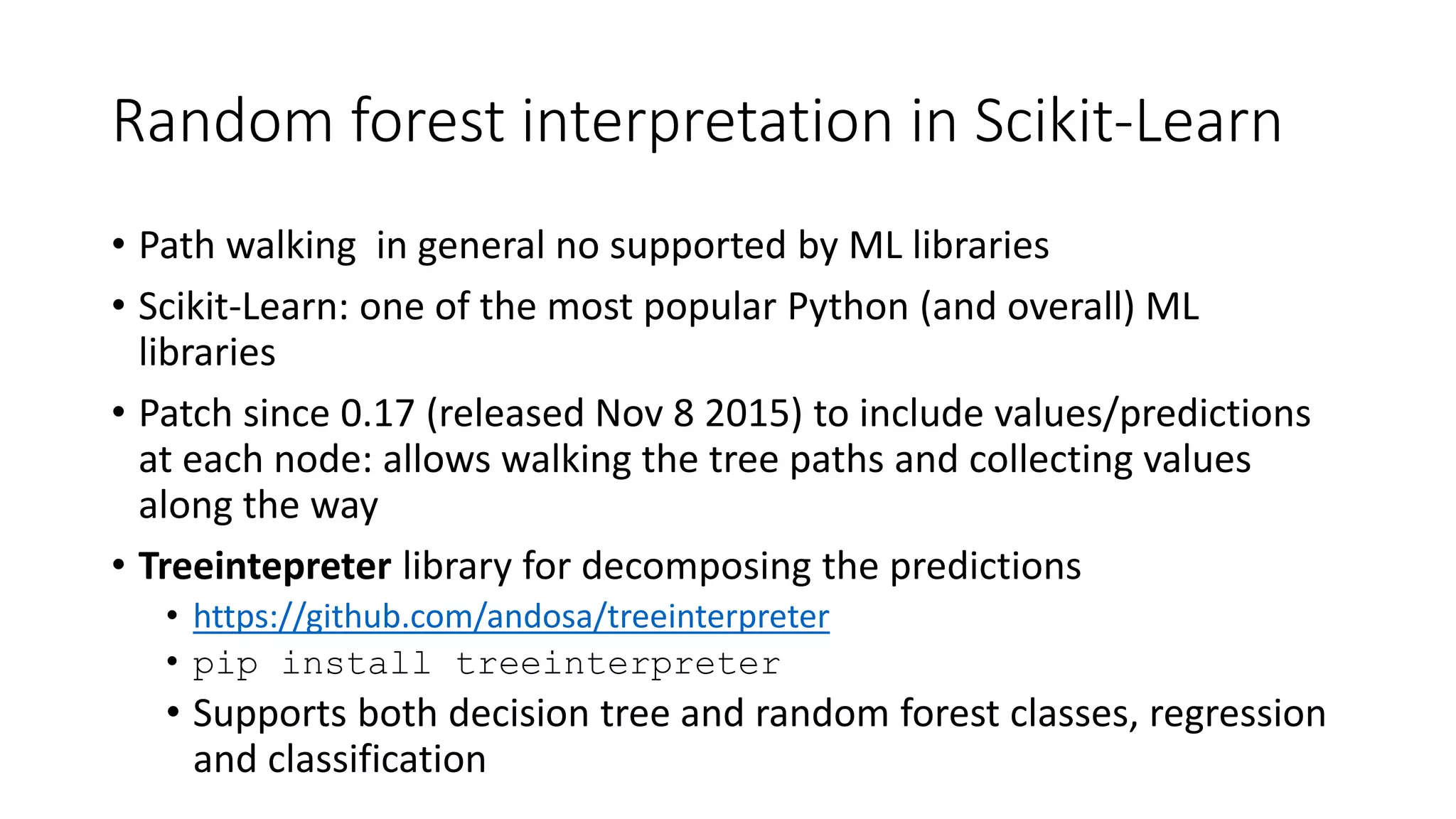
Random forest interpretation in Scikit-Learn
• Path walking in general no supported by ML libraries
• Scikit-Learn: one of the most popular Python (and overall) ML
libraries
• Patch since 0.17 (released Nov 8 2015) to include values/predictions
at each node: allows walking the tree paths and collecting values
along the way
• Treeintepreter library for decomposing the predictions
• https://github.com/andosa/treeinterpreter
• pip install treeinterpreter
• Supports both decision tree and random forest classes, regression
and classification
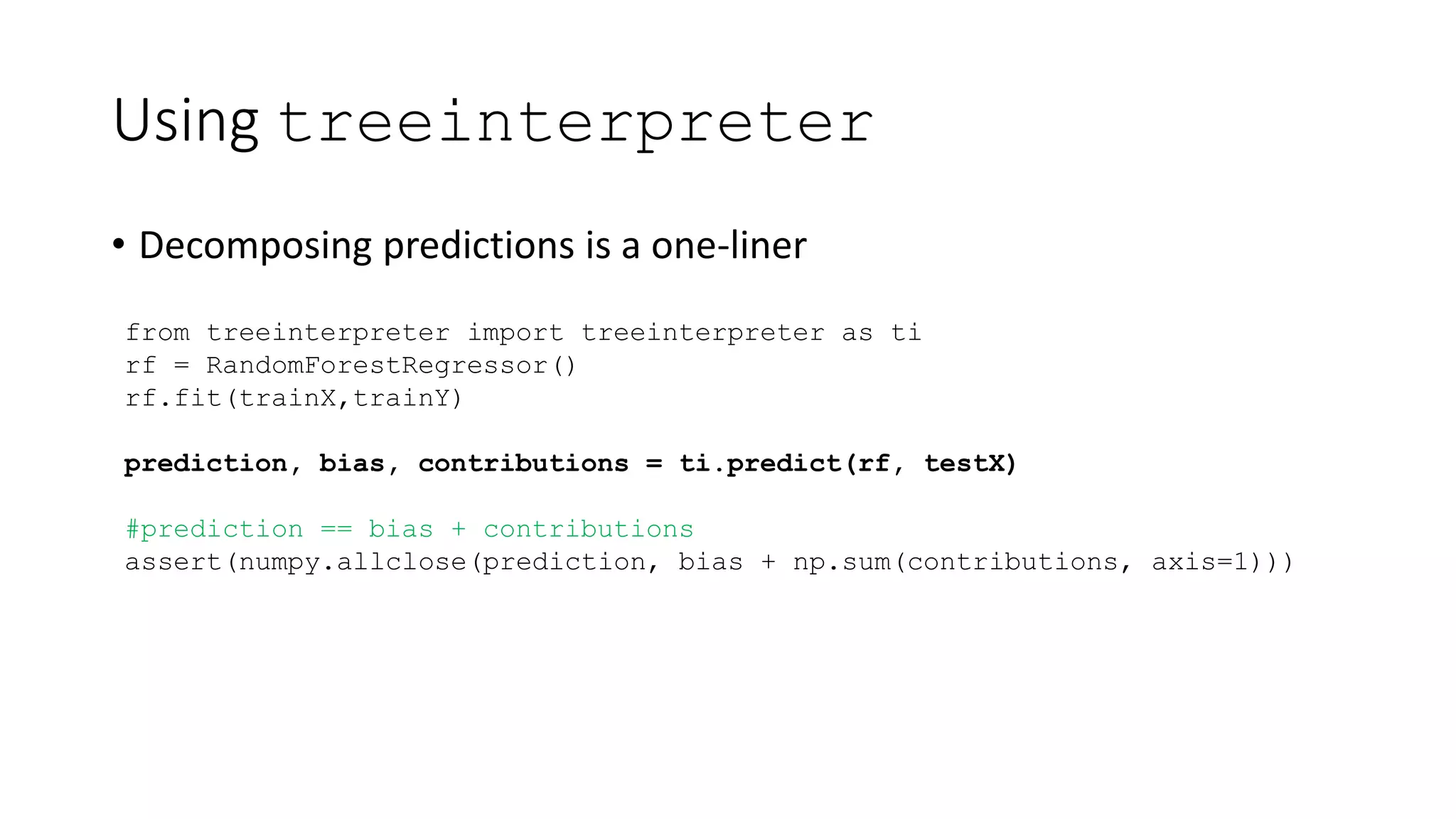
Using treeinterpreter
• Decomposing predictions is a one-liner
from treeinterpreter import treeinterpreter as ti
rf = RandomForestRegressor()
rf.fit(trainX,trainY)
prediction, bias, contributions = ti.predict(rf, testX)
#prediction == bias + contributions
assert(numpy.allclose(prediction, bias + np.sum(contributions, axis=1)))
Decomposing a prediction – boston housing
data
prediction, bias, contributions = ti.predict(rf, boston.data)
>> prediction[0]
30.69
>> bias[0]
25.588
>> sorted(zip(contributions[0], boston.feature_names),
>> key=lambda x: -abs(x[0]))
[(4.3387165697195558, 'RM'),
(-1.0771391053864874, 'TAX'),
(1.0207116129073213, 'LSTAT'),
(0.38890774812797702, 'AGE'),
(0.38381481481481539, 'ZN'),
(-0.10397222222222205, 'CRIM'),
(-0.091520697167756987, 'NOX')
...
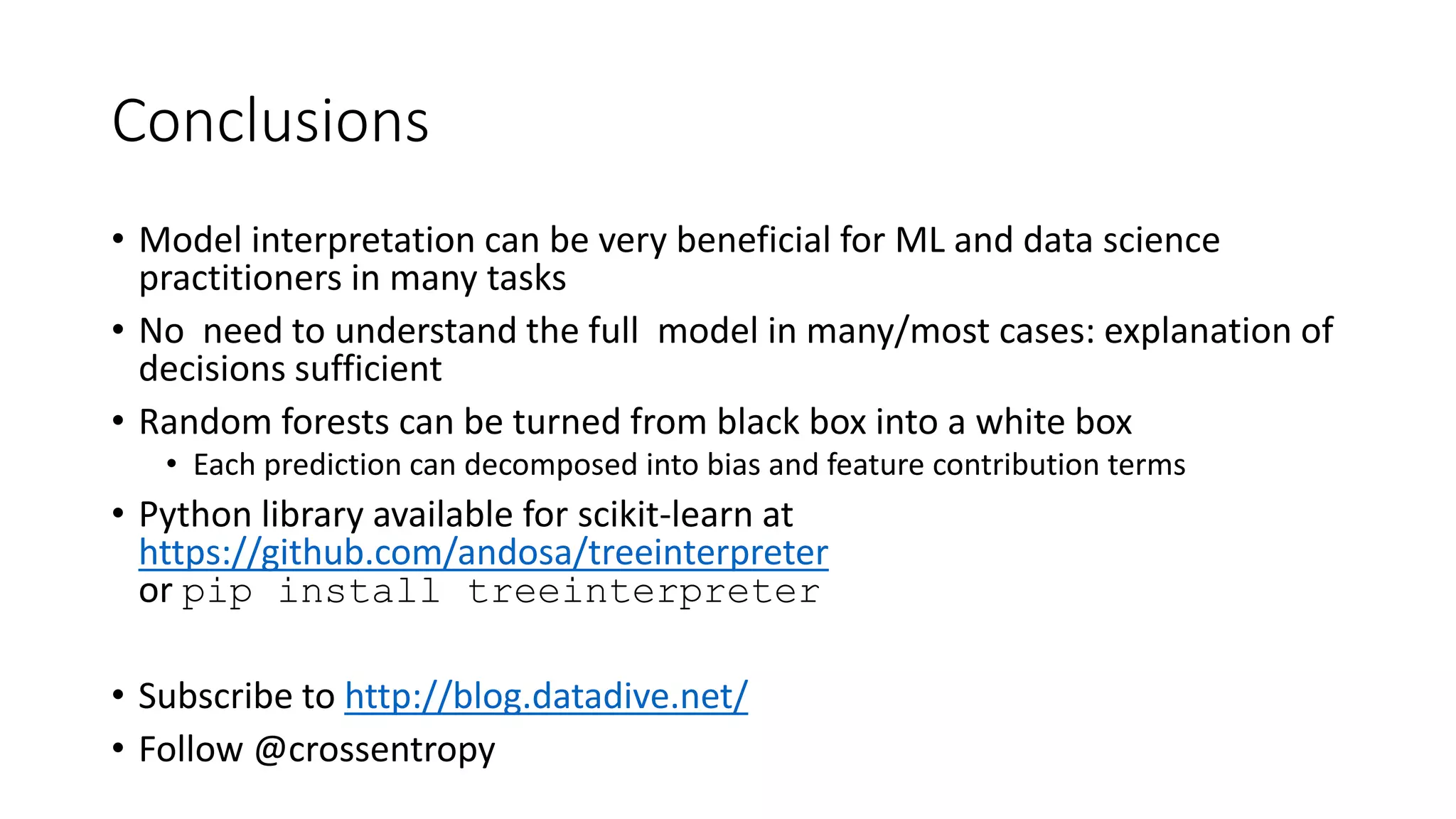
Conclusions
• Model interpretation can be very beneficial for ML and data science
practitioners in many tasks
• No need to understand the full model in many/most cases: explanation of
decisions sufficient
• Random forests can be turned from black box into a white box
• Each prediction can decomposed into bias and feature contribution terms
• Python library available for scikit-learn at
https://github.com/andosa/treeinterpreter
or pip install treeinterpreter
• Subscribe to http://blog.datadive.net/
• Follow @crossentropy

Interpreting machine learning models

  • 1.
    Interpreting machine learning models orhow to turn a random forest into a white box Ando Saabas
  • 2.
    About me • Seniorapplied scientist at Microsoft, • Using ML and statistics to improve call quality in Skype • Various projects on user engagement modelling, Skype user graph analysis, call reliability modelling, traffic shaping detection • Blogging on data science and ML @ http://blog.datadive.net/
  • 3.
    Machine learning andmodel interpretation • Machine learning studies algorithms that learn from data and make predictions • Learning algorithms are about correlations in the data • In contrast, in data science and data mining, understanding causality is essential • Applying domain knowledge requires understanding and interpreting models
  • 4.
    Usefulness of modelinterpretation • Often, we need to understand individual predictions a model is making. For example a model may • Recommend a treatment for a patient or estimate a disease to be likely. The doctor needs to understand the reasoning. • Classify a user as a scammer, but the user disputes it. The fraud analyst needs to understand why the model made the classification. • Predict that a video call will be graded poorly by the user. The engineer needs to understand why this type of call was considered problematic.
  • 5.
    Usefulness of modelinterpretation cont. • Understanding differences on a dataset level. • Why is a new software release receiving poorer feedback from customers when compared to the previous one? • Why are grain yields in one region higher than the other? • Debugging models. A model that worked earlier is giving unexpected results on newer data.
  • 6.
    Algorithmic transparency • Algorithmictransparency becoming a requirement in many fields • French Conseil d’Etat (State Council’s) recommendation in „Digital technology and fundamental rights“(2014) : Impose to algorithm- based decisions a transparency requirement, on personal data used by the algorithm, and the general reasoning it followed. • Federal Trade Commission (FTC) Chair Edith Ramirez: The agency is concerned about ‘algorithmic transparency /../’ (Oct 2015). FTC Office of Technology Research and Investigation started in March 2015 to tackle algorithmic transparency among other issues
  • 7.
    Interpretable models • Traditionally,two types of (mainstream) models considered when interpretability is required • Linear models (linear and logistic regression) • 𝑌 = 𝑎 + 𝑏1 𝑥1 + ⋯ + 𝑏 𝑛 𝑥 𝑛 • heart_disease = 0.08*tobacco + 0.043*age + 0.939*famhist + ... (from Elements of statistical learning) • Decision trees Family hist Tobacco Age > 60 Yes No 60% 20%40% 30%
  • 8.
    Example: heart diseaserisk prediction • Essentially a linear model with integer coefficients • Easy for a doctor to follow and explain From National Heart, Lung and Blood Institute.
  • 9.
    Linear models havedrawbacks • Underlying data is often non-linear • Feature binning: potentially massive increase in number of features • Basis expansion (non-linear transfor- mations of underlying features) In both cases performance will be traded for interpretability 𝑌 = 2𝑥1 + 𝑥2 − 3𝑥3 𝑌 = 2𝑥1 2 + 3𝑥1 − log 𝑥2 + 𝑥2 𝑥3 + … vs
  • 10.
    Decision trees • Decisiontrees can fit to non-linear data • Work well with both categorical and continuous data, classification and regression • Easy to understand Rooms < 3 Built_year < 2008 Crime rate < 3 35,00045,000 Floor < 2 55,00030,000 70,000 52,000 Crime_rate < 5 Yes No
  • 11.
    (Small part of)default decision tree in scikit-learn. Boston housing data 500 data points 14 features
  • 12.
    Decision trees • Decisiontrees are understandable only when they are (very) small • Tree of depth n has up 2n leaves and 2n -1 internal nodes. With depth 20, a tree can have up to 1048576 leaves • Previous slide had <200 nodes • Additionally decision trees are high variance method – low generalization, tend to overfit
  • 13.
    Random forests • Canlearn non-linear relationships in the data well • Robust to outliers • Can deal with both continuous and categorical data • Require very little input preparation (see previous three points) • Fast to train and test, trivially parallelizable • High accuracy even with minimal meta-optimization • Considered to be a black box that is difficult or impossible to interpret
  • 14.
    Random forests asa black box • Consist of a large number of decision trees (often 100s to 1000s) • Trained on bootstrapped data (sampling with replacement) • Using random feature selection
  • 15.
    Random forests asa black box • "Black box models such as random forests can't quantify the impact of each predictor to the predictions of the complex model“, in PRICAI 2014: Trends in Artificial Intelligence • Unfortunately, the random forest algorithm is a black box when it comes to evaluating the impact of a single feature on the overall performance. In Advances in Natural Language Processing 2014 • “(Random forest model) is close to a black box in the sense that it uses 810 features /../ reduction in the number of features would allow an operator to study individual decisions to have a rough idea how the global decision could have been made”. In Advances in Data Mining: Applications and Theoretical Aspects: 2014
  • 16.
    Understanding the modelvs the predictions • Keep in mind, we want to understand why a particular decision was made. Not necessarily every detail of the full model • As an analogy, we don’t need to understand how a brain works to understand why a person made a particular a decision: simple explanation can be sufficient • Ultimately, as ML models get more complex and powerful, hoping to understand the models themselves is doomed to failure • We should strive to make models explain their decisions
  • 17.
    Turning the blackbox into a white box • In fact, random forest predictions can be explained and interpreted, by decomposing predictions into mathematically exact feature contributions • Independently of the • number of features • number of trees • depth of the trees
  • 18.
    • Classical definition(from Elements of statistical learning) • Tree divides the feature space into M regions Rm (one for each leaf) • Prediction for feature vector x is the constant cm associated with region Rm the vector x belongs to 𝑑𝑡 𝑥 = 𝑚=1 𝑀 𝑐 𝑚 𝐼(𝑥 ∈ 𝑅 𝑚) Revisiting decision trees
  • 19.
    Example decision tree– predicting apartment prices Rooms < 3 Crime rate < 3 35,00045,000 Floor < 2 55,00030,000 70,000 52,000 Crime_rate < 5 Yes No Built_year > 2008
  • 20.
    Estimating apartment prices Assumean apartment [2 rooms; Built in 2010; Neighborhood crime rate: 5] We walk the tree to obtain the price Rooms < 3 Floor < 2 55,00030,000 70,000 52,000 Crime_rate < 5 Yes No Crime rate < 3 35,00045,000 Built_year > 2008
  • 21.
    Estimating apartment prices [2rooms; Built in 2010; Neighborhood crime rate: 5] Rooms < 3 Floor < 2 55,00030,000 70,000 52,000 Crime_rate < 5 Yes No Built_year > 2008 Crime rate < 3 35,00045,000
  • 22.
    Estimating apartment prices [2rooms; Built in 2010; Neighborhood crime rate: 5] Rooms < 3 Floor < 2 55,00030,000 70,000 52,000 Crime_rate < 5 Yes No Built_year > 2008 Crime rate < 3 35,00045,000
  • 23.
    Estimating apartment prices Prediction:35,000 Path taken: Rooms < 3, Built_year > 2008, Crime_rate < 3 [2 rooms; Built in 2010; Neighborhood crime rate: 5] Rooms < 3 Floor < 2 55,00030,000 70,000 52,000 Crime_rate < 5Crime rate < 3 35,00045,000 Yes No Built_year > 2008
  • 24.
    Operational view • Classicaldefinition ignores the operational aspect of the tree. • There is a decision path through the tree • All nodes (not just the leaves) have a value associated with them • Each decision along the path contributes something to the final outcome • A feature is associated with every decision • We can compute the final outcome in terms of feature contributions
  • 25.
    Estimating apartment prices Rooms< 3 Floor < 2 55,00030,000 70,000 52,000 Crime_rate < 5 Yes No Built_year > 2008 Crime rate < 3 35,00045,000 48,000 33,000 40,000
  • 26.
    Estimating apartment prices Price= 48,000 Rooms < 3 Floor < 2 55,00030,000 70,000 52,000 Crime_rate < 5 Yes No Built_year > 2008 Crime rate < 3 35,00045,000 48,000 33,000 40,000 𝐸(𝑝𝑟𝑖𝑐𝑒) = 48,000
  • 27.
    Estimating apartment prices [2rooms] Rooms < 3 Floor < 2 55,00030,000 70,000 52,000 Crime_rate < 5 Yes No Built_year > 2008 Crime rate < 3 35,00045,000 48,000 33,000 40,000 Price = 48,000 – 15,000(Rooms) 𝐸(𝑝𝑟𝑖𝑐𝑒|𝑟𝑜𝑜𝑚𝑠 < 3) = 33,000
  • 28.
    Estimating apartment prices Rooms< 3 Floor < 2 55,00030,000 70,000 52,000 Crime_rate < 5 Yes No Built_year > 2008 Crime rate < 3 35,00045,000 48,000 33,000 40,000 Price = 48,000 – 15,000(Rooms) + 7,000(Built_year) [Built 2010]
  • 29.
    Estimating apartment prices Rooms< 3 Floor < 2 55,00030,000 70,000 52,000 Crime_rate < 5 Built_year > 2008 Crime rate < 3 35,00045,000 48,000 33,000 40,000 Price = 48,000 – 15,000(Rooms) + 7,000(Built_year) – 5,000(Crime_rate) [Crime rate 5]
  • 30.
    Estimating apartment prices Rooms< 3 Floor < 2 55,00030,000 70,000 52,000 Crime_rate < 5 Built_year > 2008 Crime rate < 3 35,00045,000 48,000 33,000 40,000 Price = 48,000 – 15,000(Rooms) + 7,000(Built_year) – 5,000(Crime_rate) = 35,000
  • 31.
    • We candefine the the decision tree in term of the bias and contribution from each feature. • Similar to linear regression (prediction = bias + feature1contribution + … + featurencontribution), but on a prediction level, not model level • Does not depend on the size of the tree or number of features • Works equally well for • Regression and classification trees • Multivalued and multilabel data Decomposition for decision trees dt(𝑥) = 𝑏𝑖𝑎𝑠 + 𝑖=1 𝑁 𝑐𝑜𝑛𝑡𝑟(𝑖, 𝑥))dt 𝑥 = 𝑚=1 𝑀 𝑐 𝑚 𝐼(𝑥 ∈ 𝑅 𝑚)
  • 32.
    Deeper inspections • Wecan have more fine grained definition in addition to pure feature contributions • Separate negative and positive contributions • Contribution from decisions (floor = 1  -15000) • Contribution from interactions (floor == 1 & has_terrace  3000) • etc • Number of features typically not a concern because of the long tail. In practice, top 10 features contribute the vast majority of the overall deviation from the mean
  • 33.
    From decision treesto random forests • Prediction of a random forest is the average of the predictions of individual trees • From distributivity of multiplication and associativity of addition, random forest prediction can be defined as the average of bias term of individual trees + sum of averages of each feature contribution from individual trees • prediction = bias + feature1contribution + … + featurencontribution RF 𝑥 = 1 𝐽 𝑗=1 𝐽 𝑑𝑡𝑗(𝑥) RF 𝑥 = 1 𝐽 𝑗=1 𝐽 𝑏𝑖𝑎𝑠𝑗 𝑥 + ( 1 𝐽 𝑗=1 𝐽 𝑐𝑜𝑛𝑡𝑟𝑗 1, 𝑥 + ⋯ + 1 𝐽 𝑗=1 𝐽 𝑐𝑜𝑛𝑡𝑟𝑗 𝑛, 𝑥 )
  • 34.
    Random forest interpretationin Scikit-Learn • Path walking in general no supported by ML libraries • Scikit-Learn: one of the most popular Python (and overall) ML libraries • Patch since 0.17 (released Nov 8 2015) to include values/predictions at each node: allows walking the tree paths and collecting values along the way • Treeintepreter library for decomposing the predictions • https://github.com/andosa/treeinterpreter • pip install treeinterpreter • Supports both decision tree and random forest classes, regression and classification
  • 35.
    Using treeinterpreter • Decomposingpredictions is a one-liner from treeinterpreter import treeinterpreter as ti rf = RandomForestRegressor() rf.fit(trainX,trainY) prediction, bias, contributions = ti.predict(rf, testX) #prediction == bias + contributions assert(numpy.allclose(prediction, bias + np.sum(contributions, axis=1)))
  • 36.
    Decomposing a prediction– boston housing data prediction, bias, contributions = ti.predict(rf, boston.data) >> prediction[0] 30.69 >> bias[0] 25.588 >> sorted(zip(contributions[0], boston.feature_names), >> key=lambda x: -abs(x[0])) [(4.3387165697195558, 'RM'), (-1.0771391053864874, 'TAX'), (1.0207116129073213, 'LSTAT'), (0.38890774812797702, 'AGE'), (0.38381481481481539, 'ZN'), (-0.10397222222222205, 'CRIM'), (-0.091520697167756987, 'NOX') ...
  • 37.
    Conclusions • Model interpretationcan be very beneficial for ML and data science practitioners in many tasks • No need to understand the full model in many/most cases: explanation of decisions sufficient • Random forests can be turned from black box into a white box • Each prediction can decomposed into bias and feature contribution terms • Python library available for scikit-learn at https://github.com/andosa/treeinterpreter or pip install treeinterpreter • Subscribe to http://blog.datadive.net/ • Follow @crossentropy