Parallel Computing
Mohamed Zahran (aka Z)
mzahran@cs.nyu.edu
http://www.mzahran.com
CSCI-UA.0480-003
MPI - II
Many slides of this
lecture are adopted
and slightly modified from:
• Gerassimos Barlas
• Peter S. Pacheco
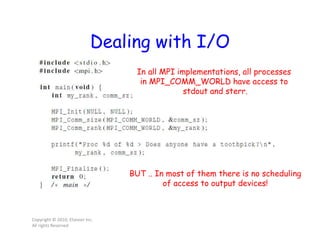
Dealing with I/O
Copyright © 2010, Elsevier Inc.
All rights Reserved
In all MPI implementations, all processes
in MPI_COMM_WORLD have access to
stdout and sterr.
BUT .. In most of them there is no scheduling
of access to output devices!
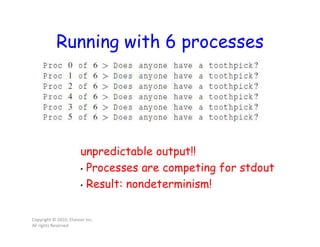
Running with 6 processes
Copyright © 2010, Elsevier Inc.
All rights Reserved
unpredictable output!!
• Processes are competing for stdout
• Result: nondeterminism!
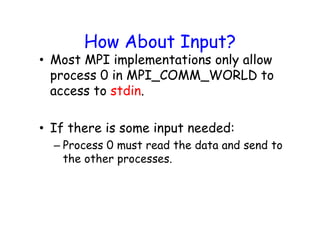
How About Input?
• Most MPI implementations only allow
process 0 in MPI_COMM_WORLD to
access to stdin.
• If there is some input needed:
– Process 0 must read the data and send to
the other processes.
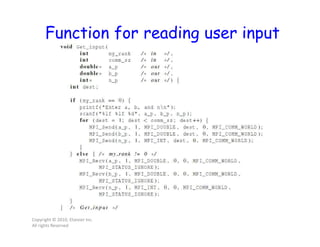
Function for reading user input
Copyright © 2010, Elsevier Inc.
All rights Reserved
Let’s apply what we’ve learned so
far, to solve an example more
sophisticated than printing
strings!
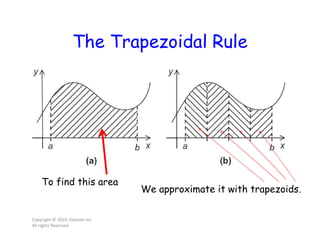
The Trapezoidal Rule
Copyright © 2010, Elsevier Inc.
All rights Reserved
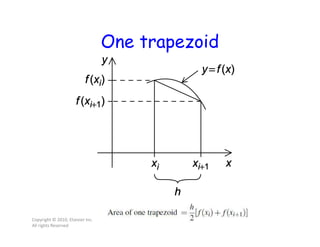
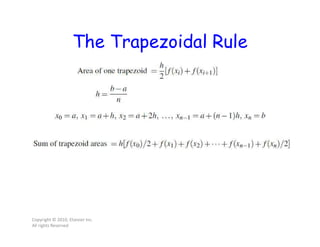
To find this area
We approximate it with trapezoids.
One trapezoid
Copyright © 2010, Elsevier Inc.
All rights Reserved
The Trapezoidal Rule
Copyright © 2010, Elsevier Inc.
All rights Reserved
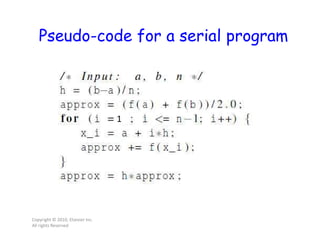
Pseudo-code for a serial program
Copyright © 2010, Elsevier Inc.
All rights Reserved
1
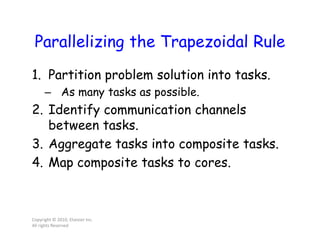
Parallelizing the Trapezoidal Rule
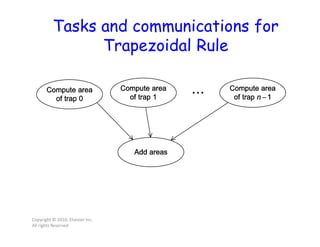
1. Partition problem solution into tasks.
– As many tasks as possible.
2. Identify communication channels
between tasks.
3. Aggregate tasks into composite tasks.
4. Map composite tasks to cores.
Copyright © 2010, Elsevier Inc.
All rights Reserved
Tasks and communications for
Trapezoidal Rule
Copyright © 2010, Elsevier Inc.
All rights Reserved
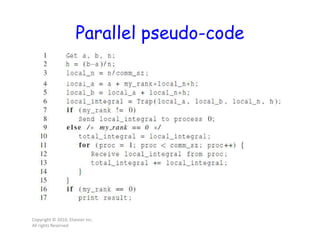
Parallel pseudo-code
Copyright © 2010, Elsevier Inc.
All rights Reserved
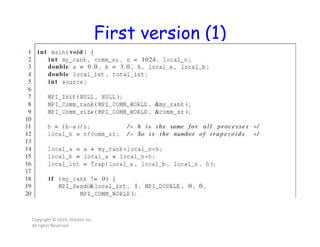
First version (1)
Copyright © 2010, Elsevier Inc.
All rights Reserved
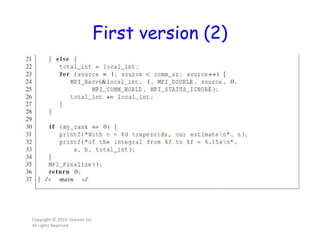
First version (2)
Copyright © 2010, Elsevier Inc.
All rights Reserved
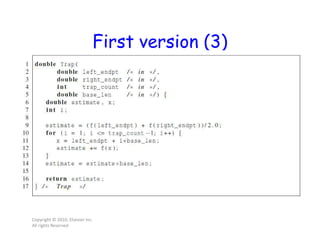
First version (3)
Copyright © 2010, Elsevier Inc.
All rights Reserved
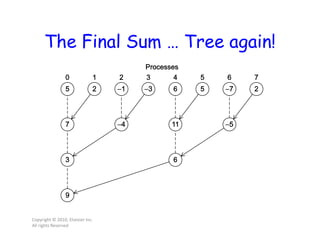
The Final Sum … Tree again!
Copyright © 2010, Elsevier Inc.
All rights Reserved
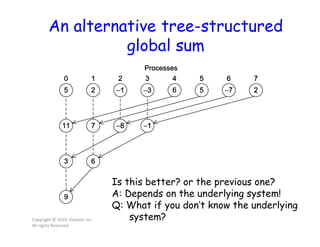
An alternative tree-structured
global sum
Copyright © 2010, Elsevier Inc.
All rights Reserved
Is this better? or the previous one?
A: Depends on the underlying system!
Q: What if you don’t know the underlying
system?
Reduction
• Reducing a set of numbers into a smaller
set of numbers via a function
– Example: reducing the group [1, 2, 3, 4, 5]
with the sum function  15
• MPI provides a handy function that
handles almost all of the common
reductions that a programmer needs to
do in a parallel application
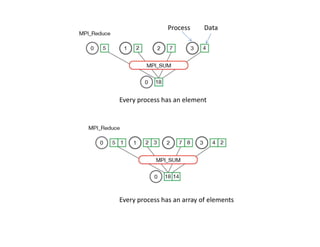
Every process has an element
Every process has an array of elements
Process Data
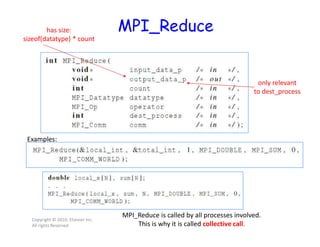
MPI_Reduce
Copyright © 2010, Elsevier Inc.
All rights Reserved
only relevant
to dest_process
has size:
sizeof(datatype) * count
MPI_Reduce is called by all processes involved.
This is why it is called collective call.
Examples:
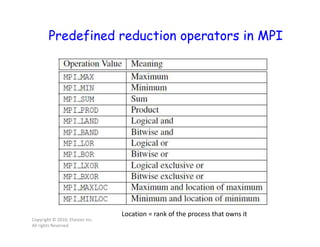
Predefined reduction operators in MPI
Copyright © 2010, Elsevier Inc.
All rights Reserved
Location = rank of the process that owns it
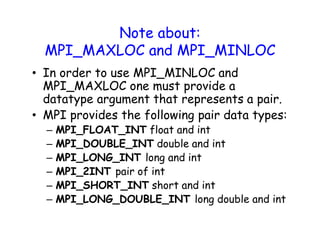
Note about:
MPI_MAXLOC and MPI_MINLOC
• In order to use MPI_MINLOC and
MPI_MAXLOC one must provide a
datatype argument that represents a pair.
• MPI provides the following pair data types:
– MPI_FLOAT_INT float and int
– MPI_DOUBLE_INT double and int
– MPI_LONG_INT long and int
– MPI_2INT pair of int
– MPI_SHORT_INT short and int
– MPI_LONG_DOUBLE_INT long double and int
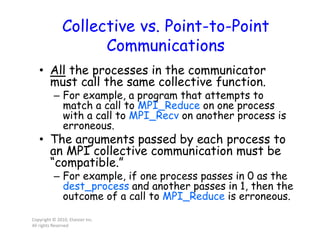
Collective vs. Point-to-Point
Communications
• All the processes in the communicator
must call the same collective function.
– For example, a program that attempts to
match a call to MPI_Reduce on one process
with a call to MPI_Recv on another process is
erroneous.
• The arguments passed by each process to
an MPI collective communication must be
“compatible.”
– For example, if one process passes in 0 as the
dest_process and another passes in 1, then the
outcome of a call to MPI_Reduce is erroneous.
Copyright © 2010, Elsevier Inc.
All rights Reserved
Collective vs. Point-to-Point
Communications
• The output_data_p argument is only
used on dest_process.
• However, all of the processes still need
to pass in an actual argument
corresponding to output_data_p, even if
it’s just NULL.
• All collective communication calls are
blocking.
Copyright © 2010, Elsevier Inc.
All rights Reserved
Collective vs. Point-to-Point
Communications
• Point-to-point communications are
matched on the basis of tags and
communicators.
• Collective communications don’t use
tags.
• They’re matched solely on the basis of
the communicator and the order in
which they’re called.
Copyright © 2010, Elsevier Inc.
All rights Reserved
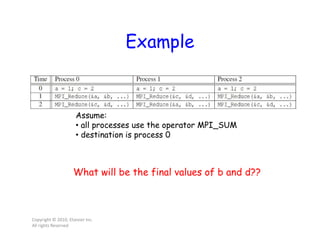
Example
Copyright © 2010, Elsevier Inc.
All rights Reserved
Assume:
• all processes use the operator MPI_SUM
• destination is process 0
What will be the final values of b and d??
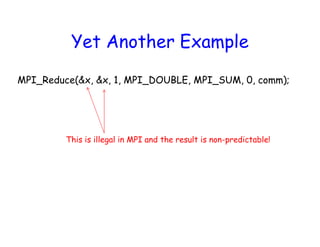
Yet Another Example
MPI_Reduce(&x, &x, 1, MPI_DOUBLE, MPI_SUM, 0, comm);
This is illegal in MPI and the result is non-predictable!
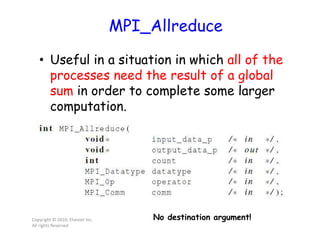
MPI_Allreduce
• Useful in a situation in which all of the
processes need the result of a global
sum in order to complete some larger
computation.
Copyright © 2010, Elsevier Inc.
All rights Reserved
No destination argument!
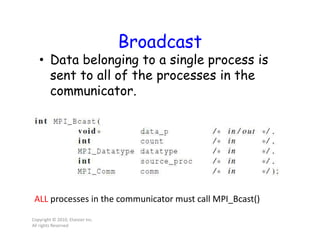
Broadcast
• Data belonging to a single process is
sent to all of the processes in the
communicator.
Copyright © 2010, Elsevier Inc.
All rights Reserved
ALL processes in the communicator must call MPI_Bcast()
Copyright © 2010, Elsevier Inc.
All rights Reserved
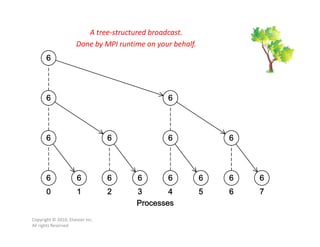
A tree-structured broadcast.
Done by MPI runtime on your behalf.
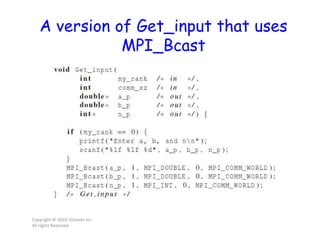
A version of Get_input that uses
MPI_Bcast
Copyright © 2010, Elsevier Inc.
All rights Reserved
Conclusions
• A communicator is a collection of
processes that can send messages to
each other.
• Collective communications involve all the
processes in a communicator.
• When studying MPI be careful of the
caveats (i.e. usage that leads to crash,
nondeterministic behavior, … ).
Copyright © 2010, Elsevier Inc.
All rights Reserved
Powered by TCPDF (www.tcpdf.org)Powered by TCPDF (www.tcpdf.org)

MPI - 2

  • 1.
    Parallel Computing Mohamed Zahran(aka Z) mzahran@cs.nyu.edu http://www.mzahran.com CSCI-UA.0480-003 MPI - II Many slides of this lecture are adopted and slightly modified from: • Gerassimos Barlas • Peter S. Pacheco
  • 2.
    Dealing with I/O Copyright© 2010, Elsevier Inc. All rights Reserved In all MPI implementations, all processes in MPI_COMM_WORLD have access to stdout and sterr. BUT .. In most of them there is no scheduling of access to output devices!
  • 3.
    Running with 6processes Copyright © 2010, Elsevier Inc. All rights Reserved unpredictable output!! • Processes are competing for stdout • Result: nondeterminism!
  • 4.
    How About Input? •Most MPI implementations only allow process 0 in MPI_COMM_WORLD to access to stdin. • If there is some input needed: – Process 0 must read the data and send to the other processes.
  • 5.
    Function for readinguser input Copyright © 2010, Elsevier Inc. All rights Reserved
  • 6.
    Let’s apply whatwe’ve learned so far, to solve an example more sophisticated than printing strings!
  • 7.
    The Trapezoidal Rule Copyright© 2010, Elsevier Inc. All rights Reserved To find this area We approximate it with trapezoids.
  • 8.
    One trapezoid Copyright ©2010, Elsevier Inc. All rights Reserved
  • 9.
    The Trapezoidal Rule Copyright© 2010, Elsevier Inc. All rights Reserved
  • 10.
    Pseudo-code for aserial program Copyright © 2010, Elsevier Inc. All rights Reserved 1
  • 11.
    Parallelizing the TrapezoidalRule 1. Partition problem solution into tasks. – As many tasks as possible. 2. Identify communication channels between tasks. 3. Aggregate tasks into composite tasks. 4. Map composite tasks to cores. Copyright © 2010, Elsevier Inc. All rights Reserved
  • 12.
    Tasks and communicationsfor Trapezoidal Rule Copyright © 2010, Elsevier Inc. All rights Reserved
  • 13.
    Parallel pseudo-code Copyright ©2010, Elsevier Inc. All rights Reserved
  • 14.
    First version (1) Copyright© 2010, Elsevier Inc. All rights Reserved
  • 15.
    First version (2) Copyright© 2010, Elsevier Inc. All rights Reserved
  • 16.
    First version (3) Copyright© 2010, Elsevier Inc. All rights Reserved
  • 17.
    The Final Sum… Tree again! Copyright © 2010, Elsevier Inc. All rights Reserved
  • 18.
    An alternative tree-structured globalsum Copyright © 2010, Elsevier Inc. All rights Reserved Is this better? or the previous one? A: Depends on the underlying system! Q: What if you don’t know the underlying system?
  • 19.
    Reduction • Reducing aset of numbers into a smaller set of numbers via a function – Example: reducing the group [1, 2, 3, 4, 5] with the sum function  15 • MPI provides a handy function that handles almost all of the common reductions that a programmer needs to do in a parallel application
  • 20.
    Every process hasan element Every process has an array of elements Process Data
  • 21.
    MPI_Reduce Copyright © 2010,Elsevier Inc. All rights Reserved only relevant to dest_process has size: sizeof(datatype) * count MPI_Reduce is called by all processes involved. This is why it is called collective call. Examples:
  • 22.
    Predefined reduction operatorsin MPI Copyright © 2010, Elsevier Inc. All rights Reserved Location = rank of the process that owns it
  • 23.
    Note about: MPI_MAXLOC andMPI_MINLOC • In order to use MPI_MINLOC and MPI_MAXLOC one must provide a datatype argument that represents a pair. • MPI provides the following pair data types: – MPI_FLOAT_INT float and int – MPI_DOUBLE_INT double and int – MPI_LONG_INT long and int – MPI_2INT pair of int – MPI_SHORT_INT short and int – MPI_LONG_DOUBLE_INT long double and int
  • 24.
    Collective vs. Point-to-Point Communications •All the processes in the communicator must call the same collective function. – For example, a program that attempts to match a call to MPI_Reduce on one process with a call to MPI_Recv on another process is erroneous. • The arguments passed by each process to an MPI collective communication must be “compatible.” – For example, if one process passes in 0 as the dest_process and another passes in 1, then the outcome of a call to MPI_Reduce is erroneous. Copyright © 2010, Elsevier Inc. All rights Reserved
  • 25.
    Collective vs. Point-to-Point Communications •The output_data_p argument is only used on dest_process. • However, all of the processes still need to pass in an actual argument corresponding to output_data_p, even if it’s just NULL. • All collective communication calls are blocking. Copyright © 2010, Elsevier Inc. All rights Reserved
  • 26.
    Collective vs. Point-to-Point Communications •Point-to-point communications are matched on the basis of tags and communicators. • Collective communications don’t use tags. • They’re matched solely on the basis of the communicator and the order in which they’re called. Copyright © 2010, Elsevier Inc. All rights Reserved
  • 27.
    Example Copyright © 2010,Elsevier Inc. All rights Reserved Assume: • all processes use the operator MPI_SUM • destination is process 0 What will be the final values of b and d??
  • 28.
    Yet Another Example MPI_Reduce(&x,&x, 1, MPI_DOUBLE, MPI_SUM, 0, comm); This is illegal in MPI and the result is non-predictable!
  • 29.
    MPI_Allreduce • Useful ina situation in which all of the processes need the result of a global sum in order to complete some larger computation. Copyright © 2010, Elsevier Inc. All rights Reserved No destination argument!
  • 30.
    Broadcast • Data belongingto a single process is sent to all of the processes in the communicator. Copyright © 2010, Elsevier Inc. All rights Reserved ALL processes in the communicator must call MPI_Bcast()
  • 31.
    Copyright © 2010,Elsevier Inc. All rights Reserved A tree-structured broadcast. Done by MPI runtime on your behalf.
  • 32.
    A version ofGet_input that uses MPI_Bcast Copyright © 2010, Elsevier Inc. All rights Reserved
  • 33.
    Conclusions • A communicatoris a collection of processes that can send messages to each other. • Collective communications involve all the processes in a communicator. • When studying MPI be careful of the caveats (i.e. usage that leads to crash, nondeterministic behavior, … ). Copyright © 2010, Elsevier Inc. All rights Reserved Powered by TCPDF (www.tcpdf.org)Powered by TCPDF (www.tcpdf.org)