give its 40 key words "make its download able link to directly download it "Of course! Here is a comprehensive design for a PowerPoint presentation (PPT) on the introduction to Parallel and Distributed Computing. This design includes slide content, speaker notes, and visual design ideas.
---
### **Presentation Title: An Introduction to Parallel and Distributed Computing**
**Target Audience:** Undergraduate students, early graduates, or professionals new to the field.
**Presentation Length:** 45-60 minutes.
---
### **Slide Design & Visual Theme**
* **Theme:** Use a clean, modern, and professional template.
* **Color Scheme:**
* **Primary:** Navy Blue (conveys trust, stability)
* **Accent 1:** Electric Blue/Cyan (for highlights, represents data flow)
* **Accent 2:** Orange (for calls to action, warnings, key points)
* **Background:** White or very light grey (for readability)
* **Fonts:** Use a sans-serif font for headings (e.g., **Montserrat**, **Arial Black**) and a clean sans-serif for body text (e.g., **Open Sans**, **Calibri**). Keep font sizes large and readable.
* **Icons:** Use a consistent set of minimalist icons (from resources like Flaticon or The Noun Project) to represent concepts like speed, networks, computers, etc.
---
### **Slide-by-Slide Breakdown**
#### **Slide 1: Title Slide**
* **Title:** **Unlocking High Performance: An Introduction to Parallel and Distributed Computing**
* **Subtitle:** Solving Bigger Problems, Faster
* **Visual:** A high-quality, abstract image representing a network or data flow (e.g., connections between nodes, flowing particles).
* **Content:**
* Your Name/Department
* Date/Event Name
* **Speaker Notes:** Start with a engaging question: "Have you ever wondered how Google returns search results in milliseconds, or how scientists simulate entire galaxies? The answer lies in the power of not using one computer, but many, working together."
---
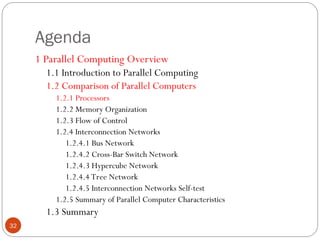
#### **Slide 2: Agenda**
* **Title:** **What We'll Cover Today**
* **Visual:** Simple icons next to each agenda item.
* **Content (Bulleted List with Icons):**
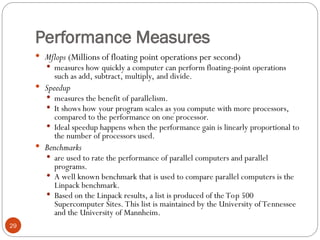
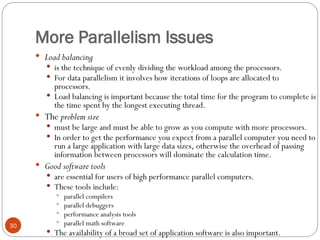
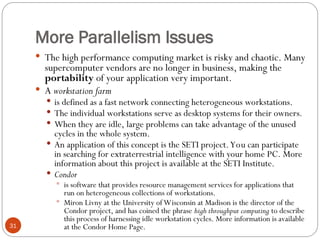
* The Need for Speed: Why Go Beyond a Single CPU?
* Core Concepts: Parallel vs. Distributed Computing
* Parallel Computing: Deep Dive (Architectures, Models)
* Distributed Computing: Deep Dive (Key Characteristics, Examples)
* How They Work Together: Hybrid Models
* Real-World Applications
* Key Challenges and The Future
* **Speaker Notes:** "This presentation will give you a foundational understanding of these two critical fields, how they differ, and how they power the technology we use every day."
---
#### **Slide 3: The Need for Speed: The Sequential Bottleneck**
* **Title:** **Why Can't We Just Use Faster CPUs?**
* **Visual:** A graph showing the end of "Denard Scaling" (the breakdown of Moore's Law in terms of clock speed). Show a single, overwhelmed CPU core with a queue of tasks.
*