- a group of sentences organized around a central topic.
“A solidly written paragraph takes its readers
on a clear path, without detours.”
1
2
Topic Sentence - tells the reader what the paragraph is
going to be about.
- It also helps the writing under control.
- sometimes called the “controlling idea" of a paragraph.
1
2
Supporting Sentence – make the topic more interesting or
help explain it more clearly .
- It helps support a topic sentence through providing sensory
details, facts, or examples that expand upon, explain, or prove a
paragraph’s main idea or topic sentence.
Clincher/Concluding Sentence –provides a logical conclusion
based on the information found in the supporting sentences.
-also used to cement the main idea in the reader’s mind.3
My mother is neither tall nor heavy, but she’s the biggest
person in my life. There has been no other person with a greater
influence on me. Most mothers feed, wash, and clothe their
children, and my mother is no exception. But more than this, she
made sure that I received the finest education possible. This
education was not at expensive schools or famous universities,
but at home, by her knee, patiently. My mother explained to me
the difference between right and wrong; the virtues of
generosity, honesty, and hard work; and the importance of
family and social ties. From her I understood who I was, where I
belonged, and how I should spend my energy. No matter how big I
might grow to be, I hope to be as great as my mother.
3
Topic Sentence
Supporting Sentence
Clincher
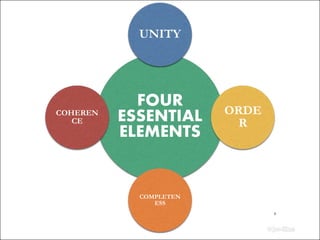
FOUR
ESSENTIAL
ELEMENTS
UNITY
ORDE
R
COMPLETEN
ESS
COHEREN
CE
4
UNITY
• Refers to the extent to which all of the
ideas contained within a given paragraph
‘hang together’ in a way that is easy for the
reader to understand.
• Unity in a paragraph begins with the topic
sentence.
5
6
ORDER
• Refers to the way you organize your supporting
sentences.
Whether in chronological order, order of importance,
or another logical presentation detail.
• Helps the reader grasp the meaning and avoid
confusion
COHERENCE
• The quality the makes your writing
understandable.
• Closely related to UNITY.
• Uses transition words that show order (first
second, third); logic (furthermore, in addition, in
fact)
Paragraphs need to connect each other and work together as a whole.
7
8
COMPLETENESS
• Completeness means a paragraph is well-
developed.
• All sentences should clearly and sufficiently
support the main idea.
9
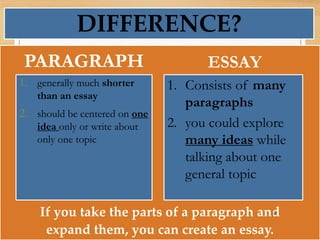
Paragraph writing is the
foundation of all essay
writing, whether the form
is expository, persuasive,
narrative, etc.
If you take the parts of a paragraph and
expand them, you can create an essay.
ESSAY
1. generally much shorter
than an essay
2. should be centered on one
idea only or write about
only one topic
10
1. Consists of many
paragraphs
2. you could explore
many ideas while
talking about one
general topic
PARAGRAPH
DIFFERENCE?
11
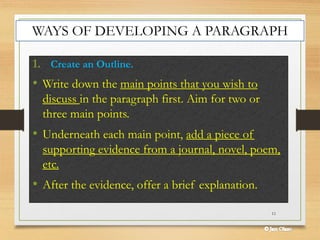
1. Create an Outline.
• Write down the main points that you wish to
discuss in the paragraph first. Aim for two or
three main points.
• Underneath each main point, add a piece of
supporting evidence from a journal, novel, poem,
etc.
• After the evidence, offer a brief explanation.
WAYS OF DEVELOPING A PARAGRAPH
12
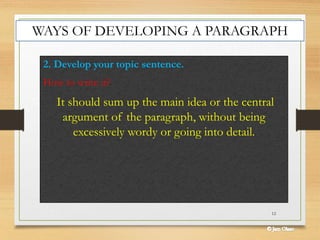
2. Develop your topic sentence.
How to write it?
It should sum up the main idea or the central
argument of the paragraph, without being
excessively wordy or going into detail.
WAYS OF DEVELOPING A PARAGRAPH
13
.
3. Give supporting details
For example, a piece of support in an essay about drug
usage could read, "Drug usage is becoming an increasing
problem in the United States." After that, introduce a
statistic showing the rise of drug usage over the last
decade.
• Use quotations and evidence. Analyze these and/or give further
explanation for their relevance or connection to the topic.
WAYS OF DEVELOPING A PARAGRAPH
14
.
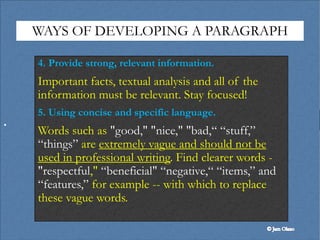
4. Provide strong, relevant information.
Important facts, textual analysis and all of the
information must be relevant. Stay focused!
5. Using concise and specific language.
Words such as "good," "nice," "bad,“ “stuff,”
“things” are extremely vague and should not be
used in professional writing. Find clearer words -
"respectful," “beneficial" “negative,“ “items,” and
“features,” for example -- with which to replace
these vague words.
WAYS OF DEVELOPING A PARAGRAPH
6. Use colorful and clear words.
Furthermore, do not use confusing words or words whose
meaning you are not sure of, because your lack of
understanding will translate to the reader.
7. Craft a strong conclusion statement.
At the end of one paragraph, suggest that there is another
idea that piggybacks on top of the one that you have
discussed, or state that there are some disagreeing ideas in
the field.
15
WAYS OF DEVELOPING A PARAGRAPH
8. Utilize appropriate transition words
Ex: Order (first,second,last),
Spatial Relationships (above, below),
Logic (furthermore, in addition, in fact), etc.
9. Edit for correct grammar and mechanics.
Ensure that your paper is free of mistakes in spelling,
capitalization, punctuation, verb tense, word choice and
syntax.
16
WAYS OF DEVELOPING A PARAGRAPH

Paragraphs

  • 1.
    - a groupof sentences organized around a central topic. “A solidly written paragraph takes its readers on a clear path, without detours.” 1
  • 2.
    2 Topic Sentence -tells the reader what the paragraph is going to be about. - It also helps the writing under control. - sometimes called the “controlling idea" of a paragraph. 1 2 Supporting Sentence – make the topic more interesting or help explain it more clearly . - It helps support a topic sentence through providing sensory details, facts, or examples that expand upon, explain, or prove a paragraph’s main idea or topic sentence. Clincher/Concluding Sentence –provides a logical conclusion based on the information found in the supporting sentences. -also used to cement the main idea in the reader’s mind.3
  • 3.
    My mother isneither tall nor heavy, but she’s the biggest person in my life. There has been no other person with a greater influence on me. Most mothers feed, wash, and clothe their children, and my mother is no exception. But more than this, she made sure that I received the finest education possible. This education was not at expensive schools or famous universities, but at home, by her knee, patiently. My mother explained to me the difference between right and wrong; the virtues of generosity, honesty, and hard work; and the importance of family and social ties. From her I understood who I was, where I belonged, and how I should spend my energy. No matter how big I might grow to be, I hope to be as great as my mother. 3 Topic Sentence Supporting Sentence Clincher
  • 4.
  • 5.
    UNITY • Refers tothe extent to which all of the ideas contained within a given paragraph ‘hang together’ in a way that is easy for the reader to understand. • Unity in a paragraph begins with the topic sentence. 5
  • 6.
    6 ORDER • Refers tothe way you organize your supporting sentences. Whether in chronological order, order of importance, or another logical presentation detail. • Helps the reader grasp the meaning and avoid confusion
  • 7.
    COHERENCE • The qualitythe makes your writing understandable. • Closely related to UNITY. • Uses transition words that show order (first second, third); logic (furthermore, in addition, in fact) Paragraphs need to connect each other and work together as a whole. 7
  • 8.
    8 COMPLETENESS • Completeness meansa paragraph is well- developed. • All sentences should clearly and sufficiently support the main idea.
  • 9.
    9 Paragraph writing isthe foundation of all essay writing, whether the form is expository, persuasive, narrative, etc.
  • 10.
    If you takethe parts of a paragraph and expand them, you can create an essay. ESSAY 1. generally much shorter than an essay 2. should be centered on one idea only or write about only one topic 10 1. Consists of many paragraphs 2. you could explore many ideas while talking about one general topic PARAGRAPH DIFFERENCE?
  • 11.
    11 1. Create anOutline. • Write down the main points that you wish to discuss in the paragraph first. Aim for two or three main points. • Underneath each main point, add a piece of supporting evidence from a journal, novel, poem, etc. • After the evidence, offer a brief explanation. WAYS OF DEVELOPING A PARAGRAPH
  • 12.
    12 2. Develop yourtopic sentence. How to write it? It should sum up the main idea or the central argument of the paragraph, without being excessively wordy or going into detail. WAYS OF DEVELOPING A PARAGRAPH
  • 13.
    13 . 3. Give supportingdetails For example, a piece of support in an essay about drug usage could read, "Drug usage is becoming an increasing problem in the United States." After that, introduce a statistic showing the rise of drug usage over the last decade. • Use quotations and evidence. Analyze these and/or give further explanation for their relevance or connection to the topic. WAYS OF DEVELOPING A PARAGRAPH
  • 14.
    14 . 4. Provide strong,relevant information. Important facts, textual analysis and all of the information must be relevant. Stay focused! 5. Using concise and specific language. Words such as "good," "nice," "bad,“ “stuff,” “things” are extremely vague and should not be used in professional writing. Find clearer words - "respectful," “beneficial" “negative,“ “items,” and “features,” for example -- with which to replace these vague words. WAYS OF DEVELOPING A PARAGRAPH
  • 15.
    6. Use colorfuland clear words. Furthermore, do not use confusing words or words whose meaning you are not sure of, because your lack of understanding will translate to the reader. 7. Craft a strong conclusion statement. At the end of one paragraph, suggest that there is another idea that piggybacks on top of the one that you have discussed, or state that there are some disagreeing ideas in the field. 15 WAYS OF DEVELOPING A PARAGRAPH
  • 16.
    8. Utilize appropriatetransition words Ex: Order (first,second,last), Spatial Relationships (above, below), Logic (furthermore, in addition, in fact), etc. 9. Edit for correct grammar and mechanics. Ensure that your paper is free of mistakes in spelling, capitalization, punctuation, verb tense, word choice and syntax. 16 WAYS OF DEVELOPING A PARAGRAPH