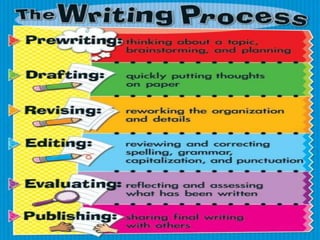
Introduction
Unit 1
Think about These Questions:
• Why do we write?
• Why is writing important?
• What kind of writing are we doing?
• Are we writing for others or ourselves?
• What are the kinds of writing?
• One kind of writing is a PARAGRAPH.
• What is the paragraph??
• A paragraph is a group of sentences about a
topic ( the main idea ).
• How many kinds of writing do we usually have?
• 1- A descriptive paragraph : the writer describes
a person, a place, or a thing.
• 2- An example paragraph: the writer explains a
topic by giving examples.
• 3- A process paragraph: the writer explains how
to do something step by step.
• 4- An opinion paragraph: the writer expresses his
or her feelings, ideas, and opinions about a topic.
• 5- A narrative paragraph: the writer tells a story.
How do we write a paragraph?
• Formatting a paragraph:
• 1- Margins:
• A paragraph must have a margin on the right
and a margin on the left. This means that the
paragraph begins 1 inch or 1 ¼ inches from
edge of the paper.
• 2- Spacing:
• A paragraph should be double-spaced
• 3- Indenting:
• The first sentence of a paragraph must be
indented. This means that it begins five spaces
in from the left margin. Indenting shows the
reader that a new paragraph is beginning.
• 4- Connected sentences:
• The sentences in a paragraph should follow each
other. It is not a paragraph if every sentence
begins on a new line. A well-supported paragraph
has at least 5 sentences and often more.
• 5- Title:
• A paragraph by itself usually has a title. This is
one word or a group of words that tells what the
topic is.
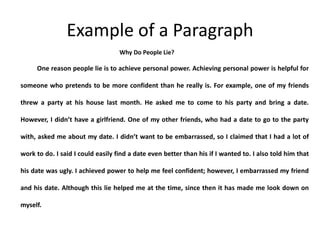
Example of a Paragraph
Why Do People Lie?
One reason people lie is to achieve personal power. Achieving personal power is helpful for
someone who pretends to be more confident than he really is. For example, one of my friends
threw a party at his house last month. He asked me to come to his party and bring a date.
However, I didn’t have a girlfriend. One of my other friends, who had a date to go to the party
with, asked me about my date. I didn’t want to be embarrassed, so I claimed that I had a lot of
work to do. I said I could easily find a date even better than his if I wanted to. I also told him that
his date was ugly. I achieved power to help me feel confident; however, I embarrassed my friend
and his date. Although this lie helped me at the time, since then it has made me look down on
myself.
Developing a Paragraph
Part 2
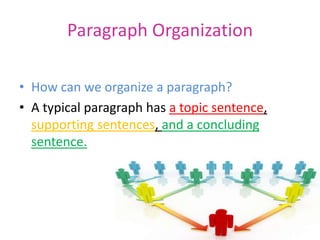
Paragraph Organization
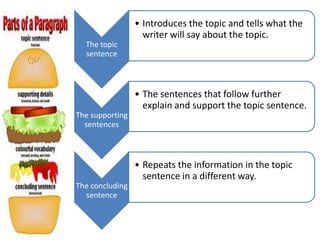
• How can we organize a paragraph?
• A typical paragraph has a topic sentence,
supporting sentences, and a concluding
sentence.
The topic
sentence
• Introduces the topic and tells what the
writer will say about the topic.
The supporting
sentences
• The sentences that follow further
explain and support the topic sentence.
The concluding
sentence
• Repeats the information in the topic
sentence in a different way.
An example of a Paragraph
Organization
• Exercise 2 - Page 6
The Topic Sentence:
• The topic sentence is usually the first or the
second sentence in a paragraph.
• It introduces a new idea. It presents the topic
and explains what the writer will say about
the topic.
• This explanation is called the controlling idea.
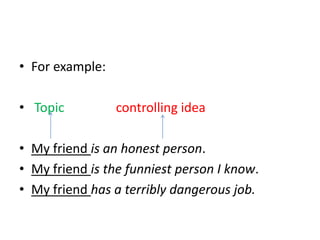
• For example:
• Topic controlling idea
• My friend is an honest person.
• My friend is the funniest person I know.
• My friend has a terribly dangerous job.
What should we write in a topic
sentence?
• 1- A topic sentence must not be a simple fact
or a specific detail.
• 2- The controlling idea must say something
about the topic that can then be supported,
developed, or demonstrated in the supporting
sentences.
• 3- The controlling idea must also not be too
general or unclear.
• As instance:
• A surprise party is a kind of party. ( too general).
• There were 14 guests at my surprise birthday
party. ( too specific).
• My classmates gave me an unforgettable surprise
party for my 18th birthday. 
• Do exercises 3-5 on page 7
Supporting Sentences
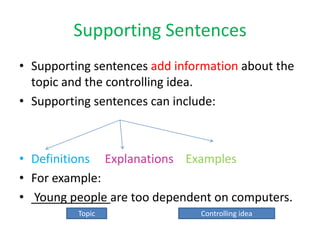
• Supporting sentences add information about the
topic and the controlling idea.
• Supporting sentences can include:
• Definitions Explanations Examples
• For example:
• Young people are too dependent on computers.
Topic Controlling idea
• See examples on page 8 and answer the
exercises.
Concluding Sentence
• The concluding, or final, sentence of a
paragraph usually reminds the reader of the
topic and controlling idea of the paragraph.
• The concluding sentence restates the main
idea.
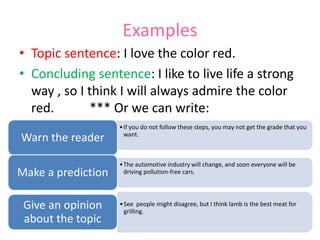
Examples
• Topic sentence: I love the color red.
• Concluding sentence: I like to live life a strong
way , so I think I will always admire the color
red. *** Or we can write:
•If you do not follow these steps, you may not get the grade that you
want.
Warn the reader
•The automotive industry will change, and soon everyone will be
driving pollution-free cars.Make a prediction
•See people might disagree, but I think lamb is the best meat for
grilling.
Give an opinion
about the topic
• Sometimes writers signal the concluding
sentence by using the phrase in conclusion
• For example:
• In conclusion, learning a second language has
many advantages.
• Exercise 7+8 on page 11 
Unity and Coherence
Part 3
Unity within a Paragraph
• 1- A paragraph must have unity.
• 2- A paragraph has unity when all the sentences support a single
idea.
• 3- The paragraph must have one controlling idea in the topic
sentence. Otherwise the paragraph loses focus.
• 4- The supporting sentences must support or explain the
controlling idea with examples, details, steps, or definitions.
Otherwise, the paragraph will not be about one single idea.
• 5- The concluding sentence should restate the idea in the topic
sentence. Otherwise the main idea might not be clear.
Examples
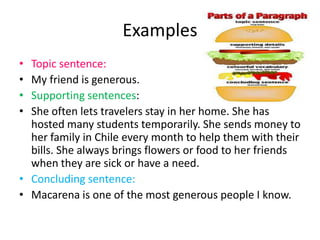
• Topic sentence:
• My friend is generous.
• Supporting sentences:
• She often lets travelers stay in her home. She has
hosted many students temporarily. She sends money to
her family in Chile every month to help them with their
bills. She always brings flowers or food to her friends
when they are sick or have a need.
• Concluding sentence:
• Macarena is one of the most generous people I know.
• Exercise 1& 2 on page 13
Coherence within a Paragraph
• A paragraph must also have coherence. This
means that the supporting details are
organized so that information that goes
together appears together.
• writers often use
time
space
order of importance
• Read the paragraph 6 on page 17
Editing Your Writing
• A sentence is a statement that expresses a
complete idea.
• Sentences form the building blocks of written
communication.
• They include affirmative statements, negative
statements, and questions.
• A complete sentence must have a subject and
a verb.
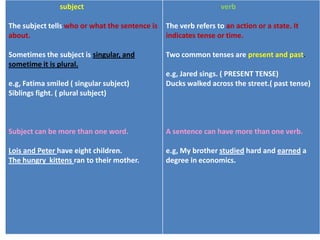
subject
The subject tells who or what the sentence is
about.
Sometimes the subject is singular, and
sometime it is plural.
e.g, Fatima smiled ( singular subject)
Siblings fight. ( plural subject)
Subject can be more than one word.
Lois and Peter have eight children.
The hungry kittens ran to their mother.
verb
The verb refers to an action or a state. It
indicates tense or time.
Two common tenses are present and past.
e.g, Jared sings. ( PRESENT TENSE)
Ducks walked across the street.( past tense)
A sentence can have more than one verb.
e.g, My brother studied hard and earned a
degree in economics.
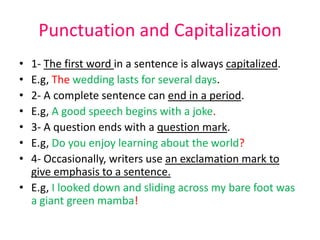
Punctuation and Capitalization
• 1- The first word in a sentence is always capitalized.
• E.g, The wedding lasts for several days.
• 2- A complete sentence can end in a period.
• E.g, A good speech begins with a joke.
• 3- A question ends with a question mark.
• E.g, Do you enjoy learning about the world?
• 4- Occasionally, writers use an exclamation mark to
give emphasis to a sentence.
• E.g, I looked down and sliding across my bare foot was
a giant green mamba!
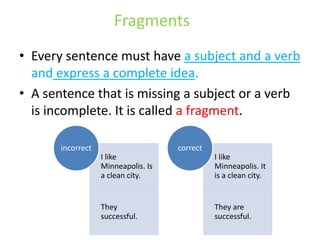
Fragments
• Every sentence must have a subject and a verb
and express a complete idea.
• A sentence that is missing a subject or a verb
is incomplete. It is called a fragment.
I like
Minneapolis. Is
a clean city.
They
successful.
incorrect
I like
Minneapolis. It
is a clean city.
They are
successful.
correct
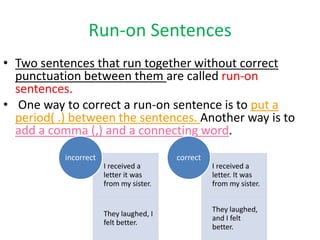
Run-on Sentences
• Two sentences that run together without correct
punctuation between them are called run-on
sentences.
• One way to correct a run-on sentence is to put a
period( .) between the sentences. Another way is to
add a comma (,) and a connecting word.
I received a
letter it was
from my sister.
They laughed, I
felt better.
incorrect
I received a
letter. It was
from my sister.
They laughed,
and I felt
better.
correct
Part 5
• Do some exercises
Chapter 1 writing (1)

Chapter 1 writing (1)

  • 1.
  • 2.
    Think about TheseQuestions: • Why do we write? • Why is writing important? • What kind of writing are we doing? • Are we writing for others or ourselves? • What are the kinds of writing?
  • 3.
    • One kindof writing is a PARAGRAPH. • What is the paragraph?? • A paragraph is a group of sentences about a topic ( the main idea ).
  • 4.
    • How manykinds of writing do we usually have? • 1- A descriptive paragraph : the writer describes a person, a place, or a thing. • 2- An example paragraph: the writer explains a topic by giving examples. • 3- A process paragraph: the writer explains how to do something step by step. • 4- An opinion paragraph: the writer expresses his or her feelings, ideas, and opinions about a topic. • 5- A narrative paragraph: the writer tells a story.
  • 5.
    How do wewrite a paragraph? • Formatting a paragraph: • 1- Margins: • A paragraph must have a margin on the right and a margin on the left. This means that the paragraph begins 1 inch or 1 ¼ inches from edge of the paper.
  • 6.
    • 2- Spacing: •A paragraph should be double-spaced • 3- Indenting: • The first sentence of a paragraph must be indented. This means that it begins five spaces in from the left margin. Indenting shows the reader that a new paragraph is beginning.
  • 7.
    • 4- Connectedsentences: • The sentences in a paragraph should follow each other. It is not a paragraph if every sentence begins on a new line. A well-supported paragraph has at least 5 sentences and often more. • 5- Title: • A paragraph by itself usually has a title. This is one word or a group of words that tells what the topic is.
  • 8.
    Example of aParagraph Why Do People Lie? One reason people lie is to achieve personal power. Achieving personal power is helpful for someone who pretends to be more confident than he really is. For example, one of my friends threw a party at his house last month. He asked me to come to his party and bring a date. However, I didn’t have a girlfriend. One of my other friends, who had a date to go to the party with, asked me about my date. I didn’t want to be embarrassed, so I claimed that I had a lot of work to do. I said I could easily find a date even better than his if I wanted to. I also told him that his date was ugly. I achieved power to help me feel confident; however, I embarrassed my friend and his date. Although this lie helped me at the time, since then it has made me look down on myself.
  • 10.
  • 11.
    Paragraph Organization • Howcan we organize a paragraph? • A typical paragraph has a topic sentence, supporting sentences, and a concluding sentence.
  • 12.
    The topic sentence • Introducesthe topic and tells what the writer will say about the topic. The supporting sentences • The sentences that follow further explain and support the topic sentence. The concluding sentence • Repeats the information in the topic sentence in a different way.
  • 13.
    An example ofa Paragraph Organization • Exercise 2 - Page 6
  • 14.
    The Topic Sentence: •The topic sentence is usually the first or the second sentence in a paragraph. • It introduces a new idea. It presents the topic and explains what the writer will say about the topic. • This explanation is called the controlling idea.
  • 15.
    • For example: •Topic controlling idea • My friend is an honest person. • My friend is the funniest person I know. • My friend has a terribly dangerous job.
  • 16.
    What should wewrite in a topic sentence? • 1- A topic sentence must not be a simple fact or a specific detail. • 2- The controlling idea must say something about the topic that can then be supported, developed, or demonstrated in the supporting sentences. • 3- The controlling idea must also not be too general or unclear.
  • 17.
    • As instance: •A surprise party is a kind of party. ( too general). • There were 14 guests at my surprise birthday party. ( too specific). • My classmates gave me an unforgettable surprise party for my 18th birthday.  • Do exercises 3-5 on page 7
  • 18.
    Supporting Sentences • Supportingsentences add information about the topic and the controlling idea. • Supporting sentences can include: • Definitions Explanations Examples • For example: • Young people are too dependent on computers. Topic Controlling idea
  • 19.
    • See exampleson page 8 and answer the exercises.
  • 20.
    Concluding Sentence • Theconcluding, or final, sentence of a paragraph usually reminds the reader of the topic and controlling idea of the paragraph. • The concluding sentence restates the main idea.
  • 21.
    Examples • Topic sentence:I love the color red. • Concluding sentence: I like to live life a strong way , so I think I will always admire the color red. *** Or we can write: •If you do not follow these steps, you may not get the grade that you want. Warn the reader •The automotive industry will change, and soon everyone will be driving pollution-free cars.Make a prediction •See people might disagree, but I think lamb is the best meat for grilling. Give an opinion about the topic
  • 22.
    • Sometimes writerssignal the concluding sentence by using the phrase in conclusion • For example: • In conclusion, learning a second language has many advantages. • Exercise 7+8 on page 11 
  • 23.
  • 24.
    Unity within aParagraph • 1- A paragraph must have unity. • 2- A paragraph has unity when all the sentences support a single idea. • 3- The paragraph must have one controlling idea in the topic sentence. Otherwise the paragraph loses focus. • 4- The supporting sentences must support or explain the controlling idea with examples, details, steps, or definitions. Otherwise, the paragraph will not be about one single idea. • 5- The concluding sentence should restate the idea in the topic sentence. Otherwise the main idea might not be clear.
  • 25.
    Examples • Topic sentence: •My friend is generous. • Supporting sentences: • She often lets travelers stay in her home. She has hosted many students temporarily. She sends money to her family in Chile every month to help them with their bills. She always brings flowers or food to her friends when they are sick or have a need. • Concluding sentence: • Macarena is one of the most generous people I know.
  • 26.
    • Exercise 1&2 on page 13
  • 27.
    Coherence within aParagraph • A paragraph must also have coherence. This means that the supporting details are organized so that information that goes together appears together. • writers often use time space order of importance
  • 28.
    • Read theparagraph 6 on page 17
  • 29.
    Editing Your Writing •A sentence is a statement that expresses a complete idea. • Sentences form the building blocks of written communication. • They include affirmative statements, negative statements, and questions. • A complete sentence must have a subject and a verb.
  • 30.
    subject The subject tellswho or what the sentence is about. Sometimes the subject is singular, and sometime it is plural. e.g, Fatima smiled ( singular subject) Siblings fight. ( plural subject) Subject can be more than one word. Lois and Peter have eight children. The hungry kittens ran to their mother. verb The verb refers to an action or a state. It indicates tense or time. Two common tenses are present and past. e.g, Jared sings. ( PRESENT TENSE) Ducks walked across the street.( past tense) A sentence can have more than one verb. e.g, My brother studied hard and earned a degree in economics.
  • 31.
    Punctuation and Capitalization •1- The first word in a sentence is always capitalized. • E.g, The wedding lasts for several days. • 2- A complete sentence can end in a period. • E.g, A good speech begins with a joke. • 3- A question ends with a question mark. • E.g, Do you enjoy learning about the world? • 4- Occasionally, writers use an exclamation mark to give emphasis to a sentence. • E.g, I looked down and sliding across my bare foot was a giant green mamba!
  • 32.
    Fragments • Every sentencemust have a subject and a verb and express a complete idea. • A sentence that is missing a subject or a verb is incomplete. It is called a fragment. I like Minneapolis. Is a clean city. They successful. incorrect I like Minneapolis. It is a clean city. They are successful. correct
  • 33.
    Run-on Sentences • Twosentences that run together without correct punctuation between them are called run-on sentences. • One way to correct a run-on sentence is to put a period( .) between the sentences. Another way is to add a comma (,) and a connecting word. I received a letter it was from my sister. They laughed, I felt better. incorrect I received a letter. It was from my sister. They laughed, and I felt better. correct
  • 34.
    Part 5 • Dosome exercises