PARAFFIN WAX
THERAPY
©2020 Rohit Bhaskar PT 1
 WAX:
 Paraffin wax approx: 54c contained with
mineral oil such as liquid paraffin to
produce temperature controlled bath
at a temp b/w 42 to 50c.
 These temperature are higher slightly
than would be tolerated if placed in
hot water.
 Specific heat of paraffin wax is less than of
water (2.72kj/per degree for wax and 4.2
kj/per k for water).
©2020 Rohit Bhaskar PT 2
WAX THERAPY
 Wax therapy, which uses a bath of molten
paraffin wax, is one of the most effective
ways of applying heat to improve mobility
by warming the connective tissues. Wax
therapy is mainly used on your hands
along with an exercise program.
©2020 Rohit Bhaskar PT 3
•
•
The temperature of the paraffin wax is maintained
at 47 - 55°c.
In the case of parraffin, it provides superficial heat
with a depth of 1 cm.
•
•
COMPOSITION:
It is a combined immersion technique with
Paraffin wax + mineral oilfor conductive heat
gains.
For therapeutic use:
– 7 units of wax ---------1unit mineraloil.
– The paraffin wax is then kept at low
temperature and remains warm for a longer
time than water.
©2020 Rohit Bhaskar PT 4
Principal of wax therapy
 The mode of the transmission of heat
(heat exchange) from paraffin to the
patient skin is by conduction method.
©2020 Rohit Bhaskar PT 5
Characteristics of wax
 Low thermal conductivity , provides superficial
heat with a depth of 1 cm.
 Gives of heat very slowly – no rapid loss of heat.
 Temperature is maintained at 47 - 55°c.
 Melting point of wax is 55˚C.
 It is self insulating. (The first layer creates a thin
layer of air next to the skin which acts as an
insulator)
©2020 Rohit Bhaskar PT 6
Parts of Paraffin Bath unit
 Container,
 Mains,
 Thermostat,
 Thermostat pilot lamp,
 Power pilot lamp,
 Lid, and
 Caster.
©2020 Rohit Bhaskar PT 7
Care of apparatus
 Clean part before immersion.
 Clean unit regularly.
 Remove wax from unit.
 Remove slat from bottom and clean.
 Remove residual wax with paper towel.
 The complete wax & oil should be
changed every six months.
©2020 Rohit Bhaskar PT 8
PHYSIOLOGICAL EFFECTS :
 1.Heat production:
 There is a marked increase in skin temperature in the
1st two minute, up to 12-13°c. This drop, while in the
wax wrapping to an increase of about 8°c at the
end of 30 minutes.
 In the subcutaneous fascia, there is an increase of 5°c
at
the end of the treatment.
 In the superficial muscles, is only about 2-3°c
rise in temperature at the end of the
treatment.
 2. Circulating effect:
 Stimulation of superficial capillaries and arterioles
cause local hyperaemia and reflex vasodilatation.
This is marked only in the region of the skin.
©2020 Rohit Bhaskar PT 9
• The hyperaemia is due to response of the skin to
its function of heat regulation.
• The effects of vasodilatation in the muscle are
negligible, but then may be some reflex heating
in the joints.
• Skin and subcutaneous tissue temperature drop
after15-20 minute, reducing the vasodilatation.
• Exercise after the wax is essential to increase the
muscle circulation and sedative effect of heat to
obtain more range of movement and muscle
strength.
©2020 Rohit Bhaskar PT 10
• 3. Analgesic effect:
• The most important effect of wax its marked sedative effect
onthe tissue.
• The moist heat is remarkable soothing to thepatient.
• It is this effect that is used prior to the exercise, in the
treatment of superficially placed joints.
• It is very comfortable to the patient.
• 4. Stretching effect:
• Wax leaves the skin moist, soft and pliable.
• This is useful for stretching scar and adhesion before
applying mobilization techniques.
©2020 Rohit Bhaskar PT 11
Indications:
1. Pain and Muscle Spasm:
2. Oedema and Inflammation:
3. Adhesions and Scars:
©2020 Rohit Bhaskar PT 12
Contrindications:
1. Impaire skin sensation (hot/cold sensation test):
anaesthesia, hypostasia, hyperesthesia, parastesia.
2. Some dermatological conditions: eczema,dermatis.
(report any reactions after ttt).
3. Circulatory dysfunction ( varicose veins, DVT, arterial
disease)
4. Analgesic drugs as pain tolerance to heat is impaired.
5. Infections and open wounds ( as it increases the
infective activity) such as in blood born infections.
©2020 Rohit Bhaskar PT 13
Cont…
6. Cancer, tumors or tuberculosis ( TB) in the area tobe treated as it ↑
the metabolic activity & rate of growth.
7. Gross oedema with a very thin and delicate skin covering the area .
8. Lack of comprehension ( children, senile , head injuries,
confused, agitated,…)
9. Deep X~ray therapy within three months prior to treatment
↓ bloodflow thus impaired sensation.
10. External or internal metal fixators, implants (metal plates in orthopedics).
15
©2020 Rohit Bhaskar PT 14
Advantages:
 2 or 3 patients can be treated in the same
time.
 Useful for pt. with poor heat tolerance, dry
scaly skins, after Plaster of Paris removal.
 Can be followed by therapeutic exercises.
 Can be carried out at home.
 Wax can mold around the bony contours of
feet & hands.
 Heat is applied evenly by conduction.
©2020 Rohit Bhaskar PT 15
Disadvantages:
1. Effective only for distal extremities in the terms of ease of
application.
2. No method of temperature controls once applied.
3. Sedimentation occurs at the bottom.
4.It is a passive treatment: exercise may not be performed
simultaneously.
5.The bath must be cleaned regularly & emptied at least twice a year.
6. Contamination of oil by atmospheric dust.
7. It also poses environmental concerns regarding its disposal.
©2020 Rohit Bhaskar PT 16
PARAFFIN WAX
 Along with the use of hydrotherapy, the use of
paraffin wax therapy can be traced all the
way back to Roman Empire.
 In those ancient times, the Roman would pour hot
waxes on the body in preparation for message
therapy.
 Later the French embraced paraffin therapy by
melting paraffin wax and spreading it on wounds
to accelerate healing.
 In world War I, the British used paraffin wax therapy
as a protocol to treat orthopedic disorders in
military hospitals.
©2020 Rohit Bhaskar PT 17
 In modern times, paraffin therapy is quite common and widely used
to aid in the treatment of conditions such as the following:
 Arthritis
 Bursitis
 Eczema
 Fibromyalgia
 Inflammation
 Muscle spasms
 Overworked/fatigued muscle
 Psoriasis
 Scar Tissue
 Stiff Joints
 Tendonitis
 Tennis Elbow
©2020 Rohit Bhaskar PT 18
Paraffin Wax:
 The melted wax needs to be maintained at a temperature
of 40°C - 45°C for treatment purposes.
 The temperature of the wax must be checked
before treatment is given.
 This method of heating the tissue has the
advantage that it is the most convenient way of
applying conducted heat to the extremities.
 As the wax solidifies from its molten state it releases
its energy of latent heat and this heat energy is
conducted into the tissue.
 The composition of solid wax , liquid paraffin ,
petroleum jelly 7:3:1.
©2020 Rohit Bhaskar PT 19
METHODS OF PARAFFIN WAX
BATH/DIP METHOD:
 The part to be treated must be clean and free
from cuts, rashes or infection.
 Fingers apart, dip hand and remove.
 Wait, harden and opaque
 Redip 6 to 10 times.
 Wrap in plastic bags, wax paper then towel.
 Don't move hand during dipping or rest which
prevent to crack coating and allow air to
penetrate and cool rapidly..
©2020 Rohit Bhaskar PT 20
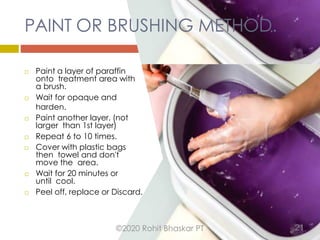
PAINT OR BRUSHING METHOD.
 Paint a layer of paraffin
onto treatment area with
a brush.
 Wait for opaque and
harden.
 Paint another layer. (not
larger than 1st layer)
 Repeat 6 to 10 times.
 Cover with plastic bags
then towel and don't
move the area.
 Wait for 20 minutes or
until cool.
 Peel off, replace or Discard.
©2020 Rohit Bhaskar PT 21
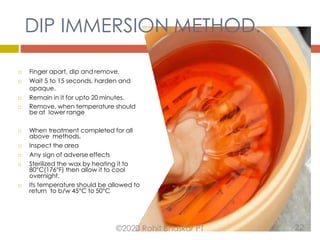
DIP IMMERSION METHOD.
 Finger apart, dip and remove.
 Wait 5 to 15 seconds, harden and
opaque.
 Remain in it for upto 20 minutes.
 Remove, when temperature should
be at lower range
 When treatment completed for all
above methods,
 Inspect the area
 Any sign of adverse effects
 Sterilized the wax by heating it to
80°C(176°F) then allow it to cool
overnight.
 Its temperature should be allowed to
return to b/w 45°C to 50°C
©2020 Rohit Bhaskar PT 22
DIRECT POURING METHOD.
 The molten wax is directly poured by
a mug or utensil on the part to be
treated and wrapped around a
towel.
 The wax is allowed to solidify for
about 10-12 minutes.
©2020 Rohit Bhaskar PT 23
TOWELLING OR BANDAGING METHOD.
 A towel or roll of bandage is immersed in in
molten paraffin wax and then wrapped
around body part.
 This method usually used for treating
proximal parts of the body.
©2020 Rohit Bhaskar PT 24
Physiological effects
 Increase metabolic activity
 Increase blood supply
 Increase tissue fluid exchange
 Nerve stimulation
 Decrease viscosity
 Increase extensibility of collagen
©2020 Rohit Bhaskar PT 25
Therapeutic uses
 Encourage healing
 Decrease edema
 Decrease pain
 Decrease muscle spasm
 Increase joint range
 Precursor to stretching
©2020 Rohit Bhaskar PT 26
Advantages
 Maintain good contact with highly
contoured areas
 Easy to use
 Inexpensive
 Body part can be elevated.
 Oil lubricate and conditions the skin
 Can be used by the patient at home
©2020 Rohit Bhaskar PT 27
Disadvantages
 Messy and time consuming to apply
 Cannot be used an open skin lesions as it
may contaminate the lesion
 Risk of cross contamination if
paraffin is reused.
 Part in depended position for dip
immersion method.
©2020 Rohit Bhaskar PT 28
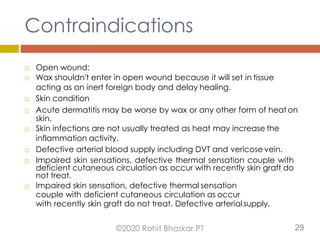
Contraindications
 Open wound:
 Wax shouldn't enter in open wound because it will set in tissue
acting as an inert foreign body and delay healing.
 Skin condition
 Acute dermatitis may be worse by wax or any other form of heat on
skin.
 Skin infections are not usually treated as heat may increase the
inflammation activity.
 Defective arterial blood supply including DVT and vericose vein.
 Impaired skin sensations, defective thermal sensation couple with
deficient cutaneous circulation as occur with recently skin graft do
not treat.
 Impaired skin sensation, defective thermal sensation
couple with deficient cutaneous circulation as occur
with recently skin graft do not treat. Defective arterial supply.
©2020 Rohit Bhaskar PT 29
EFFECTS OF PARAFFIN
 Marked increase in the temperature of skin
 Less increase in other superficial tissue.
 CIRCULATORY EFFECTS:
 Stimulating of Superficial capillaries and arterioles
causing local hyperemia and reflex vasodilation.
 Neurogenic vasodilation due to the action of
vasodilator formed as a result of sweat gland
activity.
©2020 Rohit Bhaskar PT 30
 EFFECTS ON SKIN:
 Skin become moist and soft after wax application
which helps to soften adhesions and scars in the
skin prior to mobilizing and stretching procedures.
 EFFECTS ON SENSORY NERVES:
 Mild heating appears to have a sedative effect on
sensory nerve endings.
 In RA or degenerative joint diseases, decrease
pain and muscle spasm.
©2020 Rohit Bhaskar PT 31
DANGER
 Inflammable, if it becomes overheated
for precaution have Fire blanket,
Suitable CO2 or Foam extinguisher.
©2020 Rohit Bhaskar PT 32
©2020 Rohit Bhaskar PT 33
THANK YOU

Wax Therapy - Techniques, Indiactions and Contraindications - Dr Rohit Bhaskar

  • 1.
  • 2.
     WAX:  Paraffinwax approx: 54c contained with mineral oil such as liquid paraffin to produce temperature controlled bath at a temp b/w 42 to 50c.  These temperature are higher slightly than would be tolerated if placed in hot water.  Specific heat of paraffin wax is less than of water (2.72kj/per degree for wax and 4.2 kj/per k for water). ©2020 Rohit Bhaskar PT 2
  • 3.
    WAX THERAPY  Waxtherapy, which uses a bath of molten paraffin wax, is one of the most effective ways of applying heat to improve mobility by warming the connective tissues. Wax therapy is mainly used on your hands along with an exercise program. ©2020 Rohit Bhaskar PT 3
  • 4.
    • • The temperature ofthe paraffin wax is maintained at 47 - 55°c. In the case of parraffin, it provides superficial heat with a depth of 1 cm. • • COMPOSITION: It is a combined immersion technique with Paraffin wax + mineral oilfor conductive heat gains. For therapeutic use: – 7 units of wax ---------1unit mineraloil. – The paraffin wax is then kept at low temperature and remains warm for a longer time than water. ©2020 Rohit Bhaskar PT 4
  • 5.
    Principal of waxtherapy  The mode of the transmission of heat (heat exchange) from paraffin to the patient skin is by conduction method. ©2020 Rohit Bhaskar PT 5
  • 6.
    Characteristics of wax Low thermal conductivity , provides superficial heat with a depth of 1 cm.  Gives of heat very slowly – no rapid loss of heat.  Temperature is maintained at 47 - 55°c.  Melting point of wax is 55˚C.  It is self insulating. (The first layer creates a thin layer of air next to the skin which acts as an insulator) ©2020 Rohit Bhaskar PT 6
  • 7.
    Parts of ParaffinBath unit  Container,  Mains,  Thermostat,  Thermostat pilot lamp,  Power pilot lamp,  Lid, and  Caster. ©2020 Rohit Bhaskar PT 7
  • 8.
    Care of apparatus Clean part before immersion.  Clean unit regularly.  Remove wax from unit.  Remove slat from bottom and clean.  Remove residual wax with paper towel.  The complete wax & oil should be changed every six months. ©2020 Rohit Bhaskar PT 8
  • 9.
    PHYSIOLOGICAL EFFECTS : 1.Heat production:  There is a marked increase in skin temperature in the 1st two minute, up to 12-13°c. This drop, while in the wax wrapping to an increase of about 8°c at the end of 30 minutes.  In the subcutaneous fascia, there is an increase of 5°c at the end of the treatment.  In the superficial muscles, is only about 2-3°c rise in temperature at the end of the treatment.  2. Circulating effect:  Stimulation of superficial capillaries and arterioles cause local hyperaemia and reflex vasodilatation. This is marked only in the region of the skin. ©2020 Rohit Bhaskar PT 9
  • 10.
    • The hyperaemiais due to response of the skin to its function of heat regulation. • The effects of vasodilatation in the muscle are negligible, but then may be some reflex heating in the joints. • Skin and subcutaneous tissue temperature drop after15-20 minute, reducing the vasodilatation. • Exercise after the wax is essential to increase the muscle circulation and sedative effect of heat to obtain more range of movement and muscle strength. ©2020 Rohit Bhaskar PT 10
  • 11.
    • 3. Analgesiceffect: • The most important effect of wax its marked sedative effect onthe tissue. • The moist heat is remarkable soothing to thepatient. • It is this effect that is used prior to the exercise, in the treatment of superficially placed joints. • It is very comfortable to the patient. • 4. Stretching effect: • Wax leaves the skin moist, soft and pliable. • This is useful for stretching scar and adhesion before applying mobilization techniques. ©2020 Rohit Bhaskar PT 11
  • 12.
    Indications: 1. Pain andMuscle Spasm: 2. Oedema and Inflammation: 3. Adhesions and Scars: ©2020 Rohit Bhaskar PT 12
  • 13.
    Contrindications: 1. Impaire skinsensation (hot/cold sensation test): anaesthesia, hypostasia, hyperesthesia, parastesia. 2. Some dermatological conditions: eczema,dermatis. (report any reactions after ttt). 3. Circulatory dysfunction ( varicose veins, DVT, arterial disease) 4. Analgesic drugs as pain tolerance to heat is impaired. 5. Infections and open wounds ( as it increases the infective activity) such as in blood born infections. ©2020 Rohit Bhaskar PT 13
  • 14.
    Cont… 6. Cancer, tumorsor tuberculosis ( TB) in the area tobe treated as it ↑ the metabolic activity & rate of growth. 7. Gross oedema with a very thin and delicate skin covering the area . 8. Lack of comprehension ( children, senile , head injuries, confused, agitated,…) 9. Deep X~ray therapy within three months prior to treatment ↓ bloodflow thus impaired sensation. 10. External or internal metal fixators, implants (metal plates in orthopedics). 15 ©2020 Rohit Bhaskar PT 14
  • 15.
    Advantages:  2 or3 patients can be treated in the same time.  Useful for pt. with poor heat tolerance, dry scaly skins, after Plaster of Paris removal.  Can be followed by therapeutic exercises.  Can be carried out at home.  Wax can mold around the bony contours of feet & hands.  Heat is applied evenly by conduction. ©2020 Rohit Bhaskar PT 15
  • 16.
    Disadvantages: 1. Effective onlyfor distal extremities in the terms of ease of application. 2. No method of temperature controls once applied. 3. Sedimentation occurs at the bottom. 4.It is a passive treatment: exercise may not be performed simultaneously. 5.The bath must be cleaned regularly & emptied at least twice a year. 6. Contamination of oil by atmospheric dust. 7. It also poses environmental concerns regarding its disposal. ©2020 Rohit Bhaskar PT 16
  • 17.
    PARAFFIN WAX  Alongwith the use of hydrotherapy, the use of paraffin wax therapy can be traced all the way back to Roman Empire.  In those ancient times, the Roman would pour hot waxes on the body in preparation for message therapy.  Later the French embraced paraffin therapy by melting paraffin wax and spreading it on wounds to accelerate healing.  In world War I, the British used paraffin wax therapy as a protocol to treat orthopedic disorders in military hospitals. ©2020 Rohit Bhaskar PT 17
  • 18.
     In moderntimes, paraffin therapy is quite common and widely used to aid in the treatment of conditions such as the following:  Arthritis  Bursitis  Eczema  Fibromyalgia  Inflammation  Muscle spasms  Overworked/fatigued muscle  Psoriasis  Scar Tissue  Stiff Joints  Tendonitis  Tennis Elbow ©2020 Rohit Bhaskar PT 18
  • 19.
    Paraffin Wax:  Themelted wax needs to be maintained at a temperature of 40°C - 45°C for treatment purposes.  The temperature of the wax must be checked before treatment is given.  This method of heating the tissue has the advantage that it is the most convenient way of applying conducted heat to the extremities.  As the wax solidifies from its molten state it releases its energy of latent heat and this heat energy is conducted into the tissue.  The composition of solid wax , liquid paraffin , petroleum jelly 7:3:1. ©2020 Rohit Bhaskar PT 19
  • 20.
    METHODS OF PARAFFINWAX BATH/DIP METHOD:  The part to be treated must be clean and free from cuts, rashes or infection.  Fingers apart, dip hand and remove.  Wait, harden and opaque  Redip 6 to 10 times.  Wrap in plastic bags, wax paper then towel.  Don't move hand during dipping or rest which prevent to crack coating and allow air to penetrate and cool rapidly.. ©2020 Rohit Bhaskar PT 20
  • 21.
    PAINT OR BRUSHINGMETHOD.  Paint a layer of paraffin onto treatment area with a brush.  Wait for opaque and harden.  Paint another layer. (not larger than 1st layer)  Repeat 6 to 10 times.  Cover with plastic bags then towel and don't move the area.  Wait for 20 minutes or until cool.  Peel off, replace or Discard. ©2020 Rohit Bhaskar PT 21
  • 22.
    DIP IMMERSION METHOD. Finger apart, dip and remove.  Wait 5 to 15 seconds, harden and opaque.  Remain in it for upto 20 minutes.  Remove, when temperature should be at lower range  When treatment completed for all above methods,  Inspect the area  Any sign of adverse effects  Sterilized the wax by heating it to 80°C(176°F) then allow it to cool overnight.  Its temperature should be allowed to return to b/w 45°C to 50°C ©2020 Rohit Bhaskar PT 22
  • 23.
    DIRECT POURING METHOD. The molten wax is directly poured by a mug or utensil on the part to be treated and wrapped around a towel.  The wax is allowed to solidify for about 10-12 minutes. ©2020 Rohit Bhaskar PT 23
  • 24.
    TOWELLING OR BANDAGINGMETHOD.  A towel or roll of bandage is immersed in in molten paraffin wax and then wrapped around body part.  This method usually used for treating proximal parts of the body. ©2020 Rohit Bhaskar PT 24
  • 25.
    Physiological effects  Increasemetabolic activity  Increase blood supply  Increase tissue fluid exchange  Nerve stimulation  Decrease viscosity  Increase extensibility of collagen ©2020 Rohit Bhaskar PT 25
  • 26.
    Therapeutic uses  Encouragehealing  Decrease edema  Decrease pain  Decrease muscle spasm  Increase joint range  Precursor to stretching ©2020 Rohit Bhaskar PT 26
  • 27.
    Advantages  Maintain goodcontact with highly contoured areas  Easy to use  Inexpensive  Body part can be elevated.  Oil lubricate and conditions the skin  Can be used by the patient at home ©2020 Rohit Bhaskar PT 27
  • 28.
    Disadvantages  Messy andtime consuming to apply  Cannot be used an open skin lesions as it may contaminate the lesion  Risk of cross contamination if paraffin is reused.  Part in depended position for dip immersion method. ©2020 Rohit Bhaskar PT 28
  • 29.
    Contraindications  Open wound: Wax shouldn't enter in open wound because it will set in tissue acting as an inert foreign body and delay healing.  Skin condition  Acute dermatitis may be worse by wax or any other form of heat on skin.  Skin infections are not usually treated as heat may increase the inflammation activity.  Defective arterial blood supply including DVT and vericose vein.  Impaired skin sensations, defective thermal sensation couple with deficient cutaneous circulation as occur with recently skin graft do not treat.  Impaired skin sensation, defective thermal sensation couple with deficient cutaneous circulation as occur with recently skin graft do not treat. Defective arterial supply. ©2020 Rohit Bhaskar PT 29
  • 30.
    EFFECTS OF PARAFFIN Marked increase in the temperature of skin  Less increase in other superficial tissue.  CIRCULATORY EFFECTS:  Stimulating of Superficial capillaries and arterioles causing local hyperemia and reflex vasodilation.  Neurogenic vasodilation due to the action of vasodilator formed as a result of sweat gland activity. ©2020 Rohit Bhaskar PT 30
  • 31.
     EFFECTS ONSKIN:  Skin become moist and soft after wax application which helps to soften adhesions and scars in the skin prior to mobilizing and stretching procedures.  EFFECTS ON SENSORY NERVES:  Mild heating appears to have a sedative effect on sensory nerve endings.  In RA or degenerative joint diseases, decrease pain and muscle spasm. ©2020 Rohit Bhaskar PT 31
  • 32.
    DANGER  Inflammable, ifit becomes overheated for precaution have Fire blanket, Suitable CO2 or Foam extinguisher. ©2020 Rohit Bhaskar PT 32
  • 33.
    ©2020 Rohit BhaskarPT 33 THANK YOU