
Big Data and Small Decives 
Katharina Morik, Artificial Intelligence, 
TU Dortmund University, Germany
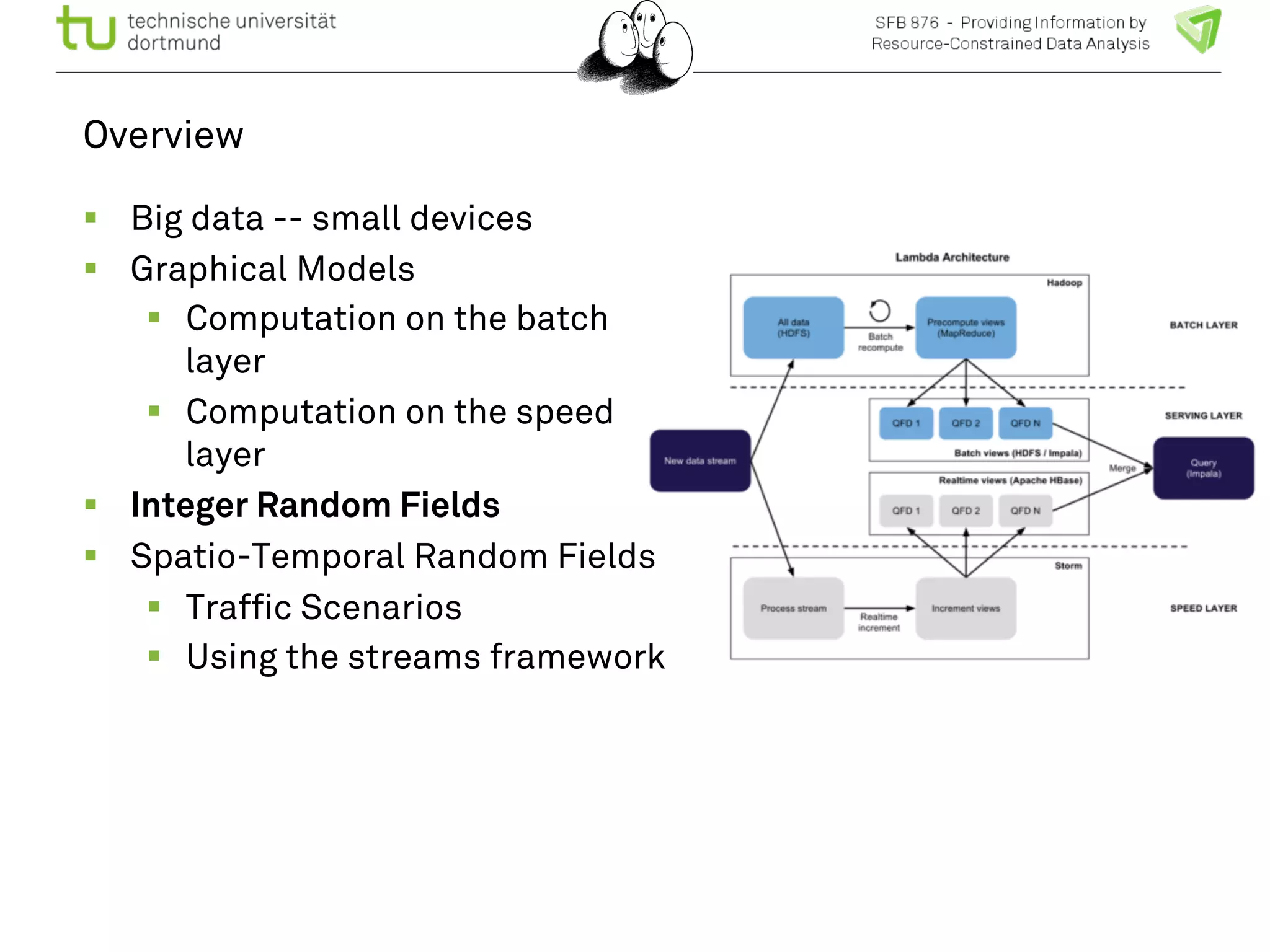
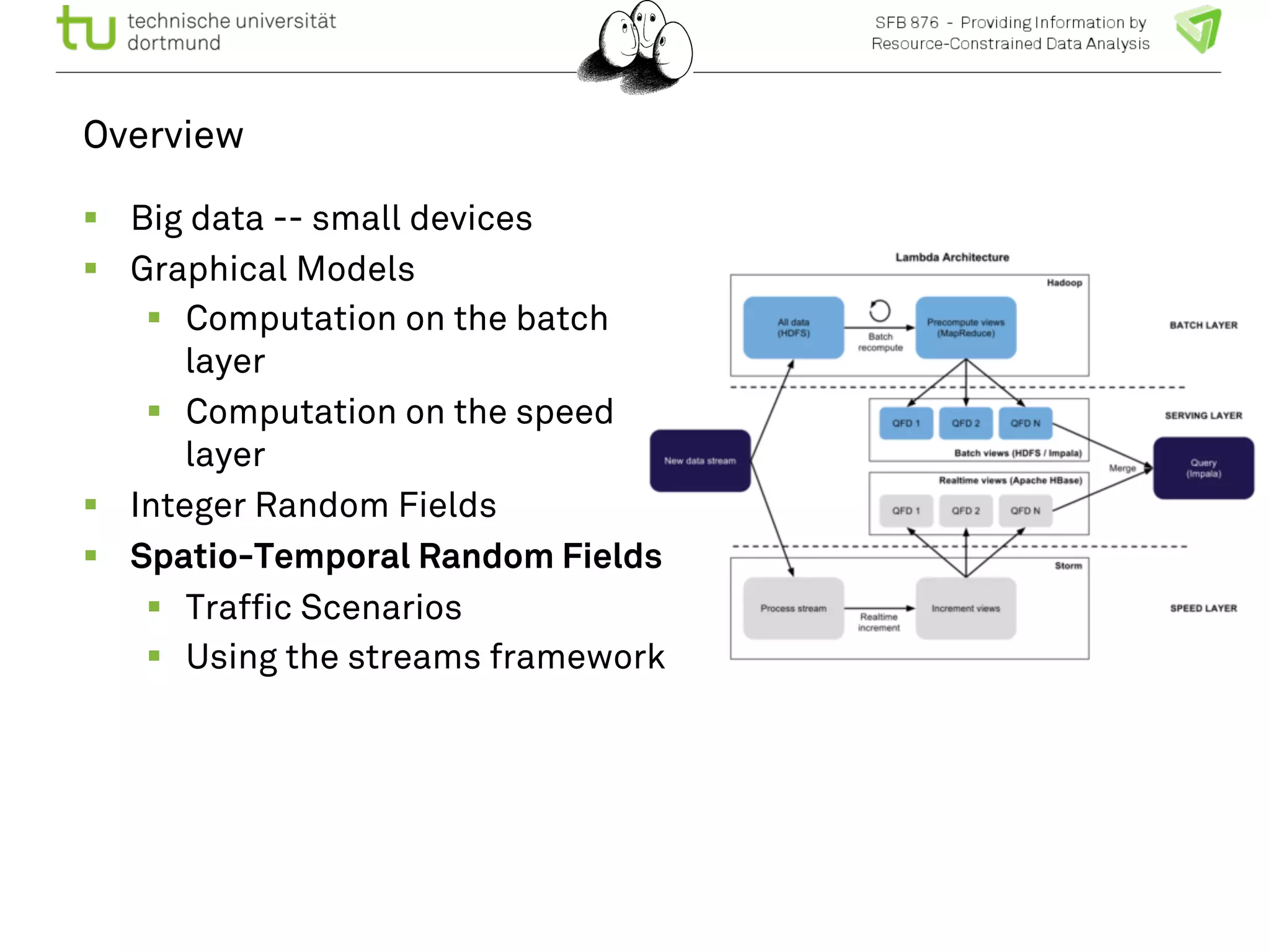
Overview 
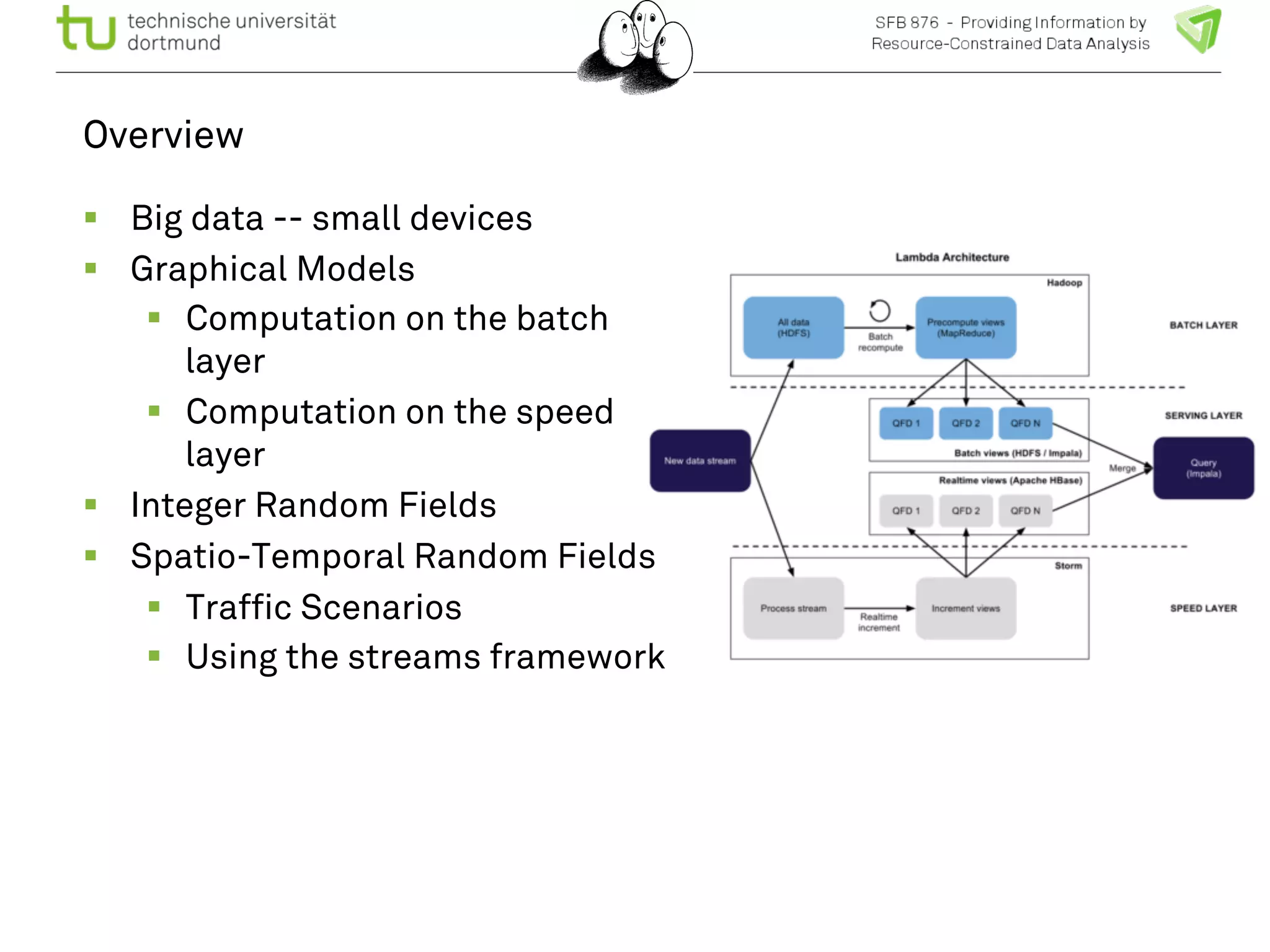
! Big data -- small devices 
! Graphical Models 
! Computation on the batch 
layer 
! Computation on the speed 
layer 
! Integer Random Fields 
! Spatio-Temporal Random Fields 
! Traffic Scenarios 
! Using the streams framework
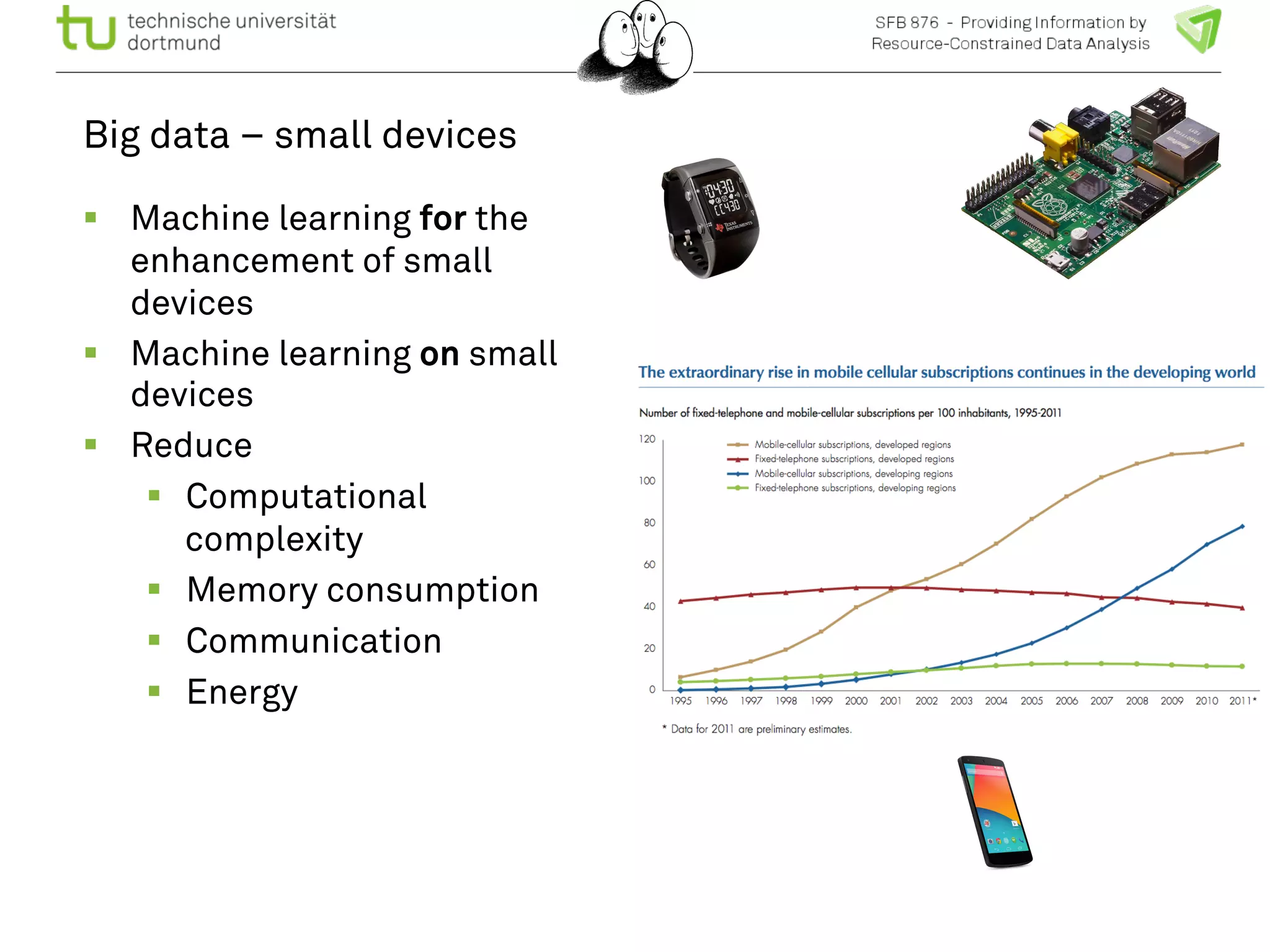
Big data – small devices 
! Machine learning for the 
enhancement of small 
devices 
! Machine learning on small 
devices 
! Reduce 
! Computational 
complexity 
! Memory consumption 
! Communication 
! Energy
Overview 
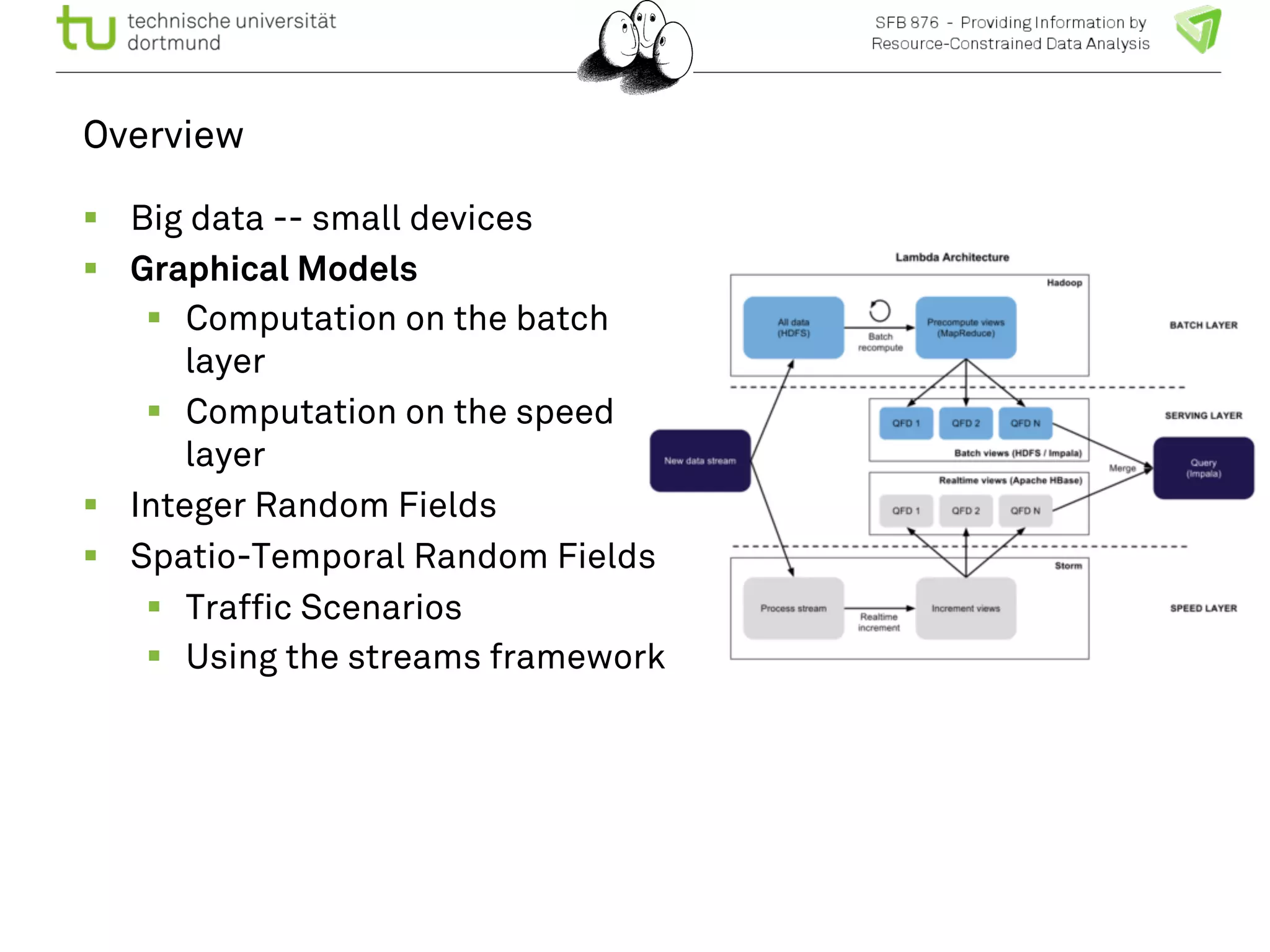
! Big data -- small devices 
! Graphical Models 
! Computation on the batch 
layer 
! Computation on the speed 
layer 
! Integer Random Fields 
! Spatio-Temporal Random Fields 
! Traffic Scenarios 
! Using the streams framework
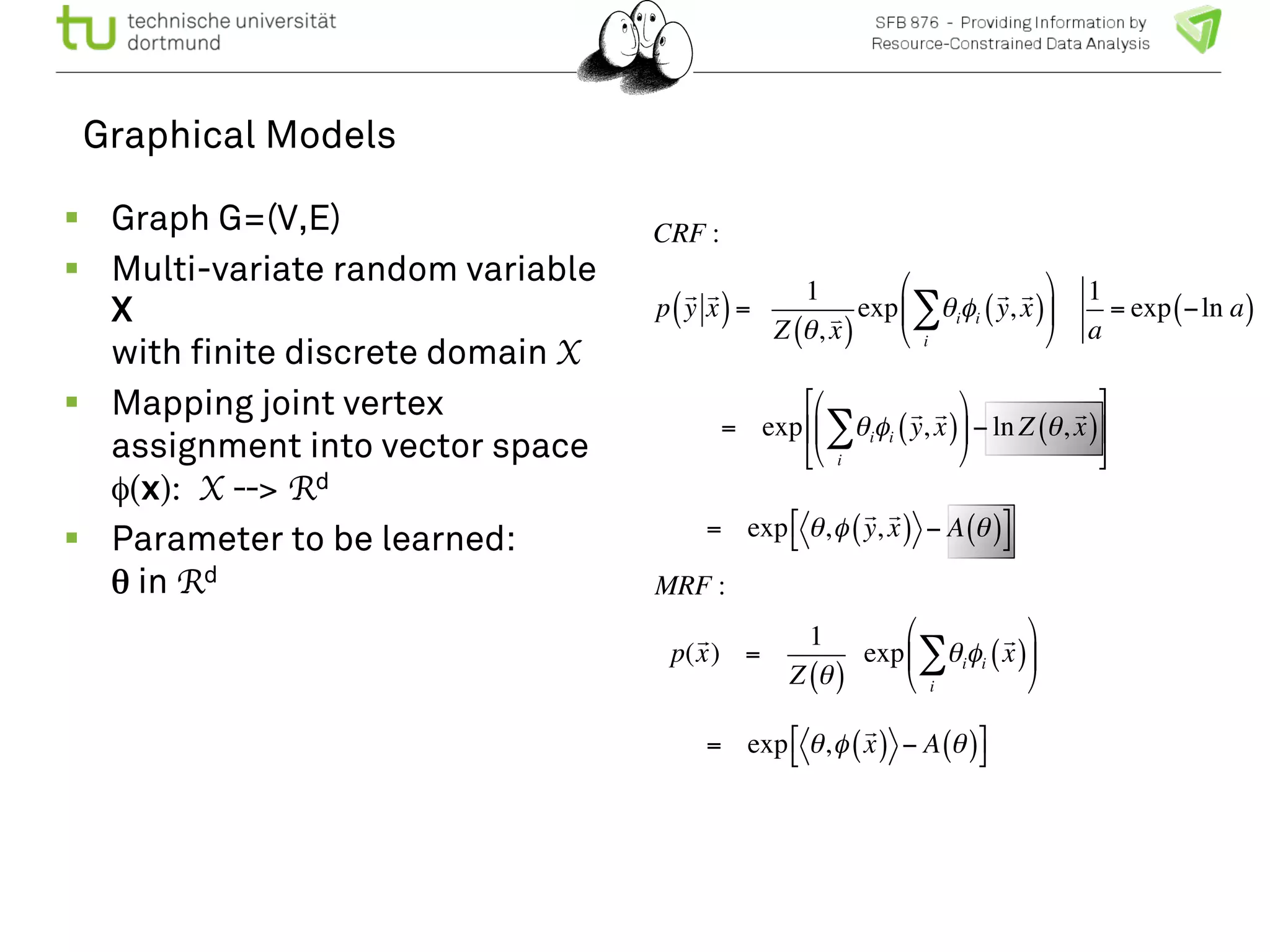
Graphical Models 
! Graph G=(V,E) 
! Multi-variate random variable 
X 
with finite discrete domain X 
! Mapping joint vertex 
assignment into vector space 
φ(x): X --> Rd 
! Parameter to be learned: 
θ in Rd 
CRF : 
p 
( ! 
! 
y 
x) = 
1 
! 
( x) 
Z θ, 
Σ 
exp θi 
φi 
( ! 
x) 
! 
y, 
i 
" 
# $ 
% 
& ' 
1 
a 
= exp(−ln a) 
Σ 
= exp θi 
φi 
( ! 
x) 
! 
y, 
i 
" 
# $ 
% 
& ' 
! 
( x) 
− ln Z θ, 
) 
* + 
, 
- . 
! 
x ( ) − A θ ( ) )* 
= exp θ,φ 
! 
y, 
,- 
MRF : 
p( 
! 
x) = 
1 
Z θ ( ) 
Σ 
exp θi 
φi 
! 
(x) 
i 
" 
# $ 
% 
& ' 
! 
x ( ) − A θ ( ) )* 
= exp θ,φ 
,-
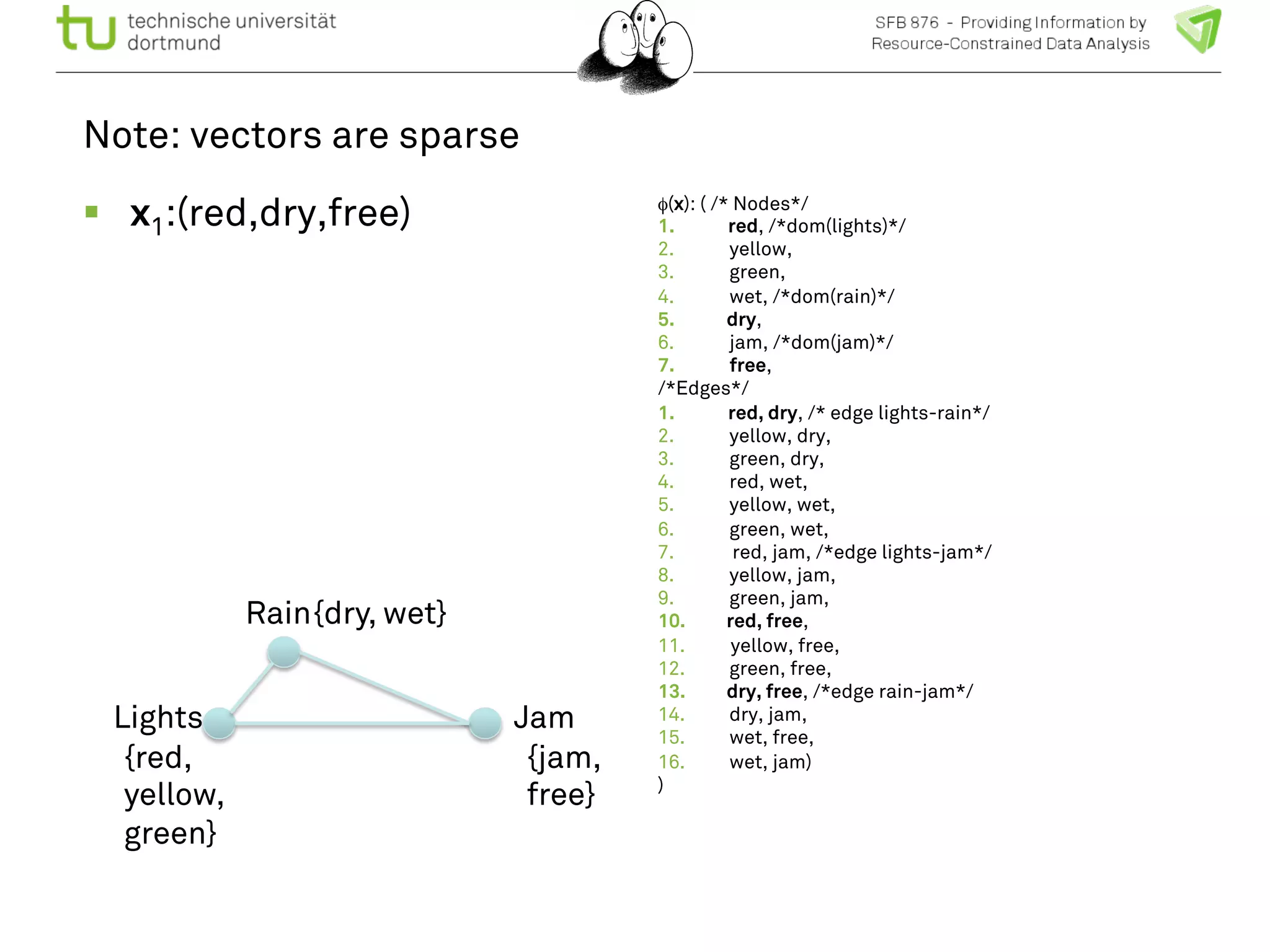
Note: vectors are sparse 
φ(x): ( /* Nodes*/ 
1. red, /*dom(lights)*/ 
2. yellow, 
3. green, 
4. wet, /*dom(rain)*/ 
5. dry, 
6. jam, /*dom(jam)*/ 
7. free, 
/*Edges*/ 
1. red, dry, /* edge lights-rain*/ 
2. yellow, dry, 
3. green, dry, 
4. red, wet, 
5. yellow, wet, 
6. green, wet, 
7. red, jam, /*edge lights-jam*/ 
8. yellow, jam, 
9. green, jam, 
10. red, free, 
11. yellow, free, 
12. green, free, 
13. dry, free, /*edge rain-jam*/ 
14. dry, jam, 
15. wet, free, 
16. wet, jam) 
) 
! x1:(red,dry,free) 
Lights 
Rain 
Jam 
{jam, 
free} 
{dry, wet} 
{red, 
yellow, 
green}
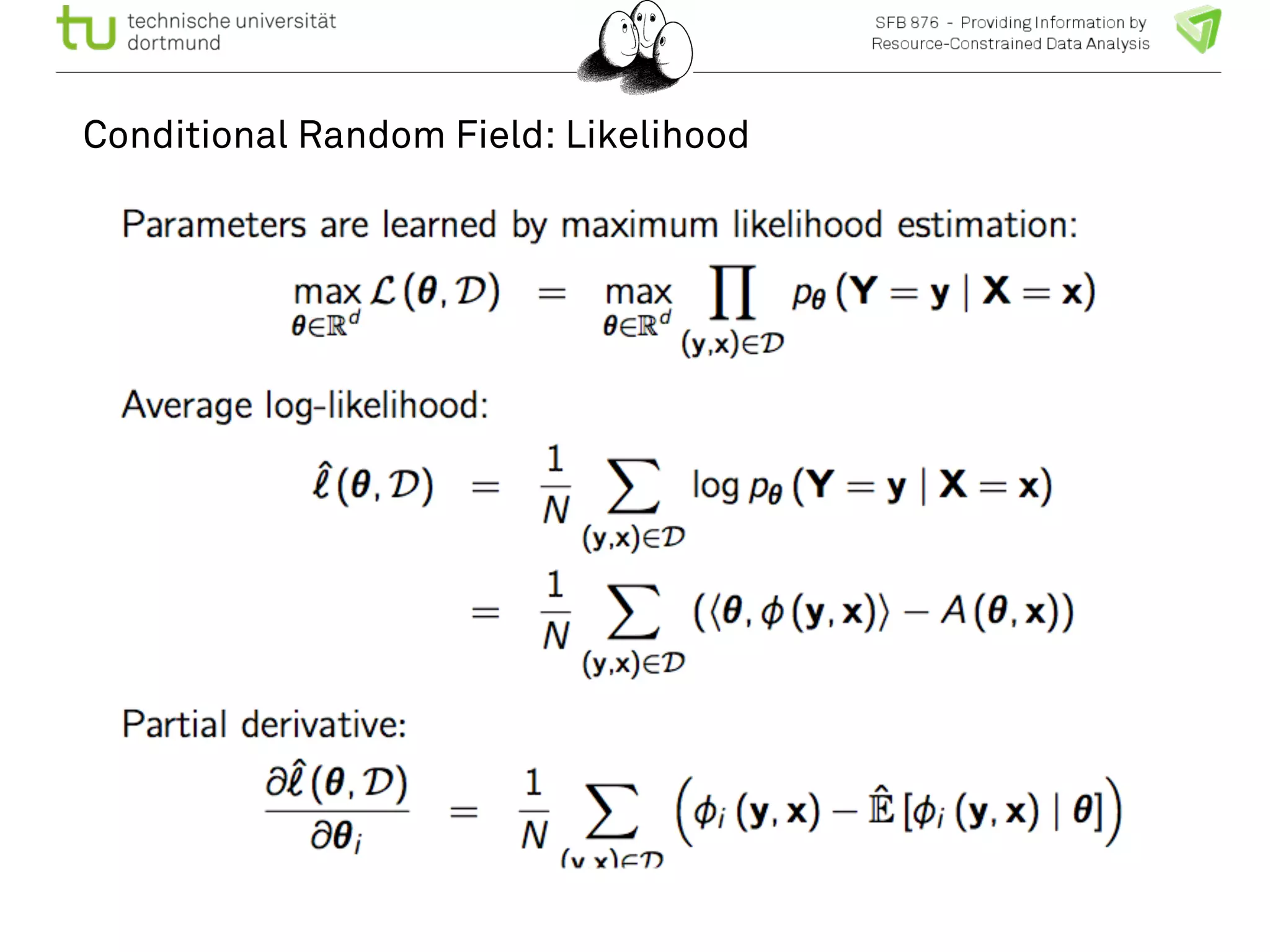
Conditional Random Field: Likelihood
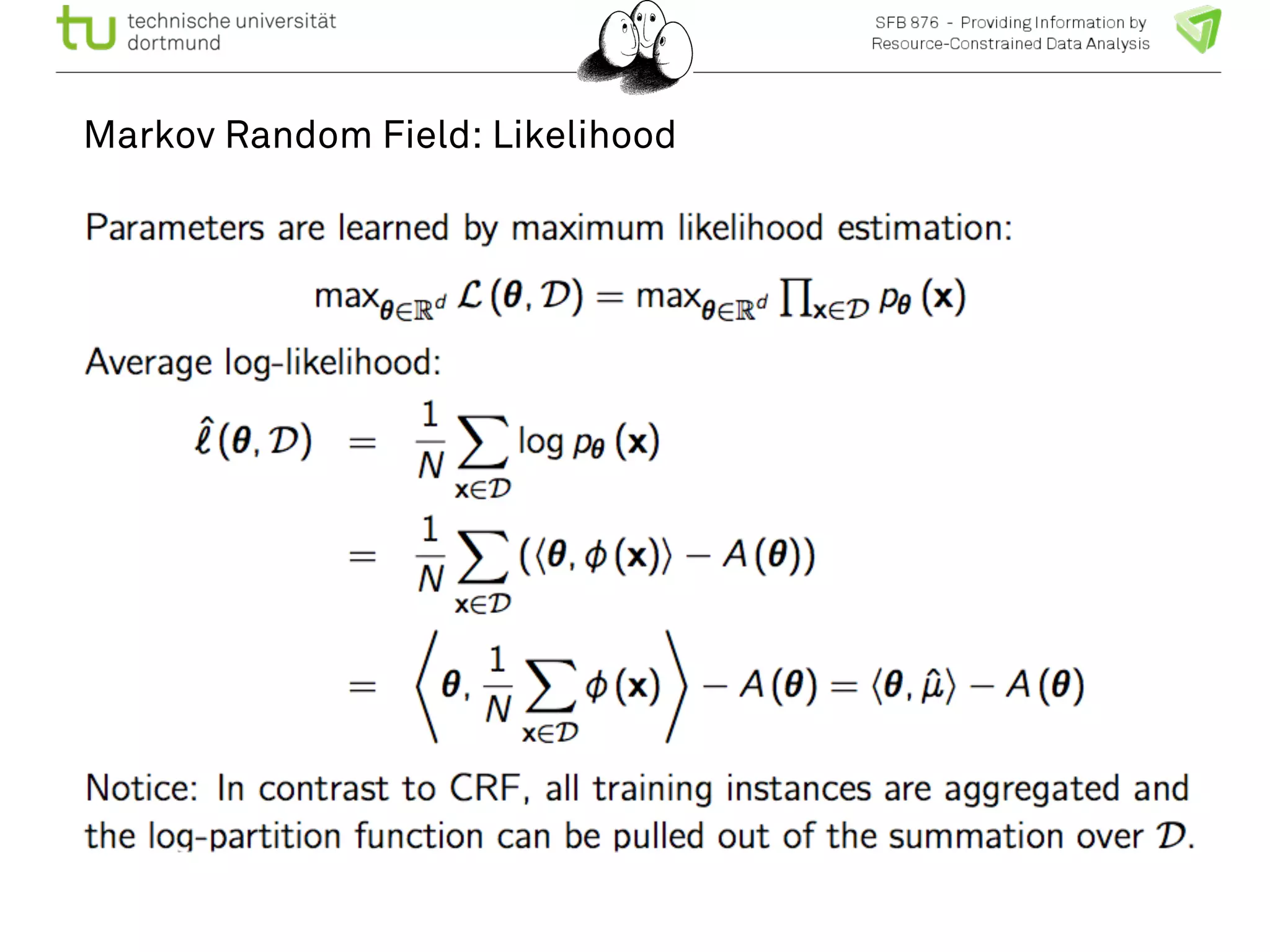
Markov Random Field: Likelihood
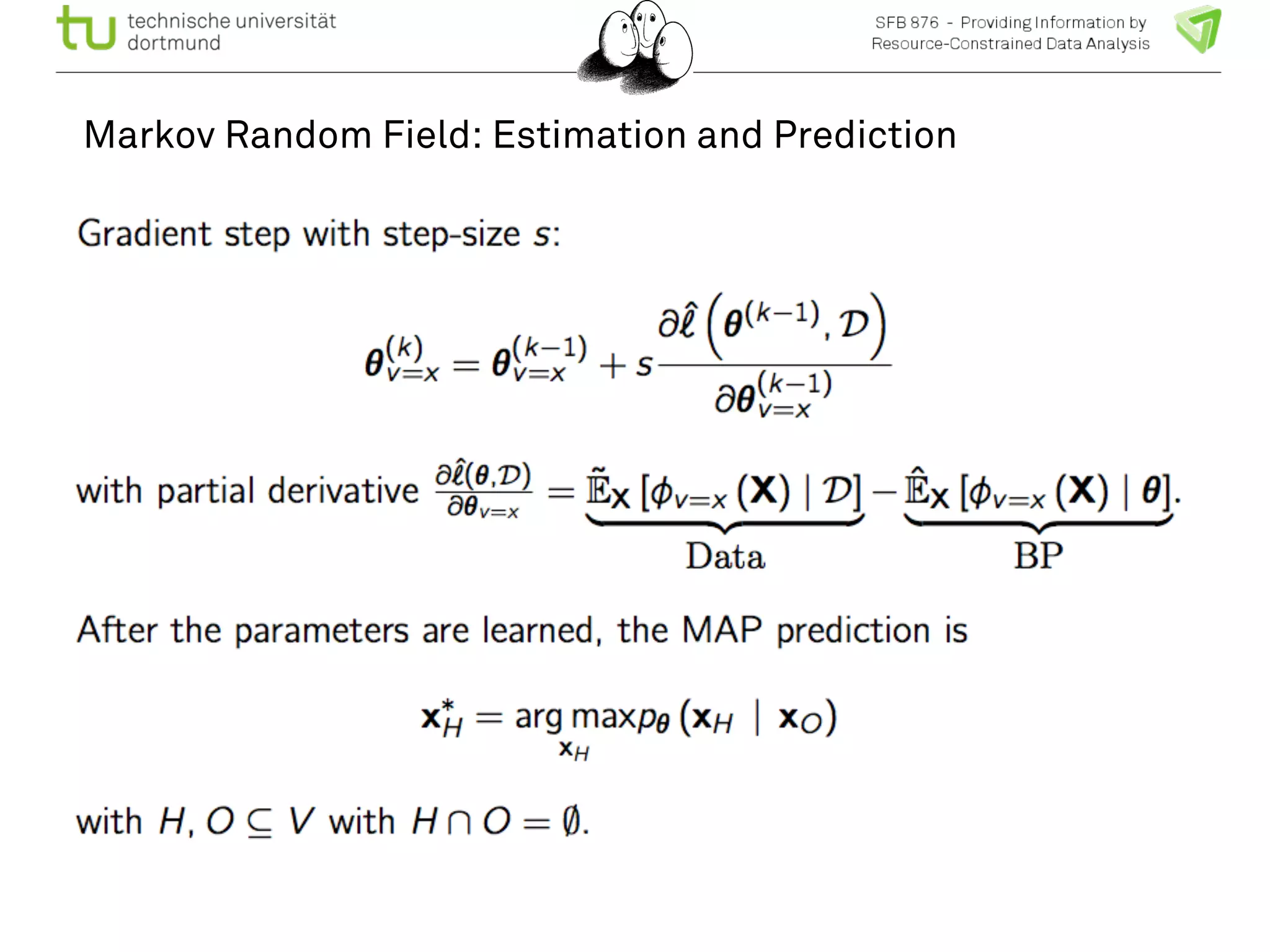
Markov Random Field: Estimation and Prediction
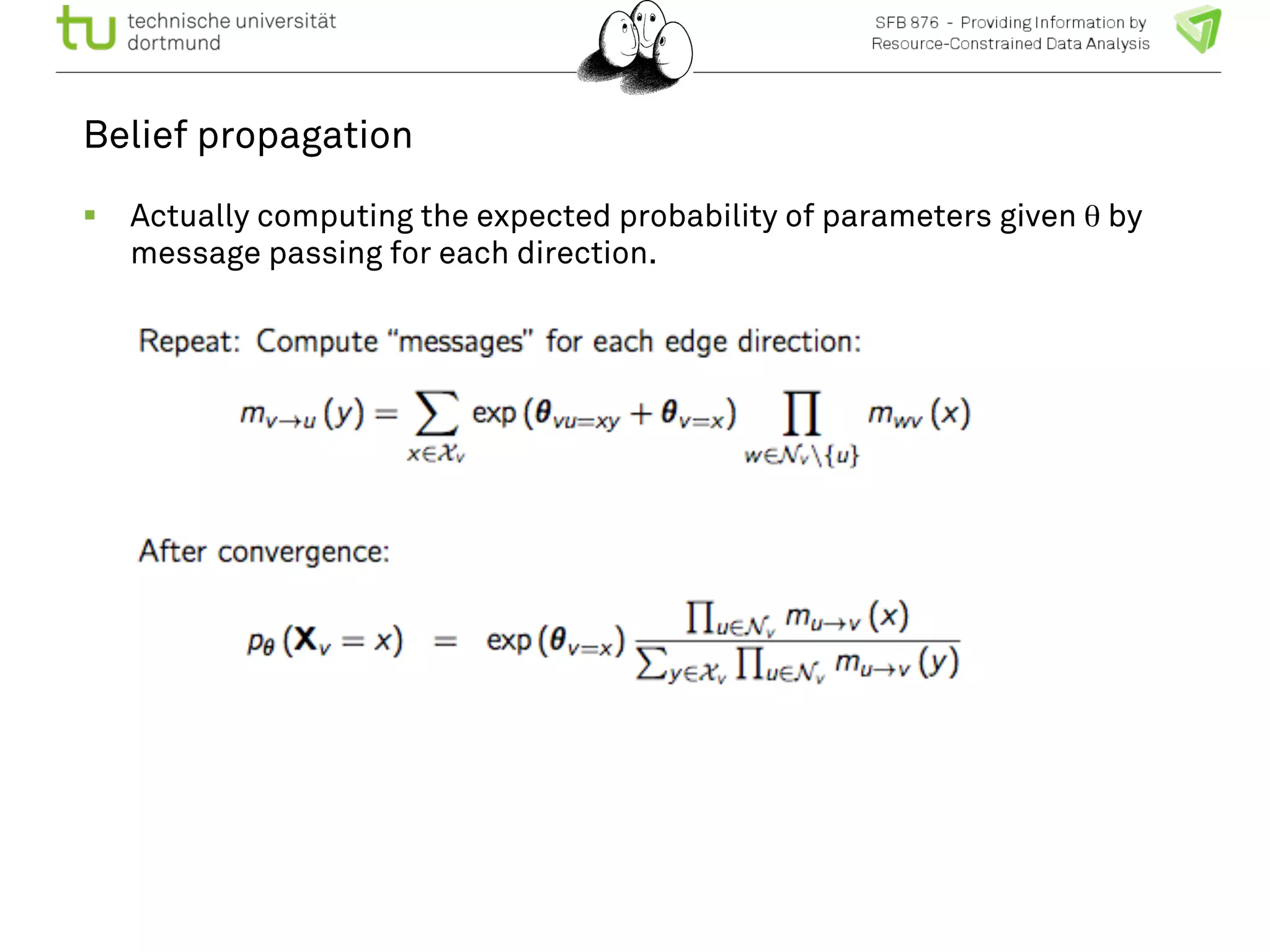
Belief propagation 
! Actually computing the expected probability of parameters given θ by 
message passing for each direction.
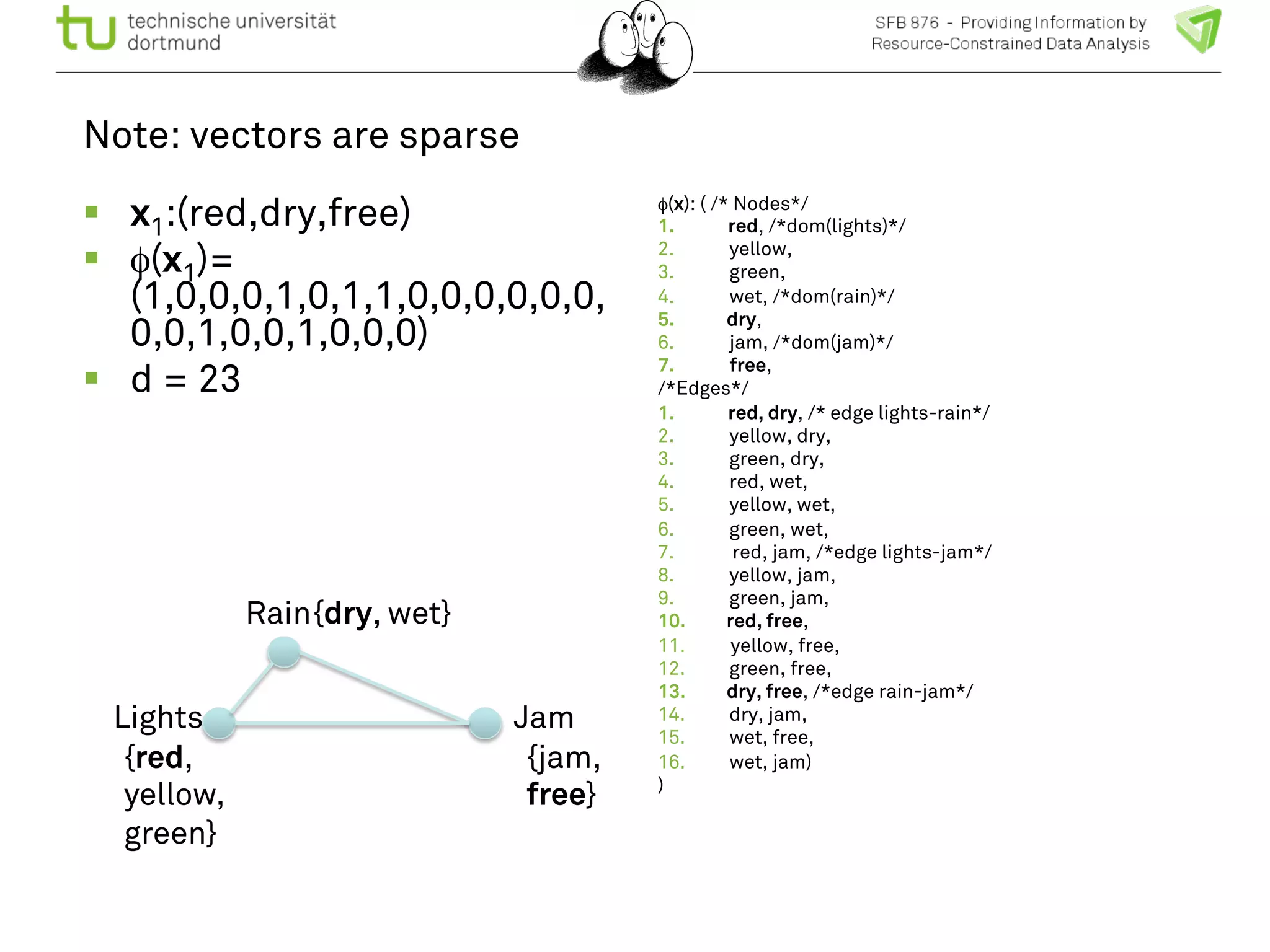
Note: vectors are sparse 
φ(x): ( /* Nodes*/ 
1. red, /*dom(lights)*/ 
2. yellow, 
3. green, 
4. wet, /*dom(rain)*/ 
5. dry, 
6. jam, /*dom(jam)*/ 
7. free, 
/*Edges*/ 
1. red, dry, /* edge lights-rain*/ 
2. yellow, dry, 
3. green, dry, 
4. red, wet, 
5. yellow, wet, 
6. green, wet, 
7. red, jam, /*edge lights-jam*/ 
8. yellow, jam, 
9. green, jam, 
10. red, free, 
11. yellow, free, 
12. green, free, 
13. dry, free, /*edge rain-jam*/ 
14. dry, jam, 
15. wet, free, 
16. wet, jam) 
) 
! x1:(red,dry,free) 
! φ(x1)= 
(1,0,0,0,1,0,1,1,0,0,0,0,0,0, 
0,0,1,0,0,1,0,0,0) 
! d = 23 
Lights 
Rain 
Jam 
{jam, 
free} 
{dry, wet} 
{red, 
yellow, 
green}
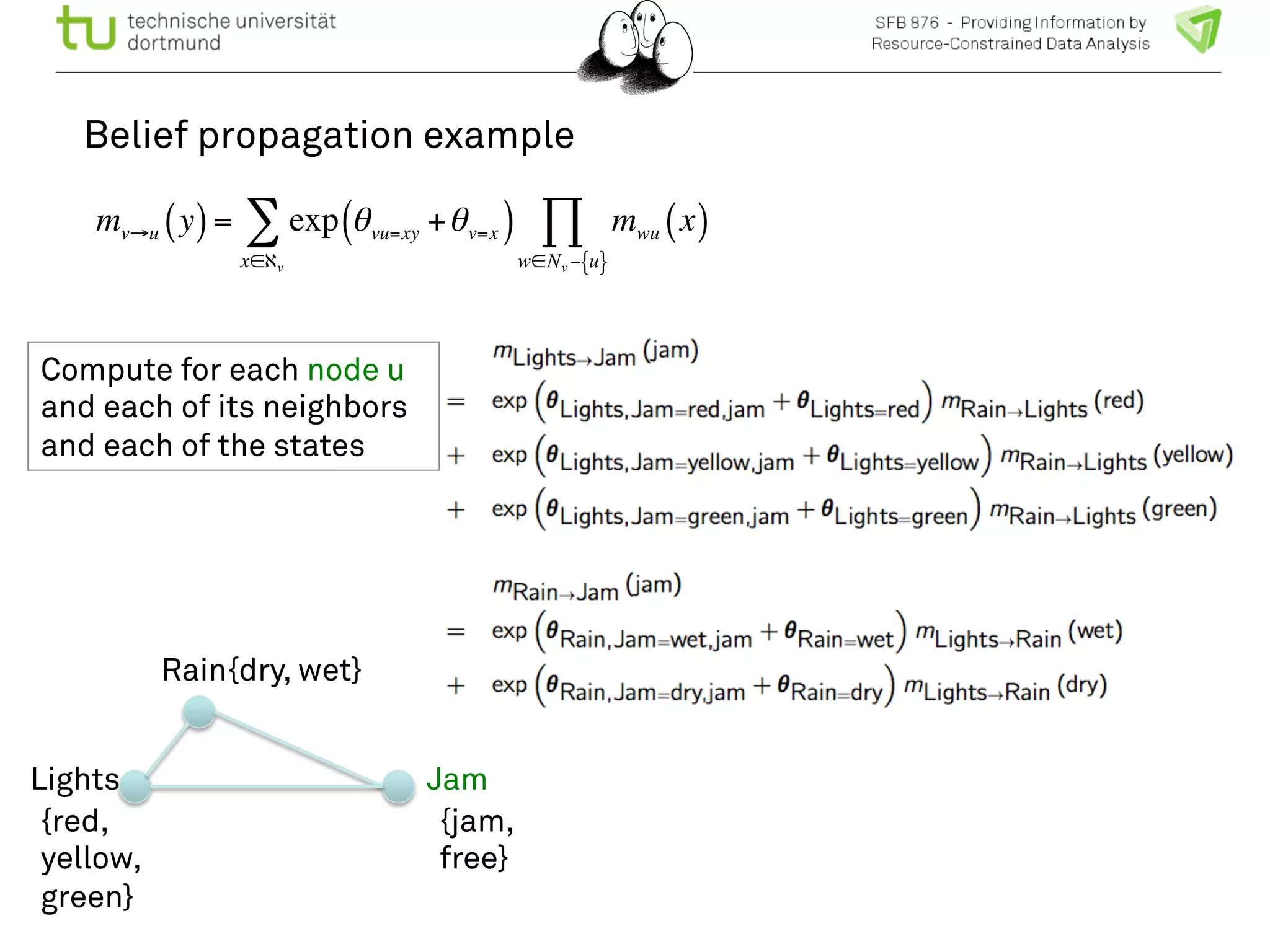
Belief propagation example 
Π 
Σ 
mv→u (y) = exp θvu=xy +θv=x ( ) mwu (x) 
Lights 
Rain 
Jam 
{jam, 
free} 
{dry, wet} 
{red, 
yellow, 
green} 
w∈Nv−{u} 
x∈ℵv 
Compute for each node u 
and each of its neighbors 
and each of the states
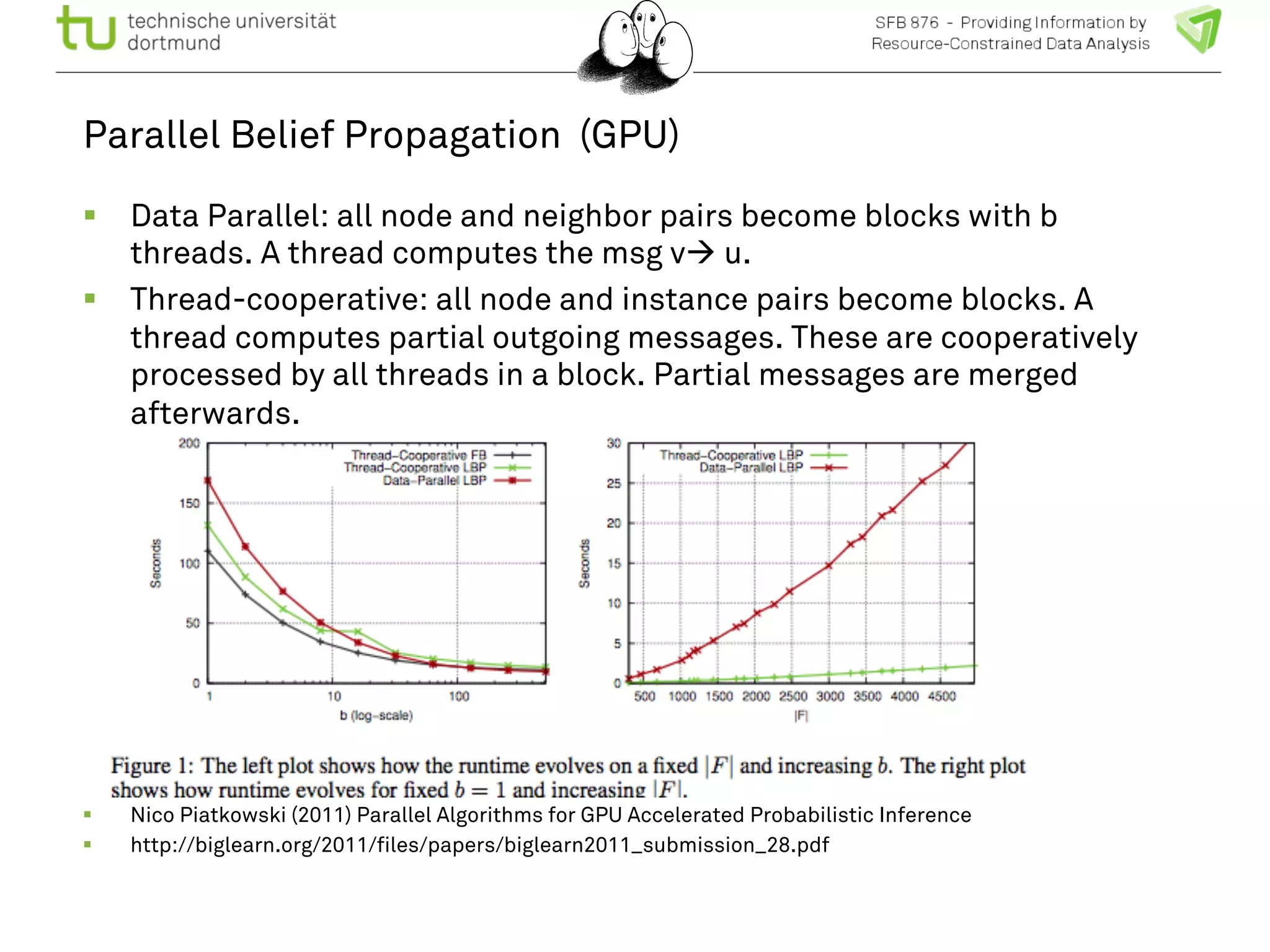
Parallel Belief Propagation (GPU) 
! Data Parallel: all node and neighbor pairs become blocks with b 
threads. A thread computes the msg v" u. 
! Thread-cooperative: all node and instance pairs become blocks. A 
thread computes partial outgoing messages. These are cooperatively 
processed by all threads in a block. Partial messages are merged 
afterwards. 
! Nico Piatkowski (2011) Parallel Algorithms for GPU Accelerated Probabilistic Inference 
! http://biglearn.org/2011/files/papers/biglearn2011_submission_28.pdf
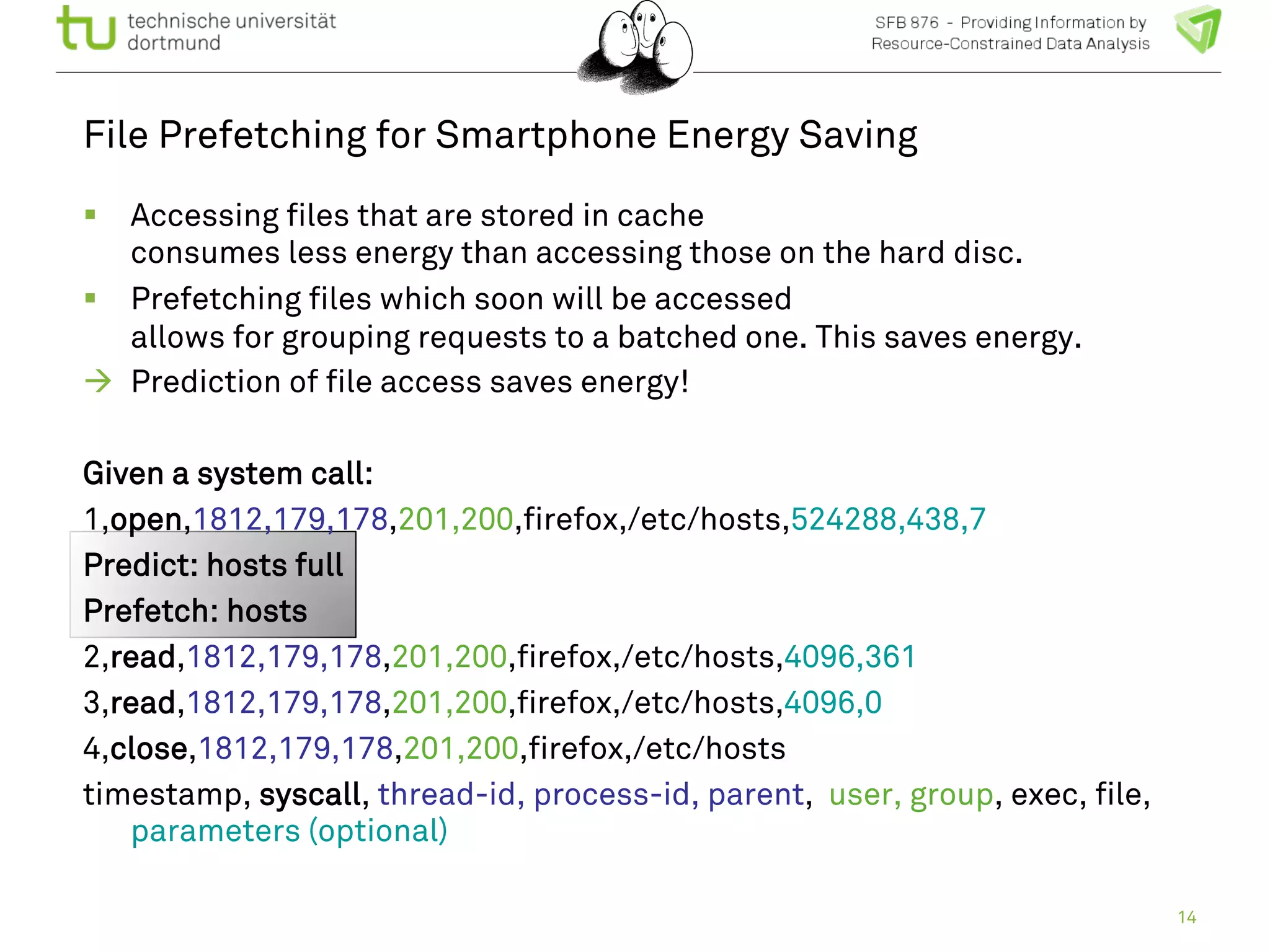
File Prefetching for Smartphone Energy Saving 
! Accessing files that are stored in cache 
consumes less energy than accessing those on the hard disc. 
! Prefetching files which soon will be accessed 
allows for grouping requests to a batched one. This saves energy. 
" Prediction of file access saves energy! 
Given a system call: 
1,open,1812,179,178,201,200,firefox,/etc/hosts,524288,438,7 
Predict: hosts full 
Prefetch: hosts 
2,read,1812,179,178,201,200,firefox,/etc/hosts,4096,361 
3,read,1812,179,178,201,200,firefox,/etc/hosts,4096,0 
4,close,1812,179,178,201,200,firefox,/etc/hosts 
timestamp, syscall, thread-id, process-id, parent, user, group, exec, file, 
parameters (optional) 
14
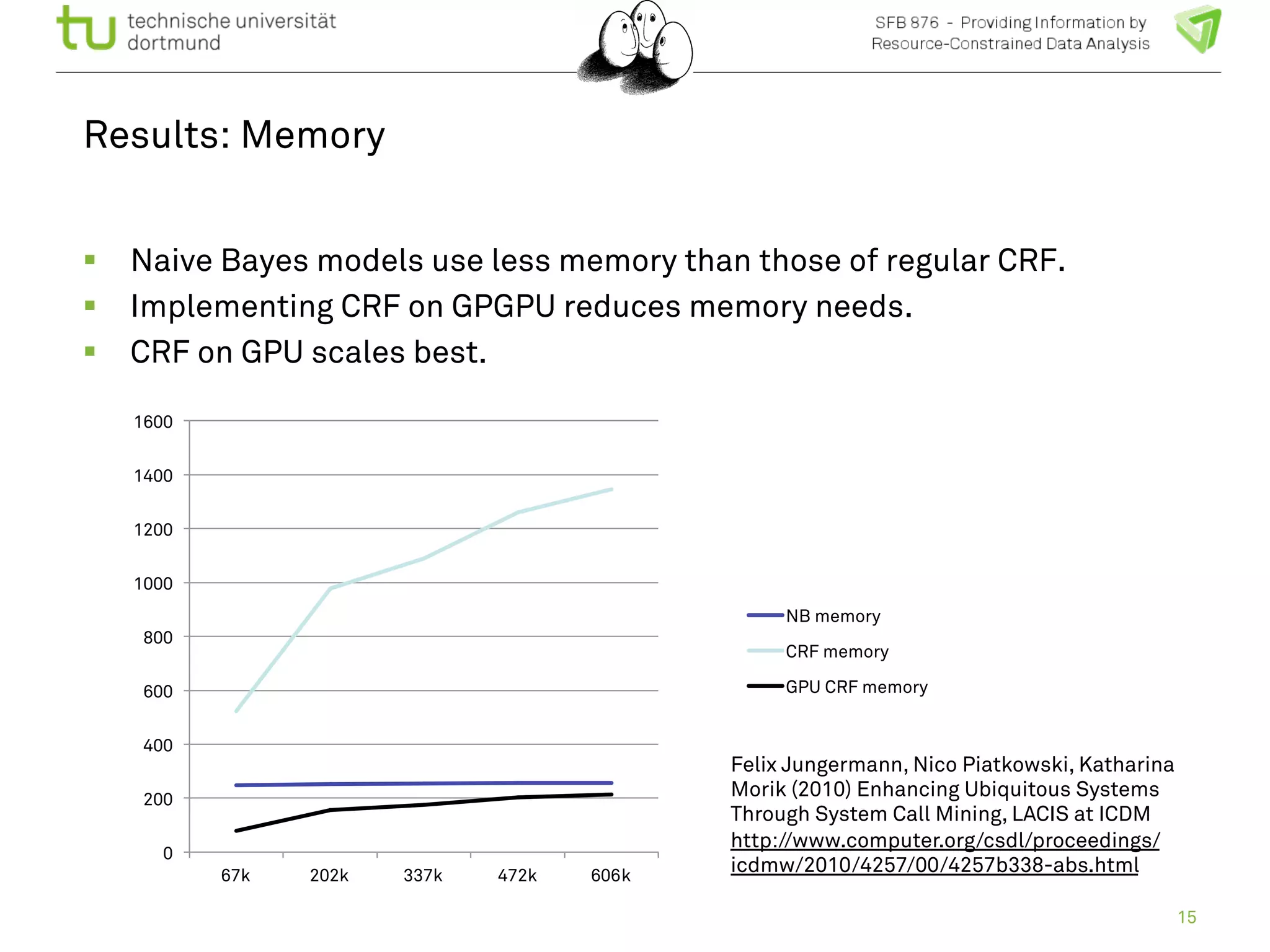
Results: Memory 
! Naive Bayes models use less memory than those of regular CRF. 
! Implementing CRF on GPGPU reduces memory needs. 
! CRF on GPU scales best. 
15 
1600 
1400 
1200 
1000 
800 
600 
400 
200 
0 
67k 202k 337k 472k 606k 
NB memory 
CRF memory 
GPU CRF memory 
Felix Jungermann, Nico Piatkowski, Katharina 
Morik (2010) Enhancing Ubiquitous Systems 
Through System Call Mining, LACIS at ICDM 
http://www.computer.org/csdl/proceedings/ 
icdmw/2010/4257/00/4257b338-abs.html
Overview 
! Big data -- small devices 
! Graphical Models 
! Computation on the batch 
layer 
! Computation on the speed 
layer 
! Integer Random Fields 
! Spatio-Temporal Random Fields 
! Traffic Scenarios 
! Using the streams framework
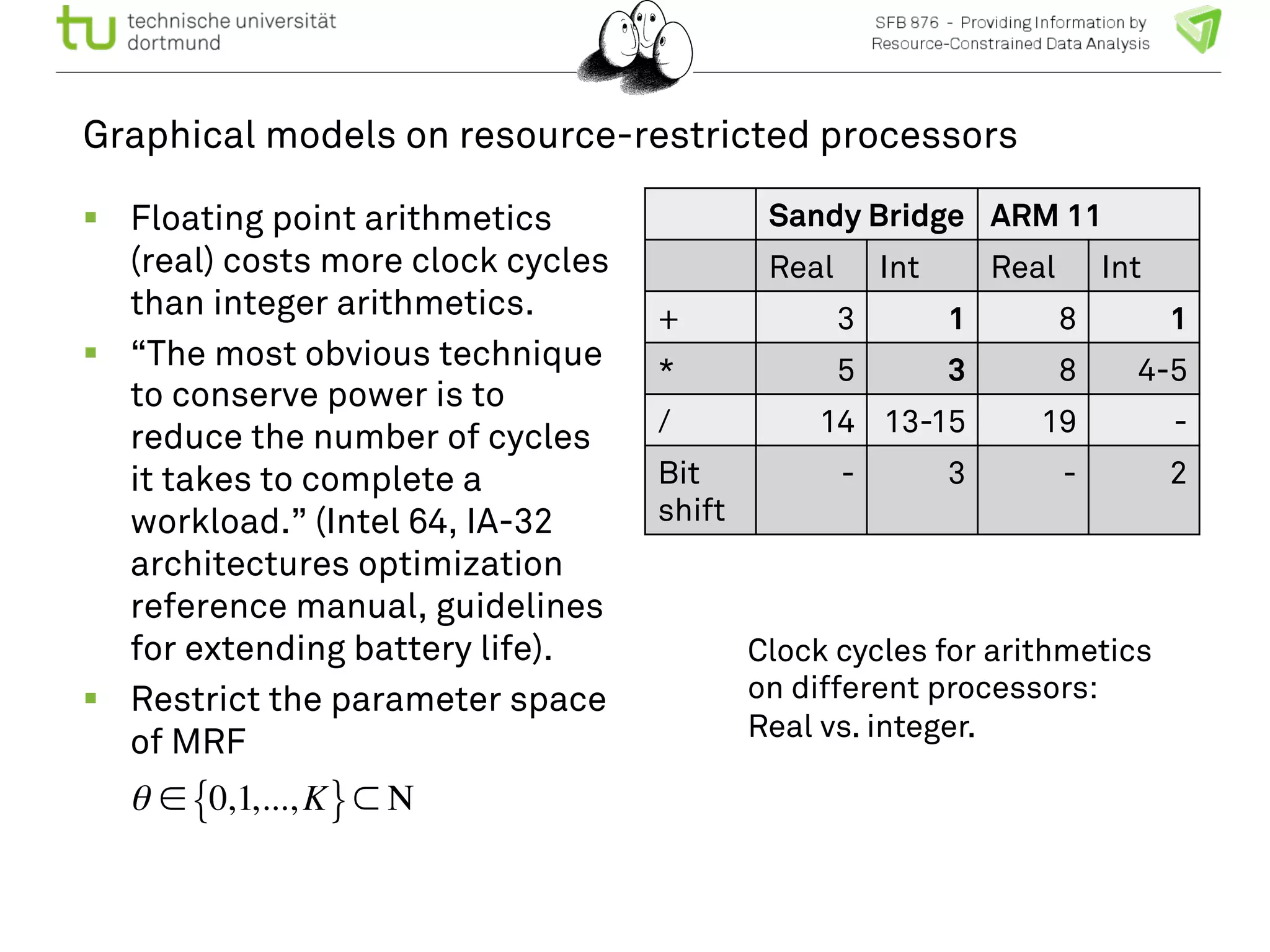
Graphical models on resource-restricted processors 
! Floating point arithmetics 
(real) costs more clock cycles 
than integer arithmetics. 
! “The most obvious technique 
to conserve power is to 
reduce the number of cycles 
it takes to complete a 
workload.” (Intel 64, IA-32 
architectures optimization 
reference manual, guidelines 
for extending battery life). 
! Restrict the parameter space 
of MRF 
Sandy Bridge ARM 11 
Real Int Real Int 
+ 3 1 8 1 
* 5 3 8 4-5 
/ 14 13-15 19 - 
Bit 
- 3 - 2 
shift 
Clock cycles for arithmetics 
on different processors: 
Real vs. integer. 
θ ∈{0,1,...,K}⊂ Ν
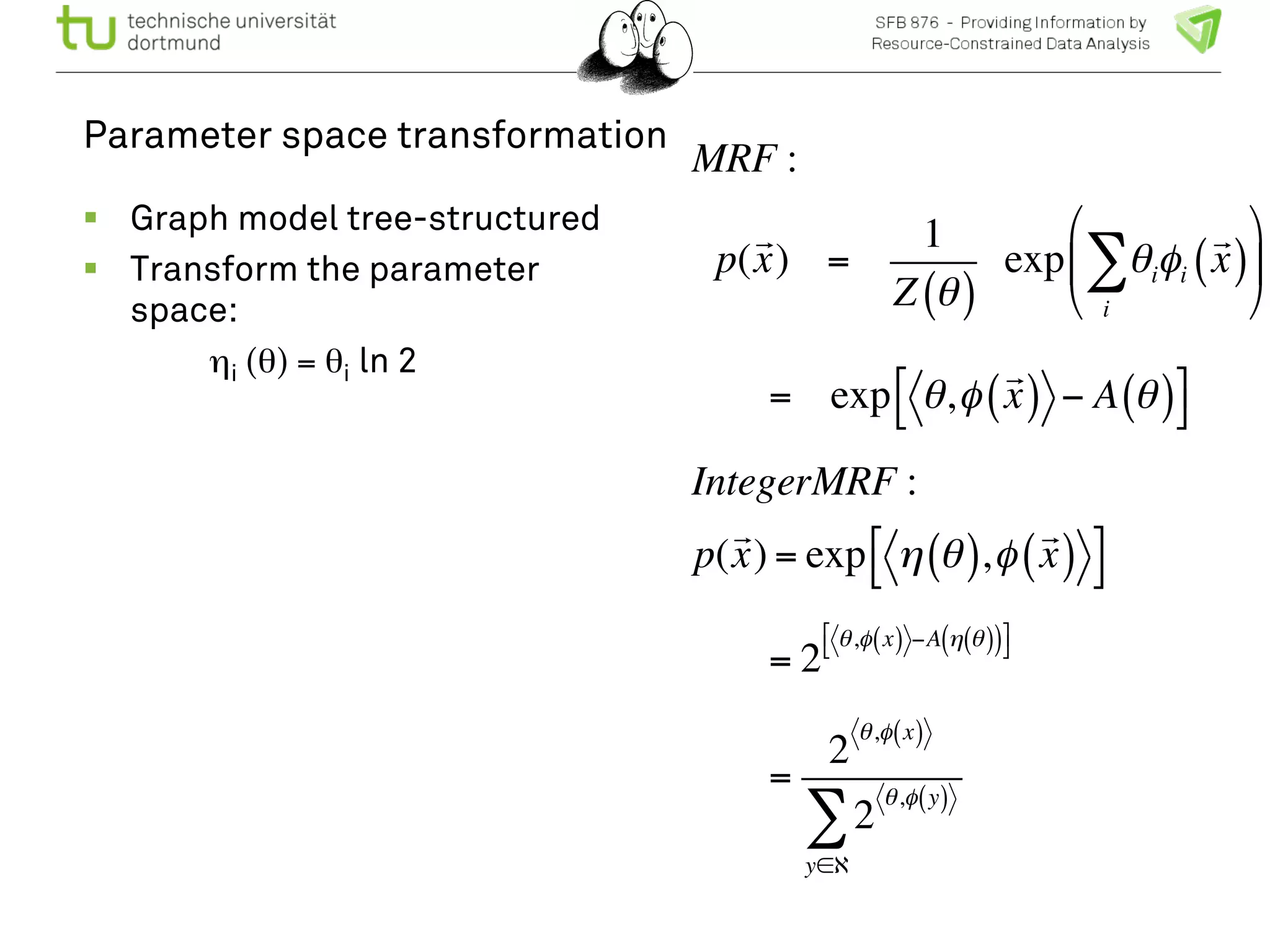
Parameter space transformation 
! Graph model tree-structured 
! Transform the parameter 
space: 
ηi (θ) = θi ln 2 
MRF : 
p( 
! 
x) = 
1 
Z θ ( ) 
Σ 
exp θi 
φi 
! 
(x) 
i 
" 
# $ 
% 
& ' 
! 
x ( ) − A θ ( ) )* 
= exp θ,φ 
+, 
IntegerMRF : 
p( 
! 
x) = exp η θ ( ),φ 
! 
x ( ) )* 
+, 
= 2 
θ ,φ x ( ) −A η θ ( ) ( ) )* 
+, 
= 
2 θ ,φ (x) 
2 θ ,φ (y) 
y∈ℵ 
Σ
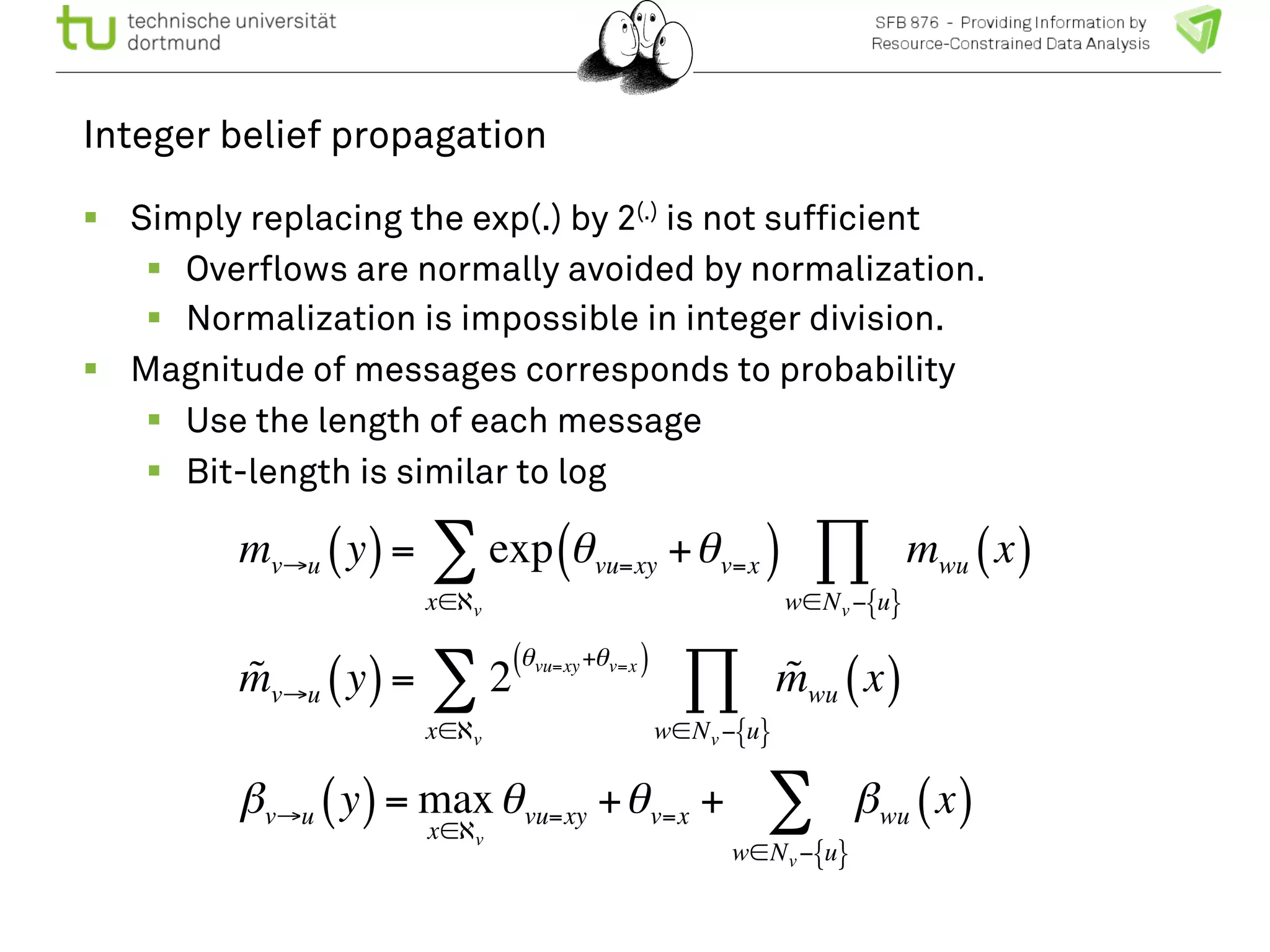
Integer belief propagation 
! Simply replacing the exp(.) by 2(.) is not sufficient 
! Overflows are normally avoided by normalization. 
! Normalization is impossible in integer division. 
! Magnitude of messages corresponds to probability 
! Use the length of each message 
! Bit-length is similar to log 
Π 
Σ 
mv→u (y) = exp θvu=xy +θv=x ( ) mwu (x) 
w∈Nv−{u} 
x∈ℵv 
m! v→u (y) = 2 (θvu=xy+θv=x ) 
Σ m! wu (x) 
x∈ℵv 
Π 
w∈Nv−{u} 
βv→u (y) = max 
x∈ℵv 
Σ 
θvu=xy +θv=x + βwu (x) 
w∈Nv−{u}
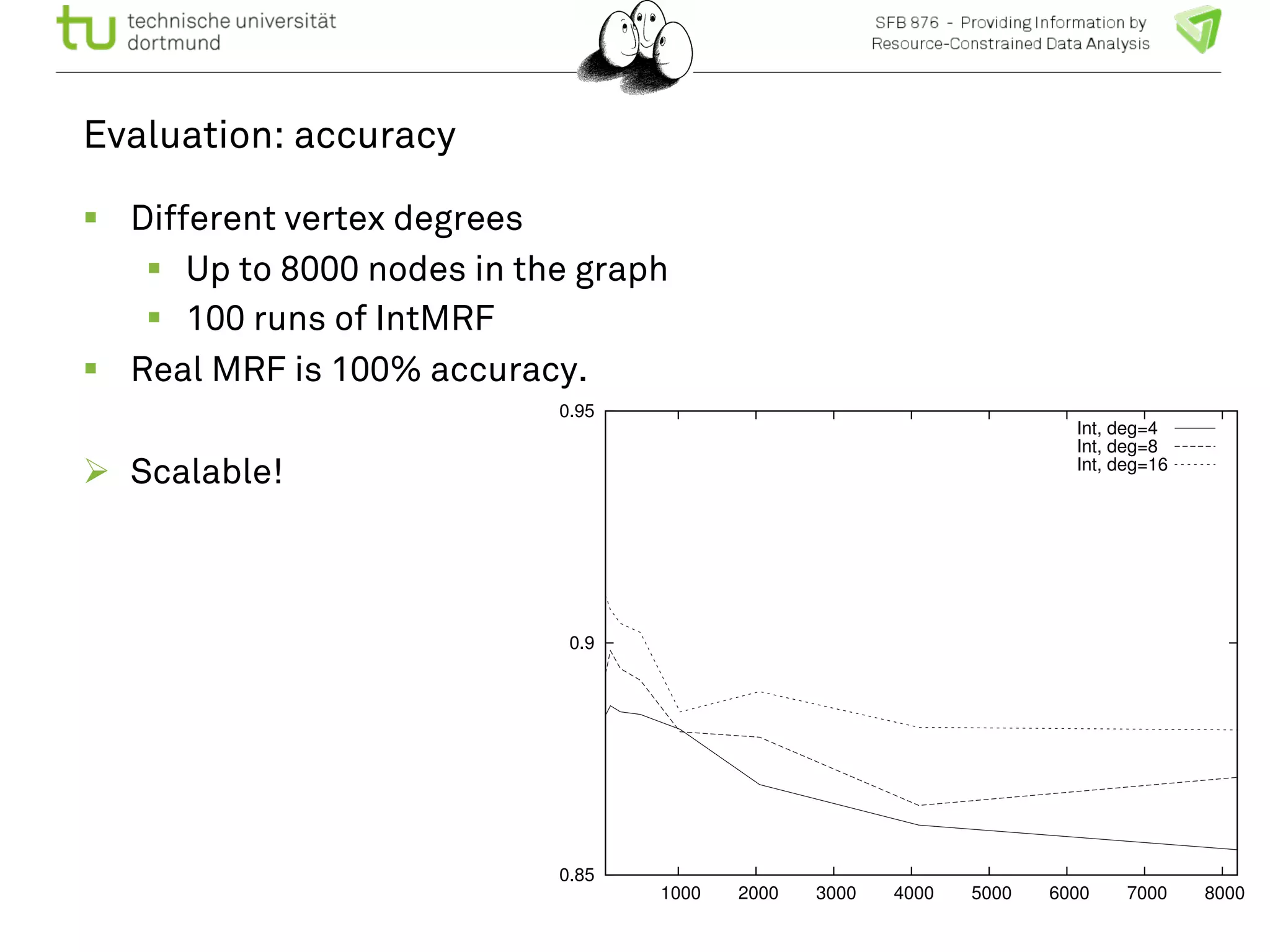
Evaluation: accuracy 
0.95 
0.9 
0.85 
Int, deg=4 
Int, deg=8 
Int, deg=16 
1000 2000 3000 4000 5000 6000 7000 8000 
! Different vertex degrees 
! Up to 8000 nodes in the graph 
! 100 runs of IntMRF 
! Real MRF is 100% accuracy. 
# Scalable!
Integer models use less clock cycles and memory 
! Integer MRF shows 
! high accuracy: 86 – 92% 
of full MRF for up to 8 
states and 8000 nodes 
! high speed-up: 2.56 
Raspberry Pie and 2.34 
for Sandy Bridge 
! Graphical models can now be 
computed on small devices. 
! Using less clock cycles really 
saves energy. 
Nico Piatkowski, Sangkyun Lee, Katharina Morik (2014) 
The Integer Approximation of Undirected Graphical 
Models, ICPRAM 
http://www-ai.cs.uni-dortmund.de/ 
PublicPublicationFiles/piatkowski_etal_2014a.pdf
Overview 
! Big data -- small devices 
! Graphical Models 
! Computation on the batch 
layer 
! Computation on the speed 
layer 
! Integer Random Fields 
! Spatio-Temporal Random Fields 
! Traffic Scenarios 
! Using the streams framework
Spatio-temporal random fields 
! The spatio-temporal graph is 
trained to predict each node’s 
maximum a posteriori 
probability with the marginal 
probabilities. 
! Generative model predicting 
all nodes. 
! Dimension 
T x |V0| x | X| + 
[(T-1)(|V0|+3|E0|)+ |E0|] x |X|2 
! Remember: vectors are sparse 
we have to exploit that! 
User queries: 
Given traffic densities at all 
nodes at t1, t2, t3, what is the 
probability of traffic density 
at node A at time t5? 
Given state “jam” at place A 
ts, which other places have a 
higher probability for “jam” in 
ts < t < te?
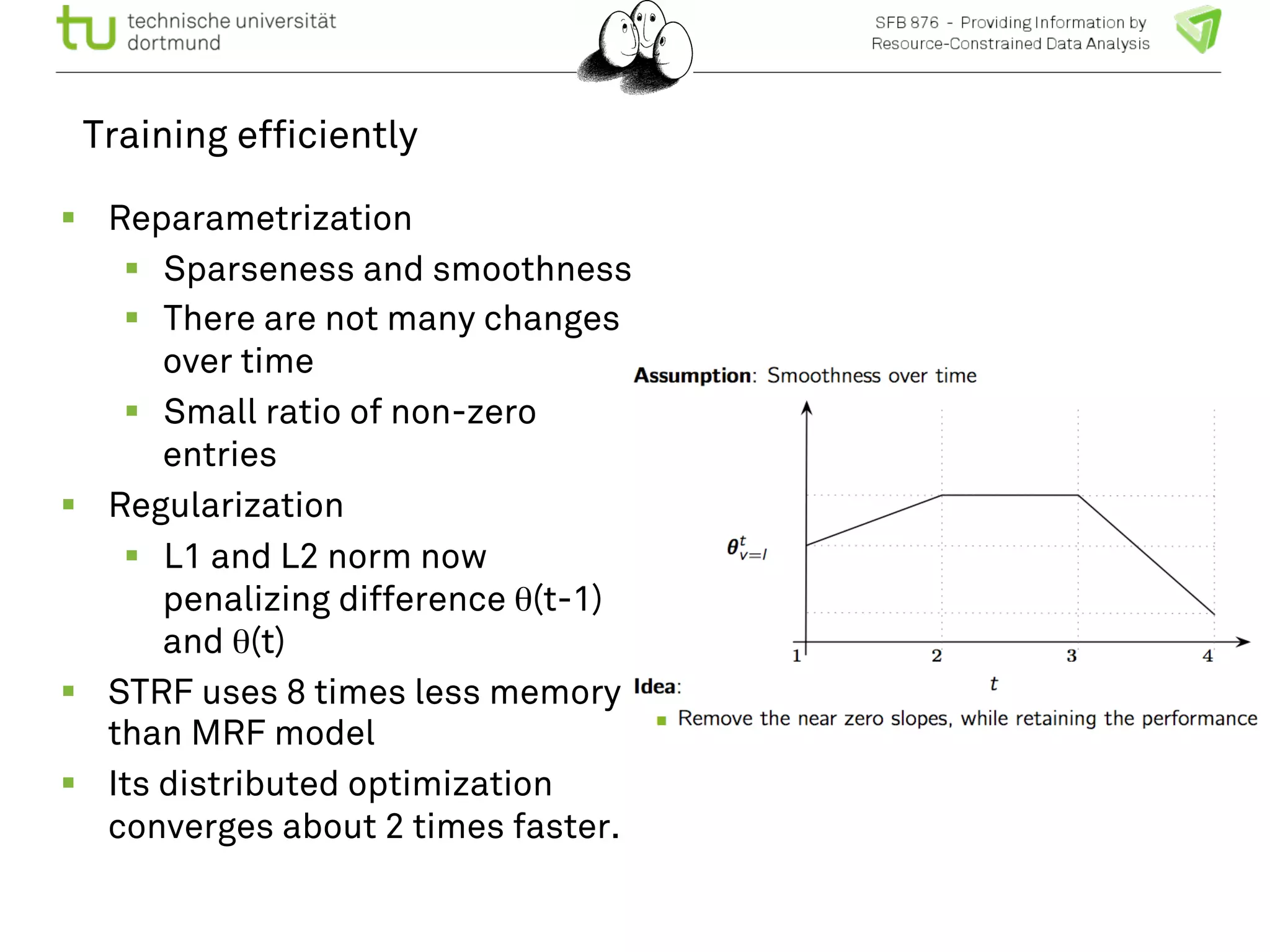
Training efficiently 
! Reparametrization 
! Sparseness and smoothness 
! There are not many changes 
over time 
! Small ratio of non-zero 
entries 
! Regularization 
! L1 and L2 norm now 
penalizing difference θ(t-1) 
and θ(t) 
! STRF uses 8 times less memory 
than MRF model 
! Its distributed optimization 
converges about 2 times faster.
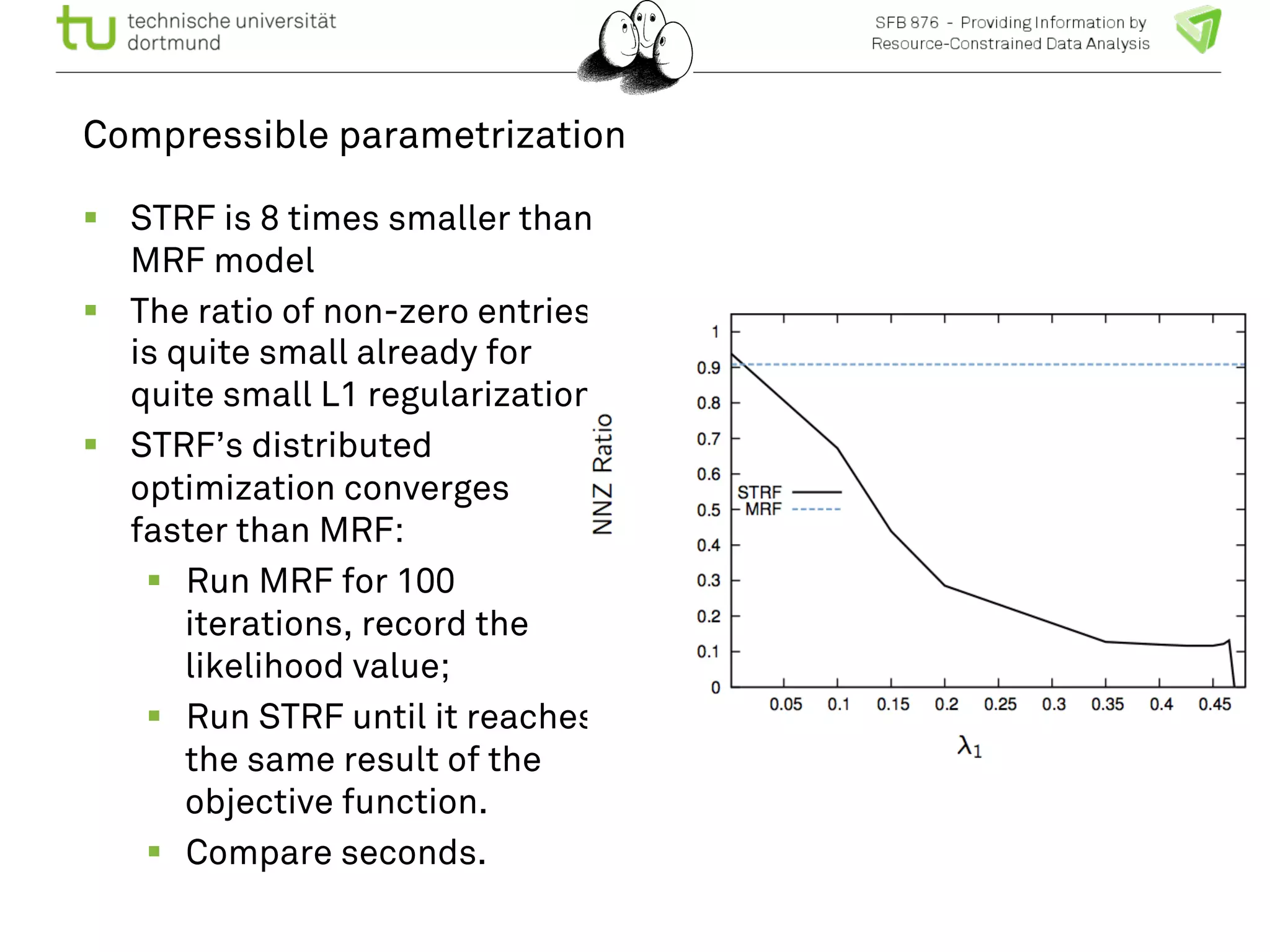
Compressible parametrization 
! STRF is 8 times smaller than 
MRF model 
! The ratio of non-zero entries 
is quite small already for 
quite small L1 regularization 
! STRF’s distributed 
optimization converges 
faster than MRF: 
! Run MRF for 100 
iterations, record the 
likelihood value; 
! Run STRF until it reaches 
the same result of the 
objective function. 
! Compare seconds.
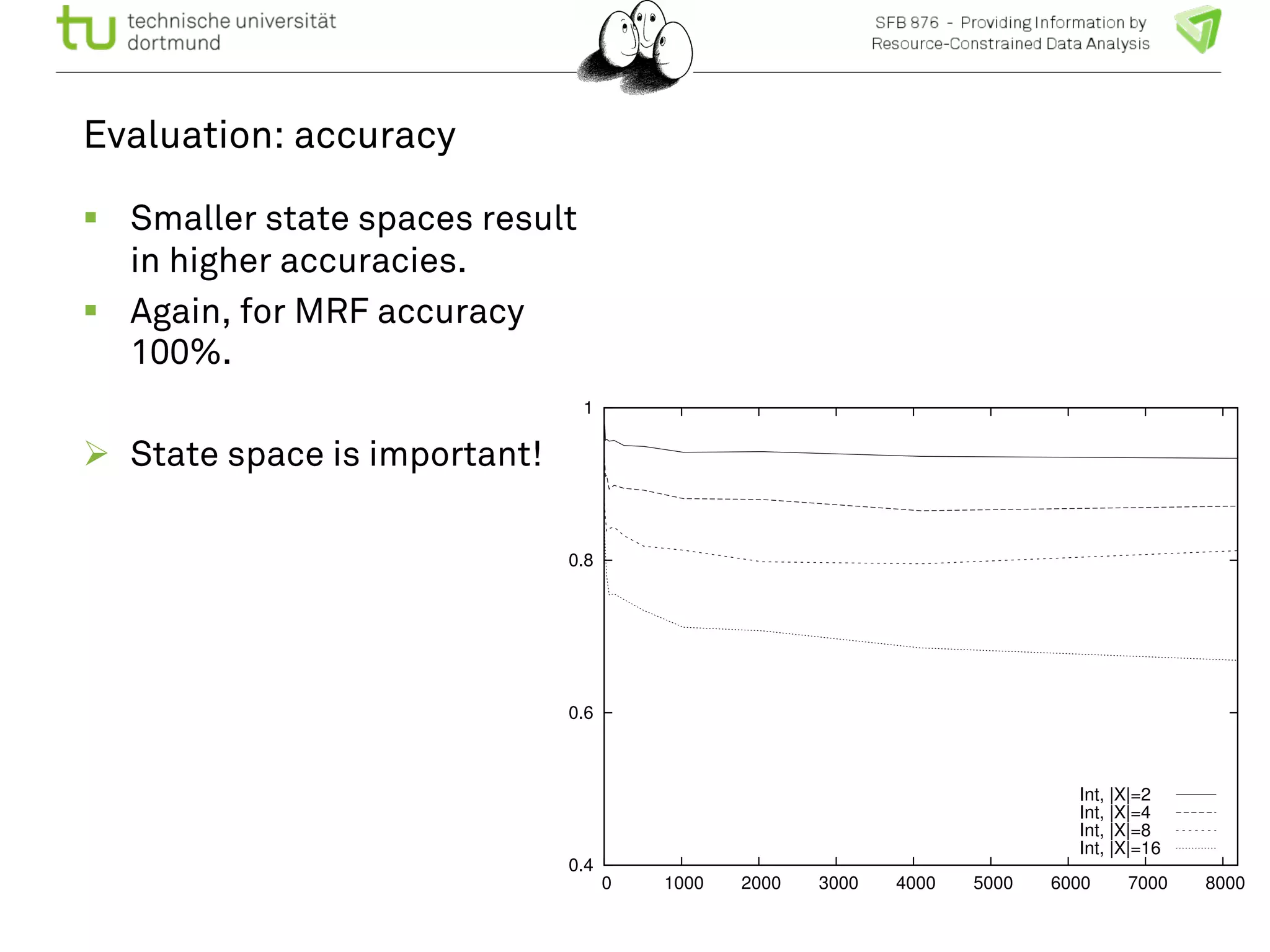
Evaluation: accuracy 
! Smaller state spaces result 
in higher accuracies. 
! Again, for MRF accuracy 
100%. 
# State space is important! 
1 
0.8 
0.6 
0.4 
Int, |X|=2 
Int, |X|=4 
Int, |X|=8 
Int, |X|=16 
0 1000 2000 3000 4000 5000 6000 7000 8000
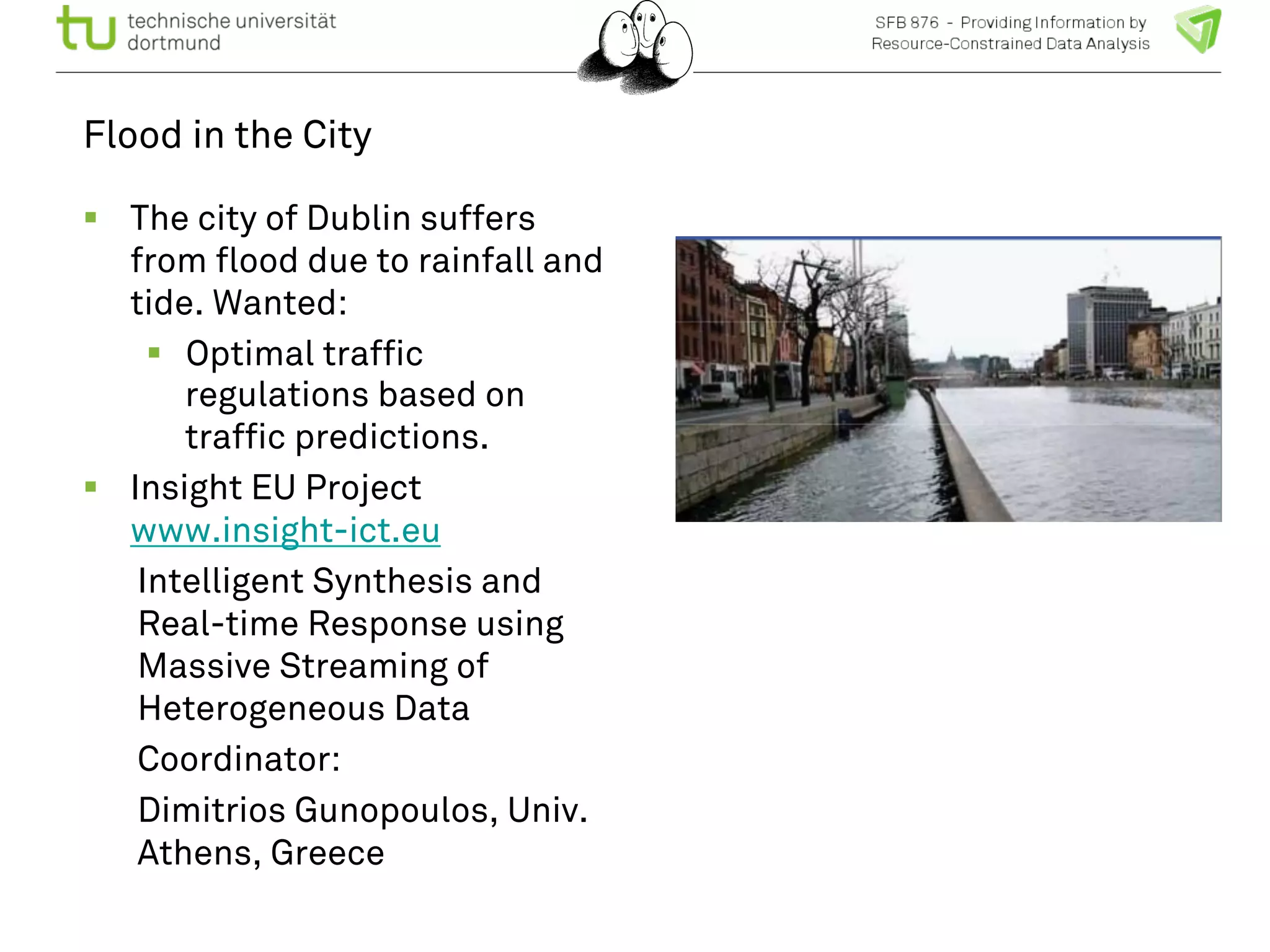
Flood in the City 
! The city of Dublin suffers 
from flood due to rainfall and 
tide. Wanted: 
! Optimal traffic 
regulations based on 
traffic predictions. 
! Insight EU Project 
www.insight-ict.eu 
Intelligent Synthesis and 
Real-time Response using 
Massive Streaming of 
Heterogeneous Data 
Coordinator: 
Dimitrios Gunopoulos, Univ. 
Athens, Greece
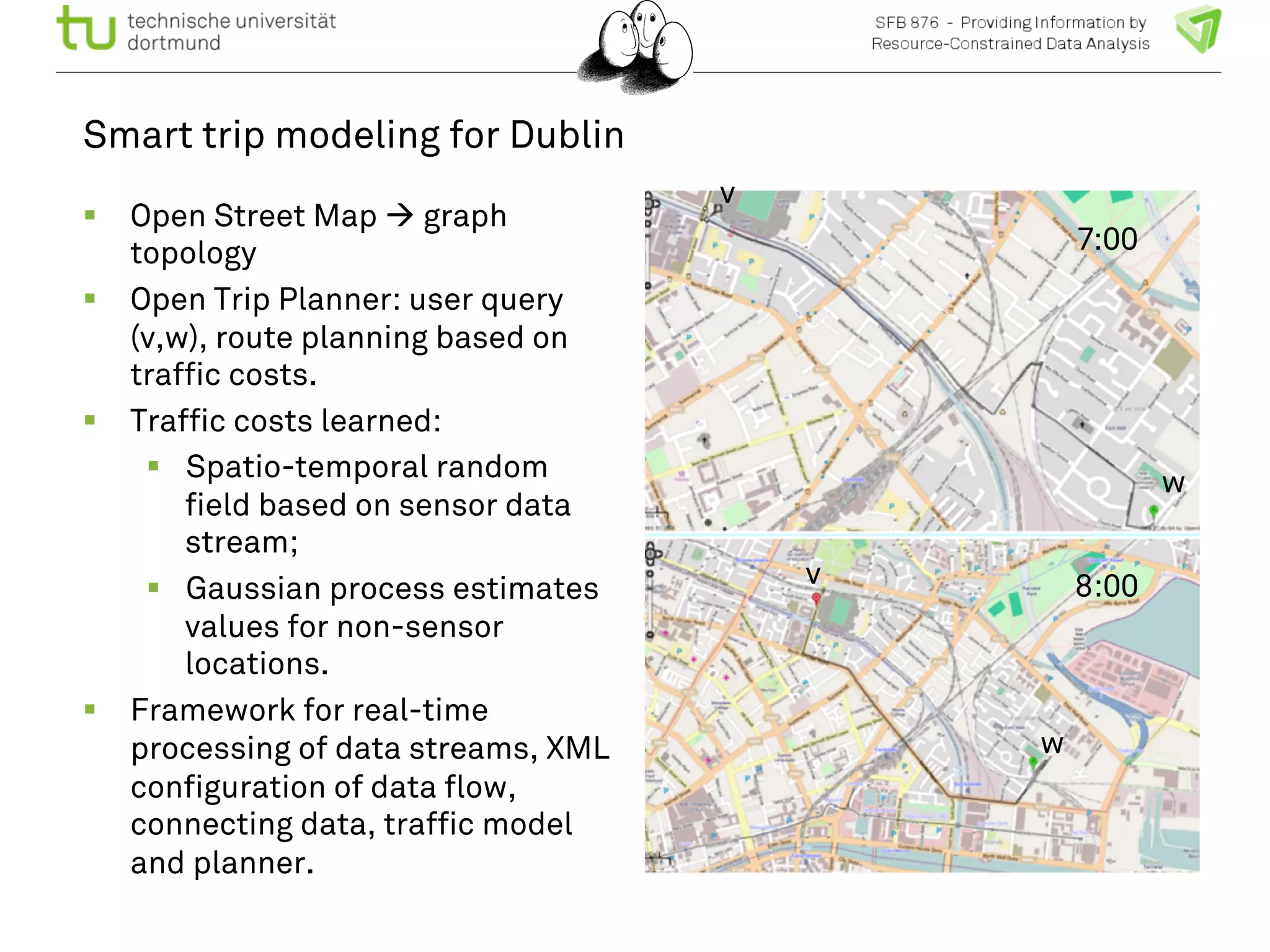
Smart trip modeling for Dublin 
! Open Street Map " graph 
topology 
! Open Trip Planner: user query 
(v,w), route planning based on 
traffic costs. 
! Traffic costs learned: 
! Spatio-temporal random 
field based on sensor data 
stream; 
! Gaussian process estimates 
values for non-sensor 
locations. 
! Framework for real-time 
processing of data streams, XML 
configuration of data flow, 
connecting data, traffic model 
and planner. 
7:00 
8:00 
v 
v 
w 
w
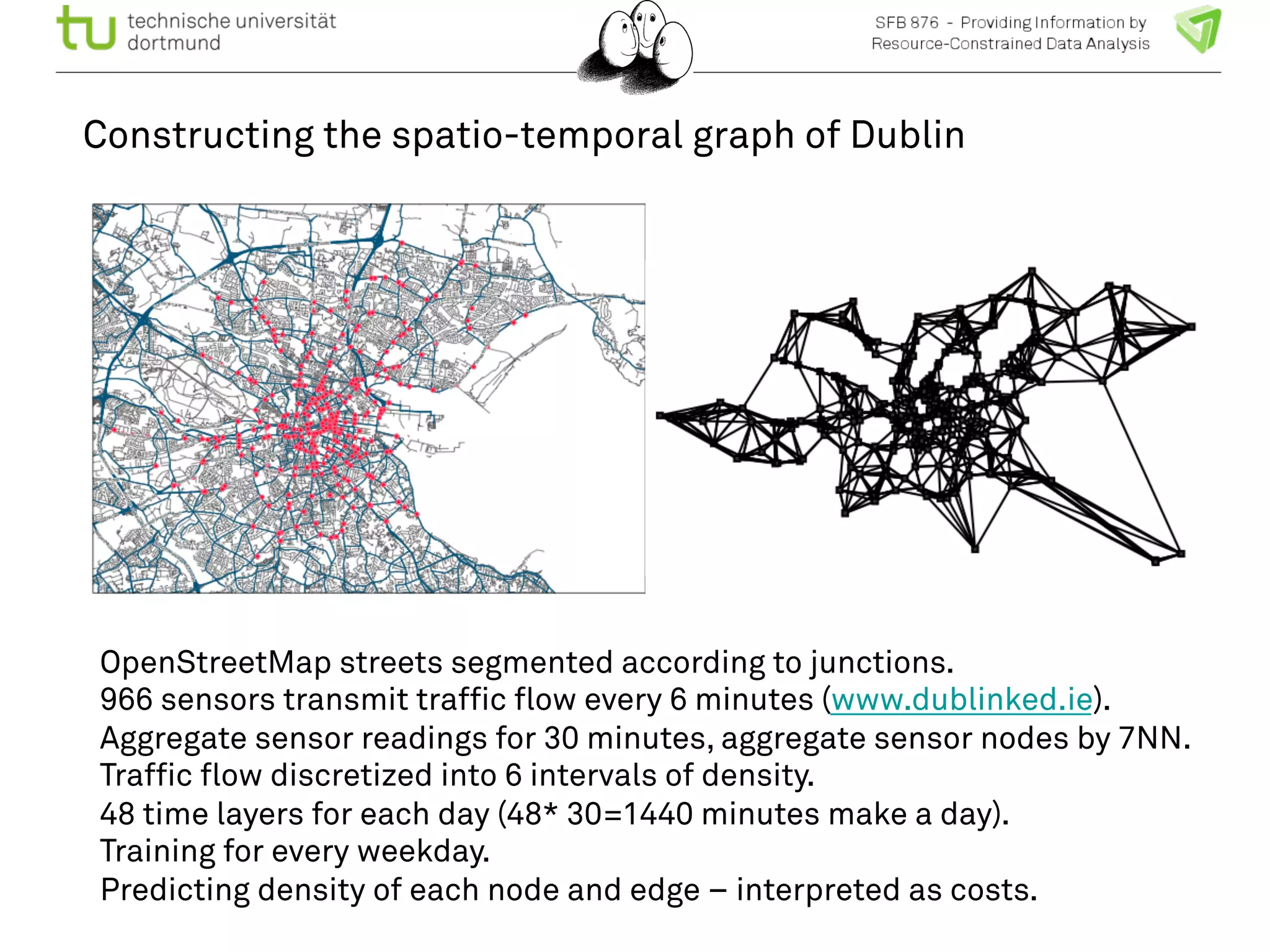
Constructing the spatio-temporal graph of Dublin 
OpenStreetMap streets segmented according to junctions. 
966 sensors transmit traffic flow every 6 minutes (www.dublinked.ie). 
Aggregate sensor readings for 30 minutes, aggregate sensor nodes by 7NN. 
Traffic flow discretized into 6 intervals of density. 
48 time layers for each day (48* 30=1440 minutes make a day). 
Training for every weekday. 
Predicting density of each node and edge – interpreted as costs.
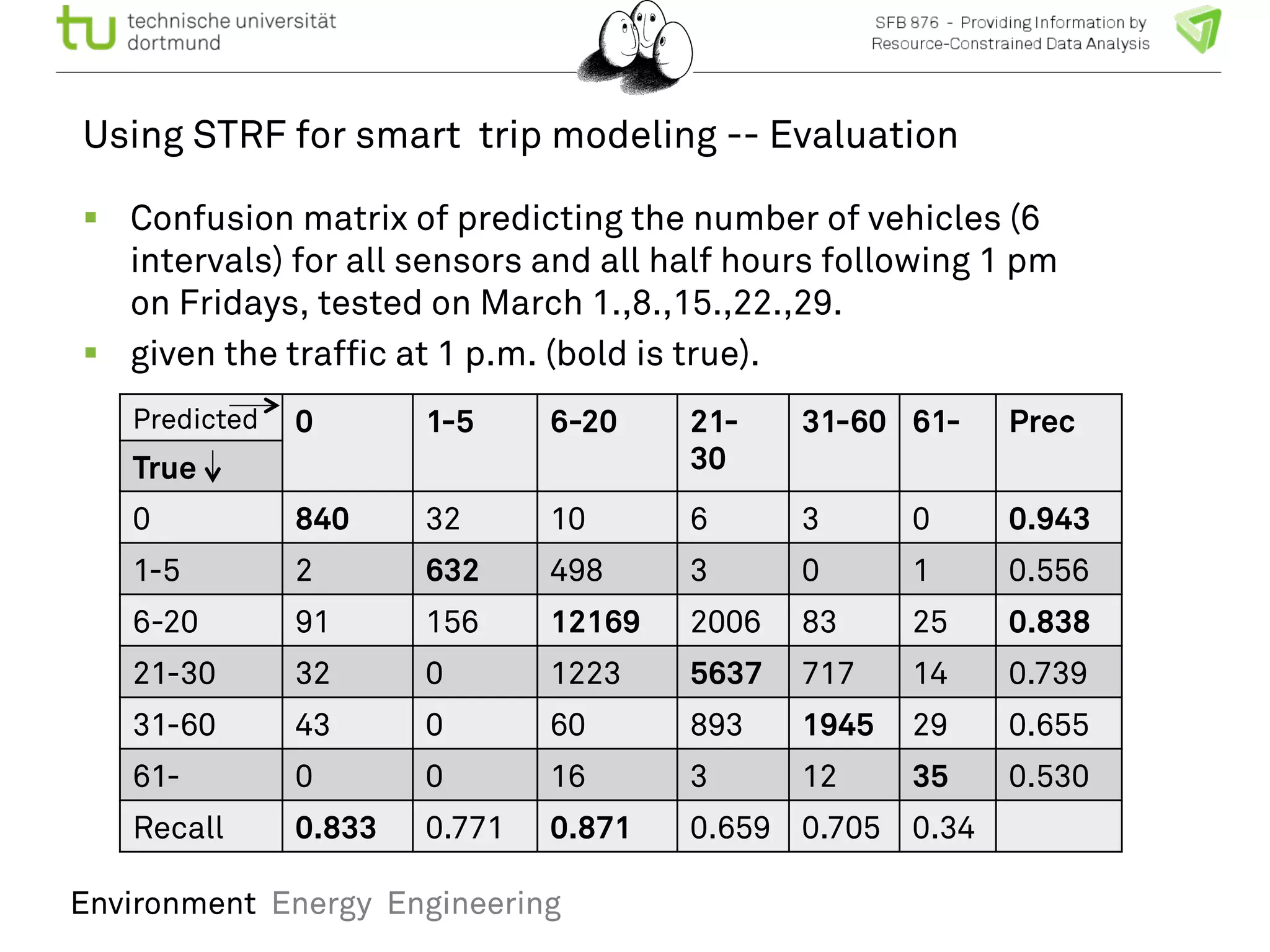
Using STRF for smart trip modeling -- Evaluation 
! Confusion matrix of predicting the number of vehicles (6 
intervals) for all sensors and all half hours following 1 pm 
on Fridays, tested on March 1.,8.,15.,22.,29. 
! given the traffic at 1 p.m. (bold is true). 
Predicted 0 1-5 6-20 21- 
30 
31-60 61- Prec 
True 
0 840 32 10 6 3 0 0.943 
1-5 2 632 498 3 0 1 0.556 
6-20 91 156 12169 2006 83 25 0.838 
21-30 32 0 1223 5637 717 14 0.739 
31-60 43 0 60 893 1945 29 0.655 
61- 0 0 16 3 12 35 0.530 
Recall 0.833 0.771 0.871 0.659 0.705 0.34 
Environment Energy Engineering
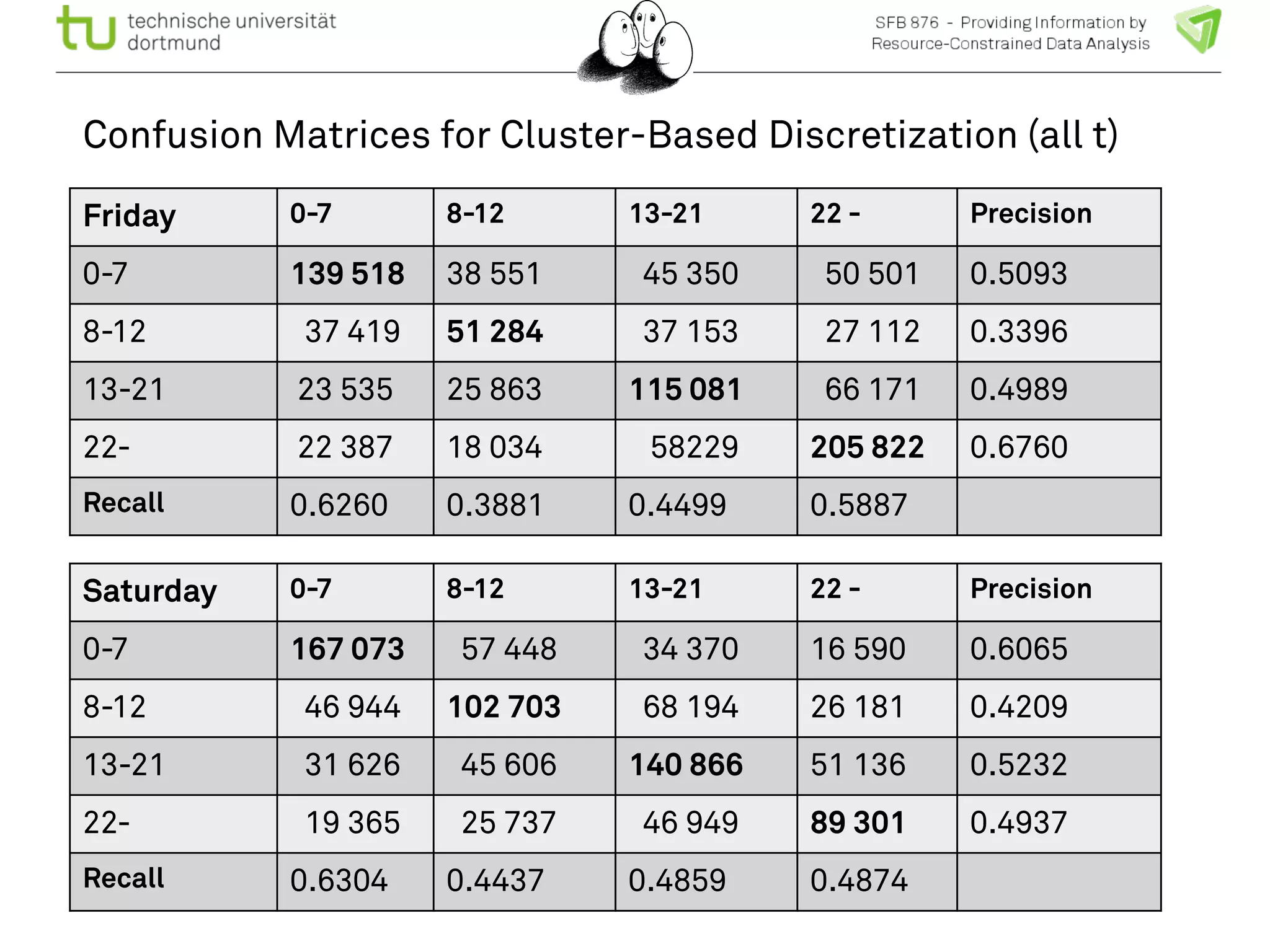
Confusion Matrices for Cluster-Based Discretization (all t) 
Friday 0-7 8-12 13-21 22 - Precision 
0-7 139 518 38 551 45 350 50 501 0.5093 
8-12 37 419 51 284 37 153 27 112 0.3396 
13-21 23 535 25 863 115 081 66 171 0.4989 
22- 22 387 18 034 58229 205 822 0.6760 
Recall 0.6260 0.3881 0.4499 0.5887 
Saturday 0-7 8-12 13-21 22 - Precision 
0-7 167 073 57 448 34 370 16 590 0.6065 
8-12 46 944 102 703 68 194 26 181 0.4209 
13-21 31 626 45 606 140 866 51 136 0.5232 
22- 19 365 25 737 46 949 89 301 0.4937 
Recall 0.6304 0.4437 0.4859 0.4874
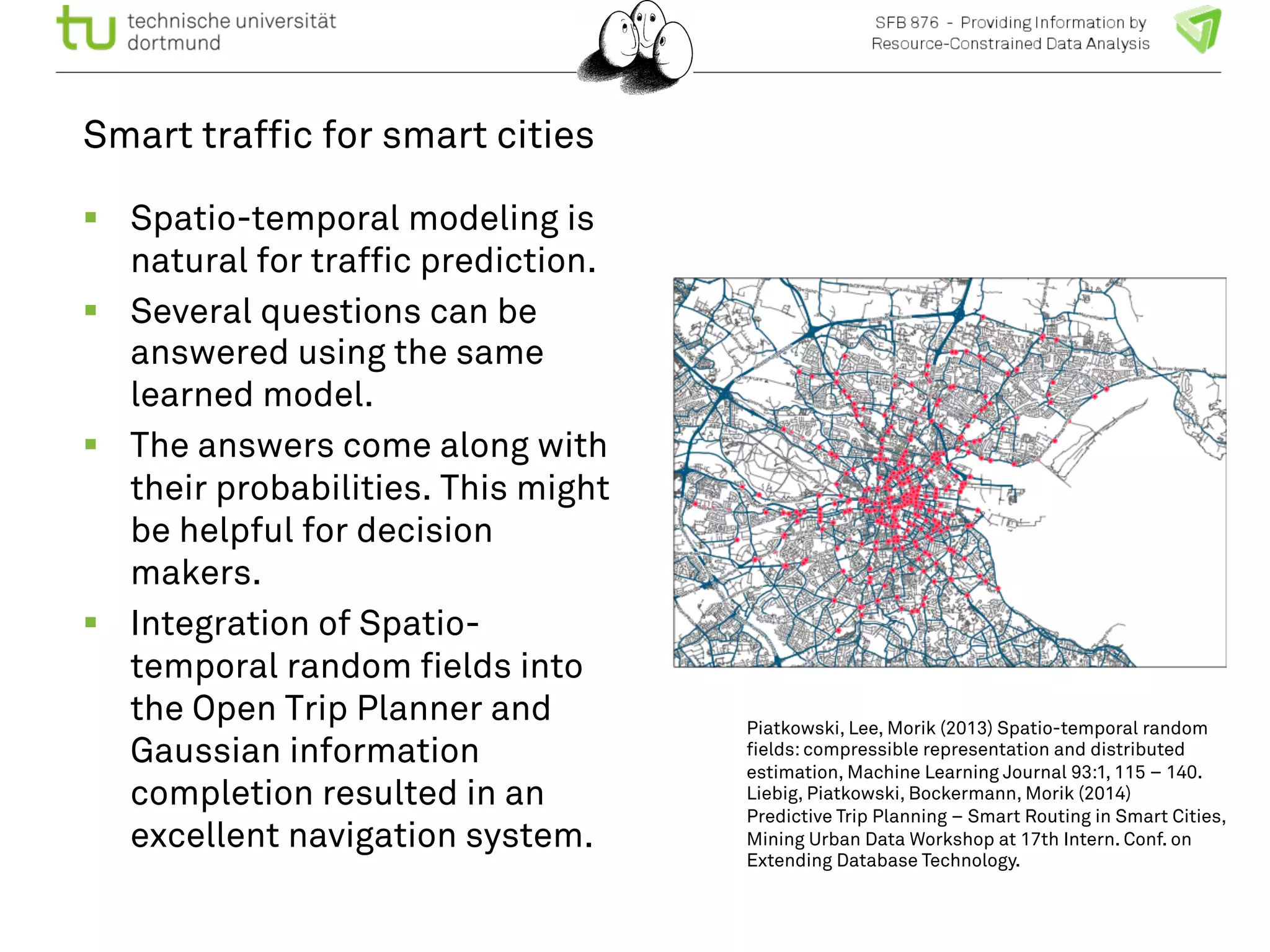
Smart traffic for smart cities 
! Spatio-temporal modeling is 
natural for traffic prediction. 
! Several questions can be 
answered using the same 
learned model. 
! The answers come along with 
their probabilities. This might 
be helpful for decision 
makers. 
! Integration of Spatio-temporal 
random fields into 
the Open Trip Planner and 
Gaussian information 
completion resulted in an 
excellent navigation system. 
Piatkowski, Lee, Morik (2013) Spatio-temporal random 
fields: compressible representation and distributed 
estimation, Machine Learning Journal 93:1, 115 – 140. 
Liebig, Piatkowski, Bockermann, Morik (2014) 
Predictive Trip Planning – Smart Routing in Smart Cities, 
Mining Urban Data Workshop at 17th Intern. Conf. on 
Extending Database Technology.
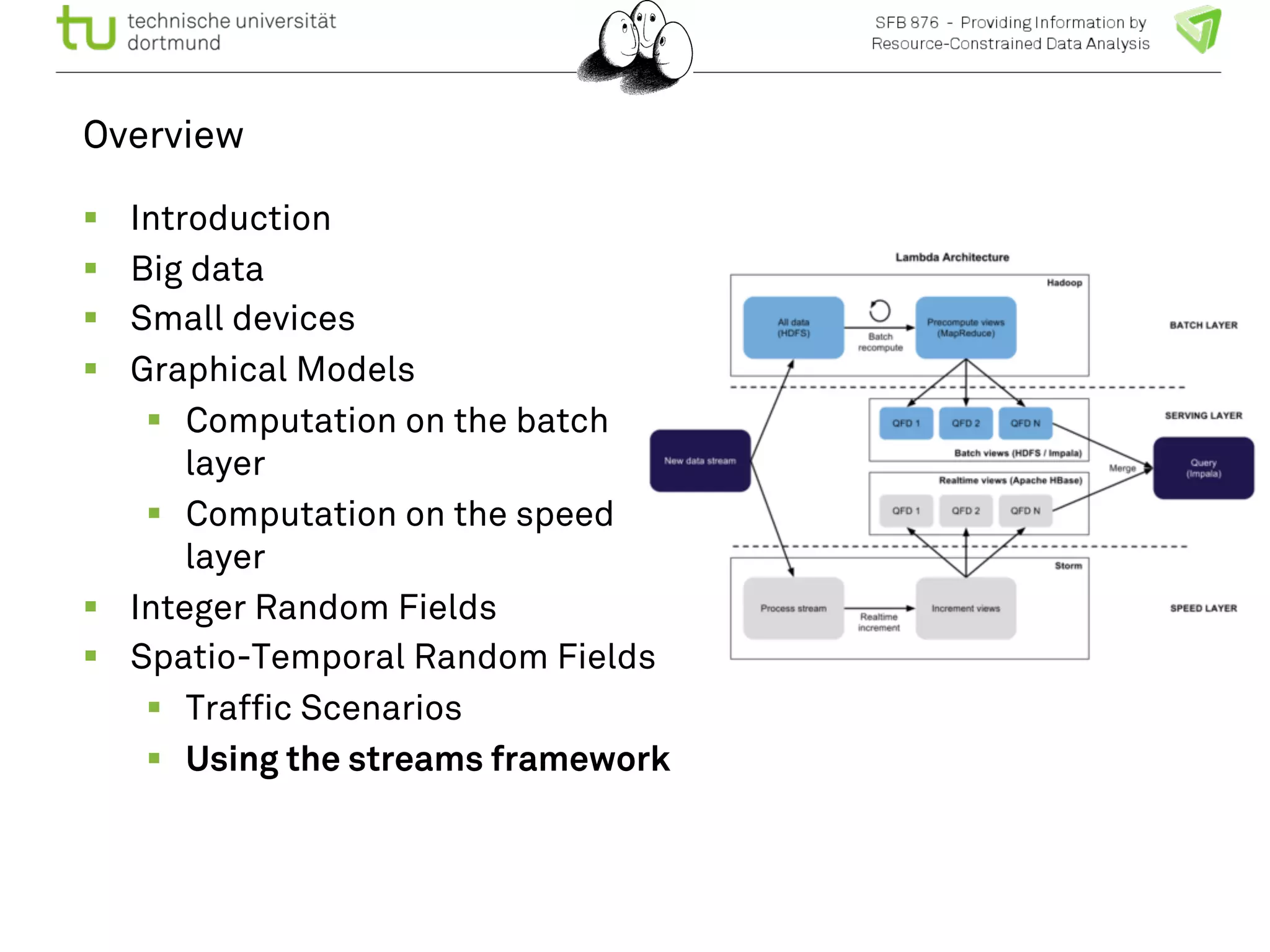
Overview 
! Introduction 
! Big data 
! Small devices 
! Graphical Models 
! Computation on the batch 
layer 
! Computation on the speed 
layer 
! Integer Random Fields 
! Spatio-Temporal Random Fields 
! Traffic Scenarios 
! Using the streams framework
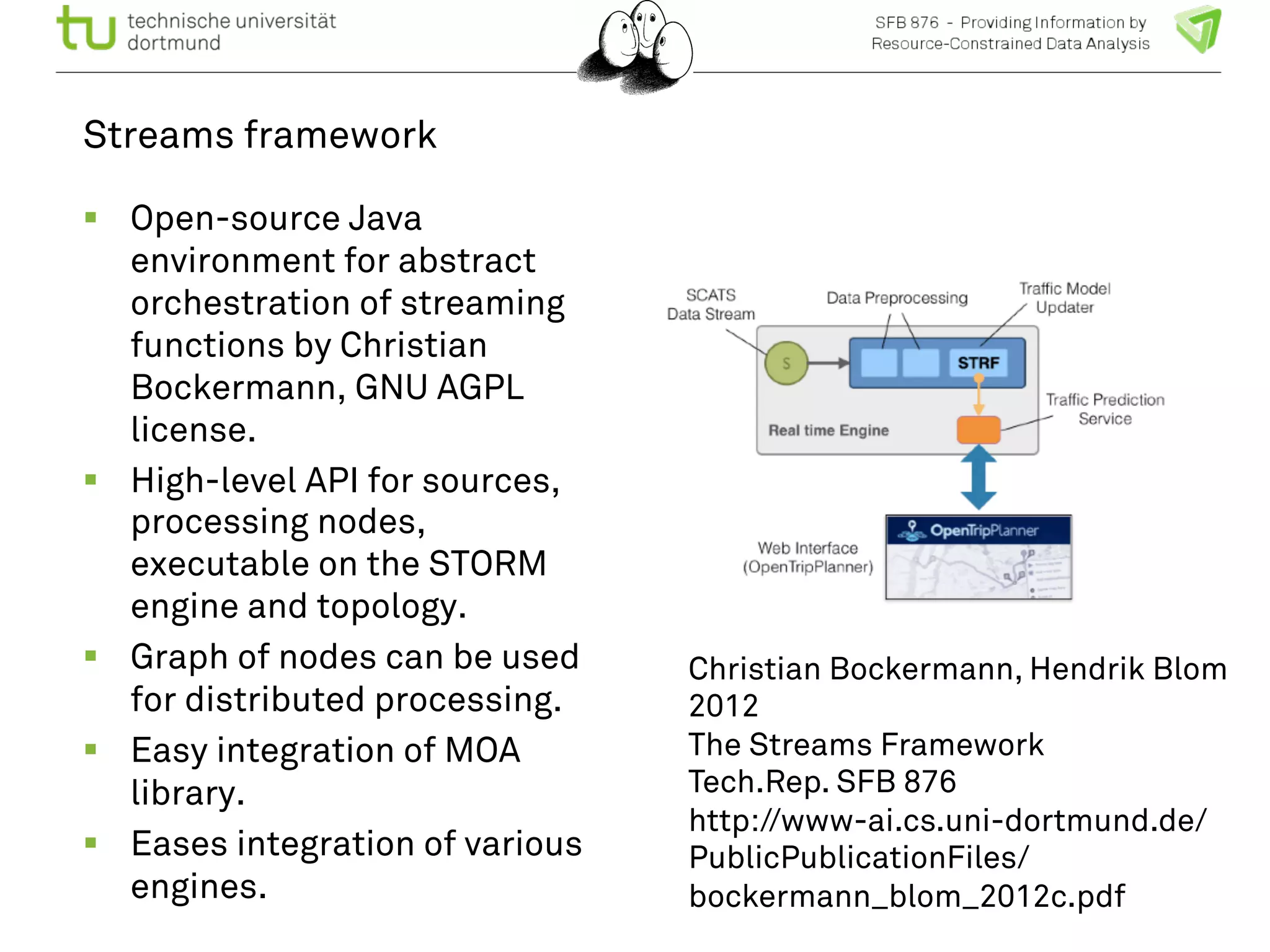
Streams framework 
! Open-source Java 
environment for abstract 
orchestration of streaming 
functions by Christian 
Bockermann, GNU AGPL 
license. 
! High-level API for sources, 
processing nodes, 
executable on the STORM 
engine and topology. 
! Graph of nodes can be used 
for distributed processing. 
! Easy integration of MOA 
library. 
! Eases integration of various 
engines. 
Christian Bockermann, Hendrik Blom 
2012 
The Streams Framework 
Tech.Rep. SFB 876 
http://www-ai.cs.uni-dortmund.de/ 
PublicPublicationFiles/ 
bockermann_blom_2012c.pdf
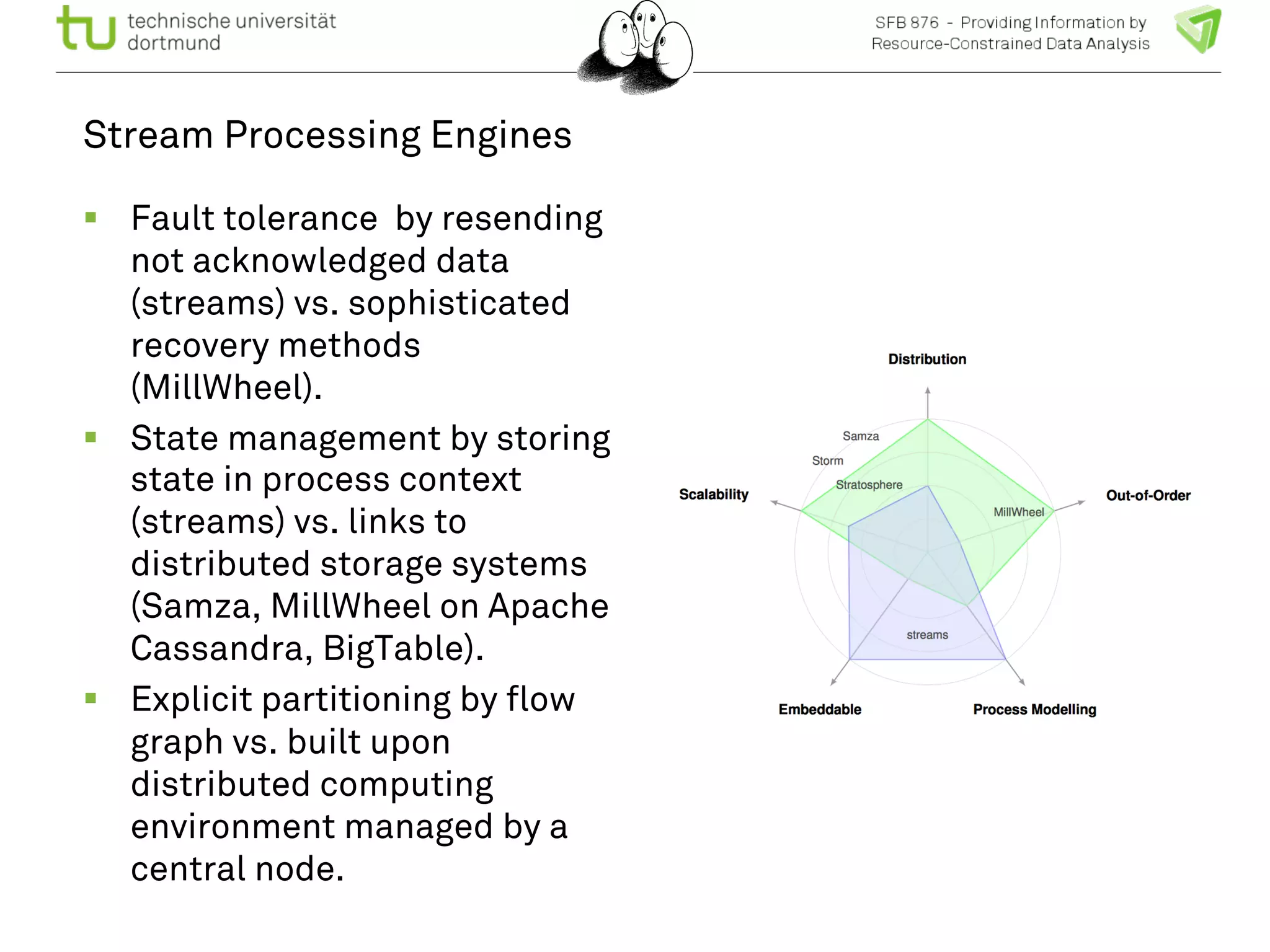
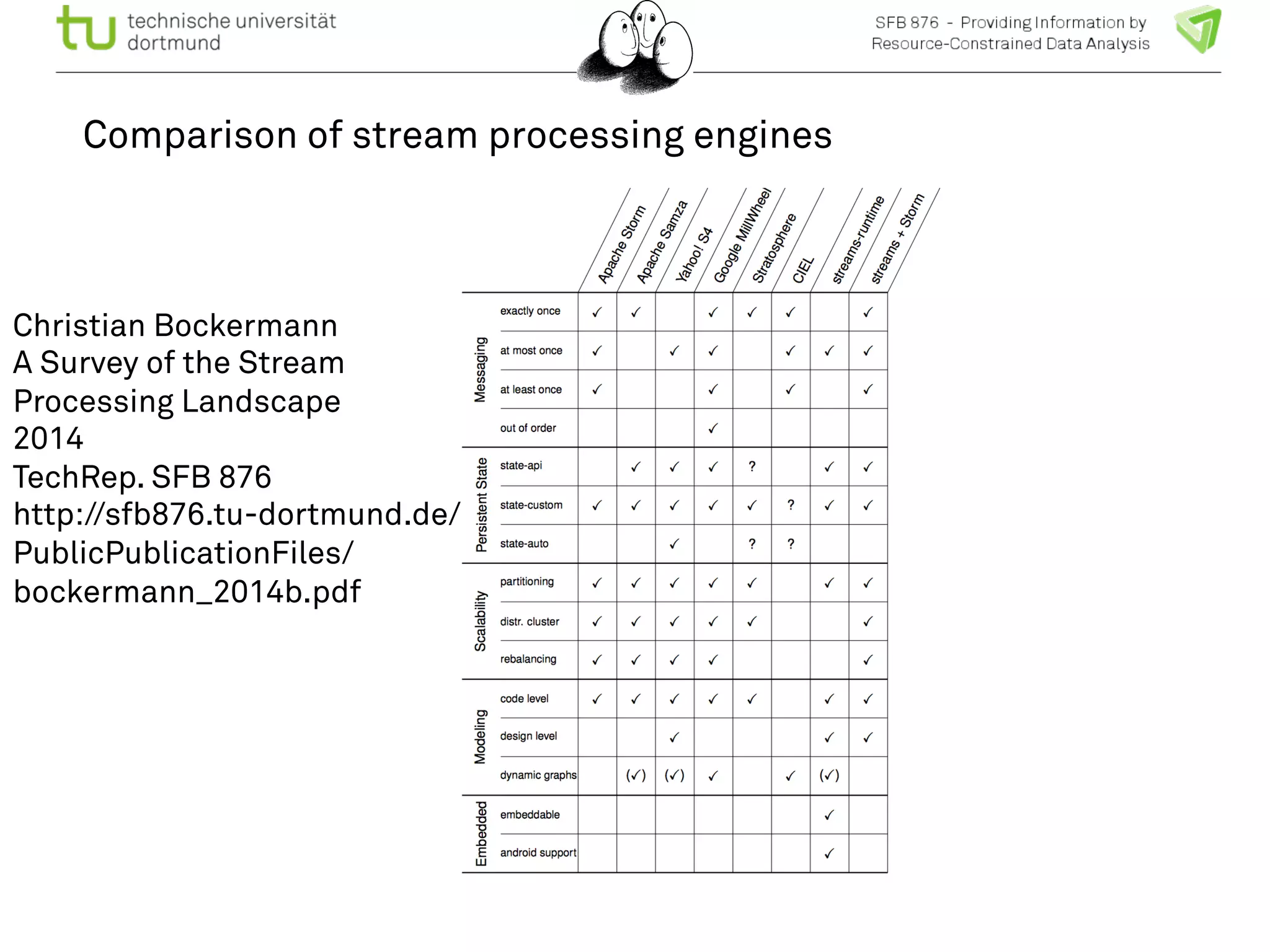
Stream Processing Engines 
! Fault tolerance by resending 
not acknowledged data 
(streams) vs. sophisticated 
recovery methods 
(MillWheel). 
! State management by storing 
state in process context 
(streams) vs. links to 
distributed storage systems 
(Samza, MillWheel on Apache 
Cassandra, BigTable). 
! Explicit partitioning by flow 
graph vs. built upon 
distributed computing 
environment managed by a 
central node.
Comparison of stream processing engines 
Christian Bockermann 
A Survey of the Stream 
Processing Landscape 
2014 
TechRep. SFB 876 
http://sfb876.tu-dortmund.de/ 
PublicPublicationFiles/ 
bockermann_2014b.pdf
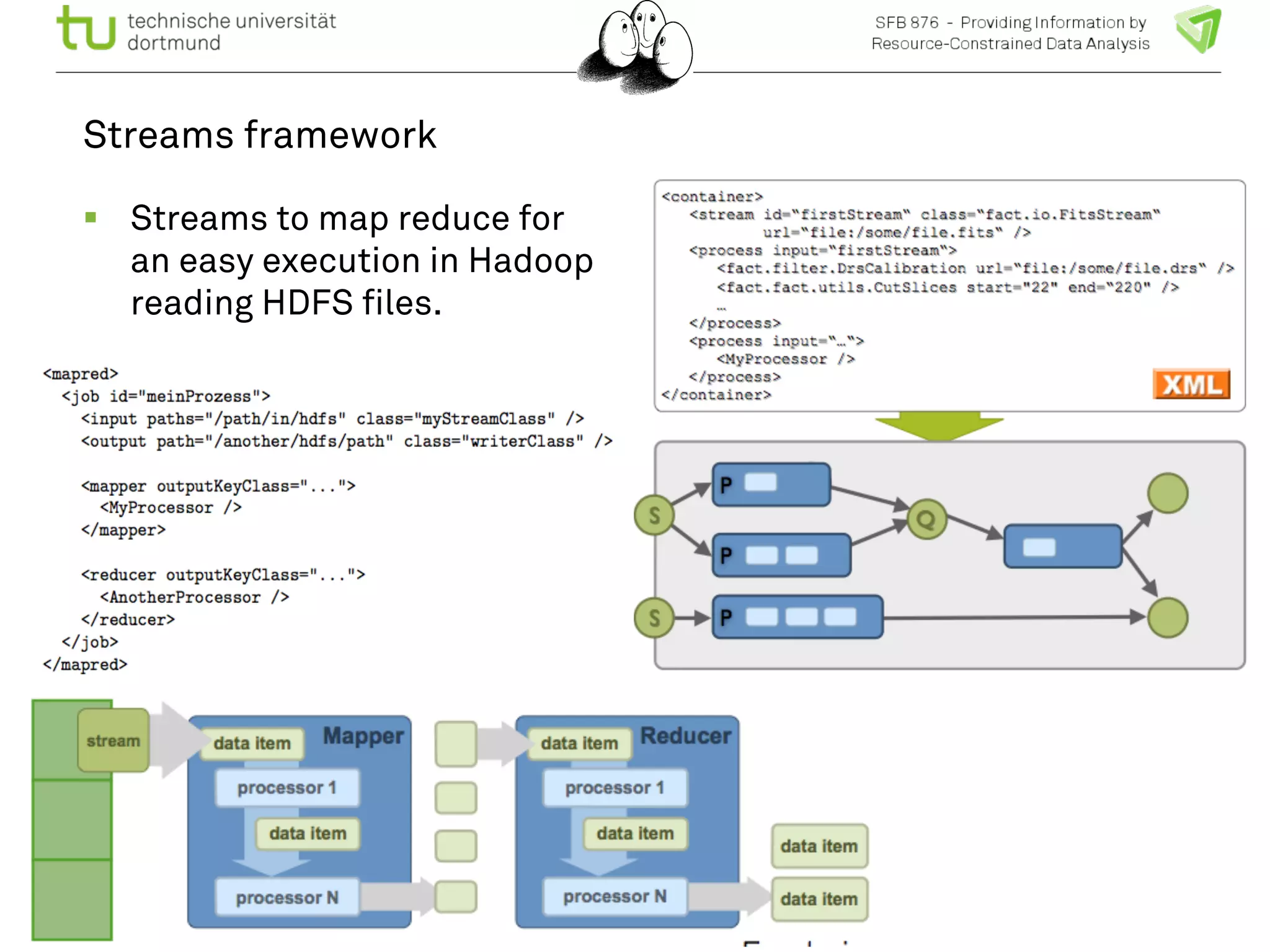
Streams framework 
! Streams to map reduce for 
an easy execution in Hadoop 
reading HDFS files.
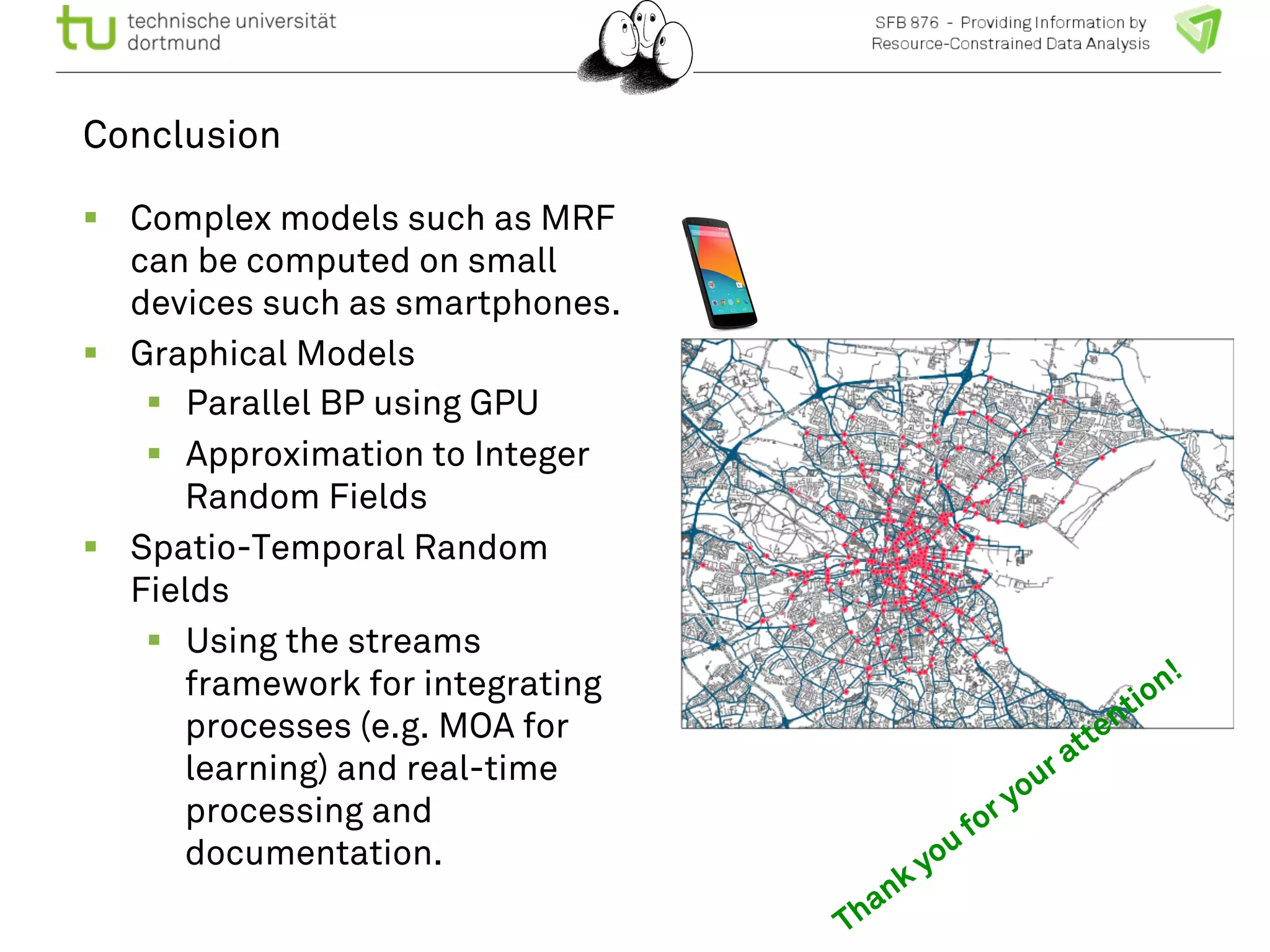
Conclusion 
! Complex models such as MRF 
can be computed on small 
devices such as smartphones. 
! Graphical Models 
! Parallel BP using GPU 
! Approximation to Integer 
Random Fields 
! Spatio-Temporal Random 
Fields 
! Using the streams 
framework for integrating 
processes (e.g. MOA for 
learning) and real-time 
processing and 
documentation.
References 
! Nico Piatkowski (2011) Parallel Algorithms 
for GPU Accelerated Probabilistic 
Inference 
http://biglearn.org/2011/files/papers/ 
biglearn2011_submission_28.pdf 
! Felix Jungermann, Nico Piatkowski, 
Katharina Morik (2010) Enhancing 
Ubiquitous Systems Through System Call 
Mining, LACIS at ICDM 
http://www.computer.org/csdl/proceedings/ 
icdmw/2010/4257/00/4257b338-abs.html 
! Nico Piatkowski, Sangkyun Lee, Katharina 
Morik (2014) The Integer Approximation of 
Undirected Graphical Models, ICPRAM 
http://www-ai.cs.uni-dortmund.de/ 
PublicPublicationFiles/ 
piatkowski_etal_2014a.pdf 
! Piatkowski, Lee, Morik (2013) Spatio-temporal 
random fields: compressible 
representation and distributed 
estimation, Machine Learning Journal 
93:1, 115 – 140. 
! Liebig, Piatkowski, Bockermann, Morik 
(2014) Predictive Trip Planning – Smart 
Routing in Smart Cities, Mining Urban 
Data Workshop at 17th Intern. Conf. on 
Extending Database Technology. 
! Streams framework 
Christian Bockermann, Hendrik Blom 
2012 The Streams Framework 
Tech.Rep. SFB 876 
http://www-ai.cs.uni-dortmund.de/ 
PublicPublicationFiles/ 
bockermann_blom_2012c.pdf 
! Christian Bockermann (2014) A Survey of 
the Stream Processing Landscape 
TechRep. SFB 876 
http://sfb876.tu-dortmund.de/ 
PublicPublicationFiles/ 
bockermann_2014b.pdf 
! For streams software (not just scripts!) 
check: 
http://www-ai.cs.uni-dortmund.de/ 
SOFTWARE/streams/

Big Data and Small Devices by Katharina Morik

  • 1.
    Big Data andSmall Decives Katharina Morik, Artificial Intelligence, TU Dortmund University, Germany
  • 2.
    Overview ! Bigdata -- small devices ! Graphical Models ! Computation on the batch layer ! Computation on the speed layer ! Integer Random Fields ! Spatio-Temporal Random Fields ! Traffic Scenarios ! Using the streams framework
  • 3.
    Big data –small devices ! Machine learning for the enhancement of small devices ! Machine learning on small devices ! Reduce ! Computational complexity ! Memory consumption ! Communication ! Energy
  • 4.
    Overview ! Bigdata -- small devices ! Graphical Models ! Computation on the batch layer ! Computation on the speed layer ! Integer Random Fields ! Spatio-Temporal Random Fields ! Traffic Scenarios ! Using the streams framework
  • 5.
    Graphical Models !Graph G=(V,E) ! Multi-variate random variable X with finite discrete domain X ! Mapping joint vertex assignment into vector space φ(x): X --> Rd ! Parameter to be learned: θ in Rd CRF : p ( ! ! y x) = 1 ! ( x) Z θ, Σ exp θi φi ( ! x) ! y, i " # $ % & ' 1 a = exp(−ln a) Σ = exp θi φi ( ! x) ! y, i " # $ % & ' ! ( x) − ln Z θ, ) * + , - . ! x ( ) − A θ ( ) )* = exp θ,φ ! y, ,- MRF : p( ! x) = 1 Z θ ( ) Σ exp θi φi ! (x) i " # $ % & ' ! x ( ) − A θ ( ) )* = exp θ,φ ,-
  • 6.
    Note: vectors aresparse φ(x): ( /* Nodes*/ 1. red, /*dom(lights)*/ 2. yellow, 3. green, 4. wet, /*dom(rain)*/ 5. dry, 6. jam, /*dom(jam)*/ 7. free, /*Edges*/ 1. red, dry, /* edge lights-rain*/ 2. yellow, dry, 3. green, dry, 4. red, wet, 5. yellow, wet, 6. green, wet, 7. red, jam, /*edge lights-jam*/ 8. yellow, jam, 9. green, jam, 10. red, free, 11. yellow, free, 12. green, free, 13. dry, free, /*edge rain-jam*/ 14. dry, jam, 15. wet, free, 16. wet, jam) ) ! x1:(red,dry,free) Lights Rain Jam {jam, free} {dry, wet} {red, yellow, green}
  • 7.
  • 8.
  • 9.
    Markov Random Field:Estimation and Prediction
  • 10.
    Belief propagation !Actually computing the expected probability of parameters given θ by message passing for each direction.
  • 11.
    Note: vectors aresparse φ(x): ( /* Nodes*/ 1. red, /*dom(lights)*/ 2. yellow, 3. green, 4. wet, /*dom(rain)*/ 5. dry, 6. jam, /*dom(jam)*/ 7. free, /*Edges*/ 1. red, dry, /* edge lights-rain*/ 2. yellow, dry, 3. green, dry, 4. red, wet, 5. yellow, wet, 6. green, wet, 7. red, jam, /*edge lights-jam*/ 8. yellow, jam, 9. green, jam, 10. red, free, 11. yellow, free, 12. green, free, 13. dry, free, /*edge rain-jam*/ 14. dry, jam, 15. wet, free, 16. wet, jam) ) ! x1:(red,dry,free) ! φ(x1)= (1,0,0,0,1,0,1,1,0,0,0,0,0,0, 0,0,1,0,0,1,0,0,0) ! d = 23 Lights Rain Jam {jam, free} {dry, wet} {red, yellow, green}
  • 12.
    Belief propagation example Π Σ mv→u (y) = exp θvu=xy +θv=x ( ) mwu (x) Lights Rain Jam {jam, free} {dry, wet} {red, yellow, green} w∈Nv−{u} x∈ℵv Compute for each node u and each of its neighbors and each of the states
  • 13.
    Parallel Belief Propagation(GPU) ! Data Parallel: all node and neighbor pairs become blocks with b threads. A thread computes the msg v" u. ! Thread-cooperative: all node and instance pairs become blocks. A thread computes partial outgoing messages. These are cooperatively processed by all threads in a block. Partial messages are merged afterwards. ! Nico Piatkowski (2011) Parallel Algorithms for GPU Accelerated Probabilistic Inference ! http://biglearn.org/2011/files/papers/biglearn2011_submission_28.pdf
  • 14.
    File Prefetching forSmartphone Energy Saving ! Accessing files that are stored in cache consumes less energy than accessing those on the hard disc. ! Prefetching files which soon will be accessed allows for grouping requests to a batched one. This saves energy. " Prediction of file access saves energy! Given a system call: 1,open,1812,179,178,201,200,firefox,/etc/hosts,524288,438,7 Predict: hosts full Prefetch: hosts 2,read,1812,179,178,201,200,firefox,/etc/hosts,4096,361 3,read,1812,179,178,201,200,firefox,/etc/hosts,4096,0 4,close,1812,179,178,201,200,firefox,/etc/hosts timestamp, syscall, thread-id, process-id, parent, user, group, exec, file, parameters (optional) 14
  • 15.
    Results: Memory !Naive Bayes models use less memory than those of regular CRF. ! Implementing CRF on GPGPU reduces memory needs. ! CRF on GPU scales best. 15 1600 1400 1200 1000 800 600 400 200 0 67k 202k 337k 472k 606k NB memory CRF memory GPU CRF memory Felix Jungermann, Nico Piatkowski, Katharina Morik (2010) Enhancing Ubiquitous Systems Through System Call Mining, LACIS at ICDM http://www.computer.org/csdl/proceedings/ icdmw/2010/4257/00/4257b338-abs.html
  • 16.
    Overview ! Bigdata -- small devices ! Graphical Models ! Computation on the batch layer ! Computation on the speed layer ! Integer Random Fields ! Spatio-Temporal Random Fields ! Traffic Scenarios ! Using the streams framework
  • 17.
    Graphical models onresource-restricted processors ! Floating point arithmetics (real) costs more clock cycles than integer arithmetics. ! “The most obvious technique to conserve power is to reduce the number of cycles it takes to complete a workload.” (Intel 64, IA-32 architectures optimization reference manual, guidelines for extending battery life). ! Restrict the parameter space of MRF Sandy Bridge ARM 11 Real Int Real Int + 3 1 8 1 * 5 3 8 4-5 / 14 13-15 19 - Bit - 3 - 2 shift Clock cycles for arithmetics on different processors: Real vs. integer. θ ∈{0,1,...,K}⊂ Ν
  • 18.
    Parameter space transformation ! Graph model tree-structured ! Transform the parameter space: ηi (θ) = θi ln 2 MRF : p( ! x) = 1 Z θ ( ) Σ exp θi φi ! (x) i " # $ % & ' ! x ( ) − A θ ( ) )* = exp θ,φ +, IntegerMRF : p( ! x) = exp η θ ( ),φ ! x ( ) )* +, = 2 θ ,φ x ( ) −A η θ ( ) ( ) )* +, = 2 θ ,φ (x) 2 θ ,φ (y) y∈ℵ Σ
  • 19.
    Integer belief propagation ! Simply replacing the exp(.) by 2(.) is not sufficient ! Overflows are normally avoided by normalization. ! Normalization is impossible in integer division. ! Magnitude of messages corresponds to probability ! Use the length of each message ! Bit-length is similar to log Π Σ mv→u (y) = exp θvu=xy +θv=x ( ) mwu (x) w∈Nv−{u} x∈ℵv m! v→u (y) = 2 (θvu=xy+θv=x ) Σ m! wu (x) x∈ℵv Π w∈Nv−{u} βv→u (y) = max x∈ℵv Σ θvu=xy +θv=x + βwu (x) w∈Nv−{u}
  • 20.
    Evaluation: accuracy 0.95 0.9 0.85 Int, deg=4 Int, deg=8 Int, deg=16 1000 2000 3000 4000 5000 6000 7000 8000 ! Different vertex degrees ! Up to 8000 nodes in the graph ! 100 runs of IntMRF ! Real MRF is 100% accuracy. # Scalable!
  • 21.
    Integer models useless clock cycles and memory ! Integer MRF shows ! high accuracy: 86 – 92% of full MRF for up to 8 states and 8000 nodes ! high speed-up: 2.56 Raspberry Pie and 2.34 for Sandy Bridge ! Graphical models can now be computed on small devices. ! Using less clock cycles really saves energy. Nico Piatkowski, Sangkyun Lee, Katharina Morik (2014) The Integer Approximation of Undirected Graphical Models, ICPRAM http://www-ai.cs.uni-dortmund.de/ PublicPublicationFiles/piatkowski_etal_2014a.pdf
  • 22.
    Overview ! Bigdata -- small devices ! Graphical Models ! Computation on the batch layer ! Computation on the speed layer ! Integer Random Fields ! Spatio-Temporal Random Fields ! Traffic Scenarios ! Using the streams framework
  • 23.
    Spatio-temporal random fields ! The spatio-temporal graph is trained to predict each node’s maximum a posteriori probability with the marginal probabilities. ! Generative model predicting all nodes. ! Dimension T x |V0| x | X| + [(T-1)(|V0|+3|E0|)+ |E0|] x |X|2 ! Remember: vectors are sparse we have to exploit that! User queries: Given traffic densities at all nodes at t1, t2, t3, what is the probability of traffic density at node A at time t5? Given state “jam” at place A ts, which other places have a higher probability for “jam” in ts < t < te?
  • 24.
    Training efficiently !Reparametrization ! Sparseness and smoothness ! There are not many changes over time ! Small ratio of non-zero entries ! Regularization ! L1 and L2 norm now penalizing difference θ(t-1) and θ(t) ! STRF uses 8 times less memory than MRF model ! Its distributed optimization converges about 2 times faster.
  • 25.
    Compressible parametrization !STRF is 8 times smaller than MRF model ! The ratio of non-zero entries is quite small already for quite small L1 regularization ! STRF’s distributed optimization converges faster than MRF: ! Run MRF for 100 iterations, record the likelihood value; ! Run STRF until it reaches the same result of the objective function. ! Compare seconds.
  • 26.
    Evaluation: accuracy !Smaller state spaces result in higher accuracies. ! Again, for MRF accuracy 100%. # State space is important! 1 0.8 0.6 0.4 Int, |X|=2 Int, |X|=4 Int, |X|=8 Int, |X|=16 0 1000 2000 3000 4000 5000 6000 7000 8000
  • 27.
    Flood in theCity ! The city of Dublin suffers from flood due to rainfall and tide. Wanted: ! Optimal traffic regulations based on traffic predictions. ! Insight EU Project www.insight-ict.eu Intelligent Synthesis and Real-time Response using Massive Streaming of Heterogeneous Data Coordinator: Dimitrios Gunopoulos, Univ. Athens, Greece
  • 28.
    Smart trip modelingfor Dublin ! Open Street Map " graph topology ! Open Trip Planner: user query (v,w), route planning based on traffic costs. ! Traffic costs learned: ! Spatio-temporal random field based on sensor data stream; ! Gaussian process estimates values for non-sensor locations. ! Framework for real-time processing of data streams, XML configuration of data flow, connecting data, traffic model and planner. 7:00 8:00 v v w w
  • 29.
    Constructing the spatio-temporalgraph of Dublin OpenStreetMap streets segmented according to junctions. 966 sensors transmit traffic flow every 6 minutes (www.dublinked.ie). Aggregate sensor readings for 30 minutes, aggregate sensor nodes by 7NN. Traffic flow discretized into 6 intervals of density. 48 time layers for each day (48* 30=1440 minutes make a day). Training for every weekday. Predicting density of each node and edge – interpreted as costs.
  • 30.
    Using STRF forsmart trip modeling -- Evaluation ! Confusion matrix of predicting the number of vehicles (6 intervals) for all sensors and all half hours following 1 pm on Fridays, tested on March 1.,8.,15.,22.,29. ! given the traffic at 1 p.m. (bold is true). Predicted 0 1-5 6-20 21- 30 31-60 61- Prec True 0 840 32 10 6 3 0 0.943 1-5 2 632 498 3 0 1 0.556 6-20 91 156 12169 2006 83 25 0.838 21-30 32 0 1223 5637 717 14 0.739 31-60 43 0 60 893 1945 29 0.655 61- 0 0 16 3 12 35 0.530 Recall 0.833 0.771 0.871 0.659 0.705 0.34 Environment Energy Engineering
  • 31.
    Confusion Matrices forCluster-Based Discretization (all t) Friday 0-7 8-12 13-21 22 - Precision 0-7 139 518 38 551 45 350 50 501 0.5093 8-12 37 419 51 284 37 153 27 112 0.3396 13-21 23 535 25 863 115 081 66 171 0.4989 22- 22 387 18 034 58229 205 822 0.6760 Recall 0.6260 0.3881 0.4499 0.5887 Saturday 0-7 8-12 13-21 22 - Precision 0-7 167 073 57 448 34 370 16 590 0.6065 8-12 46 944 102 703 68 194 26 181 0.4209 13-21 31 626 45 606 140 866 51 136 0.5232 22- 19 365 25 737 46 949 89 301 0.4937 Recall 0.6304 0.4437 0.4859 0.4874
  • 32.
    Smart traffic forsmart cities ! Spatio-temporal modeling is natural for traffic prediction. ! Several questions can be answered using the same learned model. ! The answers come along with their probabilities. This might be helpful for decision makers. ! Integration of Spatio-temporal random fields into the Open Trip Planner and Gaussian information completion resulted in an excellent navigation system. Piatkowski, Lee, Morik (2013) Spatio-temporal random fields: compressible representation and distributed estimation, Machine Learning Journal 93:1, 115 – 140. Liebig, Piatkowski, Bockermann, Morik (2014) Predictive Trip Planning – Smart Routing in Smart Cities, Mining Urban Data Workshop at 17th Intern. Conf. on Extending Database Technology.
  • 33.
    Overview ! Introduction ! Big data ! Small devices ! Graphical Models ! Computation on the batch layer ! Computation on the speed layer ! Integer Random Fields ! Spatio-Temporal Random Fields ! Traffic Scenarios ! Using the streams framework
  • 34.
    Streams framework !Open-source Java environment for abstract orchestration of streaming functions by Christian Bockermann, GNU AGPL license. ! High-level API for sources, processing nodes, executable on the STORM engine and topology. ! Graph of nodes can be used for distributed processing. ! Easy integration of MOA library. ! Eases integration of various engines. Christian Bockermann, Hendrik Blom 2012 The Streams Framework Tech.Rep. SFB 876 http://www-ai.cs.uni-dortmund.de/ PublicPublicationFiles/ bockermann_blom_2012c.pdf
  • 35.
    Stream Processing Engines ! Fault tolerance by resending not acknowledged data (streams) vs. sophisticated recovery methods (MillWheel). ! State management by storing state in process context (streams) vs. links to distributed storage systems (Samza, MillWheel on Apache Cassandra, BigTable). ! Explicit partitioning by flow graph vs. built upon distributed computing environment managed by a central node.
  • 36.
    Comparison of streamprocessing engines Christian Bockermann A Survey of the Stream Processing Landscape 2014 TechRep. SFB 876 http://sfb876.tu-dortmund.de/ PublicPublicationFiles/ bockermann_2014b.pdf
  • 37.
    Streams framework !Streams to map reduce for an easy execution in Hadoop reading HDFS files.
  • 38.
    Conclusion ! Complexmodels such as MRF can be computed on small devices such as smartphones. ! Graphical Models ! Parallel BP using GPU ! Approximation to Integer Random Fields ! Spatio-Temporal Random Fields ! Using the streams framework for integrating processes (e.g. MOA for learning) and real-time processing and documentation.
  • 39.
    References ! NicoPiatkowski (2011) Parallel Algorithms for GPU Accelerated Probabilistic Inference http://biglearn.org/2011/files/papers/ biglearn2011_submission_28.pdf ! Felix Jungermann, Nico Piatkowski, Katharina Morik (2010) Enhancing Ubiquitous Systems Through System Call Mining, LACIS at ICDM http://www.computer.org/csdl/proceedings/ icdmw/2010/4257/00/4257b338-abs.html ! Nico Piatkowski, Sangkyun Lee, Katharina Morik (2014) The Integer Approximation of Undirected Graphical Models, ICPRAM http://www-ai.cs.uni-dortmund.de/ PublicPublicationFiles/ piatkowski_etal_2014a.pdf ! Piatkowski, Lee, Morik (2013) Spatio-temporal random fields: compressible representation and distributed estimation, Machine Learning Journal 93:1, 115 – 140. ! Liebig, Piatkowski, Bockermann, Morik (2014) Predictive Trip Planning – Smart Routing in Smart Cities, Mining Urban Data Workshop at 17th Intern. Conf. on Extending Database Technology. ! Streams framework Christian Bockermann, Hendrik Blom 2012 The Streams Framework Tech.Rep. SFB 876 http://www-ai.cs.uni-dortmund.de/ PublicPublicationFiles/ bockermann_blom_2012c.pdf ! Christian Bockermann (2014) A Survey of the Stream Processing Landscape TechRep. SFB 876 http://sfb876.tu-dortmund.de/ PublicPublicationFiles/ bockermann_2014b.pdf ! For streams software (not just scripts!) check: http://www-ai.cs.uni-dortmund.de/ SOFTWARE/streams/