Significance of Existentialism
Prepared by
Lalji Baraiya
Research Scholar,
Department of English, MKBU.
Existentialism is
Philosophical
movement which
claims that
individual human
beings have full
responsibility for
creating the
meaning of their
own lives.
The subject exists, and for some, he alone exists; that
is to say, if any essence whatever exists, it is the
individual’s subjective state of existence.
(William s. Sahakian and Mabel L. Sahakian, Ideas of the Great
Philosophers, NY Bames and Noble,Inc., 1966,p.167)
“Man is nothing else but
what he purpose, he
exists only in so far as he
realizes himself, he is
therefore nothing else but
the sum of his actions,
nothing else but what his
life is.”
- Jean- Paul Sarte
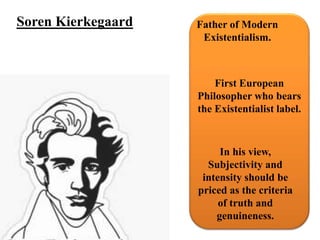
Soren Kierkegaard Father of Modern
Existentialism.
First European
Philosopher who bears
the Existentialist label.
In his view,
Subjectivity and
intensity should be
priced as the criteria
of truth and
genuineness.
Friedrich Nietzsche
(1844- 1900)
Key figure in the rise of
existentialism.
According to him
Christianity is to be overcome
by putting in its place the
doctrine of Superman, that is,
man surpassing himself.
Martin Heidegger
(1889-1976)
Being and Time
In his book he gave very
impressive analysis of
human existence, the
prominence of the
important themes of
existentialism like care,
anxiety, guilt, and above
all death is brought out
here.
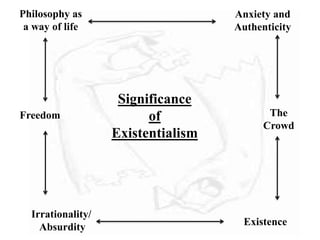
Significance
of
Existentialism
Philosophy as
a way of life
Anxiety and
Authenticity
Freedom
Existence
Irrationality/
Absurdity
The
Crowd
Philosophy as a way of life
Immanence: Philosophy studies life from the inside.
The fundamental truths of my existence are not representations
not, that is, ideas, propositions or symbols the meaning of
which can be separated from their origin. Rather, the truths of
existence re immediately lived, felt and acted.’
- Kierkegaard
Anxiety • A key idea here is that
human existence is in some
way ‘ on its own’, anxiety is
the recognition of this fact.
Authenticity
• Evaluating solely in terms of the measurable outcomes of production
was seen as reinforcing the secularization of the institutions of
political, social, or economic life; and reinforcing also the
abandonment of any broader sense of the spiritual dimension.
Freedom
• “ There is nothing else that acts through me or
that shoulders my responsibility.”
Situatedness
• “ My body and its characteristics in a historical
world and my past, all weigh upon freedom. This
is what makes freedom meaningful. Suppose I
tried to exists as free, while pretending to be in
abstraction from the situation. In that case I will
have no idea what possibilities are open to me
and what choices need to be made, here and
now. In such a case, my freedom will be illusory.”
( Philosophical genesis in Hegel)
Existence
• For many existentialists,
authentic existence involves
a certain tension be
recognized and lived
through, but not resolved:
this tension might be
between the animal and the
rational or between tactility
and transcendence.
( Sartre and de Beauvoir)
“My acts are free, I am
not free not to act.”
- Marcel
Irrationality/ Absurdity • Many existentialists argued
that nature as a whole has
no design, no reason for
existing.
• Human existence as action is
doomed to always destroy itself.
• My freedom will not only be
undetermined by knowledge
or reason but from the point
of view of the latter freedom
will even appear absurd.
The Crowd
Existentialism generally
carries social or political
dimension. In so far he
or she is authentic , the
freedom of the human
being will show a certain
‘ resolution’ or
‘commitment’, and this
will involve so the being-
and particularly the
authentic being of others.
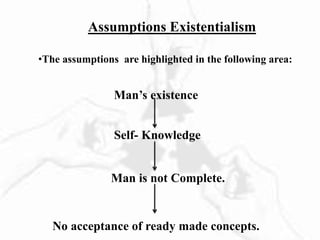
Assumptions Existentialism
•The assumptions are highlighted in the following area:
Man’s existence
Self- Knowledge
Man is not Complete.
No acceptance of ready made concepts.
Man’s Existence
The
starting
point for all
existence is
the
recognition
of the
individual
existence.
Man makes
himself
through
choices
among many
alternatives of
this
Philosophy.
Self- Knowledge
The existentialist considers
‘ self- know thyself’ as the
basic premise of this
Philosophy.
Man is not Complete
According to existentialism a man is not
complete, he is in the process of ‘becoming’.
Man is expected to meet challenges, march on
the process of becoming a complete man.
Ready made concepts
Existentialism believes
that a man cannot
accept ready made
concepts of existence
forced upon him.
He is free agent to shape his own life.
The existentialist
considers, that each
man has the
responsibility of
creating his own
values and in doing so,
he chooses freedom
and responsibility.
Limitations
The view point of
existentialism appear to
be impractical and
inapplicable in an in
materialistic world.
It requires a good deal
of time and effort on the
part of the teacher to
develop individual
relationship with student.
The terminologies used in existentialism
is not clear. Concepts such as ‘Being’,
‘Person’, ‘Existence’ are ambiguous.
Conclusion
Philosophers consider Existentialism as the nature of
the human condition.
Existentialist accepts the conclusion that existence
precedes as essence.
Existentialist emphasize the person as subject.
References
Cavell, Stanley. “Existentialism and Analytical Philosophy.”
Daedalus, vol. 93, no. 3, 1964, pp. 946–74. JSTOR,
http://www.jstor.org/stable/20026868. Accessed 22 Aug. 2022.
Crowell,Steven,Existentialism, The Stanford Encyclopedia of
Philosophy ( Summer 2020 edi.),Edward N.Zalta(ed.)
https://plato.stanford.edu/entries/existentialism/
Burnham D. and Papandreopoulos G., Existentialism, The
Internet Encyclopedia of Philosophy, ISSN 2161-
0002, https://iep.utm.edu/existent/ .
Marrakesh,Rachid,ExistentialismandHumanism,Academia.ed
u,https://d1wqtxts1xzle7.cloudfront.net/4716326/sartre-with-
cover-page-v2.pdf
William s. Sahakian and Mabel L. Sahakian, Ideas of the
Great Philosophers, NY Bames and Noble,Inc., 1966,p.167
Feedback
Thank you…

Paper 2 existentialism.pptx

  • 1.
    Significance of Existentialism Preparedby Lalji Baraiya Research Scholar, Department of English, MKBU.
  • 2.
    Existentialism is Philosophical movement which claimsthat individual human beings have full responsibility for creating the meaning of their own lives.
  • 3.
    The subject exists,and for some, he alone exists; that is to say, if any essence whatever exists, it is the individual’s subjective state of existence. (William s. Sahakian and Mabel L. Sahakian, Ideas of the Great Philosophers, NY Bames and Noble,Inc., 1966,p.167)
  • 4.
    “Man is nothingelse but what he purpose, he exists only in so far as he realizes himself, he is therefore nothing else but the sum of his actions, nothing else but what his life is.” - Jean- Paul Sarte
  • 5.
    Soren Kierkegaard Fatherof Modern Existentialism. First European Philosopher who bears the Existentialist label. In his view, Subjectivity and intensity should be priced as the criteria of truth and genuineness.
  • 6.
    Friedrich Nietzsche (1844- 1900) Keyfigure in the rise of existentialism. According to him Christianity is to be overcome by putting in its place the doctrine of Superman, that is, man surpassing himself.
  • 7.
    Martin Heidegger (1889-1976) Being andTime In his book he gave very impressive analysis of human existence, the prominence of the important themes of existentialism like care, anxiety, guilt, and above all death is brought out here.
  • 8.
    Significance of Existentialism Philosophy as a wayof life Anxiety and Authenticity Freedom Existence Irrationality/ Absurdity The Crowd
  • 9.
    Philosophy as away of life Immanence: Philosophy studies life from the inside. The fundamental truths of my existence are not representations not, that is, ideas, propositions or symbols the meaning of which can be separated from their origin. Rather, the truths of existence re immediately lived, felt and acted.’ - Kierkegaard
  • 10.
    Anxiety • Akey idea here is that human existence is in some way ‘ on its own’, anxiety is the recognition of this fact. Authenticity • Evaluating solely in terms of the measurable outcomes of production was seen as reinforcing the secularization of the institutions of political, social, or economic life; and reinforcing also the abandonment of any broader sense of the spiritual dimension.
  • 11.
    Freedom • “ Thereis nothing else that acts through me or that shoulders my responsibility.” Situatedness • “ My body and its characteristics in a historical world and my past, all weigh upon freedom. This is what makes freedom meaningful. Suppose I tried to exists as free, while pretending to be in abstraction from the situation. In that case I will have no idea what possibilities are open to me and what choices need to be made, here and now. In such a case, my freedom will be illusory.” ( Philosophical genesis in Hegel)
  • 12.
    Existence • For manyexistentialists, authentic existence involves a certain tension be recognized and lived through, but not resolved: this tension might be between the animal and the rational or between tactility and transcendence. ( Sartre and de Beauvoir) “My acts are free, I am not free not to act.” - Marcel
  • 13.
    Irrationality/ Absurdity •Many existentialists argued that nature as a whole has no design, no reason for existing. • Human existence as action is doomed to always destroy itself. • My freedom will not only be undetermined by knowledge or reason but from the point of view of the latter freedom will even appear absurd.
  • 14.
    The Crowd Existentialism generally carriessocial or political dimension. In so far he or she is authentic , the freedom of the human being will show a certain ‘ resolution’ or ‘commitment’, and this will involve so the being- and particularly the authentic being of others.
  • 15.
    Assumptions Existentialism •The assumptionsare highlighted in the following area: Man’s existence Self- Knowledge Man is not Complete. No acceptance of ready made concepts.
  • 16.
    Man’s Existence The starting point forall existence is the recognition of the individual existence. Man makes himself through choices among many alternatives of this Philosophy.
  • 17.
    Self- Knowledge The existentialistconsiders ‘ self- know thyself’ as the basic premise of this Philosophy.
  • 18.
    Man is notComplete According to existentialism a man is not complete, he is in the process of ‘becoming’. Man is expected to meet challenges, march on the process of becoming a complete man.
  • 19.
    Ready made concepts Existentialismbelieves that a man cannot accept ready made concepts of existence forced upon him. He is free agent to shape his own life. The existentialist considers, that each man has the responsibility of creating his own values and in doing so, he chooses freedom and responsibility.
  • 20.
    Limitations The view pointof existentialism appear to be impractical and inapplicable in an in materialistic world. It requires a good deal of time and effort on the part of the teacher to develop individual relationship with student. The terminologies used in existentialism is not clear. Concepts such as ‘Being’, ‘Person’, ‘Existence’ are ambiguous.
  • 21.
    Conclusion Philosophers consider Existentialismas the nature of the human condition. Existentialist accepts the conclusion that existence precedes as essence. Existentialist emphasize the person as subject.
  • 22.
    References Cavell, Stanley. “Existentialismand Analytical Philosophy.” Daedalus, vol. 93, no. 3, 1964, pp. 946–74. JSTOR, http://www.jstor.org/stable/20026868. Accessed 22 Aug. 2022. Crowell,Steven,Existentialism, The Stanford Encyclopedia of Philosophy ( Summer 2020 edi.),Edward N.Zalta(ed.) https://plato.stanford.edu/entries/existentialism/ Burnham D. and Papandreopoulos G., Existentialism, The Internet Encyclopedia of Philosophy, ISSN 2161- 0002, https://iep.utm.edu/existent/ .
  • 23.
  • 24.
  • 25.