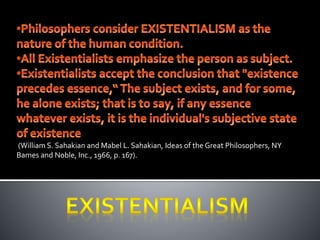
Philosophers consider EXISTENTIALISM as the
nature of the human condition.
All Existentialists emphasize the person as subject.
Existentialists accept the conclusion that "existence
precedes essence“.
The subject exists, and for some, he alone exists; that
is to say, if any essence whatever exists, it is the
individual's subjective state of existence (William S.
Sahakian and Mabel L. Sahakian, Ideas of the Great
Philosophers, NY Bames and Noble, Inc., 1966, p. 167).
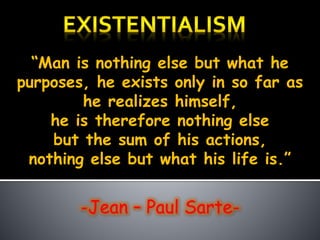
“Man is nothing else but what he
purposes, he exists only in so far as
he realizes himself,
he is therefore nothing else
but the sum of his actions,
nothing else but what his life is.”
-Jean – Paul Sarte-
(William S. Sahakian and Mabel L. Sahakian, Ideas of the Great Philosophers, NY
Bames and Noble, Inc., 1966, p. 167).
KEYTHEMES OF EXISTENTIALISM
1. Philosophy as aWay of Life
Philosophy should not be thought of primarily either as
an attempt to investigate and understand the self or the world,
or as a special occupation that concerns only a few. Rather,
philosophy must be thought of as fully integrated within life. To
be sure, there may need to be professional philosophers, who
develop an elaborate set of methods and concepts (Sartre
makes this point frequently) but life can be lived philosophically
without a technical knowledge of philosophy.
KEYTHEMES OF EXISTENTIALISM
1. Philosophy as aWay of Life
Second, a notion that we can call ‘ ’:
philosophy studies life from the inside.
“
” –
Kierkegaard-
KEYTHEMES OF EXISTENTIALISM
1. Philosophy as aWay of Life
KEYTHEMES OF EXISTENTIALISM
2. Anxiety and Authenticity
Authenticity
Anxiety
KEYTHEMES OF EXISTENTIALISM
3. Freedom
“there is nothing else that acts through me, or
that shoulders my responsibility”
For example, I say ‘I am a student’ (treating myself as having a
fixed, thing-like identity) or ‘I had no choice’ (treating myself as
belonging to the causal chain). I am ascribing a fixed identity or
set of qualities to myself, much as I would say ‘that is a piece of
granite’. In that case I am existing in denial of my distinctively
human mode of existence; I am fleeing from my freedom.This is
inauthenticity or ‘bad faith’. As we shall see, inauthenticity is not
just an occasional pitfall of human life, but essential to it. Human
existence is a constant falling away from an authentic recognition
of its freedom.
KEYTHEMES OF EXISTENTIALISM
4. Situatedness
The necessity of viewing or understanding
life and existence from the ‘inside’.
KEYTHEMES OF EXISTENTIALISM
5. Existence
For many existentialists, authentic existence involves a
certain tension be recognised and lived through, but not resolved:
this tension might be between the animal and the rational
(important in Nietzsche) or between facticity and transcendence
(Sartre and de Beauvoir).
“my acts are free, I am not free not to act”
Marcel
KEYTHEMES OF EXISTENTIALISM
6. Irrationality/Absurdity
Among the most famous ideas associated with
existentialism is that of ‘absurdity’. Human existence might be
described as ‘absurd’ in one of the following senses.
First, many existentialists argued that nature as a
whole has no design, no reason for existing.
A second meaning of the absurd is this: my freedom will
not only be undetermined by knowledge or reason, but from
the point of view of the latter my freedom will even appear
absurd.
Third, human existence as action is doomed to always
destroy itself.
KEYTHEMES OF EXISTENTIALISM
7.The Crowd
Existentialism generally also carries a social or political
dimension. Insofar as he or she is authentic, the freedom of the
human being will show a certain ‘resolution’ or ‘commitment’, and
this will involve also the being – and particularly the authentic
being – of others.
‘that is what everybody does’
Thus, existentialism is a philosophical
movement that is generally considered a study that
pursues meaning in existence and seeks value for the
existing individual. As a result, questions regarding
the meaning of life and subjective experience are
seen as being of paramount importance, above all
other scientific and philosophical pursuits.
Soren Kierkegaard (1813 – 1855) is regarded as the
father of modern existentialism and is the first
European Philosopher who bears the existentialist label.
In his view, subjectivity and intensity should be priced as
the criteria of truth and genuineness. We touch reality in
intense moments of existence especially moments of
painful decision. These moments are characterized by
deep anxiety, and life is known in such moments and
cannot be reduced to just system of ideas.
Friedrich Nietzsche (1844 – 1900) is regarded
as a key figure in the rise of existentialism.
According to him Christianity is to be
overcome by putting in its place the doctrine of
Superman, that is, man surpassing himself.
Martin Heidegger (1889 – 1976) in his book
Being andTime, gave a very impressive
analysis of human existence, the
prominence of the important themes of
existentialism like care, anxiety, guilt and
above all death is brought out here.
EDUCATIONAL PHILOSOPHY OF
EXISTENTIALISM
The aim of Education : Existentialists believe that the most
important kind of knowledge is about the human condition and the
choices that each person has to make, and that education is a
process of developing consciousness about the freedom to choose
and the meaning of responsibility for one’s choices. Hence, the
notion of group norms, authority, and established order – social,
political, philosophical, religious, and so on – are rejected. The
existentialists recognize few standards, customs to traditions, or
eternal truths; in this respect, existentialism is at odds with the
ideas of idealism and realism.
Total Development :The existentialists have aimed at
total development of personality through education.
Education should aim at the whole man. It should aim
at character formation and self – realization. In the
existentialist classroom, subject matter takes second
place to helping the students understand and
appreciate themselves as unique individuals who
accept complete responsibility for their thoughts,
feelings, and actions. Since feeling is not divorced from
reason in decision making, the existentialist demands
the education of the whole person, not just the mind.
Subjective Knowledge : The present age of science has made too
much of objective knowledge, so much so, that the term has come
to mean unreal, non-sense, ignorant and irrelevant. The
existentialists rightly, point out that subjective knowledge is even
more important than objective knowledge. They rightly hold that
truth is subjectivity. It is a human value and values are not facts.
Reduction of values to facts has led to widespread loss of faith in
values. Therefore, along with the teaching of science and
mathematics, the humanities, art, literature should be also be given
suitable place in curriculum at every stage of education. Most of the
ills of the modern man are due to over – objective attitude. This
requires a subjectivist correction in the light of existentialist ideas.
Importance of Environment :The present industrial, economic,
political and social environment is valueless.Therefore, it helps
confusion and corruption, tensions and conflicts.The
existentialists seek to provide an environment proper to self –
development and self – consciousness.The environment in the
school requires contribution from humanities, arts and educand
so that he may cease to become a cog in the social wheel.
Rather he should develop to a self – conscious and sensitive
individual.
Child – Centred Education : Existentialist education is child –
centred. It gives full freedom to the child. The teacher should
help the child to know himself and recognize his being.
Freedom is required for natural development. Education should
convert imperfection into perfection. Education should be
according to the individual’s needs and abilities of the child. The
relation of the child to himself should be strengthened by
education.
Curriculum : Existentialists prefer to free learners to choose
what to study and also determine what is true and by what
criteria to determine these truths. The curriculum would avoid
systematic knowledge or structured disciplines, and the
students would be free to select from many available learning
situations. The learners would choose the knowledge they wish
to possess. The humanities are commonly given tremendous
emphasis. They are explored as a means of providing students
with vicarious experiences that will help unleash their own
creativity and self – expression. For example, rather than
emphasizing historical events, existentialists focus upon the
actions of historical individuals, each of whom provides
possible models for the students’ own behaviour.
Learning Experiences : An existentialist curriculum would
consist of experiences and subjects that lend themselves to
philosophical dialogue and acts of choice making. Because
the choice is personal and subjective, subjects that are
emotional, aesthetic and philosophical are appropriate.
Literature, drama, film – making, art, and so on, are
important, because, they portray the human condition and
choice – making conditions. The curriculum would stress self
– expressive activities, experimentation, and media that
illustrate emotions, feelings and insights.
The Teacher :
According to the existentialists the teacher creates an educational
situation in which the student may establish contact with himself,
become conscious of it and achieve self – realization. This requires
existential approach in the teacher himself. He should also have an
experience of self – realization so that he may be capable of guiding
the students in this process. The teacher’s role is to help students
define their own essence by exposing them to various paths they
may take in life and creating an environment in which they may
freely choose their own preferred way.Existentialist methods focus
on the individual. Learning is self paced, self directed, and includes
a great deal of individual contact with the teacher, who relates to
each student openly and honestly.
The student :The student should feel
completely free for realizing his ‘self’.
Under the guidance of the teacher,
the student should try to realize his
‘self’ through introversion.The
student accepts the discipline
Religious and Moral Education :
The existentialists particularly lay emphasis upon religion
and moral education. Religion allows a person to develop himself.
Religious education gives him an understanding of his existence in
the cosmos. It shows the religious path of self – realization. It also
makes him capable of utilizing faith in self – development. Moral
education is closely related to religious education. Both develop
the inner self and help in the realization of the infinite within the
finite.
existentialismpresentation-140815221408-phpapp01.pdf

existentialismpresentation-140815221408-phpapp01.pdf

  • 3.
    Philosophers consider EXISTENTIALISMas the nature of the human condition. All Existentialists emphasize the person as subject. Existentialists accept the conclusion that "existence precedes essence“. The subject exists, and for some, he alone exists; that is to say, if any essence whatever exists, it is the individual's subjective state of existence (William S. Sahakian and Mabel L. Sahakian, Ideas of the Great Philosophers, NY Bames and Noble, Inc., 1966, p. 167).
  • 4.
    “Man is nothingelse but what he purposes, he exists only in so far as he realizes himself, he is therefore nothing else but the sum of his actions, nothing else but what his life is.” -Jean – Paul Sarte-
  • 5.
    (William S. Sahakianand Mabel L. Sahakian, Ideas of the Great Philosophers, NY Bames and Noble, Inc., 1966, p. 167).
  • 6.
    KEYTHEMES OF EXISTENTIALISM 1.Philosophy as aWay of Life Philosophy should not be thought of primarily either as an attempt to investigate and understand the self or the world, or as a special occupation that concerns only a few. Rather, philosophy must be thought of as fully integrated within life. To be sure, there may need to be professional philosophers, who develop an elaborate set of methods and concepts (Sartre makes this point frequently) but life can be lived philosophically without a technical knowledge of philosophy.
  • 7.
    KEYTHEMES OF EXISTENTIALISM 1.Philosophy as aWay of Life Second, a notion that we can call ‘ ’: philosophy studies life from the inside. “ ” – Kierkegaard-
  • 8.
    KEYTHEMES OF EXISTENTIALISM 1.Philosophy as aWay of Life
  • 9.
    KEYTHEMES OF EXISTENTIALISM 2.Anxiety and Authenticity Authenticity Anxiety
  • 10.
    KEYTHEMES OF EXISTENTIALISM 3.Freedom “there is nothing else that acts through me, or that shoulders my responsibility” For example, I say ‘I am a student’ (treating myself as having a fixed, thing-like identity) or ‘I had no choice’ (treating myself as belonging to the causal chain). I am ascribing a fixed identity or set of qualities to myself, much as I would say ‘that is a piece of granite’. In that case I am existing in denial of my distinctively human mode of existence; I am fleeing from my freedom.This is inauthenticity or ‘bad faith’. As we shall see, inauthenticity is not just an occasional pitfall of human life, but essential to it. Human existence is a constant falling away from an authentic recognition of its freedom.
  • 11.
    KEYTHEMES OF EXISTENTIALISM 4.Situatedness The necessity of viewing or understanding life and existence from the ‘inside’.
  • 12.
    KEYTHEMES OF EXISTENTIALISM 5.Existence For many existentialists, authentic existence involves a certain tension be recognised and lived through, but not resolved: this tension might be between the animal and the rational (important in Nietzsche) or between facticity and transcendence (Sartre and de Beauvoir). “my acts are free, I am not free not to act” Marcel
  • 13.
    KEYTHEMES OF EXISTENTIALISM 6.Irrationality/Absurdity Among the most famous ideas associated with existentialism is that of ‘absurdity’. Human existence might be described as ‘absurd’ in one of the following senses. First, many existentialists argued that nature as a whole has no design, no reason for existing. A second meaning of the absurd is this: my freedom will not only be undetermined by knowledge or reason, but from the point of view of the latter my freedom will even appear absurd. Third, human existence as action is doomed to always destroy itself.
  • 14.
    KEYTHEMES OF EXISTENTIALISM 7.TheCrowd Existentialism generally also carries a social or political dimension. Insofar as he or she is authentic, the freedom of the human being will show a certain ‘resolution’ or ‘commitment’, and this will involve also the being – and particularly the authentic being – of others. ‘that is what everybody does’
  • 15.
    Thus, existentialism isa philosophical movement that is generally considered a study that pursues meaning in existence and seeks value for the existing individual. As a result, questions regarding the meaning of life and subjective experience are seen as being of paramount importance, above all other scientific and philosophical pursuits.
  • 16.
    Soren Kierkegaard (1813– 1855) is regarded as the father of modern existentialism and is the first European Philosopher who bears the existentialist label. In his view, subjectivity and intensity should be priced as the criteria of truth and genuineness. We touch reality in intense moments of existence especially moments of painful decision. These moments are characterized by deep anxiety, and life is known in such moments and cannot be reduced to just system of ideas.
  • 17.
    Friedrich Nietzsche (1844– 1900) is regarded as a key figure in the rise of existentialism. According to him Christianity is to be overcome by putting in its place the doctrine of Superman, that is, man surpassing himself.
  • 18.
    Martin Heidegger (1889– 1976) in his book Being andTime, gave a very impressive analysis of human existence, the prominence of the important themes of existentialism like care, anxiety, guilt and above all death is brought out here.
  • 19.
    EDUCATIONAL PHILOSOPHY OF EXISTENTIALISM Theaim of Education : Existentialists believe that the most important kind of knowledge is about the human condition and the choices that each person has to make, and that education is a process of developing consciousness about the freedom to choose and the meaning of responsibility for one’s choices. Hence, the notion of group norms, authority, and established order – social, political, philosophical, religious, and so on – are rejected. The existentialists recognize few standards, customs to traditions, or eternal truths; in this respect, existentialism is at odds with the ideas of idealism and realism.
  • 20.
    Total Development :Theexistentialists have aimed at total development of personality through education. Education should aim at the whole man. It should aim at character formation and self – realization. In the existentialist classroom, subject matter takes second place to helping the students understand and appreciate themselves as unique individuals who accept complete responsibility for their thoughts, feelings, and actions. Since feeling is not divorced from reason in decision making, the existentialist demands the education of the whole person, not just the mind.
  • 21.
    Subjective Knowledge :The present age of science has made too much of objective knowledge, so much so, that the term has come to mean unreal, non-sense, ignorant and irrelevant. The existentialists rightly, point out that subjective knowledge is even more important than objective knowledge. They rightly hold that truth is subjectivity. It is a human value and values are not facts. Reduction of values to facts has led to widespread loss of faith in values. Therefore, along with the teaching of science and mathematics, the humanities, art, literature should be also be given suitable place in curriculum at every stage of education. Most of the ills of the modern man are due to over – objective attitude. This requires a subjectivist correction in the light of existentialist ideas.
  • 22.
    Importance of Environment:The present industrial, economic, political and social environment is valueless.Therefore, it helps confusion and corruption, tensions and conflicts.The existentialists seek to provide an environment proper to self – development and self – consciousness.The environment in the school requires contribution from humanities, arts and educand so that he may cease to become a cog in the social wheel. Rather he should develop to a self – conscious and sensitive individual.
  • 23.
    Child – CentredEducation : Existentialist education is child – centred. It gives full freedom to the child. The teacher should help the child to know himself and recognize his being. Freedom is required for natural development. Education should convert imperfection into perfection. Education should be according to the individual’s needs and abilities of the child. The relation of the child to himself should be strengthened by education.
  • 24.
    Curriculum : Existentialistsprefer to free learners to choose what to study and also determine what is true and by what criteria to determine these truths. The curriculum would avoid systematic knowledge or structured disciplines, and the students would be free to select from many available learning situations. The learners would choose the knowledge they wish to possess. The humanities are commonly given tremendous emphasis. They are explored as a means of providing students with vicarious experiences that will help unleash their own creativity and self – expression. For example, rather than emphasizing historical events, existentialists focus upon the actions of historical individuals, each of whom provides possible models for the students’ own behaviour.
  • 25.
    Learning Experiences :An existentialist curriculum would consist of experiences and subjects that lend themselves to philosophical dialogue and acts of choice making. Because the choice is personal and subjective, subjects that are emotional, aesthetic and philosophical are appropriate. Literature, drama, film – making, art, and so on, are important, because, they portray the human condition and choice – making conditions. The curriculum would stress self – expressive activities, experimentation, and media that illustrate emotions, feelings and insights.
  • 26.
    The Teacher : Accordingto the existentialists the teacher creates an educational situation in which the student may establish contact with himself, become conscious of it and achieve self – realization. This requires existential approach in the teacher himself. He should also have an experience of self – realization so that he may be capable of guiding the students in this process. The teacher’s role is to help students define their own essence by exposing them to various paths they may take in life and creating an environment in which they may freely choose their own preferred way.Existentialist methods focus on the individual. Learning is self paced, self directed, and includes a great deal of individual contact with the teacher, who relates to each student openly and honestly.
  • 27.
    The student :Thestudent should feel completely free for realizing his ‘self’. Under the guidance of the teacher, the student should try to realize his ‘self’ through introversion.The student accepts the discipline
  • 28.
    Religious and MoralEducation : The existentialists particularly lay emphasis upon religion and moral education. Religion allows a person to develop himself. Religious education gives him an understanding of his existence in the cosmos. It shows the religious path of self – realization. It also makes him capable of utilizing faith in self – development. Moral education is closely related to religious education. Both develop the inner self and help in the realization of the infinite within the finite.