Existentialism in LiteratureVarinder KumarN.J.S.A. Government College, Kapurthala (Punjab)
Objective of this presentationTo know the meaning of existentialismTo discuss the main themes of existentialismTo review the philosophy of existentialistsTo review existentialism in literatureTo know what we can learn from existentialists
Meaning and definition of existentialismRojmamureduniyameinKharabi He Zafar,AsebastikokahinviranabanayahotaExistentialism in the broader sense is a philosophy that is centered upon the analysis of the existence and of the way human beings find themselves existing in the world.The notion is that humans exist first and then each individual spends a lifetime changing their essence of nature.A philosophy concerned with finding self and the meaning of life through free will, choice and personal responsibility.
ExistentialismDefining existentialism is difficult as these philosophers not only contradict each other, but individuals tend to contradict their own stated beliefs both in writings and in actions.Those most often associated with existentialism failed to form a cohesive philosophical discipline based on existential theories.Existentialism too multi form and mutable to be compressed into a line.    Will DurantExistentialism is not a philosophy but a label for several widely different revolts against traditional philosophy.Walter Kaufmann,1975Though existentialism is a term applied loosely to range of philosophies, there are unifying themes in the writings of the existentialists.
Definitions of existentialismThe doctrine that existence takes precedence over essence and holding that man is totally free and responsible for his acts.  This responsibility is the source of dread and anguish that encompass mankind.Webster’s new World Dictionary,1979A philosophy that emphasizes the uniqueness and isolation of the individual experience in a hostile or indifferent universe, regards human existence as unexplainable, and stresses freedom of choice and responsibility for the consequences of one’s acts.American Heritage Dictionary of the English Language,1992
Definitions of existentialismPhilosophy of individual mind confronted by the changing contemporary world.Will and Ariel DurantInterpretations of Life,1970Individual’s existence is unique and his essence is the gradual and ever changing product of his existence in the flux of time. 5000BC, Heraleitus explained the changing phenomenon. Nothing is, everything becomes, everything at every moment is ceasing to be what it was, and is becoming what it will be.  In this flux all things are in conflict with their opposites, but the conflict produces the fertile union of opposites.
Underlying concepts of existentialismHuman free will (contrary to determinism)Each individual human being is fundamentally alone.Human nature is chosen through life choicesA person is best when struggling against their individual nature, fighting and struggling for life. Society is unnatural and its traditional religious and secular rules are arbitrary.Personal responsibility(ability to respond) and (self, not policed) discipline is crucial.Worldly desire is futile as the world is illusion and progress is delusion.
What is not existentialism?Wealth, pleasures or honor make the good life.Social values and structure control the individual.Accept what is and that is enough in life.Science can and will make everything better.People are basically good but ruined by society or external forces.
Behaviour of existentialistsSeek to avoid intruding on the lives and boundaries of others.Disown the pattern of universe and try to find their own meaning for themselves.  They are not footballs of others’ opinions.  They feel in iron-cage of systems, but try to look at the stars than at the bars.Creativity in their behaviour.Rejection of authority as the only authority which any person has is himself, he is answerable only to himself as well.Responsible and compassionate.Self-actualising people(as Maslow or Carl Rogers)
Philosophers and other personalities associated with existentialismThe term existentialism coined by French philosopher Gabriel Marcel around 1943 and adopted by Jean Paul Sartre in 1945.Soren Kierkegaard and Friedrich Nietzsche were two of the first philosophers considered fundamental to the existentialist movement.Jasper, Heideggar, Sartre,Walter Kaufmann, MerleayPonty. Phenomenology: Edmund Husserl, ( Heidegger, Sartre)Literature: Camus, Barth, Dostoevsky, Goethe, Simone de Beauvoir, Kafka, Milton, Hermann HesseTheology: Barth, Buber, Marcel, Niebuhs, Tillich,Psychology: Victor Frankle, Rollow May, Irwin D Yalon.
Major themes of ExistentialismFocus on concrete existenceExistence precedes essenceMoral individualismSubjectivityAngstFreedomAuthenticity and inauthenticityThe absurd
Focus on concrete existenceExistentialist thinkers focus on the question of concrete human existence and the conditions of this existence rather than hypothesizing a human essence.Existence comes from the latin “existere” meaning “to stand out”.Man exists in a state of distance from the world that he nonetheless remains in the midst of. Man is alone and he has to pursue his path from alone to alone in great solitude.
Existence precedes essenceExistence precedes essence(Sartre)This implies that we first exist an humans and we then become whom we decide to be through our free will or choice. Each individual has unique existence and his essence or essential character is the gradual and ever-changing product of his existence in the flux of time.A man’s essence is formed by his total past, to which he adds in every moment of his life.We are sum of our decisions or conscious choices.
Moral individualismMorals not decided by society but by oneself.Morals or laws decided by society or person in power, are all arbitrary.Ethics is the responsible use of freedom.Kierkegaard reacted against the tradition by insisting that the highest good for the individual is to find his or her own unique vocation.I must find a truth that is true for me—the idea for which I can live or die.(Kierkegaard)My Zarathustra fights with his hands so that they are free to bless.(Nietzsche)Superman beyond good and evil (Nietzsche)
SubjectivityExistentialists have stressed the importance of passionate individual action in deciding questions of both morality and truth.Personal experience and acting on one’s own convictions are essential in arriving at the truth.Understanding of a situation by someone involved in that situation is superior to that of a detached and objective observer.Most important questions are not accessible to science or logic.Phenomenology: record of individual experiences. It is neither the deductive or empirical methods of natural science.  It consists of realizing the presence of an object and elucidating the meaning through intuition.
AngstAngst, sometimes called dread, anxiety or even anguish is common to all existentialists.It reveals the character of human life and illuminates the nature of the world.  In Kierkegaard’s conception, dread (Angst) is not fear, caused by some external threat.  In fear, constructive measures are possible to remove it. But angst is an inward passion, continuous melancholy or sudden terrifying emotion.Sartre treats anguish as the reflective appreciation of the Self as freedom. It is the realisation that a nothingness slips in between the Self and my past and future so that nothing relieves me from the necessity of continually choosing myself and nothing guarantees validity of the values which I choose.
Freedom to chooseHumanity’s primary distinction is the freedom to choose.Human beings do not have a fixed nature, or essence as other animals and plants do, Each human being makes choices that create his or her own nature.Choice is therefore central to human existence, and is inescapable, even the refusal to choose is a choice.Freedom to choice entails commitment and responsibility.As individuals are free to choose their own path, they must accept the risk and responsibility of following their commitment wherever it leads.
AuthenticityOne has to “find oneself” and then live in accordance with this self.The authentic act is one that is in accordance with one’s freedom.One should let one’s actual values come into play when one makes a choice, so that one can take the responsibility for that act.
AbsurdThere is no meaning to be found in the world beyond what meaning we give to it.It is not essential that good people will receive good award and bad people will receive bad awards.Anything can happen to anyone, and a tragic event can happen with anyone.
Fyodor DostoevskyStudied individual will, freedom, and anguish.Because of his long association with criminals, he had an intense interest in abnormal and perverted types of psychology that he analysedNotes from underground, the fictionized diary explores a man’s inner thoughts and struggles.Brothers Karamazov-rationalism vs irrationalism, struggle between love and hatred, faith and unfaith, conflict between generations. Repulsive father(Fyador) and his four sons each representing a universal trait of humanity like saintliness(Alyosha), passion and sensuality(Dmitri), intellect(Ivan) and ugliness of body, mind and spirit(Smerdyakov).Dostoevsky explores the right of a child to raise his hand against his father and by extension the right of man to raise his hand against God.
SorenkierkegaardHe is considered the first existentialist, his works were popularized by Heidegger, and others.Formulated the aesthetic, ethical and religious as modes of existence.He insisted on the need for individual decision and leaps of faith in the search for religious truth and contradicted Protestant rationalist theology.The individual must be prepared to defy the norms of society for the sake of higher authority of a personally valid way of life.
Friedrich NietzschePerhaps the most suggestive and stimulating philosopherWill to power (liberated Schopenheur’svulantarism from pessimism)God is Dead and Superman is the hope.Master mentality and slave mentalityAnything that crushes genius is evil.Superman beyond good and evil.How spirit transformed from camel, to lion, to child.Thus Spake Zarathustra the future bible(Archrya Rajneesh)
Friedrich Nietzsche’s famous quotes and existentialism  The individual has always had to struggle to keep from being overwhelmed by the tribe.  If you try it, you will be lonely often and sometimes frightened.  But no price is too high to pay for the privilege of owning yourself.Of the necessity, partymen becomes liars.Insanity in individuals is something rare-but in groups, parties, nations, it the rule.Convictions are more dangerous enemies of the truth than lies.Morality is the herd-instinct in the individual.
Friedrich Nietzsche and famous quotesThe secret of reaping the greatest fruitfulness and the greatest enjoyment from life is to live dangerously.He who has a why to live can bear with almost anyhow.Man is a rope stretched between the animal and the superman –a rope over an abyss.Existence really is an imperfect tense that never becomes a present.
Friedrich NietzscheAssociated with evolutionist, Nazi and then existentialist.Friedrich Nietzsche studied Schopenhauer’s work “the world and will and idea” based on the philosophy of will.  But Nietzsche formed his philosophy on will to power.Nietzsche is most influential philosopher found in most of writers, psychologists, etc.
Edmund HusserlAustrian born German philosopher and mathematicianDeveloped the concept of essences and beingA leader in the development of the phenomenology As phenomenologist interested in things as they appear to consciousness, rather than things in themselves.Profound influence upon existentialists.
Martin HeideggerStudied under Husserl and interested in the “question of being” (Being and Time)Individual as being-in-the world is characterized by action and anxiety and considering that world is not our primary way of being in the world.Attempted to reveal the concealed nature of being.Why should there be being at all, when there should be nothing.
Jean Paul SartreGifted playwriter, novelist, philosopher and political activist.He was offered the Nobel Prize for literature in 1964, but refused.There is no fixed human nature or essence  of lonely human being and so the individual has to choose his or her being.This choice brings with it responsibility.Those who do not choose, but base their lives on pre-arranged moral and philosophical systems are said to be acting in bad faith.
Jean Paul SatreNausea (novel)-30 year old Antoine Roquentin frustrated by meaningless routine matters  of existence, crimes, perversions, cheatings, hypocrisies, etc feels a ‘sweetish sickness’ called as nausea.  In the end he accepts the indifference of the physical world to man’s aspirations and man is able to see that realisation not only as a regret but also as an opportunity.People are free to make their own meaning: a freedom that is also a responsibility, because without that commitment there will be no meaning.
Jean Paul SartreBeing and Nothing is the corner stone of existentialism. It encompasses the dilemmas and aspirations of individual in contemporary society. Themes like Being, Existence, Essence, Nothingness, Freedom, anguish, etc. are explored.Each of us is alone and  helpless.  Life has no meaning in itself, only the individual can give meaning to his life-by the free choice of his project and goal, and by recognizing his responsibility for the results.
Karl JaspersContemporary of Sartre, Camus, German psychiatrist, philosopher, and theologian.Concerned with human reactions to extreme situations.It is the work of Jaspers that the seeds sown by Kierkegaard and Nietzsche first grew into existentialism. (Walter Kaufmann)
Simone De BeauviorFeminist writer, editor of many of Sartre’s works. Women’s social subjugation is credited to patriarchal rather than biological or psychological structures.
Albert CamusLife is essentially absurd: full of injustice, millions work in repetitive exploitative jobs.We should rebel against these absurdities by refusing to participate in them.He dramatized the problems of violence and morality, of “man versus the state” in four plays presented in Paris theaters.
Notes on AbsurdThe emotional and intellectual awareness of the fact of death in contrast to the potent desire for immortality.Contradiction between two things. This contradiction exists between man’s longing for duration and the inevitability of his death.The absurd describes the relation between man and the world.  Man is born, struggles, and dies; he is innocent and yet he suffers and ultimately is aloneSisyphus is the incarnation of the Absurd Hero.The realisation that life is absurd cannot be an end, but only a beginning. Life can be magnificient and overwhelming .
Albert Camus-The Myth of SisyphusHuman conditions as absurd, confrontation between man’s desire for significance, meaning and clarity on the one hand and the cold and indifferent universe on the other hand.Absurd leads to choice of suicide or leap of faith or recognition. Recognition is the only defensible option.I draw from the absurd three consequences, which are my revolt, my freedom, and my passion.  By the mere activity of consciousness I transform into a rule of life what was an invitation to death and I refuse suicide.
Franz KafkaKafka presents a world that is at once real and dream like and in which individual burdened with guilt, isolation and anxiety makes a futile search for personal salvation.Kafka stands between Nietzsche and the existentialists and pictures the world into which man is thrown into godless world and faces the absurd world.His novels Trial(1925), The Castle(1926) present isolated men confronting vast, elusive, heartless bureaucracies.
The MetamorphosisKafka’s novel Metamorphosis depicts travelling salesman GregorSamsa who finds himself inexplicably transformed overnight into a gigantic insect with many legsKafka saw all life as an insect’s dream Man is drawn into meaningless routines, manipulated by the outside world.
Maurice MerleauPontyPhenomenologist ExistentialistUnlike many phenomenologists, he affirmed the reality of a world that transcends our consciousness of it.In his studies of perception, he laid emphasis on the physical and the biological as levels of conceptualization that preconditioned as mental concepts.
Hermann HesseSteppenwolf(Novel)-portrays man’s split between his humanity, and his wolf-like aggression and homelessness.Duality of the nature is the major theme in the novel and two main characters-Harry Hallar and Hermine illustrate this duality.  Harry illustrates the duality through inner conflict and an outer conflict.  Hermine represents the duality of human nature through an outer conflict.  Hermine is a socialite and she coerces Harry to agree to subject himself to society.  Then Harry murders her.
Hermann Hesse-SidharthaNovel based upon Indian mysticism states that enlightenment is individualistic, knowledge can be transferred but one has to learn and earn the wisdom through one’s own efforts.The hero, Sidharatha, has to undergo all the experiences like mendicant wanderer, wealthy businessman, and finally companion to a humble ferryman.  His final peace comes only after he has had his full share of pleasure and pain.One has to gain wisdom with one’s own efforts.
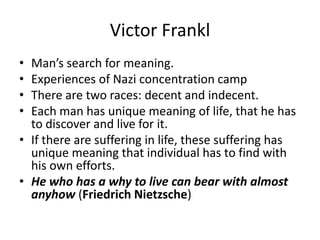
Victor FranklMan’s search for meaning.Experiences of Nazi concentration campThere are two races: decent and indecent.Each man has unique meaning of life, that he has to discover and live for it.If there are suffering in life, these suffering has unique meaning that individual has to find with his own efforts.He who has a why to live can bear with almost anyhow (Friedrich Nietzsche)
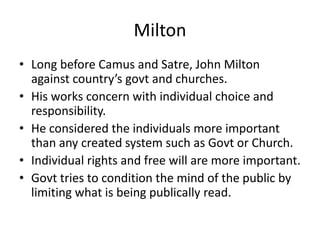
MiltonLong before Camus and Satre, John Milton against country’s govt and churches.His works concern with individual choice and responsibility.He considered the individuals more important than any created system such as Govt or Church.Individual rights and free will are more important.Govt tries to condition the mind of the public by limiting what is being publically read.
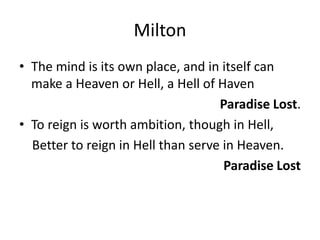
MiltonThe mind is its own place, and in itself can make a Heaven or Hell, a Hell of HavenParadise Lost.To reign is worth ambition, though in Hell,    Better to reign in Hell than serve in Heaven.Paradise Lost
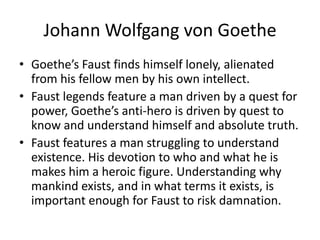
Johann Wolfgang von GoetheGoethe’s Faust finds himself lonely, alienated from his fellow men by his own intellect.Faust legends feature a man driven by a quest for power, Goethe’s anti-hero is driven by quest to know and understand himself and absolute truth.Faust features a man struggling to understand existence. His devotion to who and what he is makes him a heroic figure. Understanding why mankind exists, and in what terms it exists, is important enough for Faust to risk damnation.
John S BarthBarth’s characters in novels are primarily on quests for self-definition.  Barth’s heros are engaged in search for meaning, a justification for life amidst the tension between the relativism of post modern thought and a desire for a defined and rational ethics.
Samuel BackettSamuel Backett’s Waiting for Godot is most popular absurdist play.Structurally, Godot is a two-act play which is primarily cyclical.  It begins with two lonely tramps on a roadside who are awaiting the arrival of a figure referred to as Godot and ends with the same premise.Backett uses his characters to show that waiting is truly anguish and one must actively pursue the meaning in their life.
Is Schopenhauer existentialist?The answer is both yes as well as no.Schopenhauer bit too serious student of life is influenced by Upanishads.To him, “(Upanishads) have been the solace to my life, it will be the solace to my death”His whole philosophy surrounds the will-the striving force mysteriously controlling our whole actions.His analysis of the will led him to the conclusion that emotional, physical and sexual desires can never be satisfied and therefore these desires be moderated and negated (similar teachings we find in Buddhism and Vedanta)
Schopenhauer’s determinismTo him, there is only one Will, not the individual wills of individuals This idea is central to Schopenhauer’s form of determinism.One is part of the universe like everything else, the basic energies of the universe flow through oneself, as they flow through everything else.
Schopenhauer’s existentialismSchopenhauer reader of Kant and Hegel.But criticized their logical optimism and the belief that individual morality could be determined by society and reason as individual is guided by his own basic desires.These human desires are futile, illogical, directionless.There is element of choice when these desires are sublimated to intellect.
Schopenhauer’s existentialismGovt limited role to play just to check the destructive tendencies innate to our species.Leave each man free to work our his own salvation.He opposes the traditional German idealists in their metaphysical elevation of self-consciousness(which is too intellectualistic in its approach)
The world as willIf one looks deeply into oneself, one will discover not only one’s own essence, but also the essence of the universe.Within Schopenhauer’s vision of the world as will, there is no God to be comprehended, and the world is conceived as being meaningless.This world is evil as there is endless striving and blind impulse with no end in view, devoid of knowledge, lawless, absolutely free, entirely self-determining and almighty.
The world as ideaThe world which surrounds us is only as an idea existing in consciousness, and is only object in relation to subject, perception of a perceiver, in a world.Man is free to transform the will through contemplation of philosophy and art like music, poetry, etc.Ascetic’s struggle is none other than a supreme struggle against human nature.
What we can learnWe should not talk much about the abyss as we shall carry the risk of falling in the abyss.We should avoid the company and thought of such negative persons.  One should progress, not regress.Everything is impermanent, both good or evil have their own days and nights.Despite being pushed to our limits, we should transform the micro environment that suits one or another portfolios of passions or priorities.
What we can learnWhether there is good business or bad business, we shall always make the profit.GurdjieffEvery one of us has meaning of life.If we associate our personal motive with the welfare of the others( that should develop out of genuine compassion)  we shall create successful life.Zafar kaya pushta he rah unsemilneke, irada ho tera to harjanib se rasta he.

Existentialism

  • 1.
    Existentialism in LiteratureVarinderKumarN.J.S.A. Government College, Kapurthala (Punjab)
  • 2.
    Objective of thispresentationTo know the meaning of existentialismTo discuss the main themes of existentialismTo review the philosophy of existentialistsTo review existentialism in literatureTo know what we can learn from existentialists
  • 3.
    Meaning and definitionof existentialismRojmamureduniyameinKharabi He Zafar,AsebastikokahinviranabanayahotaExistentialism in the broader sense is a philosophy that is centered upon the analysis of the existence and of the way human beings find themselves existing in the world.The notion is that humans exist first and then each individual spends a lifetime changing their essence of nature.A philosophy concerned with finding self and the meaning of life through free will, choice and personal responsibility.
  • 4.
    ExistentialismDefining existentialism isdifficult as these philosophers not only contradict each other, but individuals tend to contradict their own stated beliefs both in writings and in actions.Those most often associated with existentialism failed to form a cohesive philosophical discipline based on existential theories.Existentialism too multi form and mutable to be compressed into a line. Will DurantExistentialism is not a philosophy but a label for several widely different revolts against traditional philosophy.Walter Kaufmann,1975Though existentialism is a term applied loosely to range of philosophies, there are unifying themes in the writings of the existentialists.
  • 5.
    Definitions of existentialismThedoctrine that existence takes precedence over essence and holding that man is totally free and responsible for his acts. This responsibility is the source of dread and anguish that encompass mankind.Webster’s new World Dictionary,1979A philosophy that emphasizes the uniqueness and isolation of the individual experience in a hostile or indifferent universe, regards human existence as unexplainable, and stresses freedom of choice and responsibility for the consequences of one’s acts.American Heritage Dictionary of the English Language,1992
  • 6.
    Definitions of existentialismPhilosophyof individual mind confronted by the changing contemporary world.Will and Ariel DurantInterpretations of Life,1970Individual’s existence is unique and his essence is the gradual and ever changing product of his existence in the flux of time. 5000BC, Heraleitus explained the changing phenomenon. Nothing is, everything becomes, everything at every moment is ceasing to be what it was, and is becoming what it will be. In this flux all things are in conflict with their opposites, but the conflict produces the fertile union of opposites.
  • 7.
    Underlying concepts ofexistentialismHuman free will (contrary to determinism)Each individual human being is fundamentally alone.Human nature is chosen through life choicesA person is best when struggling against their individual nature, fighting and struggling for life. Society is unnatural and its traditional religious and secular rules are arbitrary.Personal responsibility(ability to respond) and (self, not policed) discipline is crucial.Worldly desire is futile as the world is illusion and progress is delusion.
  • 8.
    What is notexistentialism?Wealth, pleasures or honor make the good life.Social values and structure control the individual.Accept what is and that is enough in life.Science can and will make everything better.People are basically good but ruined by society or external forces.
  • 9.
    Behaviour of existentialistsSeekto avoid intruding on the lives and boundaries of others.Disown the pattern of universe and try to find their own meaning for themselves. They are not footballs of others’ opinions. They feel in iron-cage of systems, but try to look at the stars than at the bars.Creativity in their behaviour.Rejection of authority as the only authority which any person has is himself, he is answerable only to himself as well.Responsible and compassionate.Self-actualising people(as Maslow or Carl Rogers)
  • 10.
    Philosophers and otherpersonalities associated with existentialismThe term existentialism coined by French philosopher Gabriel Marcel around 1943 and adopted by Jean Paul Sartre in 1945.Soren Kierkegaard and Friedrich Nietzsche were two of the first philosophers considered fundamental to the existentialist movement.Jasper, Heideggar, Sartre,Walter Kaufmann, MerleayPonty. Phenomenology: Edmund Husserl, ( Heidegger, Sartre)Literature: Camus, Barth, Dostoevsky, Goethe, Simone de Beauvoir, Kafka, Milton, Hermann HesseTheology: Barth, Buber, Marcel, Niebuhs, Tillich,Psychology: Victor Frankle, Rollow May, Irwin D Yalon.
  • 11.
    Major themes ofExistentialismFocus on concrete existenceExistence precedes essenceMoral individualismSubjectivityAngstFreedomAuthenticity and inauthenticityThe absurd
  • 12.
    Focus on concreteexistenceExistentialist thinkers focus on the question of concrete human existence and the conditions of this existence rather than hypothesizing a human essence.Existence comes from the latin “existere” meaning “to stand out”.Man exists in a state of distance from the world that he nonetheless remains in the midst of. Man is alone and he has to pursue his path from alone to alone in great solitude.
  • 13.
    Existence precedes essenceExistenceprecedes essence(Sartre)This implies that we first exist an humans and we then become whom we decide to be through our free will or choice. Each individual has unique existence and his essence or essential character is the gradual and ever-changing product of his existence in the flux of time.A man’s essence is formed by his total past, to which he adds in every moment of his life.We are sum of our decisions or conscious choices.
  • 14.
    Moral individualismMorals notdecided by society but by oneself.Morals or laws decided by society or person in power, are all arbitrary.Ethics is the responsible use of freedom.Kierkegaard reacted against the tradition by insisting that the highest good for the individual is to find his or her own unique vocation.I must find a truth that is true for me—the idea for which I can live or die.(Kierkegaard)My Zarathustra fights with his hands so that they are free to bless.(Nietzsche)Superman beyond good and evil (Nietzsche)
  • 15.
    SubjectivityExistentialists have stressedthe importance of passionate individual action in deciding questions of both morality and truth.Personal experience and acting on one’s own convictions are essential in arriving at the truth.Understanding of a situation by someone involved in that situation is superior to that of a detached and objective observer.Most important questions are not accessible to science or logic.Phenomenology: record of individual experiences. It is neither the deductive or empirical methods of natural science. It consists of realizing the presence of an object and elucidating the meaning through intuition.
  • 16.
    AngstAngst, sometimes calleddread, anxiety or even anguish is common to all existentialists.It reveals the character of human life and illuminates the nature of the world. In Kierkegaard’s conception, dread (Angst) is not fear, caused by some external threat. In fear, constructive measures are possible to remove it. But angst is an inward passion, continuous melancholy or sudden terrifying emotion.Sartre treats anguish as the reflective appreciation of the Self as freedom. It is the realisation that a nothingness slips in between the Self and my past and future so that nothing relieves me from the necessity of continually choosing myself and nothing guarantees validity of the values which I choose.
  • 17.
    Freedom to chooseHumanity’sprimary distinction is the freedom to choose.Human beings do not have a fixed nature, or essence as other animals and plants do, Each human being makes choices that create his or her own nature.Choice is therefore central to human existence, and is inescapable, even the refusal to choose is a choice.Freedom to choice entails commitment and responsibility.As individuals are free to choose their own path, they must accept the risk and responsibility of following their commitment wherever it leads.
  • 18.
    AuthenticityOne has to“find oneself” and then live in accordance with this self.The authentic act is one that is in accordance with one’s freedom.One should let one’s actual values come into play when one makes a choice, so that one can take the responsibility for that act.
  • 19.
    AbsurdThere is nomeaning to be found in the world beyond what meaning we give to it.It is not essential that good people will receive good award and bad people will receive bad awards.Anything can happen to anyone, and a tragic event can happen with anyone.
  • 20.
    Fyodor DostoevskyStudied individualwill, freedom, and anguish.Because of his long association with criminals, he had an intense interest in abnormal and perverted types of psychology that he analysedNotes from underground, the fictionized diary explores a man’s inner thoughts and struggles.Brothers Karamazov-rationalism vs irrationalism, struggle between love and hatred, faith and unfaith, conflict between generations. Repulsive father(Fyador) and his four sons each representing a universal trait of humanity like saintliness(Alyosha), passion and sensuality(Dmitri), intellect(Ivan) and ugliness of body, mind and spirit(Smerdyakov).Dostoevsky explores the right of a child to raise his hand against his father and by extension the right of man to raise his hand against God.
  • 21.
    SorenkierkegaardHe is consideredthe first existentialist, his works were popularized by Heidegger, and others.Formulated the aesthetic, ethical and religious as modes of existence.He insisted on the need for individual decision and leaps of faith in the search for religious truth and contradicted Protestant rationalist theology.The individual must be prepared to defy the norms of society for the sake of higher authority of a personally valid way of life.
  • 22.
    Friedrich NietzschePerhaps themost suggestive and stimulating philosopherWill to power (liberated Schopenheur’svulantarism from pessimism)God is Dead and Superman is the hope.Master mentality and slave mentalityAnything that crushes genius is evil.Superman beyond good and evil.How spirit transformed from camel, to lion, to child.Thus Spake Zarathustra the future bible(Archrya Rajneesh)
  • 23.
    Friedrich Nietzsche’s famousquotes and existentialism The individual has always had to struggle to keep from being overwhelmed by the tribe. If you try it, you will be lonely often and sometimes frightened. But no price is too high to pay for the privilege of owning yourself.Of the necessity, partymen becomes liars.Insanity in individuals is something rare-but in groups, parties, nations, it the rule.Convictions are more dangerous enemies of the truth than lies.Morality is the herd-instinct in the individual.
  • 24.
    Friedrich Nietzsche andfamous quotesThe secret of reaping the greatest fruitfulness and the greatest enjoyment from life is to live dangerously.He who has a why to live can bear with almost anyhow.Man is a rope stretched between the animal and the superman –a rope over an abyss.Existence really is an imperfect tense that never becomes a present.
  • 25.
    Friedrich NietzscheAssociated withevolutionist, Nazi and then existentialist.Friedrich Nietzsche studied Schopenhauer’s work “the world and will and idea” based on the philosophy of will. But Nietzsche formed his philosophy on will to power.Nietzsche is most influential philosopher found in most of writers, psychologists, etc.
  • 26.
    Edmund HusserlAustrian bornGerman philosopher and mathematicianDeveloped the concept of essences and beingA leader in the development of the phenomenology As phenomenologist interested in things as they appear to consciousness, rather than things in themselves.Profound influence upon existentialists.
  • 27.
    Martin HeideggerStudied underHusserl and interested in the “question of being” (Being and Time)Individual as being-in-the world is characterized by action and anxiety and considering that world is not our primary way of being in the world.Attempted to reveal the concealed nature of being.Why should there be being at all, when there should be nothing.
  • 28.
    Jean Paul SartreGiftedplaywriter, novelist, philosopher and political activist.He was offered the Nobel Prize for literature in 1964, but refused.There is no fixed human nature or essence of lonely human being and so the individual has to choose his or her being.This choice brings with it responsibility.Those who do not choose, but base their lives on pre-arranged moral and philosophical systems are said to be acting in bad faith.
  • 29.
    Jean Paul SatreNausea(novel)-30 year old Antoine Roquentin frustrated by meaningless routine matters of existence, crimes, perversions, cheatings, hypocrisies, etc feels a ‘sweetish sickness’ called as nausea. In the end he accepts the indifference of the physical world to man’s aspirations and man is able to see that realisation not only as a regret but also as an opportunity.People are free to make their own meaning: a freedom that is also a responsibility, because without that commitment there will be no meaning.
  • 30.
    Jean Paul SartreBeingand Nothing is the corner stone of existentialism. It encompasses the dilemmas and aspirations of individual in contemporary society. Themes like Being, Existence, Essence, Nothingness, Freedom, anguish, etc. are explored.Each of us is alone and helpless. Life has no meaning in itself, only the individual can give meaning to his life-by the free choice of his project and goal, and by recognizing his responsibility for the results.
  • 31.
    Karl JaspersContemporary ofSartre, Camus, German psychiatrist, philosopher, and theologian.Concerned with human reactions to extreme situations.It is the work of Jaspers that the seeds sown by Kierkegaard and Nietzsche first grew into existentialism. (Walter Kaufmann)
  • 32.
    Simone De BeauviorFeministwriter, editor of many of Sartre’s works. Women’s social subjugation is credited to patriarchal rather than biological or psychological structures.
  • 33.
    Albert CamusLife isessentially absurd: full of injustice, millions work in repetitive exploitative jobs.We should rebel against these absurdities by refusing to participate in them.He dramatized the problems of violence and morality, of “man versus the state” in four plays presented in Paris theaters.
  • 34.
    Notes on AbsurdTheemotional and intellectual awareness of the fact of death in contrast to the potent desire for immortality.Contradiction between two things. This contradiction exists between man’s longing for duration and the inevitability of his death.The absurd describes the relation between man and the world. Man is born, struggles, and dies; he is innocent and yet he suffers and ultimately is aloneSisyphus is the incarnation of the Absurd Hero.The realisation that life is absurd cannot be an end, but only a beginning. Life can be magnificient and overwhelming .
  • 35.
    Albert Camus-The Mythof SisyphusHuman conditions as absurd, confrontation between man’s desire for significance, meaning and clarity on the one hand and the cold and indifferent universe on the other hand.Absurd leads to choice of suicide or leap of faith or recognition. Recognition is the only defensible option.I draw from the absurd three consequences, which are my revolt, my freedom, and my passion. By the mere activity of consciousness I transform into a rule of life what was an invitation to death and I refuse suicide.
  • 36.
    Franz KafkaKafka presentsa world that is at once real and dream like and in which individual burdened with guilt, isolation and anxiety makes a futile search for personal salvation.Kafka stands between Nietzsche and the existentialists and pictures the world into which man is thrown into godless world and faces the absurd world.His novels Trial(1925), The Castle(1926) present isolated men confronting vast, elusive, heartless bureaucracies.
  • 37.
    The MetamorphosisKafka’s novelMetamorphosis depicts travelling salesman GregorSamsa who finds himself inexplicably transformed overnight into a gigantic insect with many legsKafka saw all life as an insect’s dream Man is drawn into meaningless routines, manipulated by the outside world.
  • 38.
    Maurice MerleauPontyPhenomenologist ExistentialistUnlikemany phenomenologists, he affirmed the reality of a world that transcends our consciousness of it.In his studies of perception, he laid emphasis on the physical and the biological as levels of conceptualization that preconditioned as mental concepts.
  • 39.
    Hermann HesseSteppenwolf(Novel)-portrays man’ssplit between his humanity, and his wolf-like aggression and homelessness.Duality of the nature is the major theme in the novel and two main characters-Harry Hallar and Hermine illustrate this duality. Harry illustrates the duality through inner conflict and an outer conflict. Hermine represents the duality of human nature through an outer conflict. Hermine is a socialite and she coerces Harry to agree to subject himself to society. Then Harry murders her.
  • 40.
    Hermann Hesse-SidharthaNovel basedupon Indian mysticism states that enlightenment is individualistic, knowledge can be transferred but one has to learn and earn the wisdom through one’s own efforts.The hero, Sidharatha, has to undergo all the experiences like mendicant wanderer, wealthy businessman, and finally companion to a humble ferryman. His final peace comes only after he has had his full share of pleasure and pain.One has to gain wisdom with one’s own efforts.
  • 41.
    Victor FranklMan’s searchfor meaning.Experiences of Nazi concentration campThere are two races: decent and indecent.Each man has unique meaning of life, that he has to discover and live for it.If there are suffering in life, these suffering has unique meaning that individual has to find with his own efforts.He who has a why to live can bear with almost anyhow (Friedrich Nietzsche)
  • 42.
    MiltonLong before Camusand Satre, John Milton against country’s govt and churches.His works concern with individual choice and responsibility.He considered the individuals more important than any created system such as Govt or Church.Individual rights and free will are more important.Govt tries to condition the mind of the public by limiting what is being publically read.
  • 43.
    MiltonThe mind isits own place, and in itself can make a Heaven or Hell, a Hell of HavenParadise Lost.To reign is worth ambition, though in Hell, Better to reign in Hell than serve in Heaven.Paradise Lost
  • 44.
    Johann Wolfgang vonGoetheGoethe’s Faust finds himself lonely, alienated from his fellow men by his own intellect.Faust legends feature a man driven by a quest for power, Goethe’s anti-hero is driven by quest to know and understand himself and absolute truth.Faust features a man struggling to understand existence. His devotion to who and what he is makes him a heroic figure. Understanding why mankind exists, and in what terms it exists, is important enough for Faust to risk damnation.
  • 45.
    John S BarthBarth’scharacters in novels are primarily on quests for self-definition. Barth’s heros are engaged in search for meaning, a justification for life amidst the tension between the relativism of post modern thought and a desire for a defined and rational ethics.
  • 46.
    Samuel BackettSamuel Backett’sWaiting for Godot is most popular absurdist play.Structurally, Godot is a two-act play which is primarily cyclical. It begins with two lonely tramps on a roadside who are awaiting the arrival of a figure referred to as Godot and ends with the same premise.Backett uses his characters to show that waiting is truly anguish and one must actively pursue the meaning in their life.
  • 47.
    Is Schopenhauer existentialist?Theanswer is both yes as well as no.Schopenhauer bit too serious student of life is influenced by Upanishads.To him, “(Upanishads) have been the solace to my life, it will be the solace to my death”His whole philosophy surrounds the will-the striving force mysteriously controlling our whole actions.His analysis of the will led him to the conclusion that emotional, physical and sexual desires can never be satisfied and therefore these desires be moderated and negated (similar teachings we find in Buddhism and Vedanta)
  • 48.
    Schopenhauer’s determinismTo him,there is only one Will, not the individual wills of individuals This idea is central to Schopenhauer’s form of determinism.One is part of the universe like everything else, the basic energies of the universe flow through oneself, as they flow through everything else.
  • 49.
    Schopenhauer’s existentialismSchopenhauer readerof Kant and Hegel.But criticized their logical optimism and the belief that individual morality could be determined by society and reason as individual is guided by his own basic desires.These human desires are futile, illogical, directionless.There is element of choice when these desires are sublimated to intellect.
  • 50.
    Schopenhauer’s existentialismGovt limitedrole to play just to check the destructive tendencies innate to our species.Leave each man free to work our his own salvation.He opposes the traditional German idealists in their metaphysical elevation of self-consciousness(which is too intellectualistic in its approach)
  • 51.
    The world aswillIf one looks deeply into oneself, one will discover not only one’s own essence, but also the essence of the universe.Within Schopenhauer’s vision of the world as will, there is no God to be comprehended, and the world is conceived as being meaningless.This world is evil as there is endless striving and blind impulse with no end in view, devoid of knowledge, lawless, absolutely free, entirely self-determining and almighty.
  • 52.
    The world asideaThe world which surrounds us is only as an idea existing in consciousness, and is only object in relation to subject, perception of a perceiver, in a world.Man is free to transform the will through contemplation of philosophy and art like music, poetry, etc.Ascetic’s struggle is none other than a supreme struggle against human nature.
  • 53.
    What we canlearnWe should not talk much about the abyss as we shall carry the risk of falling in the abyss.We should avoid the company and thought of such negative persons. One should progress, not regress.Everything is impermanent, both good or evil have their own days and nights.Despite being pushed to our limits, we should transform the micro environment that suits one or another portfolios of passions or priorities.
  • 54.
    What we canlearnWhether there is good business or bad business, we shall always make the profit.GurdjieffEvery one of us has meaning of life.If we associate our personal motive with the welfare of the others( that should develop out of genuine compassion) we shall create successful life.Zafar kaya pushta he rah unsemilneke, irada ho tera to harjanib se rasta he.