CRITICAL CULTURAL
THEORY
James P. Dimock & Kristi K. Cole
Critical Cultural Theory
 Critical cultural theory is a way to begin
unpacking and grappling with assumptions, with
beliefs, with ideology that we shape based on our
interaction and participation in our surrounding
institutions: music, television, art, literature,
newspapers, media, the internet etc.
 It explores the study of how social cultural and
political beliefs affect the various kinds of
communication and roles/tasks people have.
The Marxist Critique
a supporter
of the
political and
economic
theories of
Karl Marx
and
Friedrich
Engels.
Theory of Capitalism
 An economic and political system in which a country's
trade and industry are controlled by private owners for
profit, rather than by the state.
 Marx understood society to be a conflict between two
classes: the bourgeoisie-ruling class, and the proletariat-
working class.
 Based on the exploitation of working class by the ruling
class thus resulting in alienation of the working class for
the benefit of the ruling class.
 Petite bourgeois: researchers, scientists, doctors,
lawyers, teachers, police, military- the lower middle
class. Roles vital to the maintenance of the system
Critical Theory
 Critical theory is a school of thought that relies on
reflection, assessment, and critique of the social and
cultural
 Critical theory is multidisciplinary: bridging the gap
between theory and practice
 Critical theories are chiefly concerned with evaluating
the freedom, justice, and happiness of societies; hence
it is ongoing and reflexive. It has turned into what today
we call post-modernism.
 Critical theory privileges praxis (accepted practice or
custom) in order to rationalize, explain, and master the
world itself. Praxis unfolds along these three lines:
I. Consciousness raising: seeking to bring change by
making people aware of ‘oppression’, by unmasking
the nature, and causes of injustice.
II. Contemporary orientation: It is about understanding
and impacting the present and the future rather than
changing the past.
III. Centering the margins: is to change perspectives in
order to look at the world from the point of view of
the oppressed and make their experience, voices and
values the center of critical theory.
Critical Race Theory
Race
theories are
dialectical
but
emphasizes
race over
class
conflict
 Critical theorists define racism and prejudice differently
than how we normally define them interchangeably as
synonyms.
 Prejudice is preconceived ideas about a person or a
group. One characteristic that applies to one individual
from a group is applied to all individuals from that group.
a black man who thinks all white men like golf because
he encountered a few white men who like golf.
 Racism is however something different. It can be
understood as prejudice plus power. It becomes racism
when it has power behind it. A white person holds a
black person as slave, and that ownership is recognized
by statuses and laws, is justified by religious institutions,
and is normalized by literature and other art forms is
racism.
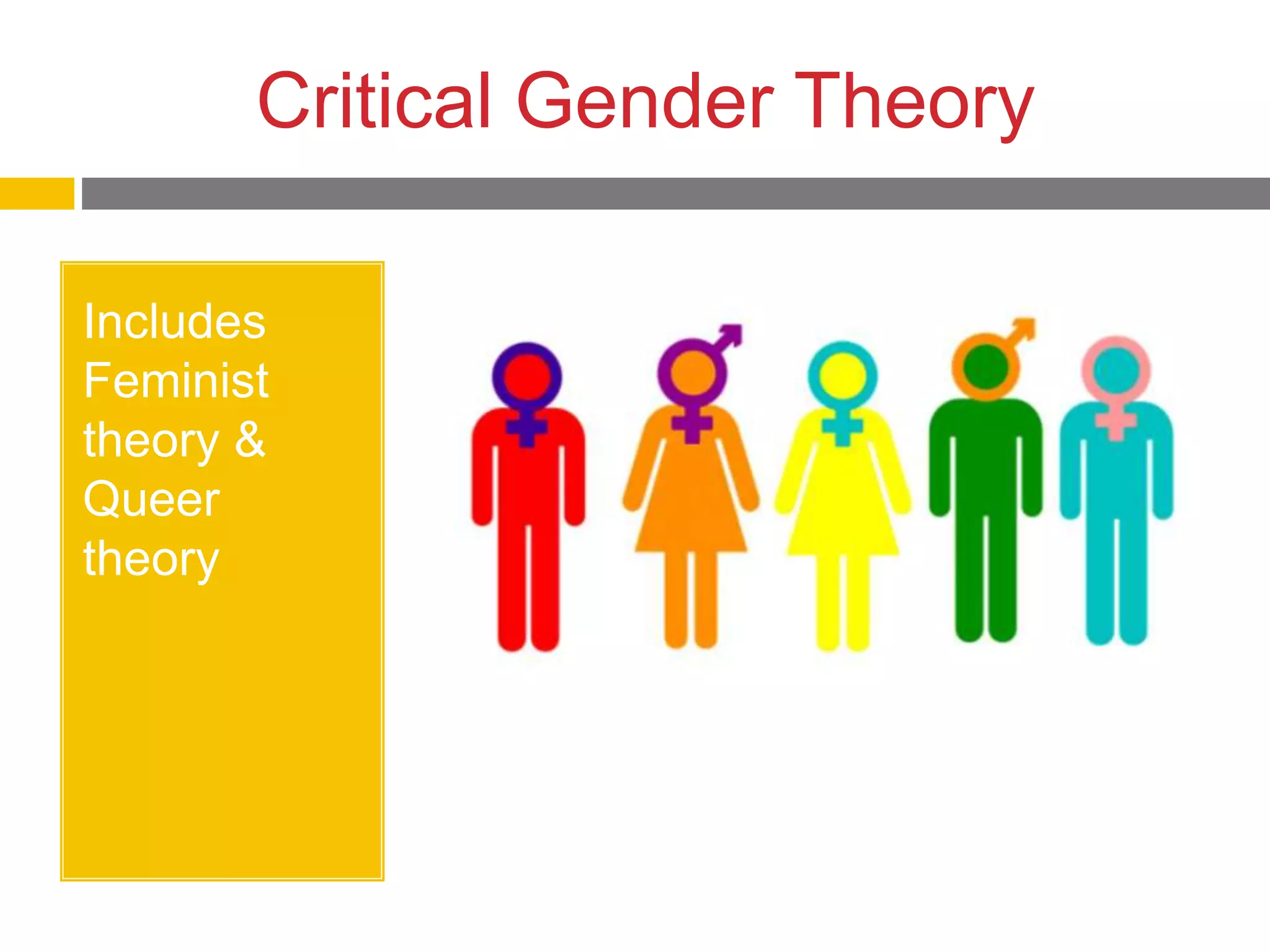
Critical Gender Theory
Includes
Feminist
theory &
Queer
theory
 Concerned with equity
between sexes
 Evolved in waves: First
wave, Second wave,
Third wave
 Focused on: women's
right to vote, women's
liberation, women's
reproductive/political/
workplace rights
 Broadly covers the
diversity of human
sexuality and gender
 Distinguishes between
the terms of Gender
and Sex
 Sets a divergence
from heterosexual
norms
 Feminism Theory Queer Theory
THANK YOU

Critical culture and theory

  • 1.
    CRITICAL CULTURAL THEORY James P.Dimock & Kristi K. Cole
  • 2.
    Critical Cultural Theory Critical cultural theory is a way to begin unpacking and grappling with assumptions, with beliefs, with ideology that we shape based on our interaction and participation in our surrounding institutions: music, television, art, literature, newspapers, media, the internet etc.  It explores the study of how social cultural and political beliefs affect the various kinds of communication and roles/tasks people have.
  • 3.
    The Marxist Critique asupporter of the political and economic theories of Karl Marx and Friedrich Engels.
  • 4.
    Theory of Capitalism An economic and political system in which a country's trade and industry are controlled by private owners for profit, rather than by the state.  Marx understood society to be a conflict between two classes: the bourgeoisie-ruling class, and the proletariat- working class.  Based on the exploitation of working class by the ruling class thus resulting in alienation of the working class for the benefit of the ruling class.  Petite bourgeois: researchers, scientists, doctors, lawyers, teachers, police, military- the lower middle class. Roles vital to the maintenance of the system
  • 5.
    Critical Theory  Criticaltheory is a school of thought that relies on reflection, assessment, and critique of the social and cultural  Critical theory is multidisciplinary: bridging the gap between theory and practice  Critical theories are chiefly concerned with evaluating the freedom, justice, and happiness of societies; hence it is ongoing and reflexive. It has turned into what today we call post-modernism.
  • 6.
     Critical theoryprivileges praxis (accepted practice or custom) in order to rationalize, explain, and master the world itself. Praxis unfolds along these three lines: I. Consciousness raising: seeking to bring change by making people aware of ‘oppression’, by unmasking the nature, and causes of injustice. II. Contemporary orientation: It is about understanding and impacting the present and the future rather than changing the past. III. Centering the margins: is to change perspectives in order to look at the world from the point of view of the oppressed and make their experience, voices and values the center of critical theory.
  • 7.
    Critical Race Theory Race theoriesare dialectical but emphasizes race over class conflict
  • 8.
     Critical theoristsdefine racism and prejudice differently than how we normally define them interchangeably as synonyms.  Prejudice is preconceived ideas about a person or a group. One characteristic that applies to one individual from a group is applied to all individuals from that group. a black man who thinks all white men like golf because he encountered a few white men who like golf.  Racism is however something different. It can be understood as prejudice plus power. It becomes racism when it has power behind it. A white person holds a black person as slave, and that ownership is recognized by statuses and laws, is justified by religious institutions, and is normalized by literature and other art forms is racism.
  • 9.
  • 10.
     Concerned withequity between sexes  Evolved in waves: First wave, Second wave, Third wave  Focused on: women's right to vote, women's liberation, women's reproductive/political/ workplace rights  Broadly covers the diversity of human sexuality and gender  Distinguishes between the terms of Gender and Sex  Sets a divergence from heterosexual norms  Feminism Theory Queer Theory
  • 11.