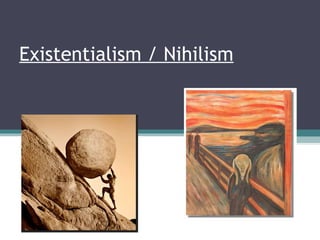
Existentialism / Nihilism
Presentation Outline I. What is Existentialism? II. A Brief History of Existentialism A. An Overview of Major Philosophers  B. Existentialism’s connection with Nihilism III. Connections to John Gardner’s  Grendel
I. What is Existentialism?
Introductory Question : What do you know with absolute certainty? (Perhaps the key question with which to begin any philosophical investigation)
“ I am….” Existentialism starts at the same point as Descartes’ philosophy – with your existence as the original certainty.  You might not know anything else, but you at least know you exist (in some way) because you are thinking.  As Descartes stated it: “ I think, therefore, I am.”
Important Announcement : Descartes was NOT an existentialist. Despite a common starting point, the two take radically different philosophical directions. Descartes starts here and runs to many additional conclusions – Existentialism basically stays here.
Existentialism is the philosophy that holds your existence as your pre-eminent truth and reality.
Existentialism in Three Main Themes:
(1) We are Free This is not referring to political freedom; rather that there are no psychological or metaphysical forces that determine the person you become or the actions you take.  You are free to be the person that you choose.  Rather than a blessing, this is a tremendous responsibility you must learn to accept.
(2) Our Existence is Absurd This means that we can give no logical sense or purpose to life – There is none to be found.
(3) Truth is Subjective This means that what is true for one person might not be true for another.
Then what? Okay, thanks to Descartes, we know we exist. To understand what Existentialism says about existence, think of the types of things a person might believe influences or controls their existence….
Such as…. An Interactive God Fate Astrology Murphy’s Law (& other laws) Grandmother’s axioms Human nature Pre-destination Freud’s sub-consious mind
Then, imagine the universe without any of these! That’s the Existential view of reality! Existentialism says there is nothing that explains, guides or gives purpose to our existence. In short – you EXIST (have “BEING”) in total FREEDOM surrounded by NOTHINGNESS.
Sartre gives his treatment on this view in his philosophical work: “Being and Nothingness”
Sartre on existentialism: Man can will nothing unless he has first understood that he must count no one but himself; that he is alone, abandoned on earth in the midst of his infinite responsibilities, without help, with no other aim than the one he sets himself, with no other destiny than the one he forges for himself on this earth. ( Being and Nothingness , 1943)
II. A Brief History of Existentialism
BACKGROUND Concepts of existentialism are found throughout the history of literature and philosophy. Its most recent development came from the French writer/philosopher Jean Paul Sartre. Popular during the radicalism of the 1960s and 1970s “ Modern” existentialism began with….
Existential Thinkers Soren Kierkegaard
KIERKEGAARD In the early 1800’s, philosophy was dominated by the work of idealists like Hegel, whose thought postulated grand theories that explained how thought, societies and nations changed and evolved over time. i.e. Hegel’s  Thesis + Antithesis = Synthesis
KIERKEGAARD This may have been great for explaining the inception of a nation, ideology or economic system, but it reduces the individual to a mere faceless cog in the workings of the universe. “ Hey! Look at me!”
KIERKEGAARD Then along comes Soren Kierkegaard 1813-1854 Danish – Lutheran His written works were inspired by his difficulties with himself, his girlfriend, and his father. (Dad was guilt-ridden, doddering and overbearing)
Important Announcement : OBJECTIVE TRUTH Comes from Externals (Things Beyond Us) SUBJECTIVE TRUTH Comes from Within Us
KIERKEGAARD Kierkegaard’s writings are the beginning of modern existentialism. For him, the individual’s existence is where it all starts. Kierkegaard believed people in the 19 th  Century to be in despair over being human. People didn’t want to exist outside of the crowd. He argued that a person who ‘follows the crowd’ does not choose his or her own identity and therefore could not live life passionately as an individual. This amounted to not existing.
KIERKEGAARD The problem for the individual is (in Kierkegaard’s view) that God has physically hidden himself from us.  There is an “infinite abyss” between us and God.  Therefore, we must struggle to make decisions in “absolute isolation” from God.
KIERKEGAARD BUT HOW? Objective reason is of no value – when God deals with us as individuals, His commands are often irrational and unique to the individual.
Kierkegaard refers to such episodes as the  “Teleological Suspension of the Ethical” Instances where individuals are commanded by God to act irrationally and/or in ways outside the ethical norm – for a specific purpose.
His Most Famous Example: God’s command to Abraham to sacrifice his son Isaac. Other examples of the Teleological Suspension of the Ethical: Jesus Paul
KIERKEGAARD Since God’s commands are often irrational and unique to the individual,  TRUTH IS SUBJECTIVE & FAITH (RELIGIOUS TRUTH) IS IRRATIONAL (not based on reason & logic)
“ IRRATIONAL”: 1. By the norms of the time 2. Not based on logic and reason
Important Announcement: While some would argue that God only occasionally commands some to act outside the norm, Kierkegaard holds that this is the way all religious experience operates.
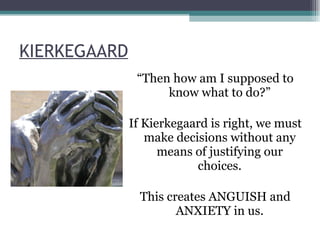
KIERKEGAARD “ Then how am I supposed to know what to do?” If Kierkegaard is right, we must make decisions without any means of justifying our choices. This creates ANGUISH and ANXIETY in us.
KIERKEGAARD In wake of this, Kierkegaard says: “ I must find the  truth that is true from me….  the idea for which I can live or die.”
KIERKEGAARD BUT HOW? Since objective reason is not a guide in making decisions, we cannot know before hand which choices will be right – therefore, we must act by taking a blind “leap of faith.”
KIERKEGAARD In the aftermath of our leap of faith, we must then consider the outcome.  This is referred to by the phrase: “ Act and Reflect”
KIERKEGAARD Kierkegaard also challenges us to: “… . live life forward, understand life backwards”
Existential Thinkers Frederick Nietzsche (1844-1900)
NIETZSCHE Throughout history, Western thought was centered around philosophy and religion, from whose tenants meaning, morality and purpose for life was given.
NIETZSCHE Nietzsche predicted that gradually, belief in religion and philosophy would diminish, moving civilization towards a day where people would have no “belief” in anything.  Nietzsche called this “belief in nothing” NIHILISM
NIETZSCHE Nietzsche predicted that the emergence of science would in large part drive humanity’s march toward  nihilism . (The Scientific Revolution had already began about one hundred years prior to Nietzsche.)
Important Announcement: It was about at this time that DARWIN and his THEORY OF EVOLUTION emerged.
NIETZSCHE Nietzsche proclaimed the dawning of this era of  nihilism  and atheism with his famous statement: “ God is Dead.”
NIETZSCHE Man is Free (without God – really free) This will further unleash the individual’s WILL TO POWER that drives the ascent of civilization. This would free the strong-willed to lord over the weak-minded.
NIETZSCHE In this environment, there would be those with a MASTER MENTALITY and those with a  SLAVE MENTALITY.
NIETZSCHE “ God is Dead” In the  nihilism  that would dominate the thought of the next century (the 1900s), he prophesized grand scale war, totalitarianism, genocide, and….
NIETZSCHE The rise of the SUPERMAN, the free and emboldened leader who acts “ beyond  (without regard to the concept of)  good and evil .” In other words, a champion of untruth, injustice, and having all things his way.
Important Announcement: NIETZSCHE THOUGHT THE (EARLY) MUSIC OF WAGNER EXPRESSED THE SPIRIT OF THE SUPERMAN. http://www.youtube.com/watch?v=V92OBNsQgxU
NIETZSCHE’S VIEW OF MAN For Nietzsche, “ Man is the rope between the ape and the Superman.”
NIETZSCHE’S VIEW OF WOMEN June Cleaver portrays the perfect Nietzschean woman. “ The role of the woman is to take care of the warrior.”
NIETZSCHE Was Nietzsche an analytical philosopher (as Camus thought)? Or was Nietzsche an advocate (as the Nazi’s thought)?
Important Announcement: In the late 1800’s – early 1900’s, psychology was dominated by the work of the behaviorists (like Pavlov) and Freud. Both saw humans as the product of conditioning childhood experiences, our subconscious mind, etc. “ Hey!  Look at me! ”
THEN CAME…. EDMUND  HUSSERL 1859-1938
EDMUND HUSSERL Philosopher – Influenced Psychology Sartre studied under Husserl. His “phenomenology” advocated SUBJECTIVE TRUTH – Things are what they are to the individual. “ Stick to the first person.”
Existential Thinkers Martin  Heidegger 1889-1976
HEIDEGGER Voluminous German Philosopher Influenced Sartre – developed concept of Being. Later found existentialism too focused on the self rather than the individual as a part of all existence. Association with early Nazi party diminished his influence.
Existential Thinkers Jean Paul Sartre 1905-1980
SARTRE French Most noted Existentialist philosopher Failed his first Baccalaureate
SARTRE HOW DID WE COME TO BE? To Sartre, the human condition is a paradox.  Thanks to Descartes, we know we exist, but for Sartre, there is no explanation of how or why. (Sartre is an atheist.)
SARTRE WHAT ARE WE SUPPOSED TO BE? Since we do not know how we came to exist, there is no way of knowing a purpose for our existence.
SARTRE “ Existence Precedes Essence” Therefore, according to Sartre, we have an existence, but no essence (a “nature” or purpose for which we were designed).
SARTRE No thing (or “nothingness”) surrounds our being to give it purpose. We exist (have “being”) in “freedom” because our existence is surrounded by “nothingness.”
SARTRE Sartre is not happy about our freedom. He actually says we are “ condemned to be free .” (trapped in an existence for which we have no way of making any sense of our purpose)
SARTRE “ NAUSEA” occurs when we struggle to find purpose or reason in our existence in NOTHINGNESS.
SARTRE Man’s Attempt to Become God “ Nausea” leads us to an attempt to create a purpose for our existence. Sartre says to attempt to create the purpose for one’s existence is to attempt to be God.
SARTRE Man’s Attempt to Become God Furthermore, we can only fail, because there are no logical answers to the questions: “ How did we come to be?”  and  “ What are we to be?”
SARTRE “ OTHERS” Another way we try to create a purpose for our existence is through relations with other people.  However, this also doesn’t work and creates further frustration leading to Sartre’s axiom: “ Hell is other people.”
Important Announcement: Before concluding that Sartre has given you an epiphany about your family’s dynamics, remember that his father died when he was young, his step-father was stern and cold, and that his relations with both his mother and the woman in his life were troubled.
SARTRE Man’s Attempt to Become God The hopelessness of this quest lead to Sartre’s statement: “ Man is a futile Passion”
SARTRE Man’s Attempt to Become God He didn’t mean that we strive to be the master of the universe, rather that we seek to create a purpose for our life.  Sartre equates this with attempting to “be God.”
SARTRE How should we then live? One might conclude that Sartre’s POV places little significance on the actions of humans.  On the contrary, with our total freedom comes total responsibility (even in situations involving duress and oppression). “ There are no innocent victims in war. ”
SARTRE We must act in “ Good Faith” rather than “Bad Faith.” We act in “good faith” when we act in a way that acknowledges our freedom.
Important Announcement: Just as he was becoming famous, Sartre proclaimed himself a Marxist.  Respect for him was diminished as he was viewed as too tolerant of the Soviet style of communism.  He committed much of his later writing efforts to attempts at reconciling philosophical contradictions between Marxism and existentialism.
Existentialist Thinkiers ALBERT CAMUS
CAMUS The most popular existentialist writer More optimistic than Sartre Died in a car accident in 1951
CAMUS ** Is he an existentialist? ** Held that life is absurd but can still have meaning. That it cannot be made rational is what makes it wonderful. Camus begins with the issue of facing the inevitability of death (Camus is an atheist).
CAMUS Camus believed that when we confront the absurdity of existence and realise the world is completely random and meaningless we experience a deep ‘nihilism’. However, far from contemplating suicide in the face of such absurdity we must conquer our fate. We need to become the ‘absurd hero’ like Sisyphus. Sisyphus conquers his absurd situation and lives life with a love and passion for which the God’s condemned him. He determines his meaning and gives life value in a world without either. ‘ One must remember Sisyphus ‘happy’!
CAMUS We must accept that we will one day die – and then chase meaning in life. The Myth of Sisyphus The champion of a just but lost cause is Camus’ hero.
Existential Thinkers Franz Kafka (1883-1924)
KAFKA Writer whose disturbing, symbolic fiction prefigured the oppression and despair of the late 20 th  century. The term Kafkaesque has, in fact, come to by applied commonly to grotesque, anxiety-producing social conditions or their treatment in literature. (Encarta) Remember the Cockroach!
Summary The Main Themes in the Existentialist thought of Sartre, Camus, Kierkegaard and Heidegger.
Big Ideas  We search for the meaning of our existence and the meaning of our death and suffering.  Reality is a lived experience. We need to confront alienation and anxiety and the absurdity of life with courage.  We should live a moral life because even though I determine my own essence, I share a common human condition.  Nothing defines you but you.       
Existence precedes essence  Traditional philosophy suggests essence precedes existence.  We imagine a hammer and then make one.  From a religious perspective God had an idea of human beings and then created them (essence then existence).  Satre turned this up side down.  We come into being, we exist and then through life we develop our essence by questioning and living.  I become “human” by becoming conscious.   
Anxiety and Angst  Despair, Anxiety and Angst (fear and dread) can enhance our understanding of ourselves.    Happiness alone will not lead to a deep understanding of existence.
Absurdity  Why am I here and is there purpose to life?  Am I simply a small speck in the universe in a world that has no meaning?  Kierkegaard asks: I stick my finger into existence, it smells of nothing.  Questions everywhere: Where am I? what is this thing called the world? Who is  it who has lured me into the thing and now leaves me here? Who am I? How did I come into the world? Why was I not consulted?
Alienation  We all experience a feeling of being separate, lost, confused, out of place, etc.  Modernity has only added to this problem.  We are alienated by our own creations; science, capitalism, politics, religion, technology, etc.  We need to confront alienation with dignity.
Death  Death is a facet of life and we must comprehend it to really understand living.  Living life as if death does not exist is irresponsibility. Examples?  Heidegger saw death as our most authentic moment i.e. you are most alive as you die  Watch clip – Fight Club (1h 15:50- 1h 20)
The “New Theology” 1960’s radical theology An existentialist Christianity Held that the New Testament narratives were myth symbolizing the existential anguish found in human existence Meaning and reality are not in the hereafter but in the “eternal now” we experience.
The “New Theology” Analysis of Traditional Christianity Traditional Response God’s will Forgiveness of sin Eternal life Our Flight Freedom/Angst Responsibility Non-Being (Death)
Existentialism – Post Mortem: Why Existentialism Faded - The figures and movements it was tied to (Sartre, 60’s radicalism) died. Philosophy changes. People want answers – not “nothingness.”
Existentialism – Post Mortem: What was lost in the death of Existentialism ? A debate over the role and potential of the individual.
III. Existentialism and John Gardner’s  Grendel (another side of  Beowulf )
GRENDEL As you will see, in addition to being a retelling of the  Beowulf  legend,  Grendel  is also an experiment that involves Existentialism, among other things (like the poetry of William Blake). Grendel is an existentialist, to an extent.
Grendel In Gardner’s novel, Grendel must choose between nihilistic and idealistic visions, each of which are symbolically represented by other characters.
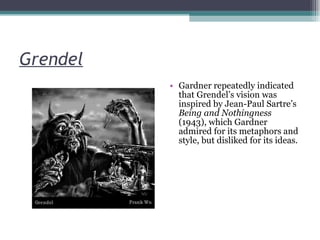
Grendel Gardner repeatedly indicated that Grendel’s vision was inspired by Jean-Paul Sartre’s  Being and Nothingness  (1943), which Gardner admired for its metaphors and style, but disliked for its ideas.
Grendel Sartre’s most famous metaphor is that of existential man peering into the abyss of nothingness and contemplating the suicide that will free him from his anguish.
To quote Sartre… “ I approach the precipice, and my scrutiny is searching for myself in my very depths.  In terms of this moment, I play with my possibilities.  My eyes, running over the abyss from top to bottom, imitate the possible fall and realize it symbolically…”
Important Announcement : Gardner neither agreed with or liked either nihilism or Sartre’s existentialism.  Instead of promoting them, he uses them as tools to trace the main ideas of Western civilization.
YOUR JOB: And it is a daunting one… Is to read  Grendel  as more than a story; to read it as a philosophical commentary.  It is from that POV that we will ultimately attempt to discuss it.  Read for symbolism, allusions, and philosophical meaning…
In Conclusion , REMEMBER : It might hurt a bit at first, but you must have fun with philosophy, or philosophy will have fun with you!

Existentialism2

  • 1.
  • 2.
    Presentation Outline I.What is Existentialism? II. A Brief History of Existentialism A. An Overview of Major Philosophers B. Existentialism’s connection with Nihilism III. Connections to John Gardner’s Grendel
  • 3.
    I. What isExistentialism?
  • 4.
    Introductory Question :What do you know with absolute certainty? (Perhaps the key question with which to begin any philosophical investigation)
  • 5.
    “ I am….”Existentialism starts at the same point as Descartes’ philosophy – with your existence as the original certainty. You might not know anything else, but you at least know you exist (in some way) because you are thinking. As Descartes stated it: “ I think, therefore, I am.”
  • 6.
    Important Announcement :Descartes was NOT an existentialist. Despite a common starting point, the two take radically different philosophical directions. Descartes starts here and runs to many additional conclusions – Existentialism basically stays here.
  • 7.
    Existentialism is thephilosophy that holds your existence as your pre-eminent truth and reality.
  • 8.
  • 9.
    (1) We areFree This is not referring to political freedom; rather that there are no psychological or metaphysical forces that determine the person you become or the actions you take. You are free to be the person that you choose. Rather than a blessing, this is a tremendous responsibility you must learn to accept.
  • 10.
    (2) Our Existenceis Absurd This means that we can give no logical sense or purpose to life – There is none to be found.
  • 11.
    (3) Truth isSubjective This means that what is true for one person might not be true for another.
  • 12.
    Then what? Okay,thanks to Descartes, we know we exist. To understand what Existentialism says about existence, think of the types of things a person might believe influences or controls their existence….
  • 13.
    Such as…. AnInteractive God Fate Astrology Murphy’s Law (& other laws) Grandmother’s axioms Human nature Pre-destination Freud’s sub-consious mind
  • 14.
    Then, imagine theuniverse without any of these! That’s the Existential view of reality! Existentialism says there is nothing that explains, guides or gives purpose to our existence. In short – you EXIST (have “BEING”) in total FREEDOM surrounded by NOTHINGNESS.
  • 15.
    Sartre gives histreatment on this view in his philosophical work: “Being and Nothingness”
  • 16.
    Sartre on existentialism:Man can will nothing unless he has first understood that he must count no one but himself; that he is alone, abandoned on earth in the midst of his infinite responsibilities, without help, with no other aim than the one he sets himself, with no other destiny than the one he forges for himself on this earth. ( Being and Nothingness , 1943)
  • 17.
    II. A BriefHistory of Existentialism
  • 18.
    BACKGROUND Concepts ofexistentialism are found throughout the history of literature and philosophy. Its most recent development came from the French writer/philosopher Jean Paul Sartre. Popular during the radicalism of the 1960s and 1970s “ Modern” existentialism began with….
  • 19.
  • 20.
    KIERKEGAARD In theearly 1800’s, philosophy was dominated by the work of idealists like Hegel, whose thought postulated grand theories that explained how thought, societies and nations changed and evolved over time. i.e. Hegel’s Thesis + Antithesis = Synthesis
  • 21.
    KIERKEGAARD This mayhave been great for explaining the inception of a nation, ideology or economic system, but it reduces the individual to a mere faceless cog in the workings of the universe. “ Hey! Look at me!”
  • 22.
    KIERKEGAARD Then alongcomes Soren Kierkegaard 1813-1854 Danish – Lutheran His written works were inspired by his difficulties with himself, his girlfriend, and his father. (Dad was guilt-ridden, doddering and overbearing)
  • 23.
    Important Announcement :OBJECTIVE TRUTH Comes from Externals (Things Beyond Us) SUBJECTIVE TRUTH Comes from Within Us
  • 24.
    KIERKEGAARD Kierkegaard’s writingsare the beginning of modern existentialism. For him, the individual’s existence is where it all starts. Kierkegaard believed people in the 19 th Century to be in despair over being human. People didn’t want to exist outside of the crowd. He argued that a person who ‘follows the crowd’ does not choose his or her own identity and therefore could not live life passionately as an individual. This amounted to not existing.
  • 25.
    KIERKEGAARD The problemfor the individual is (in Kierkegaard’s view) that God has physically hidden himself from us. There is an “infinite abyss” between us and God. Therefore, we must struggle to make decisions in “absolute isolation” from God.
  • 26.
    KIERKEGAARD BUT HOW?Objective reason is of no value – when God deals with us as individuals, His commands are often irrational and unique to the individual.
  • 27.
    Kierkegaard refers tosuch episodes as the “Teleological Suspension of the Ethical” Instances where individuals are commanded by God to act irrationally and/or in ways outside the ethical norm – for a specific purpose.
  • 28.
    His Most FamousExample: God’s command to Abraham to sacrifice his son Isaac. Other examples of the Teleological Suspension of the Ethical: Jesus Paul
  • 29.
    KIERKEGAARD Since God’scommands are often irrational and unique to the individual, TRUTH IS SUBJECTIVE & FAITH (RELIGIOUS TRUTH) IS IRRATIONAL (not based on reason & logic)
  • 30.
    “ IRRATIONAL”: 1.By the norms of the time 2. Not based on logic and reason
  • 31.
    Important Announcement: Whilesome would argue that God only occasionally commands some to act outside the norm, Kierkegaard holds that this is the way all religious experience operates.
  • 32.
    KIERKEGAARD “ Thenhow am I supposed to know what to do?” If Kierkegaard is right, we must make decisions without any means of justifying our choices. This creates ANGUISH and ANXIETY in us.
  • 33.
    KIERKEGAARD In wakeof this, Kierkegaard says: “ I must find the truth that is true from me…. the idea for which I can live or die.”
  • 34.
    KIERKEGAARD BUT HOW?Since objective reason is not a guide in making decisions, we cannot know before hand which choices will be right – therefore, we must act by taking a blind “leap of faith.”
  • 35.
    KIERKEGAARD In theaftermath of our leap of faith, we must then consider the outcome. This is referred to by the phrase: “ Act and Reflect”
  • 36.
    KIERKEGAARD Kierkegaard alsochallenges us to: “… . live life forward, understand life backwards”
  • 37.
    Existential Thinkers FrederickNietzsche (1844-1900)
  • 38.
    NIETZSCHE Throughout history,Western thought was centered around philosophy and religion, from whose tenants meaning, morality and purpose for life was given.
  • 39.
    NIETZSCHE Nietzsche predictedthat gradually, belief in religion and philosophy would diminish, moving civilization towards a day where people would have no “belief” in anything. Nietzsche called this “belief in nothing” NIHILISM
  • 40.
    NIETZSCHE Nietzsche predictedthat the emergence of science would in large part drive humanity’s march toward nihilism . (The Scientific Revolution had already began about one hundred years prior to Nietzsche.)
  • 41.
    Important Announcement: Itwas about at this time that DARWIN and his THEORY OF EVOLUTION emerged.
  • 42.
    NIETZSCHE Nietzsche proclaimedthe dawning of this era of nihilism and atheism with his famous statement: “ God is Dead.”
  • 43.
    NIETZSCHE Man isFree (without God – really free) This will further unleash the individual’s WILL TO POWER that drives the ascent of civilization. This would free the strong-willed to lord over the weak-minded.
  • 44.
    NIETZSCHE In thisenvironment, there would be those with a MASTER MENTALITY and those with a SLAVE MENTALITY.
  • 45.
    NIETZSCHE “ Godis Dead” In the nihilism that would dominate the thought of the next century (the 1900s), he prophesized grand scale war, totalitarianism, genocide, and….
  • 46.
    NIETZSCHE The riseof the SUPERMAN, the free and emboldened leader who acts “ beyond (without regard to the concept of) good and evil .” In other words, a champion of untruth, injustice, and having all things his way.
  • 47.
    Important Announcement: NIETZSCHETHOUGHT THE (EARLY) MUSIC OF WAGNER EXPRESSED THE SPIRIT OF THE SUPERMAN. http://www.youtube.com/watch?v=V92OBNsQgxU
  • 48.
    NIETZSCHE’S VIEW OFMAN For Nietzsche, “ Man is the rope between the ape and the Superman.”
  • 49.
    NIETZSCHE’S VIEW OFWOMEN June Cleaver portrays the perfect Nietzschean woman. “ The role of the woman is to take care of the warrior.”
  • 50.
    NIETZSCHE Was Nietzschean analytical philosopher (as Camus thought)? Or was Nietzsche an advocate (as the Nazi’s thought)?
  • 51.
    Important Announcement: Inthe late 1800’s – early 1900’s, psychology was dominated by the work of the behaviorists (like Pavlov) and Freud. Both saw humans as the product of conditioning childhood experiences, our subconscious mind, etc. “ Hey! Look at me! ”
  • 52.
    THEN CAME…. EDMUND HUSSERL 1859-1938
  • 53.
    EDMUND HUSSERL Philosopher– Influenced Psychology Sartre studied under Husserl. His “phenomenology” advocated SUBJECTIVE TRUTH – Things are what they are to the individual. “ Stick to the first person.”
  • 54.
    Existential Thinkers Martin Heidegger 1889-1976
  • 55.
    HEIDEGGER Voluminous GermanPhilosopher Influenced Sartre – developed concept of Being. Later found existentialism too focused on the self rather than the individual as a part of all existence. Association with early Nazi party diminished his influence.
  • 56.
    Existential Thinkers JeanPaul Sartre 1905-1980
  • 57.
    SARTRE French Mostnoted Existentialist philosopher Failed his first Baccalaureate
  • 58.
    SARTRE HOW DIDWE COME TO BE? To Sartre, the human condition is a paradox. Thanks to Descartes, we know we exist, but for Sartre, there is no explanation of how or why. (Sartre is an atheist.)
  • 59.
    SARTRE WHAT AREWE SUPPOSED TO BE? Since we do not know how we came to exist, there is no way of knowing a purpose for our existence.
  • 60.
    SARTRE “ ExistencePrecedes Essence” Therefore, according to Sartre, we have an existence, but no essence (a “nature” or purpose for which we were designed).
  • 61.
    SARTRE No thing(or “nothingness”) surrounds our being to give it purpose. We exist (have “being”) in “freedom” because our existence is surrounded by “nothingness.”
  • 62.
    SARTRE Sartre isnot happy about our freedom. He actually says we are “ condemned to be free .” (trapped in an existence for which we have no way of making any sense of our purpose)
  • 63.
    SARTRE “ NAUSEA”occurs when we struggle to find purpose or reason in our existence in NOTHINGNESS.
  • 64.
    SARTRE Man’s Attemptto Become God “ Nausea” leads us to an attempt to create a purpose for our existence. Sartre says to attempt to create the purpose for one’s existence is to attempt to be God.
  • 65.
    SARTRE Man’s Attemptto Become God Furthermore, we can only fail, because there are no logical answers to the questions: “ How did we come to be?” and “ What are we to be?”
  • 66.
    SARTRE “ OTHERS”Another way we try to create a purpose for our existence is through relations with other people. However, this also doesn’t work and creates further frustration leading to Sartre’s axiom: “ Hell is other people.”
  • 67.
    Important Announcement: Beforeconcluding that Sartre has given you an epiphany about your family’s dynamics, remember that his father died when he was young, his step-father was stern and cold, and that his relations with both his mother and the woman in his life were troubled.
  • 68.
    SARTRE Man’s Attemptto Become God The hopelessness of this quest lead to Sartre’s statement: “ Man is a futile Passion”
  • 69.
    SARTRE Man’s Attemptto Become God He didn’t mean that we strive to be the master of the universe, rather that we seek to create a purpose for our life. Sartre equates this with attempting to “be God.”
  • 70.
    SARTRE How shouldwe then live? One might conclude that Sartre’s POV places little significance on the actions of humans. On the contrary, with our total freedom comes total responsibility (even in situations involving duress and oppression). “ There are no innocent victims in war. ”
  • 71.
    SARTRE We mustact in “ Good Faith” rather than “Bad Faith.” We act in “good faith” when we act in a way that acknowledges our freedom.
  • 72.
    Important Announcement: Justas he was becoming famous, Sartre proclaimed himself a Marxist. Respect for him was diminished as he was viewed as too tolerant of the Soviet style of communism. He committed much of his later writing efforts to attempts at reconciling philosophical contradictions between Marxism and existentialism.
  • 73.
  • 74.
    CAMUS The mostpopular existentialist writer More optimistic than Sartre Died in a car accident in 1951
  • 75.
    CAMUS ** Ishe an existentialist? ** Held that life is absurd but can still have meaning. That it cannot be made rational is what makes it wonderful. Camus begins with the issue of facing the inevitability of death (Camus is an atheist).
  • 76.
    CAMUS Camus believedthat when we confront the absurdity of existence and realise the world is completely random and meaningless we experience a deep ‘nihilism’. However, far from contemplating suicide in the face of such absurdity we must conquer our fate. We need to become the ‘absurd hero’ like Sisyphus. Sisyphus conquers his absurd situation and lives life with a love and passion for which the God’s condemned him. He determines his meaning and gives life value in a world without either. ‘ One must remember Sisyphus ‘happy’!
  • 77.
    CAMUS We mustaccept that we will one day die – and then chase meaning in life. The Myth of Sisyphus The champion of a just but lost cause is Camus’ hero.
  • 78.
    Existential Thinkers FranzKafka (1883-1924)
  • 79.
    KAFKA Writer whosedisturbing, symbolic fiction prefigured the oppression and despair of the late 20 th century. The term Kafkaesque has, in fact, come to by applied commonly to grotesque, anxiety-producing social conditions or their treatment in literature. (Encarta) Remember the Cockroach!
  • 80.
    Summary The MainThemes in the Existentialist thought of Sartre, Camus, Kierkegaard and Heidegger.
  • 81.
    Big Ideas  Wesearch for the meaning of our existence and the meaning of our death and suffering. Reality is a lived experience. We need to confront alienation and anxiety and the absurdity of life with courage. We should live a moral life because even though I determine my own essence, I share a common human condition. Nothing defines you but you.      
  • 82.
    Existence precedes essence Traditional philosophy suggests essence precedes existence. We imagine a hammer and then make one. From a religious perspective God had an idea of human beings and then created them (essence then existence). Satre turned this up side down. We come into being, we exist and then through life we develop our essence by questioning and living. I become “human” by becoming conscious.  
  • 83.
    Anxiety and Angst Despair, Anxiety and Angst (fear and dread) can enhance our understanding of ourselves.   Happiness alone will not lead to a deep understanding of existence.
  • 84.
    Absurdity  Why amI here and is there purpose to life? Am I simply a small speck in the universe in a world that has no meaning? Kierkegaard asks: I stick my finger into existence, it smells of nothing. Questions everywhere: Where am I? what is this thing called the world? Who is  it who has lured me into the thing and now leaves me here? Who am I? How did I come into the world? Why was I not consulted?
  • 85.
    Alienation  We allexperience a feeling of being separate, lost, confused, out of place, etc. Modernity has only added to this problem. We are alienated by our own creations; science, capitalism, politics, religion, technology, etc. We need to confront alienation with dignity.
  • 86.
    Death  Death isa facet of life and we must comprehend it to really understand living. Living life as if death does not exist is irresponsibility. Examples? Heidegger saw death as our most authentic moment i.e. you are most alive as you die Watch clip – Fight Club (1h 15:50- 1h 20)
  • 87.
    The “New Theology”1960’s radical theology An existentialist Christianity Held that the New Testament narratives were myth symbolizing the existential anguish found in human existence Meaning and reality are not in the hereafter but in the “eternal now” we experience.
  • 88.
    The “New Theology”Analysis of Traditional Christianity Traditional Response God’s will Forgiveness of sin Eternal life Our Flight Freedom/Angst Responsibility Non-Being (Death)
  • 89.
    Existentialism – PostMortem: Why Existentialism Faded - The figures and movements it was tied to (Sartre, 60’s radicalism) died. Philosophy changes. People want answers – not “nothingness.”
  • 90.
    Existentialism – PostMortem: What was lost in the death of Existentialism ? A debate over the role and potential of the individual.
  • 91.
    III. Existentialism andJohn Gardner’s Grendel (another side of Beowulf )
  • 92.
    GRENDEL As youwill see, in addition to being a retelling of the Beowulf legend, Grendel is also an experiment that involves Existentialism, among other things (like the poetry of William Blake). Grendel is an existentialist, to an extent.
  • 93.
    Grendel In Gardner’snovel, Grendel must choose between nihilistic and idealistic visions, each of which are symbolically represented by other characters.
  • 94.
    Grendel Gardner repeatedlyindicated that Grendel’s vision was inspired by Jean-Paul Sartre’s Being and Nothingness (1943), which Gardner admired for its metaphors and style, but disliked for its ideas.
  • 95.
    Grendel Sartre’s mostfamous metaphor is that of existential man peering into the abyss of nothingness and contemplating the suicide that will free him from his anguish.
  • 96.
    To quote Sartre…“ I approach the precipice, and my scrutiny is searching for myself in my very depths. In terms of this moment, I play with my possibilities. My eyes, running over the abyss from top to bottom, imitate the possible fall and realize it symbolically…”
  • 97.
    Important Announcement :Gardner neither agreed with or liked either nihilism or Sartre’s existentialism. Instead of promoting them, he uses them as tools to trace the main ideas of Western civilization.
  • 98.
    YOUR JOB: Andit is a daunting one… Is to read Grendel as more than a story; to read it as a philosophical commentary. It is from that POV that we will ultimately attempt to discuss it. Read for symbolism, allusions, and philosophical meaning…
  • 99.
    In Conclusion ,REMEMBER : It might hurt a bit at first, but you must have fun with philosophy, or philosophy will have fun with you!