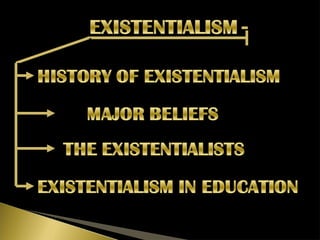
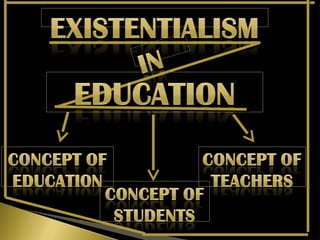
HISTORY OF
EXISTENTIALISM
THE
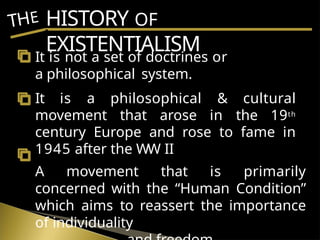
It isnot a set of doctrines or
a philosophical system.
It is a philosophical & cultural
movement that arose in the 19th
century Europe and rose to fame in
1945 after the WW II
A movement that is primarily
concerned with the “Human Condition”
which aims to reassert the importance
of individuality
4.
HISTORY OF
EXISTENTIALISM
THE
What happenedbetween 1914 and
1945? What triggered the movement?
the slaughter at Verdun or the Somme or the
Marne
the Bolshevik terror in Russia
the black-shirted and brown-shirted hysteria in
Italy and Germany
Great Depression of 1929-1935
families fell victim to Stalin's
purges Spanish Civil War
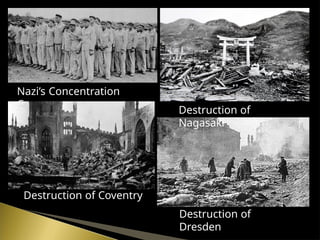
Hitler’s Nazi concentration camp
Destruction of Cities of Coventry or Dresden
or Nagasaki
5.
Battle of
Verdun Battleof
Somme
Battle of
Marne
Bolshevik
Terror Black Shirts March
on Rome
Stalin’s
Purges
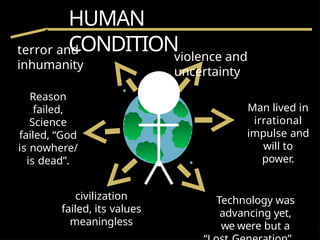
HUMAN
CONDITION
terror and
inhumanity
civilization
failed, itsvalues
meaningless
Reason
failed,
Science
failed, “God
is nowhere/
is dead”.
violence and
uncertainty
Man lived in
irrational
impulse and
will to
power.
Technology was
advancing yet,
we were but a
8.
HISTORY OF
EXISTENTIALISM
THE
What tiedall the existentialists thinker
all together?
“The problem of life as a human being.”
They take seriously the questions:
“Why Am I here?”
“What does it mean to be
human?” “How should I live my
life?”
9.
The individual shouldfigure out
his
own way
of
answering these questions without generalizing
the solution to other individuals.
What mankind need is not a divine perspective but
a human perspective about life.
Existentialism is a philosophy premised on the
individual.
Existentialists reject systems which propose to
have definitive answers to the questions of
meaning and purpose of life like Science and
Reason.
EXISTENTIALISM as PHILOSOPHY
10.
EXISTENTIALISM as
PHILOSOPHY
philosophical systemsand religion doesn’t really
know what it is like to be human – to live in the
world that we’re living in – to experience all the
fears and pain, hopes and disappointments, and joy
of life.
The Existentialists sees something more in
nature of relationship between man and
world. This has little to do with the
question of the world’s finiteness or
infiniteness; it has much to do with the fact
that existence is as man knows it; it is
specifically finite.
11.
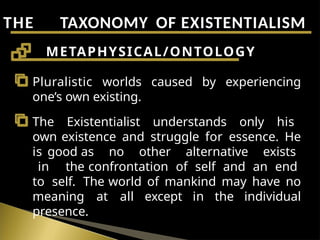
THE TAXONOMY OFEXISTENTIALISM
Pluralistic worlds caused by experiencing
one’s own existing.
The Existentialist understands only his
own existence and struggle for essence. He
is good as no other alternative exists
in the confrontation of self and an end
to self. The world of mankind may have no
meaning at all except in the individual
presence.
METAPHYSICAL/ONTOLOGY
12.
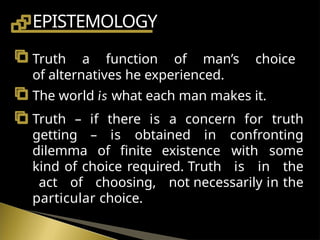
EPISTEMOLOGY
Truth a functionof man’s choice
of alternatives he experienced.
The world is what each man makes it.
Truth – if there is a concern for truth
getting – is obtained in confronting
dilemma of finite existence with some
kind of choice required. Truth is in the
act of choosing, not necessarily in the
particular choice.
13.
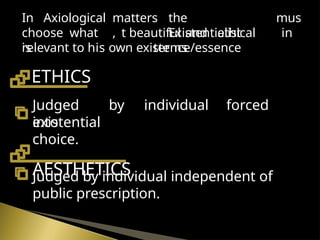
existential
choice.
AESTHETICS
Judged by individualindependent of
public prescription.
matters
,
the
Existentialist
In Axiological
choose what
is
mus
t beautiful and ethical in
terms
relevant to his own existence/essence
ETHICS
Judged by individual forced
into
15.
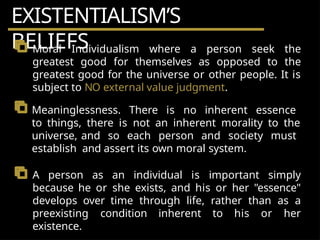
EXISTENTIALISM’S
BELIEFS
Moral Individualism wherea person seek the
greatest good for themselves as opposed to the
greatest good for the universe or other people. It is
subject to NO external value judgment.
Meaninglessness. There is no inherent essence
to things, there is not an inherent morality to the
universe, and so each person and society must
establish and assert its own moral system.
A person as an individual is important simply
because he or she exists, and his or her "essence"
develops over time through life, rather than as a
preexisting condition inherent to his or her
existence.
16.
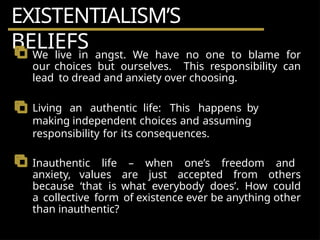
EXISTENTIALISM’S
BELIEFS
We live inangst. We have no one to blame for
our choices but ourselves. This responsibility can
lead to dread and anxiety over choosing.
Living an authentic life: This happens by
making independent choices and assuming
responsibility for its consequences.
Inauthentic life – when one’s freedom and
anxiety, values are just accepted from others
because ‘that is what everybody does’. How could
a collective form of existence ever be anything other
than inauthentic?
17.
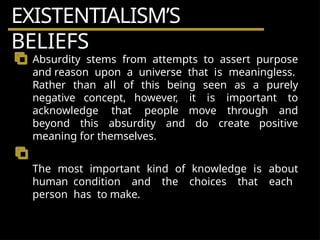
EXISTENTIALISM’S
BELIEFS
Absurdity stems fromattempts to assert purpose
and reason upon a universe that is meaningless.
Rather than all of this being seen as a purely
negative concept, however, it is important to
acknowledge that people move through and
beyond this absurdity and do create positive
meaning for themselves.
The most important kind of knowledge is about
human condition and the choices that each
person has to make.
19.
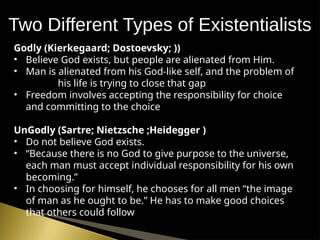
Two Different Typesof Existentialists
Godly (Kierkegaard; Dostoevsky; ))
• Believe God exists, but people are alienated from Him.
• Man is alienated from his God-like self, and the problem of
his life is trying to close that gap
• Freedom involves accepting the responsibility for choice
and committing to the choice
UnGodly (Sartre; Nietzsche ;Heidegger )
• Do not believe God exists.
• “Because there is no God to give purpose to the universe,
each man must accept individual responsibility for his own
becoming.”
• In choosing for himself, he chooses for all men “the image
of man as he ought to be.” He has to make good choices
that others could follow
20.
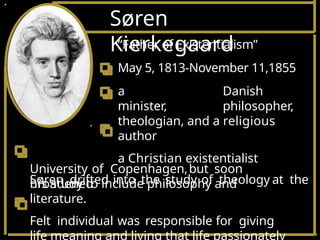
Søren
Kierkegaard
University of Copenhagen,butsoon
broadened
his study to include philosophy and
literature.
Felt individual was responsible for giving
life meaning and living that life passionately
“Father of Existentialism”
May 5, 1813-November 11,1855
a Danish
minister, philosopher,
theologian, and a religious
author
a Christian existentialist
Søren drifted into the study of theology at the
21.
Søren
Kierkegaard
“Father of
Existentialism
”
During the18th century, reason and
nature were given more importance,
objectivity was very
much emphasized, leading
to
industrial
and
was
technologica
l given
utmost
developments and
Science importance. Fromthe
scientific
viewpoint, man was also regarded as an
object. Man became a slave to machines in
developing industrial society.
Søren was worried that philosophy lost its
way.
He felt the need to seek out answers
regarding uncertain things in life like our
22.
Søren
Kierkegaard
“Father of
Existentialism
”
His existentialtheology saw the birth of
existentialism as a philosophy because he wanted
to see the individual person as achieving the
fullness of his own human existence.
When people realize that they are alive and will one
day die--and there is no meaning to cling to– the
person is in an existential crisis and would feel a
sense of dread or angst.
23.
Søren
Kierkegaard
“Father of
Existentialism
”
Kierkegaard stressedthe absurdity the
human
situation and came up with the ff. principles:
An individual must live a totally committed
life, which is only understood by the
individual
He advocated the leap of faith into Christianity
Although Christianity is incomprehensible it is the
only commitment that will save an individual from
complete and utter despair.
Once the person experienced existential crisis, he
would completely and without reservation commit
himself to God, even if it seems irrational to do so.
Søren
Kierkegaard
“Father of
Existentialism
”
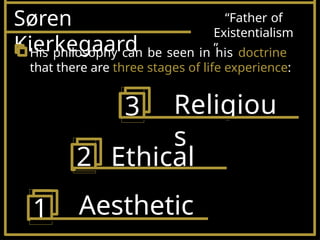
His philosophycan be seen in his doctrine
that there are three stages of life experience:
1Aesthetic – the individual may just
be interested in pleasure or romance or in
intellect pursuits that are non-committal.
The person merely observes the world in a
detached and
objective manner with no involvement
whatsoever. Here, Kierkegaard stressed that
the aesthetic mode of life remains futile
26.
Søren
Kierkegaard
“Father of
Existentialism
”
His philosophycan be seen in his doctrine
that there are three stages of life experience:
2Ethical – Man makes for himself a
decision coupled with resolute injunction
‘know thy self’ must be changed to ‘choose
thyself’. This stage is characterized by regard
for duty.
3Religious – Obedience and commitment to
God manifest on this stage.
27.
Søren
Kierkegaard
“Father of
Existentialism
”
the ideasthat
people
He brought
about should have
morals.
He believed that each person has a history
of his own and that people’s spirit/soul
should be nurtured.
He also believed that children learn
by watching others. It is important for
students and educators to be morally
sound.
Other
beliefs:
28.
Fyodor
Dostoevsky
Nov. 11, 1821– Feb. 9, 1881
born in Moscow, Russia
a Russian novelist,
essayist, short story writer,
journalist and philosopher
Wrote
widely
acclaime
d
Punishment, The Idiot ,
books
Note
s
Crime
and
from the
Underground, and The Brothers
Karamazov
29.
Fyodor
Dostoevsky
What is permittedand what is not permitted
is a question that he dramatizes again and
again, and the development of his work as a
dramatic testing of the limits of
freedom and a progressive refinement of
what he meant by the concept of freedom.
At the center of all Dostoevsky's writing is the
problem of freedom.
Crime and Punishment, The Brothers Karamazov,
and Notes to the Underground were viewed
with Existentialist philosophy.
30.
Fyodor
Dostoevsky
Themes of hisBook:
1“Life is in ourselves and not in the external”.
2Man is limited by society, economic
conditions, laws, history, the church, and
especially by God. Man, however, does
not want to be defined and limited -- he
wants to be free and
he wants to be totally and completely free.
3Man is right in wanting to be free, for
freedom is the essential attribute of his
identity.
31.
6Although
suffering, allows forsuffering,
consciousness arises from
and
necessitates suffering, it also makes possible
free will and individuality. With
consciousness, man must suffer, but without
it, man will never be free.
4“To be a human being among human beings,
and remain one forever, no matter what
misfortunes befall, not to become depressed,
and not to falter--this is what life is, herein
lies its task.”
5Suffering leads to the redemption of the soul.
Themes of his Book:
32.
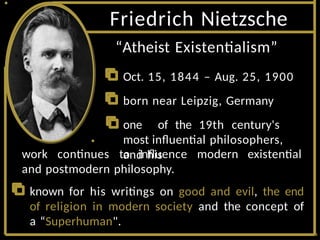
Friedrich Nietzsche
“Atheist Existentialism”
Oct.15, 1844 – Aug. 25, 1900
born near Leipzig, Germany
one of the 19th century's
most influential philosophers,
and his
work continues to influence modern existential
and postmodern philosophy.
known for his writings on good and evil, the end
of religion in modern society and the concept of
a “Superhuman".
33.
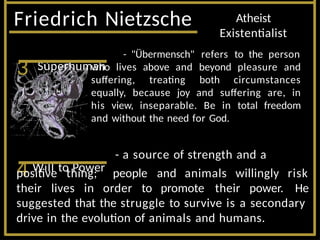
Friedrich Nietzsche Atheist
Existentialist
Heagreed with Schopenhauer that there is no
God and life is filled with pain and suffering, but
Nietzsche came to his own conclusion that
humans must get everything out of life and set
out to find out how to best do that.
1in order to achieve anything worthwhile,
whether it be scaling a mountain to take in the
views or living a good life, hardship and effort
are necessary.
34.
Friedrich Nietzsche Atheist
Existentialist
3Superhuman
- "Übermensch" refers to the person
who lives above and beyond pleasure and
suffering, treating both circumstances
equally, because joy and suffering are, in
his view, inseparable. Be in total freedom
and without the need for God.
4 Will to Power
- a source of strength and a
positive thing;
their lives in order to promote their power.
people and animals willingly risk
He
suggested that the struggle to survive is a secondary
drive in the evolution of animals and humans.
35.
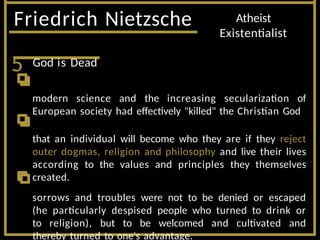
Friedrich Nietzsche Atheist
Existentialist
5God is Dead
modern science and the increasing secularization of
European society had effectively "killed" the Christian God
that an individual will become who they are if they reject
outer dogmas, religion and philosophy and live their lives
according to the values and principles they themselves
created.
sorrows and troubles were not to be denied or escaped
(he particularly despised people who turned to drink or
to religion), but to be welcomed and cultivated and
thereby turned to one's advantage.
36.
FriedrichNietzsche
was necessary tolive dangerously and take risks.
8 The only way in which life can be justified is as
an aesthetic phenomenon. His point was that, if
there is nothing outside this world (no God, no
transcendental realm of any sort), then any
justification or meaning that life has must be
assumption
universe is a useful fiction
Atheist
Existentialist
of an
orderly that
hides the
meaninglessness of existence.”
7 In order to harvest great happiness in life, it
The scientific
37.
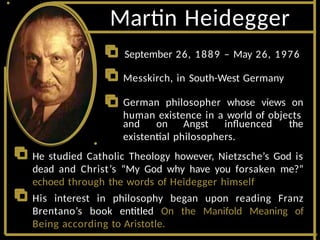
Martin Heidegger
German philosopherwhose views on
human existence in a world of objects
and on Angst influenced the
existential philosophers.
He studied Catholic Theology however, Nietzsche’s God is
dead and Christ’s “My God why have you forsaken me?”
echoed through the words of Heidegger himself
September 26, 1889 – May 26, 1976
Messkirch, in South-West Germany
His interest in philosophy began upon reading Franz
Brentano’s book entitled On the Manifold Meaning of
Being according to Aristotle.
38.
In 1927,
established
he publishedBeing
and Time which him as
the leading philosopher in
the
German Language as far as fashion and influence were
concerned.
Martin Heidegger in his book Being and Time, gave a
very impressive analysis of human existence, the
prominence of the important themes of existentialism
like care, anxiety, guilt and above all death is brought
out here.
Martin Heidegger
39.
Just jump
off the
bridgepal.
BEING AND TIME
You
should
become a
slave! You’re
weak!
I am weak. I will
not succeed. I
don’t think I can
be something
else except for a
slave. Where’s
the nearest
bridge???
INAUTHENTIC LIFE!!!
Pray that the
Lord have
mercy on
you.
You will
not
succeed in
life!
40.
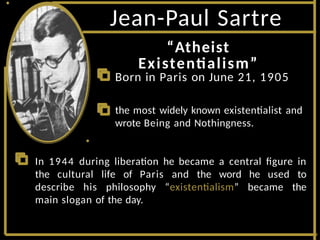
Jean-Paul Sartre
“Atheist
Existentialism”
Born inParis on June 21, 1905
the most widely known existentialist and
wrote Being and Nothingness.
In 1944 during liberation he became a central figure in
the cultural life of Paris and the word he used to
describe his philosophy “existentialism” became the
main slogan of the day.
41.
Atheist
Existentialist
Sartre’s Philosophy
The firstphilosopher who attempted to make
Existentialism into a coherent philosophy in
1943 in response to the absurdity of WW II.
Wrote Being and Nothingness; was considered
the “bible of the existentialists”.
“Existentialism is Humanism”, in a sense that
Existentialists start from nothing but humanity
itself.
42.
Sartre’s Philosophy:
Being andNothingness
“Existence precedes essence”. Man has no innate or
eternal 'nature.' Man must therefore create himself. He
must create his own nature or 'essence,' because it is not
fixed in advance."
existential moment arises when young people realize for
the first time that choice is theirs, that they are
responsible for themselves. Their question becomes "Who
am I and what should I do?
We are condemned to be free. Like actors dragged onto
the stage without having learned our lines, with no script
and no prompter to whisper stage directions to us. We
must decide for ourselves how to live."
44.
EXISTENTIALISM IN EDUCATION
levels.Others
existentialism
feel that
in
education
should
the role of
be
reserved for higher
education.
Existentialism and Søren Kierkegaard had
a very important impact on education.
Existentialism in education is significant
in a number of ways. Some argue that
existentialism should be taught to students of
all
45.
CONCEPT OF EDUCATION
Educationshould be designed to create in us a
sense of self-awareness and to contribute to our
authenticity as human beings.
It is extremely important that schools get back to
the three R’s of education. Children need to
be
taught how to succeed in life no matter
what
career they choose and schools need to
prepare
them for that
life.
1
2
3
Concerning the curriculum content, an
room for dialogue. The subjects should be the
one
existentialist experiences and subjects will create
that vividly portray individual men and women
in the act of making choices.
46.
CONCEPT OF EDUCATION
4
Child– Centered Education. It gives full freedom
to the child. The teacher should help the child
to know himself and recognize his being.
Freedom is required for natural development.
Education should convert imperfection into
perfection.
Education should be according to the individual’s
needs and abilities of the child. The relation of
the child to himself should be strengthened by
education.
47.
CONCEPT OF EDUCATION
5
Thecurriculum
would
avoid systematic
knowledge or structured disciplines, and
the
students would be free to select from many
available learning situations. The learners would
choose the knowledge they wish to possess. The
humanities are commonly given tremendous
emphasis. They are explored as a means
of
providing students with vicarious experiences
that will help unleash their own creativity and
self – expression.
48.
CONCEPT OF
STUDENTS
For Existentialists,the classroom is a free market of
ideas and as such, it must guarantee complete
freedom of thought for the individual.
Existentialists give students complete freedom, and
complete responsibility, with regard to
their
education. The only authority is one’s
self.
Students are encouraged to understand and
appreciate their uniqueness and to assume
responsibility for their
actions.
Students are not expected to live up to anyone’s
expectations besides the expectations that
they
have for
themselves.
1
2
3
49.
A student thrivesbetter when relieved from intense
competition, harsh discipline, and fear of failure.
Thus each child can grow to understand his
own
needs and values and take charge of the experiences
for changing him.
4The student accepts the discipline prescribed by
the
teacher and does not become irresponsible.
The
purpose of freedom given to him should be to enable
him to effect the full development of his individuality.
5Career-oriented education is seen as a means for
students to become aware of their individual talents
and potential, with “success” as a concept that’s open
to interpretation by the student.
6
50.
AT A TEACHER
LEVEL:
Theteacher’s role is to help students define
their
own essence by exposing them to various paths they
may take in life and creating an environment in
which they may freely choose their preferred
way.
1
2
The function of the teacher is to act only as a
referee
in the intellectual play-field, but also a source person
or facilitator of the learning process and he must not
interfere with the students’ choices or
decisions.
CONCEPT OF TEACHERS
51.
3
A teacher shouldlearn what each child’s needs are
and where the child is academically. The set
of
4
curriculum should be modeled to fit
each individual students needs or at least come
close.
The teacher’s characteristic of being ‘open’ to
possibilities includes a willingness to allow others
to re-evaluate those aspects of one’s
understandings that can be articulated. If one
chooses to ‘close’ oneself off from the criticisms
of others, one is no longer teacher.
The teacher must build positive relationships
between himself and his students. He should avoid
applying labels to children (such as ‘lazy’, ‘slow
learner’ etc.)
5
52.
•An Existentialist Approachto Teaching
•Heiddegerr, Martin. (1927). Being and Time.
•Chapter7A EXISTENTIALISM
•Macquarrie, J. (1968) : Existenatialism, Pelican Book.
•Chaube S.P. & Chaube A. (1996) : Foundations of Education, Publishing House, New Delhi.
•Chandra S.S. & Sharma R.K. (2004) : Philosophy of Education, Atlantic Publishers.
•Ekanem, Dr. Francis E. (2012). Educational Existentialism. Journal of Humanities and Social
Science.
•Maheshwari, Dr. V.K. (2011). Existentialism – As an Educational Philosophy. College,
Roorkee, India.
•Miller, Kim. (2013). Existentialism-A Great Philosophy of Education. Retrieved from:
http://blog.enroll.com/view-post/Existentialism-A-Great-Philosophy-of-Education
•Goserud, Erik J.J. (2014). Applications of Existentialism in Education.
•(2005). Philosophy of Education. McGraw-Hill Higher Education
•Ivers, Gene. (2011). Existentialism.
•McGourty, M. Burwell, Don. (2000). Existentialism. Albertson College of Idaho.