Carmen Allcock
NOON CONFERENCE
Agenda
• Pathogenesis algorithm
• Basic workup
• Additional tests our patient got done
• Qs
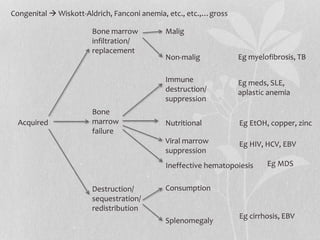
Congenital  Wiskott-Aldrich, Fanconi anemia, etc., etc.,…gross
Acquired
Bone marrow
infiltration/
replacement
Bone
marrow
failure
Destruction/
sequestration/
redistribution
Malig
Consumption
Non-malig
Splenomegaly
Immune
destruction/
suppression
Nutritional
Viral marrow
suppression
Ineffective hematopoiesis
Eg myelofibrosis, TB
Eg meds, SLE,
aplastic anemia
Eg EtOH, copper, zinc
Eg HIV, HCV, EBV
Eg MDS
Eg cirrhosis, EBV
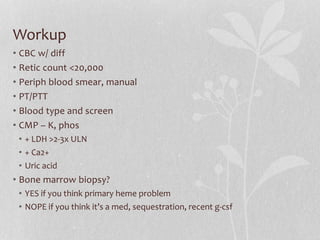
Workup
• CBC w/ diff
• Retic count <20,000
• Periph blood smear, manual
• PT/PTT
• Blood type and screen
• CMP – K, phos
• + LDH >2-3x ULN
• + Ca2+
• Uric acid
• Bone marrow biopsy?
• YES if you think primary heme problem
• NOPE if you think it’s a med, sequestration, recent g-csf
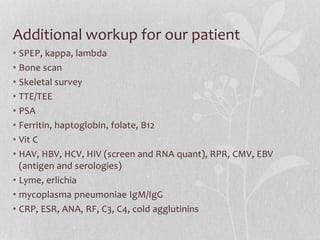
Additional workup for our patient
• SPEP, kappa, lambda
• Bone scan
• Skeletal survey
• TTE/TEE
• PSA
• Ferritin, haptoglobin, folate, B12
• Vit C
• HAV, HBV, HCV, HIV (screen and RNA quant), RPR, CMV, EBV
(antigen and serologies)
• Lyme, erlichia
• mycoplasma pneumoniae IgM/IgG
• CRP, ESR, ANA, RF, C3, C4, cold agglutinins
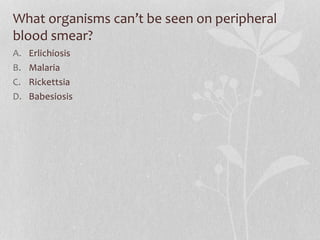
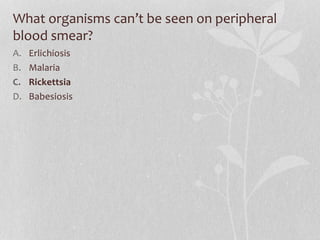
What organisms can’t be seen on peripheral
blood smear?
A. Erlichiosis
B. Malaria
C. Rickettsia
D. Babesiosis
What organisms can’t be seen on peripheral
blood smear?
A. Erlichiosis
B. Malaria
C. Rickettsia
D. Babesiosis
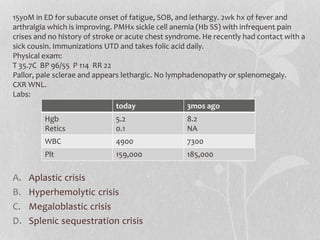
A. Aplastic crisis
B. Hyperhemolytic crisis
C. Megaloblastic crisis
D. Splenic sequestration crisis
15yoM in ED for subacute onset of fatigue, SOB, and lethargy. 2wk hx of fever and
arthralgia which is improving. PMHx sickle cell anemia (Hb SS) with infrequent pain
crises and no history of stroke or acute chest syndrome. He recently had contact with a
sick cousin. Immunizations UTD and takes folic acid daily.
Physical exam:
T 35.7C BP 96/55 P 114 RR 22
Pallor, pale sclerae and appears lethargic. No lymphadenopathy or splenomegaly.
CXR WNL.
Labs:
today 3mos ago
Hgb
Retics
5.2
0.1
8.2
NA
WBC 4900 7300
Plt 159,000 185,000
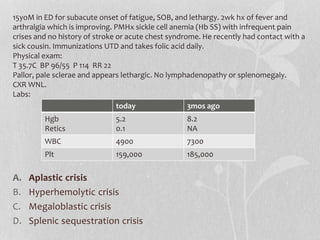
A. Aplastic crisis
B. Hyperhemolytic crisis
C. Megaloblastic crisis
D. Splenic sequestration crisis
15yoM in ED for subacute onset of fatigue, SOB, and lethargy. 2wk hx of fever and
arthralgia which is improving. PMHx sickle cell anemia (Hb SS) with infrequent pain
crises and no history of stroke or acute chest syndrome. He recently had contact with a
sick cousin. Immunizations UTD and takes folic acid daily.
Physical exam:
T 35.7C BP 96/55 P 114 RR 22
Pallor, pale sclerae and appears lethargic. No lymphadenopathy or splenomegaly.
CXR WNL.
Labs:
today 3mos ago
Hgb
Retics
5.2
0.1
8.2
NA
WBC 4900 7300
Plt 159,000 185,000
Sources
• UTD
• MKSAP

Pancytopenia

  • 1.
  • 2.
    Agenda • Pathogenesis algorithm •Basic workup • Additional tests our patient got done • Qs
  • 3.
    Congenital  Wiskott-Aldrich,Fanconi anemia, etc., etc.,…gross Acquired Bone marrow infiltration/ replacement Bone marrow failure Destruction/ sequestration/ redistribution Malig Consumption Non-malig Splenomegaly Immune destruction/ suppression Nutritional Viral marrow suppression Ineffective hematopoiesis Eg myelofibrosis, TB Eg meds, SLE, aplastic anemia Eg EtOH, copper, zinc Eg HIV, HCV, EBV Eg MDS Eg cirrhosis, EBV
  • 4.
    Workup • CBC w/diff • Retic count <20,000 • Periph blood smear, manual • PT/PTT • Blood type and screen • CMP – K, phos • + LDH >2-3x ULN • + Ca2+ • Uric acid • Bone marrow biopsy? • YES if you think primary heme problem • NOPE if you think it’s a med, sequestration, recent g-csf
  • 5.
    Additional workup forour patient • SPEP, kappa, lambda • Bone scan • Skeletal survey • TTE/TEE • PSA • Ferritin, haptoglobin, folate, B12 • Vit C • HAV, HBV, HCV, HIV (screen and RNA quant), RPR, CMV, EBV (antigen and serologies) • Lyme, erlichia • mycoplasma pneumoniae IgM/IgG • CRP, ESR, ANA, RF, C3, C4, cold agglutinins
  • 6.
    What organisms can’tbe seen on peripheral blood smear? A. Erlichiosis B. Malaria C. Rickettsia D. Babesiosis
  • 7.
    What organisms can’tbe seen on peripheral blood smear? A. Erlichiosis B. Malaria C. Rickettsia D. Babesiosis
  • 8.
    A. Aplastic crisis B.Hyperhemolytic crisis C. Megaloblastic crisis D. Splenic sequestration crisis 15yoM in ED for subacute onset of fatigue, SOB, and lethargy. 2wk hx of fever and arthralgia which is improving. PMHx sickle cell anemia (Hb SS) with infrequent pain crises and no history of stroke or acute chest syndrome. He recently had contact with a sick cousin. Immunizations UTD and takes folic acid daily. Physical exam: T 35.7C BP 96/55 P 114 RR 22 Pallor, pale sclerae and appears lethargic. No lymphadenopathy or splenomegaly. CXR WNL. Labs: today 3mos ago Hgb Retics 5.2 0.1 8.2 NA WBC 4900 7300 Plt 159,000 185,000
  • 9.
    A. Aplastic crisis B.Hyperhemolytic crisis C. Megaloblastic crisis D. Splenic sequestration crisis 15yoM in ED for subacute onset of fatigue, SOB, and lethargy. 2wk hx of fever and arthralgia which is improving. PMHx sickle cell anemia (Hb SS) with infrequent pain crises and no history of stroke or acute chest syndrome. He recently had contact with a sick cousin. Immunizations UTD and takes folic acid daily. Physical exam: T 35.7C BP 96/55 P 114 RR 22 Pallor, pale sclerae and appears lethargic. No lymphadenopathy or splenomegaly. CXR WNL. Labs: today 3mos ago Hgb Retics 5.2 0.1 8.2 NA WBC 4900 7300 Plt 159,000 185,000
  • 10.