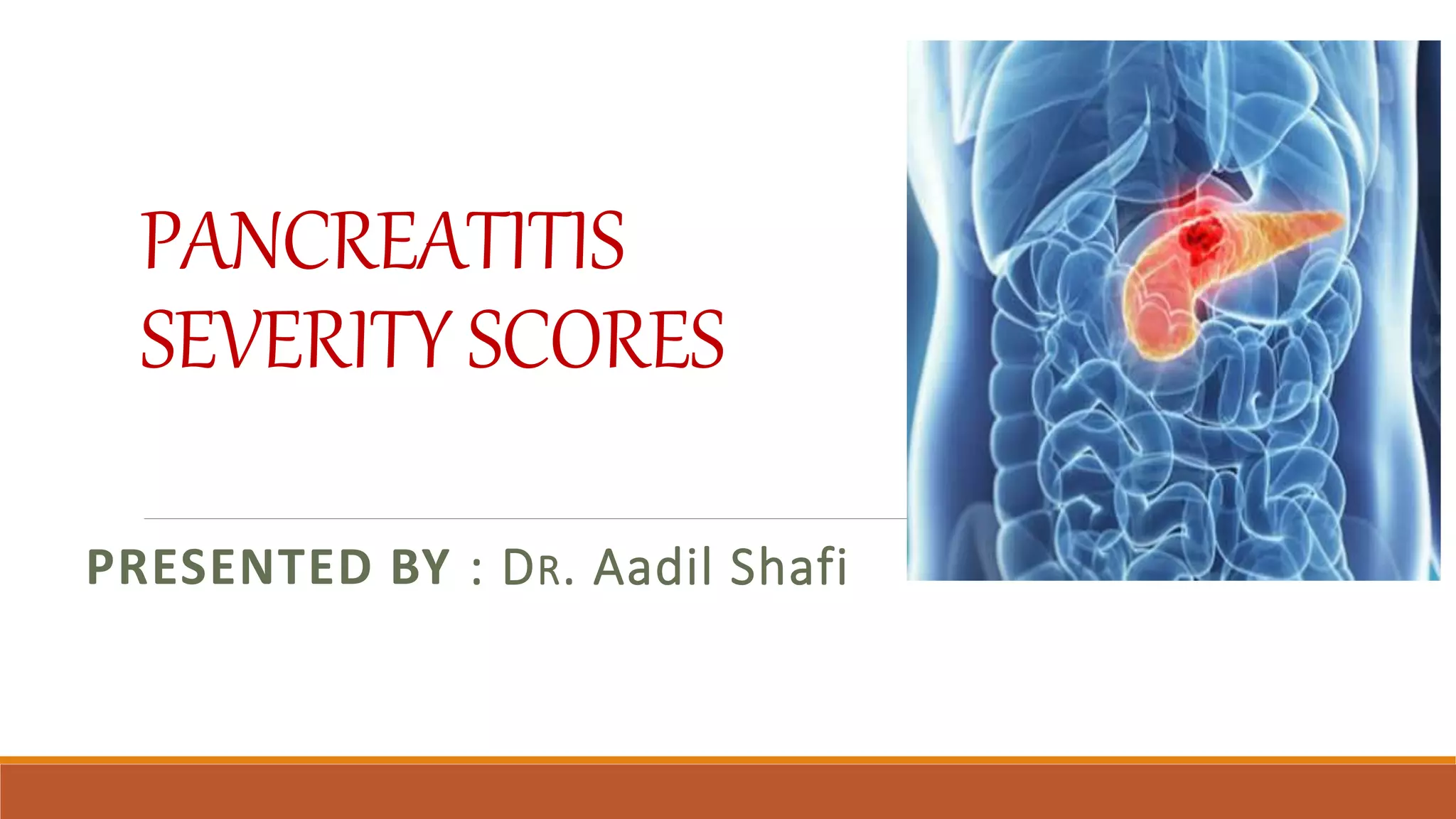
PANCREATITIS
SEVERITY SCORES
PRESENTED BY : DR. Aadil Shafi
Definition of severity of acute
pancreatitis according to
different classification systems
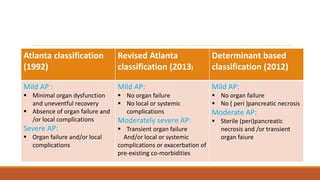
Atlanta classification
(1992)
Revised Atlanta
classification (2013)
Determinant based
classification (2012)
Mild AP :
 Minimal organ dysfunction
and uneventful recovery
 Absence of organ failure and
/or local complications
Severe AP:
 Organ failure and/or local
complications
Mild AP:
 No organ failure
 No local or systemic
complications
Moderately severe AP:
 Transient organ failure
And/or local or systemic
complications or exacerbation of
pre-existing co-morbidities
Mild AP:
 No organ failure
 No ( peri )pancreatic necrosis
Moderate AP:
 Sterile (peri)pancreatic
necrosis and /or transient
organ faiure
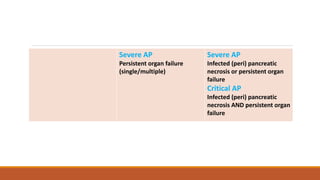
Severe AP
Persistent organ failure
(single/multiple)
Severe AP
Infected (peri) pancreatic
necrosis or persistent organ
failure
Critical AP
Infected (peri) pancreatic
necrosis AND persistent organ
failure
Severity stratification of acute
pancreatitis
WHY A SEVERITY STRATIFICATION IS NEEDED
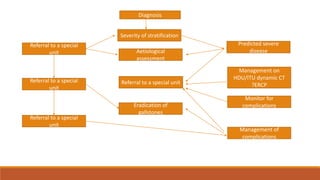
Diagnosis
Severity of stratification
Aetiological
assessment
Management on
HDU/ITU dynamic CT
?ERCP
Eradication of
gallstones
Referral to a special
unit
Referral to a special
unit
Referral to a special
unit
Predicted severe
disease
Referral to a special unit
Monitor for
complications
Management of
complications
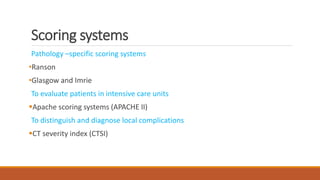
Scoring systems
Pathology –specific scoring systems
•Ranson
•Glasgow and Imrie
To evaluate patients in intensive care units
Apache scoring systems (APACHE II)
To distinguish and diagnose local complications
CT severity index (CTSI)
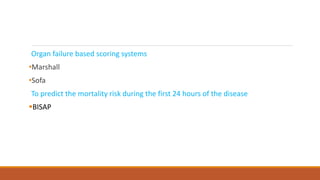
Organ failure based scoring systems
•Marshall
•Sofa
To predict the mortality risk during the first 24 hours of the disease
BISAP
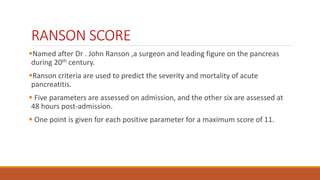
RANSON SCORE
Named after Dr . John Ranson ,a surgeon and leading figure on the pancreas
during 20th century.
Ranson criteria are used to predict the severity and mortality of acute
pancreatitis.
 Five parameters are assessed on admission, and the other six are assessed at
48 hours post-admission.
 One point is given for each positive parameter for a maximum score of 11.
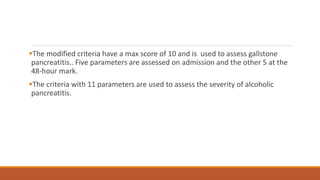
The modified criteria have a max score of 10 and is used to assess gallstone
pancreatitis.. Five parameters are assessed on admission and the other 5 at the
48-hour mark.
The criteria with 11 parameters are used to assess the severity of alcoholic
pancreatitis.
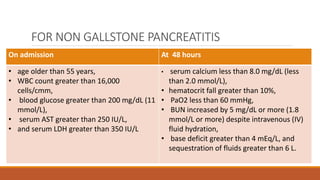
FOR NON GALLSTONE PANCREATITIS
On admission At 48 hours
• age older than 55 years,
• WBC count greater than 16,000
cells/cmm,
• blood glucose greater than 200 mg/dL (11
mmol/L),
• serum AST greater than 250 IU/L,
• and serum LDH greater than 350 IU/L
• serum calcium less than 8.0 mg/dL (less
than 2.0 mmol/L),
• hematocrit fall greater than 10%,
• PaO2 less than 60 mmHg,
• BUN increased by 5 mg/dL or more (1.8
mmol/L or more) despite intravenous (IV)
fluid hydration,
• base deficit greater than 4 mEq/L, and
sequestration of fluids greater than 6 L.
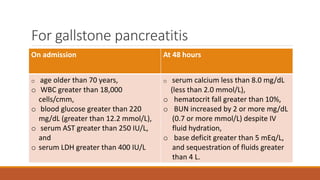
For gallstone pancreatitis
On admission At 48 hours
o age older than 70 years,
o WBC greater than 18,000
cells/cmm,
o blood glucose greater than 220
mg/dL (greater than 12.2 mmol/L),
o serum AST greater than 250 IU/L,
and
o serum LDH greater than 400 IU/L
o serum calcium less than 8.0 mg/dL
(less than 2.0 mmol/L),
o hematocrit fall greater than 10%,
o BUN increased by 2 or more mg/dL
(0.7 or more mmol/L) despite IV
fluid hydration,
o base deficit greater than 5 mEq/L,
and sequestration of fluids greater
than 4 L.
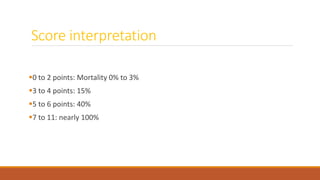
Score interpretation
0 to 2 points: Mortality 0% to 3%
3 to 4 points: 15%
5 to 6 points: 40%
7 to 11: nearly 100%
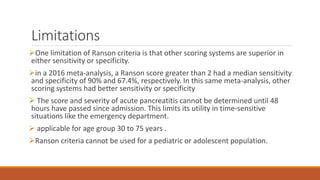
Limitations
One limitation of Ranson criteria is that other scoring systems are superior in
either sensitivity or specificity.
in a 2016 meta-analysis, a Ranson score greater than 2 had a median sensitivity
and specificity of 90% and 67.4%, respectively. In this same meta-analysis, other
scoring systems had better sensitivity or specificity
 The score and severity of acute pancreatitis cannot be determined until 48
hours have passed since admission. This limits its utility in time-sensitive
situations like the emergency department.
 applicable for age group 30 to 75 years .
Ranson criteria cannot be used for a pediatric or adolescent population.
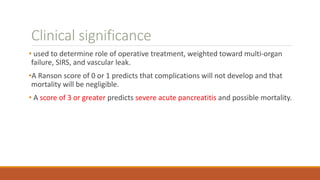
Clinical significance
• used to determine role of operative treatment, weighted toward multi-organ
failure, SIRS, and vascular leak.
•A Ranson score of 0 or 1 predicts that complications will not develop and that
mortality will be negligible.
• A score of 3 or greater predicts severe acute pancreatitis and possible mortality.
Modified Glasgow Imrie Severity
Criteria for Acute Pancreatitis
Predict outcome in acute
pancreatitis
The Glasgow Imrie score is a modification of the Ranson's criteria for acute
pancreatitis.
 It was originally composed of 9 factors however this was subsequently reduced
to 8 components due to a superior predictive value.
 Three or more positive criteria, on the basis of bloods taken on admission and
repeated within 48 hours, is indicative of severe pancreatitis and may require
transfer to a higher acuity unit.
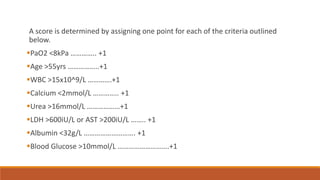
A score is determined by assigning one point for each of the criteria outlined
below.
PaO2 <8kPa ………….. +1
Age >55yrs ……………..+1
WBC >15x10^9/L ………….+1
Calcium <2mmol/L ………….. +1
Urea >16mmol/L ………………+1
LDH >600iU/L or AST >200iU/L …….. +1
Albumin <32g/L ………………………. +1
Blood Glucose >10mmol/L ……………………….+1
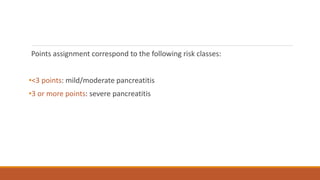
Points assignment correspond to the following risk classes:
•<3 points: mild/moderate pancreatitis
•3 or more points: severe pancreatitis
APACHE (Acute Physiology
and Chronic Health
Evaluation) II score
The APACHE II score was initially devised as a prognostic scoring system in
critically ill patients requiring ICU care.
 It provides an immediate physiologic assessment of individual patients, in
conjunction with their age and comorbidity.
The major advantage of the APACHE II scoring system, as compared to the
other systems, is that it can be used in monitoring the patient’s response to
therapy while the Ranson and the Glasgow scales are mainly meant for the
assessment at presentation.
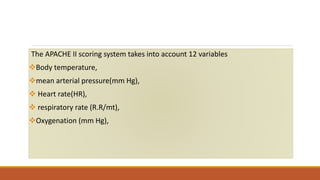
The APACHE II scoring system takes into account 12 variables
Body temperature,
mean arterial pressure(mm Hg),
 Heart rate(HR),
 respiratory rate (R.R/mt),
Oxygenation (mm Hg),
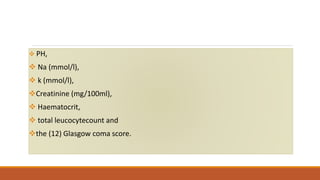
 PH,
 Na (mmol/l),
 k (mmol/l),
Creatinine (mg/100ml),
 Haematocrit,
 total leucocytecount and
the (12) Glasgow coma score.
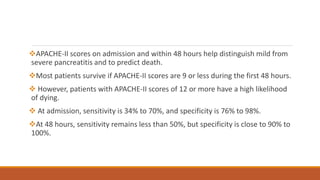
APACHE-II scores on admission and within 48 hours help distinguish mild from
severe pancreatitis and to predict death.
Most patients survive if APACHE-II scores are 9 or less during the first 48 hours.
 However, patients with APACHE-II scores of 12 or more have a high likelihood
of dying.
 At admission, sensitivity is 34% to 70%, and specificity is 76% to 98%.
At 48 hours, sensitivity remains less than 50%, but specificity is close to 90% to
100%.
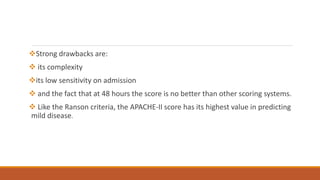
Strong drawbacks are:
 its complexity
its low sensitivity on admission
 and the fact that at 48 hours the score is no better than other scoring systems.
 Like the Ranson criteria, the APACHE-II score has its highest value in predicting
mild disease.
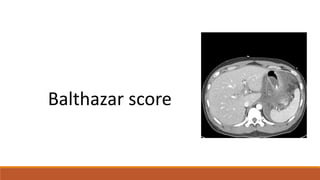
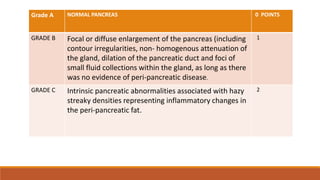
Balthazar score
Grade A NORMAL PANCREAS 0 POINTS
GRADE B Focal or diffuse enlargement of the pancreas (including
contour irregularities, non- homogenous attenuation of
the gland, dilation of the pancreatic duct and foci of
small fluid collections within the gland, as long as there
was no evidence of peri-pancreatic disease.
1
GRADE C Intrinsic pancreatic abnormalities associated with hazy
streaky densities representing inflammatory changes in
the peri-pancreatic fat.
2
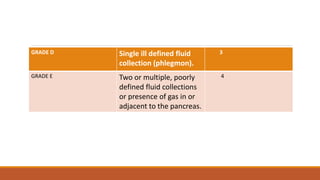
GRADE D Single ill defined fluid
collection (phlegmon).
3
GRADE E Two or multiple, poorly
defined fluid collections
or presence of gas in or
adjacent to the pancreas.
4
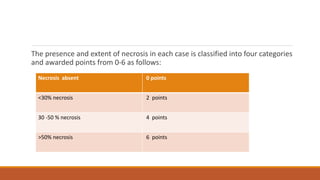
The presence and extent of necrosis in each case is classified into four categories
and awarded points from 0-6 as follows:
Necrosis absent 0 points
<30% necrosis 2 points
30 -50 % necrosis 4 points
>50% necrosis 6 points
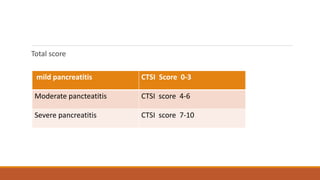
Total score
mild pancreatitis CTSI Score 0-3
Moderate pancteatitis CTSI score 4-6
Severe pancreatitis CTSI score 7-10
The Bedside Index for Severity in Acute
Pancreatitis
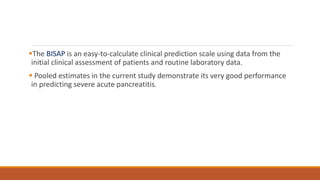
The BISAP is an easy-to-calculate clinical prediction scale using data from the
initial clinical assessment of patients and routine laboratory data.
 Pooled estimates in the current study demonstrate its very good performance
in predicting severe acute pancreatitis.
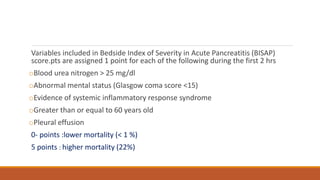
Variables included in Bedside Index of Severity in Acute Pancreatitis (BISAP)
score.pts are assigned 1 point for each of the following during the first 2 hrs
oBlood urea nitrogen > 25 mg/dl
oAbnormal mental status (Glasgow coma score <15)
oEvidence of systemic inflammatory response syndrome
oGreater than or equal to 60 years old
oPleural effusion
0- points :lower mortality (< 1 %)
5 points : higher mortality (22%)
Limitations
It has not been validated for predicting outcomes such as length of hospital
stay ,need for icu care ,or need for intervention
Harmless acute
pancreatitis score
Harmless acute pancreatitis score
It can typically be calculated within 30 min of admission and takes into account
three parameters :
Lack of rebound tenderness or guarding
Normal hematocrit
Normal serum creatinine
If none other three parameters are present …………………..pts.are likely to have a
harmless course.
Thank you

Pancreatitis severity score.pptx

  • 1.
  • 2.
    Definition of severityof acute pancreatitis according to different classification systems
  • 3.
    Atlanta classification (1992) Revised Atlanta classification(2013) Determinant based classification (2012) Mild AP :  Minimal organ dysfunction and uneventful recovery  Absence of organ failure and /or local complications Severe AP:  Organ failure and/or local complications Mild AP:  No organ failure  No local or systemic complications Moderately severe AP:  Transient organ failure And/or local or systemic complications or exacerbation of pre-existing co-morbidities Mild AP:  No organ failure  No ( peri )pancreatic necrosis Moderate AP:  Sterile (peri)pancreatic necrosis and /or transient organ faiure
  • 4.
    Severe AP Persistent organfailure (single/multiple) Severe AP Infected (peri) pancreatic necrosis or persistent organ failure Critical AP Infected (peri) pancreatic necrosis AND persistent organ failure
  • 5.
    Severity stratification ofacute pancreatitis WHY A SEVERITY STRATIFICATION IS NEEDED
  • 6.
    Diagnosis Severity of stratification Aetiological assessment Managementon HDU/ITU dynamic CT ?ERCP Eradication of gallstones Referral to a special unit Referral to a special unit Referral to a special unit Predicted severe disease Referral to a special unit Monitor for complications Management of complications
  • 7.
    Scoring systems Pathology –specificscoring systems •Ranson •Glasgow and Imrie To evaluate patients in intensive care units Apache scoring systems (APACHE II) To distinguish and diagnose local complications CT severity index (CTSI)
  • 8.
    Organ failure basedscoring systems •Marshall •Sofa To predict the mortality risk during the first 24 hours of the disease BISAP
  • 9.
    RANSON SCORE Named afterDr . John Ranson ,a surgeon and leading figure on the pancreas during 20th century. Ranson criteria are used to predict the severity and mortality of acute pancreatitis.  Five parameters are assessed on admission, and the other six are assessed at 48 hours post-admission.  One point is given for each positive parameter for a maximum score of 11.
  • 10.
    The modified criteriahave a max score of 10 and is used to assess gallstone pancreatitis.. Five parameters are assessed on admission and the other 5 at the 48-hour mark. The criteria with 11 parameters are used to assess the severity of alcoholic pancreatitis.
  • 11.
    FOR NON GALLSTONEPANCREATITIS On admission At 48 hours • age older than 55 years, • WBC count greater than 16,000 cells/cmm, • blood glucose greater than 200 mg/dL (11 mmol/L), • serum AST greater than 250 IU/L, • and serum LDH greater than 350 IU/L • serum calcium less than 8.0 mg/dL (less than 2.0 mmol/L), • hematocrit fall greater than 10%, • PaO2 less than 60 mmHg, • BUN increased by 5 mg/dL or more (1.8 mmol/L or more) despite intravenous (IV) fluid hydration, • base deficit greater than 4 mEq/L, and sequestration of fluids greater than 6 L.
  • 12.
    For gallstone pancreatitis Onadmission At 48 hours o age older than 70 years, o WBC greater than 18,000 cells/cmm, o blood glucose greater than 220 mg/dL (greater than 12.2 mmol/L), o serum AST greater than 250 IU/L, and o serum LDH greater than 400 IU/L o serum calcium less than 8.0 mg/dL (less than 2.0 mmol/L), o hematocrit fall greater than 10%, o BUN increased by 2 or more mg/dL (0.7 or more mmol/L) despite IV fluid hydration, o base deficit greater than 5 mEq/L, and sequestration of fluids greater than 4 L.
  • 13.
    Score interpretation 0 to2 points: Mortality 0% to 3% 3 to 4 points: 15% 5 to 6 points: 40% 7 to 11: nearly 100%
  • 14.
    Limitations One limitation ofRanson criteria is that other scoring systems are superior in either sensitivity or specificity. in a 2016 meta-analysis, a Ranson score greater than 2 had a median sensitivity and specificity of 90% and 67.4%, respectively. In this same meta-analysis, other scoring systems had better sensitivity or specificity  The score and severity of acute pancreatitis cannot be determined until 48 hours have passed since admission. This limits its utility in time-sensitive situations like the emergency department.  applicable for age group 30 to 75 years . Ranson criteria cannot be used for a pediatric or adolescent population.
  • 15.
    Clinical significance • usedto determine role of operative treatment, weighted toward multi-organ failure, SIRS, and vascular leak. •A Ranson score of 0 or 1 predicts that complications will not develop and that mortality will be negligible. • A score of 3 or greater predicts severe acute pancreatitis and possible mortality.
  • 16.
    Modified Glasgow ImrieSeverity Criteria for Acute Pancreatitis Predict outcome in acute pancreatitis
  • 17.
    The Glasgow Imriescore is a modification of the Ranson's criteria for acute pancreatitis.  It was originally composed of 9 factors however this was subsequently reduced to 8 components due to a superior predictive value.  Three or more positive criteria, on the basis of bloods taken on admission and repeated within 48 hours, is indicative of severe pancreatitis and may require transfer to a higher acuity unit.
  • 18.
    A score isdetermined by assigning one point for each of the criteria outlined below. PaO2 <8kPa ………….. +1 Age >55yrs ……………..+1 WBC >15x10^9/L ………….+1 Calcium <2mmol/L ………….. +1 Urea >16mmol/L ………………+1 LDH >600iU/L or AST >200iU/L …….. +1 Albumin <32g/L ………………………. +1 Blood Glucose >10mmol/L ……………………….+1
  • 19.
    Points assignment correspondto the following risk classes: •<3 points: mild/moderate pancreatitis •3 or more points: severe pancreatitis
  • 20.
    APACHE (Acute Physiology andChronic Health Evaluation) II score
  • 21.
    The APACHE IIscore was initially devised as a prognostic scoring system in critically ill patients requiring ICU care.  It provides an immediate physiologic assessment of individual patients, in conjunction with their age and comorbidity. The major advantage of the APACHE II scoring system, as compared to the other systems, is that it can be used in monitoring the patient’s response to therapy while the Ranson and the Glasgow scales are mainly meant for the assessment at presentation.
  • 22.
    The APACHE IIscoring system takes into account 12 variables Body temperature, mean arterial pressure(mm Hg),  Heart rate(HR),  respiratory rate (R.R/mt), Oxygenation (mm Hg),
  • 23.
     PH,  Na(mmol/l),  k (mmol/l), Creatinine (mg/100ml),  Haematocrit,  total leucocytecount and the (12) Glasgow coma score.
  • 24.
    APACHE-II scores onadmission and within 48 hours help distinguish mild from severe pancreatitis and to predict death. Most patients survive if APACHE-II scores are 9 or less during the first 48 hours.  However, patients with APACHE-II scores of 12 or more have a high likelihood of dying.  At admission, sensitivity is 34% to 70%, and specificity is 76% to 98%. At 48 hours, sensitivity remains less than 50%, but specificity is close to 90% to 100%.
  • 25.
    Strong drawbacks are: its complexity its low sensitivity on admission  and the fact that at 48 hours the score is no better than other scoring systems.  Like the Ranson criteria, the APACHE-II score has its highest value in predicting mild disease.
  • 26.
  • 27.
    Grade A NORMALPANCREAS 0 POINTS GRADE B Focal or diffuse enlargement of the pancreas (including contour irregularities, non- homogenous attenuation of the gland, dilation of the pancreatic duct and foci of small fluid collections within the gland, as long as there was no evidence of peri-pancreatic disease. 1 GRADE C Intrinsic pancreatic abnormalities associated with hazy streaky densities representing inflammatory changes in the peri-pancreatic fat. 2
  • 28.
    GRADE D Singleill defined fluid collection (phlegmon). 3 GRADE E Two or multiple, poorly defined fluid collections or presence of gas in or adjacent to the pancreas. 4
  • 29.
    The presence andextent of necrosis in each case is classified into four categories and awarded points from 0-6 as follows: Necrosis absent 0 points <30% necrosis 2 points 30 -50 % necrosis 4 points >50% necrosis 6 points
  • 30.
    Total score mild pancreatitisCTSI Score 0-3 Moderate pancteatitis CTSI score 4-6 Severe pancreatitis CTSI score 7-10
  • 31.
    The Bedside Indexfor Severity in Acute Pancreatitis
  • 32.
    The BISAP isan easy-to-calculate clinical prediction scale using data from the initial clinical assessment of patients and routine laboratory data.  Pooled estimates in the current study demonstrate its very good performance in predicting severe acute pancreatitis.
  • 33.
    Variables included inBedside Index of Severity in Acute Pancreatitis (BISAP) score.pts are assigned 1 point for each of the following during the first 2 hrs oBlood urea nitrogen > 25 mg/dl oAbnormal mental status (Glasgow coma score <15) oEvidence of systemic inflammatory response syndrome oGreater than or equal to 60 years old oPleural effusion 0- points :lower mortality (< 1 %) 5 points : higher mortality (22%)
  • 34.
    Limitations It has notbeen validated for predicting outcomes such as length of hospital stay ,need for icu care ,or need for intervention
  • 35.
  • 36.
    Harmless acute pancreatitisscore It can typically be calculated within 30 min of admission and takes into account three parameters : Lack of rebound tenderness or guarding Normal hematocrit Normal serum creatinine If none other three parameters are present …………………..pts.are likely to have a harmless course.
  • 37.