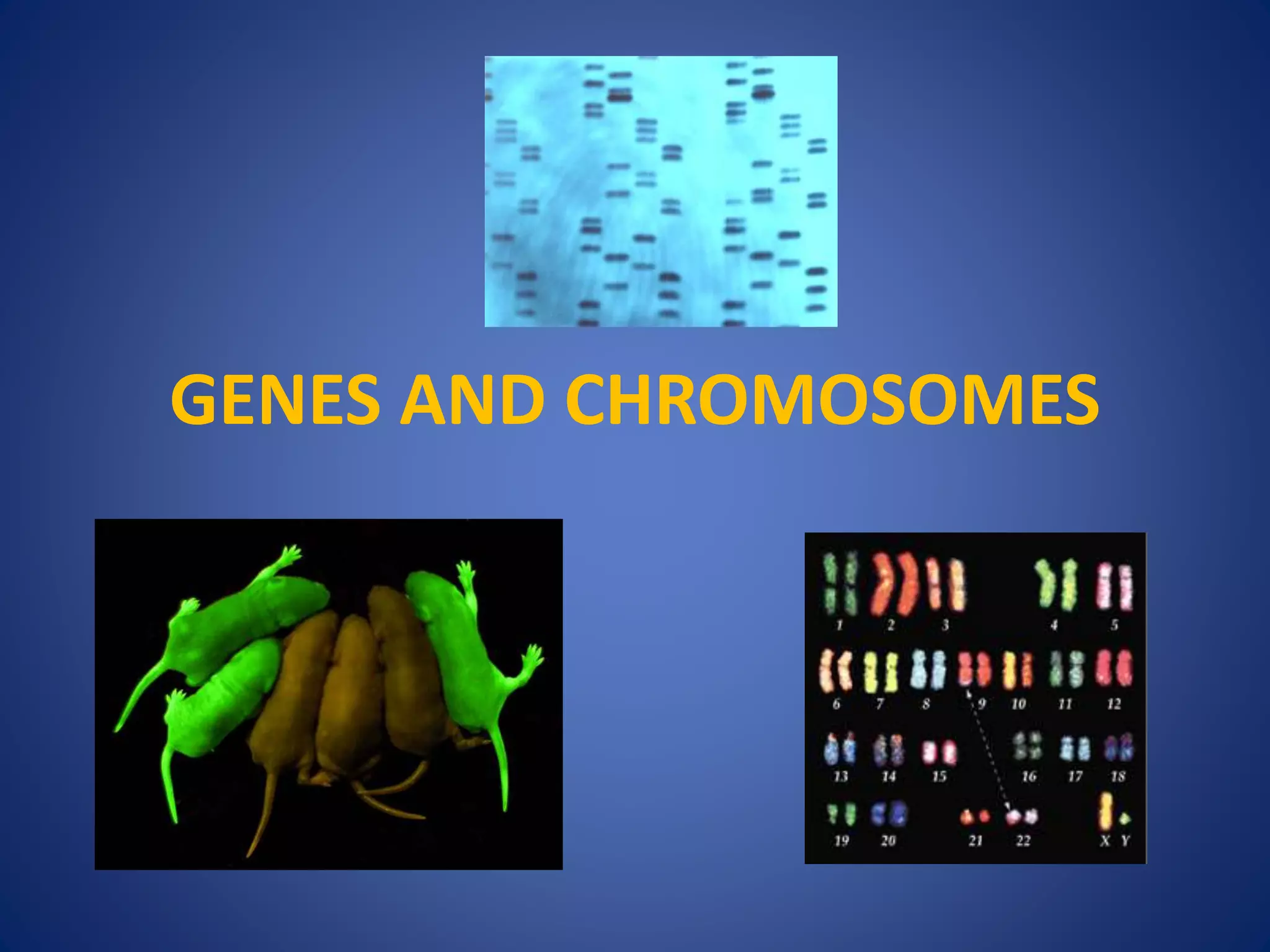
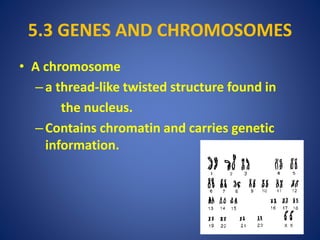
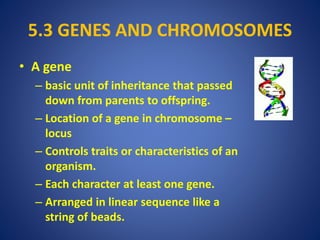
GENES AND CHROMOSOMES
5.3 GENES AND CHROMOSOMES
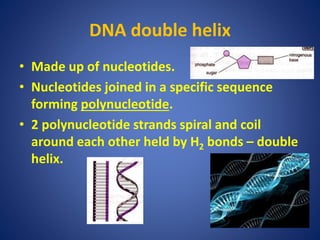
• A chromosome
–a thread-like twisted structure found in
the nucleus.
–Contains chromatin and carries genetic
information.
5.3 GENES AND CHROMOSOMES
• A gene
– basic unit of inheritance that passed
down from parents to offspring.
– Location of a gene in chromosome –
locus
– Controls traits or characteristics of an
organism.
– Each character at least one gene.
– Arranged in linear sequence like a
string of beads.
DNA double helix
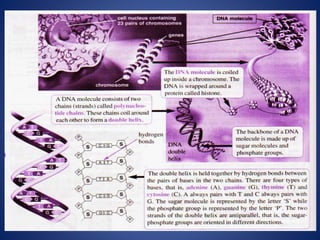
• Made up of nucleotides.
• Nucleotides joined in a specific sequence
forming polynucleotide.
• 2 polynucleotide strands spiral and coil
around each other held by H2 bonds – double
helix.
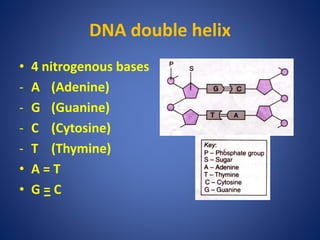
DNA double helix
• 4 nitrogenous bases
- A (Adenine)
- G (Guanine)
- C (Cytosine)
- T (Thymine)
• A = T
• G = C
Exercises
1. Why is chromosome in double helix shape?
2. Name all the nucleotide’s name.
3. How many bonds do G-C bond have.
4. How many bond do A-T bond have.
Still remember???
How a trait of an organism is manifested
from a basic unit of inheritance
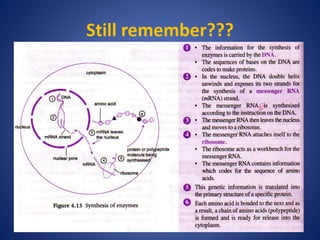
• Determination of characteristics in organisms
is controlled by DNA through – PROTEIN
SYNTHESIS.
• Genetic instruction (genetic code) – carried in
sequence of nitrogenous bases.
– Written in 3 nucleotide words or triplet codes in
DNA.
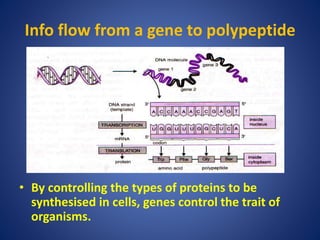
Info flow from a gene to polypeptide
• By controlling the types of proteins to be
synthesised in cells, genes control the trait of
organisms.
Exercises
1. How does the genetic code encoded ?
2. How does the enzyme synthesized?
Application of Knowledge In Genetics
1. Human genome project
2. DNA fingerprinting
3. Stem cell research
4. Genetic engineering
–Gene therapy
–GMO (genetically modified organism)
–GMF (genetically modified food)
1. HUMAN GENOME PROJECT (HGP)
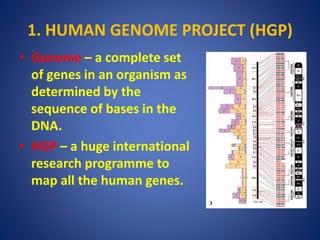
• Genome – a complete set
of genes in an organism as
determined by the
sequence of bases in the
DNA.
• HGP – a huge international
research programme to
map all the human genes.
1. HUMAN GENOME PROJECT (HGP)
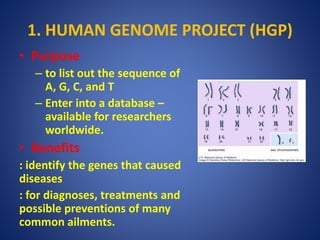
• Purpose
– to list out the sequence of
A, G, C, and T
– Enter into a database –
available for researchers
worldwide.
• Benefits
: identify the genes that caused
diseases
: for diagnoses, treatments and
possible preventions of many
common ailments.
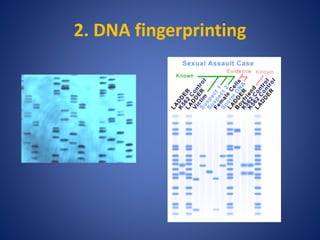
2. DNA fingerprinting
• Before this, thumbprint and fingerprint.
• Now, DNA fingerprint…….
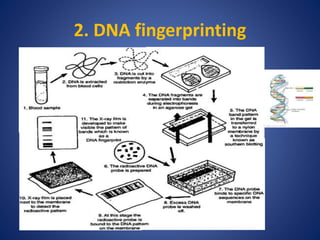
– It is a procedure used to analyse a person’s unique
collection of DNA fragments.
– Each person – unique set of DNA.
– Fragments – found on hair, saliva, blood, semen
– Usage : to screen genetic disorders.
: to track genes responsible for causing
certain diseases.
: test the compatibility of potential organ
donors with patients.
: for police to identify an individual.
2. DNA fingerprinting
Advantages of DNA fingerprinting
1. More accurate than fingerprinting.
2. More useful forensic tool
3. Provide more information – more specific
4. Very small quantities of DNA needed for highly
accurate test.
5. Sample can last longer – DNA sample can up to
25 million years.
6. Sample of mixed DNA can also be used.
7. Much harder to clean up at crime scene than
other evidence.
Disadvantages of DNA fingerprinting
• Poor quality and poorly controlled testing –
leads to ? and shoddy results.
• Even if perfect match – DNA sample from
crime scene still open to question in a
courtroom - maybe innocent people being
convicted to crime that they do not commit.
• Difficult to analyze accurately blood that is
mixed with wrong chemicals or degraded.
3. Stem cell research
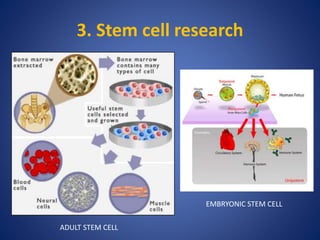
• A stem cell – a basic cell that can divide and develop
into cells with particular functions.
• Undifferentiated cells
• Unspecialized cells
• Remain in the body until they get a signal to
differentiate to the desired cell type.
• 2 types : embryonic stem cells – blastocyst
: adult stem cells – brain tissue, blood
vessels, liver, skeletal muscles.
3. Stem cell research
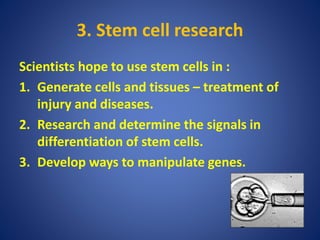
Scientists hope to use stem cells in :
1. Generate cells and tissues – treatment of
injury and diseases.
2. Research and determine the signals in
differentiation of stem cells.
3. Develop ways to manipulate genes.
3. Stem cell research
ADULT STEM CELL
EMBRYONIC STEM CELL
Ethical issues……
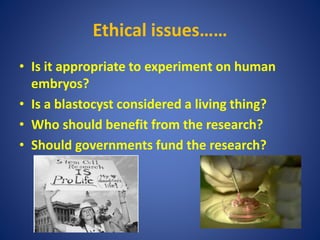
• Is it appropriate to experiment on human
embryos?
• Is a blastocyst considered a living thing?
• Who should benefit from the research?
• Should governments fund the research?
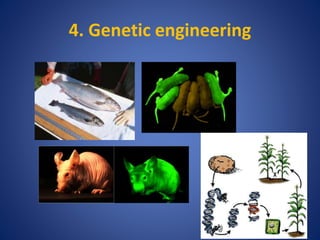
4. Genetic engineering
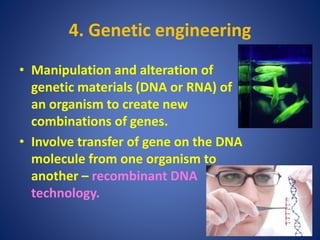
• Manipulation and alteration of
genetic materials (DNA or RNA) of
an organism to create new
combinations of genes.
• Involve transfer of gene on the DNA
molecule from one organism to
another – recombinant DNA
technology.
4. Genetic engineering
• Many applications in medicine and agricultural field:
– Produce viral proteins – generate vaccines against viral
diseases.
– Produces interferon- human protein which stops viruses
from multiplying in the body.
– Produce human growth hormone - treat growth
abnormalities.
– Produce antibodies - fight against infections, cancers,
organ rejections.
– Produce blood clotting factors – treat haemophiliacs.
– Produce enzymes – treat heart attacks and cystic fibrosis.
4. Genetic engineering
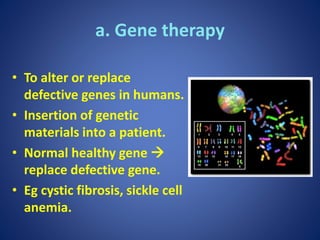
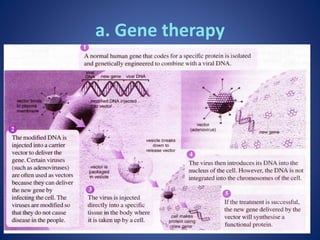
a. Gene therapy
• To alter or replace
defective genes in humans.
• Insertion of genetic
materials into a patient.
• Normal healthy gene 
replace defective gene.
• Eg cystic fibrosis, sickle cell
anemia.
a. Gene therapy
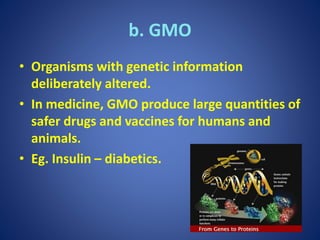
b. GMO
• Organisms with genetic information
deliberately altered.
• In medicine, GMO produce large quantities of
safer drugs and vaccines for humans and
animals.
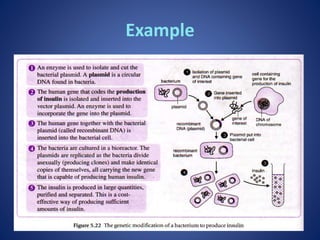
• Eg. Insulin – diabetics.
Example
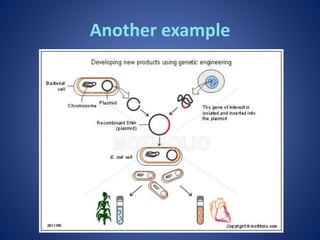
Another example
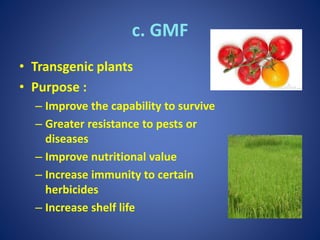
c. GMF
• Transgenic plants
• Purpose :
– Improve the capability to survive
– Greater resistance to pests or
diseases
– Improve nutritional value
– Increase immunity to certain
herbicides
– Increase shelf life
c. GMF
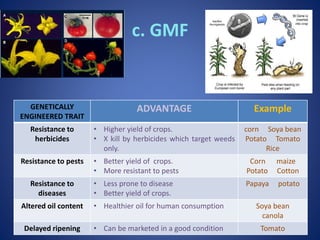
GENETICALLY
ENGINEERED TRAIT
ADVANTAGE Example
Resistance to
herbicides
• Higher yield of crops.
• X kill by herbicides which target weeds
only.
corn Soya bean
Potato Tomato
Rice
Resistance to pests • Better yield of crops.
• More resistant to pests
Corn maize
Potato Cotton
Resistance to
diseases
• Less prone to disease
• Better yield of crops.
Papaya potato
Altered oil content • Healthier oil for human consumption Soya bean
canola
Delayed ripening • Can be marketed in a good condition Tomato
c. GMF
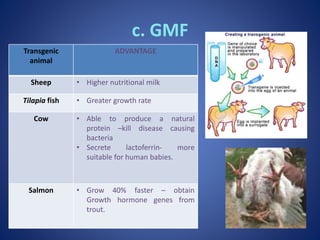
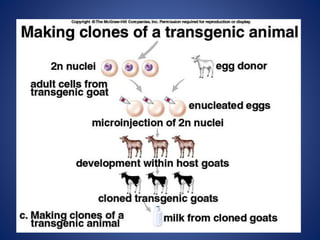
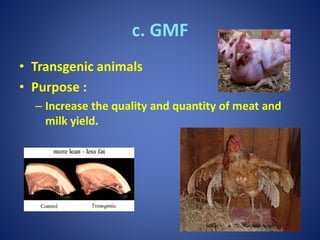
• Transgenic animals
• Purpose :
– Increase the quality and quantity of meat and
milk yield.
c. GMF
Transgenic
animal
ADVANTAGE
Sheep • Higher nutritional milk
Tilapia fish • Greater growth rate
Cow • Able to produce a natural
protein –kill disease causing
bacteria
• Secrete lactoferrin- more
suitable for human babies.
Salmon • Grow 40% faster – obtain
Growth hormone genes from
trout.
Advantage of genetic engineering
1. Enable mass production of crops and
livestock products.
2. Ensures food sources readily available at
cheaper cost.
3. Enable mass production of medical and
pharmaceutical products- treatment disease
4. Genetically engineered bacteria – remove
harmful chemicals eg. Oils spills
Disadvantages of genetic engineering
1. Is it safe? Accidental release of GMO into environment
may alter natural ecology.
2. Lead to ecological disaster- cause original species to
extinct
3. GMO may pass down genes to other similar organisms.
Eg. Experimental bacteria pass traits to natural
bacteria.
4. Disturb natural equilibrium of a habitat – colonise by
transgenic crops
5. Long term effect of consuming GMO – unknown
6. Side effect using vaccines – still uncertain.
Exercises
1. Please list out the advantages and
disadvantages of DNA fingerprinting.
2. State the 3 components that make up a unit
of nucleotide.
3. How can diabetic patients be treated
nowadays?
4. Please list out 3 advantages and
disadvantages of genetic engineering.

2 chapter 5 genes and chromosome

  • 1.
  • 2.
    5.3 GENES ANDCHROMOSOMES • A chromosome –a thread-like twisted structure found in the nucleus. –Contains chromatin and carries genetic information.
  • 3.
    5.3 GENES ANDCHROMOSOMES • A gene – basic unit of inheritance that passed down from parents to offspring. – Location of a gene in chromosome – locus – Controls traits or characteristics of an organism. – Each character at least one gene. – Arranged in linear sequence like a string of beads.
  • 4.
    DNA double helix •Made up of nucleotides. • Nucleotides joined in a specific sequence forming polynucleotide. • 2 polynucleotide strands spiral and coil around each other held by H2 bonds – double helix.
  • 5.
    DNA double helix •4 nitrogenous bases - A (Adenine) - G (Guanine) - C (Cytosine) - T (Thymine) • A = T • G = C
  • 7.
    Exercises 1. Why ischromosome in double helix shape? 2. Name all the nucleotide’s name. 3. How many bonds do G-C bond have. 4. How many bond do A-T bond have.
  • 8.
  • 9.
    How a traitof an organism is manifested from a basic unit of inheritance • Determination of characteristics in organisms is controlled by DNA through – PROTEIN SYNTHESIS. • Genetic instruction (genetic code) – carried in sequence of nitrogenous bases. – Written in 3 nucleotide words or triplet codes in DNA.
  • 10.
    Info flow froma gene to polypeptide • By controlling the types of proteins to be synthesised in cells, genes control the trait of organisms.
  • 11.
    Exercises 1. How doesthe genetic code encoded ? 2. How does the enzyme synthesized?
  • 12.
    Application of KnowledgeIn Genetics 1. Human genome project 2. DNA fingerprinting 3. Stem cell research 4. Genetic engineering –Gene therapy –GMO (genetically modified organism) –GMF (genetically modified food)
  • 13.
    1. HUMAN GENOMEPROJECT (HGP) • Genome – a complete set of genes in an organism as determined by the sequence of bases in the DNA. • HGP – a huge international research programme to map all the human genes.
  • 14.
    1. HUMAN GENOMEPROJECT (HGP) • Purpose – to list out the sequence of A, G, C, and T – Enter into a database – available for researchers worldwide. • Benefits : identify the genes that caused diseases : for diagnoses, treatments and possible preventions of many common ailments.
  • 15.
    2. DNA fingerprinting •Before this, thumbprint and fingerprint. • Now, DNA fingerprint……. – It is a procedure used to analyse a person’s unique collection of DNA fragments. – Each person – unique set of DNA. – Fragments – found on hair, saliva, blood, semen – Usage : to screen genetic disorders. : to track genes responsible for causing certain diseases. : test the compatibility of potential organ donors with patients. : for police to identify an individual.
  • 16.
  • 17.
  • 18.
    Advantages of DNAfingerprinting 1. More accurate than fingerprinting. 2. More useful forensic tool 3. Provide more information – more specific 4. Very small quantities of DNA needed for highly accurate test. 5. Sample can last longer – DNA sample can up to 25 million years. 6. Sample of mixed DNA can also be used. 7. Much harder to clean up at crime scene than other evidence.
  • 19.
    Disadvantages of DNAfingerprinting • Poor quality and poorly controlled testing – leads to ? and shoddy results. • Even if perfect match – DNA sample from crime scene still open to question in a courtroom - maybe innocent people being convicted to crime that they do not commit. • Difficult to analyze accurately blood that is mixed with wrong chemicals or degraded.
  • 20.
    3. Stem cellresearch • A stem cell – a basic cell that can divide and develop into cells with particular functions. • Undifferentiated cells • Unspecialized cells • Remain in the body until they get a signal to differentiate to the desired cell type. • 2 types : embryonic stem cells – blastocyst : adult stem cells – brain tissue, blood vessels, liver, skeletal muscles.
  • 21.
    3. Stem cellresearch Scientists hope to use stem cells in : 1. Generate cells and tissues – treatment of injury and diseases. 2. Research and determine the signals in differentiation of stem cells. 3. Develop ways to manipulate genes.
  • 22.
    3. Stem cellresearch ADULT STEM CELL EMBRYONIC STEM CELL
  • 23.
    Ethical issues…… • Isit appropriate to experiment on human embryos? • Is a blastocyst considered a living thing? • Who should benefit from the research? • Should governments fund the research?
  • 24.
    4. Genetic engineering •Manipulation and alteration of genetic materials (DNA or RNA) of an organism to create new combinations of genes. • Involve transfer of gene on the DNA molecule from one organism to another – recombinant DNA technology.
  • 25.
    4. Genetic engineering •Many applications in medicine and agricultural field: – Produce viral proteins – generate vaccines against viral diseases. – Produces interferon- human protein which stops viruses from multiplying in the body. – Produce human growth hormone - treat growth abnormalities. – Produce antibodies - fight against infections, cancers, organ rejections. – Produce blood clotting factors – treat haemophiliacs. – Produce enzymes – treat heart attacks and cystic fibrosis.
  • 26.
  • 27.
    a. Gene therapy •To alter or replace defective genes in humans. • Insertion of genetic materials into a patient. • Normal healthy gene  replace defective gene. • Eg cystic fibrosis, sickle cell anemia.
  • 28.
  • 29.
    b. GMO • Organismswith genetic information deliberately altered. • In medicine, GMO produce large quantities of safer drugs and vaccines for humans and animals. • Eg. Insulin – diabetics.
  • 30.
  • 31.
  • 32.
    c. GMF • Transgenicplants • Purpose : – Improve the capability to survive – Greater resistance to pests or diseases – Improve nutritional value – Increase immunity to certain herbicides – Increase shelf life
  • 33.
    c. GMF GENETICALLY ENGINEERED TRAIT ADVANTAGEExample Resistance to herbicides • Higher yield of crops. • X kill by herbicides which target weeds only. corn Soya bean Potato Tomato Rice Resistance to pests • Better yield of crops. • More resistant to pests Corn maize Potato Cotton Resistance to diseases • Less prone to disease • Better yield of crops. Papaya potato Altered oil content • Healthier oil for human consumption Soya bean canola Delayed ripening • Can be marketed in a good condition Tomato
  • 34.
    c. GMF • Transgenicanimals • Purpose : – Increase the quality and quantity of meat and milk yield.
  • 35.
    c. GMF Transgenic animal ADVANTAGE Sheep •Higher nutritional milk Tilapia fish • Greater growth rate Cow • Able to produce a natural protein –kill disease causing bacteria • Secrete lactoferrin- more suitable for human babies. Salmon • Grow 40% faster – obtain Growth hormone genes from trout.
  • 37.
    Advantage of geneticengineering 1. Enable mass production of crops and livestock products. 2. Ensures food sources readily available at cheaper cost. 3. Enable mass production of medical and pharmaceutical products- treatment disease 4. Genetically engineered bacteria – remove harmful chemicals eg. Oils spills
  • 38.
    Disadvantages of geneticengineering 1. Is it safe? Accidental release of GMO into environment may alter natural ecology. 2. Lead to ecological disaster- cause original species to extinct 3. GMO may pass down genes to other similar organisms. Eg. Experimental bacteria pass traits to natural bacteria. 4. Disturb natural equilibrium of a habitat – colonise by transgenic crops 5. Long term effect of consuming GMO – unknown 6. Side effect using vaccines – still uncertain.
  • 39.
    Exercises 1. Please listout the advantages and disadvantages of DNA fingerprinting. 2. State the 3 components that make up a unit of nucleotide. 3. How can diabetic patients be treated nowadays? 4. Please list out 3 advantages and disadvantages of genetic engineering.