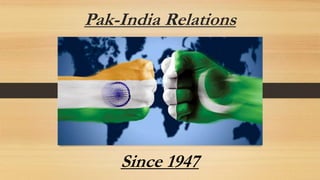
Pak-India Relations
Since 1947
Presented By:
Safdar Ali
Sukkur IBA University
Email: safdar.agriba16@iba-suk.edu.pk
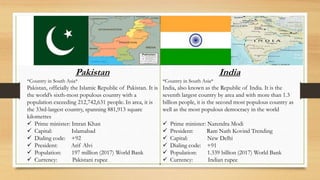
Pakistan
*Country in South Asia*
Pakistan, officially the Islamic Republic of Pakistan. It is
the world’s sixth-most populous country with a
population exceeding 212,742,631 people. In area, it is
the 33rd-largest country, spanning 881,913 square
kilometres
 Prime minister: Imran Khan
 Capital: Islamabad
 Dialing code: +92
 President: Arif Alvi
 Population: 197 million (2017) World Bank
 Currency: Pakistani rupee
India
*Country in South Asia*
India, also known as the Republic of India. It is the
seventh largest country by area and with more than 1.3
billion people, it is the second most populous country as
well as the most populous democracy in the world
 Prime minister: Narendra Modi
 President: Ram Nath Kovind Trending
 Capital: New Delhi
 Dialing code: +91
 Population: 1.339 billion (2017) World Bank
 Currency: Indian rupee
Introduction
Since 1947 Indo-Pak Relations have been under the shadows of suspicions,
misunderstanding, disappointment, tensions and wars
Both states never succeeded to win the mutual trust of each other because of
their unresolved disputes and lack of cooperation between them
But for this purpose, both countries have to overcome their short-sighted plans
and they have to reconsider their policies towards each other
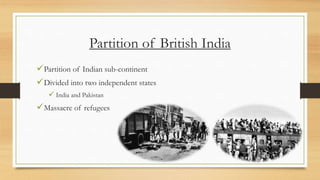
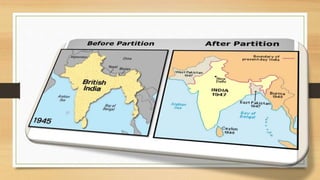
Partition of British India
Partition of Indian sub-continent
Divided into two independent states
 India and Pakistan
Massacre of refugees
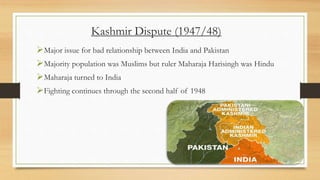
Kashmir Dispute (1947/48)
Major issue for bad relationship between India and Pakistan
Majority population was Muslims but ruler Maharaja Harisingh was Hindu
Maharaja turned to India
Fighting continues through the second half of 1948
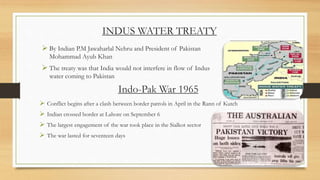
INDUS WATER TREATY
 By Indian P.M Jawaharlal Nehru and President of Pakistan
Mohammad Ayub Khan
 The treaty was that India would not interfere in flow of Indus
water coming to Pakistan
Indo-Pak War 1965
 Conflict begins after a clash between border patrols in April in the Rann of Kutch
 Indian crossed border at Lahore on September 6
 The largest engagement of the war took place in the Sialkot sector
 The war lasted for seventeen days
Tashkent Agreement 1966
Peace agreement between India and Pakistan
Agreeing to withdraw to pre-August lines and that economic and diplomatic
relations would be restored
War of 1971
Third time war over East Pakistan (Bengal)
Pakistani military crackdown on Dhaka
Pak-army surrenders at Dhaka and more than 90,000 become prisoners of war
East Pakistan becomes the independent country as Bangladesh on December 6,
1971
Simla Agreement(1972)
Agree to “put an end to the conflict”
Both sides agree to settle any disputes “by peaceful
means”
Agreement on Nuclear installations
(1988)
Neither side will attack the other's nuclear installations
Both sides agree to share information of nuclear installations
This agreement is later ratified and the both countries share information on
January 1 each year since then
1999- KARGIL WAR
In the winter of early 1999
Pakistan Army reoccupied the forward positions and strategic peaks of
Kargil, Drass and Batalik
Conflict was the infiltration of Pakistani soldiers and Kashmiri militants into
positions on the Indian side of the LOC
Pakistani soldiers climbed up the snow-bound passes and occupied some
high positions
Consequences of the war
Fall of government of Pakistan
Pervaz Musharaf came in government
Pakistan economy weakened by war
Jehadi were not happy with Pakistan
Rising tension between political parties and army of Pakistan
High casualty
The threat of international isolation against Pakistan.
Continue…
Conclusion:-
Pakistan failed to get support of international community during Kargil war
and had to withdraw.
Agra summit collapses, Indian parliament
attacked (2001)
38 people killed in an attack on the Kashmiri assembly in Srinagar
In July, Pakistani President Pervez Musharraf and Indian Prime Minister Atal
Behari Vajpayee met
On December 13, an armed attack on the Indian parliament in New Delhi
leaves 14 people dead. India blames Lashkar-e-Taiba and Jaish-e-Muhammad
for the attacks
India redeploys 5000 troops from Kashmir,
high level talk held (2006)
India redeploys 5,000 troops from Jammu and Kashmir, citing an
"improvement" in the situation there
The both countries are unable to reach an agreement on withdrawing forces
from the Siachin glacier
In September, President Musharraf and Prime Minister Singh agree to put
into place an Indo-Pak institutional anti-terrorism mechanism
2007
On February 18, the train service between India and Pakistan (the Samjhauta
Express) is bombed near Panipat
2008
In September, Pakistani President Asif Ali Zardari and Indian Prime Minister
Singh formally announce the opening of several trade routes between the
both countries
2014
On May 25, Pakistan releases 151 Indian fishermen
On May 27, Indian Prime Minister Narendra Modi holds talks with Pakistan's
Prime Minister Nawaz Sharif in New Delhi
India–Pakistan standoff
2019
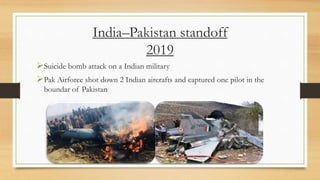
Suicide bomb attack on a Indian military
Pak Airforce shot down 2 Indian aircrafts and captured one pilot in the
boundar of Pakistan
Thanks

Pak indo relations

  • 1.
  • 2.
    Presented By: Safdar Ali SukkurIBA University Email: safdar.agriba16@iba-suk.edu.pk
  • 3.
    Pakistan *Country in SouthAsia* Pakistan, officially the Islamic Republic of Pakistan. It is the world’s sixth-most populous country with a population exceeding 212,742,631 people. In area, it is the 33rd-largest country, spanning 881,913 square kilometres  Prime minister: Imran Khan  Capital: Islamabad  Dialing code: +92  President: Arif Alvi  Population: 197 million (2017) World Bank  Currency: Pakistani rupee India *Country in South Asia* India, also known as the Republic of India. It is the seventh largest country by area and with more than 1.3 billion people, it is the second most populous country as well as the most populous democracy in the world  Prime minister: Narendra Modi  President: Ram Nath Kovind Trending  Capital: New Delhi  Dialing code: +91  Population: 1.339 billion (2017) World Bank  Currency: Indian rupee
  • 4.
    Introduction Since 1947 Indo-PakRelations have been under the shadows of suspicions, misunderstanding, disappointment, tensions and wars Both states never succeeded to win the mutual trust of each other because of their unresolved disputes and lack of cooperation between them But for this purpose, both countries have to overcome their short-sighted plans and they have to reconsider their policies towards each other
  • 5.
    Partition of BritishIndia Partition of Indian sub-continent Divided into two independent states  India and Pakistan Massacre of refugees
  • 7.
    Kashmir Dispute (1947/48) Majorissue for bad relationship between India and Pakistan Majority population was Muslims but ruler Maharaja Harisingh was Hindu Maharaja turned to India Fighting continues through the second half of 1948
  • 8.
    INDUS WATER TREATY By Indian P.M Jawaharlal Nehru and President of Pakistan Mohammad Ayub Khan  The treaty was that India would not interfere in flow of Indus water coming to Pakistan Indo-Pak War 1965  Conflict begins after a clash between border patrols in April in the Rann of Kutch  Indian crossed border at Lahore on September 6  The largest engagement of the war took place in the Sialkot sector  The war lasted for seventeen days
  • 9.
    Tashkent Agreement 1966 Peaceagreement between India and Pakistan Agreeing to withdraw to pre-August lines and that economic and diplomatic relations would be restored War of 1971 Third time war over East Pakistan (Bengal) Pakistani military crackdown on Dhaka Pak-army surrenders at Dhaka and more than 90,000 become prisoners of war East Pakistan becomes the independent country as Bangladesh on December 6, 1971
  • 10.
    Simla Agreement(1972) Agree to“put an end to the conflict” Both sides agree to settle any disputes “by peaceful means” Agreement on Nuclear installations (1988) Neither side will attack the other's nuclear installations Both sides agree to share information of nuclear installations This agreement is later ratified and the both countries share information on January 1 each year since then
  • 11.
    1999- KARGIL WAR Inthe winter of early 1999 Pakistan Army reoccupied the forward positions and strategic peaks of Kargil, Drass and Batalik Conflict was the infiltration of Pakistani soldiers and Kashmiri militants into positions on the Indian side of the LOC Pakistani soldiers climbed up the snow-bound passes and occupied some high positions
  • 12.
    Consequences of thewar Fall of government of Pakistan Pervaz Musharaf came in government Pakistan economy weakened by war Jehadi were not happy with Pakistan Rising tension between political parties and army of Pakistan High casualty The threat of international isolation against Pakistan. Continue…
  • 13.
    Conclusion:- Pakistan failed toget support of international community during Kargil war and had to withdraw.
  • 15.
    Agra summit collapses,Indian parliament attacked (2001) 38 people killed in an attack on the Kashmiri assembly in Srinagar In July, Pakistani President Pervez Musharraf and Indian Prime Minister Atal Behari Vajpayee met On December 13, an armed attack on the Indian parliament in New Delhi leaves 14 people dead. India blames Lashkar-e-Taiba and Jaish-e-Muhammad for the attacks
  • 16.
    India redeploys 5000troops from Kashmir, high level talk held (2006) India redeploys 5,000 troops from Jammu and Kashmir, citing an "improvement" in the situation there The both countries are unable to reach an agreement on withdrawing forces from the Siachin glacier In September, President Musharraf and Prime Minister Singh agree to put into place an Indo-Pak institutional anti-terrorism mechanism
  • 17.
    2007 On February 18,the train service between India and Pakistan (the Samjhauta Express) is bombed near Panipat 2008 In September, Pakistani President Asif Ali Zardari and Indian Prime Minister Singh formally announce the opening of several trade routes between the both countries
  • 18.
    2014 On May 25,Pakistan releases 151 Indian fishermen On May 27, Indian Prime Minister Narendra Modi holds talks with Pakistan's Prime Minister Nawaz Sharif in New Delhi
  • 19.
    India–Pakistan standoff 2019 Suicide bombattack on a Indian military Pak Airforce shot down 2 Indian aircrafts and captured one pilot in the boundar of Pakistan
  • 20.