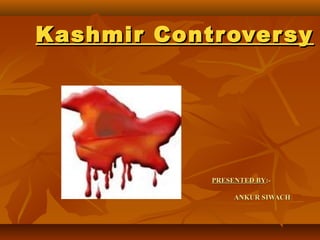
Kashmir Contr over sy

PRESENTED BY:ANKUR SIWACH
OVERVIEW
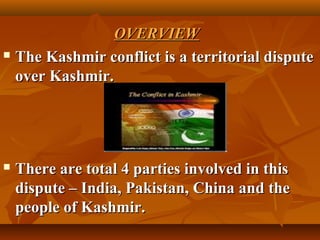
 The Kashmir conflict is a territorial dispute
over Kashmir.



There are total 4 parties involved in this
dispute – India, Pakistan, China and the
people of Kashmir.
Partition and dispute


Before Independence from British in 1947 from
1820, Kashmir was ruled by the Maharaja of
Kashmir who was Hindu although the majority of
the population were Muslim, except the Jammu
region.



The partition was made on religious lines resulting
in to the formation of two separate countries –
India and Pakistan. Pakistan insisted that Kashmir
should be given to it.


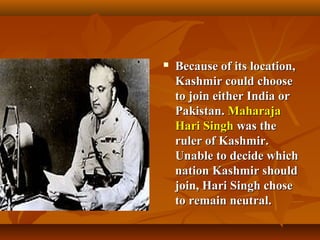
Because of its location,
Kashmir could choose
to join either India or
Pakistan. Maharaja
Hari Singh was the
ruler of Kashmir.
Unable to decide which
nation Kashmir should
join, Hari Singh chose
to remain neutral.
Indo-Pakistani War of 1947


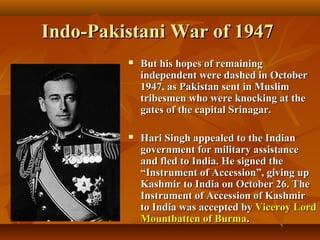
But his hopes of remaining
independent were dashed in October
1947, as Pakistan sent in Muslim
tribesmen who were knocking at the
gates of the capital Srinagar.



Hari Singh appealed to the Indian
government for military assistance
and fled to India. He signed the
“Instrument of Accession”, giving up
Kashmir to India on October 26. The
Instrument of Accession of Kashmir
to India was accepted by Viceroy Lord
Mountbatten of Burma.


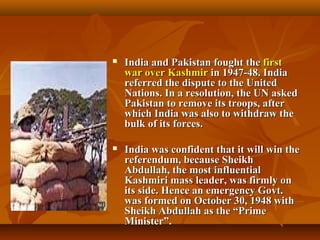
India and Pakistan fought the first
war over Kashmir in 1947-48. India
referred the dispute to the United
Nations. In a resolution, the UN asked
Pakistan to remove its troops, after
which India was also to withdraw the
bulk of its forces.



India was confident that it will win the
referendum, because Sheikh
Abdullah, the most influential
Kashmiri mass leader, was firmly on
its side. Hence an emergency Govt.
was formed on October 30, 1948 with
Sheikh Abdullah as the “Prime
Minister”.
LOC – LINE OF CONTROL


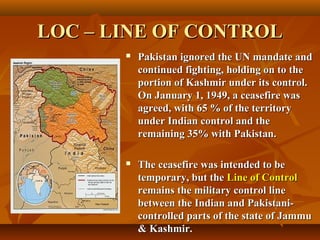
Pakistan ignored the UN mandate and
continued fighting, holding on to the
portion of Kashmir under its control.
On January 1, 1949, a ceasefire was
agreed, with 65 % of the territory
under Indian control and the
remaining 35% with Pakistan.



The ceasefire was intended to be
temporary, but the Line of Control
remains the military control line
between the Indian and Pakistanicontrolled parts of the state of Jammu
& Kashmir.
Tashkent agreement


In 1957, Kashmir was incorporated into the Indian
Union. It was given a special status under Article 370 of
India's constitution, which ensures, among other things,
that non-Kashmiri Indians cannot buy property there.



Fighting broke out again in 1965, but a ceasefire was
established. Indian Prime Minister, Lal Bhadur Shastri,
and Pakistani President, M Ayub Khan, signed the
Tashkent agreement on January 1, 1966.



They resolved to try to end the dispute, but the death of
Mr Shastri and the rise of Gen Yahya Khan in Pakistan
resulted in stalemate (deadlock).
Simla Agreement


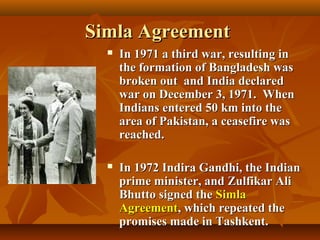
In 1971 a third war, resulting in
the formation of Bangladesh was
broken out and India declared
war on December 3, 1971. When
Indians entered 50 km into the
area of Pakistan, a ceasefire was
reached.



In 1972 Indira Gandhi, the Indian
prime minister, and Zulfikar Ali
Bhutto signed the Simla
Agreement, which repeated the
promises made in Tashkent.
Infiltration of Pakistani guerrillas


The status quo was maintained until 1989. Thereafter
Pakistani guerrillas struck in the Indian Kashmir valley.
They established a reign of terror and drove out almost
all the Hindus from the valley. Meanwhile Indian and
Pakistani troops regularly exchanged fire at the border.



India and Pakistan both tested nuclear devices in 1998,
and then in 1999 test-fired missiles. When the Indian
Prime Minister, Atal Behari Vajpayee, visited Lahore by
bus in 1999, the world felt that such a genuine effort at
friendly neighborhood relations would lower the tension
along the LOC.
Kargil War & Cross-border
troubles


But, again the cross-LOC firing in Kargil began
during the mid-1998. Indian forces drove them out
fighting bravely. The death toll, including both
soldiers and civilians, was more than 30,000.



India argued that the infiltrators were trained and
armed by Pakistan, and based in "Azad Kashmir"
with the full knowledge of the Pakistani government.
Pakistan said that they were freedom fighters (!)
from Kashmir and that it was giving only moral
support.
A Few Questions to Ponder over








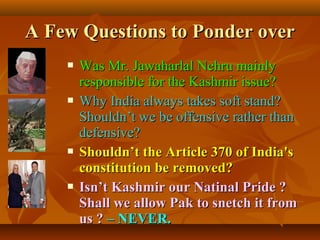
Was Mr. Jawaharlal Nehru mainly
responsible for the Kashmir issue?
Why India always takes soft stand?
Shouldn’t we be offensive rather than
defensive?
Shouldn’t the Article 370 of India's
constitution be removed?
Isn’t Kashmir our Natinal Pride ?
Shall we allow Pak to snetch it from
us ? – NEVER.

Kashmir

  • 1.
    Kashmir Contr oversy PRESENTED BY:ANKUR SIWACH
  • 2.
    OVERVIEW  The Kashmirconflict is a territorial dispute over Kashmir.  There are total 4 parties involved in this dispute – India, Pakistan, China and the people of Kashmir.
  • 3.
    Partition and dispute  BeforeIndependence from British in 1947 from 1820, Kashmir was ruled by the Maharaja of Kashmir who was Hindu although the majority of the population were Muslim, except the Jammu region.  The partition was made on religious lines resulting in to the formation of two separate countries – India and Pakistan. Pakistan insisted that Kashmir should be given to it.
  • 4.
     Because of itslocation, Kashmir could choose to join either India or Pakistan. Maharaja Hari Singh was the ruler of Kashmir. Unable to decide which nation Kashmir should join, Hari Singh chose to remain neutral.
  • 5.
    Indo-Pakistani War of1947  But his hopes of remaining independent were dashed in October 1947, as Pakistan sent in Muslim tribesmen who were knocking at the gates of the capital Srinagar.  Hari Singh appealed to the Indian government for military assistance and fled to India. He signed the “Instrument of Accession”, giving up Kashmir to India on October 26. The Instrument of Accession of Kashmir to India was accepted by Viceroy Lord Mountbatten of Burma.
  • 6.
     India and Pakistanfought the first war over Kashmir in 1947-48. India referred the dispute to the United Nations. In a resolution, the UN asked Pakistan to remove its troops, after which India was also to withdraw the bulk of its forces.  India was confident that it will win the referendum, because Sheikh Abdullah, the most influential Kashmiri mass leader, was firmly on its side. Hence an emergency Govt. was formed on October 30, 1948 with Sheikh Abdullah as the “Prime Minister”.
  • 7.
    LOC – LINEOF CONTROL  Pakistan ignored the UN mandate and continued fighting, holding on to the portion of Kashmir under its control. On January 1, 1949, a ceasefire was agreed, with 65 % of the territory under Indian control and the remaining 35% with Pakistan.  The ceasefire was intended to be temporary, but the Line of Control remains the military control line between the Indian and Pakistanicontrolled parts of the state of Jammu & Kashmir.
  • 8.
    Tashkent agreement  In 1957,Kashmir was incorporated into the Indian Union. It was given a special status under Article 370 of India's constitution, which ensures, among other things, that non-Kashmiri Indians cannot buy property there.  Fighting broke out again in 1965, but a ceasefire was established. Indian Prime Minister, Lal Bhadur Shastri, and Pakistani President, M Ayub Khan, signed the Tashkent agreement on January 1, 1966.  They resolved to try to end the dispute, but the death of Mr Shastri and the rise of Gen Yahya Khan in Pakistan resulted in stalemate (deadlock).
  • 9.
    Simla Agreement  In 1971a third war, resulting in the formation of Bangladesh was broken out and India declared war on December 3, 1971. When Indians entered 50 km into the area of Pakistan, a ceasefire was reached.  In 1972 Indira Gandhi, the Indian prime minister, and Zulfikar Ali Bhutto signed the Simla Agreement, which repeated the promises made in Tashkent.
  • 10.
    Infiltration of Pakistaniguerrillas  The status quo was maintained until 1989. Thereafter Pakistani guerrillas struck in the Indian Kashmir valley. They established a reign of terror and drove out almost all the Hindus from the valley. Meanwhile Indian and Pakistani troops regularly exchanged fire at the border.  India and Pakistan both tested nuclear devices in 1998, and then in 1999 test-fired missiles. When the Indian Prime Minister, Atal Behari Vajpayee, visited Lahore by bus in 1999, the world felt that such a genuine effort at friendly neighborhood relations would lower the tension along the LOC.
  • 11.
    Kargil War &Cross-border troubles  But, again the cross-LOC firing in Kargil began during the mid-1998. Indian forces drove them out fighting bravely. The death toll, including both soldiers and civilians, was more than 30,000.  India argued that the infiltrators were trained and armed by Pakistan, and based in "Azad Kashmir" with the full knowledge of the Pakistani government. Pakistan said that they were freedom fighters (!) from Kashmir and that it was giving only moral support.
  • 12.
    A Few Questionsto Ponder over     Was Mr. Jawaharlal Nehru mainly responsible for the Kashmir issue? Why India always takes soft stand? Shouldn’t we be offensive rather than defensive? Shouldn’t the Article 370 of India's constitution be removed? Isn’t Kashmir our Natinal Pride ? Shall we allow Pak to snetch it from us ? – NEVER.