PAK – AFGHAN
RELATIONSHIPS
Groups members
Amanullah 13786
Mansoor 14572
Adnan 14783
History of Afghanistan:
 Afghanistan (Land of the Afghan) is a
mountainous country in Central Asia
with a history and culture that
 goes back 5000 years
 In the ancient times, the land was
called Aryana by its inhabitants. In the
 medieval era, it was called Khorasan,
and in modern times, its people have
decided to call it Afghanistan.
Location of Afghanistan:
 Durand Line:
 The Pakistan-Afghan boundary was drawn
in 1893 by Sir Mortimer Durand.
 The boundary was accepted by the king of
Afghanistan in a treaty the 1893.
 When Pakistan became Afghanistan
claimed on the boundary of Pakistan.
 Opposition in UNO:
 In initial era Pak-Afghan relations were in
critical phase , Afghanistan was first
Muslim State in the World whose against
the membership of Pakistan in UNO..
 Pakistan joined the United Nations on
September 30 1947,.
 Rulers visits:
 Pakistan’s president Iskandar Mirza
visited Afghanistan in August 1956.
 Hussain Shaheed Suharwardy Prime
Minister of Pakistan toured
Afghanistan in 1957.
 These visits were reciprocated by Afghan
ruler King Zahir Shah in 1958 .
 Prime Minister Sardar Daud Khan in
1959.
 These visits helped in cultivating attitude
of reconciliation on both sides.
 Reinstatement of Relations:
 Iran successful for the better relation
Between Pakistan and Afghanistan which
resulted in the 1963 Tehran Accord.
 Afghanistan and Pakistan agreed to
restore diplomatic relations, re-open their
closed borders and resume trade and
commercial ties.
 1965 war:
 The relations were improved to such an
extent that during the 1965 India
Pakistan war, Afghanistan sided with
Pakistan which enabled Islamabad to fully
concentrate on its war with India and
worry less about the security of its western
border.
 1971 war:
 King Zahir Shah, in his state visit of 1968,
was given a very warm welcome by
Pakistan
 Afghanistan maintained strict neutrality
during the 1971 war between India and
Pakistan and refrained from taking
advantage of Pakistan’s preoccupation in
war
 Sardar Daud Era:
 In 1973 Sardar Daud take over the last
king of Afghanistan Zahir Shah
 Sardar Daud Support to
Separatists in Pakistan
 It was feared that the Daoud comeback
would once again arouse separatist
movements amongst Parkton and Balochi
living across Durand Line. And it did
happen in Baluchistan when Afghanistan
provided sanctuaries to the Murree and
Bugti insurgents in mid 70s
 Pakistan Support to anti Daud
forces:
 Considering Daud a serious threat to
Pakistan integration, Pakistan
government decided to support anti Daud
forces in destabilizing and bringing down
Daud regime.
 Resultantly , Pakistan welcomed Afghan
Islamists with anti communist and anti
Daud feelings.
 These dissidents were provided training
and other supports for their incursions
and uprisings inside Afghanistan.
 Daud visit to Pakistan:
 Daud , succumbed by Pakistan retaliation,
decided for reconciliation with Islamabad
and invited Pakistan’s Prime Minister
Zulifiqar Ali Bhutto for Kabul’s visit.
 Bhutto was given a warm welcome in
Kabul in June 1976.
 Daud was given red carpet reception in his
reciprocal visit to Islamabad in August
same year
PART 2
 Saur revolution:
 Elimination of Daud by communist forces
in April 1978 . Kabul was taken over by
the People's Democratic Party of
Afghanistan (PDPA).
 The country was renamed the Democratic
Republic of Afghanistan
 Soviet invasion:
 The December, 27th 1979 Soviet invasion
of Afghanistan, which killed Hafizullah
Amin and installed Babrak Karmal as the
country’s president.
 Which created a frightening situation for
Pakistan as it brought the Red Army
dangerously close to the Khyber Pass, the
traditional gateway of invasions of South
Asia from the north.
 American assistance to Pakistan
 President Carter, on May 4, 1980,
declared:
 “We will provide military equipment,
food and other assistance to help
Pakistan defend its independence and
national security against the seriously
increased threat from the north.”
 The American’s supply of arms,
ammunition and equipment to the
Mujahideen, was funneled through
Pakistan’s ISI.
 Pakistani assistance to Mujahidin:
 The leading recipient of American aid was
Hezb-i-Islami that proved to be the trust
worthy and deserving resistance force.
 It was Pakistan’s skill-full use of
intelligence and resources against Soviet
forces that made Afghanistan a ‘bleeding
wound’ for Moscow.
 Soviet's Left Afghanistan
 In 1989 soviet union left Afghanistan
during presidency of Mohammad
Najibullah.
 Tahreek e Taliban:
 Tehreek-i-Islami-i-Taliban Afghanistan
emerged in and around Kandhar in
September 1994 and began as a new
movement.
 With in three years Taliban were finally
able to control 27 out of 32 provinces by
the 3rd weak of May 1997.
 Pakistani Support to Taliban
 Pakistan extended full diplomatic and
economic support to the Taliban
Government.
 To reconstruct Chaman- Kandhar -
Herat- Kushka highway Pakistan provided
financial and technical support to the
Taliban as well.
 US opposition:
 On May 5th, 1999 the US Senate passed a
resolution calling on President Bush not to
recognize any government that
discriminated against women. Taliban
allowed Osama to live comfortably in
Afghanistan and in return he provided
personnel, money and hundreds of Arab
fighters to participate in the Taliban
military campaigns in the north
Pakistan-Afghanistan Relation after 9/ 11
 The horrific acts of September 11, 2001
changed the world and Pakistan Found
itself between the devil and the deep
sea.
 It marks a new phase of the Pakistan
foreign policy in general and Pakistan’s
Afghanistan policy in particular.
 Reaction of Al qaeda after attacks
from US:
 The attack was effective in destroying the
training camps.
 However, the large numbers of the Taliban
and Al Qaeda dispersed and disappeared in
to the hinterland and some fled in to the
neighboring Iran and Pakistan.
 Within 8-10 weeks the Taliban were over
powered, routed, major cities including the
capital fell on November 13th, 2001.
American Reaction
 Pakistan reaction:
 Pakistan was to either stand with America
in its war against Al Qaida and Taliban or
suffer U.S. retaliation if continue with
its pro Taliban stand.
 Pakistan opted to side the international
coalition and provide intelligence, flight
corridor and bases for logistic support
and recovery to the U.S. led military attack
over Afghanistan on October 7, 2001.
PART 3
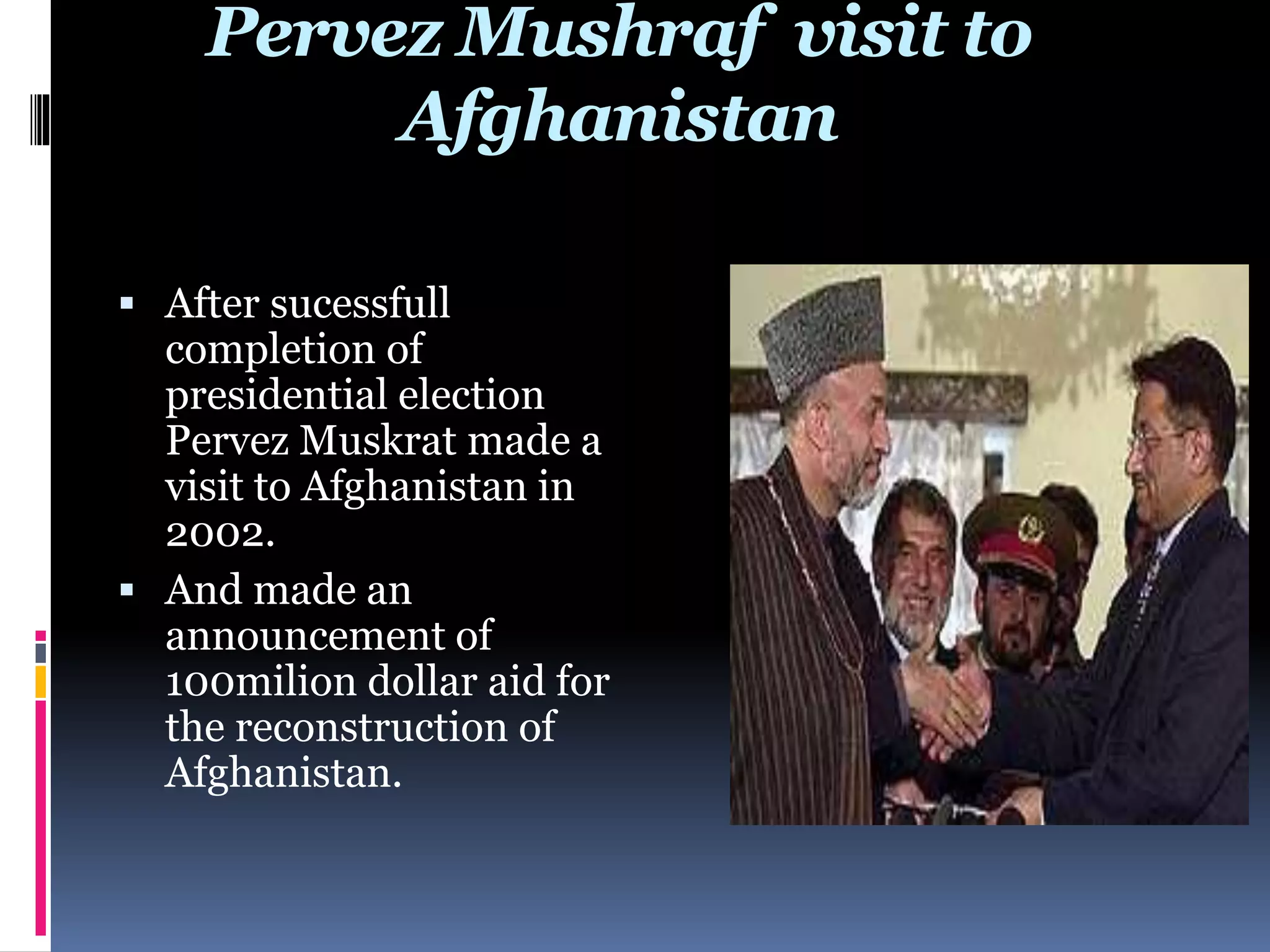
Pervez Mushraf visit to
Afghanistan
 After sucessfull
completion of
presidential election
Pervez Muskrat made a
visit to Afghanistan in
2002.
 And made an
announcement of
100milion dollar aid for
the reconstruction of
Afghanistan.
 Hamid Karzai visit to Pakistan:
 Pakistan supported the interim set up and
Hamid Karzai paid an official visit to
Pakistan in February 2002.
 And started again bilateral relations on
friendly terms.
 Pakistan offered all sort of moral,
political and economic support to
strengthen new government in Kabul
under the presidency of Karzai.
 Pakistan Support in Election:
 Pakistan also provided full support for the
peaceful conduct of presidential and
parliamentary polls in October 2004 and
September 2005.
 The border Was sealed to guard against
any invasions across the border to
disrupt election process.
 Pakistan role For Peaceful solution:
 Pakistan, to avert likely war, did its best to
mediate between U.S and the Taliban.
 George Tenet, former head of C I A, in his
book amply records Pakistan’s efforts of
bringing Taliban to the table and
averting war.
 Foreign hand and particularly Indian
Factors:
 On the contrary Afghanistan’s distant
neighbor like India was provided
opportunity to further its strategic
interests against Pakistan.
 Since then, India has found a vast
platform in Afghanistan to conduct its
covert activities in Baluchistan through
Balochi dissidents and FATA through
TTP in order to destabilize Pakistan.
Pak-Afghan relation in Asif Zardari Era
 President Asif Ali made an
official visit to Afghanistan in
January 2009 to terrorism.
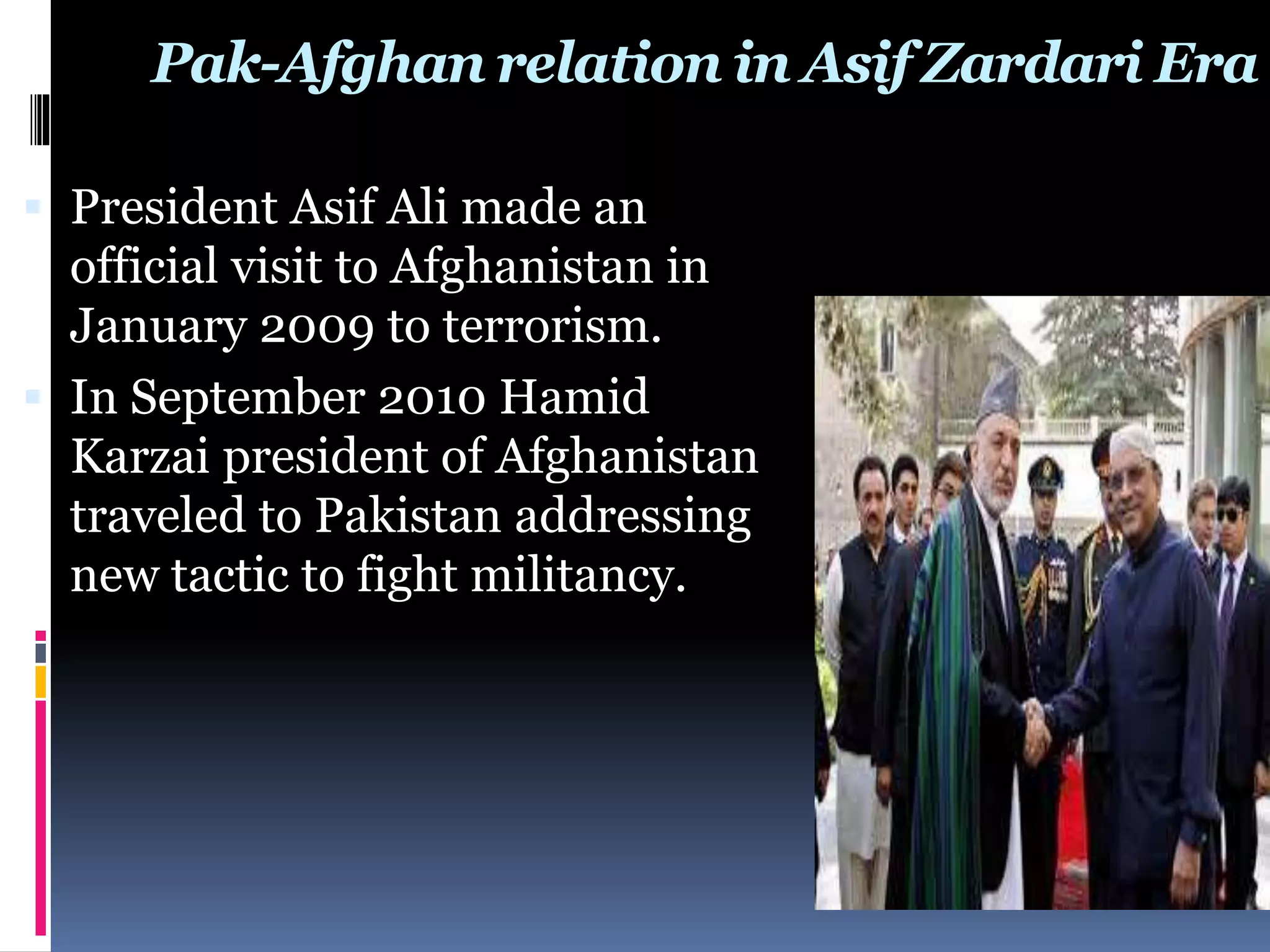
 In September 2010 Hamid
Karzai president of Afghanistan
traveled to Pakistan addressing
new tactic to fight militancy.
 Signed agreement:
 In order to enhance cooperation
amongst the two countries, in October
2010
 President has signed a Pakistan-
Afghanistan Transit Trade Agreement.
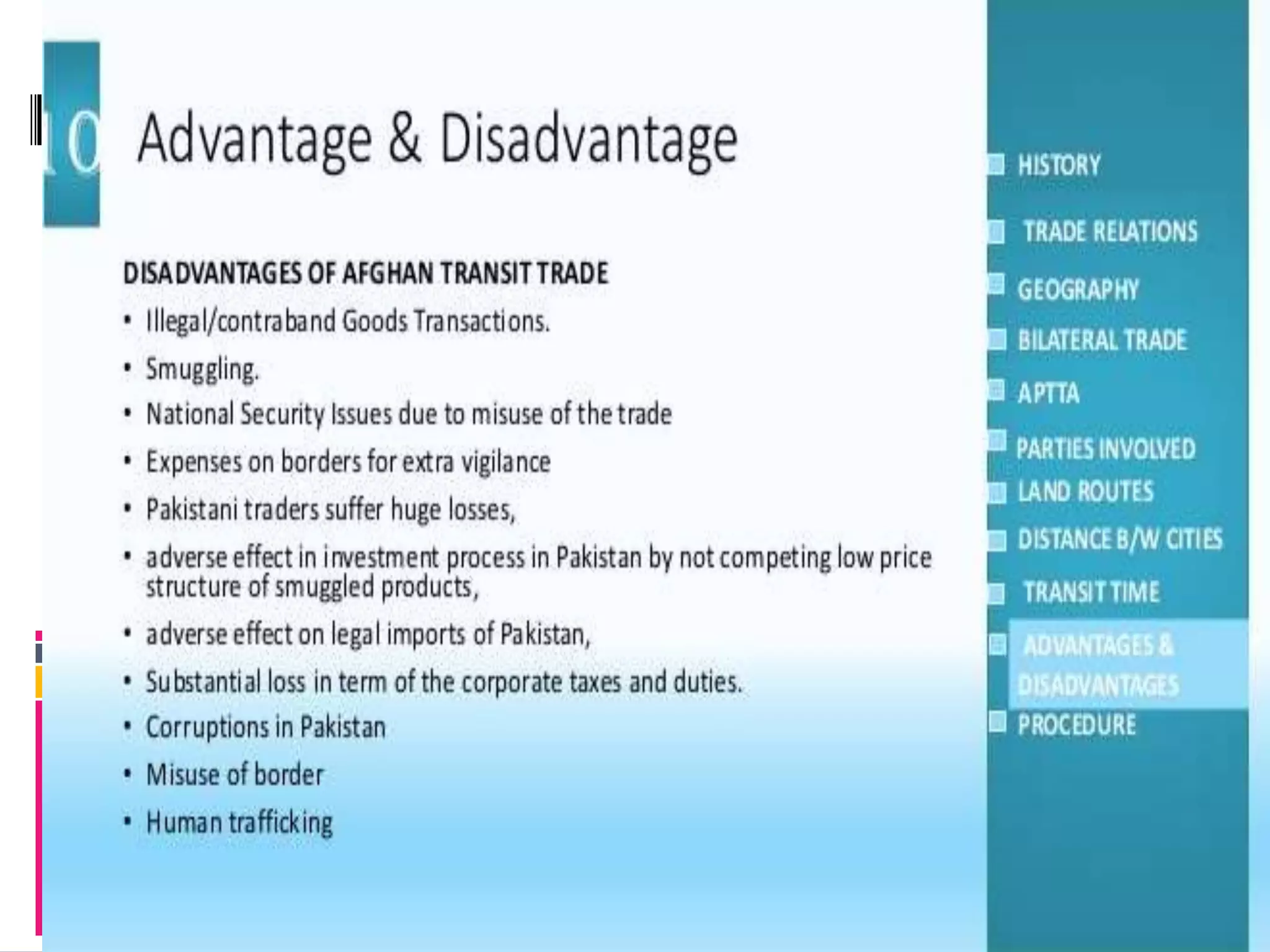
 Smuggling Products :
 Smuggling became a major business
after the establishment of the Durand
Line in 1893, which is now controlled
by a large network of mafia groups on
both sides of the border.
 Meat Smuggled:
 In Peshawar, Pakistan, local police and the
food department recovered the meat
which was smuggled to Afghanistan from
the city Peshawar on September 13, 2012.
 Minerals smuggled:
 Pakistan generates about USD 350
million dollar revenue on smuggling of
these stones annually, while
Afghanistan only earns USD 3,00,000
dollar.
 Country agreement for the
establishment of joint chamber of
commerce and industry:
 The countries also agreed to establish a joint
chamber of commerce and industry.
 Pakistan has offered to host the inaugural
session of the proposed chamber, and display
centers for industrial exhibitions will be set
up in Karachi and Kabul

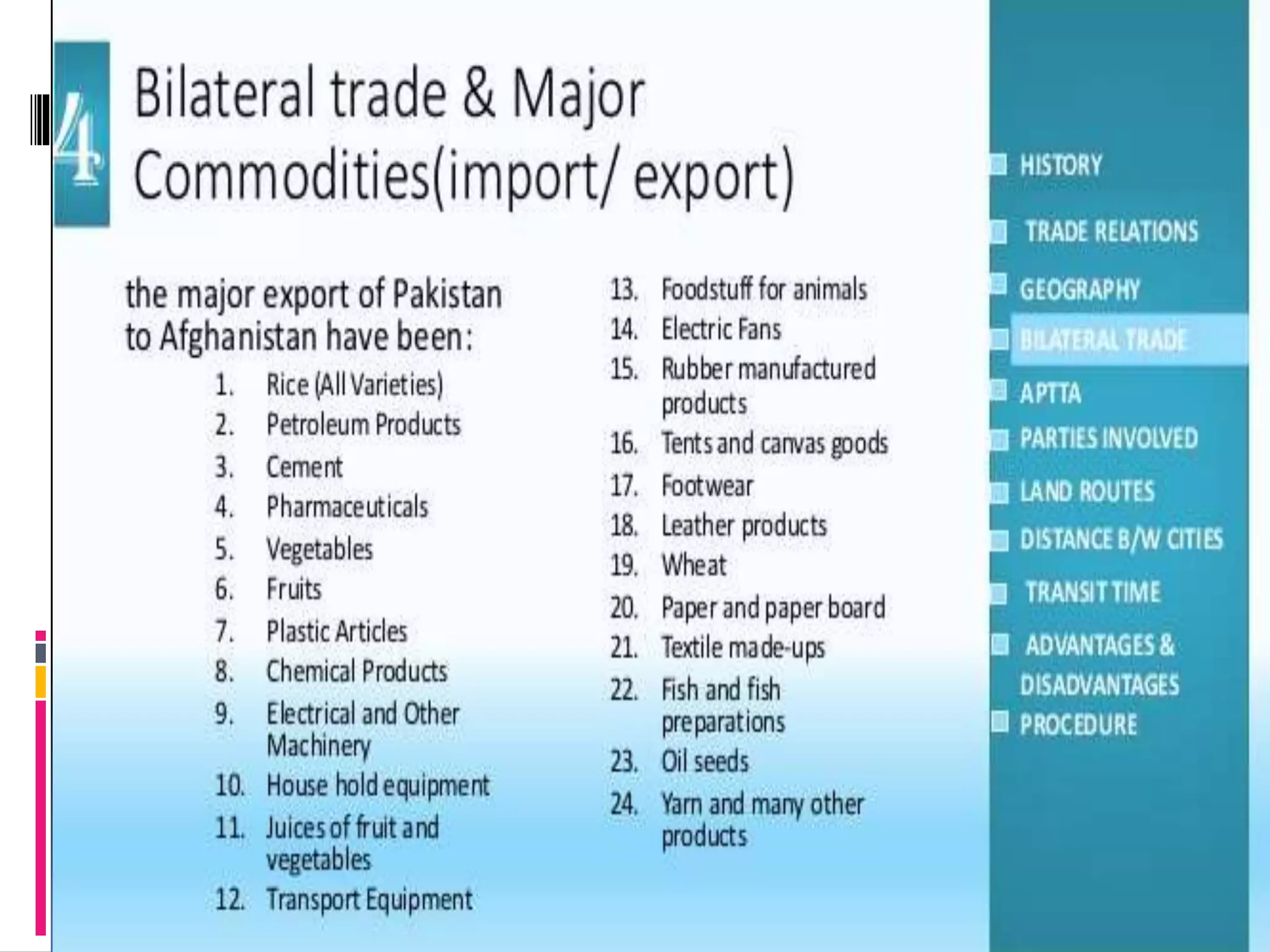
 Bilateral trade between Pakistan
and Afghanistan:
 Pakistan and Afghanistan have agreed
to strengthen trade ties and double
annual bilateral trade by 2015, after a
two-day Joint Economic Commission
(JEC) meeting January 16-17 in
Islamabad
Pak Afghan Relation
Pak Afghan Relation
Pak Afghan Relation
Pak Afghan Relation
Pak Afghan Relation

Pak Afghan Relation

  • 2.
  • 3.
  • 4.
    History of Afghanistan: Afghanistan (Land of the Afghan) is a mountainous country in Central Asia with a history and culture that  goes back 5000 years  In the ancient times, the land was called Aryana by its inhabitants. In the  medieval era, it was called Khorasan, and in modern times, its people have decided to call it Afghanistan.
  • 5.
  • 6.
     Durand Line: The Pakistan-Afghan boundary was drawn in 1893 by Sir Mortimer Durand.  The boundary was accepted by the king of Afghanistan in a treaty the 1893.  When Pakistan became Afghanistan claimed on the boundary of Pakistan.
  • 8.
     Opposition inUNO:  In initial era Pak-Afghan relations were in critical phase , Afghanistan was first Muslim State in the World whose against the membership of Pakistan in UNO..  Pakistan joined the United Nations on September 30 1947,.
  • 9.
     Rulers visits: Pakistan’s president Iskandar Mirza visited Afghanistan in August 1956.  Hussain Shaheed Suharwardy Prime Minister of Pakistan toured Afghanistan in 1957.
  • 10.
     These visitswere reciprocated by Afghan ruler King Zahir Shah in 1958 .  Prime Minister Sardar Daud Khan in 1959.  These visits helped in cultivating attitude of reconciliation on both sides.
  • 11.
     Reinstatement ofRelations:  Iran successful for the better relation Between Pakistan and Afghanistan which resulted in the 1963 Tehran Accord.  Afghanistan and Pakistan agreed to restore diplomatic relations, re-open their closed borders and resume trade and commercial ties.
  • 12.
     1965 war: The relations were improved to such an extent that during the 1965 India Pakistan war, Afghanistan sided with Pakistan which enabled Islamabad to fully concentrate on its war with India and worry less about the security of its western border.
  • 13.
     1971 war: King Zahir Shah, in his state visit of 1968, was given a very warm welcome by Pakistan  Afghanistan maintained strict neutrality during the 1971 war between India and Pakistan and refrained from taking advantage of Pakistan’s preoccupation in war
  • 14.
     Sardar DaudEra:  In 1973 Sardar Daud take over the last king of Afghanistan Zahir Shah
  • 15.
     Sardar DaudSupport to Separatists in Pakistan  It was feared that the Daoud comeback would once again arouse separatist movements amongst Parkton and Balochi living across Durand Line. And it did happen in Baluchistan when Afghanistan provided sanctuaries to the Murree and Bugti insurgents in mid 70s
  • 16.
     Pakistan Supportto anti Daud forces:  Considering Daud a serious threat to Pakistan integration, Pakistan government decided to support anti Daud forces in destabilizing and bringing down Daud regime.
  • 17.
     Resultantly ,Pakistan welcomed Afghan Islamists with anti communist and anti Daud feelings.  These dissidents were provided training and other supports for their incursions and uprisings inside Afghanistan.
  • 18.
     Daud visitto Pakistan:  Daud , succumbed by Pakistan retaliation, decided for reconciliation with Islamabad and invited Pakistan’s Prime Minister Zulifiqar Ali Bhutto for Kabul’s visit.  Bhutto was given a warm welcome in Kabul in June 1976.  Daud was given red carpet reception in his reciprocal visit to Islamabad in August same year
  • 19.
  • 20.
     Saur revolution: Elimination of Daud by communist forces in April 1978 . Kabul was taken over by the People's Democratic Party of Afghanistan (PDPA).  The country was renamed the Democratic Republic of Afghanistan
  • 21.
     Soviet invasion: The December, 27th 1979 Soviet invasion of Afghanistan, which killed Hafizullah Amin and installed Babrak Karmal as the country’s president.  Which created a frightening situation for Pakistan as it brought the Red Army dangerously close to the Khyber Pass, the traditional gateway of invasions of South Asia from the north.
  • 22.
     American assistanceto Pakistan  President Carter, on May 4, 1980, declared:  “We will provide military equipment, food and other assistance to help Pakistan defend its independence and national security against the seriously increased threat from the north.”
  • 23.
     The American’ssupply of arms, ammunition and equipment to the Mujahideen, was funneled through Pakistan’s ISI.
  • 24.
     Pakistani assistanceto Mujahidin:  The leading recipient of American aid was Hezb-i-Islami that proved to be the trust worthy and deserving resistance force.  It was Pakistan’s skill-full use of intelligence and resources against Soviet forces that made Afghanistan a ‘bleeding wound’ for Moscow.
  • 25.
     Soviet's LeftAfghanistan  In 1989 soviet union left Afghanistan during presidency of Mohammad Najibullah.
  • 26.
     Tahreek eTaliban:  Tehreek-i-Islami-i-Taliban Afghanistan emerged in and around Kandhar in September 1994 and began as a new movement.  With in three years Taliban were finally able to control 27 out of 32 provinces by the 3rd weak of May 1997.
  • 27.
     Pakistani Supportto Taliban  Pakistan extended full diplomatic and economic support to the Taliban Government.  To reconstruct Chaman- Kandhar - Herat- Kushka highway Pakistan provided financial and technical support to the Taliban as well.
  • 28.
     US opposition: On May 5th, 1999 the US Senate passed a resolution calling on President Bush not to recognize any government that discriminated against women. Taliban allowed Osama to live comfortably in Afghanistan and in return he provided personnel, money and hundreds of Arab fighters to participate in the Taliban military campaigns in the north
  • 29.
  • 30.
     The horrificacts of September 11, 2001 changed the world and Pakistan Found itself between the devil and the deep sea.  It marks a new phase of the Pakistan foreign policy in general and Pakistan’s Afghanistan policy in particular.
  • 31.
     Reaction ofAl qaeda after attacks from US:  The attack was effective in destroying the training camps.  However, the large numbers of the Taliban and Al Qaeda dispersed and disappeared in to the hinterland and some fled in to the neighboring Iran and Pakistan.  Within 8-10 weeks the Taliban were over powered, routed, major cities including the capital fell on November 13th, 2001.
  • 32.
  • 33.
     Pakistan reaction: Pakistan was to either stand with America in its war against Al Qaida and Taliban or suffer U.S. retaliation if continue with its pro Taliban stand.  Pakistan opted to side the international coalition and provide intelligence, flight corridor and bases for logistic support and recovery to the U.S. led military attack over Afghanistan on October 7, 2001.
  • 34.
  • 35.
    Pervez Mushraf visitto Afghanistan  After sucessfull completion of presidential election Pervez Muskrat made a visit to Afghanistan in 2002.  And made an announcement of 100milion dollar aid for the reconstruction of Afghanistan.
  • 37.
     Hamid Karzaivisit to Pakistan:  Pakistan supported the interim set up and Hamid Karzai paid an official visit to Pakistan in February 2002.  And started again bilateral relations on friendly terms.  Pakistan offered all sort of moral, political and economic support to strengthen new government in Kabul under the presidency of Karzai.
  • 38.
     Pakistan Supportin Election:  Pakistan also provided full support for the peaceful conduct of presidential and parliamentary polls in October 2004 and September 2005.  The border Was sealed to guard against any invasions across the border to disrupt election process.
  • 39.
     Pakistan roleFor Peaceful solution:  Pakistan, to avert likely war, did its best to mediate between U.S and the Taliban.  George Tenet, former head of C I A, in his book amply records Pakistan’s efforts of bringing Taliban to the table and averting war.
  • 40.
     Foreign handand particularly Indian Factors:  On the contrary Afghanistan’s distant neighbor like India was provided opportunity to further its strategic interests against Pakistan.  Since then, India has found a vast platform in Afghanistan to conduct its covert activities in Baluchistan through Balochi dissidents and FATA through TTP in order to destabilize Pakistan.

  • 41.
    Pak-Afghan relation inAsif Zardari Era  President Asif Ali made an official visit to Afghanistan in January 2009 to terrorism.  In September 2010 Hamid Karzai president of Afghanistan traveled to Pakistan addressing new tactic to fight militancy.
  • 42.
     Signed agreement: In order to enhance cooperation amongst the two countries, in October 2010  President has signed a Pakistan- Afghanistan Transit Trade Agreement.
  • 43.
     Smuggling Products:  Smuggling became a major business after the establishment of the Durand Line in 1893, which is now controlled by a large network of mafia groups on both sides of the border.
  • 44.
     Meat Smuggled: In Peshawar, Pakistan, local police and the food department recovered the meat which was smuggled to Afghanistan from the city Peshawar on September 13, 2012.
  • 45.
     Minerals smuggled: Pakistan generates about USD 350 million dollar revenue on smuggling of these stones annually, while Afghanistan only earns USD 3,00,000 dollar.
  • 46.
     Country agreementfor the establishment of joint chamber of commerce and industry:  The countries also agreed to establish a joint chamber of commerce and industry.  Pakistan has offered to host the inaugural session of the proposed chamber, and display centers for industrial exhibitions will be set up in Karachi and Kabul 
  • 47.
     Bilateral tradebetween Pakistan and Afghanistan:  Pakistan and Afghanistan have agreed to strengthen trade ties and double annual bilateral trade by 2015, after a two-day Joint Economic Commission (JEC) meeting January 16-17 in Islamabad