POST OPERATIVE COMPLICATIONS AND
MANAGEMENT
Presented By- Sujata Walode
MSC (OT & AT)
MGM SBSA
Introduction
2
Recovery from general anesthesia is a time of great
physiological stress for many patients.
Emergence from general anaesthesia should ideally be
smooth and gradual awakening in a control
environment.
It often begins in the operating room or during
transport to the recovery room and frequently
characterized by complications.
Even patients receiving spinal or epidural anaesthesia
can experience marked decrease in blood pressure
during transport.
Post op Complications
3
1. Pain
2. PONV
3. Delirium &emergence excitement
4. Shivering &hypothermia
5. Respiratory complications
6. Circulatory complications
7. Renal dysfunction
(1)Pain
Post-operative pain management should be an
essential and integral part of the care given to the
patient.
A ‘major postoperative pain” is defined as the pain that
could endanger life if inadequately relieved, and for
which more vigorous and effectives treatments may be
justified although carryingrisk.
4
In day care surgery, inadequate treatment of pain from
a relatively trivial insult may cause an unplanned
hospital admission.
In hand surgery, inadequate treatment of pain may
hinder mobilization function.
After Caesarean section, a mother’s pain may prejudice
the bonding with her newborn child.
5
Postoperative pain management
options
6
1)Cognitive behavioral interventions: such as relaxation,
distraction, ; these can be taught preoperatively & can
reduce pain, anxiety, & the amount of drugs needed for
pain control.
2)Systemic administration of nonsteroidal anti-
inflammatory drugs (NSAIDs) or opioids using the
traditional ‘as needed’ schedule or around-the-clock
administration
3)Patient controlled analgesia (PCA), usually meaning
self-medication with intravenous doses of an opioid; this
can include other classes of drugs administered orally or by
other routes.
4)Spinal or Epidural analgesia, usually by means of an
epidural opioid and/or local anaesthetic injected
intermittently orinfused continuously.
5)Intermittent or continuous local neural blockade
(examples of the former include intercostal nerve blockade
with local anaesthetic or cryoprobe; the latter includes
infusion of local anaesthetic through an interpleural
catheter)
6) Physical agents such as massage or application of
heator cold.
7)Electroanalgesia such as transcutaneous electrical
nerve stimulation (TENS)
7
(2)Nausea & Vomiting
8
Postoperative nausea and vomiting (PONV) are a
common problem following general anesthesia,
occurring in 20–30% of allpatients.
Moreover, PONV may occur only at home within 24 hr
of an uneventful discharge (postdischarge nausea and
vomiting) in a significant number of additional
patients.
From a patients perspective PONV can be more
problematic than postoperative pain.
Risk factors for PONV
Patients factor
Young age
Female gender
Large body habitus
History of prior PONV
History of motion sickness
Anaesthetic techniques
General anaesthesia
Opioids
Volatile anesthetics
9
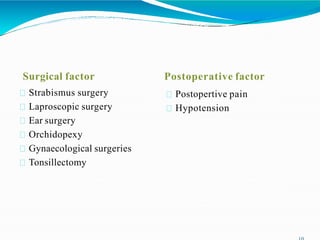
Surgical factor
Strabismus surgery
Laproscopic surgery
Ear surgery
Orchidopexy
Gynaecological surgeries
Tonsillectomy
Postoperative factor
Postopertive pain
Hypotension
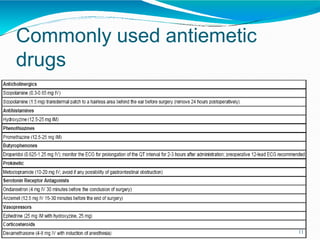
Commonly used antiemetic
drugs
11
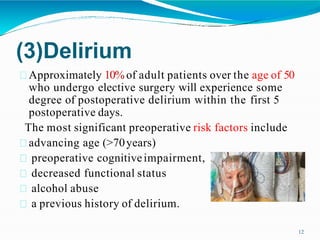
(3)Delirium
Approximately 10% of adult patients over the age of 50
who undergo elective surgery will experience some
degree of postoperative delirium within the first 5
postoperative days.
The most significant preoperative risk factors include
advancing age (>70years)
preoperative cognitiveimpairment,
decreased functional status
alcohol abuse
a previous history of delirium.
12
Intraoperative factors that are predictive of postoperative
delirium include
1.)surgical blood loss
2.) hematocrit less than 30%
3.)number of intraoperative blood transfusions.
13
Management of delirium
High risk patient should be identified before admission to
PACU.
Severely agitated patients require restraints or additional
personnel to avoid self-inflicted injury.
Elderly patients who are to undergo minor surgery should
be scheduled in an outpatient center.
It minimize the incidence of post op delirium.
14
Emergence Excitement
15
A transient confusional state that is associated with
emergence from generalanesthesia.
Should be differentiated from persistent postoperative
delirium.
Common in children, with more than 30%
experiencing agitation ordelirium.
Usually occurs within the first 10 minutes of recovery
but can have onset later in children who are brought to
the recovery room asleep.
The peak age of emergence excitement in children is
between 2 and 4years.
In children, emergence excitement is most frequently
associated with rapid “wake up” from inhalational
anesthesia.
most often associated with sevoflurane and
desflurane.
16
Preventative measures are reducing preoperative
anxiety, treating postoperative pain, and providing a
stress-free environment for recovery.
Medications that have been used to prevent and treat
emergence agitation/delirium in children include
midazolam, clonidine, dexmedetomidine, fentanyl,
ketorolac, and physostigmine.
17
(4)Shivering &
Hypothermia
Can occur due to intra op hypothermia or side effect of
anaesthetic agents.
Most important cause –redistribution of heat –core to
peripheral compartment.
Cool ambient temperature.
Use of cold I.Vfluids.
Incidence related to duration of surgery and use of
volatile anaestheticagents.
18
Management
Forced air warmingdevice.
Exclude cause such as bacteremia , sepsis ,allergy or
transfusion rxn.
Meperidine (10-25 mg) also shown to reduce shivering.
19
(5)Respiratory
complications
20
Most frequently encountered serious complications in
the PACU.
Majority are related to
1. airway obstruction
2. hypoventilation
3. hypoxemia.
Upper Airway Obstruction
21
Loss of Pharyngeal Muscle Tone
Most frequent cause of airway obstruction in the
immediate postoperativeperiod.
Characterized by a paradoxical breathing pattern.
Can be relieved by “jaw thrust maneuver” or
continuous positive airway pressure (CPAP) applied via
facemask (or both).
In selected patients, placement of an oral or nasal
airway, laryngeal mask airway, or endotracheal tube
may be required.
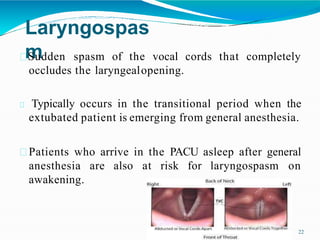
Laryngospas
m cords that completely
Sudden spasm of the vocal
occludes the laryngealopening.
Typically occurs in the transitional period when the
extubated patient is emerging from general anesthesia.
Patients who arrive in the PACU asleep after general
anesthesia are also at risk for laryngospasm on
awakening.
22
Chest wall retraction
High pitch inspiratorystridor
Decreased breath sound
Hypoxemia
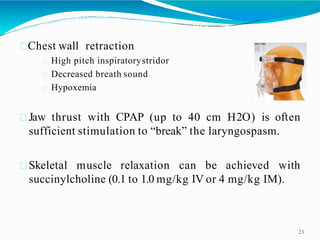
Jaw thrust with CPAP (up to 40 cm H2O) is often
sufficient stimulation to “break” the laryngospasm.
Skeletal muscle relaxation can be achieved with
succinylcholine (0.1 to 1.0 mg/kg IV or 4 mg/kg IM).
23
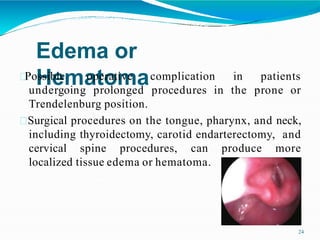
Edema or
Hematoma
Possible
undergoing
operative complication
prolonged procedures in
in patients
the prone or
Trendelenburg position.
Surgical procedures on the tongue, pharynx, and neck,
including thyroidectomy, carotid endarterectomy, and
cervical spine procedures, can produce more
localized tissue edema or hematoma.
24
Manageme
nt
25
Patients with airway obstruction should receive
supplemental oxygen
Acombined jaw-thrust and head-tilt maneuver pulls the
tongue forward and opens the airway.
Insertion of an oral or nasal airway also often alleviates the
problem.
Any secretions or blood in the hypopharynx should be
suctioned
Postoperative wound hematomas following head and neck,
thyroid, and carotid procedures can quickly compromise
the airway; opening the wound immediately relieves
tracheal compression.
Mask-ventilation of a patient with severe upper airway
obstruction resulting from edema or hematoma may be
difficult
Ready access to difficult airway equipments.
Surgical backup for performance of an emergency
tracheostomy.
Dexamethasone (0.5 mg/kg)or aerosolized racemic
epinephrine (0.5 mL of a 2.25% solution with 3 mL of
normal saline) may be useful in some cases.
26
Continuous Positive Airway Pressure
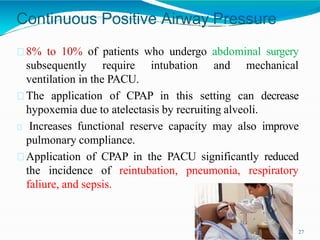
8% to 10% of patients who undergo abdominal surgery
subsequently require intubation and mechanical
ventilation in the PACU.
The application of CPAP in this setting can decrease
hypoxemia due to atelectasis by recruiting alveoli.
Increases functional reserve capacity may also improve
pulmonary compliance.
Application of CPAP in the PACU significantly reduced
the incidence of reintubation, pneumonia, respiratory
faliure, and sepsis.
27
(6)Hemodynamic
Instability
Hypertension
Common in PACU and usually within 30 min of arrival.
Patients with a history of essential hypertension are at greatest
risk.
Postoperative systemic hypertension and tachycardia are
associated with an increased risk of unplanned critical care
admission and a higher mortality .
28
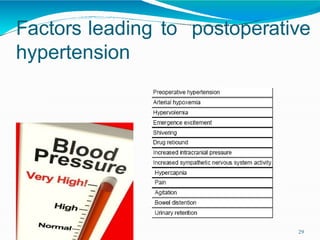
Factors leading to postoperative
hypertension
29
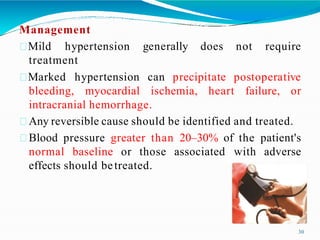
Management
Mild hypertension generally does not require
treatment
Marked hypertension can precipitate postoperative
bleeding, myocardial ischemia, heart failure, or
intracranial hemorrhage.
Any reversible cause should be identified and treated.
Blood pressure greater than 20–30% of the patient's
normal baseline or those associated with adverse
effects should betreated.
30
Mild to moderate Hypertension
31
should treated
with β-adrenergic blocker such as labetalol, esmolol,
or propranolol; or calcium channel blocker or
nitroglycerine patch.
Severe Hypertension should be treated with
intravenous infusion of nitroprusside, nitroglycerin,
nicardipine, or fenoldopam.
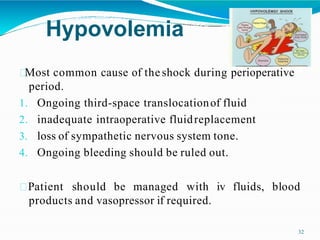
Hypovolemia
Most common cause of theshock during perioperative
period.
1. Ongoing third-space translocationof fluid
2. inadequate intraoperative fluidreplacement
3. loss of sympathetic nervous system tone.
4. Ongoing bleeding should be ruled out.
Patient should be managed with iv fluids, blood
products and vasopressor if required.
32
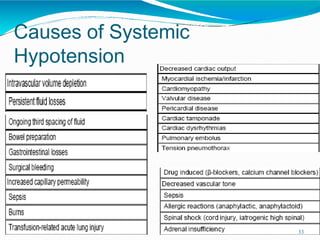
Causes of Systemic
Hypotension
33
Distributive (Decreased
Afterload)
34
Physiologic derangements, like iatrogenic
sympathectomy, critical illness, allergic reactions, and
sepsis.
Neuromuscular blocking drugs are the most common
cause of anaphylactic reactions in the operative setting
followed by latex allergy
Epinephrine is the drug of choice to treat hypotension
secondary to an allergic reaction.
If sepsis is suspected it is managed with fluid resuscitation
, vasopressors and broad spectrum antibiotics.
Cardiogenic (Intrinsic Pump
Failure)
35
Cardiogenic causes of include
1. myocardial ischemia and infarction
2. cardiomyopathy
3. cardiac tamponade
4. cardiac dysrhythmias.
In low-risk patients (<45 years of age, no known cardiac
disease, only one risk factor), postoperative ST-segment
changes on the ECG do not usually indicate myocardial
ischemia.
Cardiac
Dysrhythmias
36
in the
Reversible causes of cardiac dysrhythmias
perioperative period include
hypoxemia
hypoventilation andassociated hypercapnia,
endogenous or exogenous catecholamines,
electrolyte abnormalities
acidemia
fluid overload
anemia
substance withdrawal
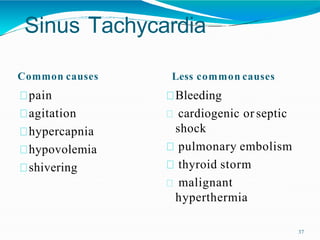
Sinus Tachycardia
37
Common causes
pain
agitation
hypercapnia
hypovolemia
shivering
Less common causes
Bleeding
cardiogenic or septic
shock
pulmonary embolism
thyroid storm
malignant
hyperthermia
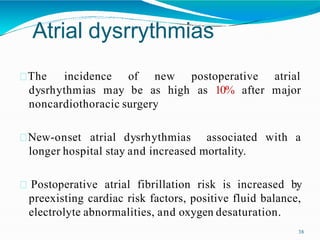
Atrial dysrrythmias
38
dysrhythmias may
The incidence of new postoperative
be as high as 10% after
atrial
major
noncardiothoracic surgery
with a
New-onset atrial dysrhythmias associated
longer hospital stay and increased mortality.
Postoperative atrial fibrillation risk is increased by
preexisting cardiac risk factors, positive fluid balance,
electrolyte abnormalities, and oxygen desaturation.
Ventricular Dysrhythmias
39
Premature ventricular contractions (PVCs) and
ventricular bigeminy occur commonly in the PACU.
True ventricular tachycardia is rare and is indicative of
underlying cardiac pathology.
Torsades de pointes, may precipitate in patients of QT
prolongation on the electrocardiogram by intrinsic or
drug related (amiodarone, procainamide, or
droperidol
Bradydysrhythmias
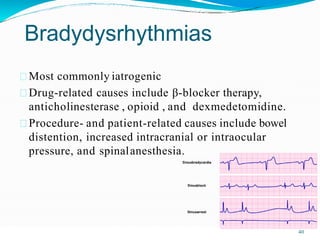
Most commonly iatrogenic
Drug-related causes include β-blocker therapy,
anticholinesterase , opioid , and dexmedetomidine.
Procedure- and patient-related causes include bowel
distention, increased intracranial or intraocular
pressure, and spinalanesthesia.
40
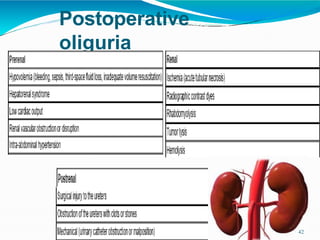
(7)Renal Dysfunction
41
Oliguria is defined as urine output<o.5ml/Kg/hr.
dysfunction includes prerenal, intrarenal,
The differential diagnosis of postoperative renal
and
postrenal causes
Frequently, thecause is multifactorial
Urinary catheter obstruction or dislodgment is easily
remedied and often overlooked
Details of the surgical procedure (urologic or
gynecologic) should be sought to rule out anatomic
obstruction or disruption of the ureters, bladder, or
urethra.
Postoperative
oliguria
42
Summariz
e
43
more than a postanaesthesia observation
PACU is
room.
It support the care of patients of all ages and at every
stage of illness.
Important complications in post anaesthesia are Pain,
PONV , delerium , airway obstruction.
The anesthesiologist is responsible for managing the
patient in thePACU.
Since its inception PACU has proved to be an
exceptionally adaptable unit equipped to meet the
demand of evolving healthsystem.
THANK
44

Post operative complications & management.pptx

  • 1.
    POST OPERATIVE COMPLICATIONSAND MANAGEMENT Presented By- Sujata Walode MSC (OT & AT) MGM SBSA
  • 2.
    Introduction 2 Recovery from generalanesthesia is a time of great physiological stress for many patients. Emergence from general anaesthesia should ideally be smooth and gradual awakening in a control environment. It often begins in the operating room or during transport to the recovery room and frequently characterized by complications. Even patients receiving spinal or epidural anaesthesia can experience marked decrease in blood pressure during transport.
  • 3.
    Post op Complications 3 1.Pain 2. PONV 3. Delirium &emergence excitement 4. Shivering &hypothermia 5. Respiratory complications 6. Circulatory complications 7. Renal dysfunction
  • 4.
    (1)Pain Post-operative pain managementshould be an essential and integral part of the care given to the patient. A ‘major postoperative pain” is defined as the pain that could endanger life if inadequately relieved, and for which more vigorous and effectives treatments may be justified although carryingrisk. 4
  • 5.
    In day caresurgery, inadequate treatment of pain from a relatively trivial insult may cause an unplanned hospital admission. In hand surgery, inadequate treatment of pain may hinder mobilization function. After Caesarean section, a mother’s pain may prejudice the bonding with her newborn child. 5
  • 6.
    Postoperative pain management options 6 1)Cognitivebehavioral interventions: such as relaxation, distraction, ; these can be taught preoperatively & can reduce pain, anxiety, & the amount of drugs needed for pain control. 2)Systemic administration of nonsteroidal anti- inflammatory drugs (NSAIDs) or opioids using the traditional ‘as needed’ schedule or around-the-clock administration 3)Patient controlled analgesia (PCA), usually meaning self-medication with intravenous doses of an opioid; this can include other classes of drugs administered orally or by other routes.
  • 7.
    4)Spinal or Epiduralanalgesia, usually by means of an epidural opioid and/or local anaesthetic injected intermittently orinfused continuously. 5)Intermittent or continuous local neural blockade (examples of the former include intercostal nerve blockade with local anaesthetic or cryoprobe; the latter includes infusion of local anaesthetic through an interpleural catheter) 6) Physical agents such as massage or application of heator cold. 7)Electroanalgesia such as transcutaneous electrical nerve stimulation (TENS) 7
  • 8.
    (2)Nausea & Vomiting 8 Postoperativenausea and vomiting (PONV) are a common problem following general anesthesia, occurring in 20–30% of allpatients. Moreover, PONV may occur only at home within 24 hr of an uneventful discharge (postdischarge nausea and vomiting) in a significant number of additional patients. From a patients perspective PONV can be more problematic than postoperative pain.
  • 9.
    Risk factors forPONV Patients factor Young age Female gender Large body habitus History of prior PONV History of motion sickness Anaesthetic techniques General anaesthesia Opioids Volatile anesthetics 9
  • 10.
    Surgical factor Strabismus surgery Laproscopicsurgery Ear surgery Orchidopexy Gynaecological surgeries Tonsillectomy Postoperative factor Postopertive pain Hypotension
  • 11.
  • 12.
    (3)Delirium Approximately 10% ofadult patients over the age of 50 who undergo elective surgery will experience some degree of postoperative delirium within the first 5 postoperative days. The most significant preoperative risk factors include advancing age (>70years) preoperative cognitiveimpairment, decreased functional status alcohol abuse a previous history of delirium. 12
  • 13.
    Intraoperative factors thatare predictive of postoperative delirium include 1.)surgical blood loss 2.) hematocrit less than 30% 3.)number of intraoperative blood transfusions. 13
  • 14.
    Management of delirium Highrisk patient should be identified before admission to PACU. Severely agitated patients require restraints or additional personnel to avoid self-inflicted injury. Elderly patients who are to undergo minor surgery should be scheduled in an outpatient center. It minimize the incidence of post op delirium. 14
  • 15.
    Emergence Excitement 15 A transientconfusional state that is associated with emergence from generalanesthesia. Should be differentiated from persistent postoperative delirium. Common in children, with more than 30% experiencing agitation ordelirium. Usually occurs within the first 10 minutes of recovery but can have onset later in children who are brought to the recovery room asleep.
  • 16.
    The peak ageof emergence excitement in children is between 2 and 4years. In children, emergence excitement is most frequently associated with rapid “wake up” from inhalational anesthesia. most often associated with sevoflurane and desflurane. 16
  • 17.
    Preventative measures arereducing preoperative anxiety, treating postoperative pain, and providing a stress-free environment for recovery. Medications that have been used to prevent and treat emergence agitation/delirium in children include midazolam, clonidine, dexmedetomidine, fentanyl, ketorolac, and physostigmine. 17
  • 18.
    (4)Shivering & Hypothermia Can occurdue to intra op hypothermia or side effect of anaesthetic agents. Most important cause –redistribution of heat –core to peripheral compartment. Cool ambient temperature. Use of cold I.Vfluids. Incidence related to duration of surgery and use of volatile anaestheticagents. 18
  • 19.
    Management Forced air warmingdevice. Excludecause such as bacteremia , sepsis ,allergy or transfusion rxn. Meperidine (10-25 mg) also shown to reduce shivering. 19
  • 20.
    (5)Respiratory complications 20 Most frequently encounteredserious complications in the PACU. Majority are related to 1. airway obstruction 2. hypoventilation 3. hypoxemia.
  • 21.
    Upper Airway Obstruction 21 Lossof Pharyngeal Muscle Tone Most frequent cause of airway obstruction in the immediate postoperativeperiod. Characterized by a paradoxical breathing pattern. Can be relieved by “jaw thrust maneuver” or continuous positive airway pressure (CPAP) applied via facemask (or both). In selected patients, placement of an oral or nasal airway, laryngeal mask airway, or endotracheal tube may be required.
  • 22.
    Laryngospas m cords thatcompletely Sudden spasm of the vocal occludes the laryngealopening. Typically occurs in the transitional period when the extubated patient is emerging from general anesthesia. Patients who arrive in the PACU asleep after general anesthesia are also at risk for laryngospasm on awakening. 22
  • 23.
    Chest wall retraction Highpitch inspiratorystridor Decreased breath sound Hypoxemia Jaw thrust with CPAP (up to 40 cm H2O) is often sufficient stimulation to “break” the laryngospasm. Skeletal muscle relaxation can be achieved with succinylcholine (0.1 to 1.0 mg/kg IV or 4 mg/kg IM). 23
  • 24.
    Edema or Hematoma Possible undergoing operative complication prolongedprocedures in in patients the prone or Trendelenburg position. Surgical procedures on the tongue, pharynx, and neck, including thyroidectomy, carotid endarterectomy, and cervical spine procedures, can produce more localized tissue edema or hematoma. 24
  • 25.
    Manageme nt 25 Patients with airwayobstruction should receive supplemental oxygen Acombined jaw-thrust and head-tilt maneuver pulls the tongue forward and opens the airway. Insertion of an oral or nasal airway also often alleviates the problem. Any secretions or blood in the hypopharynx should be suctioned Postoperative wound hematomas following head and neck, thyroid, and carotid procedures can quickly compromise the airway; opening the wound immediately relieves tracheal compression.
  • 26.
    Mask-ventilation of apatient with severe upper airway obstruction resulting from edema or hematoma may be difficult Ready access to difficult airway equipments. Surgical backup for performance of an emergency tracheostomy. Dexamethasone (0.5 mg/kg)or aerosolized racemic epinephrine (0.5 mL of a 2.25% solution with 3 mL of normal saline) may be useful in some cases. 26
  • 27.
    Continuous Positive AirwayPressure 8% to 10% of patients who undergo abdominal surgery subsequently require intubation and mechanical ventilation in the PACU. The application of CPAP in this setting can decrease hypoxemia due to atelectasis by recruiting alveoli. Increases functional reserve capacity may also improve pulmonary compliance. Application of CPAP in the PACU significantly reduced the incidence of reintubation, pneumonia, respiratory faliure, and sepsis. 27
  • 28.
    (6)Hemodynamic Instability Hypertension Common in PACUand usually within 30 min of arrival. Patients with a history of essential hypertension are at greatest risk. Postoperative systemic hypertension and tachycardia are associated with an increased risk of unplanned critical care admission and a higher mortality . 28
  • 29.
    Factors leading topostoperative hypertension 29
  • 30.
    Management Mild hypertension generallydoes not require treatment Marked hypertension can precipitate postoperative bleeding, myocardial ischemia, heart failure, or intracranial hemorrhage. Any reversible cause should be identified and treated. Blood pressure greater than 20–30% of the patient's normal baseline or those associated with adverse effects should betreated. 30
  • 31.
    Mild to moderateHypertension 31 should treated with β-adrenergic blocker such as labetalol, esmolol, or propranolol; or calcium channel blocker or nitroglycerine patch. Severe Hypertension should be treated with intravenous infusion of nitroprusside, nitroglycerin, nicardipine, or fenoldopam.
  • 32.
    Hypovolemia Most common causeof theshock during perioperative period. 1. Ongoing third-space translocationof fluid 2. inadequate intraoperative fluidreplacement 3. loss of sympathetic nervous system tone. 4. Ongoing bleeding should be ruled out. Patient should be managed with iv fluids, blood products and vasopressor if required. 32
  • 33.
  • 34.
    Distributive (Decreased Afterload) 34 Physiologic derangements,like iatrogenic sympathectomy, critical illness, allergic reactions, and sepsis. Neuromuscular blocking drugs are the most common cause of anaphylactic reactions in the operative setting followed by latex allergy Epinephrine is the drug of choice to treat hypotension secondary to an allergic reaction. If sepsis is suspected it is managed with fluid resuscitation , vasopressors and broad spectrum antibiotics.
  • 35.
    Cardiogenic (Intrinsic Pump Failure) 35 Cardiogeniccauses of include 1. myocardial ischemia and infarction 2. cardiomyopathy 3. cardiac tamponade 4. cardiac dysrhythmias. In low-risk patients (<45 years of age, no known cardiac disease, only one risk factor), postoperative ST-segment changes on the ECG do not usually indicate myocardial ischemia.
  • 36.
    Cardiac Dysrhythmias 36 in the Reversible causesof cardiac dysrhythmias perioperative period include hypoxemia hypoventilation andassociated hypercapnia, endogenous or exogenous catecholamines, electrolyte abnormalities acidemia fluid overload anemia substance withdrawal
  • 37.
    Sinus Tachycardia 37 Common causes pain agitation hypercapnia hypovolemia shivering Lesscommon causes Bleeding cardiogenic or septic shock pulmonary embolism thyroid storm malignant hyperthermia
  • 38.
    Atrial dysrrythmias 38 dysrhythmias may Theincidence of new postoperative be as high as 10% after atrial major noncardiothoracic surgery with a New-onset atrial dysrhythmias associated longer hospital stay and increased mortality. Postoperative atrial fibrillation risk is increased by preexisting cardiac risk factors, positive fluid balance, electrolyte abnormalities, and oxygen desaturation.
  • 39.
    Ventricular Dysrhythmias 39 Premature ventricularcontractions (PVCs) and ventricular bigeminy occur commonly in the PACU. True ventricular tachycardia is rare and is indicative of underlying cardiac pathology. Torsades de pointes, may precipitate in patients of QT prolongation on the electrocardiogram by intrinsic or drug related (amiodarone, procainamide, or droperidol
  • 40.
    Bradydysrhythmias Most commonly iatrogenic Drug-relatedcauses include β-blocker therapy, anticholinesterase , opioid , and dexmedetomidine. Procedure- and patient-related causes include bowel distention, increased intracranial or intraocular pressure, and spinalanesthesia. 40
  • 41.
    (7)Renal Dysfunction 41 Oliguria isdefined as urine output<o.5ml/Kg/hr. dysfunction includes prerenal, intrarenal, The differential diagnosis of postoperative renal and postrenal causes Frequently, thecause is multifactorial Urinary catheter obstruction or dislodgment is easily remedied and often overlooked Details of the surgical procedure (urologic or gynecologic) should be sought to rule out anatomic obstruction or disruption of the ureters, bladder, or urethra.
  • 42.
  • 43.
    Summariz e 43 more than apostanaesthesia observation PACU is room. It support the care of patients of all ages and at every stage of illness. Important complications in post anaesthesia are Pain, PONV , delerium , airway obstruction. The anesthesiologist is responsible for managing the patient in thePACU. Since its inception PACU has proved to be an exceptionally adaptable unit equipped to meet the demand of evolving healthsystem.
  • 44.