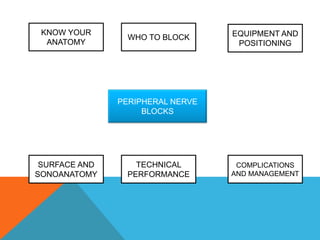
PERIPHERAL NERVE
BLOCKS
WHO TO BLOCK EQUIPMENT AND
POSITIONING
SURFACE AND
SONOANATOMY
TECHNICAL
PERFORMANCE
COMPLICATIONS
AND MANAGEMENT
KNOW YOUR
ANATOMY
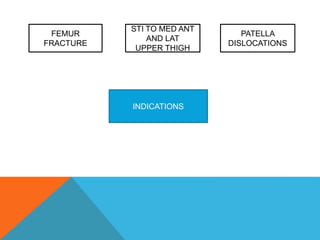
INDICATIONS
STI TO MED ANT
AND LAT
UPPER THIGH
PATELLA
DISLOCATIONS
FEMUR
FRACTURE
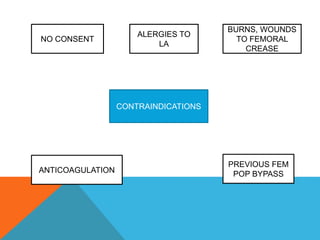
CONTRAINDICATIONS
ALERGIES TO
LA
BURNS, WOUNDS
TO FEMORAL
CREASE
PREVIOUS FEM
POP BYPASS
NO CONSENT
ANTICOAGULATION
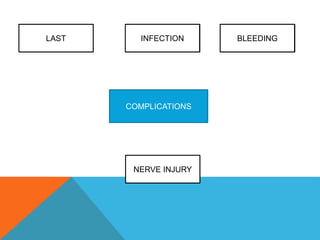
COMPLICATIONS
INFECTION BLEEDING
NERVE INJURY
INFECTION BLEEDINGLAST
EQUIPMENT
• Liner transducer
• Frequency 8-14MHz
• Better image but lesser penetration
• Depth 2-4cm
• Blunt needles to avoid neuronal damage
TECHNICAL PERFORMANCE
• Patient supine
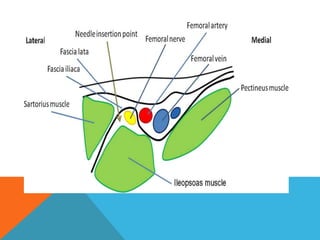
• Transverse probe position, initially over femoral artery at or immediately
to inguinal crease
• Slide transducer laterally
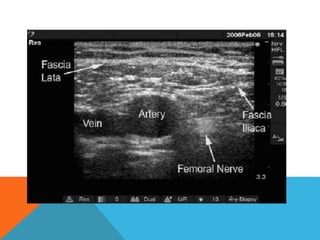
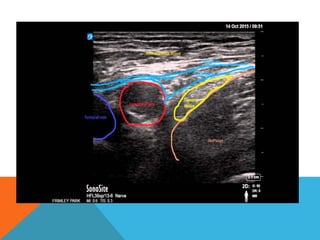
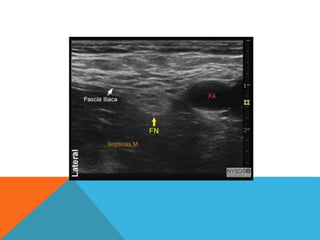
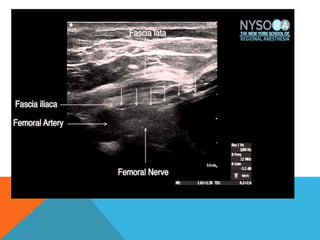
• Identify HYPERECHOIC oval or triangular shaped femoral nerve lateral
to the artery on the iliopsoas muscle, under fascia iliaca
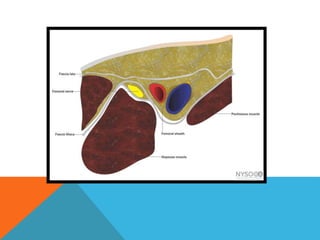
• Femoral nerve triangle created by the femoral artery medially, fascial planes
anteriorly and the iliopsoas muscle posteriorly
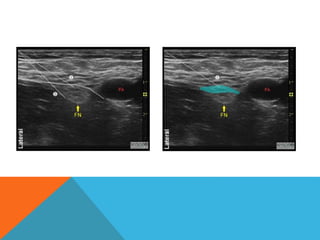
• Place needle between iliopsoas muscle and its facia, 1 cm lateral to the
nerve.
• Inject LA at this position resulting in a spread of LA around the nerve
TIPS
• Ensure haem negative aspiration prior to injecting 10-20ml of LA
• Hydrodissection
• Avoid resistance to injection to reduce risk of intraneural injection
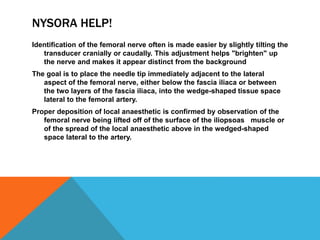
NYSORA HELP!
Identification of the femoral nerve often is made easier by slightly tilting the
transducer cranially or caudally. This adjustment helps "brighten" up
the nerve and makes it appear distinct from the background
The goal is to place the needle tip immediately adjacent to the lateral
aspect of the femoral nerve, either below the fascia iliaca or between
the two layers of the fascia iliaca, into the wedge-shaped tissue space
lateral to the femoral artery.
Proper deposition of local anaesthetic is confirmed by observation of the
femoral nerve being lifted off of the surface of the iliopsoas muscle or
of the spread of the local anaesthetic above in the wedged-shaped
space lateral to the artery.
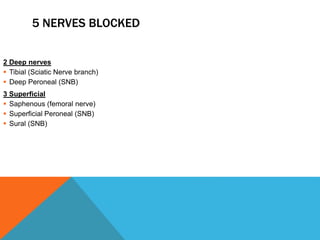
5 NERVES BLOCKED
2 Deep nerves
 Tibial (Sciatic Nerve branch)
 Deep Peroneal (SNB)
3 Superficial
 Saphenous (femoral nerve)
 Superficial Peroneal (SNB)
 Sural (SNB)
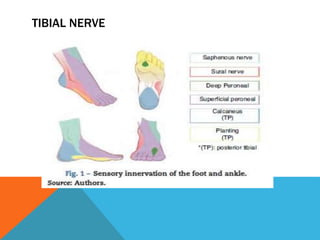
TIBIAL NERVE
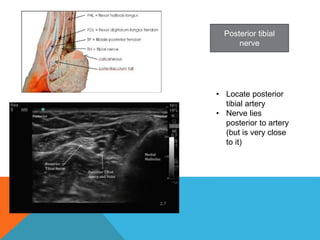
Posterior tibial
nerve
• Locate posterior
tibial artery
• Nerve lies
posterior to artery
(but is very close
to it)
TIPS
Use a small needle to minimize pain-22G
3-5ml (6-10ml) of LA (as opposed to the large volumes for the femoral nerve
block)
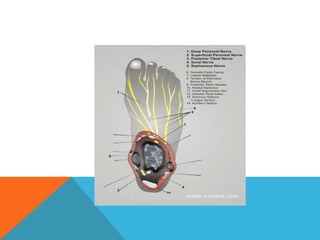
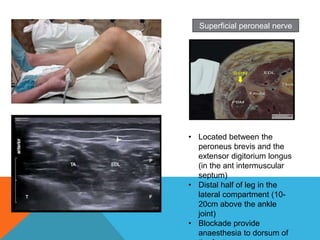
Superficial peroneal nerve
• Located between the
peroneus brevis and the
extensor digitorium longus
(in the ant intermuscular
septum)
• Distal half of leg in the
lateral compartment (10-
20cm above the ankle
joint)
• Blockade provide
anaesthesia to dorsum of
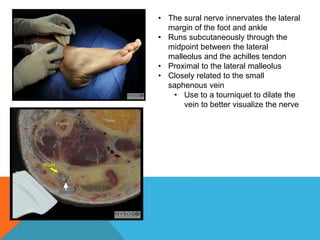
• The sural nerve innervates the lateral
margin of the foot and ankle
• Runs subcutaneously through the
midpoint between the lateral
malleolus and the achilles tendon
• Proximal to the lateral malleolus
• Closely related to the small
saphenous vein
• Use to a tourniquet to dilate the
vein to better visualize the nerve
WITH THANKS TO
NYSORA: New York School of Regional Anaesthesia
Emory university school of medicine
USRA: Advancing the Science of Ultrasound guided Regional Anaesthesia

US Guided Lower Limb Nerve Blocks

  • 2.
    PERIPHERAL NERVE BLOCKS WHO TOBLOCK EQUIPMENT AND POSITIONING SURFACE AND SONOANATOMY TECHNICAL PERFORMANCE COMPLICATIONS AND MANAGEMENT KNOW YOUR ANATOMY
  • 4.
    INDICATIONS STI TO MEDANT AND LAT UPPER THIGH PATELLA DISLOCATIONS FEMUR FRACTURE
  • 5.
    CONTRAINDICATIONS ALERGIES TO LA BURNS, WOUNDS TOFEMORAL CREASE PREVIOUS FEM POP BYPASS NO CONSENT ANTICOAGULATION
  • 6.
  • 7.
    EQUIPMENT • Liner transducer •Frequency 8-14MHz • Better image but lesser penetration • Depth 2-4cm • Blunt needles to avoid neuronal damage
  • 8.
    TECHNICAL PERFORMANCE • Patientsupine • Transverse probe position, initially over femoral artery at or immediately to inguinal crease • Slide transducer laterally • Identify HYPERECHOIC oval or triangular shaped femoral nerve lateral to the artery on the iliopsoas muscle, under fascia iliaca • Femoral nerve triangle created by the femoral artery medially, fascial planes anteriorly and the iliopsoas muscle posteriorly • Place needle between iliopsoas muscle and its facia, 1 cm lateral to the nerve. • Inject LA at this position resulting in a spread of LA around the nerve
  • 9.
    TIPS • Ensure haemnegative aspiration prior to injecting 10-20ml of LA • Hydrodissection • Avoid resistance to injection to reduce risk of intraneural injection
  • 10.
    NYSORA HELP! Identification ofthe femoral nerve often is made easier by slightly tilting the transducer cranially or caudally. This adjustment helps "brighten" up the nerve and makes it appear distinct from the background The goal is to place the needle tip immediately adjacent to the lateral aspect of the femoral nerve, either below the fascia iliaca or between the two layers of the fascia iliaca, into the wedge-shaped tissue space lateral to the femoral artery. Proper deposition of local anaesthetic is confirmed by observation of the femoral nerve being lifted off of the surface of the iliopsoas muscle or of the spread of the local anaesthetic above in the wedged-shaped space lateral to the artery.
  • 19.
    5 NERVES BLOCKED 2Deep nerves  Tibial (Sciatic Nerve branch)  Deep Peroneal (SNB) 3 Superficial  Saphenous (femoral nerve)  Superficial Peroneal (SNB)  Sural (SNB)
  • 20.
  • 22.
    Posterior tibial nerve • Locateposterior tibial artery • Nerve lies posterior to artery (but is very close to it)
  • 23.
    TIPS Use a smallneedle to minimize pain-22G 3-5ml (6-10ml) of LA (as opposed to the large volumes for the femoral nerve block)
  • 24.
    Superficial peroneal nerve •Located between the peroneus brevis and the extensor digitorium longus (in the ant intermuscular septum) • Distal half of leg in the lateral compartment (10- 20cm above the ankle joint) • Blockade provide anaesthesia to dorsum of
  • 25.
    • The suralnerve innervates the lateral margin of the foot and ankle • Runs subcutaneously through the midpoint between the lateral malleolus and the achilles tendon • Proximal to the lateral malleolus • Closely related to the small saphenous vein • Use to a tourniquet to dilate the vein to better visualize the nerve
  • 26.
    WITH THANKS TO NYSORA:New York School of Regional Anaesthesia Emory university school of medicine USRA: Advancing the Science of Ultrasound guided Regional Anaesthesia

Editor's Notes

  • #5 Lateralfemoral cutaneous nerve an obturator nerve
  • #9 Goal: visualise femoral artery.