kEY cONCEPTS iN pOST-OPERATIVE pAIN
mANAGEMENT
Dr Pranav Bansal
Associate Professor
Dept of Anaesthesiology
BPS Govt. Medical College for Women, Khanpur Kalan, Sonepat
An unpleasant sensory and emotional experience
associated with actual or potential tissue damage or
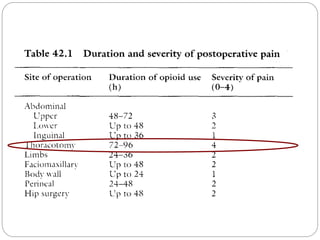
described in terms of such damage.
IASP Pain Definition (1994, 2008)
According to Katz and Melzack, pain is a personal
and subjective experience that can only be felt by
the sufferer.
It is easier to find men who will volunteer to die, than to find
those who are willing to endure pain with patience. Julius
Caesar
What is Pain?
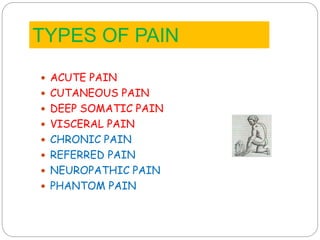
 ACUTE PAIN
 CUTANEOUS PAIN
 DEEP SOMATIC PAIN
 VISCERAL PAIN
 CHRONIC PAIN
 REFERRED PAIN
 NEUROPATHIC PAIN
 PHANTOM PAIN
TYPES OF PAIN
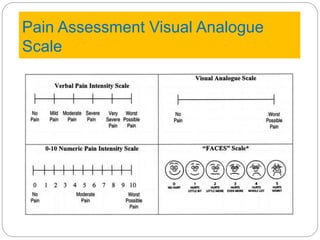
Pain Assessment Visual Analogue
Scale
Why Treat Pain?
 Basic human right!
 Moral responsiblity
 ↓ suffering and post operative complications
 ↓ likelihood of chronic pain development
 ↑ patient satisfaction
Consequences of poorly managed
acute post-operative pain
 The Patient may suffer from:
 CVS: Tachycardias, dysrhythmias, Ischaemia
 Resp: atelectasis, pneumonia
 GI: ileus, anastamosis failure
 Hypercoagulable state: DVT
 Impaired immunological state:
Delayed wound healing
 Psychological:
 Anxiety, Depression, Fatigue, Sleep
Deprivation
 Chronic Post-surgery Pain
 ForThe Healthcare professional:
 Low Morale
 Complaints to/towards/against Institute
 Litigation
Consequences of poorly managed
acute post-operative pain
CAUSES OF VARIATION IN ANALGESIC
REQUIREMENTS
 Site and type of surgery
 Age, gender
 Psychological factors
 Pharmacokinetic variability
 Pharmacodynamic variability
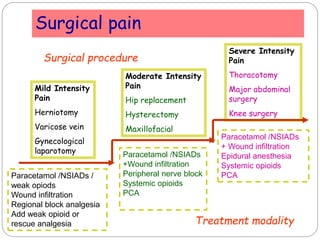
Surgical pain
Mild Intensity
Pain
Herniotomy
Varicose vein
Gynecological
laparotomy
Moderate Intensity
Pain
Hip replacement
Hysterectomy
Maxillofacial
Severe Intensity
Pain
Thoracotomy
Major abdominal
surgery
Knee surgery
Paracetamol /NSIADs /
weak opiods
Wound infiltration
Regional block analgesia
Add weak opioid or
rescue analgesia
Paracetamol /NSIADs
+Wound infiltration
Peripheral nerve block
Systemic opioids
PCA
Paracetamol /NSIADs
+ Wound infiltration
Epidural anesthesia
Systemic opioids
PCA
Treatment modality
Surgical procedure
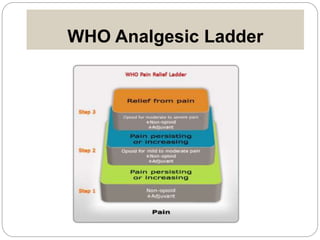
WHO Analgesic Ladder
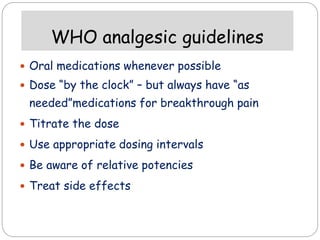
WHO analgesic guidelines
 Oral medications whenever possible
 Dose “by the clock” – but always have “as
needed”medications for breakthrough pain
 Titrate the dose
 Use appropriate dosing intervals
 Be aware of relative potencies
 Treat side effects
Multimodal (Balanced) Analgesia
Using more than one drug for pain control
 Different drugs with different mechanisms/
sites of action along pain pathway
 Each with a lower dose than if used alone
 Can provide additive or synergistic effects
 Provides better analgesia with less side
effects (mainly opiate related S/E)
Always consider multimodal analgesia when treating pain
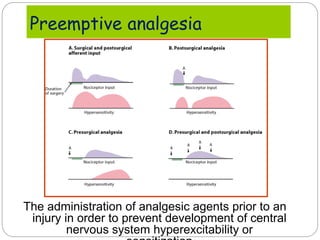
The administration of analgesic agents prior to an
injury in order to prevent development of central
nervous system hyperexcitability or
Preemptive analgesia
Methods to Treat Postoperative Pain
 Pharmacologic (Medications (PO/IV/PR)
 Acetaminophen (Paracetamol)
 NSAIDs
 Opioids
 Alpha-2 agonists
 Procedures
 Regional Anesthesia
 LA infiltration at incision site
 Nonpharmacologic Approaches
 Music and Audioanalgesia
 Transcutaneous electrical nerve stimulation (TENS)
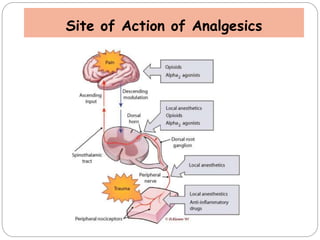
Site of Action of Analgesics
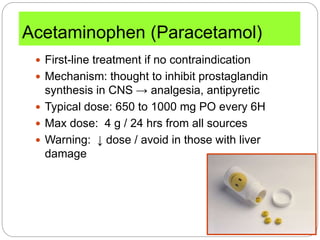
Acetaminophen (Paracetamol)
 First-line treatment if no contraindication
 Mechanism: thought to inhibit prostaglandin
synthesis in CNS → analgesia, antipyretic
 Typical dose: 650 to 1000 mg PO every 6H
 Max dose: 4 g / 24 hrs from all sources
 Warning: ↓ dose / avoid in those with liver
damage
NSAIDs
 First-line treatment
 Mechanism
 Block cyclooxygenase (COX) enzyme → ↓
prostaglandin synthesis
 COX-2 → Prostaglandins → pain, inflammation,
fever
 COX-1 → Prostaglandins → gastric protection,
hemostasis
 No physical dependence
No tolerance
Ceiling effect
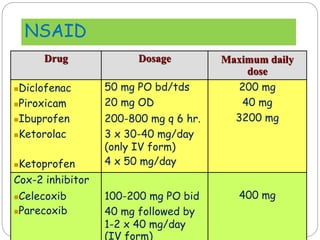
NSAID
Drug Dosage Maximum daily
dose
Diclofenac
Piroxicam
Ibuprofen
Ketorolac
Ketoprofen
50 mg PO bd/tds
20 mg OD
200-800 mg q 6 hr.
3 x 30-40 mg/day
(only IV form)
4 x 50 mg/day
200 mg
40 mg
3200 mg
Cox-2 inhibitor
Celecoxib
Parecoxib
100-200 mg PO bid
40 mg followed by
1-2 x 40 mg/day
(IV form)
400 mg
NSAIDs
 Warnings: ↓dose / avoid if
 GI ulceration
 Bleeding disorders / Coagulopathy
 Renal dysfunction
 High cardiac risk – COXII inhibitors
 Asthma
 Allergy
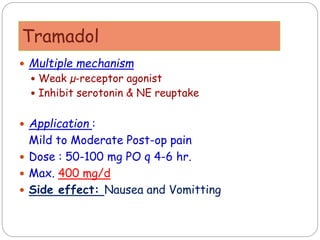
Tramadol
 Multiple mechanism
 Weak µ-receptor agonist
 Inhibit serotonin & NE reuptake
 Application :
Mild to Moderate Post-op pain
 Dose : 50-100 mg PO q 4-6 hr.
 Max. 400 mg/d
 Side effect: Nausea and Vomitting
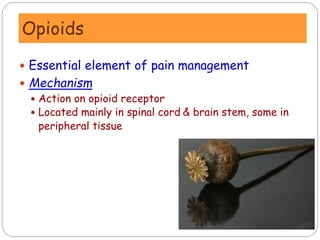
Opioids
 Essential element of pain management
 Mechanism
 Action on opioid receptor
 Located mainly in spinal cord & brain stem, some in
peripheral tissue
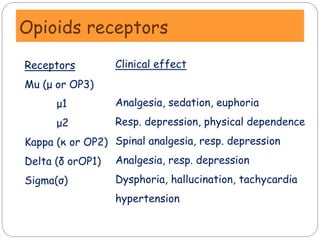
Opioids receptors
Receptors
Mu (μ or OP3)
μ1
μ2
Kappa (κ or OP2)
Delta (δ orOP1)
Sigma(σ)
Clinical effect
Analgesia, sedation, euphoria
Resp. depression, physical dependence
Spinal analgesia, resp. depression
Analgesia, resp. depression
Dysphoria, hallucination, tachycardia
hypertension
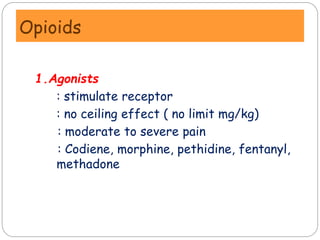
Opioids
1.Agonists
: stimulate receptor
: no ceiling effect ( no limit mg/kg)
: moderate to severe pain
: Codiene, morphine, pethidine, fentanyl,
methadone
Opioids
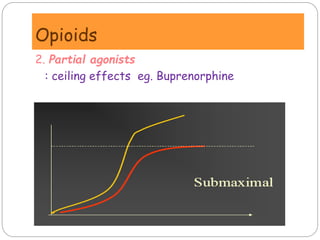
2. Partial agonists
: ceiling effects eg. Buprenorphine
Opioids
3. Agonists-antagonists
: agonist-κ or σ receptor
but antagonist to μ receptor
: can used in mild to moderate pain
: ceiling effects
: precipitate withdrawal in opioids
dependent
E.g: Pentazocine, Nalbuphine, Nalorphine
Side Effects include:
 Nausea / Vomiting, Pruritus, Constipation, Urinary
Retention, Ileus, Sedation, Respiratory Depression,
Tolerance
 Opioid Overdose
Manifests as Somnilence, respiratory depression,
bradycardia, miosis.
 Management:
 Stimulate patient
 Attach Monitors/ IV Lines and record Vitals
 Airway, Breathing, Circulation
 Shift to ICU
Opioids
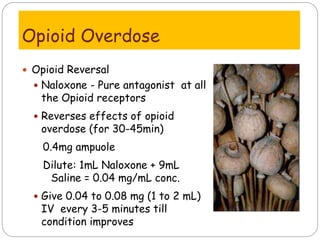
Opioid Overdose
 Opioid Reversal
 Naloxone - Pure antagonist at all
the Opioid receptors
 Reverses effects of opioid
overdose (for 30-45min)
0.4mg ampuole
Dilute: 1mL Naloxone + 9mL
Saline = 0.04 mg/mL conc.
 Give 0.04 to 0.08 mg (1 to 2 mL)
IV every 3-5 minutes till
condition improves
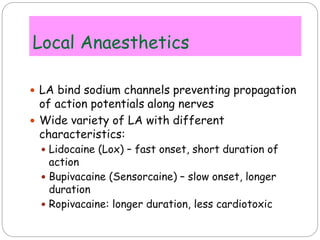
Local Anaesthetics
 LA bind sodium channels preventing propagation
of action potentials along nerves
 Wide variety of LA with different
characteristics:
 Lidocaine (Lox) – fast onset, short duration of
action
 Bupivacaine (Sensorcaine) – slow onset, longer
duration
 Ropivacaine: longer duration, less cardiotoxic
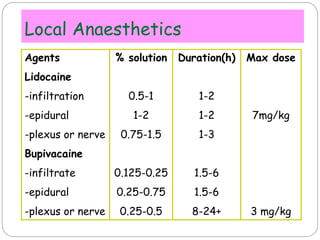
Agents
Lidocaine
-infiltration
-epidural
-plexus or nerve
Bupivacaine
-infiltrate
-epidural
-plexus or nerve
% solution
0.5-1
1-2
0.75-1.5
0.125-0.25
0.25-0.75
0.25-0.5
Duration(h)
1-2
1-2
1-3
1.5-6
1.5-6
8-24+
Max dose
7mg/kg
3 mg/kg
Local Anaesthetics
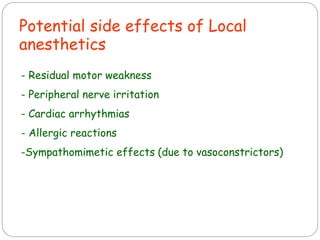
Potential side effects of Local
anesthetics
- Residual motor weakness
- Peripheral nerve irritation
- Cardiac arrhythmias
- Allergic reactions
-Sympathomimetic effects (due to vasoconstrictors)
Regional Anesthesia techniques in
PostOperative Pain Management
Peripheral nerve blocks
Ilioinguinal/hypogastric : herniorrhaphy
Brachial plexus : arm, hand
Thoracic: Intrapleural Regional Anaesthesia (IPRA),
Paravertebral, intercostal blocks
Penile : circumcision
Intercostal/paravertebral : breast
Lower Limb: Femoral, sciatic, popliteal, ankle
Paracervical : F&C, D&C, cone biopsy
Abdomen:TAP blocks
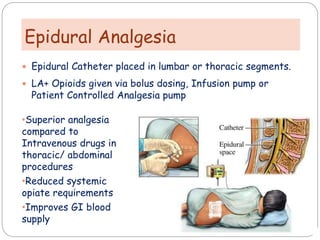
Epidural Analgesia
 Epidural Catheter placed in lumbar or thoracic segments.
 LA+ Opioids given via bolus dosing, Infusion pump or
Patient Controlled Analgesia pump
•Superior analgesia
compared to
Intravenous drugs in
thoracic/ abdominal
procedures
•Reduced systemic
opiate requirements
•Improves GI blood
supply
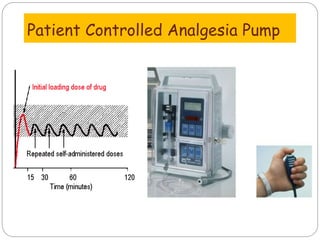
Patient Controlled Analgesia Pump
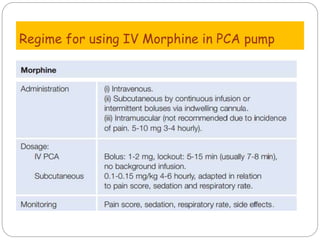
Regime for using IV Morphine in PCA pump
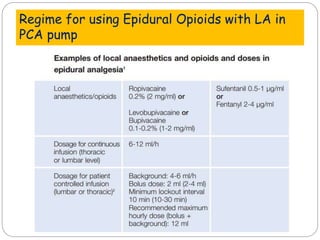
Regime for using Epidural Opioids with LA in
PCA pump
Advantages of PCA:
 Allows patient participation and gives them
autonomy in their treatment
 Rapid titration
 Precise Analgesic calculations for scientific
studies
 Reduced analgesic requirements
 Reduced incidence of breakthrough pain
 Less staffing and monitoring concerns
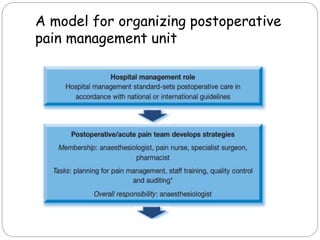
A model for organizing postoperative
pain management unit
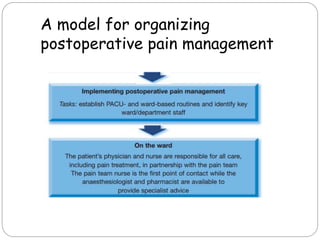
A model for organizing
postoperative pain management
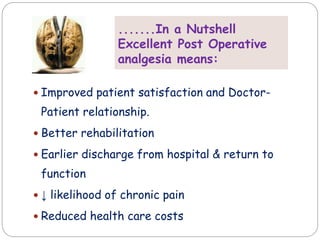
.......In a Nutshell
Excellent Post Operative
analgesia means:
 Improved patient satisfaction and Doctor-
Patient relationship.
 Better rehabilitation
 Earlier discharge from hospital & return to
function
 ↓ likelihood of chronic pain
 Reduced health care costs
Pranav post operative pain management

Pranav post operative pain management

  • 1.
    kEY cONCEPTS iNpOST-OPERATIVE pAIN mANAGEMENT Dr Pranav Bansal Associate Professor Dept of Anaesthesiology BPS Govt. Medical College for Women, Khanpur Kalan, Sonepat
  • 2.
    An unpleasant sensoryand emotional experience associated with actual or potential tissue damage or described in terms of such damage. IASP Pain Definition (1994, 2008) According to Katz and Melzack, pain is a personal and subjective experience that can only be felt by the sufferer. It is easier to find men who will volunteer to die, than to find those who are willing to endure pain with patience. Julius Caesar What is Pain?
  • 3.
     ACUTE PAIN CUTANEOUS PAIN  DEEP SOMATIC PAIN  VISCERAL PAIN  CHRONIC PAIN  REFERRED PAIN  NEUROPATHIC PAIN  PHANTOM PAIN TYPES OF PAIN
  • 4.
    Pain Assessment VisualAnalogue Scale
  • 5.
    Why Treat Pain? Basic human right!  Moral responsiblity  ↓ suffering and post operative complications  ↓ likelihood of chronic pain development  ↑ patient satisfaction
  • 6.
    Consequences of poorlymanaged acute post-operative pain  The Patient may suffer from:  CVS: Tachycardias, dysrhythmias, Ischaemia  Resp: atelectasis, pneumonia  GI: ileus, anastamosis failure  Hypercoagulable state: DVT  Impaired immunological state: Delayed wound healing
  • 7.
     Psychological:  Anxiety,Depression, Fatigue, Sleep Deprivation  Chronic Post-surgery Pain  ForThe Healthcare professional:  Low Morale  Complaints to/towards/against Institute  Litigation Consequences of poorly managed acute post-operative pain
  • 8.
    CAUSES OF VARIATIONIN ANALGESIC REQUIREMENTS  Site and type of surgery  Age, gender  Psychological factors  Pharmacokinetic variability  Pharmacodynamic variability
  • 10.
    Surgical pain Mild Intensity Pain Herniotomy Varicosevein Gynecological laparotomy Moderate Intensity Pain Hip replacement Hysterectomy Maxillofacial Severe Intensity Pain Thoracotomy Major abdominal surgery Knee surgery Paracetamol /NSIADs / weak opiods Wound infiltration Regional block analgesia Add weak opioid or rescue analgesia Paracetamol /NSIADs +Wound infiltration Peripheral nerve block Systemic opioids PCA Paracetamol /NSIADs + Wound infiltration Epidural anesthesia Systemic opioids PCA Treatment modality Surgical procedure
  • 11.
  • 12.
    WHO analgesic guidelines Oral medications whenever possible  Dose “by the clock” – but always have “as needed”medications for breakthrough pain  Titrate the dose  Use appropriate dosing intervals  Be aware of relative potencies  Treat side effects
  • 13.
    Multimodal (Balanced) Analgesia Usingmore than one drug for pain control  Different drugs with different mechanisms/ sites of action along pain pathway  Each with a lower dose than if used alone  Can provide additive or synergistic effects  Provides better analgesia with less side effects (mainly opiate related S/E) Always consider multimodal analgesia when treating pain
  • 14.
    The administration ofanalgesic agents prior to an injury in order to prevent development of central nervous system hyperexcitability or Preemptive analgesia
  • 15.
    Methods to TreatPostoperative Pain  Pharmacologic (Medications (PO/IV/PR)  Acetaminophen (Paracetamol)  NSAIDs  Opioids  Alpha-2 agonists  Procedures  Regional Anesthesia  LA infiltration at incision site  Nonpharmacologic Approaches  Music and Audioanalgesia  Transcutaneous electrical nerve stimulation (TENS)
  • 16.
    Site of Actionof Analgesics
  • 17.
    Acetaminophen (Paracetamol)  First-linetreatment if no contraindication  Mechanism: thought to inhibit prostaglandin synthesis in CNS → analgesia, antipyretic  Typical dose: 650 to 1000 mg PO every 6H  Max dose: 4 g / 24 hrs from all sources  Warning: ↓ dose / avoid in those with liver damage
  • 18.
    NSAIDs  First-line treatment Mechanism  Block cyclooxygenase (COX) enzyme → ↓ prostaglandin synthesis  COX-2 → Prostaglandins → pain, inflammation, fever  COX-1 → Prostaglandins → gastric protection, hemostasis  No physical dependence No tolerance Ceiling effect
  • 19.
    NSAID Drug Dosage Maximumdaily dose Diclofenac Piroxicam Ibuprofen Ketorolac Ketoprofen 50 mg PO bd/tds 20 mg OD 200-800 mg q 6 hr. 3 x 30-40 mg/day (only IV form) 4 x 50 mg/day 200 mg 40 mg 3200 mg Cox-2 inhibitor Celecoxib Parecoxib 100-200 mg PO bid 40 mg followed by 1-2 x 40 mg/day (IV form) 400 mg
  • 20.
    NSAIDs  Warnings: ↓dose/ avoid if  GI ulceration  Bleeding disorders / Coagulopathy  Renal dysfunction  High cardiac risk – COXII inhibitors  Asthma  Allergy
  • 21.
    Tramadol  Multiple mechanism Weak µ-receptor agonist  Inhibit serotonin & NE reuptake  Application : Mild to Moderate Post-op pain  Dose : 50-100 mg PO q 4-6 hr.  Max. 400 mg/d  Side effect: Nausea and Vomitting
  • 22.
    Opioids  Essential elementof pain management  Mechanism  Action on opioid receptor  Located mainly in spinal cord & brain stem, some in peripheral tissue
  • 23.
    Opioids receptors Receptors Mu (μor OP3) μ1 μ2 Kappa (κ or OP2) Delta (δ orOP1) Sigma(σ) Clinical effect Analgesia, sedation, euphoria Resp. depression, physical dependence Spinal analgesia, resp. depression Analgesia, resp. depression Dysphoria, hallucination, tachycardia hypertension
  • 24.
    Opioids 1.Agonists : stimulate receptor :no ceiling effect ( no limit mg/kg) : moderate to severe pain : Codiene, morphine, pethidine, fentanyl, methadone
  • 25.
    Opioids 2. Partial agonists :ceiling effects eg. Buprenorphine
  • 26.
    Opioids 3. Agonists-antagonists : agonist-κor σ receptor but antagonist to μ receptor : can used in mild to moderate pain : ceiling effects : precipitate withdrawal in opioids dependent E.g: Pentazocine, Nalbuphine, Nalorphine
  • 27.
    Side Effects include: Nausea / Vomiting, Pruritus, Constipation, Urinary Retention, Ileus, Sedation, Respiratory Depression, Tolerance  Opioid Overdose Manifests as Somnilence, respiratory depression, bradycardia, miosis.  Management:  Stimulate patient  Attach Monitors/ IV Lines and record Vitals  Airway, Breathing, Circulation  Shift to ICU Opioids
  • 28.
    Opioid Overdose  OpioidReversal  Naloxone - Pure antagonist at all the Opioid receptors  Reverses effects of opioid overdose (for 30-45min) 0.4mg ampuole Dilute: 1mL Naloxone + 9mL Saline = 0.04 mg/mL conc.  Give 0.04 to 0.08 mg (1 to 2 mL) IV every 3-5 minutes till condition improves
  • 29.
    Local Anaesthetics  LAbind sodium channels preventing propagation of action potentials along nerves  Wide variety of LA with different characteristics:  Lidocaine (Lox) – fast onset, short duration of action  Bupivacaine (Sensorcaine) – slow onset, longer duration  Ropivacaine: longer duration, less cardiotoxic
  • 30.
    Agents Lidocaine -infiltration -epidural -plexus or nerve Bupivacaine -infiltrate -epidural -plexusor nerve % solution 0.5-1 1-2 0.75-1.5 0.125-0.25 0.25-0.75 0.25-0.5 Duration(h) 1-2 1-2 1-3 1.5-6 1.5-6 8-24+ Max dose 7mg/kg 3 mg/kg Local Anaesthetics
  • 31.
    Potential side effectsof Local anesthetics - Residual motor weakness - Peripheral nerve irritation - Cardiac arrhythmias - Allergic reactions -Sympathomimetic effects (due to vasoconstrictors)
  • 32.
    Regional Anesthesia techniquesin PostOperative Pain Management
  • 33.
    Peripheral nerve blocks Ilioinguinal/hypogastric: herniorrhaphy Brachial plexus : arm, hand Thoracic: Intrapleural Regional Anaesthesia (IPRA), Paravertebral, intercostal blocks Penile : circumcision Intercostal/paravertebral : breast Lower Limb: Femoral, sciatic, popliteal, ankle Paracervical : F&C, D&C, cone biopsy Abdomen:TAP blocks
  • 34.
    Epidural Analgesia  EpiduralCatheter placed in lumbar or thoracic segments.  LA+ Opioids given via bolus dosing, Infusion pump or Patient Controlled Analgesia pump •Superior analgesia compared to Intravenous drugs in thoracic/ abdominal procedures •Reduced systemic opiate requirements •Improves GI blood supply
  • 35.
  • 36.
    Regime for usingIV Morphine in PCA pump
  • 37.
    Regime for usingEpidural Opioids with LA in PCA pump
  • 38.
    Advantages of PCA: Allows patient participation and gives them autonomy in their treatment  Rapid titration  Precise Analgesic calculations for scientific studies  Reduced analgesic requirements  Reduced incidence of breakthrough pain  Less staffing and monitoring concerns
  • 39.
    A model fororganizing postoperative pain management unit
  • 40.
    A model fororganizing postoperative pain management
  • 41.
    .......In a Nutshell ExcellentPost Operative analgesia means:  Improved patient satisfaction and Doctor- Patient relationship.  Better rehabilitation  Earlier discharge from hospital & return to function  ↓ likelihood of chronic pain  Reduced health care costs