PAIN MANAGEMENT
BY
DR.DHARATI
1
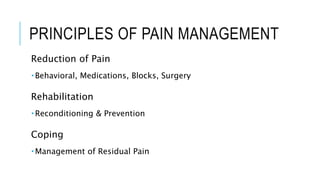
PRINCIPLES OF PAIN MANAGEMENT
Reduction of Pain
 Behavioral, Medications, Blocks, Surgery
Rehabilitation
 Reconditioning & Prevention
Coping
 Management of Residual Pain
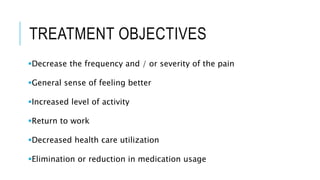
TREATMENT OBJECTIVES
Decrease the frequency and / or severity of the pain
General sense of feeling better
Increased level of activity
Return to work
Decreased health care utilization
Elimination or reduction in medication usage
MANAGEMENT (GENERAL
CONSIDERATION)
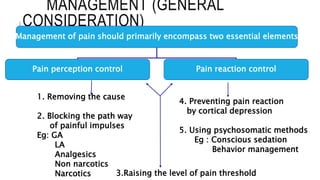
Management of pain should primarily encompass two essential elements
Pain perception control Pain reaction control
1. Removing the cause
2. Blocking the path way
of painful impulses
Eg: GA
LA
Analgesics
Non narcotics
Narcotics
4. Preventing pain reaction
by cortical depression
5. Using psychosomatic methods
Eg : Conscious sedation
Behavior management
3.Raising the level of pain threshold
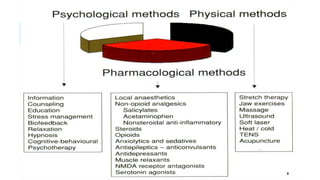
METHODS OF PAIN CONTROL
5
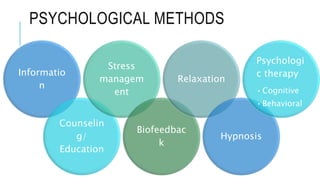
PSYCHOLOGICAL METHODS
Informatio
n
Counselin
g/
Education
Stress
managem
ent
Biofeedbac
k
Relaxation
Hypnosis
Psychologi
c therapy
•Cognitive
•Behavioral
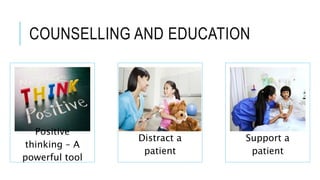
COUNSELLING AND EDUCATION
Positive
thinking – A
powerful tool
Distract a
patient
Support a
patient
STRESS MANAGEMENT
Emotional and physical pain are closely related, and persistent
pain can lead to increased levels of stress.
Learning how to deal with stress in healthy ways can position a
patient to cope more effectively with his chronic pain.
Eating well, getting plenty of sleep and engaging in other
physical activity are all positive ways for patient to handle stress
and pain.
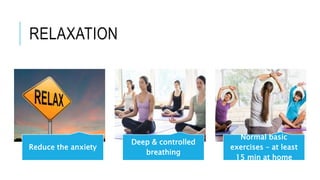
RELAXATION
Reduce the anxiety
Deep & controlled
breathing
Normal basic
exercises – at least
15 min at home
BIOFEEDBACK (BUONOMONO,1979)
One technique can help to gain more control over normally
involuntary functions – called biofeedback
This therapy used to help prevent or treat conditions like migraine
headache , chronic pain, and high blood pressure.
The idea behind it is that by becoming aware of what’s going inside
your body you can gain more control over your health.
HYPNOSIS
The induction of a state of consciousness in which a person
apparently loses the power of voluntary action and is highly
responsive to suggestion or direction.
First suggest by Franz A Mesmer – 1773
Uses
To reduce anxiety, nervousness and pain
To control functional and psychosomatic gapping
To induce anesthesia
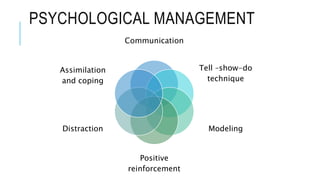
PSYCHOLOGICAL MANAGEMENT
Communication
Tell –show-do
technique
Modeling
Positive
reinforcement
Distraction
Assimilation
and coping
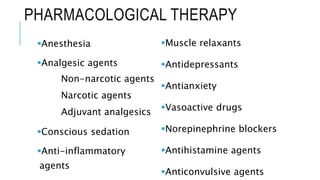
PHARMACOLOGICAL THERAPY
Anesthesia
Analgesic agents
Non-narcotic agents
Narcotic agents
Adjuvant analgesics
Conscious sedation
Anti-inflammatory
agents
Muscle relaxants
Antidepressants
Antianxiety
Vasoactive drugs
Norepinephrine blockers
Antihistamine agents

Anticonvulsive agents
ANESTHESIA
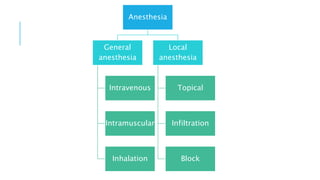
Anesthesia
General
anesthesia
Intravenous
Intramuscular
Inhalation
Local
anesthesia
Topical
Infiltration
Block
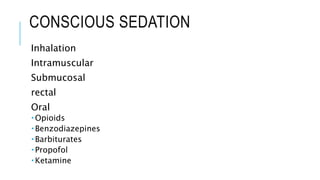
CONSCIOUS SEDATION
Inhalation
Intramuscular
Submucosal
rectal
Oral
 Opioids
 Benzodiazepines
 Barbiturates
 Propofol
 Ketamine
ANALGESIC
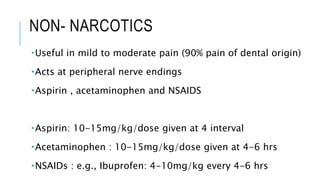
NON- NARCOTICS
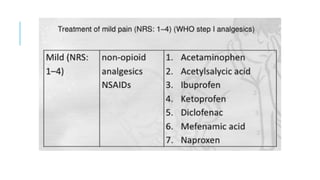
Useful in mild to moderate pain (90% pain of dental origin)
Acts at peripheral nerve endings
Aspirin , acetaminophen and NSAIDS
Aspirin: 10-15mg/kg/dose given at 4 interval
Acetaminophen : 10-15mg/kg/dose given at 4-6 hrs
NSAIDs : e.g., Ibuprofen: 4-10mg/kg every 4-6 hrs
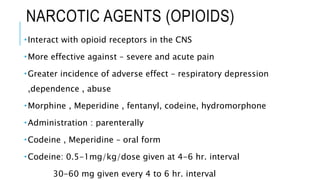
NARCOTIC AGENTS (OPIOIDS)
Interact with opioid receptors in the CNS
More effective against – severe and acute pain
Greater incidence of adverse effect – respiratory depression
,dependence , abuse
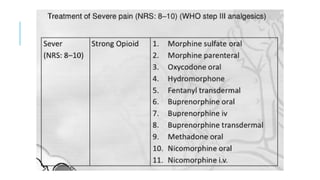
Morphine , Meperidine , fentanyl, codeine, hydromorphone
Administration : parenterally
Codeine , Meperidine – oral form
Codeine: 0.5-1mg/kg/dose given at 4-6 hr. interval
30-60 mg given every 4 to 6 hr. interval
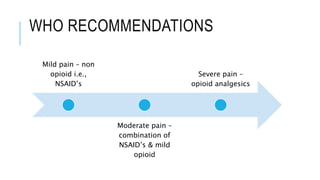
WHO RECOMMENDATIONS
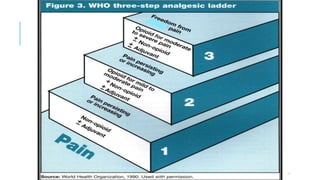
Mild pain – non
opioid i.e.,
NSAID’s
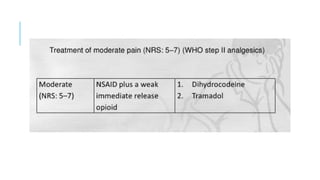
Moderate pain –
combination of
NSAID’s & mild
opioid
Severe pain –
opioid analgesics
24
25
26
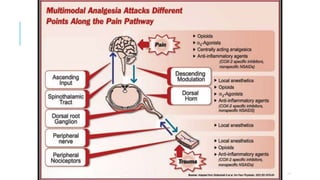
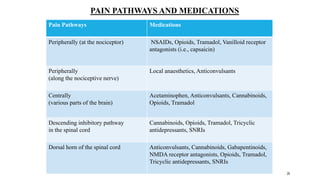
PAIN PATHWAYS AND MEDICATIONS
Pain Pathways Medications
Peripherally (at the nociceptor) NSAIDs, Opioids, Tramadol, Vanilloid receptor
antagonists (i.e., capsaicin)
Peripherally
(along the nociceptive nerve)
Local anaesthetics, Anticonvulsants
Centrally
(various parts of the brain)
Acetaminophen, Anticonvulsants, Cannabinoids,
Opioids, Tramadol
Descending inhibitory pathway
in the spinal cord
Cannabinoids, Opioids, Tramadol, Tricyclic
antidepressants, SNRIs
Dorsal horn of the spinal cord Anticonvulsants, Cannabinoids, Gabapentinoids,
NMDA receptor antagonists, Opioids, Tramadol,
Tricyclic antidepressants, SNRIs
PHYSICAL THERAPY
ULTRASOUND
Ultrasound is applied using a transducer or applicator that is
in direct contact with the patient's skin.
Therapeutic ultrasound in physical therapy is alternating
compression and rarefaction of sound waves with a frequency
of 0.7 to 3.3 MHz.
Conditions for which ultrasound may be used for treatment
include ligament sprains, muscle strains, tendonitis, joint
inflammation, rheumatoid arthritis, osteoarthritis, and scar
Electro galvanic stimulation
An electrical therapeutic modality sending a current to the
body at select voltages and frequencies to stimulate pain
receptors, disperse edema or neutralize muscle spasms
Deep heat
Heat therapy, also called thermotherapy, is the use of heat in
therapy, such as for pain relief.
It can take the form of a hot cloth, hot water, ultrasound,
heating pad, hydro collator packs, cordless FIR heat therapy
wraps
The therapeutic effects of heat include increasing the
extensibility of collagen tissues, decreasing joint stiffness,
reducing pain, relieving muscle spasms, reducing
Occupational therapy
Occupational therapy (OT) is the use of assessment
and treatment to develop, recover or maintain the
daily living and work skills of people with a physical,
mental, or cognitive disorder
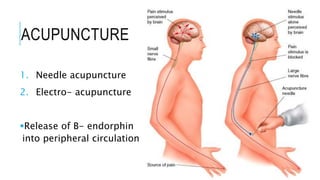
ACUPUNCTURE
1. Needle acupuncture
2. Electro- acupuncture
Release of B- endorphin
into peripheral circulation
MANUAL TECHNIQUES
Massage
Spray and stretch technique
Meditation
Exercise/Yoga
Physical activity
Postural training
SURGICAL INTERRUPTION OF PAIN
PATHWAY
Cutting the pain pathways  severing peripheral
nerves or cutting the fibers in ventrolateral spinal cord
Radicotomy / Rhizotomy
The surgical cutting of the nerve roots of the spine,
usually the sensory or posterior roots to relieve pain
or eliminate paralysis.
Peripheral first neurons
Cordotomy
Surgical procedure that disables selected pain-conducting
tracts in the spinal cord, in order to achieve loss of pain
and temperature perception. This procedure is commonly
performed on patients experiencing severe pain due to
cancer or other incurable diseases.
Tractotomy
The surgical severing of nerve tracts especially in the
Thalamotomy
Thalamotomy is the precise destruction of a tiny area
of the brain called the thalamus that controls some
involuntary movements
It is primarily effective for tremors such as those
associated with Parkinson's disease
CONCLUSION
Only with an understanding of pain ,its pathways and its origin can we
as clinicians come to a proper diagnosis and come up with a treatment
plan.
The most important part of managing pain is understanding the problem
and cause of pain. It is only through proper diagnosis and appropriate
therapy.
We must have to differentiate pains that are from dental, oral and
masticatory sources and those which emanate elsewhere.
THANK YOU
• Text book of Medical Physiology, 10th edition, Arther C Gyton.
• Dental Clinics of North America 1978: 22 (1); 1-61.
• Text book of ‘Oral medicine’- 10th edition, Burkett’s.
• Gray's Anatomy – 38th Edition, Churchill Eivingstone.
• Understanding “Medical physiology”- 3rd edition, R L Bijlani.
 Core Topics in Pain – Anita Holdcroft, Sian Jagger.
REFERENCES

Pain management

  • 1.
  • 2.
    PRINCIPLES OF PAINMANAGEMENT Reduction of Pain  Behavioral, Medications, Blocks, Surgery Rehabilitation  Reconditioning & Prevention Coping  Management of Residual Pain
  • 3.
    TREATMENT OBJECTIVES Decrease thefrequency and / or severity of the pain General sense of feeling better Increased level of activity Return to work Decreased health care utilization Elimination or reduction in medication usage
  • 4.
    MANAGEMENT (GENERAL CONSIDERATION) Management ofpain should primarily encompass two essential elements Pain perception control Pain reaction control 1. Removing the cause 2. Blocking the path way of painful impulses Eg: GA LA Analgesics Non narcotics Narcotics 4. Preventing pain reaction by cortical depression 5. Using psychosomatic methods Eg : Conscious sedation Behavior management 3.Raising the level of pain threshold
  • 5.
    METHODS OF PAINCONTROL 5
  • 6.
  • 7.
    COUNSELLING AND EDUCATION Positive thinking– A powerful tool Distract a patient Support a patient
  • 8.
    STRESS MANAGEMENT Emotional andphysical pain are closely related, and persistent pain can lead to increased levels of stress. Learning how to deal with stress in healthy ways can position a patient to cope more effectively with his chronic pain. Eating well, getting plenty of sleep and engaging in other physical activity are all positive ways for patient to handle stress and pain.
  • 9.
    RELAXATION Reduce the anxiety Deep& controlled breathing Normal basic exercises – at least 15 min at home
  • 10.
    BIOFEEDBACK (BUONOMONO,1979) One techniquecan help to gain more control over normally involuntary functions – called biofeedback This therapy used to help prevent or treat conditions like migraine headache , chronic pain, and high blood pressure. The idea behind it is that by becoming aware of what’s going inside your body you can gain more control over your health.
  • 11.
    HYPNOSIS The induction ofa state of consciousness in which a person apparently loses the power of voluntary action and is highly responsive to suggestion or direction. First suggest by Franz A Mesmer – 1773 Uses To reduce anxiety, nervousness and pain To control functional and psychosomatic gapping To induce anesthesia
  • 12.
  • 13.
    PHARMACOLOGICAL THERAPY Anesthesia Analgesic agents Non-narcoticagents Narcotic agents Adjuvant analgesics Conscious sedation Anti-inflammatory agents Muscle relaxants Antidepressants Antianxiety Vasoactive drugs Norepinephrine blockers Antihistamine agents Anticonvulsive agents
  • 14.
  • 15.
  • 16.
    CONSCIOUS SEDATION Inhalation Intramuscular Submucosal rectal Oral  Opioids Benzodiazepines  Barbiturates  Propofol  Ketamine
  • 17.
  • 18.
    NON- NARCOTICS Useful inmild to moderate pain (90% pain of dental origin) Acts at peripheral nerve endings Aspirin , acetaminophen and NSAIDS Aspirin: 10-15mg/kg/dose given at 4 interval Acetaminophen : 10-15mg/kg/dose given at 4-6 hrs NSAIDs : e.g., Ibuprofen: 4-10mg/kg every 4-6 hrs
  • 19.
    NARCOTIC AGENTS (OPIOIDS) Interactwith opioid receptors in the CNS More effective against – severe and acute pain Greater incidence of adverse effect – respiratory depression ,dependence , abuse Morphine , Meperidine , fentanyl, codeine, hydromorphone Administration : parenterally Codeine , Meperidine – oral form Codeine: 0.5-1mg/kg/dose given at 4-6 hr. interval 30-60 mg given every 4 to 6 hr. interval
  • 20.
    WHO RECOMMENDATIONS Mild pain– non opioid i.e., NSAID’s Moderate pain – combination of NSAID’s & mild opioid Severe pain – opioid analgesics
  • 24.
  • 25.
  • 26.
    26 PAIN PATHWAYS ANDMEDICATIONS Pain Pathways Medications Peripherally (at the nociceptor) NSAIDs, Opioids, Tramadol, Vanilloid receptor antagonists (i.e., capsaicin) Peripherally (along the nociceptive nerve) Local anaesthetics, Anticonvulsants Centrally (various parts of the brain) Acetaminophen, Anticonvulsants, Cannabinoids, Opioids, Tramadol Descending inhibitory pathway in the spinal cord Cannabinoids, Opioids, Tramadol, Tricyclic antidepressants, SNRIs Dorsal horn of the spinal cord Anticonvulsants, Cannabinoids, Gabapentinoids, NMDA receptor antagonists, Opioids, Tramadol, Tricyclic antidepressants, SNRIs
  • 27.
  • 28.
    ULTRASOUND Ultrasound is appliedusing a transducer or applicator that is in direct contact with the patient's skin. Therapeutic ultrasound in physical therapy is alternating compression and rarefaction of sound waves with a frequency of 0.7 to 3.3 MHz. Conditions for which ultrasound may be used for treatment include ligament sprains, muscle strains, tendonitis, joint inflammation, rheumatoid arthritis, osteoarthritis, and scar
  • 29.
    Electro galvanic stimulation Anelectrical therapeutic modality sending a current to the body at select voltages and frequencies to stimulate pain receptors, disperse edema or neutralize muscle spasms Deep heat Heat therapy, also called thermotherapy, is the use of heat in therapy, such as for pain relief. It can take the form of a hot cloth, hot water, ultrasound, heating pad, hydro collator packs, cordless FIR heat therapy wraps The therapeutic effects of heat include increasing the extensibility of collagen tissues, decreasing joint stiffness, reducing pain, relieving muscle spasms, reducing
  • 30.
    Occupational therapy Occupational therapy(OT) is the use of assessment and treatment to develop, recover or maintain the daily living and work skills of people with a physical, mental, or cognitive disorder
  • 31.
    ACUPUNCTURE 1. Needle acupuncture 2.Electro- acupuncture Release of B- endorphin into peripheral circulation
  • 32.
    MANUAL TECHNIQUES Massage Spray andstretch technique Meditation Exercise/Yoga Physical activity Postural training
  • 33.
    SURGICAL INTERRUPTION OFPAIN PATHWAY Cutting the pain pathways  severing peripheral nerves or cutting the fibers in ventrolateral spinal cord
  • 34.
    Radicotomy / Rhizotomy Thesurgical cutting of the nerve roots of the spine, usually the sensory or posterior roots to relieve pain or eliminate paralysis. Peripheral first neurons
  • 35.
    Cordotomy Surgical procedure thatdisables selected pain-conducting tracts in the spinal cord, in order to achieve loss of pain and temperature perception. This procedure is commonly performed on patients experiencing severe pain due to cancer or other incurable diseases. Tractotomy The surgical severing of nerve tracts especially in the
  • 36.
    Thalamotomy Thalamotomy is theprecise destruction of a tiny area of the brain called the thalamus that controls some involuntary movements It is primarily effective for tremors such as those associated with Parkinson's disease
  • 37.
    CONCLUSION Only with anunderstanding of pain ,its pathways and its origin can we as clinicians come to a proper diagnosis and come up with a treatment plan. The most important part of managing pain is understanding the problem and cause of pain. It is only through proper diagnosis and appropriate therapy. We must have to differentiate pains that are from dental, oral and masticatory sources and those which emanate elsewhere.
  • 38.
  • 39.
    • Text bookof Medical Physiology, 10th edition, Arther C Gyton. • Dental Clinics of North America 1978: 22 (1); 1-61. • Text book of ‘Oral medicine’- 10th edition, Burkett’s. • Gray's Anatomy – 38th Edition, Churchill Eivingstone. • Understanding “Medical physiology”- 3rd edition, R L Bijlani.  Core Topics in Pain – Anita Holdcroft, Sian Jagger. REFERENCES

Editor's Notes

  • #5 Pain threshold – a point at which the body first perceives a stimulus as being painful
  • #13 Hand shake, patting , eye contact Addlestone 1959
  • #27 NMDA- N-methyle D- receptor SNRIs- Serotonin –Norepinephrine reuptake inhibitors