PAIN MANAGEMENT
Presented By:
Mr. Abhay Rajpoot
WHAT IS PAIN?
DEFINITIONS
“PAIN” is defined as an unpleasant sensory and
emotional experience arising from actual or
potential tissue damage or described in terms of
such damage.(IASP) (mersskey & bogduk,1994).
Pain is subjective,protective,and it is modified by
developmental, behavioural, personality and
cultural factors.
FIFTH VITAL SIGN
TYPES OF PAIN
CLASSIC CATEGORY
•NOCICEPTIVE
•NEUROPATHIC
•PAIN INTENSITY
•TIME COURSE
physiology of pain
TRANSDUCTION
TRANSMISSION
PERCEPTION
MODULATION
Modulation
3
2
1
Effects of pain
Increased heart rate
 Diaphoresis
increased blood glucose
levels
dilatation of pupils
decreased GI motility
increased muscle tension
 increased respiratory
rate
THEORIES RELATED TO
PAIN
The Gate Control Theory
• Proposed by Melzack and Wall in
1965
• Stimulation of the skin evokes
nervous impulses
• Stimulation of the large diameter
fibers inhibits the transmission
of pain, thus closing the gate
SPECIFICITY THEORY
• One of the earliest pain theory.
• Proposed by Descartes in seventeenth
century.(1664)Muler(1840).
• Distinct pain receptors-free nerve
endings in the tissue.with transmission by
nerves directly to the brain.
• Pain is purely an afferent sensory
experience.
PATTERN THEORY (INTENSITY
THEORY)
Goldschneider in 1896 and expanded by
Weddell and Sinclair in 1947
Pattern of stimulation of nerve endings
determines whether the brain would
interpret stimuli as pain Attributes
sensation of pain to pattern, or
frequency and intensity of stimulation
applied that excite touch, pressure, or
temperature resources in the skin
Biochemical Theories
Biochemical Theories pain-producing, pain-
mediating and pain chemoreceptors are
located in the brain Endogenous opiates –
inhibits pain by blocking substance P
Periacquedactal gray area Chemical pain
mediators and inhibitors Bradykinin e.
acetylcholine Substance P f. capsaicin
Histamine g. Potassium ions prostaglandin
NURSING ASSESSMENT OF
PAIN
CHARACTERISTICS OF PAIN
• INTENSITY
• TIMING
• LOCATION
• QUALITY
• PERSONAL MEANING
• AGGRAVATING AND ALLEVIATING
FACTORS
• PAIN BEHAVIOURS
FACES PAIN SCALE
THE NURSE’S ROLE IN PAIN
MANAGEMENT
• IDENTIFYING GOALS FOR PAIN
MANAGEMENT
• ESTABLISHING THE NURSE-PATIENT
RELATIONSHIP AND TEACHING
• PROVIDING PHYSICAL CARE
• MANAGING ANXIETY RELATED TO
PAIN
PAIN MANAGEMENT
STRATEGIES
• Pain management strategies include both
pharmacologic and nonpharmacologic
approaches.
• PHARMACOLOGIC INTERVENTIONS
• NON-PHARMACOLOGIC
INTERVENTIONS
PHARMACOLOGIC
INTERVENTIONS
Mild pain
Paracetamol (acetaminophen), or a
non steroidal anti-inflammatory drug
(NSAID) such as ibuprofen or
aspirin. NSAIDS have anti-
inflammatory, analgesic and
antipyretic effects. The anti-
inflammatory action relieves pain by
interfering with cyclooxygenase.
Mild to moderate pain
Mild to moderate pain Paracetamol,
an NSAID and/or paracetamol in a
combination product with a weak
opioid such as hydrocodone, may
provide greater relief than their
separate use. Also combination of
opioid with acetaminophen can be
frequently used such as Percocet,
Vicodin, or Norco.
Moderate to severe pain
When treating moderate to severe pain,
the type of the pain, acute or chronic,
needs to be considered. The type of pain
can result in different medications being
prescribed. Certain medications may work
better for acute pain, others for chronic
pain, and some may work equally well on
both. Acute pain medication is for rapid
onset of pain such as from an inflicted
trauma or to treat post-operative pain.
Chronic pain medication is for alleviating
long-lasting, ongoing pain.
Morphine - is the gold standard to which
all narcotics are compared. Fentanyl - has
the benefit of less histamine release and
thus fewer side effects.
Oxycodone - is used across the Americas
and Europe for relief of serious chronic
pain.
Pethidine - known in North America as
meperidine, is not recommended for pain
management due to its low potency, short
duration of action, and toxicity associated
with repeated
Amitriptyline- is prescribed for chronic
muscular pain in the arms, legs, neck and
lower back. While opiates are often used
in the management of chronic pain, high
doses are associated with an increased
Opioids
Opioid medications can provide a short,
intermediate or long acting analgesia
depending upon the specific properties
of the medication and whether it is
formulated as an extended release drug.
Opioid medications may be administered
orally, by injection, via nasal mucosa or
oral mucosa, rectally, intravenously,
epidurally and intrathecally.
Non-steroidal anti-inflammatory
drugs
The other major group of analgesics are
non-steroidal anti-inflammatory drugs
(NSAID). Acetaminophen/paracetamol is
not always included in this class of
medications. However, acetaminophen
may be administered as a single
medication or in combination with other
analgesics (both NSAIDs and opioids).
Antidepressants and
antiepileptic drug
Some antidepressant and antiepileptic
drugs are used in chronic pain
management and act primarily within the
pain pathways of the central nervous
system, though peripheral mechanisms
have been attributed as well.
NON - PHARMACOLOGIC
Non-pharmacological pain management is the
management of pain without medications. This
method utilizes ways to alter thoughts and
focus concentration to better manage and
reduce pain. Methods of non- pharmacological
pain include:
Superficial Heat
Superficial heat can produce heating effects at a depth
limited to between 1 cm and 2 cm. Deeper tissues are
generally not heated owing to the thermal insulation of
subcutaneous fat and the increased cutaneous blood
flow that dissipates heat. It has been found to be helpful
in diminishing pain and decreasing local muscle spasm.
Cryotherapy
Cryotherapy can be achieved through the use of ice, ice
packs, or continuously via adjustable cuffs attached to
cold water dispensers. Intramuscular temperatures can
be reduced by between 3 °C and 7 °C, which functions
to reduce local metabolism, inflammation, and pain.
Cryotherapy works by decreasing nerve conduction
velocity, termed cold-induced neuropraxia, along pain
fibers with a reduction of the muscle spindle activity
responsible for mediating local muscle tone.
Exercise
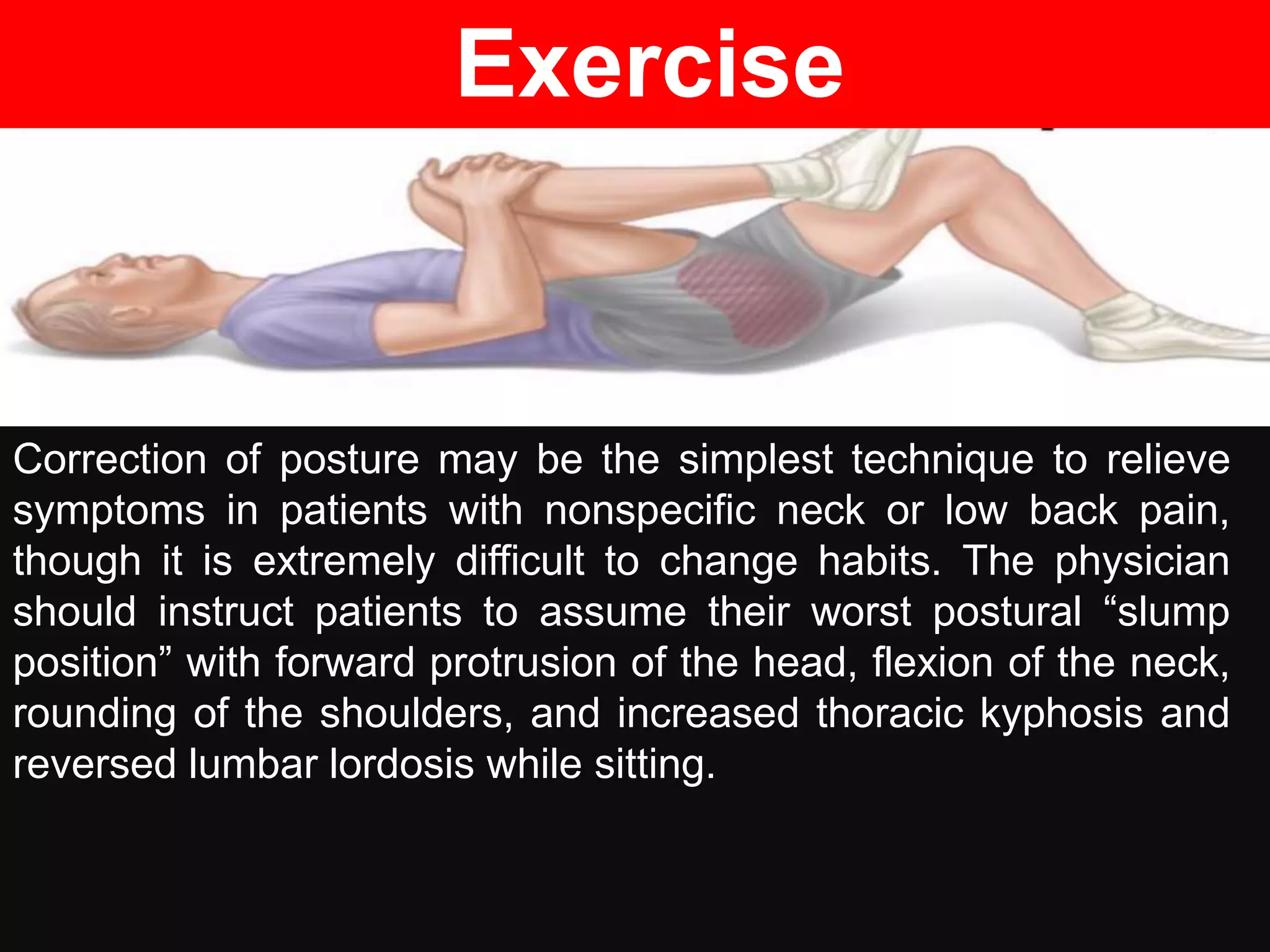
Correction of posture may be the simplest technique to relieve
symptoms in patients with nonspecific neck or low back pain,
though it is extremely difficult to change habits. The physician
should instruct patients to assume their worst postural “slump
position” with forward protrusion of the head, flexion of the neck,
rounding of the shoulders, and increased thoracic kyphosis and
reversed lumbar lordosis while sitting.
TENS and PENS
TENS and PENS stand for Transcutaneous
Electrical Nerve Stimulation and Percutaneous
Electical Nerve Stimulation respectively. Both
procedures can be helpful in alleviating some of the
more painful symptoms of peripheral neuropathy,
but have to be used repeatedly to sustain the
benefits. During TENS procedures, a small battery
operated device is worn by the patient and
electrodes are typically placed on the surface of the
skin, over the area where the pain is felt. Low level
electrical current is then applied for usually about
thirty minutes, several times throughout the day.
The PENS procedure is similar in concept to
TENS. The main difference is that instead of
using the surface electrodes seen in TENS
devices, PENS uses needle probes as
electrodes that are inserted through the skin.
These needle probes are typically placed
next to the nerve causing painful neuropathy
symptoms and then stimulated. PENS can be
used in people who do not get sufficient pain
relief from TENS
ACUPUNCTURE
Traditional Chinese acupuncture involves the insertion of
extremely fine needles into the skin at specific "acupoints." This
may relieve pain by releasing endorphins, the body's natural pain-
killing chemicals, and by affecting the part of the brain that
governs serotonin, a brain chemical involved with mood.a
cupuncture is generally quite safe, and the complication rate
appears to be quite low
ACUPRESSURE
Acupressure points (also called
potent points) are places on the skin
that are especially sensitive to
bioelectrical impulses in the body and
conduct those impulses
readily.Stimulating these points with
pressure, needles, or heat triggers
the release of endorphins,which are
the neurochemicals that relieve pain.
As a result, pain is blocked and the
flow of blood and oxygen to the
affected area is increased. This
causes the muscles to relax and
promotes healing.
CUTANEOUS STIMULATION AND MASSAGE
• The gate control theory of pain proposes
that stimulation of fibres that transmit non-
painful sensations can block or decrease
the transmission of pain impulses.
• Massage, which is generalized cutaneous
stimulation of the body promotes comfort
through muscle relaxation.
DISTRACTION
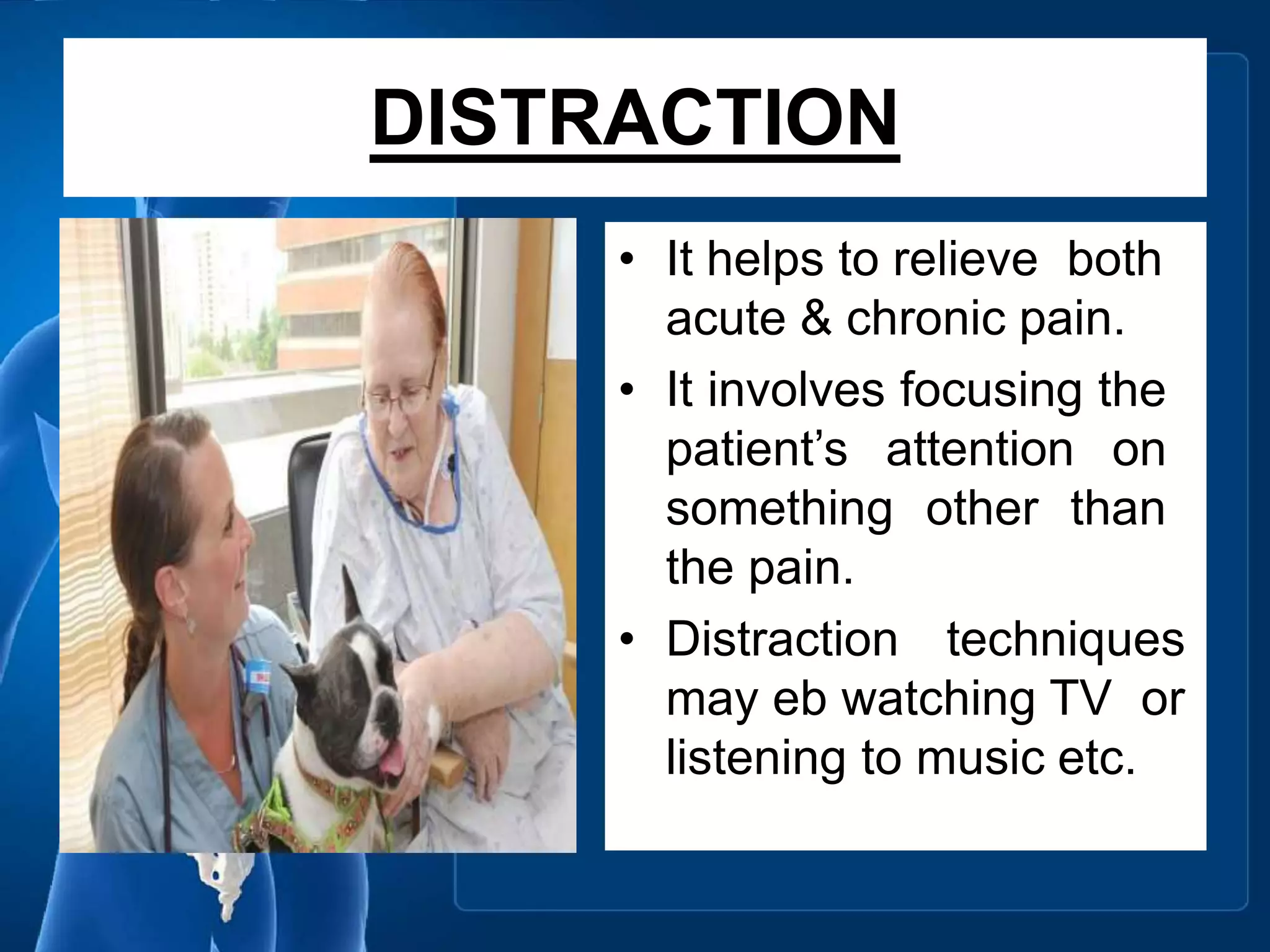
• It helps to relieve both
acute & chronic pain.
• It involves focusing the
patient’s attention on
something other than
the pain.
• Distraction techniques
may eb watching TV or
listening to music etc.
Traction
Cervical traction is a therapeutic modality that can be
administered with the patient in the supine or seated
position. Traction may reduce neck pain and works
through a number of mechanisms including passive
stretching of myofascial elements, gapping of facet
joints, improving neural foraminal opening, and reducing
cervical disc herniation. It has been found to reduce
radicular symptoms in individuals with confirmed
radiculopathy and localized neck pain in individuals with
cervicogenic pain and spondylosis. Cervical traction
may be initiated during physical therapy with the patient
properly instructed in home use
Pain management

Pain management

  • 1.
  • 2.
  • 3.
    DEFINITIONS “PAIN” is definedas an unpleasant sensory and emotional experience arising from actual or potential tissue damage or described in terms of such damage.(IASP) (mersskey & bogduk,1994). Pain is subjective,protective,and it is modified by developmental, behavioural, personality and cultural factors.
  • 4.
  • 5.
    TYPES OF PAIN CLASSICCATEGORY •NOCICEPTIVE •NEUROPATHIC •PAIN INTENSITY •TIME COURSE
  • 6.
  • 7.
  • 8.
  • 9.
    Effects of pain Increasedheart rate  Diaphoresis increased blood glucose levels dilatation of pupils decreased GI motility increased muscle tension  increased respiratory rate
  • 10.
  • 11.
    The Gate ControlTheory • Proposed by Melzack and Wall in 1965 • Stimulation of the skin evokes nervous impulses • Stimulation of the large diameter fibers inhibits the transmission of pain, thus closing the gate
  • 13.
    SPECIFICITY THEORY • Oneof the earliest pain theory. • Proposed by Descartes in seventeenth century.(1664)Muler(1840). • Distinct pain receptors-free nerve endings in the tissue.with transmission by nerves directly to the brain. • Pain is purely an afferent sensory experience.
  • 15.
    PATTERN THEORY (INTENSITY THEORY) Goldschneiderin 1896 and expanded by Weddell and Sinclair in 1947 Pattern of stimulation of nerve endings determines whether the brain would interpret stimuli as pain Attributes sensation of pain to pattern, or frequency and intensity of stimulation applied that excite touch, pressure, or temperature resources in the skin
  • 17.
    Biochemical Theories Biochemical Theoriespain-producing, pain- mediating and pain chemoreceptors are located in the brain Endogenous opiates – inhibits pain by blocking substance P Periacquedactal gray area Chemical pain mediators and inhibitors Bradykinin e. acetylcholine Substance P f. capsaicin Histamine g. Potassium ions prostaglandin
  • 18.
  • 19.
    CHARACTERISTICS OF PAIN •INTENSITY • TIMING • LOCATION • QUALITY • PERSONAL MEANING • AGGRAVATING AND ALLEVIATING FACTORS • PAIN BEHAVIOURS
  • 21.
  • 22.
    THE NURSE’S ROLEIN PAIN MANAGEMENT • IDENTIFYING GOALS FOR PAIN MANAGEMENT • ESTABLISHING THE NURSE-PATIENT RELATIONSHIP AND TEACHING • PROVIDING PHYSICAL CARE • MANAGING ANXIETY RELATED TO PAIN
  • 23.
    PAIN MANAGEMENT STRATEGIES • Painmanagement strategies include both pharmacologic and nonpharmacologic approaches. • PHARMACOLOGIC INTERVENTIONS • NON-PHARMACOLOGIC INTERVENTIONS
  • 24.
  • 25.
    Mild pain Paracetamol (acetaminophen),or a non steroidal anti-inflammatory drug (NSAID) such as ibuprofen or aspirin. NSAIDS have anti- inflammatory, analgesic and antipyretic effects. The anti- inflammatory action relieves pain by interfering with cyclooxygenase.
  • 26.
    Mild to moderatepain Mild to moderate pain Paracetamol, an NSAID and/or paracetamol in a combination product with a weak opioid such as hydrocodone, may provide greater relief than their separate use. Also combination of opioid with acetaminophen can be frequently used such as Percocet, Vicodin, or Norco.
  • 27.
    Moderate to severepain When treating moderate to severe pain, the type of the pain, acute or chronic, needs to be considered. The type of pain can result in different medications being prescribed. Certain medications may work better for acute pain, others for chronic pain, and some may work equally well on both. Acute pain medication is for rapid onset of pain such as from an inflicted trauma or to treat post-operative pain. Chronic pain medication is for alleviating long-lasting, ongoing pain.
  • 28.
    Morphine - isthe gold standard to which all narcotics are compared. Fentanyl - has the benefit of less histamine release and thus fewer side effects. Oxycodone - is used across the Americas and Europe for relief of serious chronic pain. Pethidine - known in North America as meperidine, is not recommended for pain management due to its low potency, short duration of action, and toxicity associated with repeated Amitriptyline- is prescribed for chronic muscular pain in the arms, legs, neck and lower back. While opiates are often used in the management of chronic pain, high doses are associated with an increased
  • 29.
    Opioids Opioid medications canprovide a short, intermediate or long acting analgesia depending upon the specific properties of the medication and whether it is formulated as an extended release drug. Opioid medications may be administered orally, by injection, via nasal mucosa or oral mucosa, rectally, intravenously, epidurally and intrathecally.
  • 30.
    Non-steroidal anti-inflammatory drugs The othermajor group of analgesics are non-steroidal anti-inflammatory drugs (NSAID). Acetaminophen/paracetamol is not always included in this class of medications. However, acetaminophen may be administered as a single medication or in combination with other analgesics (both NSAIDs and opioids).
  • 31.
    Antidepressants and antiepileptic drug Someantidepressant and antiepileptic drugs are used in chronic pain management and act primarily within the pain pathways of the central nervous system, though peripheral mechanisms have been attributed as well.
  • 33.
    NON - PHARMACOLOGIC Non-pharmacologicalpain management is the management of pain without medications. This method utilizes ways to alter thoughts and focus concentration to better manage and reduce pain. Methods of non- pharmacological pain include:
  • 34.
    Superficial Heat Superficial heatcan produce heating effects at a depth limited to between 1 cm and 2 cm. Deeper tissues are generally not heated owing to the thermal insulation of subcutaneous fat and the increased cutaneous blood flow that dissipates heat. It has been found to be helpful in diminishing pain and decreasing local muscle spasm.
  • 35.
    Cryotherapy Cryotherapy can beachieved through the use of ice, ice packs, or continuously via adjustable cuffs attached to cold water dispensers. Intramuscular temperatures can be reduced by between 3 °C and 7 °C, which functions to reduce local metabolism, inflammation, and pain. Cryotherapy works by decreasing nerve conduction velocity, termed cold-induced neuropraxia, along pain fibers with a reduction of the muscle spindle activity responsible for mediating local muscle tone.
  • 36.
    Exercise Correction of posturemay be the simplest technique to relieve symptoms in patients with nonspecific neck or low back pain, though it is extremely difficult to change habits. The physician should instruct patients to assume their worst postural “slump position” with forward protrusion of the head, flexion of the neck, rounding of the shoulders, and increased thoracic kyphosis and reversed lumbar lordosis while sitting.
  • 37.
    TENS and PENS TENSand PENS stand for Transcutaneous Electrical Nerve Stimulation and Percutaneous Electical Nerve Stimulation respectively. Both procedures can be helpful in alleviating some of the more painful symptoms of peripheral neuropathy, but have to be used repeatedly to sustain the benefits. During TENS procedures, a small battery operated device is worn by the patient and electrodes are typically placed on the surface of the skin, over the area where the pain is felt. Low level electrical current is then applied for usually about thirty minutes, several times throughout the day.
  • 38.
    The PENS procedureis similar in concept to TENS. The main difference is that instead of using the surface electrodes seen in TENS devices, PENS uses needle probes as electrodes that are inserted through the skin. These needle probes are typically placed next to the nerve causing painful neuropathy symptoms and then stimulated. PENS can be used in people who do not get sufficient pain relief from TENS
  • 40.
    ACUPUNCTURE Traditional Chinese acupunctureinvolves the insertion of extremely fine needles into the skin at specific "acupoints." This may relieve pain by releasing endorphins, the body's natural pain- killing chemicals, and by affecting the part of the brain that governs serotonin, a brain chemical involved with mood.a cupuncture is generally quite safe, and the complication rate appears to be quite low
  • 41.
    ACUPRESSURE Acupressure points (alsocalled potent points) are places on the skin that are especially sensitive to bioelectrical impulses in the body and conduct those impulses readily.Stimulating these points with pressure, needles, or heat triggers the release of endorphins,which are the neurochemicals that relieve pain. As a result, pain is blocked and the flow of blood and oxygen to the affected area is increased. This causes the muscles to relax and promotes healing.
  • 42.
    CUTANEOUS STIMULATION ANDMASSAGE • The gate control theory of pain proposes that stimulation of fibres that transmit non- painful sensations can block or decrease the transmission of pain impulses. • Massage, which is generalized cutaneous stimulation of the body promotes comfort through muscle relaxation.
  • 43.
    DISTRACTION • It helpsto relieve both acute & chronic pain. • It involves focusing the patient’s attention on something other than the pain. • Distraction techniques may eb watching TV or listening to music etc.
  • 44.
    Traction Cervical traction isa therapeutic modality that can be administered with the patient in the supine or seated position. Traction may reduce neck pain and works through a number of mechanisms including passive stretching of myofascial elements, gapping of facet joints, improving neural foraminal opening, and reducing cervical disc herniation. It has been found to reduce radicular symptoms in individuals with confirmed radiculopathy and localized neck pain in individuals with cervicogenic pain and spondylosis. Cervical traction may be initiated during physical therapy with the patient properly instructed in home use