A 
Presentation 
On 
“Translation lookaside buffer”
Content 
a. What is Translational look aside buffer. 
b. Use of Translational look aside buffer. 
c. How it works. 
d. Content addressable memory (CAM) 
e. Page walk. 
f. Structure of TLB.
What is Translational look aside 
buffer (t. l. b) 
The translation look aside buffer (TLB) is a cache for 
page table entries. It works in much the same way as 
the data cache: it stores recently accessed page table 
entries. It also relies on locality of reference
use of t. l. b 
It is cumbersome and time consuming to calculate the 
physical address from linear address for every memory 
location. A Translation Look-aside Buffer (TLB) 
simplifies the process. TLB is a page table cache, which 
stores the 32 recently accessed page table entries.
how it work’s 
The paging unit receives a 32-bit linear address from 
the segmentation unit. The upper 20 bits of the linear 
address is compared with all 32-entries in the 
translation look-aside buffer (TLB) to check if it 
matches with any of the entries. If it matches, the 32- 
bit physical address is calculated from matching TLB 
entry and placed on the address bus.
Content addressable memory and 
page walk 
The TLB is sometimes implemented as content-addressable 
memory (CAM). The CAM search key is 
the virtual address and the search result is a physical 
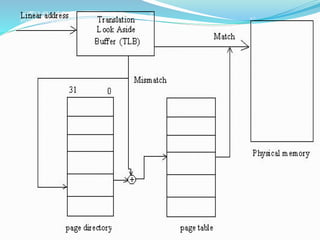
address. If the requested address is present in the TLB, 
the CAM search yields a match quickly and the 
retrieved physical address can be used to access 
memory. This is called a TLB hit. If the requested 
address is not in the TLB, it is a miss, and the 
translation proceeds by looking up the page table in a 
process called a page walk.
Page walk 
The page walk is an expensive process, as it involves 
reading the contents of multiple memory locations 
and using them to compute the physical address. After 
the physical address is determined by the page walk, 
the virtual address to physical address mapping is 
entered into the TLB.
Structure of TLB 
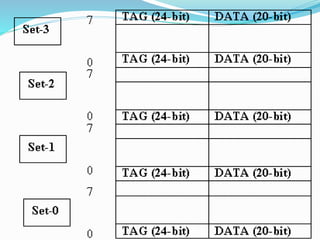
TLB has 4 sets of eight entries each. Each entry 
consists of a TAG and a DATA. Tags are 24 bit wide. 
They contain 20 upper bits of linear address, a valid bit 
and three attribute bits. The Data portion of each 
entry contains higher 20 bits of the Physical address.
Translation lookaside buffer

Translation lookaside buffer

  • 1.
    A Presentation On “Translation lookaside buffer”
  • 2.
    Content a. Whatis Translational look aside buffer. b. Use of Translational look aside buffer. c. How it works. d. Content addressable memory (CAM) e. Page walk. f. Structure of TLB.
  • 3.
    What is Translationallook aside buffer (t. l. b) The translation look aside buffer (TLB) is a cache for page table entries. It works in much the same way as the data cache: it stores recently accessed page table entries. It also relies on locality of reference
  • 4.
    use of t.l. b It is cumbersome and time consuming to calculate the physical address from linear address for every memory location. A Translation Look-aside Buffer (TLB) simplifies the process. TLB is a page table cache, which stores the 32 recently accessed page table entries.
  • 5.
    how it work’s The paging unit receives a 32-bit linear address from the segmentation unit. The upper 20 bits of the linear address is compared with all 32-entries in the translation look-aside buffer (TLB) to check if it matches with any of the entries. If it matches, the 32- bit physical address is calculated from matching TLB entry and placed on the address bus.
  • 6.
    Content addressable memoryand page walk The TLB is sometimes implemented as content-addressable memory (CAM). The CAM search key is the virtual address and the search result is a physical address. If the requested address is present in the TLB, the CAM search yields a match quickly and the retrieved physical address can be used to access memory. This is called a TLB hit. If the requested address is not in the TLB, it is a miss, and the translation proceeds by looking up the page table in a process called a page walk.
  • 7.
    Page walk Thepage walk is an expensive process, as it involves reading the contents of multiple memory locations and using them to compute the physical address. After the physical address is determined by the page walk, the virtual address to physical address mapping is entered into the TLB.
  • 9.
    Structure of TLB TLB has 4 sets of eight entries each. Each entry consists of a TAG and a DATA. Tags are 24 bit wide. They contain 20 upper bits of linear address, a valid bit and three attribute bits. The Data portion of each entry contains higher 20 bits of the Physical address.