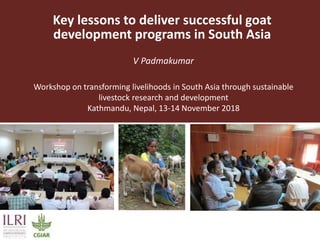
Key lessons to deliver successful goat
development programs in South Asia
V Padmakumar
Workshop on transforming livelihoods in South Asia through sustainable
livestock research and development
Kathmandu, Nepal, 13-14 November 2018
Key lessons from 3 goat projects in India
Issue: Huge Demand Supply Gap
IND: Projected demand for chevon in 2030 is 4.236 MMT against projected production of 2.049 MMT per
year. Population – 140 M (2007) to 135 M (2012)
NPL: Goat meat worth 15 million USD imported; Goat population, no of HHs and no of goats/HH increased
marginally 2011-2017
Key lessons from 3 goat projects in India
Issue: Huge Demand Supply Gap
IND: Projected demand for chevon in 2030 is 4.236 MMT against projected production of 2.049 MMT per
year. Population – 140 M (2007) to 135 M (2012)
NPL: Goat meat worth 15 million USD imported; Goat population, no of HHs and no of goats/HH increased
marginally 2011-2017
There can be a two pronged approach
Increase number of goats
per household
Increase number of
households rearing goats
IMPORT?
YIELD GAP?
Priority intervention - 1
1. Increase number of goats per HH: Reduce mortality
Promote trained private veterinary health care service providers
in the villages with backstopping support from local
veterinarians
To ensure financial sustainability, provide 5+1
goat units
Definition of Minor Veterinary Services by
State government
Privatising cold chain management (HBL)
Total HHs 2.46 million; Mortality 30%; Vaccination coverage 20%; Maintaining more no has limitation - NPL: 4.67 (2011) to 4.5 (2017)
Priority intervention - 2
2. Increase number of rearers: Commercial goat producers
Provide progressive farmers, entrepreneurs, women and youth
with soft credit and infrastructural support to set up farms
Backstopping (technical innovations to reduce yield gap-Genetics,
Feed; Health, farm budgeting; market intelligence-VCC App)
Pilot dairy goat production and
products for niche market
50+2 goat unit in Ahmednagar, India
Population NPL: 10.99 million to 11.22 million from 2011 to 2017; HH 2.35 M to 2.46 M (NPL)
Priority intervention – 3
(supporting production)
3. Privatize buck production (focus progressive farmers)
Promote farmer entrepreneurs interested to invest in buck
production
Buck rearers: Technical programme, monitoring and certification
by CIRG/NARC/AH Department
Buck keepers: Selected farmers /goat groups
/NGO; buck rotation
Financial support by public/private initiatives
Priority intervention – 4
(supporting marketing)
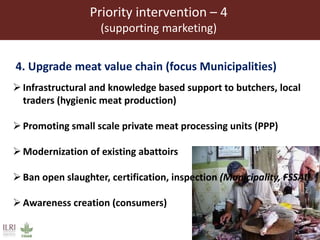
4. Upgrade meat value chain (focus Municipalities)
Infrastructural and knowledge based support to butchers, local
traders (hygienic meat production)
Promoting small scale private meat processing units (PPP)
Modernization of existing abattoirs
Ban open slaughter, certification, inspection (Municipality, FSSAI)
Awareness creation (consumers)
This presentation is licensed for use under the Creative Commons Attribution 4.0 International Licence.
better lives through livestock
ilri.org
ILRI thanks all donors and organizations who globally supported its work through their contributions
to the CGIAR system

Key lessons to deliver successful goat development programs in South Asia

  • 1.
    Key lessons todeliver successful goat development programs in South Asia V Padmakumar Workshop on transforming livelihoods in South Asia through sustainable livestock research and development Kathmandu, Nepal, 13-14 November 2018
  • 2.
    Key lessons from3 goat projects in India Issue: Huge Demand Supply Gap IND: Projected demand for chevon in 2030 is 4.236 MMT against projected production of 2.049 MMT per year. Population – 140 M (2007) to 135 M (2012) NPL: Goat meat worth 15 million USD imported; Goat population, no of HHs and no of goats/HH increased marginally 2011-2017
  • 3.
    Key lessons from3 goat projects in India Issue: Huge Demand Supply Gap IND: Projected demand for chevon in 2030 is 4.236 MMT against projected production of 2.049 MMT per year. Population – 140 M (2007) to 135 M (2012) NPL: Goat meat worth 15 million USD imported; Goat population, no of HHs and no of goats/HH increased marginally 2011-2017 There can be a two pronged approach Increase number of goats per household Increase number of households rearing goats IMPORT? YIELD GAP?
  • 4.
    Priority intervention -1 1. Increase number of goats per HH: Reduce mortality Promote trained private veterinary health care service providers in the villages with backstopping support from local veterinarians To ensure financial sustainability, provide 5+1 goat units Definition of Minor Veterinary Services by State government Privatising cold chain management (HBL) Total HHs 2.46 million; Mortality 30%; Vaccination coverage 20%; Maintaining more no has limitation - NPL: 4.67 (2011) to 4.5 (2017)
  • 5.
    Priority intervention -2 2. Increase number of rearers: Commercial goat producers Provide progressive farmers, entrepreneurs, women and youth with soft credit and infrastructural support to set up farms Backstopping (technical innovations to reduce yield gap-Genetics, Feed; Health, farm budgeting; market intelligence-VCC App) Pilot dairy goat production and products for niche market 50+2 goat unit in Ahmednagar, India Population NPL: 10.99 million to 11.22 million from 2011 to 2017; HH 2.35 M to 2.46 M (NPL)
  • 6.
    Priority intervention –3 (supporting production) 3. Privatize buck production (focus progressive farmers) Promote farmer entrepreneurs interested to invest in buck production Buck rearers: Technical programme, monitoring and certification by CIRG/NARC/AH Department Buck keepers: Selected farmers /goat groups /NGO; buck rotation Financial support by public/private initiatives
  • 7.
    Priority intervention –4 (supporting marketing) 4. Upgrade meat value chain (focus Municipalities) Infrastructural and knowledge based support to butchers, local traders (hygienic meat production) Promoting small scale private meat processing units (PPP) Modernization of existing abattoirs Ban open slaughter, certification, inspection (Municipality, FSSAI) Awareness creation (consumers)
  • 8.
    This presentation islicensed for use under the Creative Commons Attribution 4.0 International Licence. better lives through livestock ilri.org ILRI thanks all donors and organizations who globally supported its work through their contributions to the CGIAR system

Editor's Notes

  • #2 There MUST be a CGIAR logo or a CRP logo. You can copy and paste the logo you need from the final slide of this presentation. Then you can delete that final slide   To replace a photo above, copy and paste this link in your browser: http://www.flickr.com/photos/ilri/sets/72157632057087650/detail/   Find a photo you like and the right size, copy and paste it in the block above.