Business plan for a centralized pig
abattoir in Masaka, Uganda
Uganda smallholder smallholder pigs value chain review and planning meeting
Kampala, 14-15 May 2015
Mable Kabagabu
Presentation summary
• Background
• Business strategy
• SWOT Analysis
• Market opportunity.
• Market segregation
• Competition
• Pork demand
• Pork supply
• Financing plan
• Implementation
• Recommendation
Background
• Pig production has been on the increase in Uganda. According to
information from (MAAIF 2011) the numbers of pigs in Uganda has been
increasing by 3% today’s more than two million pigs are in the hands of
1.1 million households (MAAIF 2009).
• In 2011, Uganda had the highest per capita consumption of pork in sub-
Saharan Africa (3.4 kg per person per year) (ILRI 2011).
• However, the pork production is characterized by several constraints, like
limited market information and standards, poor slaughter technologies
and infrastructures, disease control and public health concerns which
posses a health risk to pork consumers. (ILRI 2014).
• Therefore the is need for central pig abattoir where pigs can be properly
slaughtered, inspected for quality before being released to the market for
consumption.
4
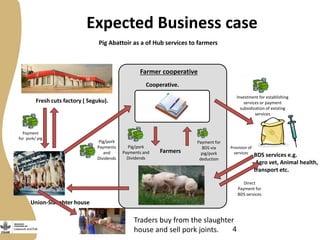
Expected Business case
Union-Slaughter house
Pig Abattoir as a of Hub services to farmers
Fresh cuts factory ( Seguku).
Farmers
Cooperative.
Farmer cooperative
Payment for
BDS via
pig/pork
deduction
Payment
for pork/ pig
BDS services e.g.
Agro vet, Animal health,
transport etc.
Provision of
services
Direct
Payment for
BDS services
Pig/pork
Payments
and
Dividends
Pig/pork
Payments and
Dividends
Investment for establishing
services or payment
subsidization of existing
services
Traders buy from the slaughter
house and sell pork joints.
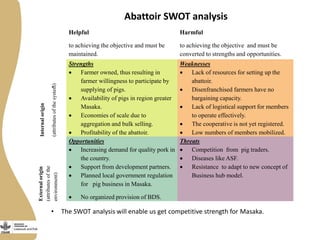
Abattoir SWOT analysis
.
Helpful
to achieving the objective and must be
maintained.
Harmful
to achieving the objective and must be
converted to strengths and opportunities.
Internalorigin
(attributesofthesystem)
Strengths
 Farmer owned, thus resulting in
farmer willingness to participate by
supplying of pigs.
 Availability of pigs in region greater
Masaka.
 Economies of scale due to
aggregation and bulk selling.
 Profitability of the abattoir.
Weaknesses
 Lack of resources for setting up the
abattoir.
 Disenfranchised farmers have no
bargaining capacity.
 Lack of logistical support for members
to operate effectively.
 The cooperative is not yet registered.
 Low numbers of members mobilized.
Externalorigin
(attributesofthe
environment)
Opportunities
 Increasing demand for quality pork in
the country.
 Support from development partners.
 Planned local government regulation
for pig business in Masaka.
 No organized provision of BDS.
Threats
 Competition from pig traders.
 Diseases like ASF.
 Resistance to adapt to new concept of
Business hub model.
• The SWOT analysis will enable us get competitive strength for Masaka.
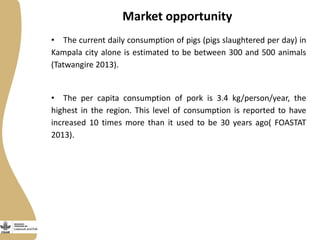
Market opportunity
• The current daily consumption of pigs (pigs slaughtered per day) in
Kampala city alone is estimated to be between 300 and 500 animals
(Tatwangire 2013).
• The per capita consumption of pork is 3.4 kg/person/year, the
highest in the region. This level of consumption is reported to have
increased 10 times more than it used to be 30 years ago( FOASTAT
2013).
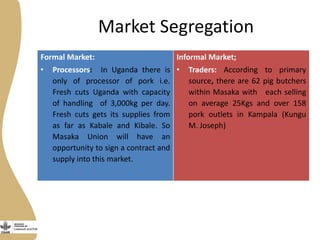
Market Segregation
Formal Market:
• Processors: In Uganda there is
only of processor of pork i.e.
Fresh cuts Uganda with capacity
of handling of 3,000kg per day.
Fresh cuts gets its supplies from
as far as Kabale and Kibale. So
Masaka Union will have an
opportunity to sign a contract and
supply into this market.
Informal Market;
• Traders: According to primary
source, there are 62 pig butchers
within Masaka with each selling
on average 25Kgs and over 158
pork outlets in Kampala (Kungu
M. Joseph)
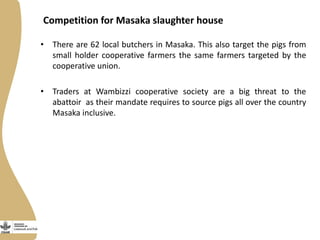
Competition for Masaka slaughter house
• There are 62 local butchers in Masaka. This also target the pigs from
small holder cooperative farmers the same farmers targeted by the
cooperative union.
• Traders at Wambizzi cooperative society are a big threat to the
abattoir as their mandate requires to source pigs all over the country
Masaka inclusive.
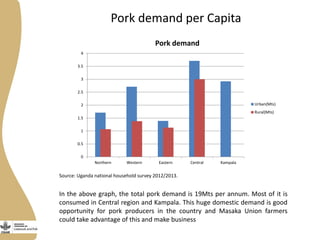
Pork demand per Capita
0
0.5
1
1.5
2
2.5
3
3.5
4
Northern Western Eastern Central Kampala
Pork demand
Urban(Mts)
Rural(Mts)
Source: Uganda national household survey 2012/2013.
In the above graph, the total pork demand is 19Mts per annum. Most of it is
consumed in Central region and Kampala. This huge domestic demand is good
opportunity for pork producers in the country and Masaka Union farmers
could take advantage of this and make business
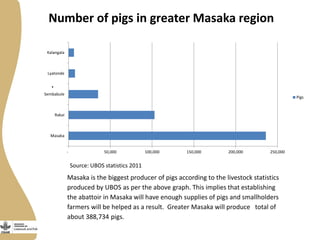
Number of pigs in greater Masaka region
.
- 50,000 100,000 150,000 200,000 250,000
Masaka
Rakai
Sembabule
Lyatonde
Kalangala
Pigs
Masaka is the biggest producer of pigs according to the livestock statistics
produced by UBOS as per the above graph. This implies that establishing
the abattoir in Masaka will have enough supplies of pigs and smallholders
farmers will be helped as a result. Greater Masaka will produce total of
about 388,734 pigs.
Source: UBOS statistics 2011
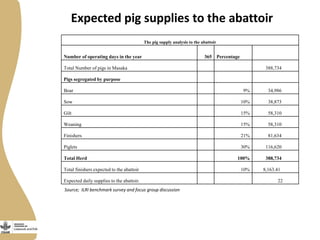
Expected pig supplies to the abattoir
The pig supply analysis to the abattoir
Number of operating days in the year 365 Percentage
Total Number of pigs in Masaka 388,734
Pigs segregated by purpose
Boar 9% 34,986
Sow 10% 38,873
Gilt 15% 58,310
Weaning 15% 58,310
Finishers 21% 81,634
Piglets 30% 116,620
Total Herd 100% 388,734
Total finishers expected to the abattoir 10% 8,163.41
Expected daily supplies to the abattoir. 22
Source; ILRI benchmark survey and focus group discussion
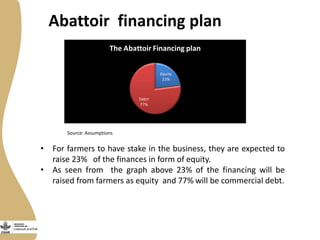
Abattoir financing plan
• For farmers to have stake in the business, they are expected to
raise 23% of the finances in form of equity.
• As seen from the graph above 23% of the financing will be
raised from farmers as equity and 77% will be commercial debt.
Equity
23%
Debit
77%
The Abattoir Financing plan
Source: Assumptions
Phased Implementation of the Abattoir
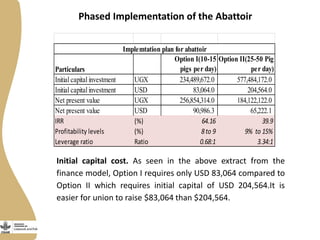
Initial capital cost. As seen in the above extract from the
finance model, Option I requires only USD 83,064 compared to
Option II which requires initial capital of USD 204,564.It is
easier for union to raise $83,064 than $204,564.
Particulars
Option I(10-15
pigs per day)
Option II(25-50 Pig
per day)
Initial capital investment UGX 234,489,672.0 577,484,172.0
Initial capital investment USD 83,064.0 204,564.0
Net present value UGX 256,854,314.0 184,122,122.0
Net present value USD 90,986.3 65,222.1
IRR (%) 64.16 39.9
Profitability levels (%) 8to 9 9% to 15%
Leverage ratio Ratio 0.68:1 3.34:1
Implemtation plan for abattoir
Organization of Masaka abattoir
.
Chairman
BOD.
Accountant
General
hand-staff
Slaughterers
Abattoir
Manager.
Source: Cooperative by-laws
Abattoir management
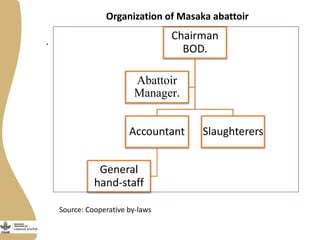
• The Board of Directors:
This will comprise of representatives from different primary
cooperatives. The BOD will have 9 delegates each representing a
primary cooperative. This BOD will be the top most policy organ of
the union responsible for policies and strategic plans. It will directly
supervise the operations of the business and management team
headed by the secretary manager.
• Abattoir Manager. The secretary manager will be the overall paid
employee of the union responsible to operationalize the abattoir
activities. He will be responsible for all the staff of the abattoir and is
expected to turn around the farmers investment into profitable
business.
Risk and Mitigations of the abattoir
Risk Mitigation
• There is eminent risk of the abattoir
not attracting membership from the
greater Masaka region as planned.
This means less buy in for abattoir
and related services by the
smallholder farmers .
• The Cooperative leadership,
development partners to mobilize
and support mobilization effort.
This will reduce the objection from
small holder farmers shunning the
abattoir business by the cooperative.
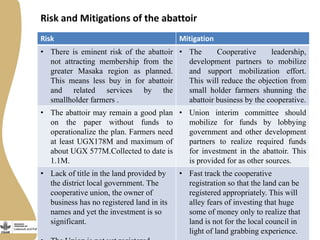
• The abattoir may remain a good plan
on the paper without funds to
operationalize the plan. Farmers need
at least UGX178M and maximum of
about UGX 577M.Collected to date is
1.1M.
• Union interim committee should
mobilize for funds by lobbying
government and other development
partners to realize required funds
for investment in the abattoir. This
is provided for as other sources.
• Lack of title in the land provided by
the district local government. The
cooperative union, the owner of
business has no registered land in its
names and yet the investment is so
significant.
• Fast track the cooperative
registration so that the land can be
registered appropriately. This will
alley fears of investing that huge
some of money only to realize that
land is not for the local council in
light of land grabbing experience.
Recommendations
.
 Economically: The abattoir is economically viable and subjective to the
results of the financial projections for options 1 and 2,the two options
may be implemented as mutually exclusive projects as a result of funds
availability may be implemented in the phased way as mobilization of start
capital may be insufficient.
 Increased pig supply: The sustainability of abattoir profitability depends
on mobilizing and recruiting more farmers beyond the current 392
farmers and 10 primary cooperatives.
 Significant initial Capital expenditure: This expenditure will delay profits
to the union as the break even period is after the 4th year. It is
recommended that the union starts small and grows gradually to full
capacity of the required option.
 Establishment of BDS
Other recommendations
• Private public partnership: The cooperative union can enter a
partnership with government under Private Public Partnership to
raise enough capital for investment.
• Lobby for government support: The union can lobby for funding
from government projects like CAIIP and AMP to realize their
business dream
• Private Partnership: Private Individual/individuals can invest in the
abattoir business, as the union focuses on supply of pigs. This will
ensure ready market for their pigs and no operational costs
incurred by the union at the abattoir.
CGIAR is a global partnership that unites organizations engaged in research for a food secure future. The CGIAR
Research Program on Livestock and Fish aims to increase the productivity of small-scale livestock and fish systems
in sustainable ways, making meat, milk and fish more available and affordable across the developing world.
CGIAR Research Program on Livestock and Fish
livestockfish.cgiar.org

Business plan for a centralized pig abattoir in Masaka, Uganda

  • 1.
    Business plan fora centralized pig abattoir in Masaka, Uganda Uganda smallholder smallholder pigs value chain review and planning meeting Kampala, 14-15 May 2015 Mable Kabagabu
  • 2.
    Presentation summary • Background •Business strategy • SWOT Analysis • Market opportunity. • Market segregation • Competition • Pork demand • Pork supply • Financing plan • Implementation • Recommendation
  • 3.
    Background • Pig productionhas been on the increase in Uganda. According to information from (MAAIF 2011) the numbers of pigs in Uganda has been increasing by 3% today’s more than two million pigs are in the hands of 1.1 million households (MAAIF 2009). • In 2011, Uganda had the highest per capita consumption of pork in sub- Saharan Africa (3.4 kg per person per year) (ILRI 2011). • However, the pork production is characterized by several constraints, like limited market information and standards, poor slaughter technologies and infrastructures, disease control and public health concerns which posses a health risk to pork consumers. (ILRI 2014). • Therefore the is need for central pig abattoir where pigs can be properly slaughtered, inspected for quality before being released to the market for consumption.
  • 4.
    4 Expected Business case Union-Slaughterhouse Pig Abattoir as a of Hub services to farmers Fresh cuts factory ( Seguku). Farmers Cooperative. Farmer cooperative Payment for BDS via pig/pork deduction Payment for pork/ pig BDS services e.g. Agro vet, Animal health, transport etc. Provision of services Direct Payment for BDS services Pig/pork Payments and Dividends Pig/pork Payments and Dividends Investment for establishing services or payment subsidization of existing services Traders buy from the slaughter house and sell pork joints.
  • 5.
    Abattoir SWOT analysis . Helpful toachieving the objective and must be maintained. Harmful to achieving the objective and must be converted to strengths and opportunities. Internalorigin (attributesofthesystem) Strengths  Farmer owned, thus resulting in farmer willingness to participate by supplying of pigs.  Availability of pigs in region greater Masaka.  Economies of scale due to aggregation and bulk selling.  Profitability of the abattoir. Weaknesses  Lack of resources for setting up the abattoir.  Disenfranchised farmers have no bargaining capacity.  Lack of logistical support for members to operate effectively.  The cooperative is not yet registered.  Low numbers of members mobilized. Externalorigin (attributesofthe environment) Opportunities  Increasing demand for quality pork in the country.  Support from development partners.  Planned local government regulation for pig business in Masaka.  No organized provision of BDS. Threats  Competition from pig traders.  Diseases like ASF.  Resistance to adapt to new concept of Business hub model. • The SWOT analysis will enable us get competitive strength for Masaka.
  • 6.
    Market opportunity • Thecurrent daily consumption of pigs (pigs slaughtered per day) in Kampala city alone is estimated to be between 300 and 500 animals (Tatwangire 2013). • The per capita consumption of pork is 3.4 kg/person/year, the highest in the region. This level of consumption is reported to have increased 10 times more than it used to be 30 years ago( FOASTAT 2013).
  • 7.
    Market Segregation Formal Market: •Processors: In Uganda there is only of processor of pork i.e. Fresh cuts Uganda with capacity of handling of 3,000kg per day. Fresh cuts gets its supplies from as far as Kabale and Kibale. So Masaka Union will have an opportunity to sign a contract and supply into this market. Informal Market; • Traders: According to primary source, there are 62 pig butchers within Masaka with each selling on average 25Kgs and over 158 pork outlets in Kampala (Kungu M. Joseph)
  • 8.
    Competition for Masakaslaughter house • There are 62 local butchers in Masaka. This also target the pigs from small holder cooperative farmers the same farmers targeted by the cooperative union. • Traders at Wambizzi cooperative society are a big threat to the abattoir as their mandate requires to source pigs all over the country Masaka inclusive.
  • 9.
    Pork demand perCapita 0 0.5 1 1.5 2 2.5 3 3.5 4 Northern Western Eastern Central Kampala Pork demand Urban(Mts) Rural(Mts) Source: Uganda national household survey 2012/2013. In the above graph, the total pork demand is 19Mts per annum. Most of it is consumed in Central region and Kampala. This huge domestic demand is good opportunity for pork producers in the country and Masaka Union farmers could take advantage of this and make business
  • 10.
    Number of pigsin greater Masaka region . - 50,000 100,000 150,000 200,000 250,000 Masaka Rakai Sembabule Lyatonde Kalangala Pigs Masaka is the biggest producer of pigs according to the livestock statistics produced by UBOS as per the above graph. This implies that establishing the abattoir in Masaka will have enough supplies of pigs and smallholders farmers will be helped as a result. Greater Masaka will produce total of about 388,734 pigs. Source: UBOS statistics 2011
  • 11.
    Expected pig suppliesto the abattoir The pig supply analysis to the abattoir Number of operating days in the year 365 Percentage Total Number of pigs in Masaka 388,734 Pigs segregated by purpose Boar 9% 34,986 Sow 10% 38,873 Gilt 15% 58,310 Weaning 15% 58,310 Finishers 21% 81,634 Piglets 30% 116,620 Total Herd 100% 388,734 Total finishers expected to the abattoir 10% 8,163.41 Expected daily supplies to the abattoir. 22 Source; ILRI benchmark survey and focus group discussion
  • 12.
    Abattoir financing plan •For farmers to have stake in the business, they are expected to raise 23% of the finances in form of equity. • As seen from the graph above 23% of the financing will be raised from farmers as equity and 77% will be commercial debt. Equity 23% Debit 77% The Abattoir Financing plan Source: Assumptions
  • 13.
    Phased Implementation ofthe Abattoir Initial capital cost. As seen in the above extract from the finance model, Option I requires only USD 83,064 compared to Option II which requires initial capital of USD 204,564.It is easier for union to raise $83,064 than $204,564. Particulars Option I(10-15 pigs per day) Option II(25-50 Pig per day) Initial capital investment UGX 234,489,672.0 577,484,172.0 Initial capital investment USD 83,064.0 204,564.0 Net present value UGX 256,854,314.0 184,122,122.0 Net present value USD 90,986.3 65,222.1 IRR (%) 64.16 39.9 Profitability levels (%) 8to 9 9% to 15% Leverage ratio Ratio 0.68:1 3.34:1 Implemtation plan for abattoir
  • 14.
    Organization of Masakaabattoir . Chairman BOD. Accountant General hand-staff Slaughterers Abattoir Manager. Source: Cooperative by-laws
  • 15.
    Abattoir management • TheBoard of Directors: This will comprise of representatives from different primary cooperatives. The BOD will have 9 delegates each representing a primary cooperative. This BOD will be the top most policy organ of the union responsible for policies and strategic plans. It will directly supervise the operations of the business and management team headed by the secretary manager. • Abattoir Manager. The secretary manager will be the overall paid employee of the union responsible to operationalize the abattoir activities. He will be responsible for all the staff of the abattoir and is expected to turn around the farmers investment into profitable business.
  • 16.
    Risk and Mitigationsof the abattoir Risk Mitigation • There is eminent risk of the abattoir not attracting membership from the greater Masaka region as planned. This means less buy in for abattoir and related services by the smallholder farmers . • The Cooperative leadership, development partners to mobilize and support mobilization effort. This will reduce the objection from small holder farmers shunning the abattoir business by the cooperative. • The abattoir may remain a good plan on the paper without funds to operationalize the plan. Farmers need at least UGX178M and maximum of about UGX 577M.Collected to date is 1.1M. • Union interim committee should mobilize for funds by lobbying government and other development partners to realize required funds for investment in the abattoir. This is provided for as other sources. • Lack of title in the land provided by the district local government. The cooperative union, the owner of business has no registered land in its names and yet the investment is so significant. • Fast track the cooperative registration so that the land can be registered appropriately. This will alley fears of investing that huge some of money only to realize that land is not for the local council in light of land grabbing experience.
  • 17.
    Recommendations .  Economically: Theabattoir is economically viable and subjective to the results of the financial projections for options 1 and 2,the two options may be implemented as mutually exclusive projects as a result of funds availability may be implemented in the phased way as mobilization of start capital may be insufficient.  Increased pig supply: The sustainability of abattoir profitability depends on mobilizing and recruiting more farmers beyond the current 392 farmers and 10 primary cooperatives.  Significant initial Capital expenditure: This expenditure will delay profits to the union as the break even period is after the 4th year. It is recommended that the union starts small and grows gradually to full capacity of the required option.  Establishment of BDS
  • 18.
    Other recommendations • Privatepublic partnership: The cooperative union can enter a partnership with government under Private Public Partnership to raise enough capital for investment. • Lobby for government support: The union can lobby for funding from government projects like CAIIP and AMP to realize their business dream • Private Partnership: Private Individual/individuals can invest in the abattoir business, as the union focuses on supply of pigs. This will ensure ready market for their pigs and no operational costs incurred by the union at the abattoir.
  • 19.
    CGIAR is aglobal partnership that unites organizations engaged in research for a food secure future. The CGIAR Research Program on Livestock and Fish aims to increase the productivity of small-scale livestock and fish systems in sustainable ways, making meat, milk and fish more available and affordable across the developing world. CGIAR Research Program on Livestock and Fish livestockfish.cgiar.org

Editor's Notes

  • #4 Page title minimum of 30 points and maximum of two lines Main point 6 point smaller than slide title Bullet points 4 point less than main point Font type is Calibri It is advised in one slide maximum 6 bullets We recommend you use images on slides You can change partner logos on front page You have to duplicate this slide for more inside pages