


Broiler Industry Development in Thailand
Market Integration and Value Chain Development
Expanding Regional and Global Markets
Dr. Viroj NaRanong
Mr. Phunjasit Chokesomritpol
Thailand Development Research Institute
13 December 2017 1
Summary
 Development of Thai Broiler Industry (1970s - Present)
 Success Factors
• Institutional Arrangement
• Technology Adoption and Adaptation
• Market-Driven Approach
 Expanding to regional and global markets
2
Broiler Production (2012-2016)
3
62.8% 66.6% 67.1% 66.3% 65.5%
6.4%
6.0%
8.8%
9.5% 10.4%
30.8%
27.3%
24.1%
24.1%
24.0%
0
200,000
400,000
600,000
800,000
1,000,000
1,200,000
1,400,000
1,600,000
1,800,000
2,000,000
2012 2013 2014 2015 2016
MT
Export Processed
Export Frozen
Domestic Consumption
Source: Office of Agricultural Economics (OAE)
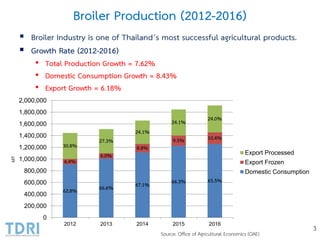
 Broiler Industry is one of Thailand’s most successful agricultural products.
 Growth Rate (2012-2016)
• Total Production Growth = 7.62%
• Domestic Consumption Growth = 8.43%
• Export Growth = 6.18%
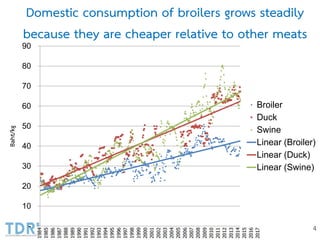
Domestic consumption of broilers grows steadily
because they are cheaper relative to other meats
4-
10
20
30
40
50
60
70
80
90
Baht/kg
Broiler
Duck
Swine
Linear (Broiler)
Linear (Duck)
Linear (Swine)
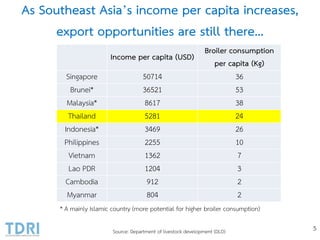
As Southeast Asia’s income per capita increases,
export opportunities are still there…
5
Income per capita (USD)
Broiler consumption
per capita (Kg)
Singapore 50714 36
Brunei* 36521 53
Malaysia* 8617 38
Thailand 5281 24
Indonesia* 3469 26
Philippines 2255 10
Vietnam 1362 7
Lao PDR 1204 3
Cambodia 912 2
Myanmar 804 2
Source: Department of livestock development (DLD)
* A mainly Islamic country (more potential for higher broiler consumption)
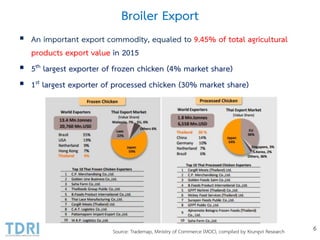
Broiler Export
 An important export commodity, equaled to 9.45% of total agricultural
products export value in 2015
 5th largest exporter of frozen chicken (4% market share)
 1st largest exporter of processed chicken (30% market share)
6Source: Trademap, Ministry of Commerce (MOC), compiled by Krungsri Research
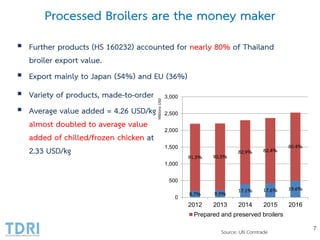
Processed Broilers are the money maker
 Further products (HS 160232) accounted for nearly 80% of Thailand
broiler export value.
 Export mainly to Japan (54%) and EU (36%)
7
8.7% 9.5% 17.1% 17.6% 19.6%
91.3% 90.5%
82.9% 82.4%
80.4%
0
500
1,000
1,500
2,000
2,500
3,000
2012 2013 2014 2015 2016
MillionsUSD
Prepared and preserved broilers
Source: UN Comtrade
 Variety of products, made-to-order
 Average value added = 4.26 USD/kg
almost doubled to average value
added of chilled/frozen chicken at
2.33 USD/kg
Development of Thai Broiler Industry
From1970s to Present
8
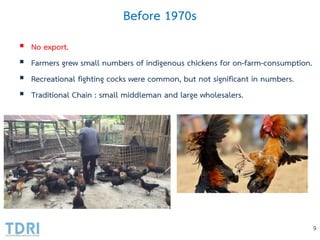
Before 1970s
 No export.
 Farmers grew small numbers of indigenous chickens for on-farm-consumption.
 Recreational fighting cocks were common, but not significant in numbers.
 Traditional Chain : small middleman and large wholesalers.
9
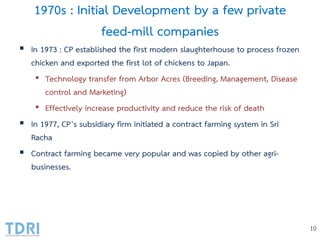
1970s : Initial Development by a few private
feed-mill companies
 In 1973 : CP established the first modern slaughterhouse to process frozen
chicken and exported the first lot of chickens to Japan.
• Technology transfer from Arbor Acres (Breeding, Management, Disease
control and Marketing)
• Effectively increase productivity and reduce the risk of death
 In 1977, CP’s subsidiary firm initiated a contract farming system in Sri
Racha
 Contract farming became very popular and was copied by other agri-
businesses.
10
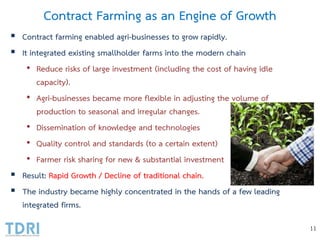
Contract Farming as an Engine of Growth
 Contract farming enabled agri-businesses to grow rapidly.
 It integrated existing smallholder farms into the modern chain
• Reduce risks of large investment (including the cost of having idle
capacity).
• Agri-businesses became more flexible in adjusting the volume of
production to seasonal and irregular changes.
• Dissemination of knowledge and technologies
• Quality control and standards (to a certain extent)
• Farmer risk sharing for new & substantial investment
 Result: Rapid Growth / Decline of traditional chain.
 The industry became highly concentrated in the hands of a few leading
integrated firms.
11
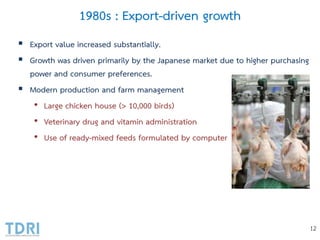
1980s : Export-driven growth
 Export value increased substantially.
 Growth was driven primarily by the Japanese market due to higher purchasing
power and consumer preferences.
 Modern production and farm management
• Large chicken house (> 10,000 birds)
• Veterinary drug and vitamin administration
• Use of ready-mixed feeds formulated by computer
12
Value-added product through processing.
 SE Asia has no comparative advantage to grow livestock due to the lack of
protein feeds –i.e. Soybean (36%) or even fishmeal (66%)
• Aggressive promotion and protection of soybean and maize has
resulted in high prices of major animal feeds in Thailand.
 Therefore, the cost of production is higher than the US and Brazil.
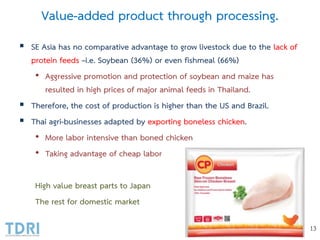
 Thai agri-businesses adapted by exporting boneless chicken.
• More labor intensive than boned chicken
• Taking advantage of cheap labor
High value breast parts to Japan
The rest for domestic market
13
Export Volume
14
0
100,000
200,000
300,000
400,000
500,000
600,000
700,000
800,000 1973
1977
1982
1987
1988
1989
1990
1991
1992
1993
1994
1995
1996
1997
1998
1999
2000
2001
2002
2003
2004
2005
2006
2007
2008
2009
2010
2011
2012
2013
2014
2015
2016
MT
Chilled and Frozen Processed and Further Total Export
0.73%
Source: Adapted from Thai Broiler Processing Exporters Association
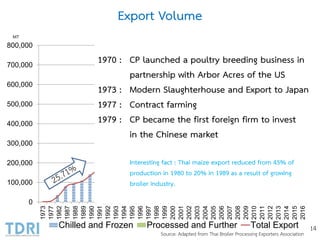
1970 : CP launched a poultry breeding business in
partnership with Arbor Acres of the US
1973 : Modern Slaughterhouse and Export to Japan
1977 : Contract farming
1979 : CP became the first foreign firm to invest
in the Chinese market
Interesting fact : Thai maize export reduced from 45% of
production in 1980 to 20% in 1989 as a result of growing
broiler industry.
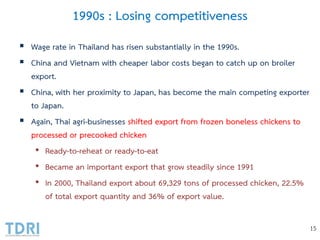
1990s : Losing competitiveness
 Wage rate in Thailand has risen substantially in the 1990s.
 China and Vietnam with cheaper labor costs began to catch up on broiler
export.
 China, with her proximity to Japan, has become the main competing exporter
to Japan.
 Again, Thai agri-businesses shifted export from frozen boneless chickens to
processed or precooked chicken
• Ready-to-reheat or ready-to-eat
• Became an important export that grow steadily since 1991
• In 2000, Thailand export about 69,329 tons of processed chicken, 22.5%
of total export quantity and 36% of export value.
15
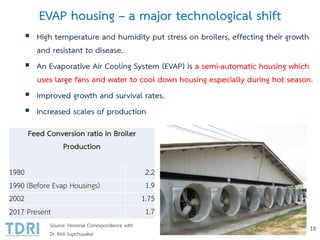
EVAP housing – a major technological shift
16
 High temperature and humidity put stress on broilers, effecting their growth
and resistant to disease.
 An Evaporative Air Cooling System (EVAP) is a semi-automatic housing which
uses large fans and water to cool down housing especially during hot season.
 Improved growth and survival rates.
 Increased scales of production
Feed Conversion ratio in Broiler
Production
1980 2.2
1990 (Before Evap Housings) 1.9
2002 1.75
2017 Present 1.7
Source: Personal Correspondence with
Dr. Kitti Supchusakul
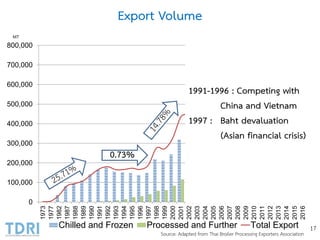
Export Volume
17
0
100,000
200,000
300,000
400,000
500,000
600,000
700,000
800,000 1973
1977
1982
1987
1988
1989
1990
1991
1992
1993
1994
1995
1996
1997
1998
1999
2000
2001
2002
2003
2004
2005
2006
2007
2008
2009
2010
2011
2012
2013
2014
2015
2016
MT
Chilled and Frozen Processed and Further Total Export
0.73%
Source: Adapted from Thai Broiler Processing Exporters Association
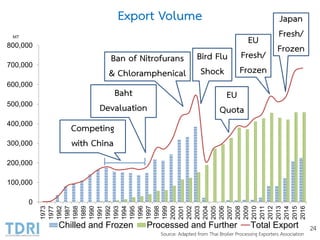
1991-1996 : Competing with
China and Vietnam
1997 : Baht devaluation
(Asian financial crisis)
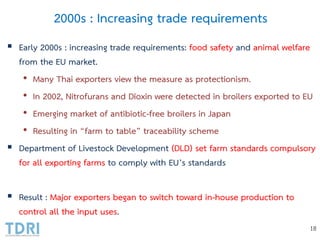
2000s : Increasing trade requirements
 Early 2000s : increasing trade requirements: food safety and animal welfare
from the EU market.
• Many Thai exporters view the measure as protectionism.
• In 2002, Nitrofurans and Dioxin were detected in broilers exported to EU
• Emerging market of antibiotic-free broilers in Japan
• Resulting in “farm to table” traceability scheme
 Department of Livestock Development (DLD) set farm standards compulsory
for all exporting farms to comply with EU’s standards
 Result : Major exporters began to switch toward in-house production to
control all the input uses.
18
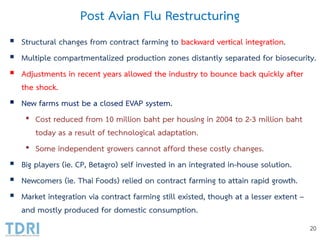
2004 Avian Flu Outbreaks – institutional responses
 The government responded swiftly and decisively.
 Strict regulations were issued:
• Stomping out of affected animals
• No AI vaccination allowed
• New farm standards (must upgrade to closed evap systems)
• Quarantine and movement control
• Nation-wide intensive surveillance (known as ‘X-ray’)
• Disposal of infected materials/Disinfection of affected premises
• Poultry restocking in affected area must waited additional 90 days
• Registration of flock and fighting rings
19
Post Avian Flu Restructuring
 Structural changes from contract farming to backward vertical integration.
 Multiple compartmentalized production zones distantly separated for biosecurity.
 Adjustments in recent years allowed the industry to bounce back quickly after
the shock.
 New farms must be a closed EVAP system.
• Cost reduced from 10 million baht per housing in 2004 to 2-3 million baht
today as a result of technological adaptation.
• Some independent growers cannot afford these costly changes.
 Big players (ie. CP, Betagro) self invested in an integrated in-house solution.
 Newcomers (ie. Thai Foods) relied on contract farming to attain rapid growth.
 Market integration via contract farming still existed, though at a lesser extent –
and mostly produced for domestic consumption.
20
Export Volume
21
0
100,000
200,000
300,000
400,000
500,000
600,000
700,000
800,000 1973
1977
1982
1987
1988
1989
1990
1991
1992
1993
1994
1995
1996
1997
1998
1999
2000
2001
2002
2003
2004
2005
2006
2007
2008
2009
2010
2011
2012
2013
2014
2015
2016
MT
Chilled and Frozen Processed and Further Total Export
0.73%
Source: Adapted from Thai Broiler Processing Exporters Association
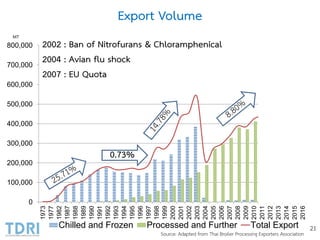
2002 : Ban of Nitrofurans & Chloramphenical
2004 : Avian flu shock
2007 : EU Quota
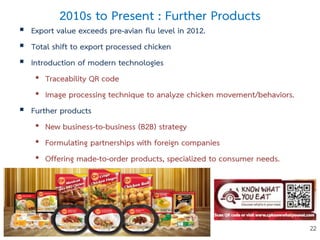
2010s to Present : Further Products
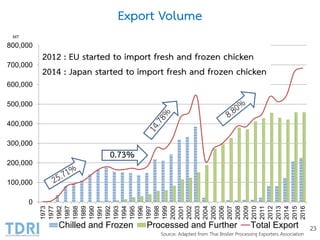
 Export value exceeds pre-avian flu level in 2012.
 Total shift to export processed chicken
 Introduction of modern technologies
• Traceability QR code
• Image processing technique to analyze chicken movement/behaviors.
 Further products
• New business-to-business (B2B) strategy
• Formulating partnerships with foreign companies
• Offering made-to-order products, specialized to consumer needs.
22
Export Volume
23
0
100,000
200,000
300,000
400,000
500,000
600,000
700,000
800,000 1973
1977
1982
1987
1988
1989
1990
1991
1992
1993
1994
1995
1996
1997
1998
1999
2000
2001
2002
2003
2004
2005
2006
2007
2008
2009
2010
2011
2012
2013
2014
2015
2016
MT
Chilled and Frozen Processed and Further Total Export
0.73%
Source: Adapted from Thai Broiler Processing Exporters Association
2012 : EU started to import fresh and frozen chicken
2014 : Japan started to import fresh and frozen chicken
Export Volume
24
0
100,000
200,000
300,000
400,000
500,000
600,000
700,000
800,000 1973
1977
1982
1987
1988
1989
1990
1991
1992
1993
1994
1995
1996
1997
1998
1999
2000
2001
2002
2003
2004
2005
2006
2007
2008
2009
2010
2011
2012
2013
2014
2015
2016
MT
Chilled and Frozen Processed and Further Total Export
Competing
with China
EU
Quota
EU
Fresh/
Frozen
Baht
Devaluation
Ban of Nitrofurans
& Chloramphenical
Bird Flu
Shock
Japan
Fresh/
Frozen
Source: Adapted from Thai Broiler Processing Exporters Association
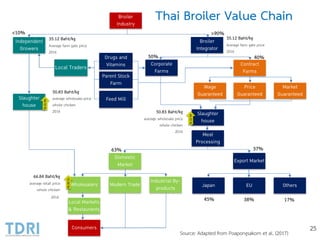
Thai Broiler Value Chain
25
Broiler
Industry
Independent
Growers
Slaughter
house
Broiler
Integrator
Corporate
Farms
Contract
Farms
Wage
Guaranteed
Price
Guaranteed
Slaughter
house
Meat
Processing
Domestic
Market
Wholesalers
Local Markets
& Restaurants
Consumers
Modern Trade
Industrial By-
products
Export Market
Japan EU Others
Market
Guaranteed
Local Traders
44.72%
44.72%
31.50%
>90%
40%50%
37%63%
38% 17%45%
<10%
35.12 Baht/kg
Average farm gate price
2016
35.12 Baht/kg
Average farm gate price
2016
50.83 Baht/kg
average wholesale price
whole chicken
2016
50.83 Baht/kg
average wholesale price
whole chicken
2016
66.84 Baht/kg
average retail price
whole chicken
2016
Drugs and
Vitamins
Parent Stock
Farm
Feed Mill
Source: Adapted from Poapongsakorn et al. (2017)
Success, but not trouble-free…
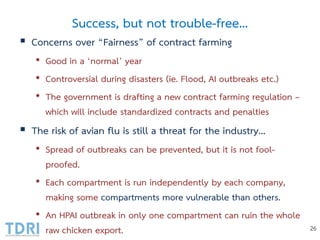
 Concerns over “Fairness” of contract farming
• Good in a ‘normal’ year
• Controversial during disasters (ie. Flood, AI outbreaks etc.)
• The government is drafting a new contract farming regulation –
which will include standardized contracts and penalties
 The risk of avian flu is still a threat for the industry…
• Spread of outbreaks can be prevented, but it is not fool-
proofed.
• Each compartment is run independently by each company,
making some compartments more vulnerable than others.
• An HPAI outbreak in only one compartment can ruin the whole
raw chicken export. 26
Success, but not without some flaws…
 Animal feeds
• Will rely more on import
 Dumping issues
• Due to various eating preferences, dumping is always
possible/a threat
 Trade related investment measure
• Neighboring countries tend to aim at self-sufficiency
rather than importing
• In the long run cross-border investment would be
more important.
27
Expanding to Regional and Global Markets
28
Expanding toward regional and global markets
 Trade with the global markets (Japan and EU)
 Investment strategies
• Organic Growth = feed businesses + contract farming
 Mainly wage/income guaranteed
 Thailand business model
 Solutions differed by local contexts.
• Rapid Growth = Mergers and Acquisitions
 Integration Broiler business in USA (2006) and Turkey
(2006-2007)
 In other ASEAN countries, investment is still at an early
stage
• Production aimed for domestic market only 29
Outbound Investment to ASEAN countries (1)
 Malaysia
• Struggled at first due to nationalistic policy
• Shifting policy allowed rapid growth
• High domestic demands
• No tariff on animal feeds = reduce production cost
 Vietnam
• More than 20 years
• Rapid growth
• Extension in retail businesses
30
Outbound Investment to ASEAN countries (2)
 Philippines
• Disincentives: politics and existing agri-businesses
• Recent investment after negotiation with President
Arroyo – situated on an island (natural compartment)
 Lao PDR
• Depend on trade until recently
• Investment after import tariff and protectionism
policy
31
Recap of CP strategy to success
 First mover advantage
 Institutional Arrangement
• contract farming as an enabler, close coordination between
government and businesses, esp. during/after crises.
 Technologies
• adopt quickly, adapt frequently
 Market-driven
• Change with the market, realized strength and weakness,
formulate long-term partnership.
• Outbound investment to produce locally.
32
Thank you
viroj@tdri.or.th
phunjasit@tdri.or.th
33

Broiler Industry Development in Thailand

  • 1.
    Broiler Industry Developmentin Thailand Market Integration and Value Chain Development Expanding Regional and Global Markets Dr. Viroj NaRanong Mr. Phunjasit Chokesomritpol Thailand Development Research Institute 13 December 2017 1
  • 2.
    Summary  Development ofThai Broiler Industry (1970s - Present)  Success Factors • Institutional Arrangement • Technology Adoption and Adaptation • Market-Driven Approach  Expanding to regional and global markets 2
  • 3.
    Broiler Production (2012-2016) 3 62.8%66.6% 67.1% 66.3% 65.5% 6.4% 6.0% 8.8% 9.5% 10.4% 30.8% 27.3% 24.1% 24.1% 24.0% 0 200,000 400,000 600,000 800,000 1,000,000 1,200,000 1,400,000 1,600,000 1,800,000 2,000,000 2012 2013 2014 2015 2016 MT Export Processed Export Frozen Domestic Consumption Source: Office of Agricultural Economics (OAE)  Broiler Industry is one of Thailand’s most successful agricultural products.  Growth Rate (2012-2016) • Total Production Growth = 7.62% • Domestic Consumption Growth = 8.43% • Export Growth = 6.18%
  • 4.
    Domestic consumption ofbroilers grows steadily because they are cheaper relative to other meats 4- 10 20 30 40 50 60 70 80 90 Baht/kg Broiler Duck Swine Linear (Broiler) Linear (Duck) Linear (Swine)
  • 5.
    As Southeast Asia’sincome per capita increases, export opportunities are still there… 5 Income per capita (USD) Broiler consumption per capita (Kg) Singapore 50714 36 Brunei* 36521 53 Malaysia* 8617 38 Thailand 5281 24 Indonesia* 3469 26 Philippines 2255 10 Vietnam 1362 7 Lao PDR 1204 3 Cambodia 912 2 Myanmar 804 2 Source: Department of livestock development (DLD) * A mainly Islamic country (more potential for higher broiler consumption)
  • 6.
    Broiler Export  Animportant export commodity, equaled to 9.45% of total agricultural products export value in 2015  5th largest exporter of frozen chicken (4% market share)  1st largest exporter of processed chicken (30% market share) 6Source: Trademap, Ministry of Commerce (MOC), compiled by Krungsri Research
  • 7.
    Processed Broilers arethe money maker  Further products (HS 160232) accounted for nearly 80% of Thailand broiler export value.  Export mainly to Japan (54%) and EU (36%) 7 8.7% 9.5% 17.1% 17.6% 19.6% 91.3% 90.5% 82.9% 82.4% 80.4% 0 500 1,000 1,500 2,000 2,500 3,000 2012 2013 2014 2015 2016 MillionsUSD Prepared and preserved broilers Source: UN Comtrade  Variety of products, made-to-order  Average value added = 4.26 USD/kg almost doubled to average value added of chilled/frozen chicken at 2.33 USD/kg
  • 8.
    Development of ThaiBroiler Industry From1970s to Present 8
  • 9.
    Before 1970s  Noexport.  Farmers grew small numbers of indigenous chickens for on-farm-consumption.  Recreational fighting cocks were common, but not significant in numbers.  Traditional Chain : small middleman and large wholesalers. 9
  • 10.
    1970s : InitialDevelopment by a few private feed-mill companies  In 1973 : CP established the first modern slaughterhouse to process frozen chicken and exported the first lot of chickens to Japan. • Technology transfer from Arbor Acres (Breeding, Management, Disease control and Marketing) • Effectively increase productivity and reduce the risk of death  In 1977, CP’s subsidiary firm initiated a contract farming system in Sri Racha  Contract farming became very popular and was copied by other agri- businesses. 10
  • 11.
    Contract Farming asan Engine of Growth  Contract farming enabled agri-businesses to grow rapidly.  It integrated existing smallholder farms into the modern chain • Reduce risks of large investment (including the cost of having idle capacity). • Agri-businesses became more flexible in adjusting the volume of production to seasonal and irregular changes. • Dissemination of knowledge and technologies • Quality control and standards (to a certain extent) • Farmer risk sharing for new & substantial investment  Result: Rapid Growth / Decline of traditional chain.  The industry became highly concentrated in the hands of a few leading integrated firms. 11
  • 12.
    1980s : Export-drivengrowth  Export value increased substantially.  Growth was driven primarily by the Japanese market due to higher purchasing power and consumer preferences.  Modern production and farm management • Large chicken house (> 10,000 birds) • Veterinary drug and vitamin administration • Use of ready-mixed feeds formulated by computer 12
  • 13.
    Value-added product throughprocessing.  SE Asia has no comparative advantage to grow livestock due to the lack of protein feeds –i.e. Soybean (36%) or even fishmeal (66%) • Aggressive promotion and protection of soybean and maize has resulted in high prices of major animal feeds in Thailand.  Therefore, the cost of production is higher than the US and Brazil.  Thai agri-businesses adapted by exporting boneless chicken. • More labor intensive than boned chicken • Taking advantage of cheap labor High value breast parts to Japan The rest for domestic market 13
  • 14.
    Export Volume 14 0 100,000 200,000 300,000 400,000 500,000 600,000 700,000 800,000 1973 1977 1982 1987 1988 1989 1990 1991 1992 1993 1994 1995 1996 1997 1998 1999 2000 2001 2002 2003 2004 2005 2006 2007 2008 2009 2010 2011 2012 2013 2014 2015 2016 MT Chilledand Frozen Processed and Further Total Export 0.73% Source: Adapted from Thai Broiler Processing Exporters Association 1970 : CP launched a poultry breeding business in partnership with Arbor Acres of the US 1973 : Modern Slaughterhouse and Export to Japan 1977 : Contract farming 1979 : CP became the first foreign firm to invest in the Chinese market Interesting fact : Thai maize export reduced from 45% of production in 1980 to 20% in 1989 as a result of growing broiler industry.
  • 15.
    1990s : Losingcompetitiveness  Wage rate in Thailand has risen substantially in the 1990s.  China and Vietnam with cheaper labor costs began to catch up on broiler export.  China, with her proximity to Japan, has become the main competing exporter to Japan.  Again, Thai agri-businesses shifted export from frozen boneless chickens to processed or precooked chicken • Ready-to-reheat or ready-to-eat • Became an important export that grow steadily since 1991 • In 2000, Thailand export about 69,329 tons of processed chicken, 22.5% of total export quantity and 36% of export value. 15
  • 16.
    EVAP housing –a major technological shift 16  High temperature and humidity put stress on broilers, effecting their growth and resistant to disease.  An Evaporative Air Cooling System (EVAP) is a semi-automatic housing which uses large fans and water to cool down housing especially during hot season.  Improved growth and survival rates.  Increased scales of production Feed Conversion ratio in Broiler Production 1980 2.2 1990 (Before Evap Housings) 1.9 2002 1.75 2017 Present 1.7 Source: Personal Correspondence with Dr. Kitti Supchusakul
  • 17.
    Export Volume 17 0 100,000 200,000 300,000 400,000 500,000 600,000 700,000 800,000 1973 1977 1982 1987 1988 1989 1990 1991 1992 1993 1994 1995 1996 1997 1998 1999 2000 2001 2002 2003 2004 2005 2006 2007 2008 2009 2010 2011 2012 2013 2014 2015 2016 MT Chilledand Frozen Processed and Further Total Export 0.73% Source: Adapted from Thai Broiler Processing Exporters Association 1991-1996 : Competing with China and Vietnam 1997 : Baht devaluation (Asian financial crisis)
  • 18.
    2000s : Increasingtrade requirements  Early 2000s : increasing trade requirements: food safety and animal welfare from the EU market. • Many Thai exporters view the measure as protectionism. • In 2002, Nitrofurans and Dioxin were detected in broilers exported to EU • Emerging market of antibiotic-free broilers in Japan • Resulting in “farm to table” traceability scheme  Department of Livestock Development (DLD) set farm standards compulsory for all exporting farms to comply with EU’s standards  Result : Major exporters began to switch toward in-house production to control all the input uses. 18
  • 19.
    2004 Avian FluOutbreaks – institutional responses  The government responded swiftly and decisively.  Strict regulations were issued: • Stomping out of affected animals • No AI vaccination allowed • New farm standards (must upgrade to closed evap systems) • Quarantine and movement control • Nation-wide intensive surveillance (known as ‘X-ray’) • Disposal of infected materials/Disinfection of affected premises • Poultry restocking in affected area must waited additional 90 days • Registration of flock and fighting rings 19
  • 20.
    Post Avian FluRestructuring  Structural changes from contract farming to backward vertical integration.  Multiple compartmentalized production zones distantly separated for biosecurity.  Adjustments in recent years allowed the industry to bounce back quickly after the shock.  New farms must be a closed EVAP system. • Cost reduced from 10 million baht per housing in 2004 to 2-3 million baht today as a result of technological adaptation. • Some independent growers cannot afford these costly changes.  Big players (ie. CP, Betagro) self invested in an integrated in-house solution.  Newcomers (ie. Thai Foods) relied on contract farming to attain rapid growth.  Market integration via contract farming still existed, though at a lesser extent – and mostly produced for domestic consumption. 20
  • 21.
    Export Volume 21 0 100,000 200,000 300,000 400,000 500,000 600,000 700,000 800,000 1973 1977 1982 1987 1988 1989 1990 1991 1992 1993 1994 1995 1996 1997 1998 1999 2000 2001 2002 2003 2004 2005 2006 2007 2008 2009 2010 2011 2012 2013 2014 2015 2016 MT Chilledand Frozen Processed and Further Total Export 0.73% Source: Adapted from Thai Broiler Processing Exporters Association 2002 : Ban of Nitrofurans & Chloramphenical 2004 : Avian flu shock 2007 : EU Quota
  • 22.
    2010s to Present: Further Products  Export value exceeds pre-avian flu level in 2012.  Total shift to export processed chicken  Introduction of modern technologies • Traceability QR code • Image processing technique to analyze chicken movement/behaviors.  Further products • New business-to-business (B2B) strategy • Formulating partnerships with foreign companies • Offering made-to-order products, specialized to consumer needs. 22
  • 23.
    Export Volume 23 0 100,000 200,000 300,000 400,000 500,000 600,000 700,000 800,000 1973 1977 1982 1987 1988 1989 1990 1991 1992 1993 1994 1995 1996 1997 1998 1999 2000 2001 2002 2003 2004 2005 2006 2007 2008 2009 2010 2011 2012 2013 2014 2015 2016 MT Chilledand Frozen Processed and Further Total Export 0.73% Source: Adapted from Thai Broiler Processing Exporters Association 2012 : EU started to import fresh and frozen chicken 2014 : Japan started to import fresh and frozen chicken
  • 24.
    Export Volume 24 0 100,000 200,000 300,000 400,000 500,000 600,000 700,000 800,000 1973 1977 1982 1987 1988 1989 1990 1991 1992 1993 1994 1995 1996 1997 1998 1999 2000 2001 2002 2003 2004 2005 2006 2007 2008 2009 2010 2011 2012 2013 2014 2015 2016 MT Chilledand Frozen Processed and Further Total Export Competing with China EU Quota EU Fresh/ Frozen Baht Devaluation Ban of Nitrofurans & Chloramphenical Bird Flu Shock Japan Fresh/ Frozen Source: Adapted from Thai Broiler Processing Exporters Association
  • 25.
    Thai Broiler ValueChain 25 Broiler Industry Independent Growers Slaughter house Broiler Integrator Corporate Farms Contract Farms Wage Guaranteed Price Guaranteed Slaughter house Meat Processing Domestic Market Wholesalers Local Markets & Restaurants Consumers Modern Trade Industrial By- products Export Market Japan EU Others Market Guaranteed Local Traders 44.72% 44.72% 31.50% >90% 40%50% 37%63% 38% 17%45% <10% 35.12 Baht/kg Average farm gate price 2016 35.12 Baht/kg Average farm gate price 2016 50.83 Baht/kg average wholesale price whole chicken 2016 50.83 Baht/kg average wholesale price whole chicken 2016 66.84 Baht/kg average retail price whole chicken 2016 Drugs and Vitamins Parent Stock Farm Feed Mill Source: Adapted from Poapongsakorn et al. (2017)
  • 26.
    Success, but nottrouble-free…  Concerns over “Fairness” of contract farming • Good in a ‘normal’ year • Controversial during disasters (ie. Flood, AI outbreaks etc.) • The government is drafting a new contract farming regulation – which will include standardized contracts and penalties  The risk of avian flu is still a threat for the industry… • Spread of outbreaks can be prevented, but it is not fool- proofed. • Each compartment is run independently by each company, making some compartments more vulnerable than others. • An HPAI outbreak in only one compartment can ruin the whole raw chicken export. 26
  • 27.
    Success, but notwithout some flaws…  Animal feeds • Will rely more on import  Dumping issues • Due to various eating preferences, dumping is always possible/a threat  Trade related investment measure • Neighboring countries tend to aim at self-sufficiency rather than importing • In the long run cross-border investment would be more important. 27
  • 28.
    Expanding to Regionaland Global Markets 28
  • 29.
    Expanding toward regionaland global markets  Trade with the global markets (Japan and EU)  Investment strategies • Organic Growth = feed businesses + contract farming  Mainly wage/income guaranteed  Thailand business model  Solutions differed by local contexts. • Rapid Growth = Mergers and Acquisitions  Integration Broiler business in USA (2006) and Turkey (2006-2007)  In other ASEAN countries, investment is still at an early stage • Production aimed for domestic market only 29
  • 30.
    Outbound Investment toASEAN countries (1)  Malaysia • Struggled at first due to nationalistic policy • Shifting policy allowed rapid growth • High domestic demands • No tariff on animal feeds = reduce production cost  Vietnam • More than 20 years • Rapid growth • Extension in retail businesses 30
  • 31.
    Outbound Investment toASEAN countries (2)  Philippines • Disincentives: politics and existing agri-businesses • Recent investment after negotiation with President Arroyo – situated on an island (natural compartment)  Lao PDR • Depend on trade until recently • Investment after import tariff and protectionism policy 31
  • 32.
    Recap of CPstrategy to success  First mover advantage  Institutional Arrangement • contract farming as an enabler, close coordination between government and businesses, esp. during/after crises.  Technologies • adopt quickly, adapt frequently  Market-driven • Change with the market, realized strength and weakness, formulate long-term partnership. • Outbound investment to produce locally. 32
  • 33.

Editor's Notes

  • #13 (1973 – 5 million baht) (1980 – 350 million baht) (1974 – 36.4 million birds) (1981 – 288 million in 1981)