PaaSword: A Holistic Data Privacy and Security
by Design Framework for Cloud Services
Yiannis Verginadis, Antonis Michalas, Panagiotis Gouvas,
Gunther Schiefer, Gerald Hubsch, Iraklis Paraskakis
CLOSER 2015, Lisbon, May 21, 2015
Information Management Unit / ICCS of NTUA www.imu.iccs.gr
Agenda
 Introduction
 Data Security Challenges in the Cloud
 PaaSword Framework
 Conclusions
Information Management Unit / ICCS of NTUA www.imu.iccs.gr
Introduction
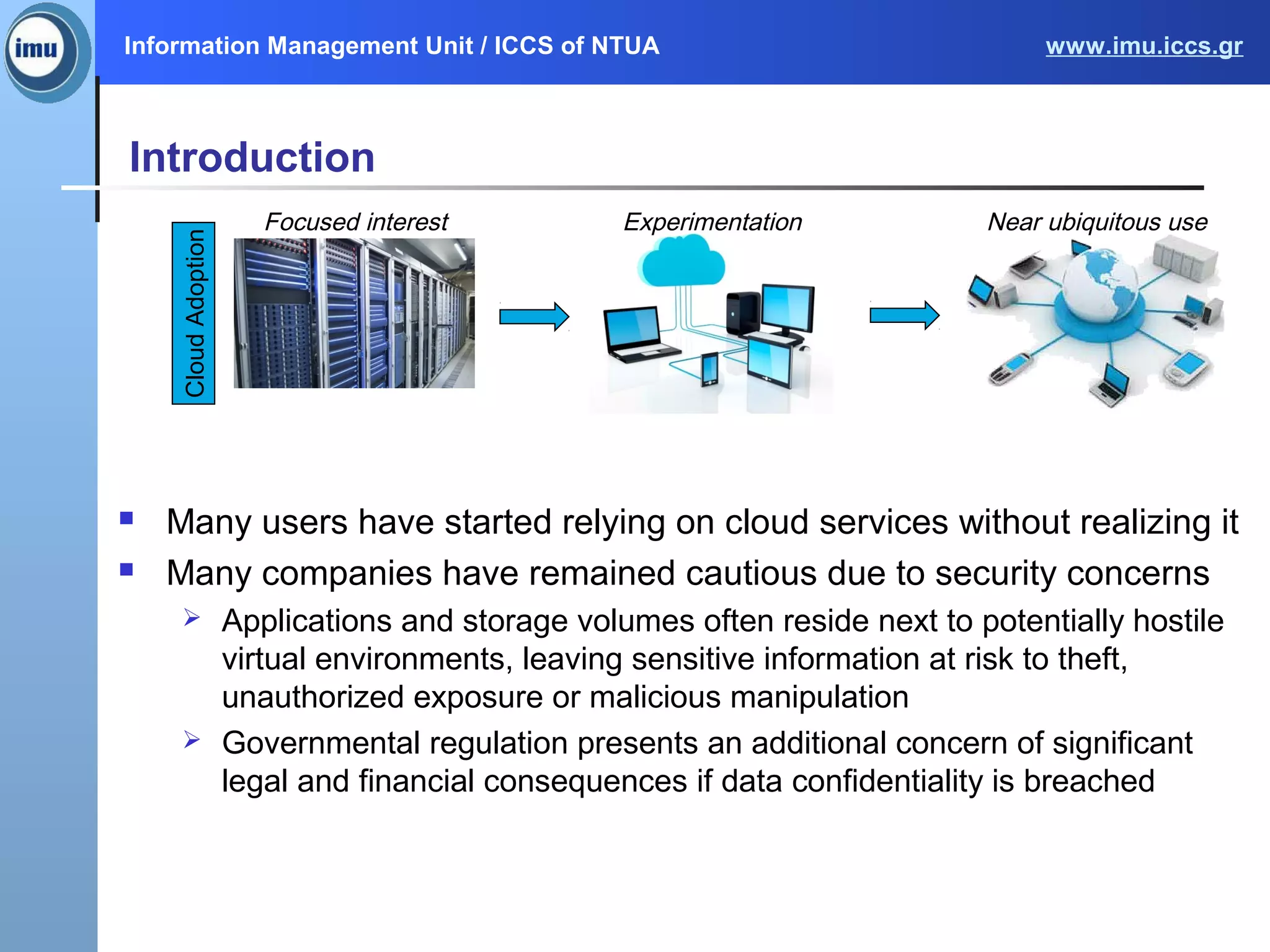
 Many users have started relying on cloud services without realizing it
 Many companies have remained cautious due to security concerns
 Applications and storage volumes often reside next to potentially hostile
virtual environments, leaving sensitive information at risk to theft,
unauthorized exposure or malicious manipulation
 Governmental regulation presents an additional concern of significant
legal and financial consequences if data confidentiality is breached
Focused interest Experimentation Near ubiquitous use
CloudAdoption
Information Management Unit / ICCS of NTUA www.imu.iccs.gr
Related Work
 Commonly used access control models (Ferrari 2010) are:
 Mandatory Access Control (MAC)
 Discretionary Access Control (DAC)
 Role-Based Access Control (RBAC)
 Extending these models:
 location-aware access control (LAAC) - there is a clear lack of
supporting additional pertinent contextual information (Cleeff et
al.,2010)
 context-aware access control (CAAC) – with shortcomings like:

lack of support for dynamically generated context (Covington et al., 2001)

lack of fine-grained data access control (Kayes et al., 2013)
Information Management Unit / ICCS of NTUA www.imu.iccs.gr
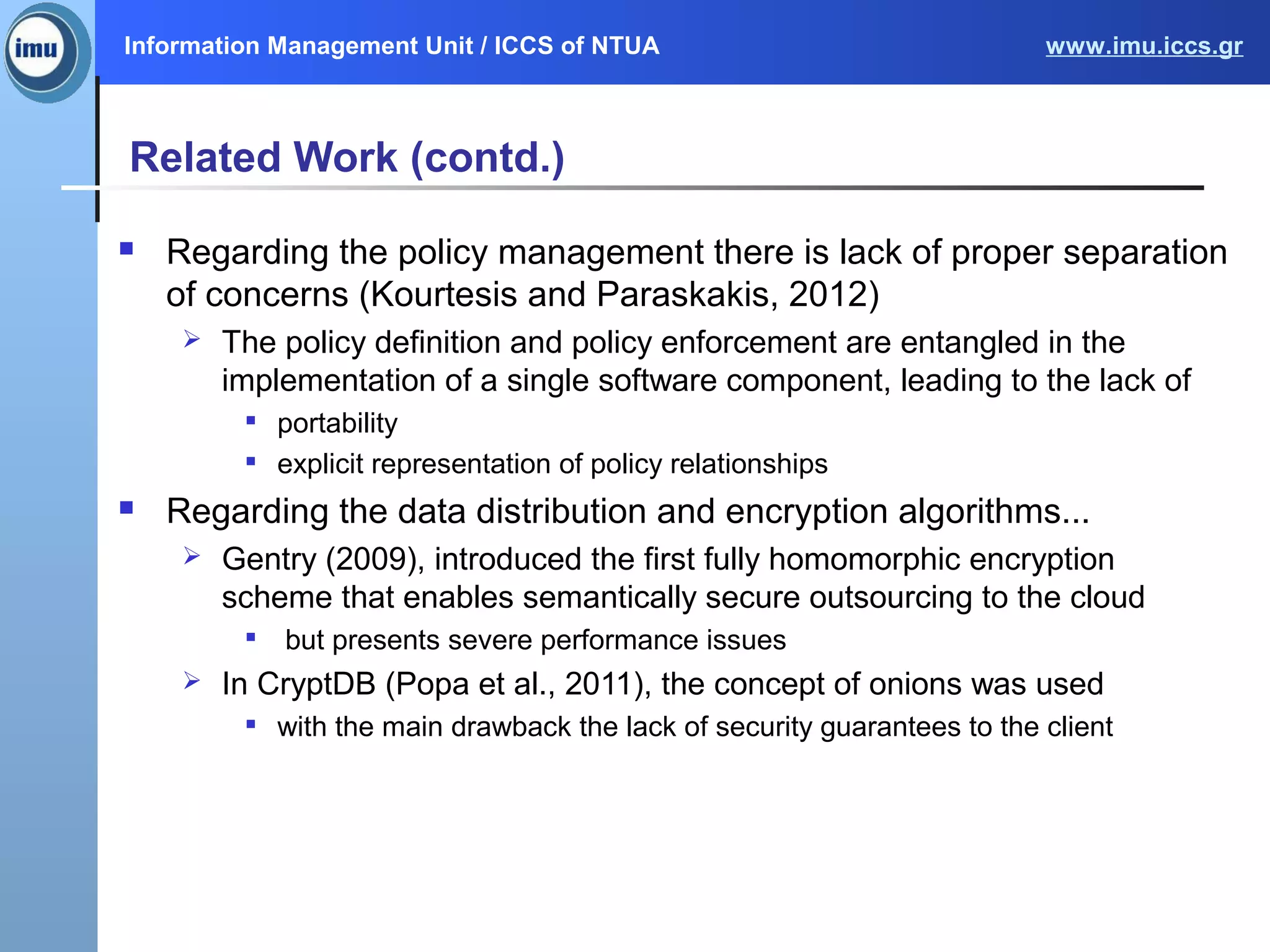
Related Work (contd.)
 Regarding the policy management there is lack of proper separation
of concerns (Kourtesis and Paraskakis, 2012)
 The policy definition and policy enforcement are entangled in the
implementation of a single software component, leading to the lack of

portability

explicit representation of policy relationships
 Regarding the data distribution and encryption algorithms...
 Gentry (2009), introduced the first fully homomorphic encryption
scheme that enables semantically secure outsourcing to the cloud

but presents severe performance issues
 In CryptDB (Popa et al., 2011), the concept of onions was used

with the main drawback the lack of security guarantees to the client
Information Management Unit / ICCS of NTUA www.imu.iccs.gr
Agenda
 Introduction
 Data Security Challenges in the Cloud
 PaaSword Framework
 Conclusions
Information Management Unit / ICCS of NTUA www.imu.iccs.gr
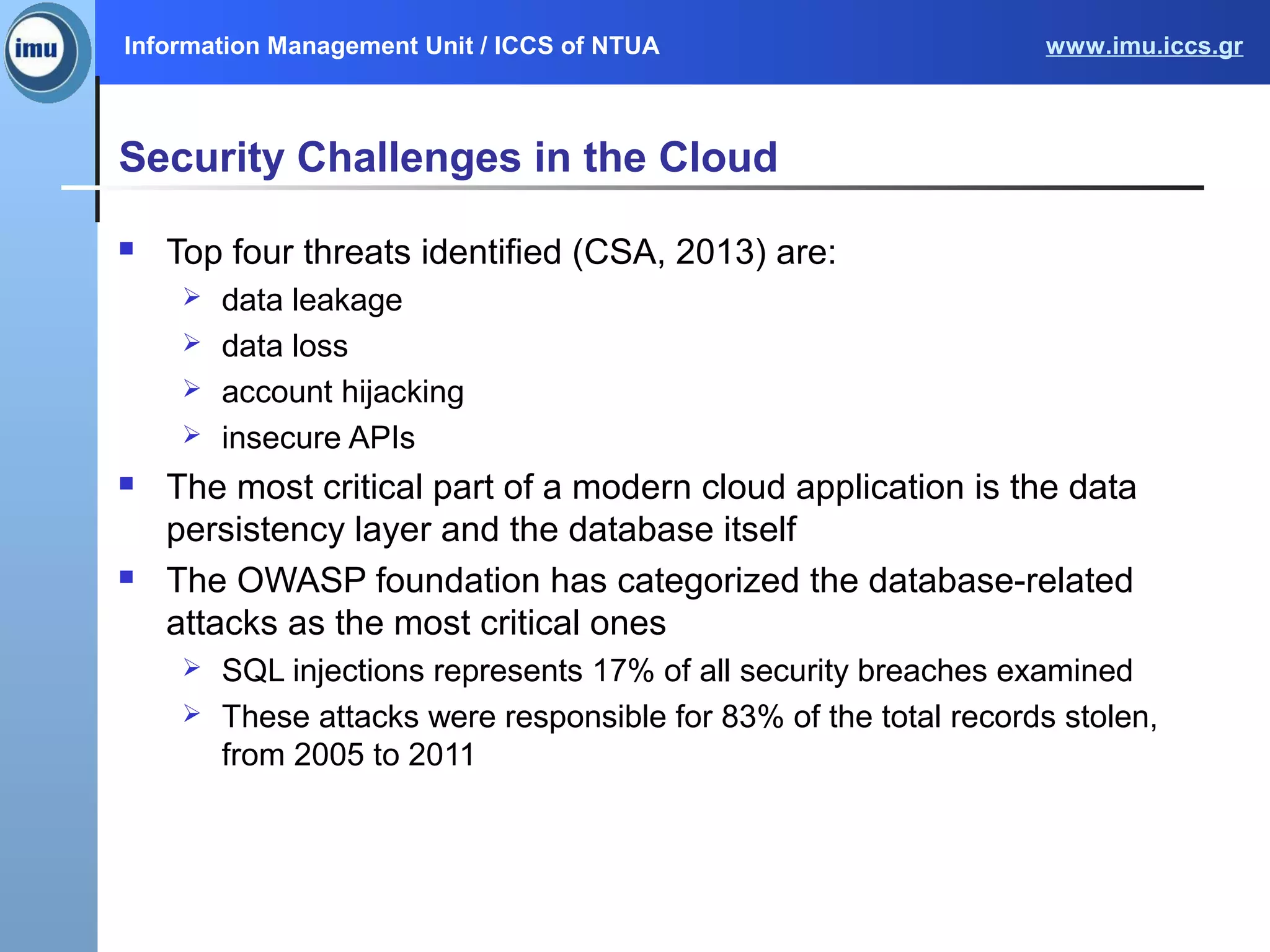
Security Challenges in the Cloud
 Top four threats identified (CSA, 2013) are:
 data leakage
 data loss
 account hijacking
 insecure APIs
 The most critical part of a modern cloud application is the data
persistency layer and the database itself
 The OWASP foundation has categorized the database-related
attacks as the most critical ones
 SQL injections represents 17% of all security breaches examined
 These attacks were responsible for 83% of the total records stolen,
from 2005 to 2011
Information Management Unit / ICCS of NTUA www.imu.iccs.gr
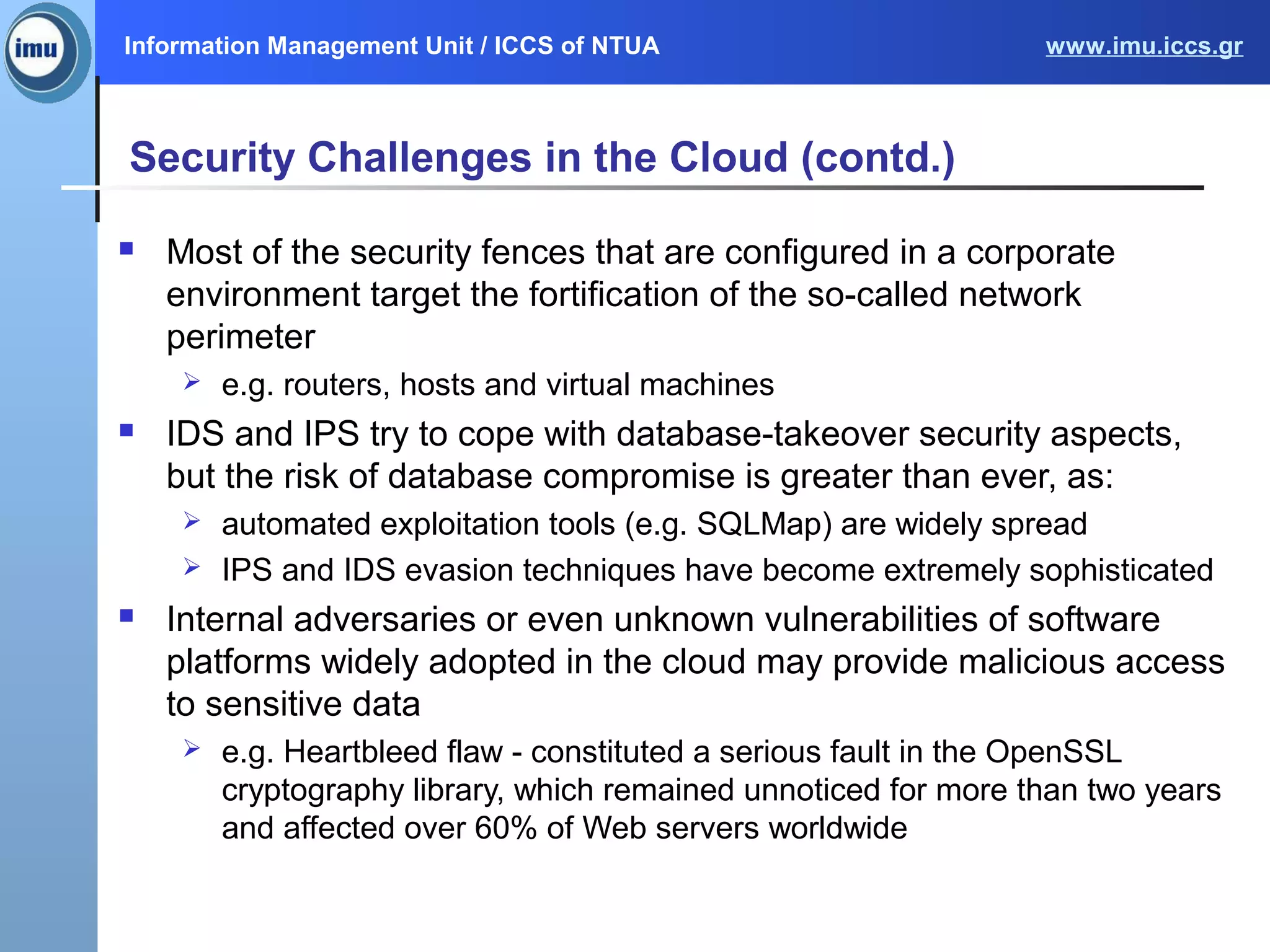
Security Challenges in the Cloud (contd.)
 Most of the security fences that are configured in a corporate
environment target the fortification of the so-called network
perimeter
 e.g. routers, hosts and virtual machines
 IDS and IPS try to cope with database-takeover security aspects,
but the risk of database compromise is greater than ever, as:
 automated exploitation tools (e.g. SQLMap) are widely spread
 IPS and IDS evasion techniques have become extremely sophisticated
 Internal adversaries or even unknown vulnerabilities of software
platforms widely adopted in the cloud may provide malicious access
to sensitive data
 e.g. Heartbleed flaw - constituted a serious fault in the OpenSSL
cryptography library, which remained unnoticed for more than two years
and affected over 60% of Web servers worldwide
Information Management Unit / ICCS of NTUA www.imu.iccs.gr
Security Challenges in the Cloud (contd.)
 Regarding the post-exploitation phase things are even worse in the
case where a symmetric encryption algorithm has been employed
 cracking toolkits that utilize GPU processing power (e.g. oclHashcat) are able to
crack ciphers using brute-force techniques with an attack rate of 162 billion
attempts per second
 The application developer is the one responsible for both
 sanitizing all HTTP-input parameters
 reassuring that compromised data will be useless
 Nevertheless, the mere utilization of an IaaS or PaaS provider, may
by itself spawn a multitude of inherent vulnerabilities
 that cannot be tackled effectively as they typically exceed the
responsibilities of an application developer
Information Management Unit / ICCS of NTUA www.imu.iccs.gr
Agenda
 Introduction
 Data Security Challenges in the Cloud
 PaaSword Framework
 Conclusions
Information Management Unit / ICCS of NTUA www.imu.iccs.gr
Threat Model
 We assume a semi-honest adversarial model for the cloud provider
(Paladi et al., 2014; Santos et al., 2009)
 a malicious cloud provider correctly follows the protocol specification
but can intercept all messages and may attempt to use them in order to
learn information that otherwise should remain private
 For the rest of the participants we consider the threat model (Santos
et al., 2009) that assumes that privileged access rights can be used
by a remote adversary, ADV, to leak confidential information
 e.g. a corrupted system administrator, can obtain remote access to any
host maintained by the provider.
 the adversary cannot access the volatile memory of any guest virtual
machine (VM) residing on the compute hosts of the provider
Information Management Unit / ICCS of NTUA www.imu.iccs.gr
Context-aware Access Model
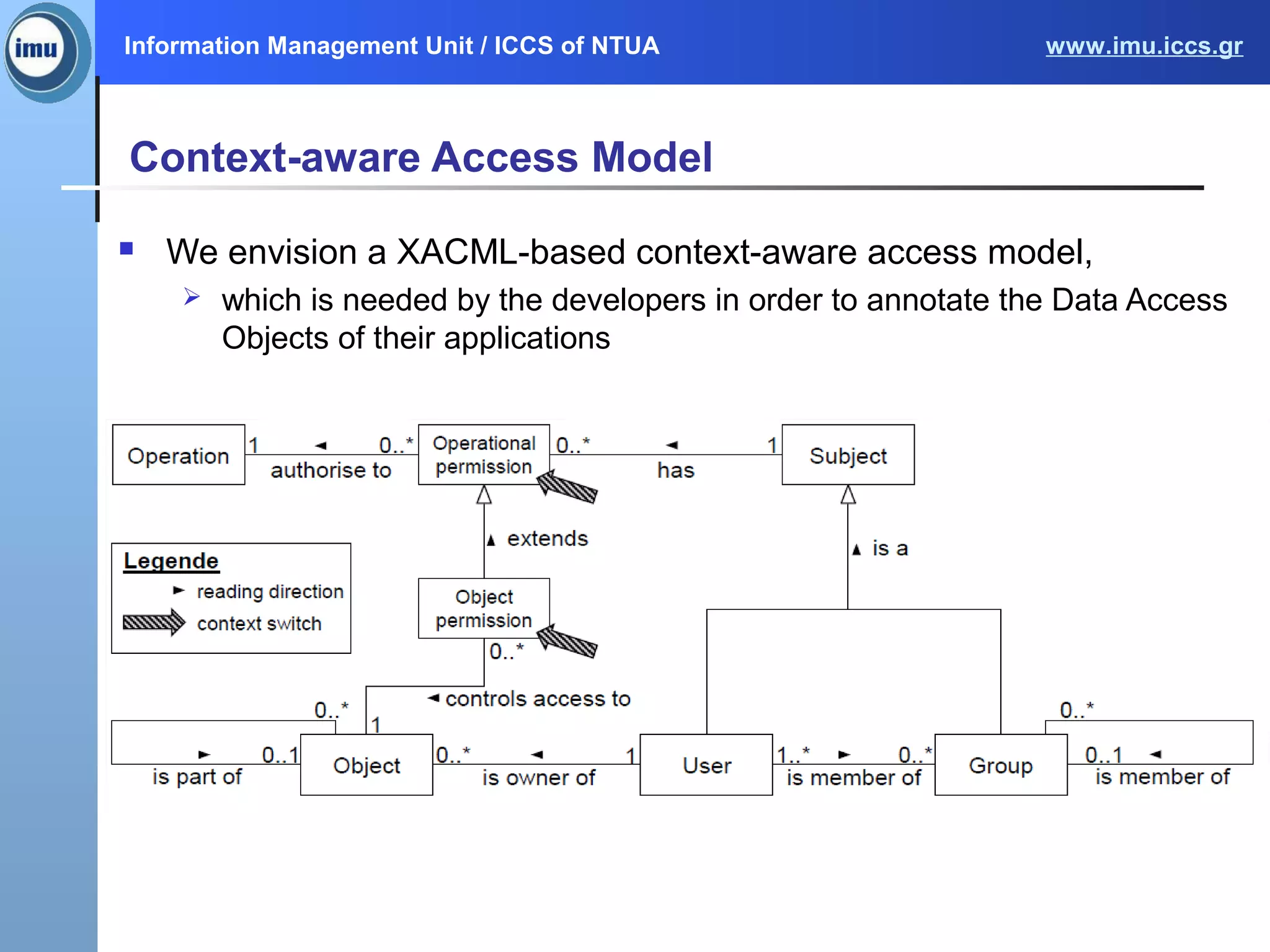
 We envision a XACML-based context-aware access model,
 which is needed by the developers in order to annotate the Data Access
Objects of their applications
Information Management Unit / ICCS of NTUA www.imu.iccs.gr
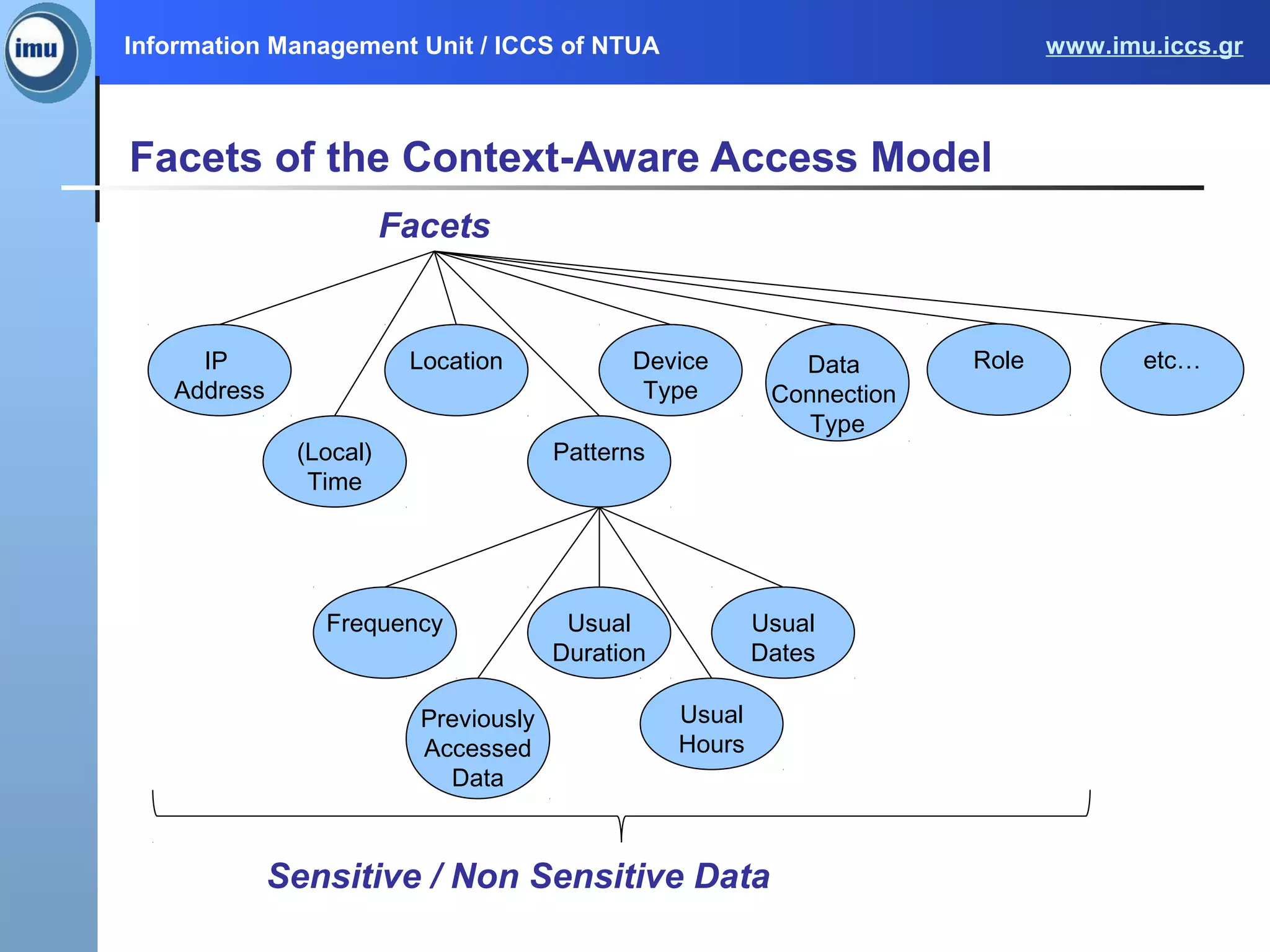
Facets of the Context-Aware Access Model
Facets
IP
Address
(Local)
Time
Location Device
Type
Data
Connection
Type
etc…
Patterns
Frequency Usual
Duration
Usual
Dates
Usual
Hours
Previously
Accessed
Data
Sensitive / Non Sensitive Data
Role
Information Management Unit / ICCS of NTUA www.imu.iccs.gr
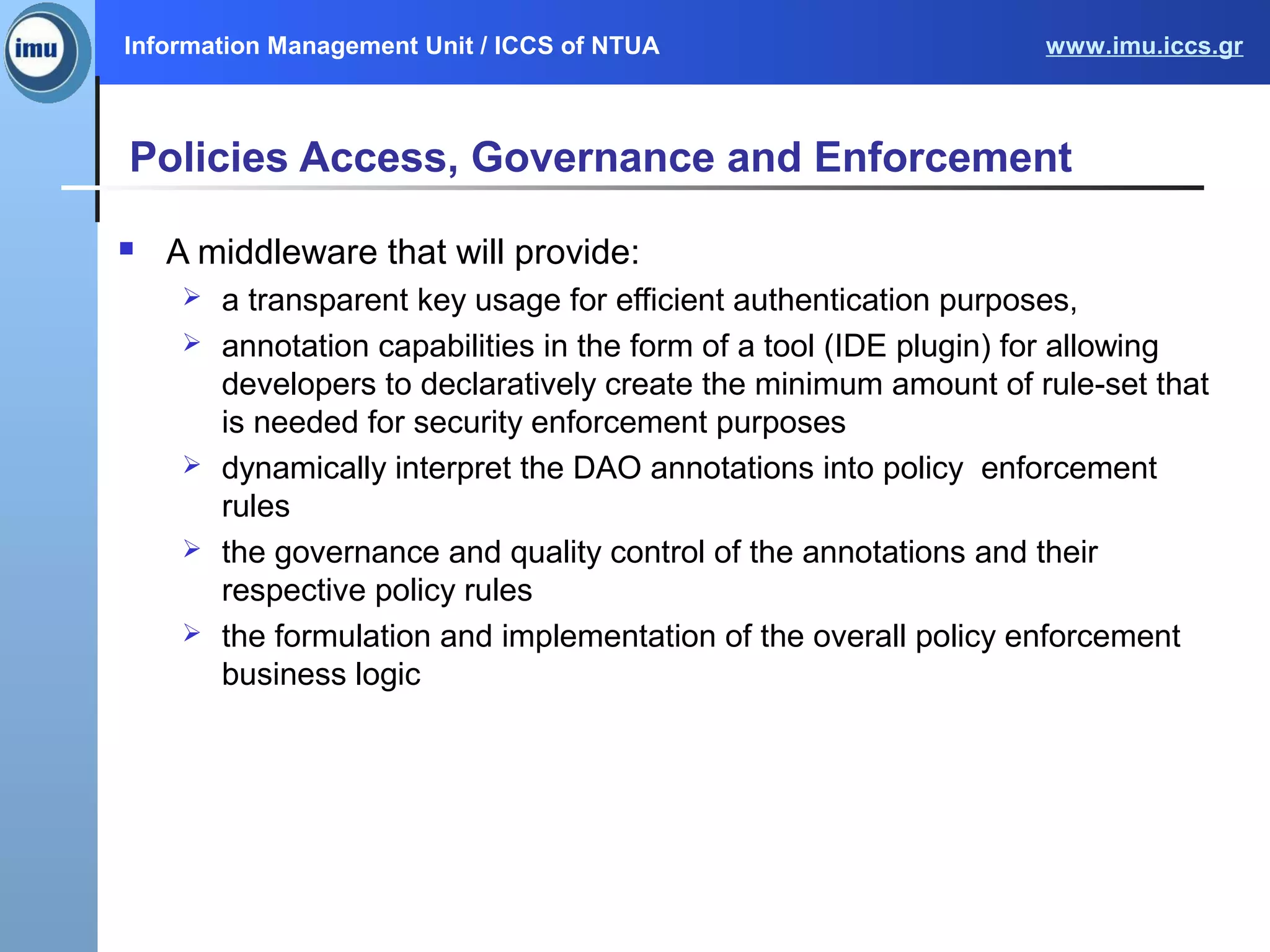
Policies Access, Governance and Enforcement
 A middleware that will provide:
 a transparent key usage for efficient authentication purposes,
 annotation capabilities in the form of a tool (IDE plugin) for allowing
developers to declaratively create the minimum amount of rule-set that
is needed for security enforcement purposes
 dynamically interpret the DAO annotations into policy enforcement
rules
 the governance and quality control of the annotations and their
respective policy rules
 the formulation and implementation of the overall policy enforcement
business logic
Information Management Unit / ICCS of NTUA www.imu.iccs.gr
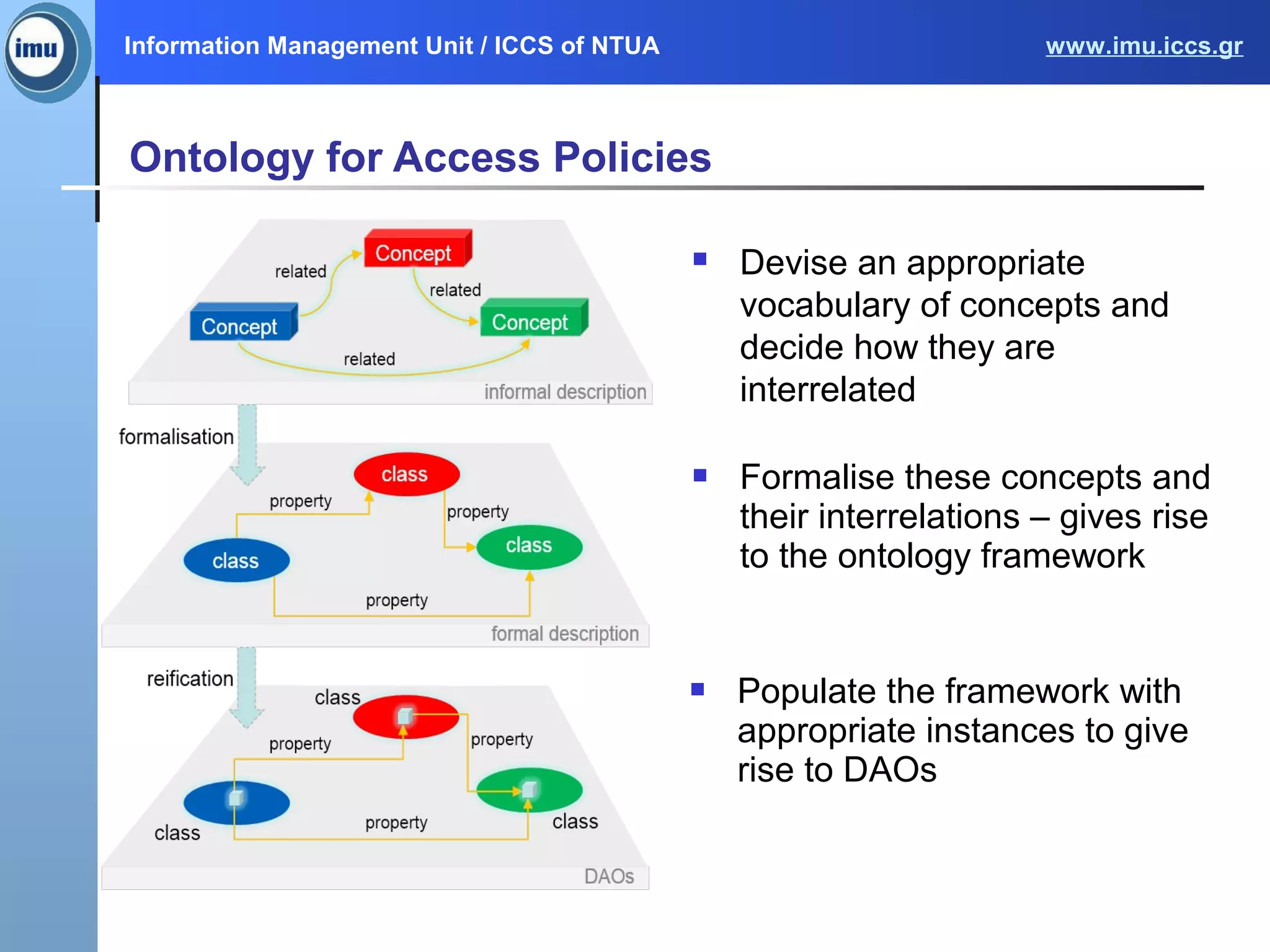
 Devise an appropriate
vocabulary of concepts and
decide how they are
interrelated
 Populate the framework with
appropriate instances to give
rise to DAOs
 Formalise these concepts and
their interrelations – gives rise
to the ontology framework
Ontology for Access Policies
Information Management Unit / ICCS of NTUA www.imu.iccs.gr
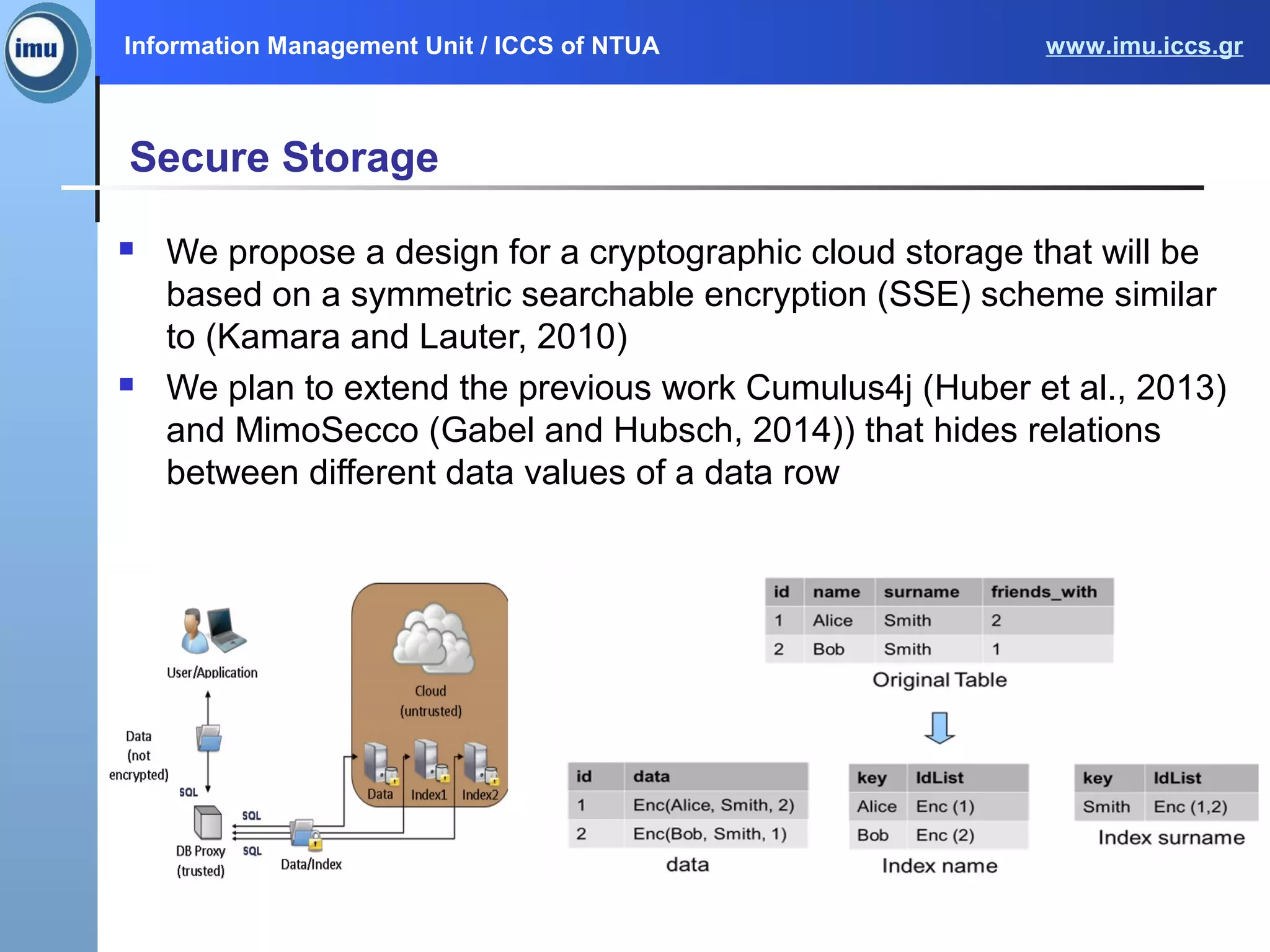
Secure Storage
 We propose a design for a cryptographic cloud storage that will be
based on a symmetric searchable encryption (SSE) scheme similar
to (Kamara and Lauter, 2010)
 We plan to extend the previous work Cumulus4j (Huber et al., 2013)
and MimoSecco (Gabel and Hubsch, 2014)) that hides relations
between different data values of a data row
Information Management Unit / ICCS of NTUA www.imu.iccs.gr
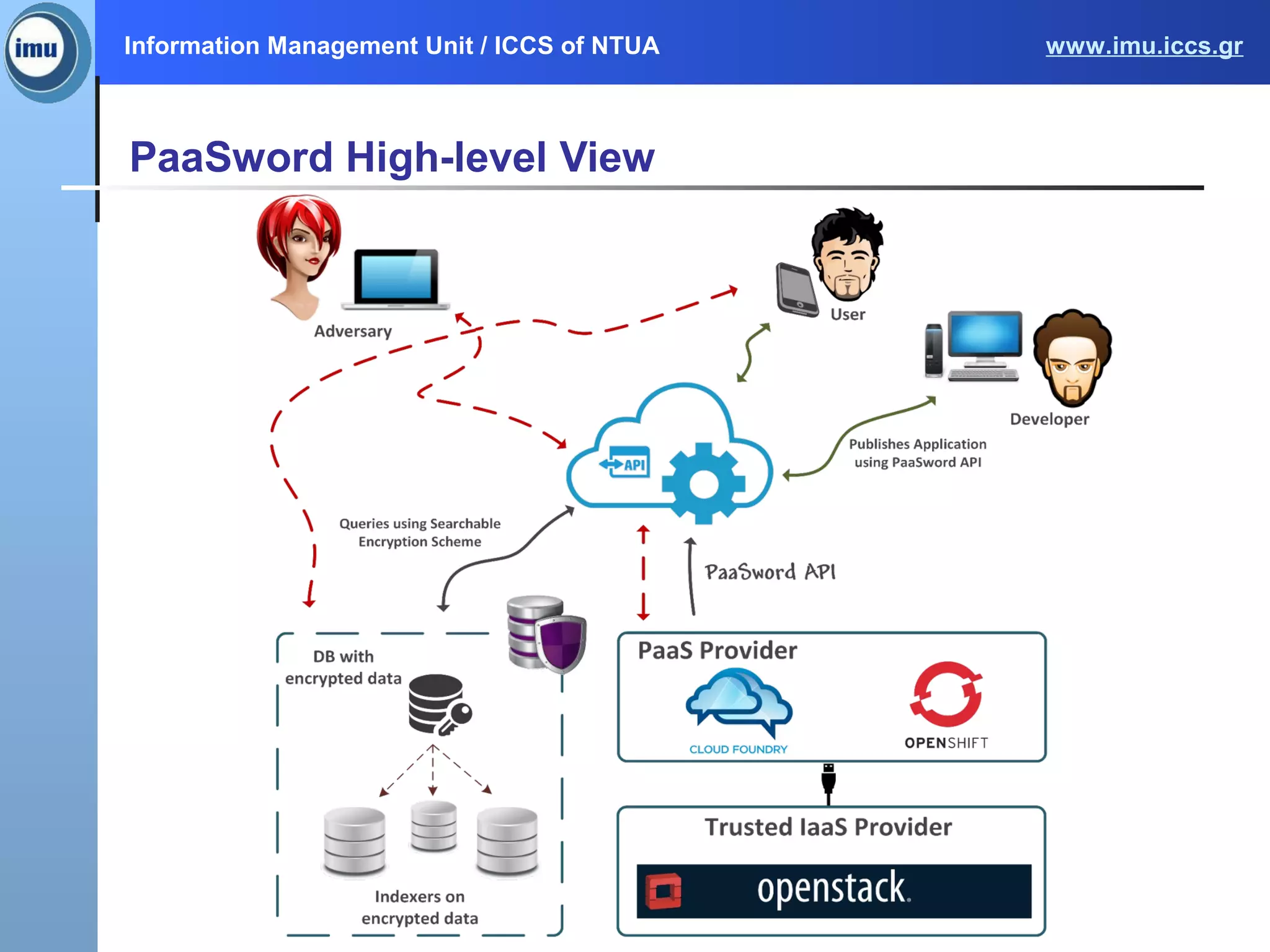
PaaSword High-level View
Information Management Unit / ICCS of NTUA www.imu.iccs.gr
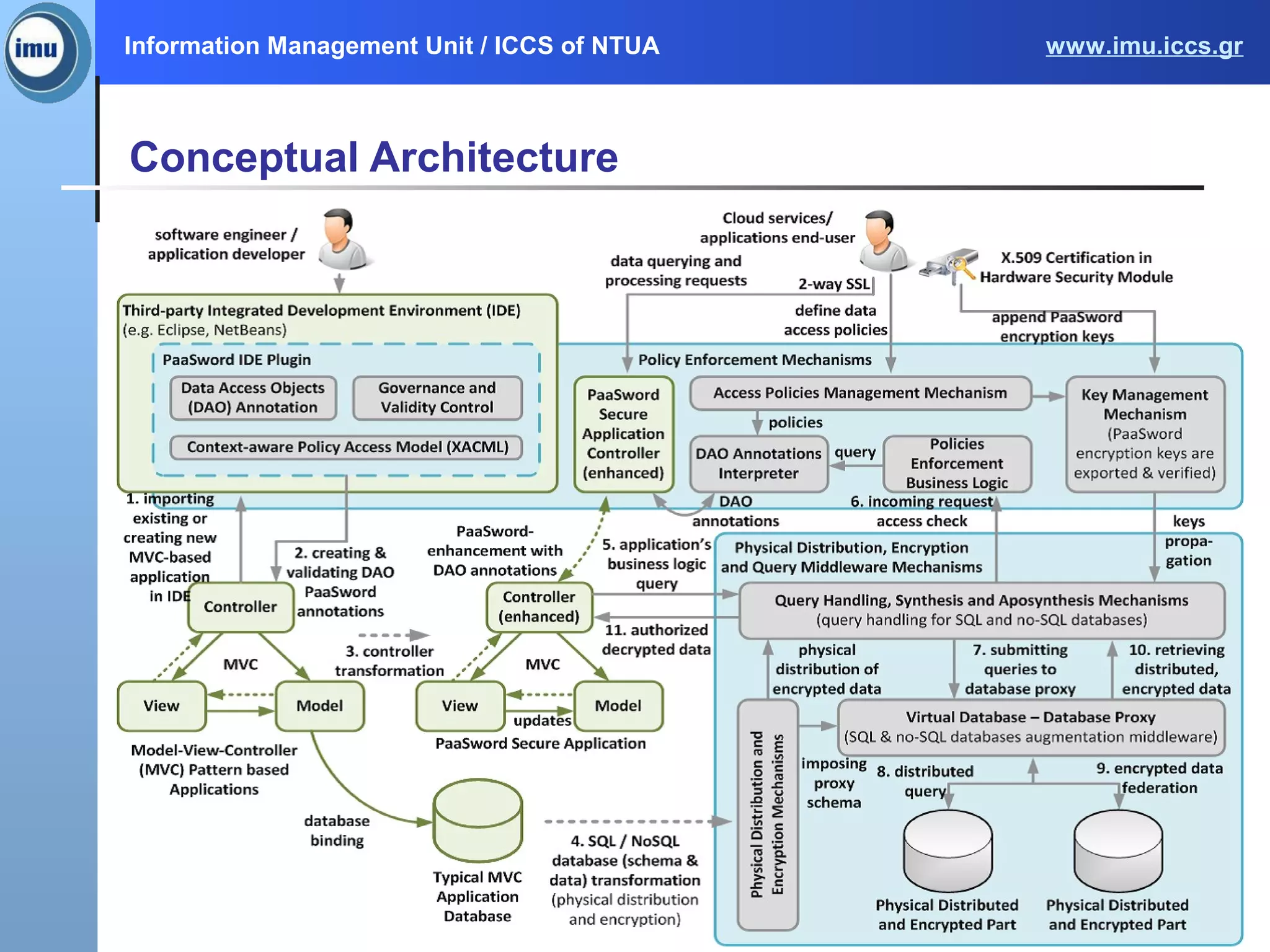
Conceptual Architecture
Information Management Unit / ICCS of NTUA www.imu.iccs.gr
Agenda
 Introduction
 Data Security Challenges in the Cloud
 PaaSword Framework
 Conclusions
Information Management Unit / ICCS of NTUA www.imu.iccs.gr
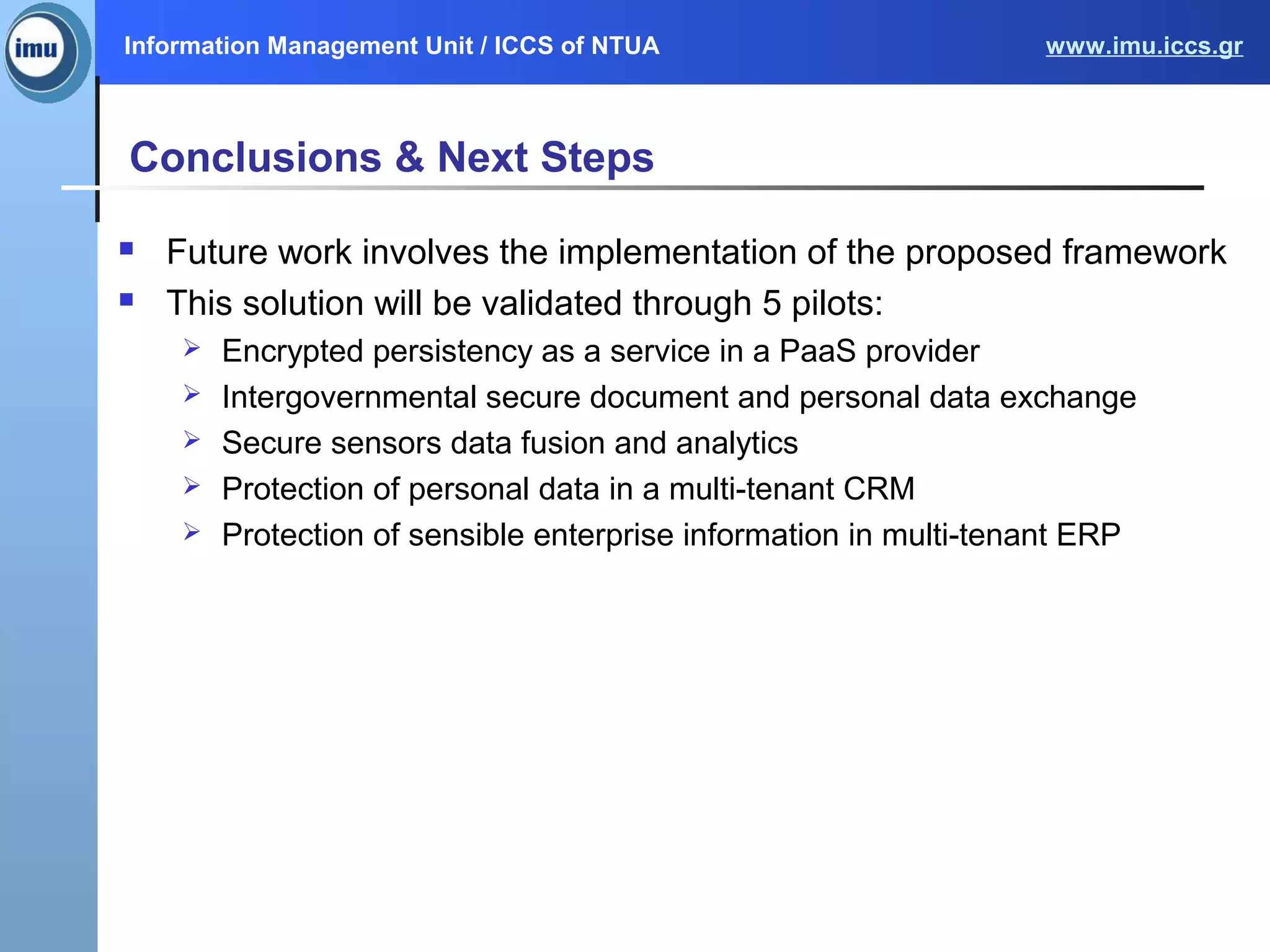
Conclusions & Next Steps
 Future work involves the implementation of the proposed framework
 This solution will be validated through 5 pilots:
 Encrypted persistency as a service in a PaaS provider
 Intergovernmental secure document and personal data exchange
 Secure sensors data fusion and analytics
 Protection of personal data in a multi-tenant CRM
 Protection of sensible enterprise information in multi-tenant ERP
Thank you for listening!
Acknowledgements:
This work is related to the PaaSword project and
has received funding from the European
Union’s Horizon 2020 research and
innovation programme under grant

PaaSword: A Holistic Data Privacy and Security by Design Framework for Cloud Services

  • 1.
    PaaSword: A HolisticData Privacy and Security by Design Framework for Cloud Services Yiannis Verginadis, Antonis Michalas, Panagiotis Gouvas, Gunther Schiefer, Gerald Hubsch, Iraklis Paraskakis CLOSER 2015, Lisbon, May 21, 2015
  • 2.
    Information Management Unit/ ICCS of NTUA www.imu.iccs.gr Agenda  Introduction  Data Security Challenges in the Cloud  PaaSword Framework  Conclusions
  • 3.
    Information Management Unit/ ICCS of NTUA www.imu.iccs.gr Introduction  Many users have started relying on cloud services without realizing it  Many companies have remained cautious due to security concerns  Applications and storage volumes often reside next to potentially hostile virtual environments, leaving sensitive information at risk to theft, unauthorized exposure or malicious manipulation  Governmental regulation presents an additional concern of significant legal and financial consequences if data confidentiality is breached Focused interest Experimentation Near ubiquitous use CloudAdoption
  • 4.
    Information Management Unit/ ICCS of NTUA www.imu.iccs.gr Related Work  Commonly used access control models (Ferrari 2010) are:  Mandatory Access Control (MAC)  Discretionary Access Control (DAC)  Role-Based Access Control (RBAC)  Extending these models:  location-aware access control (LAAC) - there is a clear lack of supporting additional pertinent contextual information (Cleeff et al.,2010)  context-aware access control (CAAC) – with shortcomings like:  lack of support for dynamically generated context (Covington et al., 2001)  lack of fine-grained data access control (Kayes et al., 2013)
  • 5.
    Information Management Unit/ ICCS of NTUA www.imu.iccs.gr Related Work (contd.)  Regarding the policy management there is lack of proper separation of concerns (Kourtesis and Paraskakis, 2012)  The policy definition and policy enforcement are entangled in the implementation of a single software component, leading to the lack of  portability  explicit representation of policy relationships  Regarding the data distribution and encryption algorithms...  Gentry (2009), introduced the first fully homomorphic encryption scheme that enables semantically secure outsourcing to the cloud  but presents severe performance issues  In CryptDB (Popa et al., 2011), the concept of onions was used  with the main drawback the lack of security guarantees to the client
  • 6.
    Information Management Unit/ ICCS of NTUA www.imu.iccs.gr Agenda  Introduction  Data Security Challenges in the Cloud  PaaSword Framework  Conclusions
  • 7.
    Information Management Unit/ ICCS of NTUA www.imu.iccs.gr Security Challenges in the Cloud  Top four threats identified (CSA, 2013) are:  data leakage  data loss  account hijacking  insecure APIs  The most critical part of a modern cloud application is the data persistency layer and the database itself  The OWASP foundation has categorized the database-related attacks as the most critical ones  SQL injections represents 17% of all security breaches examined  These attacks were responsible for 83% of the total records stolen, from 2005 to 2011
  • 8.
    Information Management Unit/ ICCS of NTUA www.imu.iccs.gr Security Challenges in the Cloud (contd.)  Most of the security fences that are configured in a corporate environment target the fortification of the so-called network perimeter  e.g. routers, hosts and virtual machines  IDS and IPS try to cope with database-takeover security aspects, but the risk of database compromise is greater than ever, as:  automated exploitation tools (e.g. SQLMap) are widely spread  IPS and IDS evasion techniques have become extremely sophisticated  Internal adversaries or even unknown vulnerabilities of software platforms widely adopted in the cloud may provide malicious access to sensitive data  e.g. Heartbleed flaw - constituted a serious fault in the OpenSSL cryptography library, which remained unnoticed for more than two years and affected over 60% of Web servers worldwide
  • 9.
    Information Management Unit/ ICCS of NTUA www.imu.iccs.gr Security Challenges in the Cloud (contd.)  Regarding the post-exploitation phase things are even worse in the case where a symmetric encryption algorithm has been employed  cracking toolkits that utilize GPU processing power (e.g. oclHashcat) are able to crack ciphers using brute-force techniques with an attack rate of 162 billion attempts per second  The application developer is the one responsible for both  sanitizing all HTTP-input parameters  reassuring that compromised data will be useless  Nevertheless, the mere utilization of an IaaS or PaaS provider, may by itself spawn a multitude of inherent vulnerabilities  that cannot be tackled effectively as they typically exceed the responsibilities of an application developer
  • 10.
    Information Management Unit/ ICCS of NTUA www.imu.iccs.gr Agenda  Introduction  Data Security Challenges in the Cloud  PaaSword Framework  Conclusions
  • 11.
    Information Management Unit/ ICCS of NTUA www.imu.iccs.gr Threat Model  We assume a semi-honest adversarial model for the cloud provider (Paladi et al., 2014; Santos et al., 2009)  a malicious cloud provider correctly follows the protocol specification but can intercept all messages and may attempt to use them in order to learn information that otherwise should remain private  For the rest of the participants we consider the threat model (Santos et al., 2009) that assumes that privileged access rights can be used by a remote adversary, ADV, to leak confidential information  e.g. a corrupted system administrator, can obtain remote access to any host maintained by the provider.  the adversary cannot access the volatile memory of any guest virtual machine (VM) residing on the compute hosts of the provider
  • 12.
    Information Management Unit/ ICCS of NTUA www.imu.iccs.gr Context-aware Access Model  We envision a XACML-based context-aware access model,  which is needed by the developers in order to annotate the Data Access Objects of their applications
  • 13.
    Information Management Unit/ ICCS of NTUA www.imu.iccs.gr Facets of the Context-Aware Access Model Facets IP Address (Local) Time Location Device Type Data Connection Type etc… Patterns Frequency Usual Duration Usual Dates Usual Hours Previously Accessed Data Sensitive / Non Sensitive Data Role
  • 14.
    Information Management Unit/ ICCS of NTUA www.imu.iccs.gr Policies Access, Governance and Enforcement  A middleware that will provide:  a transparent key usage for efficient authentication purposes,  annotation capabilities in the form of a tool (IDE plugin) for allowing developers to declaratively create the minimum amount of rule-set that is needed for security enforcement purposes  dynamically interpret the DAO annotations into policy enforcement rules  the governance and quality control of the annotations and their respective policy rules  the formulation and implementation of the overall policy enforcement business logic
  • 15.
    Information Management Unit/ ICCS of NTUA www.imu.iccs.gr  Devise an appropriate vocabulary of concepts and decide how they are interrelated  Populate the framework with appropriate instances to give rise to DAOs  Formalise these concepts and their interrelations – gives rise to the ontology framework Ontology for Access Policies
  • 16.
    Information Management Unit/ ICCS of NTUA www.imu.iccs.gr Secure Storage  We propose a design for a cryptographic cloud storage that will be based on a symmetric searchable encryption (SSE) scheme similar to (Kamara and Lauter, 2010)  We plan to extend the previous work Cumulus4j (Huber et al., 2013) and MimoSecco (Gabel and Hubsch, 2014)) that hides relations between different data values of a data row
  • 17.
    Information Management Unit/ ICCS of NTUA www.imu.iccs.gr PaaSword High-level View
  • 18.
    Information Management Unit/ ICCS of NTUA www.imu.iccs.gr Conceptual Architecture
  • 19.
    Information Management Unit/ ICCS of NTUA www.imu.iccs.gr Agenda  Introduction  Data Security Challenges in the Cloud  PaaSword Framework  Conclusions
  • 20.
    Information Management Unit/ ICCS of NTUA www.imu.iccs.gr Conclusions & Next Steps  Future work involves the implementation of the proposed framework  This solution will be validated through 5 pilots:  Encrypted persistency as a service in a PaaS provider  Intergovernmental secure document and personal data exchange  Secure sensors data fusion and analytics  Protection of personal data in a multi-tenant CRM  Protection of sensible enterprise information in multi-tenant ERP
  • 21.
    Thank you forlistening! Acknowledgements: This work is related to the PaaSword project and has received funding from the European Union’s Horizon 2020 research and innovation programme under grant