
Security Architecture
and Design
Security architecture is a unified security design that addresses the necessities and
potential risks involved in a certain scenario or environment. It also specifies when and
where to apply security controls.
As described in the CISSP Study Guide, Security Architecture and Design describes
fundamental logical hardware, operating system, and software security components,
and how to use those components to design, architect, and evaluate secure computer
systems.
It is further divided into 3 domains and each of them cover:
1. The hardware and software requirements to have a secure computer system.
2. The logical models required to keep the system secure
3. The evaluation models that quantify how secure the system really is.
2
How can businesses benefit by having a
strong Security Architecture?
 Fewer Breaches of Your Systems Architecture
 Compliance with Key Data Security Standards
 Being a Strong Security Architecture Example Helps to Earn Trust
 Preventing a Loss of Business
3
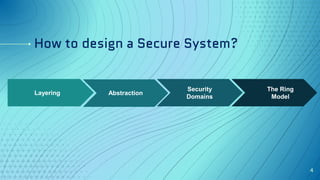
How to design a Secure System?
4
Security
Domains
Layering Abstraction
 The Ring
Model
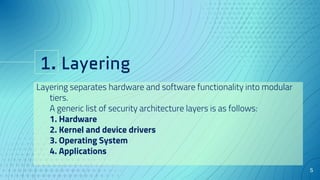
1. Layering
Layering separates hardware and software functionality into modular
tiers.
A generic list of security architecture layers is as follows:
1. Hardware
2. Kernel and device drivers
3. Operating System
4. Applications
5
2. Abstraction
Abstraction hides unnecessary details from the user.
Complexity is the enemy of security. That said, computers are
tremendously complex machines and Abstraction provides a way to
manage that complexity.
6
3. Security Domains
A security domain is the list of objects a subject is allowed to access.
More broadly defined, domains are groups of subjects and objects
with similar security requirements.
7
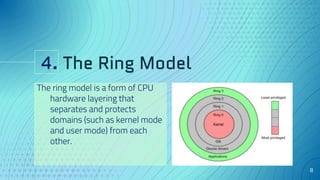
4. The Ring Model
The ring model is a form of CPU
hardware layering that
separates and protects
domains (such as kernel mode
and user mode) from each
other.
8
Domain #1
The hardware and software
requirements to have a secure
computer system.
9
SECURE HARDWARE ARCHITECTURE
10
Secure Hardware Architecture focuses on the physical computer
hardware required to have a secure system. The hardware must
provide confidentiality, integrity, and availability for processes, data,
and users.
It is further divided into the following components:
 The System Unit and Motherboard
 The Computer Bus
 Northbridge and southbridge
Computer Bus:
11
Northbridge and Southbridge:
SECURE OPERATING SYSTEM AND
SOFTWARE ARCHITECTURE
12
Secure Operating System and Software Architecture builds upon the
secure hardware described in the previous slide, providing a secure
interface between hardware and the applications (and users) which
access the hardware. Operating systems provide memory, resource,
and process management.
The most sensitive components in which security is required are:
 The Kernel
 Virtualization
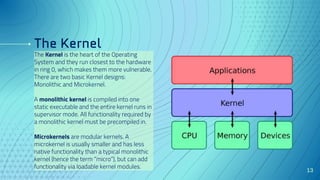
The Kernel
13
The Kernel is the heart of the Operating
System and they run closest to the hardware
in ring 0, which makes them more vulnerable.
There are two basic Kernel designs:
Monolithic and Microkernel.
A monolithic kernel is compiled into one
static executable and the entire kernel runs in
supervisor mode. All functionality required by
a monolithic kernel must be precompiled in.
Microkernels are modular kernels. A
microkernel is usually smaller and has less
native functionality than a typical monolithic
kernel (hence the term “micro”), but can add
functionality via loadable kernel modules.
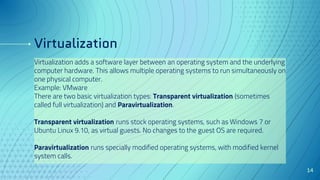
Virtualization
14
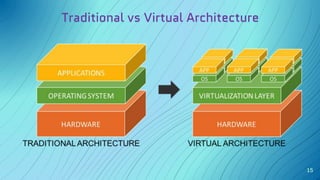
Virtualization adds a software layer between an operating system and the underlying
computer hardware. This allows multiple operating systems to run simultaneously on
one physical computer.
Example: VMware
There are two basic virtualization types: Transparent virtualization (sometimes
called full virtualization) and Paravirtualization.
Transparent virtualization runs stock operating systems, such as Windows 7 or
Ubuntu Linux 9.10, as virtual guests. No changes to the guest OS are required.
Paravirtualization runs specially modified operating systems, with modified kernel
system calls.
Traditional vs Virtual Architecture
15
Domain #2
The logical models required to
keep the system secure.
16
Security Models
17
 Bell-LaPadula
 Biba
 Clark & Wilson
 Non-interference
 State machine
 Access Matrix
 Information flow
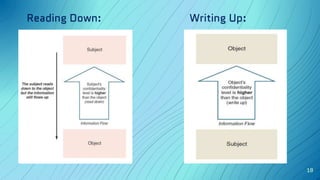
Reading Down:
18
Writing Up:
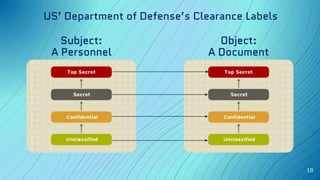
Subject:
A Personnel
19
Object:
A Document
US’ Department of Defense’s Clearance Labels
Bell-LaPadula Model
20
 This model was developed by David Elliott Bell and Leonard J. LaPadula on behalf
of the MITRE Corporation for the US’ Department of Defense.
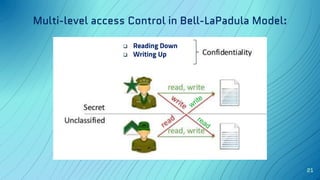
 It follows the Reading down and Writing up method.
 It is focused on maintaining the confidentiality of objects.
It is no longer used because the model does not maintain integrity in any way.
A low-clearance operative can submit false data which moves up to high clearance
levels. Nothing to prevent unauthorized alteration of data.
Multi-level access Control in Bell-LaPadula Model:
21
 Reading Down
 Writing Up
Biba Model
22
 This model was developed by Kenneth Biba at the MITRE Corporation.
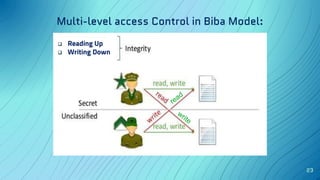
 It follows the Reading up and Writing down method.
 While many governments are primarily concerned with confidentiality, most
businesses desire to ensure that the integrity of the information is protected at
the highest level. Biba is the model of choice when integrity protection is vital.
 If a high-ranking subject issues data, everyone can trust that data. If a low-
ranking subject issues some sort of data, no one above that subject has
permission to trust it.
Multi-level access Control in Biba Model:
23
 Reading Up
 Writing Down
Domain #3
The evaluation models that
quantify how secure the
system really is.
24
Evaluation methods
25
Evaluation criteria provide a standard for qualifying the security of a
computer system or network.
 The Trusted Computer System Evaluation Criteria (TCSEC).
 The Trusted Network Interpretation (TNI).
 The European Information Technology Security Evaluation
Criteria (ITSEC).
 The Common Criteria.
26
Thank you
srishtiahuja16@gmail.com
slashsrishti
srishtiahuja16

Security Architecture and Design - CISSP

  • 1.
  • 2.
    Security architecture isa unified security design that addresses the necessities and potential risks involved in a certain scenario or environment. It also specifies when and where to apply security controls. As described in the CISSP Study Guide, Security Architecture and Design describes fundamental logical hardware, operating system, and software security components, and how to use those components to design, architect, and evaluate secure computer systems. It is further divided into 3 domains and each of them cover: 1. The hardware and software requirements to have a secure computer system. 2. The logical models required to keep the system secure 3. The evaluation models that quantify how secure the system really is. 2
  • 3.
    How can businessesbenefit by having a strong Security Architecture?  Fewer Breaches of Your Systems Architecture  Compliance with Key Data Security Standards  Being a Strong Security Architecture Example Helps to Earn Trust  Preventing a Loss of Business 3
  • 4.
    How to designa Secure System? 4 Security Domains Layering Abstraction  The Ring Model
  • 5.
    1. Layering Layering separateshardware and software functionality into modular tiers. A generic list of security architecture layers is as follows: 1. Hardware 2. Kernel and device drivers 3. Operating System 4. Applications 5
  • 6.
    2. Abstraction Abstraction hidesunnecessary details from the user. Complexity is the enemy of security. That said, computers are tremendously complex machines and Abstraction provides a way to manage that complexity. 6
  • 7.
    3. Security Domains Asecurity domain is the list of objects a subject is allowed to access. More broadly defined, domains are groups of subjects and objects with similar security requirements. 7
  • 8.
    4. The RingModel The ring model is a form of CPU hardware layering that separates and protects domains (such as kernel mode and user mode) from each other. 8
  • 9.
    Domain #1 The hardwareand software requirements to have a secure computer system. 9
  • 10.
    SECURE HARDWARE ARCHITECTURE 10 SecureHardware Architecture focuses on the physical computer hardware required to have a secure system. The hardware must provide confidentiality, integrity, and availability for processes, data, and users. It is further divided into the following components:  The System Unit and Motherboard  The Computer Bus  Northbridge and southbridge
  • 11.
  • 12.
    SECURE OPERATING SYSTEMAND SOFTWARE ARCHITECTURE 12 Secure Operating System and Software Architecture builds upon the secure hardware described in the previous slide, providing a secure interface between hardware and the applications (and users) which access the hardware. Operating systems provide memory, resource, and process management. The most sensitive components in which security is required are:  The Kernel  Virtualization
  • 13.
    The Kernel 13 The Kernelis the heart of the Operating System and they run closest to the hardware in ring 0, which makes them more vulnerable. There are two basic Kernel designs: Monolithic and Microkernel. A monolithic kernel is compiled into one static executable and the entire kernel runs in supervisor mode. All functionality required by a monolithic kernel must be precompiled in. Microkernels are modular kernels. A microkernel is usually smaller and has less native functionality than a typical monolithic kernel (hence the term “micro”), but can add functionality via loadable kernel modules.
  • 14.
    Virtualization 14 Virtualization adds asoftware layer between an operating system and the underlying computer hardware. This allows multiple operating systems to run simultaneously on one physical computer. Example: VMware There are two basic virtualization types: Transparent virtualization (sometimes called full virtualization) and Paravirtualization. Transparent virtualization runs stock operating systems, such as Windows 7 or Ubuntu Linux 9.10, as virtual guests. No changes to the guest OS are required. Paravirtualization runs specially modified operating systems, with modified kernel system calls.
  • 15.
    Traditional vs VirtualArchitecture 15
  • 16.
    Domain #2 The logicalmodels required to keep the system secure. 16
  • 17.
    Security Models 17  Bell-LaPadula Biba  Clark & Wilson  Non-interference  State machine  Access Matrix  Information flow
  • 18.
  • 19.
    Subject: A Personnel 19 Object: A Document US’Department of Defense’s Clearance Labels
  • 20.
    Bell-LaPadula Model 20  Thismodel was developed by David Elliott Bell and Leonard J. LaPadula on behalf of the MITRE Corporation for the US’ Department of Defense.  It follows the Reading down and Writing up method.  It is focused on maintaining the confidentiality of objects. It is no longer used because the model does not maintain integrity in any way. A low-clearance operative can submit false data which moves up to high clearance levels. Nothing to prevent unauthorized alteration of data.
  • 21.
    Multi-level access Controlin Bell-LaPadula Model: 21  Reading Down  Writing Up
  • 22.
    Biba Model 22  Thismodel was developed by Kenneth Biba at the MITRE Corporation.  It follows the Reading up and Writing down method.  While many governments are primarily concerned with confidentiality, most businesses desire to ensure that the integrity of the information is protected at the highest level. Biba is the model of choice when integrity protection is vital.  If a high-ranking subject issues data, everyone can trust that data. If a low- ranking subject issues some sort of data, no one above that subject has permission to trust it.
  • 23.
    Multi-level access Controlin Biba Model: 23  Reading Up  Writing Down
  • 24.
    Domain #3 The evaluationmodels that quantify how secure the system really is. 24
  • 25.
    Evaluation methods 25 Evaluation criteriaprovide a standard for qualifying the security of a computer system or network.  The Trusted Computer System Evaluation Criteria (TCSEC).  The Trusted Network Interpretation (TNI).  The European Information Technology Security Evaluation Criteria (ITSEC).  The Common Criteria.
  • 26.