1
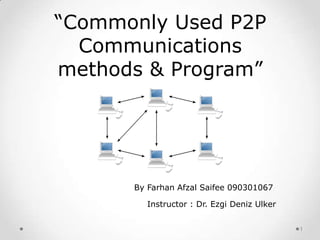
“Commonly Used P2P
Communications
methods & Program”
By Farhan Afzal Saifee 090301067
Instructor : Dr. Ezgi Deniz Ulker
2
CONTENTS
• What is Peer to Peer?
- Properties of Peer to Peer
• Knowledge of Client – Server Architecture.
• How does Internet P2P works?
• Peer to Peer Systems Modes
- Centralized, Decentralized or Hierarchical
• Types of Peer 2 Peer Network.
• Commonly Used Peer to Peer Programs.
3
What is Peer to Peer?
• The term Peer refers to a user computer
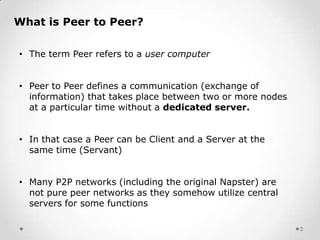
• Peer to Peer defines a communication (exchange of
information) that takes place between two or more nodes
at a particular time without a dedicated server.
• In that case a Peer can be Client and a Server at the
same time (Servant)
• Many P2P networks (including the original Napster) are
not pure peer networks as they somehow utilize central
servers for some functions
4
Properties of Peer to Peer Systems
1. Unreliable, uncoordinated, unmanaged
- No central authority, peers are completely independent
- Increases flexibility of individual peers.
2. Large collection of resources
-Voluntary participation, global reach
-Millions of simultaneous users
3. Network is dynamic: nodes enter and leave the network
“frequently” and Nodes are Anonymous.
5
Knowledge of Client - Server
• It is a system that includes a
client and a server, and the
client-server model works as a
series of transactions between
the two.
1. The client initiates the
transaction by sending a
request to the server,
2. And the server, which is always
in a state of readiness to accept
requests, responds by providing
a service or resource to the
client.
6
How does Internet P2P Works.
1. User downloads and executes a peer-to-peer networking
program (Gnutellanet )
2. User enters the IP address of another computer
belonging to the network. (Must know 3 - 5 Addresses)
3. Once the computer finds another network member on-
line, it will connect to that user's connection (who has
gotten their IP address from another user's connection
and so on).
4. Users can choose how many member connections to seek
at one time and determine which files they wish to share
or password protect.
7
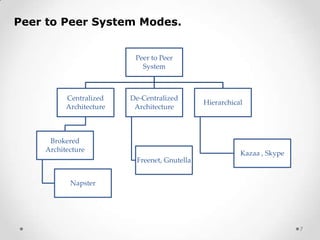
Peer to Peer System Modes.
Peer to Peer
System
Centralized
Architecture
Brokered
Architecture
Napster
De-Centralized
Architecture
Freenet, Gnutella
Hierarchical
Kazaa , Skype
8
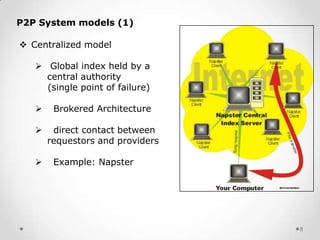
 Centralized model
 Global index held by a
central authority
(single point of failure)
 Brokered Architecture
 direct contact between
requestors and providers
 Example: Napster
P2P System models (1)
9
How Napster Works
0 – Every Servant is registering
to the broker
1 – Servant contacts the broker
that has the information of the
resources held by other
servants who are registered to
the broker
2 - Broker responds to the
servant, sends the IP address of
a servant that has the desired
file.
3 – The downloading process
takes place.
10
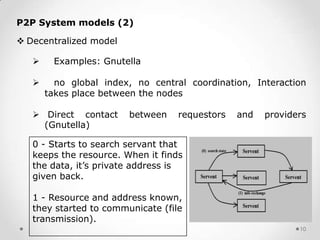
P2P System models (2)
 Decentralized model
 Examples: Gnutella
 no global index, no central coordination, Interaction
takes place between the nodes
 Direct contact between requestors and providers
(Gnutella)
0 - Starts to search servant that
keeps the resource. When it finds
the data, it’s private address is
given back.
1 - Resource and address known,
they started to communicate (file
transmission).
11
P2P System models (3)
 Hierarchical model
 Introduction of “super-peers” or “Super-Nodes”
 Mix of centralized and decentralized model
 Example: FastTrack Protocol,Kazaa
12
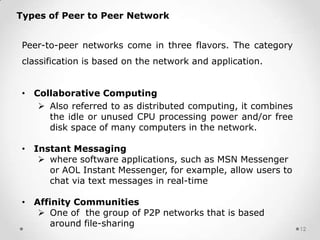
Types of Peer to Peer Network
Peer-to-peer networks come in three flavors. The category
classification is based on the network and application.
• Collaborative Computing
 Also referred to as distributed computing, it combines
the idle or unused CPU processing power and/or free
disk space of many computers in the network.
• Instant Messaging
 where software applications, such as MSN Messenger
or AOL Instant Messenger, for example, allow users to
chat via text messages in real-time
• Affinity Communities
 One of the group of P2P networks that is based
around file-sharing
13
Commonly Used Peer to Peer Programs.
1. BitTorrent
2. Ares
3. Limewire
4. Skype
5. Yahoo Messenger
6. Ebay Web Application
7. Viber
8. Tango
9. FrostWire
14
Commonly Used Peer to Peer Programs. “SKYPE”
 Skype is a peer-to-peer (p2p) VoIP client developed by
the organization that created Kazaa.
 It is very similar to the MSN and Yahoo IM
applications, as it has capabilities for voice-
calls, instant messaging
 The underlying protocols and techniques it employs are
quite different
 Two types of nodes in this overlay network, ordinary
hosts and super nodes (SN).
• An ordinary host is a Skype application that can be
used to place voice calls and send text messages.
• A super node is an ordinary host’s end-point on the
Skype network.
15
“SKYPE” Cont…
16
“SKYPE” Cont…
17
“SKYPE” Cont…
• Skype clearly has both peer-to-peer components as well as
client-server components
• Account data is stored in central servers. But audio streams
from peer to peer.
• The contact list, as well as the authentication, as you
noticed, goes through Skype's servers
18
Thank you for
your Attention

Commonly Used Peer to Peer Methods & Applications

  • 1.
    1 “Commonly Used P2P Communications methods& Program” By Farhan Afzal Saifee 090301067 Instructor : Dr. Ezgi Deniz Ulker
  • 2.
    2 CONTENTS • What isPeer to Peer? - Properties of Peer to Peer • Knowledge of Client – Server Architecture. • How does Internet P2P works? • Peer to Peer Systems Modes - Centralized, Decentralized or Hierarchical • Types of Peer 2 Peer Network. • Commonly Used Peer to Peer Programs.
  • 3.
    3 What is Peerto Peer? • The term Peer refers to a user computer • Peer to Peer defines a communication (exchange of information) that takes place between two or more nodes at a particular time without a dedicated server. • In that case a Peer can be Client and a Server at the same time (Servant) • Many P2P networks (including the original Napster) are not pure peer networks as they somehow utilize central servers for some functions
  • 4.
    4 Properties of Peerto Peer Systems 1. Unreliable, uncoordinated, unmanaged - No central authority, peers are completely independent - Increases flexibility of individual peers. 2. Large collection of resources -Voluntary participation, global reach -Millions of simultaneous users 3. Network is dynamic: nodes enter and leave the network “frequently” and Nodes are Anonymous.
  • 5.
    5 Knowledge of Client- Server • It is a system that includes a client and a server, and the client-server model works as a series of transactions between the two. 1. The client initiates the transaction by sending a request to the server, 2. And the server, which is always in a state of readiness to accept requests, responds by providing a service or resource to the client.
  • 6.
    6 How does InternetP2P Works. 1. User downloads and executes a peer-to-peer networking program (Gnutellanet ) 2. User enters the IP address of another computer belonging to the network. (Must know 3 - 5 Addresses) 3. Once the computer finds another network member on- line, it will connect to that user's connection (who has gotten their IP address from another user's connection and so on). 4. Users can choose how many member connections to seek at one time and determine which files they wish to share or password protect.
  • 7.
    7 Peer to PeerSystem Modes. Peer to Peer System Centralized Architecture Brokered Architecture Napster De-Centralized Architecture Freenet, Gnutella Hierarchical Kazaa , Skype
  • 8.
    8  Centralized model Global index held by a central authority (single point of failure)  Brokered Architecture  direct contact between requestors and providers  Example: Napster P2P System models (1)
  • 9.
    9 How Napster Works 0– Every Servant is registering to the broker 1 – Servant contacts the broker that has the information of the resources held by other servants who are registered to the broker 2 - Broker responds to the servant, sends the IP address of a servant that has the desired file. 3 – The downloading process takes place.
  • 10.
    10 P2P System models(2)  Decentralized model  Examples: Gnutella  no global index, no central coordination, Interaction takes place between the nodes  Direct contact between requestors and providers (Gnutella) 0 - Starts to search servant that keeps the resource. When it finds the data, it’s private address is given back. 1 - Resource and address known, they started to communicate (file transmission).
  • 11.
    11 P2P System models(3)  Hierarchical model  Introduction of “super-peers” or “Super-Nodes”  Mix of centralized and decentralized model  Example: FastTrack Protocol,Kazaa
  • 12.
    12 Types of Peerto Peer Network Peer-to-peer networks come in three flavors. The category classification is based on the network and application. • Collaborative Computing  Also referred to as distributed computing, it combines the idle or unused CPU processing power and/or free disk space of many computers in the network. • Instant Messaging  where software applications, such as MSN Messenger or AOL Instant Messenger, for example, allow users to chat via text messages in real-time • Affinity Communities  One of the group of P2P networks that is based around file-sharing
  • 13.
    13 Commonly Used Peerto Peer Programs. 1. BitTorrent 2. Ares 3. Limewire 4. Skype 5. Yahoo Messenger 6. Ebay Web Application 7. Viber 8. Tango 9. FrostWire
  • 14.
    14 Commonly Used Peerto Peer Programs. “SKYPE”  Skype is a peer-to-peer (p2p) VoIP client developed by the organization that created Kazaa.  It is very similar to the MSN and Yahoo IM applications, as it has capabilities for voice- calls, instant messaging  The underlying protocols and techniques it employs are quite different  Two types of nodes in this overlay network, ordinary hosts and super nodes (SN). • An ordinary host is a Skype application that can be used to place voice calls and send text messages. • A super node is an ordinary host’s end-point on the Skype network.
  • 15.
  • 16.
  • 17.
    17 “SKYPE” Cont… • Skypeclearly has both peer-to-peer components as well as client-server components • Account data is stored in central servers. But audio streams from peer to peer. • The contact list, as well as the authentication, as you noticed, goes through Skype's servers
  • 18.