CLASSIFICATION:CLASSIFICATION:
Kingdom: MycotaKingdom: Mycota
Division: EumycotaDivision: Eumycota
Subdivision:Subdivision:
BasidiomycotinaBasidiomycotina
INTRODUCTION:INTRODUCTION:
The genus includes about 3000The genus includes about 3000
species of these 147 has beenspecies of these 147 has been
reported from India.reported from India.
It causes a rust disease - blackIt causes a rust disease - black
stem rust of Wheatstem rust of Wheat..
Class: TeliomycetesClass: Teliomycetes
Order: UredinalesOrder: Uredinales
Family: PucciniaceaeFamily: Pucciniaceae
Genus: PucciniaGenus: Puccinia
 Species : graminisSpecies : graminis
 Puccinia graminisPuccinia graminis is an obligateis an obligate
parasite.parasite.
 It is a heterocious parasite.It is a heterocious parasite.
 It’s life cycle on Wheat and onIt’s life cycle on Wheat and on
Barberry.Barberry.
 Wheat is a primary host.Wheat is a primary host.
 Barberry is a secondary orBarberry is a secondary or
alternate host.alternate host.
Dikaryophase Reproduction:Dikaryophase Reproduction:
On WheatOn Wheat PucciniaPuccinia reproduces byreproduces by
(Asexual) sporulation.(Asexual) sporulation.
The spores are of two kinds:The spores are of two kinds:
(i)(i) Uridiospores (2N)Uridiospores (2N)
UridosporangiumUridosporangium
(ii)(ii) Telutospores (2N)Telutospores (2N)
TelutosporangiumTelutosporangium
(iii) Basidio spores(iii) Basidio spores
Each cell contains a pairEach cell contains a pair
of nuclei (n + n)of nuclei (n + n)
constituting a dikaryon.constituting a dikaryon.
To obtain nutritionTo obtain nutrition
haplophase phase develophaplophase phase develop
haustoria.haustoria.
Uredineal Stage:Uredineal Stage:
The hyphae of the dikaryoticThe hyphae of the dikaryotic
mycelium - aggregate nearmycelium - aggregate near
the surface of the infectedthe surface of the infected
organ to form a hyphal massorgan to form a hyphal mass
known as Ureida.known as Ureida.
 The tip of each hyphae swells toThe tip of each hyphae swells to
form a single binucleate ovalform a single binucleate oval
uredospore formed in a group.uredospore formed in a group.
uredinium or uredosorus.uredinium or uredosorus.
 They exert pressure on theThey exert pressure on the
epidermis, finally ruptured inepidermis, finally ruptured in
form of slits through which rustyform of slits through which rusty
coloured Uredospores are seen.coloured Uredospores are seen.
Puccinia
Uredo-
Mycelium
Uredospore
Puccinia
Uredo-
sporangium
-Wheat
Uredospore
are stalked,
unicellular
oval,
binucleate
structures,
rusty red in
colour.
Telial Stage:Telial Stage:
 Late in growing season,Late in growing season,
Uredospores are metamorphosesUredospores are metamorphoses
into Telutospores in the sameinto Telutospores in the same
Uredosori.Uredosori.
 Uredosori is known as Telutosori.Uredosori is known as Telutosori.
 Telutospores are dark brown orTelutospores are dark brown or
black in colour.black in colour.
Stage III: Telia bearingStage III: Telia bearing
teliospores (n+n>2n)teliospores (n+n>2n)
PucciniaPuccinia TelutoTeluto
sporangiumsporangium
Telutospores
TelutosporesTelutospores
Dark brown orDark brown or
black in colour.black in colour.
stalked, twostalked, two
celled, spindlecelled, spindle
shaped.shaped.
The wall is thick,The wall is thick,
black andblack and
smooth.smooth.
Puccinia telutoPuccinia teluto
sporesspores
•Each cell has two nuclei (one plus strain
and the other of minus strain).
•final stage on primary host
•Telutospore matures, the nuclei in each
cell fuse to form a diploid nucleus
(Kayogamy) (2N).
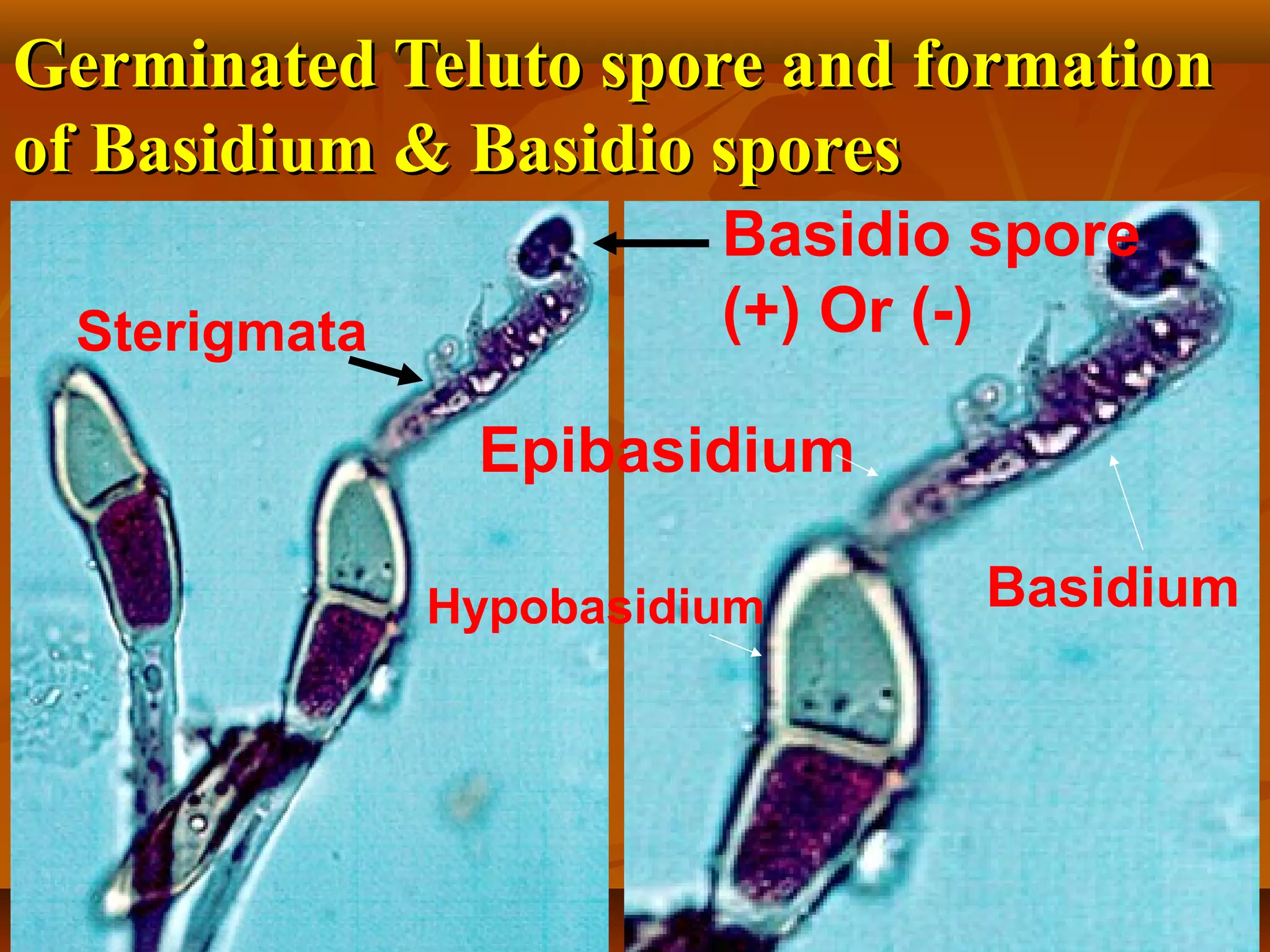
Germination of Teluto sporeGermination of Teluto spore
 On SoilOn Soil
 Favourable condition- ProperFavourable condition- Proper
Temperature, MoistureTemperature, Moisture
 Germination of Teluto spore-Germination of Teluto spore-
germination tube - Epibasidiumgermination tube - Epibasidium
Germination ofGermination of
TeliosporeTeliospore
Germination tube
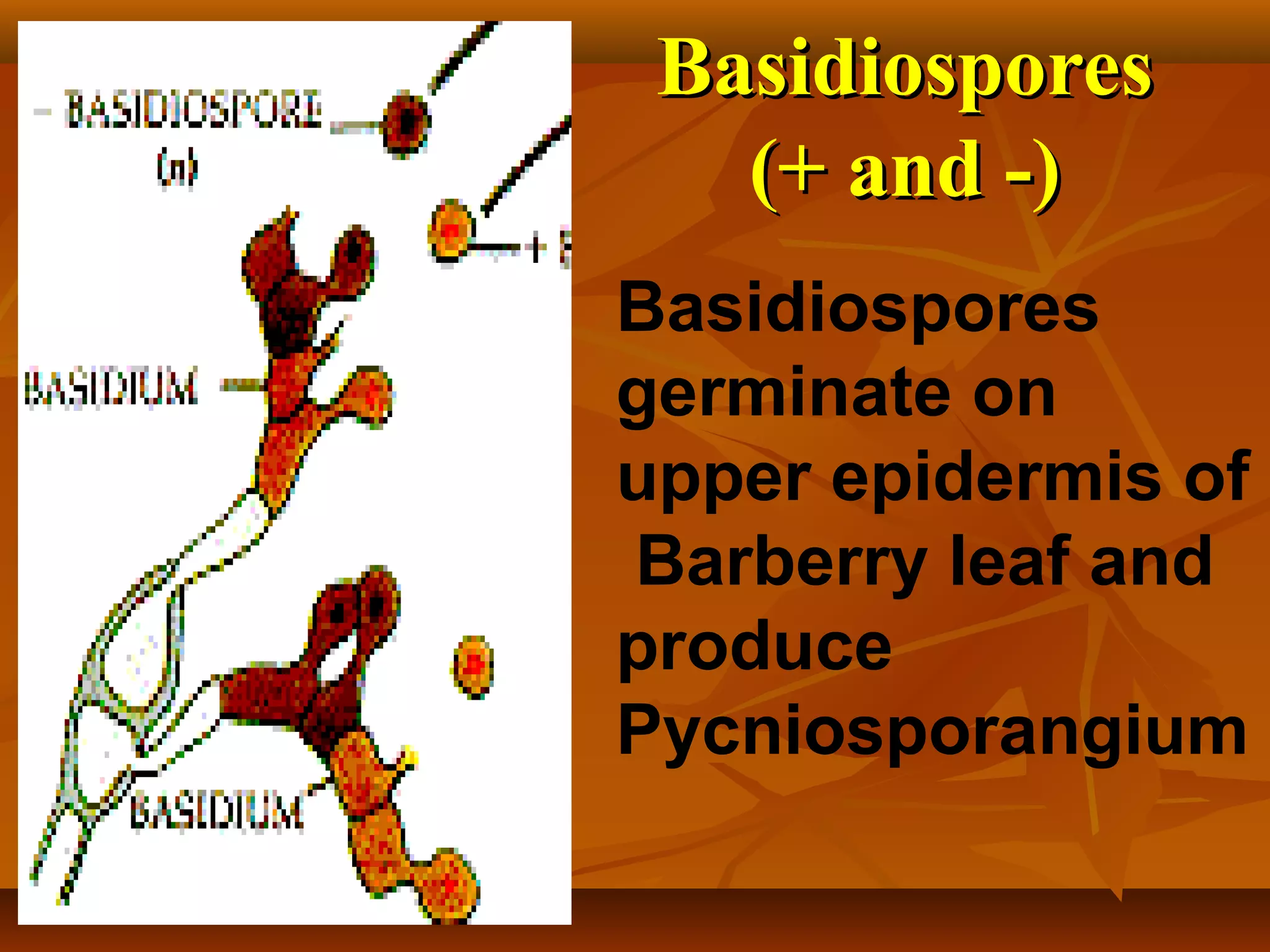
Germinated Teluto spore and formationGerminated Teluto spore and formation
of Basidium & Basidio sporesof Basidium & Basidio spores
Epibasidium
Basidio spore
(+) Or (-)Sterigmata
Hypobasidium Basidium
BasidiosporesBasidiospores
(+ and -)(+ and -)
Basidiospores
germinate on
upper epidermis of
Barberry leaf and
produce
Pycniosporangium
Stages ofStages of
Puccinia onPuccinia on
Barberry leafBarberry leaf
 Pycniospores stage:Pycniospores stage: On upperOn upper
epidermis with +ve and – veepidermis with +ve and – ve
basidiospores (Sexual reproduction)basidiospores (Sexual reproduction)
(Plasmogamy)(Plasmogamy)
 Aecidiospore stageAecidiospore stage: On lower: On lower
epidermis, Binucleate Aecidiosporeepidermis, Binucleate Aecidiospore
Infection ofInfection of PucciniaPuccinia on Barberryon Barberry
leaf Lower and Upper sidesleaf Lower and Upper sides
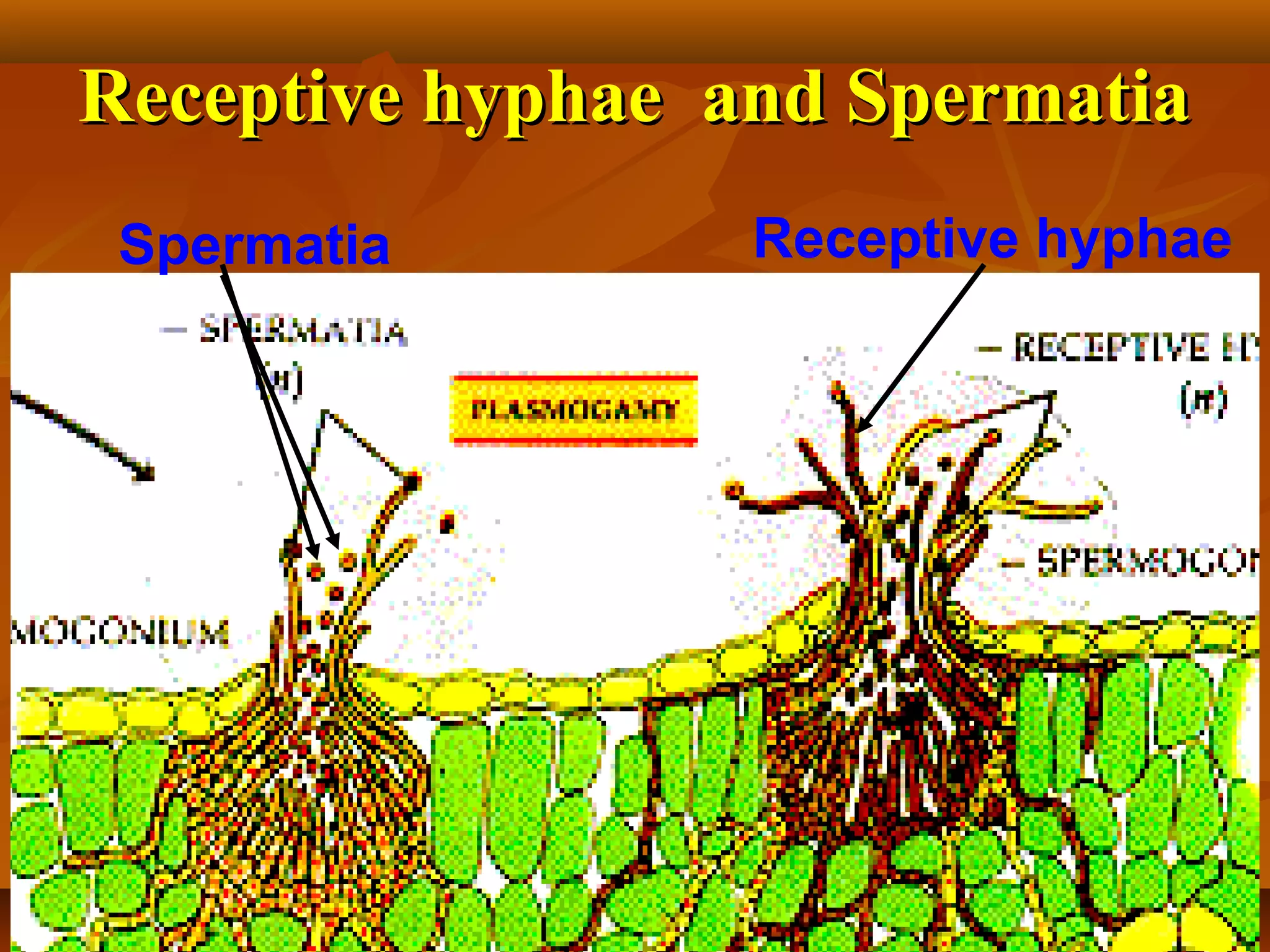
Puccinia PycniumPuccinia Pycnium on Upperon Upper
epidermisepidermis
Receptive hyphae and SpermatiaReceptive hyphae and Spermatia
Spermatia Receptive hyphae
Develop-Develop-
ment ofment of
AecidiospAecidiosp
orangiumorangium
Stage I: Aecia bearingStage I: Aecia bearing
aeciospores (n+n)aeciospores (n+n)
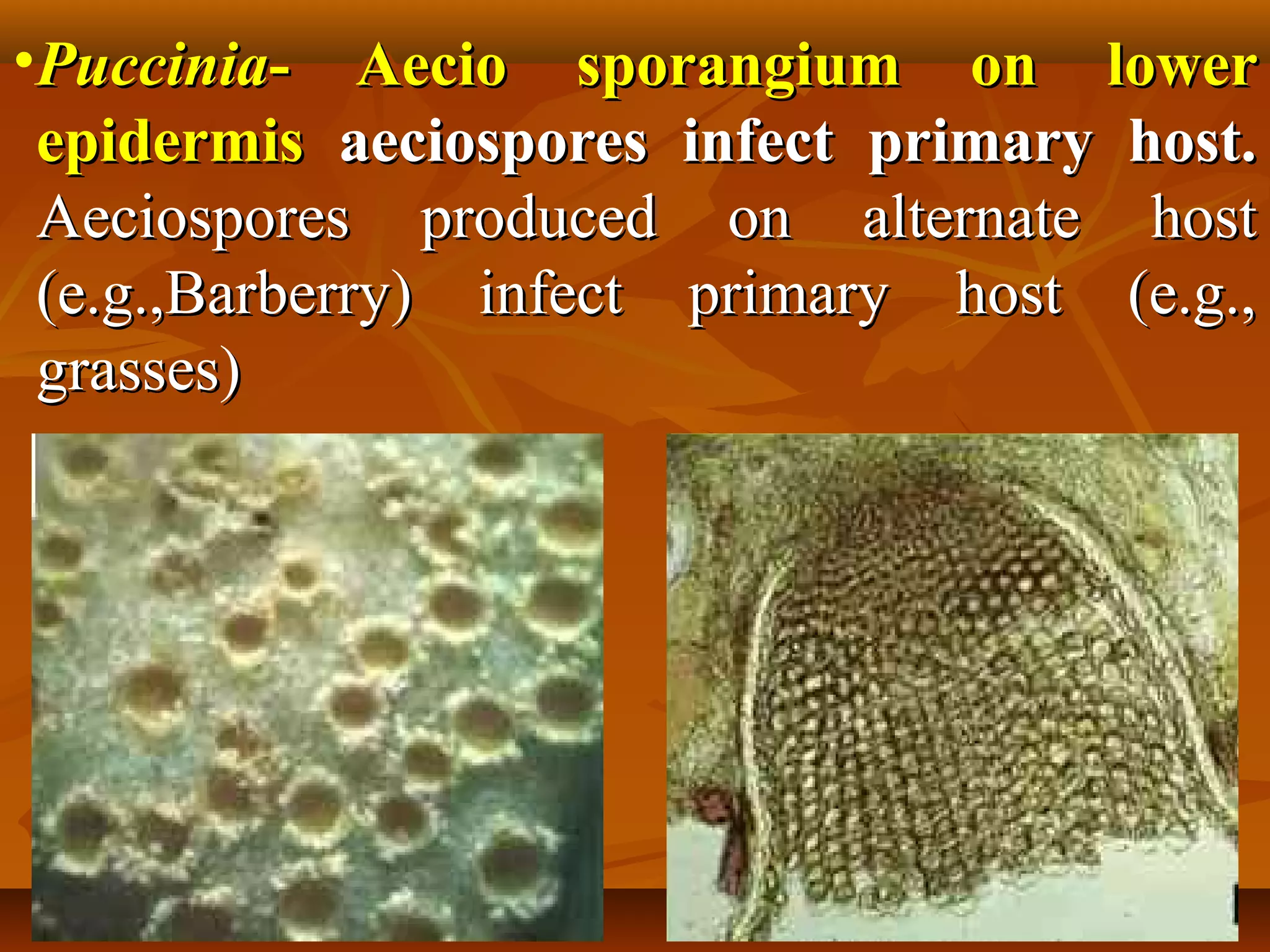
•PucciniaPuccinia- Aecio sporangium on lower- Aecio sporangium on lower
epidermisepidermis aeciospores infect primary host.aeciospores infect primary host.
Aeciospores produced on alternate hostAeciospores produced on alternate host
(e.g.,Barberry) infect primary host (e.g.,(e.g.,Barberry) infect primary host (e.g.,
grasses)grasses)
 Aeciospores-Aeciospores-
round, yellowishround, yellowish
red, Unicellular,red, Unicellular,
binucleate, thickbinucleate, thick
walled, 6 germwalled, 6 germ
pores.pores.
 Germinate onGerminate on
wheat plant.wheat plant.
Aeciospores
Aecidiosporangium
Puccinia-Puccinia-
Polymorphic fungiPolymorphic fungi
 Polymorphism: Various types ofPolymorphism: Various types of
spores produced during life cyclespores produced during life cycle
according to hosts life cycle andaccording to hosts life cycle and
climatic condition.climatic condition.
 Known as Polymorphism.Known as Polymorphism.
 Fungi shows polymorphism knownFungi shows polymorphism known
as Polymorphic fungi.as Polymorphic fungi.
Puccinia Life Cycle
Puccinia life cyclePuccinia
Life Cycle
This powerpoint was kindly donated to
www.worldofteaching.com
http://www.worldofteaching.com
Is home to well over a thousand powerpoints
submitted by teachers. This a free site. Please visit
and I hope it will help in your teaching
Puccinia fungus

  • 1.
    CLASSIFICATION:CLASSIFICATION: Kingdom: MycotaKingdom: Mycota Division:EumycotaDivision: Eumycota Subdivision:Subdivision: BasidiomycotinaBasidiomycotina
  • 2.
    INTRODUCTION:INTRODUCTION: The genus includesabout 3000The genus includes about 3000 species of these 147 has beenspecies of these 147 has been reported from India.reported from India. It causes a rust disease - blackIt causes a rust disease - black stem rust of Wheatstem rust of Wheat..
  • 3.
    Class: TeliomycetesClass: Teliomycetes Order:UredinalesOrder: Uredinales Family: PucciniaceaeFamily: Pucciniaceae Genus: PucciniaGenus: Puccinia  Species : graminisSpecies : graminis
  • 4.
     Puccinia graminisPucciniagraminis is an obligateis an obligate parasite.parasite.  It is a heterocious parasite.It is a heterocious parasite.  It’s life cycle on Wheat and onIt’s life cycle on Wheat and on Barberry.Barberry.  Wheat is a primary host.Wheat is a primary host.  Barberry is a secondary orBarberry is a secondary or alternate host.alternate host.
  • 6.
    Dikaryophase Reproduction:Dikaryophase Reproduction: OnWheatOn Wheat PucciniaPuccinia reproduces byreproduces by (Asexual) sporulation.(Asexual) sporulation. The spores are of two kinds:The spores are of two kinds: (i)(i) Uridiospores (2N)Uridiospores (2N) UridosporangiumUridosporangium (ii)(ii) Telutospores (2N)Telutospores (2N) TelutosporangiumTelutosporangium (iii) Basidio spores(iii) Basidio spores
  • 7.
    Each cell containsa pairEach cell contains a pair of nuclei (n + n)of nuclei (n + n) constituting a dikaryon.constituting a dikaryon. To obtain nutritionTo obtain nutrition haplophase phase develophaplophase phase develop haustoria.haustoria.
  • 8.
    Uredineal Stage:Uredineal Stage: Thehyphae of the dikaryoticThe hyphae of the dikaryotic mycelium - aggregate nearmycelium - aggregate near the surface of the infectedthe surface of the infected organ to form a hyphal massorgan to form a hyphal mass known as Ureida.known as Ureida.
  • 9.
     The tipof each hyphae swells toThe tip of each hyphae swells to form a single binucleate ovalform a single binucleate oval uredospore formed in a group.uredospore formed in a group. uredinium or uredosorus.uredinium or uredosorus.  They exert pressure on theThey exert pressure on the epidermis, finally ruptured inepidermis, finally ruptured in form of slits through which rustyform of slits through which rusty coloured Uredospores are seen.coloured Uredospores are seen.
  • 11.
  • 12.
  • 13.
  • 14.
    Telial Stage:Telial Stage: Late in growing season,Late in growing season, Uredospores are metamorphosesUredospores are metamorphoses into Telutospores in the sameinto Telutospores in the same Uredosori.Uredosori.  Uredosori is known as Telutosori.Uredosori is known as Telutosori.  Telutospores are dark brown orTelutospores are dark brown or black in colour.black in colour.
  • 15.
    Stage III: TeliabearingStage III: Telia bearing teliospores (n+n>2n)teliospores (n+n>2n)
  • 16.
  • 17.
    TelutosporesTelutospores Dark brown orDarkbrown or black in colour.black in colour. stalked, twostalked, two celled, spindlecelled, spindle shaped.shaped. The wall is thick,The wall is thick, black andblack and smooth.smooth.
  • 18.
    Puccinia telutoPuccinia teluto sporesspores •Eachcell has two nuclei (one plus strain and the other of minus strain). •final stage on primary host •Telutospore matures, the nuclei in each cell fuse to form a diploid nucleus (Kayogamy) (2N).
  • 19.
    Germination of TelutosporeGermination of Teluto spore  On SoilOn Soil  Favourable condition- ProperFavourable condition- Proper Temperature, MoistureTemperature, Moisture  Germination of Teluto spore-Germination of Teluto spore- germination tube - Epibasidiumgermination tube - Epibasidium
  • 20.
  • 21.
    Germinated Teluto sporeand formationGerminated Teluto spore and formation of Basidium & Basidio sporesof Basidium & Basidio spores Epibasidium Basidio spore (+) Or (-)Sterigmata Hypobasidium Basidium
  • 22.
    BasidiosporesBasidiospores (+ and -)(+and -) Basidiospores germinate on upper epidermis of Barberry leaf and produce Pycniosporangium
  • 23.
    Stages ofStages of PucciniaonPuccinia on Barberry leafBarberry leaf  Pycniospores stage:Pycniospores stage: On upperOn upper epidermis with +ve and – veepidermis with +ve and – ve basidiospores (Sexual reproduction)basidiospores (Sexual reproduction) (Plasmogamy)(Plasmogamy)  Aecidiospore stageAecidiospore stage: On lower: On lower epidermis, Binucleate Aecidiosporeepidermis, Binucleate Aecidiospore
  • 24.
    Infection ofInfection ofPucciniaPuccinia on Barberryon Barberry leaf Lower and Upper sidesleaf Lower and Upper sides
  • 25.
    Puccinia PycniumPuccinia Pycniumon Upperon Upper epidermisepidermis
  • 26.
    Receptive hyphae andSpermatiaReceptive hyphae and Spermatia Spermatia Receptive hyphae
  • 27.
  • 28.
    Stage I: AeciabearingStage I: Aecia bearing aeciospores (n+n)aeciospores (n+n)
  • 29.
    •PucciniaPuccinia- Aecio sporangiumon lower- Aecio sporangium on lower epidermisepidermis aeciospores infect primary host.aeciospores infect primary host. Aeciospores produced on alternate hostAeciospores produced on alternate host (e.g.,Barberry) infect primary host (e.g.,(e.g.,Barberry) infect primary host (e.g., grasses)grasses)
  • 30.
     Aeciospores-Aeciospores- round, yellowishround,yellowish red, Unicellular,red, Unicellular, binucleate, thickbinucleate, thick walled, 6 germwalled, 6 germ pores.pores.  Germinate onGerminate on wheat plant.wheat plant. Aeciospores Aecidiosporangium
  • 31.
    Puccinia-Puccinia- Polymorphic fungiPolymorphic fungi Polymorphism: Various types ofPolymorphism: Various types of spores produced during life cyclespores produced during life cycle according to hosts life cycle andaccording to hosts life cycle and climatic condition.climatic condition.  Known as Polymorphism.Known as Polymorphism.  Fungi shows polymorphism knownFungi shows polymorphism known as Polymorphic fungi.as Polymorphic fungi.
  • 32.
  • 33.
  • 34.
    This powerpoint waskindly donated to www.worldofteaching.com http://www.worldofteaching.com Is home to well over a thousand powerpoints submitted by teachers. This a free site. Please visit and I hope it will help in your teaching