2
•The class Basidiomycetesis the
most advanced group in fungi. It
includes more than 500 genera. This
big group of fungi includes both
saprophytic and parasitic species.
•As in the Ascomycetes motile
structures are lacking in this class
and the mycelium is comprised of
septate and branched hyphae.
3.
•The Basidiomycetes producehighly
complicated fruit bodies called the
basidicarps. They are concerned with
reproduction and bear reproductive
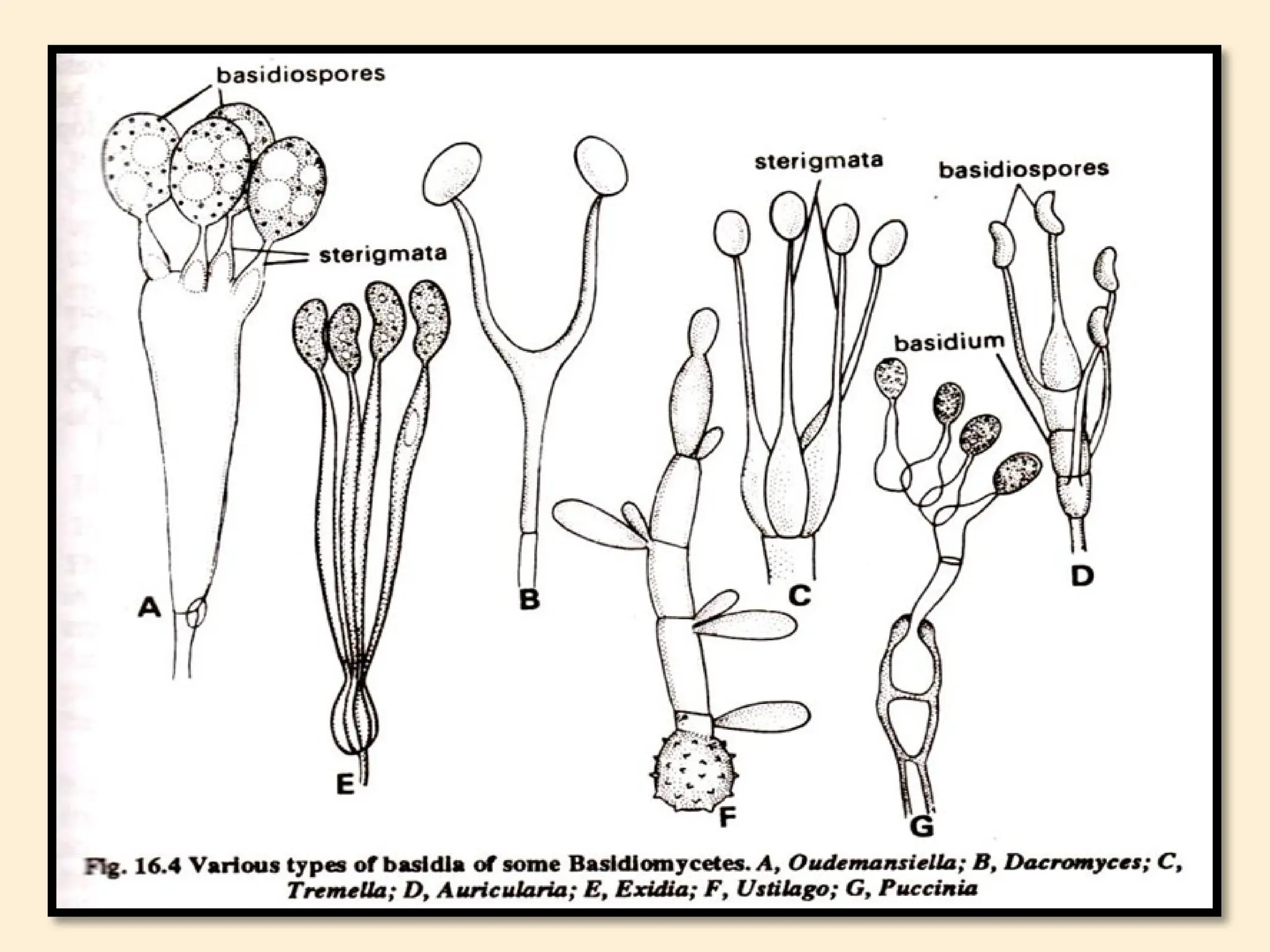
structures called basidia. The
members of the class are
characterized by presence of spores
called basidiospores. These spores
are produced after nuclear fusion
followed by meiosis. Unlike
ascospores, the basidiospores are
borne externally on characteristic
structures called basidia.
4.
4
Basidiomycetes usually showtwo types
of mycelium or hyphae:
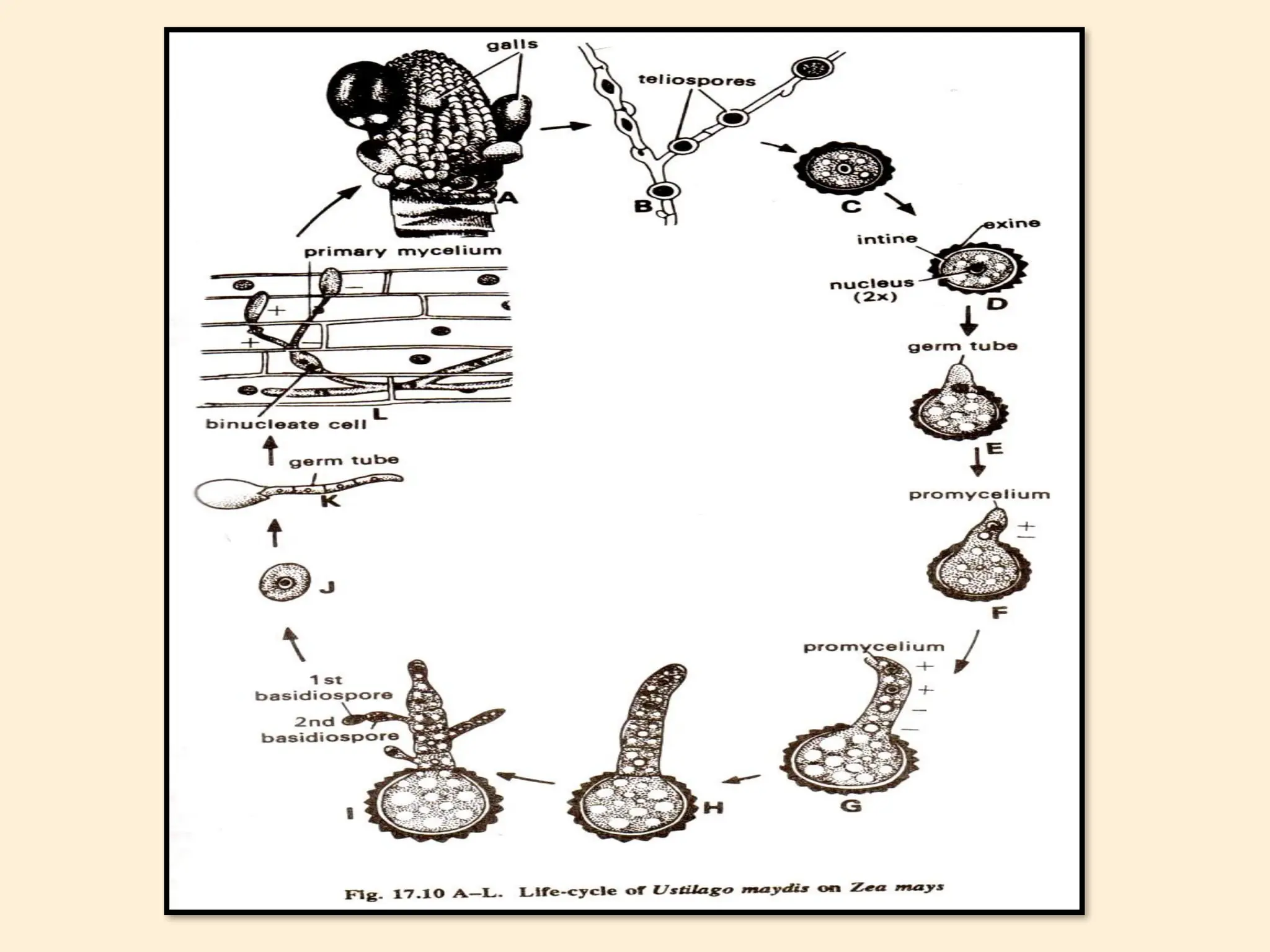
1.Primary mycelium: It usually
develops from the germination of a
basidiospore. The cells of the
hyphae are uninucleate
(monokaryotic).
5.
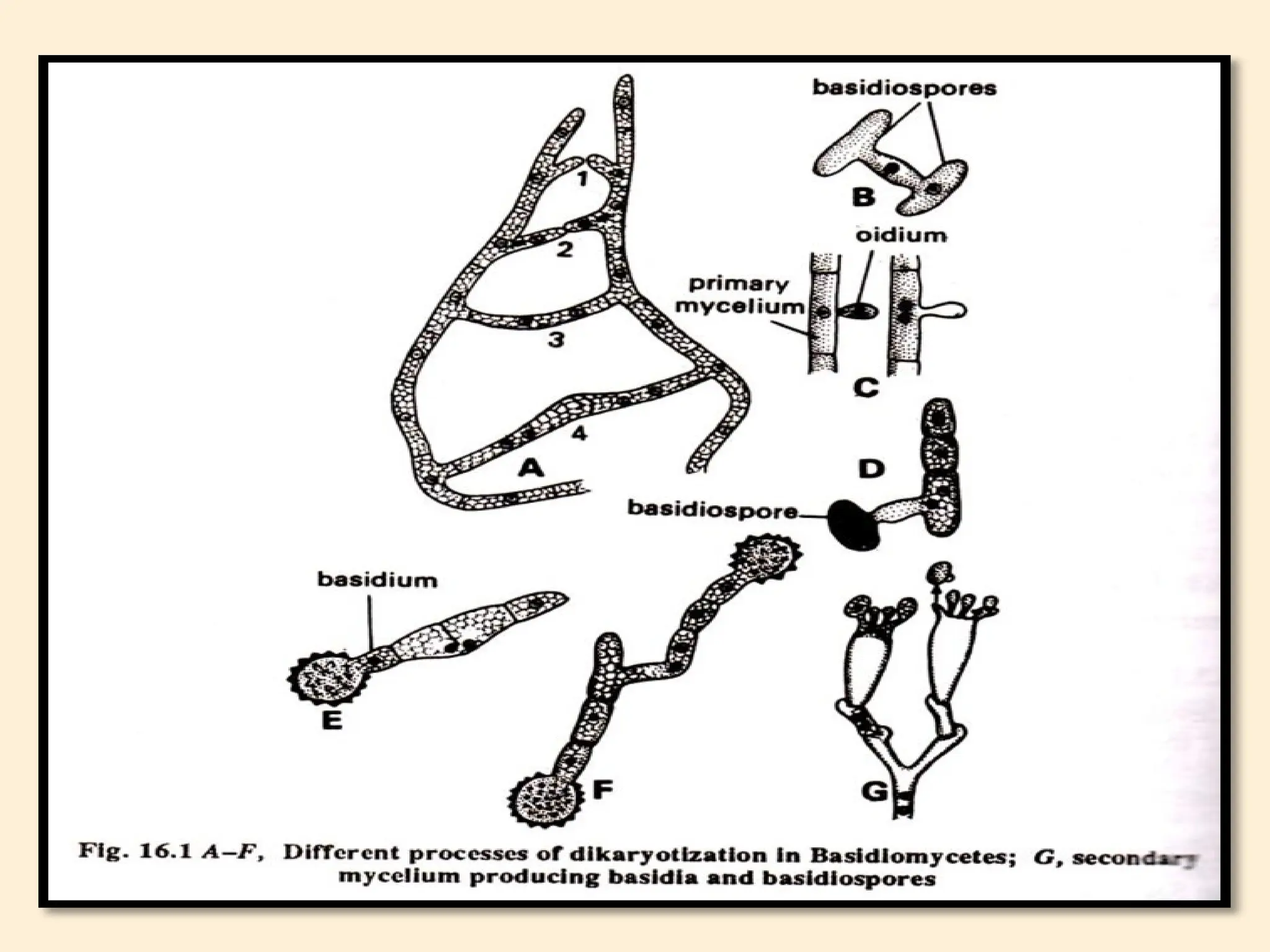
2.Secindary mycelium: Inthis
type the cells are binucleate
(dikaryotic). The dikaryotic mycelium
originates when two uninucleate cells
of monokaryotic mycelia fuse with
each other. Basidia are carried on
dikaryotic mycelia and never on
monokaryotic mycelia. Many
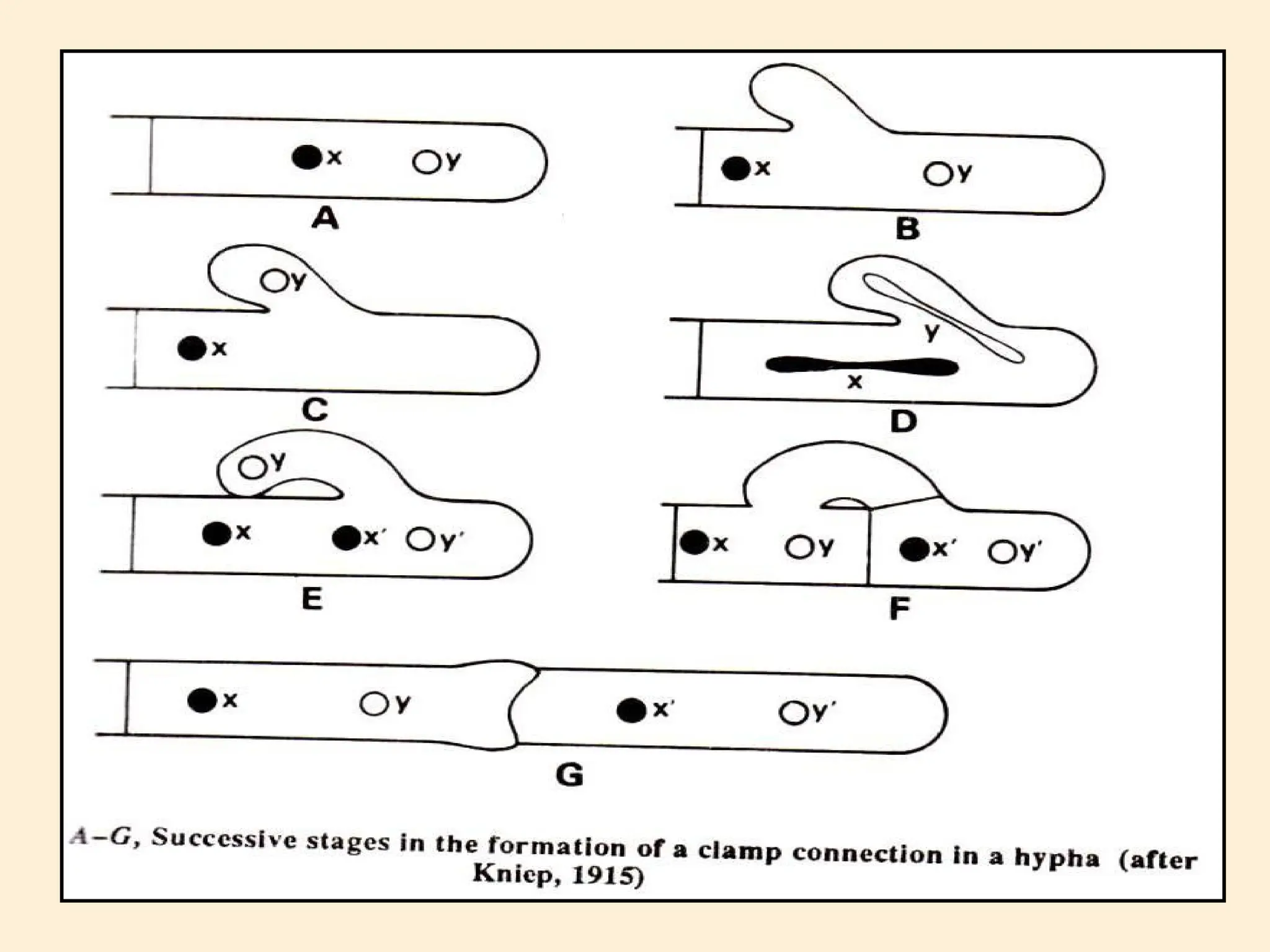
dikaryotic mycelia show side
appendages as out growths known as
clamp connections indicates that the
subtending mycelium is dikaryotic.
8.
8
Classification:
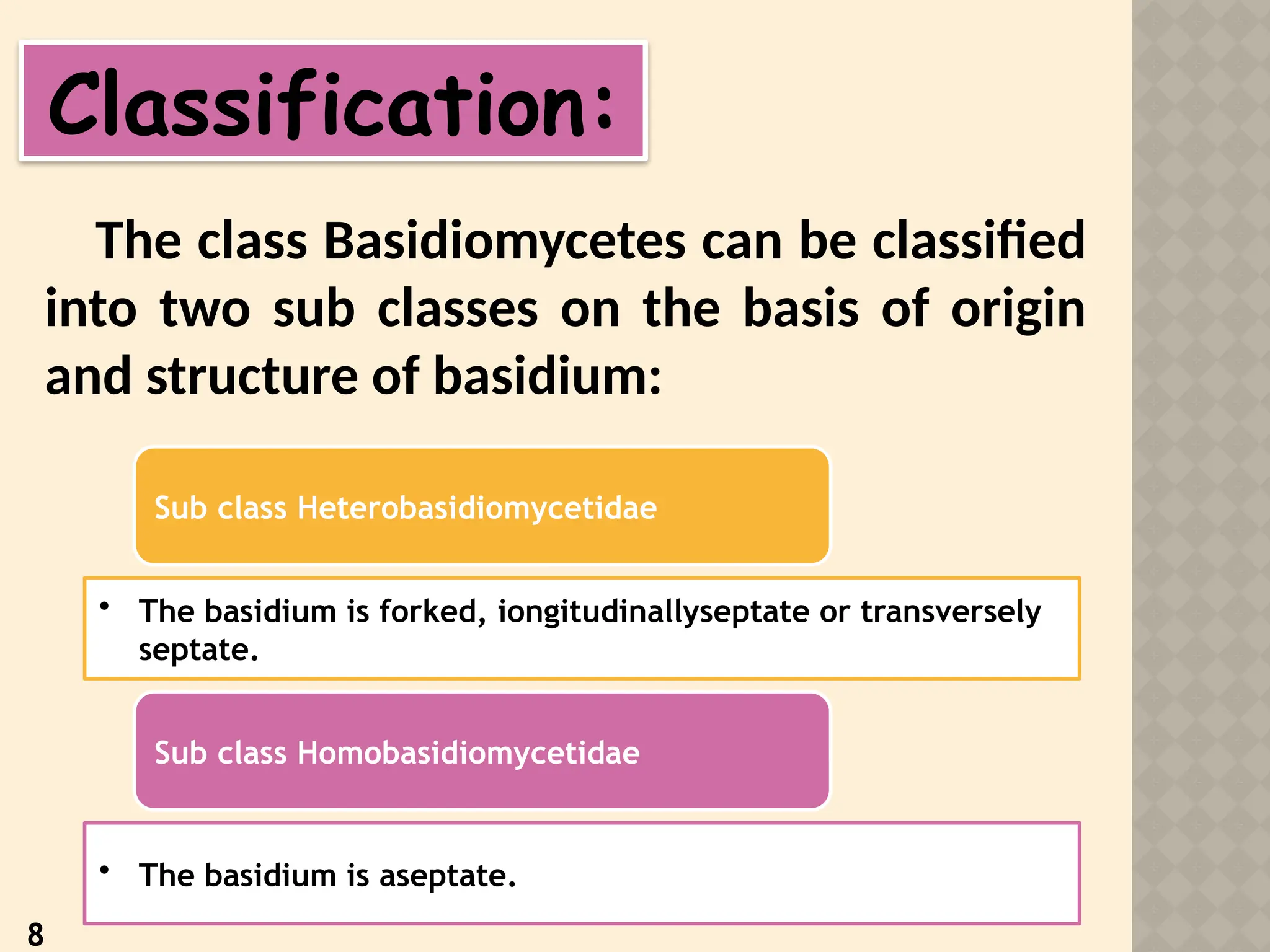
The class Basidiomycetescan be classified
into two sub classes on the basis of origin
and structure of basidium:
Sub class Heterobasidiomycetidae
• The basidium is forked, iongitudinallyseptate or transversely
septate.
Sub class Homobasidiomycetidae
• The basidium is aseptate.
10.
The sub classincludes species
which are specialized parasites of
higher plants. We will discuss only
the smut and rust fungi. So, we will
refer to two orders only:
10
1. Order Ustilaginales (Smut fungi): Teliospores are produced
intercalary.
2. Order Uredinales (Rust fungi): Teliospores are produced
terminally.
11.
11
Order Ustilaginales
(Smut fungi)
TheUstilaginales include the smut fungi.
The smut fungi do not form fructifications
(basidiocarps). They are highly specialized
parasites of angiosperms especially to family
Gramineae. They cause destructive diseases
known as smut diseases because they form
black dusty masses of spores which soot or
smut. From order Ustilaginales we shall deal
only with family Ustilaginaceae.
Ustilago is thegenus of smut fungi on
which Ustilaginaceae and Ustilaginales are
based. The smut diseases are of two types.
They are loose smuts and covered smuts. In
the loose smut the infected grain has its wall
broken up early and the smut spores
(teliospores) are released, the infected spike
looks quite different from the normal spike,
what is kept of its structure is the axis and few
filaments to which the smut spores may
adhere. On the other hand, in the covered
smut the wall of the infected grains does not
rupture and it encloses the teliospores.
15.
Which are releasedonly during the
mechanical treatment to separate grains
from the straw. Both loose and covered
smuts have little or no effect on the
vegetative growth of host.
Ustilagotritici causes the loose smut of
wheat.
Ustilagohordei causes the covered smut of
barley.
15
17.
17
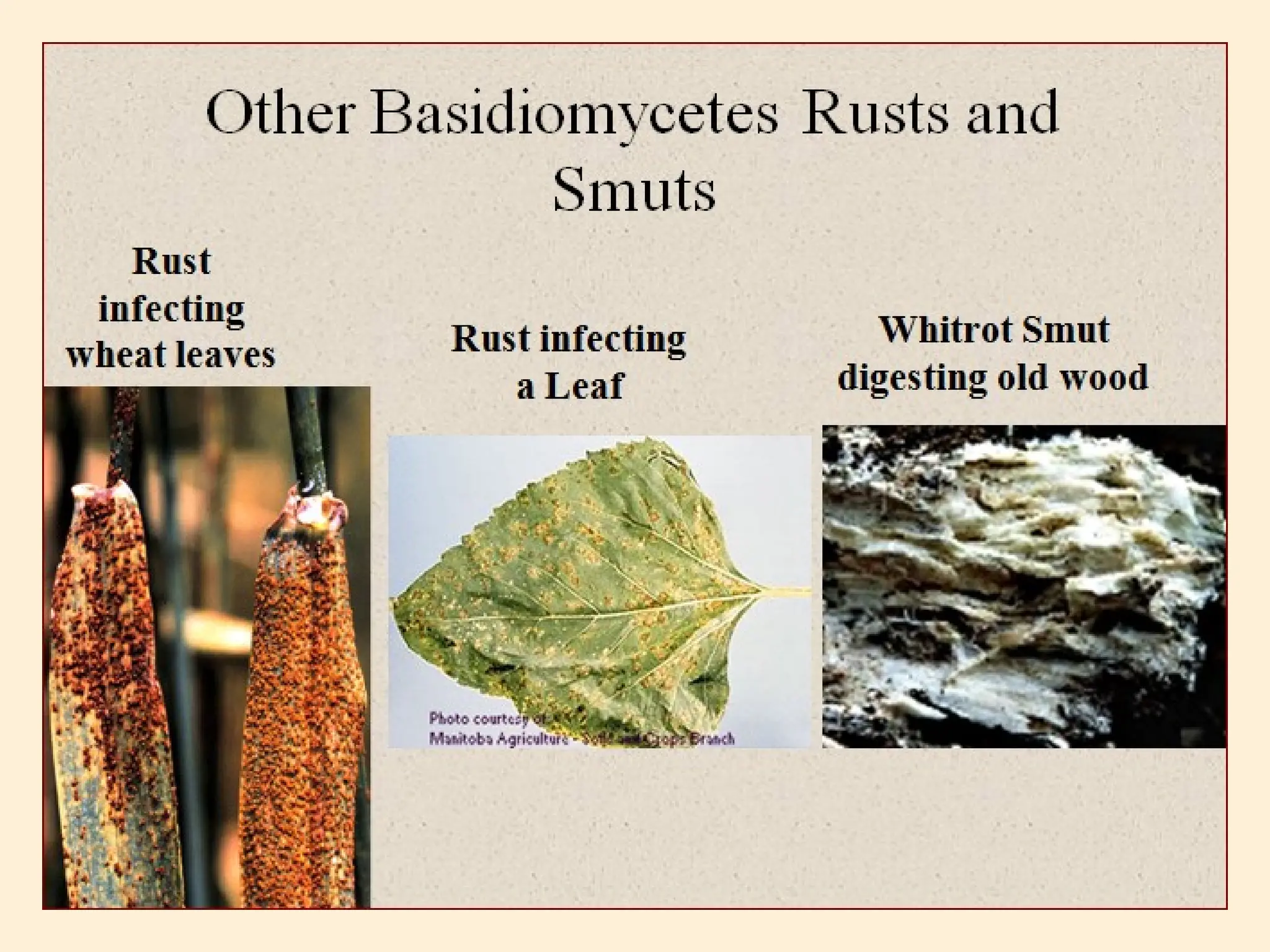
ORDER UREDINALES
(RUST FUNGI)
Themembers of order Uredinales are
economically important because the
majority of them cause disease of cereals
and other crops resulting in enormous
losses. These organisms receive the popular
name rusts or rust fungi from the rusty
colour of the spores which appear on the
surface of the host as pustules.
19.
Distinguishing features:
1.Basidiocarp islaking or poorly
developed.
2.Teliospores are produced terminally
and on germination produces 4-called
basidium, each cell of which forms 4
basidiospores.
The mycelium of the rusts is
intercellular, branched, septate and
uninucleate (monokaryotic) in its first
phase and binucleate (dikaryotic) in its
later stages. It produces haustoria into
host cells. Clamp connections are rare.
20.
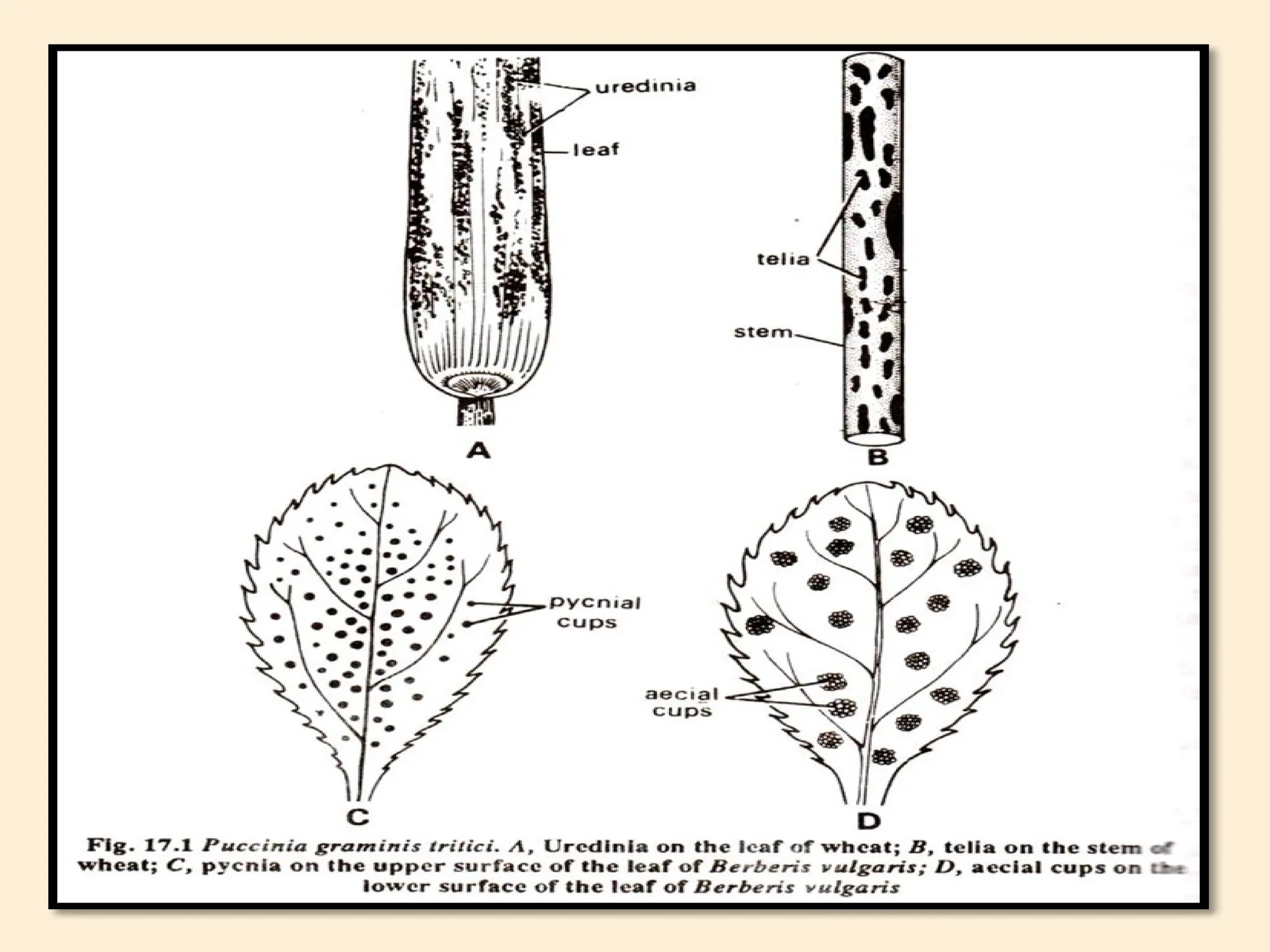
The rust fungimay produce five types
of spores in a regular sequence given
below:
Stage 0: Spermogonia (pycnia or
pycnidia) bearing spermatia (pycniospores
or pycnidiospores) and receptive hyphae.
Stage I: Aecia (aecidia) bearing
aeciospores (aecidiospores).
Stage II: Uredia (uredosori) bearing
uredospores.
Stage III: Telia (teliosori or teleutosori)
bearing teliospores or teleutospores.
Stage IV: Basidiospores produced on
basidia coming out from germinating
teliospores.
21.
The rust funguswhich has the five
different types of spores in its cycle is
known as long cycled. On the other hand,
when one or more of these types are
missed it is known as a short cycled.
Rusts may be heteroecious or
autoecious. In the heteroecious rust the
parasite completes the entire life cycle
producing various spore forms on two
hosts like Pucciniagraminis which
produces spermatia and aeciospores on
barberry while, uredospores and
teleutospores can be produced on wheat
22.
The basidiospores ofPucciniagraminis
are produced when the teleutospores
germinate. On the other hand, in the
autoecious rust, the different types of
spores are produced on one and same
host such as Uromycesvignae which
infects cowpea (Vignasinensis).
Classification:
On the basis of the teleutospores
structure, the Uredinales have been
classified by modern mycologists into two
families: Pucciniaceae and
23.
It is characterizedby the presence
stalked teleutospores. The m
important and widely distribu
genus belonging to this family
Puccinia.
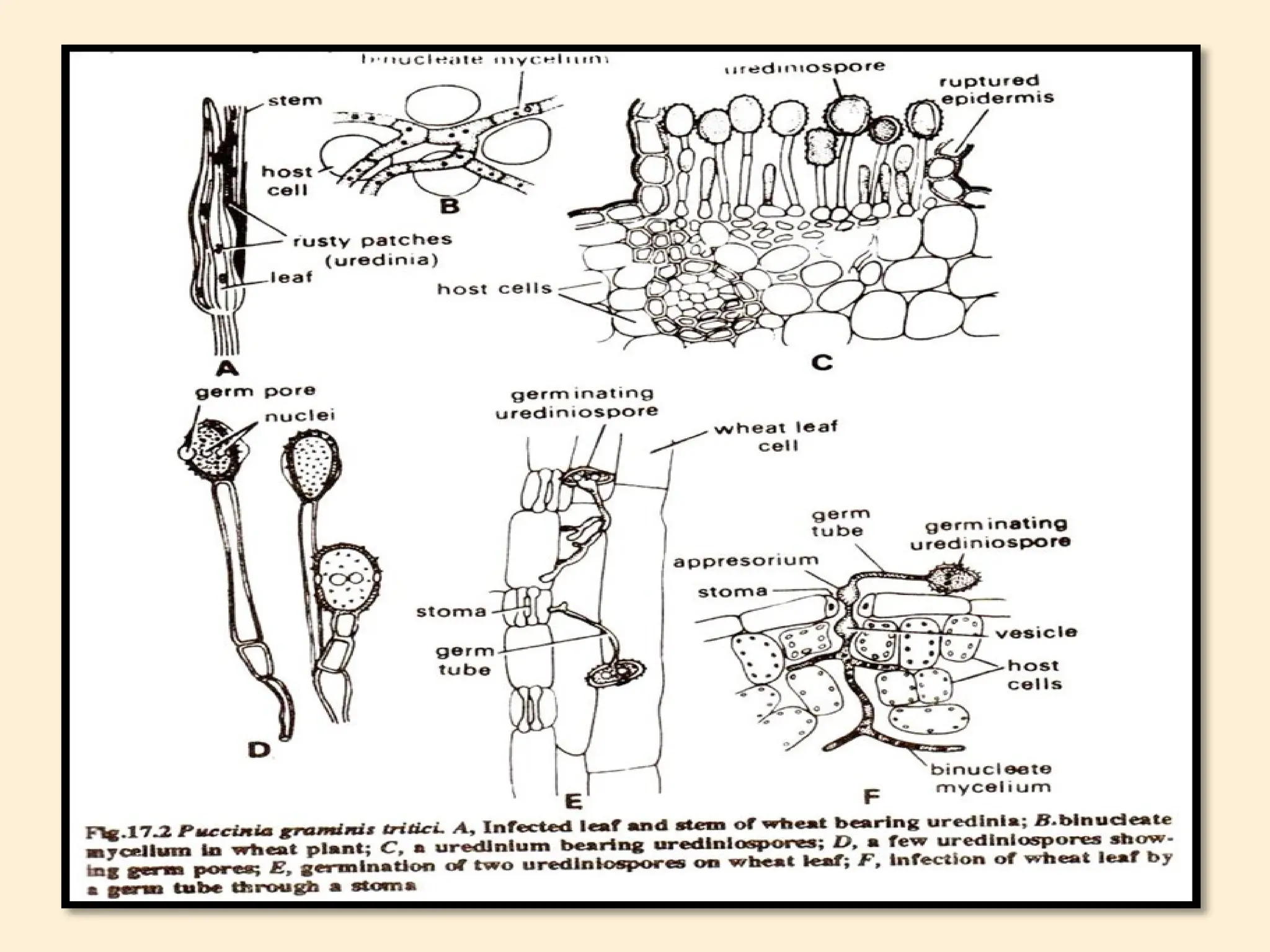
Pucciniagraministritici causes
black stem rust of wheat.
23
Fmily Pucciniaceae
26.
26
Fmily
Melampsoraceae
The characteristic featureof the
family is the unicellular
teleutospores which are sessile
and united laterally in the form of
crusts or columns.
Melamsporalini causes the rust of
linum.
28
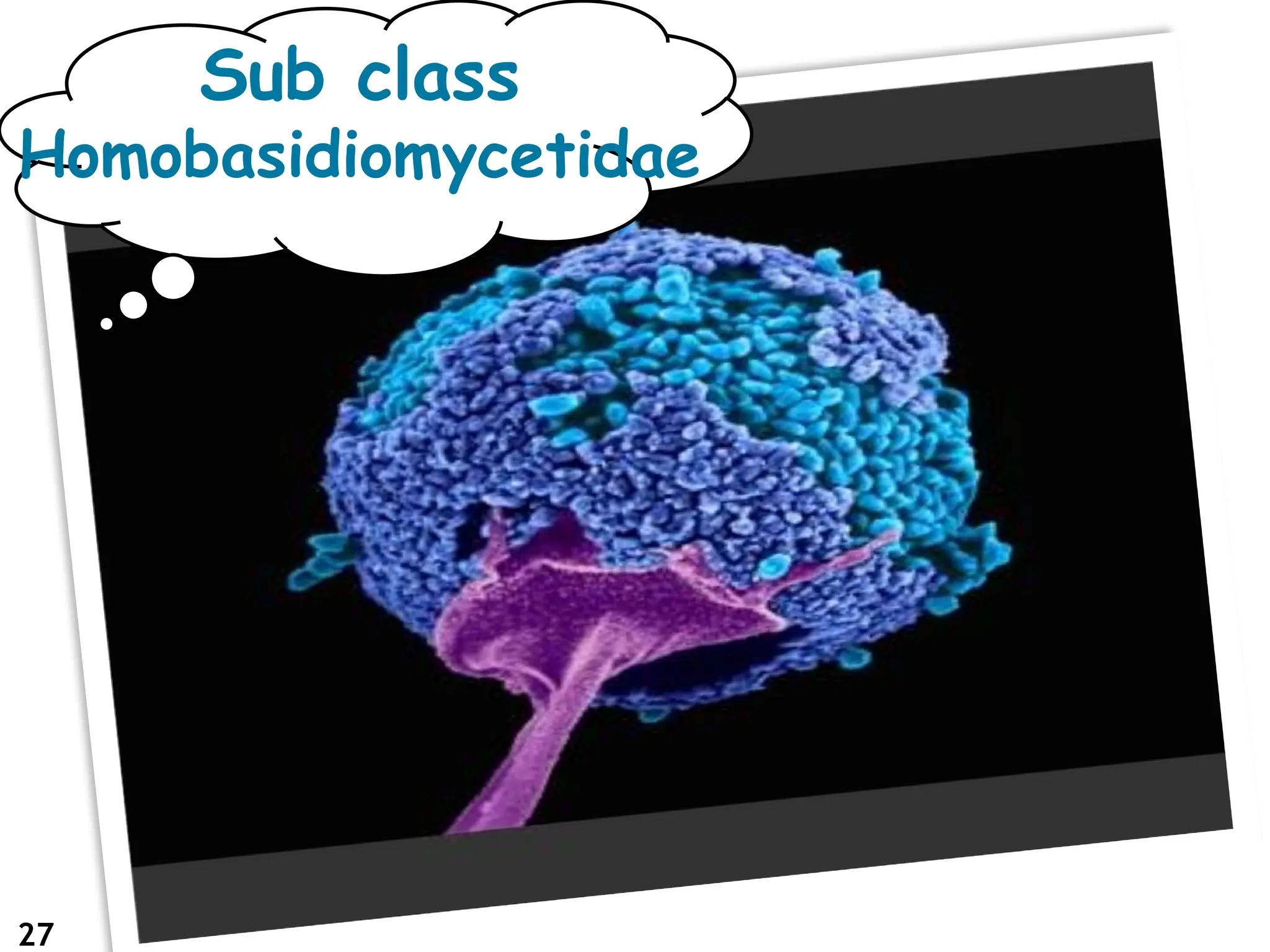
The sub classHomobasidiomycetidae is
divided into the following two series:
1.Series Hymenomycetes: The members
of Hymenomycetes bear their basidia in a
well defined hymenium which is exposed
even when the basidiospores are young
and undeveloped.
2.Series Gasteromycetes: On the other
hand, the hymenium of the members of
Gasteromycetes is enclosed and never
exposed. It disintegrates when the
basidiospores are mature. The
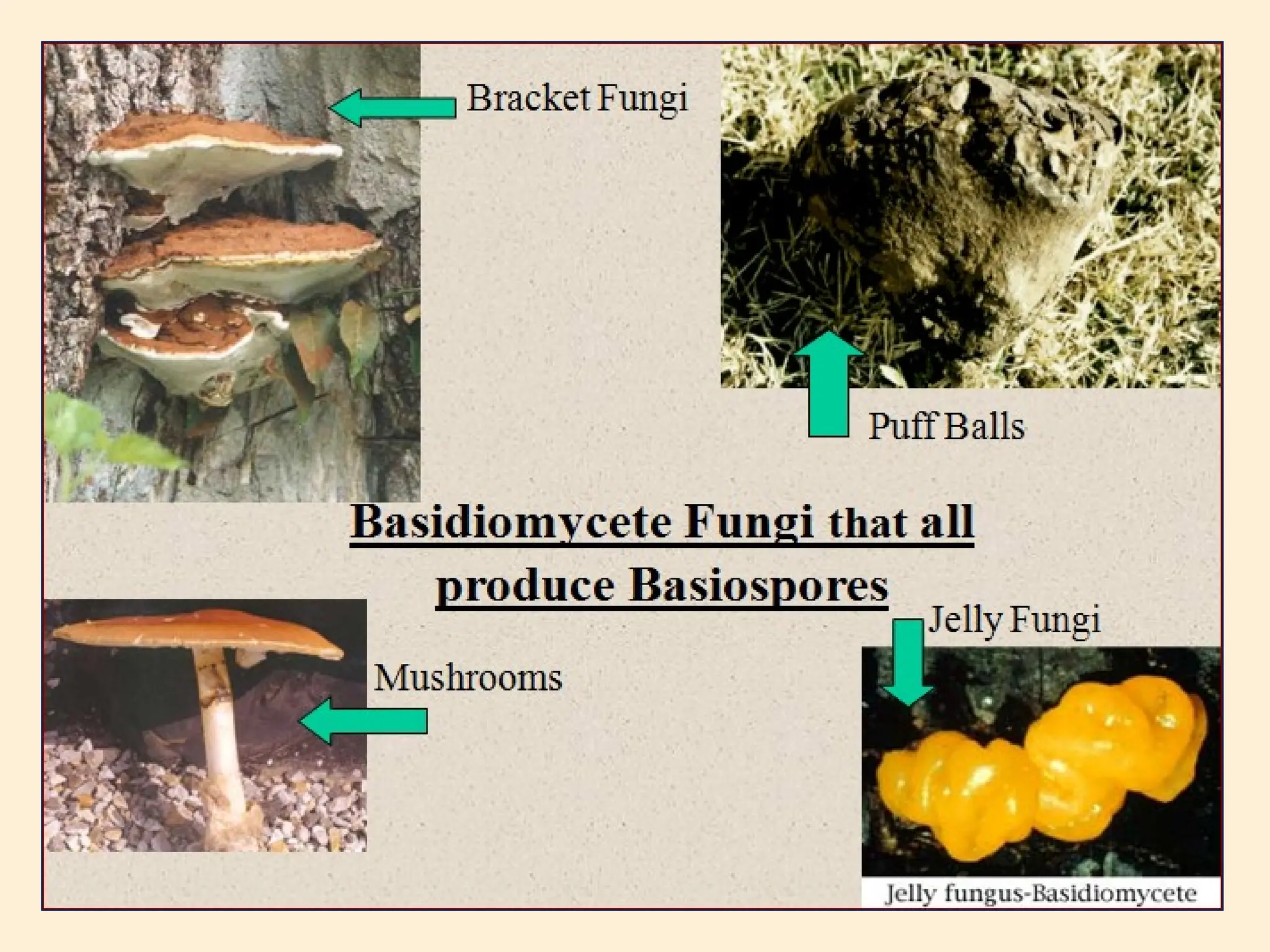
Gasteromycetes include the puff balls, the
earthstars, the stink horns and the bird's
nest fungi.
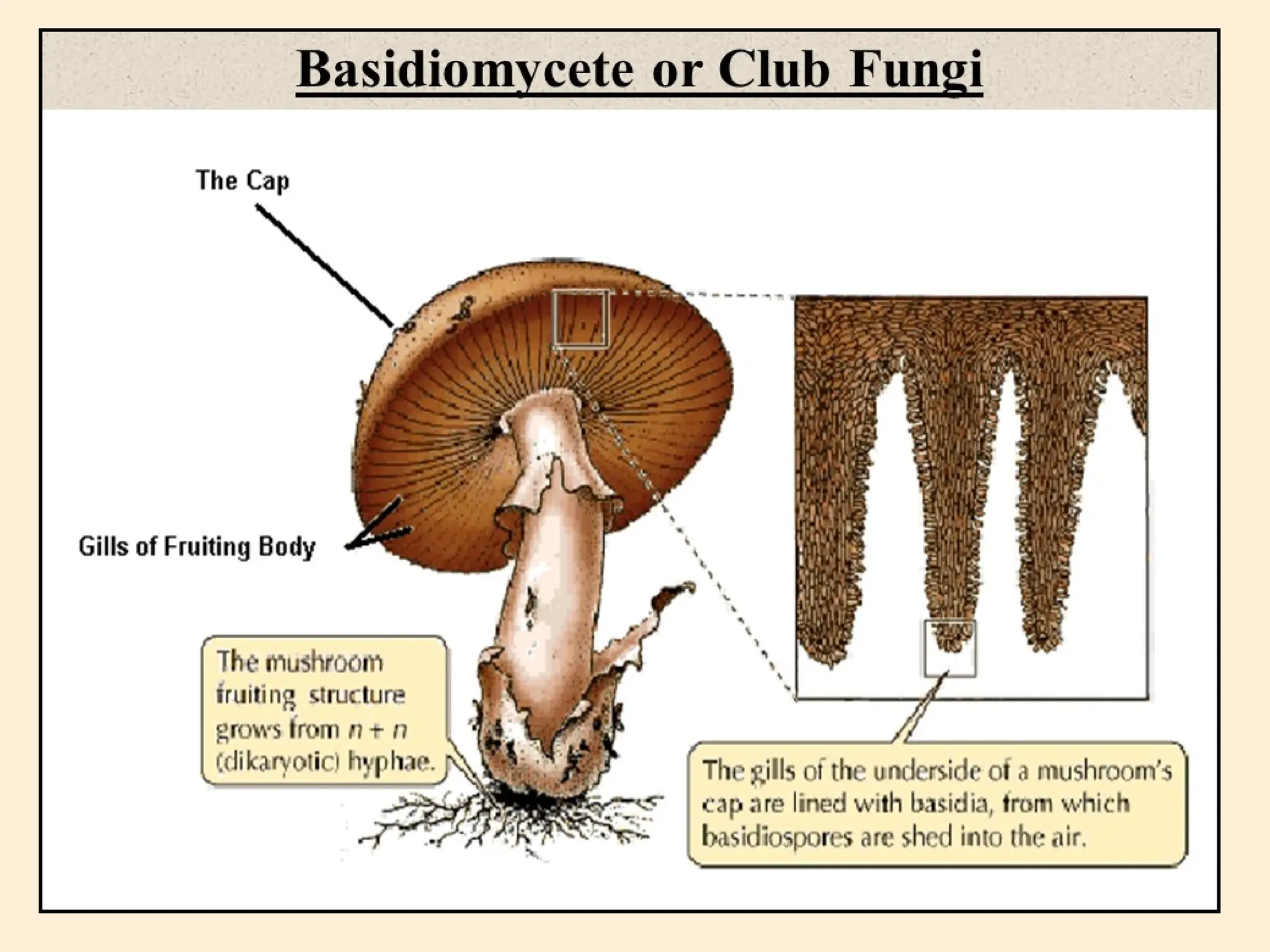
1.Basidiocarp is fleshyand distinguishable into a
stalk and pileus.
2.They bear their basidia on the surface of gills,
on both sides, which are generally borne on
the underside of an umbrella like structure, the
pileus.
35.
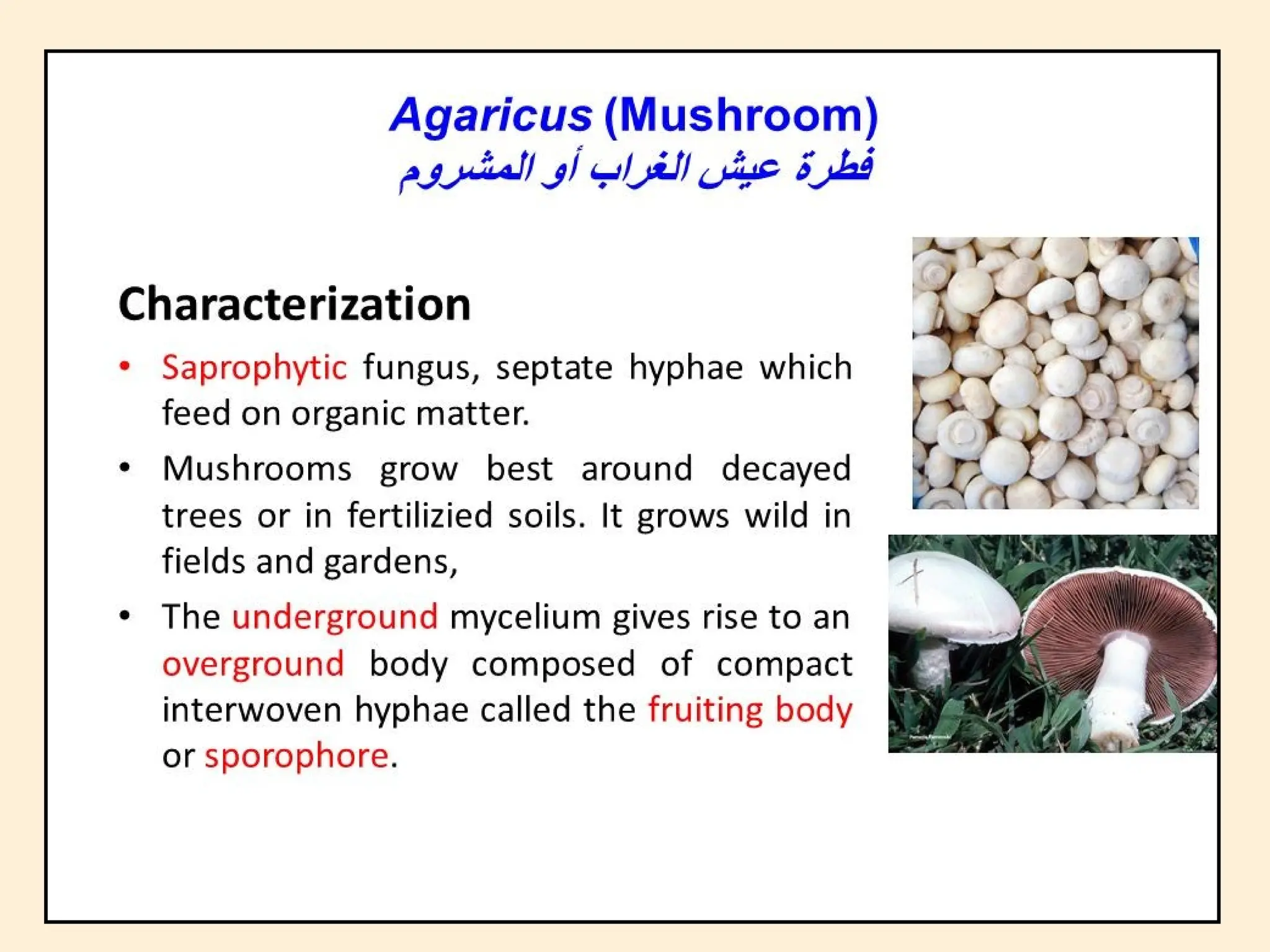
Agaricus is thebest known genus of the family.
It is an edible gilled fungus which is
cosmopolitan in its distribution and grows wild.
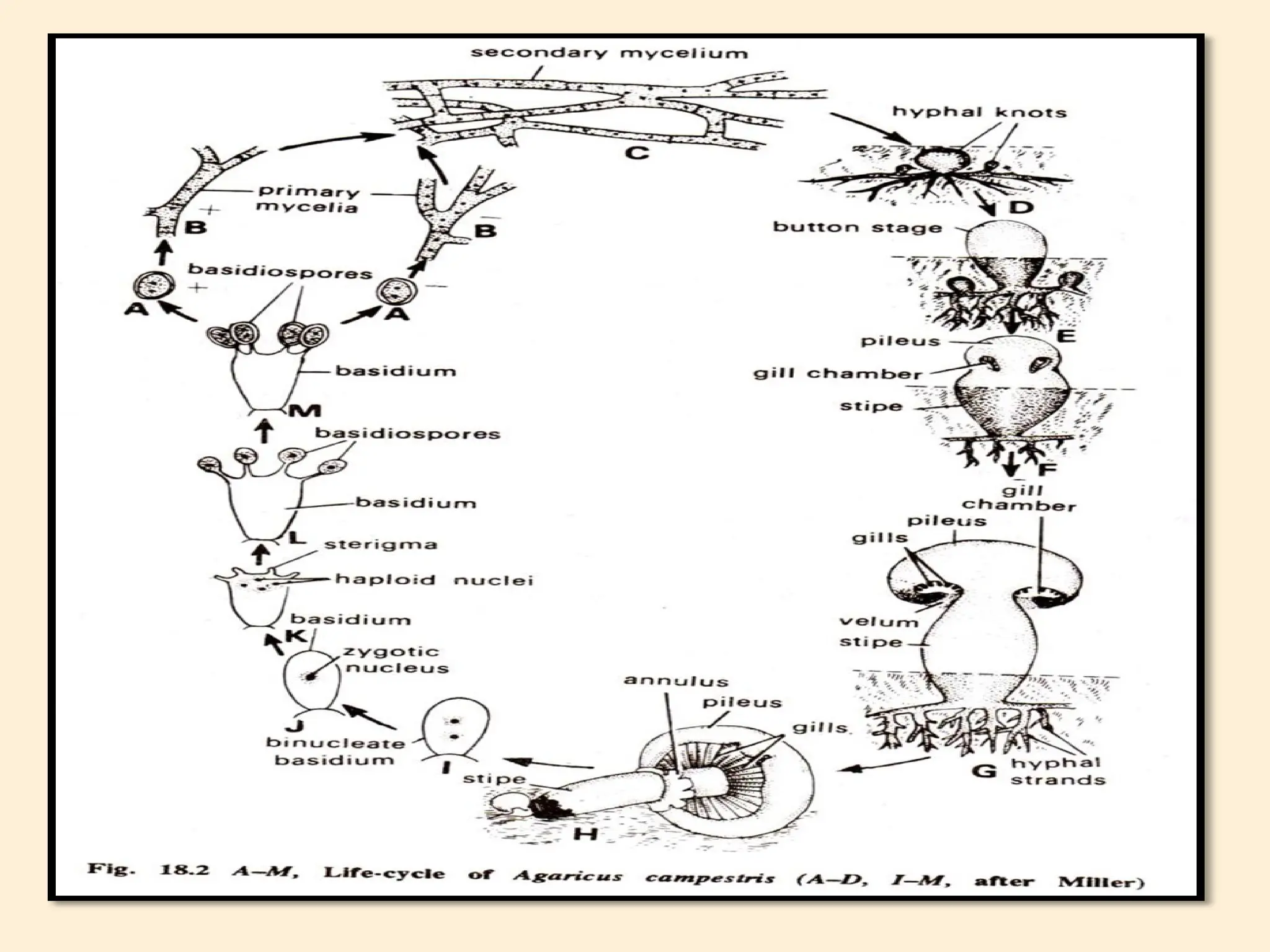
The basidiocarp of Agaricus begins as a tiny
knot of huphal cells, it eventually develops into a
small globose, or ovoid body commonly called
the “button stage”.
As the growth proceeds the upper region of it
becomes differentiated from the lower and
develops into a cap or pileus and stipe or stalk
respectively.
36.
The margin ofthe young pileus is connected to
the stipe by a membrane, known as the inner
veil. As the basidiocarp grows, the upper portion
of the button expands into the cap or pileus and
the inner veil ruptures.
Remmants of the inner veil remain attached
around the upper of the stipe in the form of a
ring or annulus. In this way the gills are fully
exposed.
39.
39
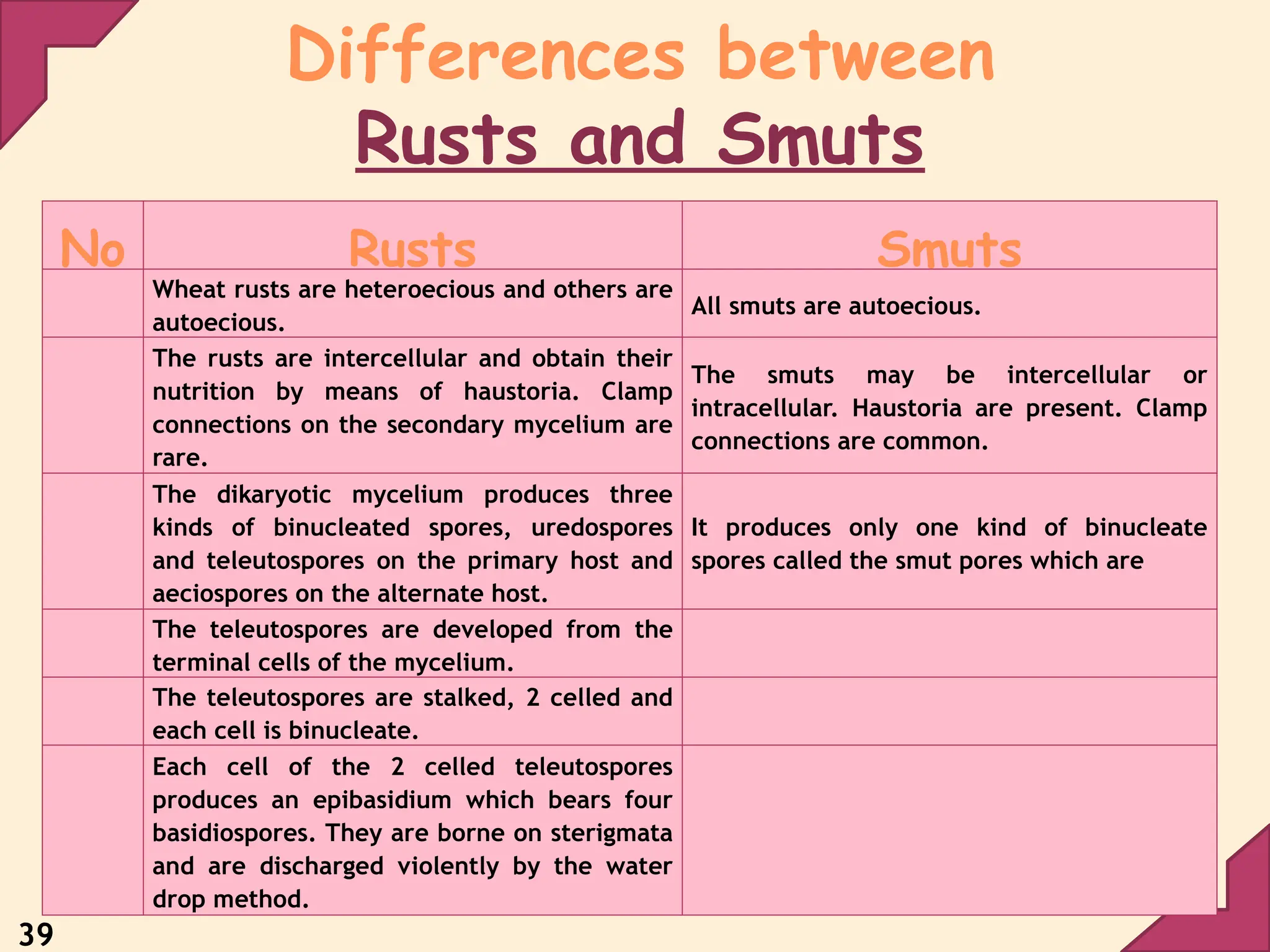
Differences between
Rusts andSmuts
No Rusts Smuts
Wheat rusts are heteroecious and others are
autoecious.
All smuts are autoecious.
The rusts are intercellular and obtain their
nutrition by means of haustoria. Clamp
connections on the secondary mycelium are
rare.
The smuts may be intercellular or
intracellular. Haustoria are present. Clamp
connections are common.
The dikaryotic mycelium produces three
kinds of binucleated spores, uredospores
and teleutospores on the primary host and
aeciospores on the alternate host.
It produces only one kind of binucleate
spores called the smut pores which are
The teleutospores are developed from the
terminal cells of the mycelium.
The teleutospores are stalked, 2 celled and
each cell is binucleate.
Each cell of the 2 celled teleutospores
produces an epibasidium which bears four
basidiospores. They are borne on sterigmata
and are discharged violently by the water
drop method.