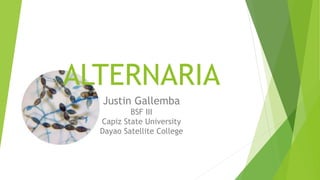
ALTERNARIA
Justin Gallemba
BSF III
Capiz State University
Dayao Satellite College
 The mold Alternaria is a well recognized allergy
causing fungus.
 Alternaria spores can be detected from spring
through late fall in most temperate areas, and
can reach levels of thousands of spores per cubic
meter of air.
 Alternaria spores can be at their highest
concentrations during dry, windy conditions that
are ideal for the spores to become airborne.
 Alternaria is currently comprised of about 40-50
species.
 It is commonly isolated from plants, soil, food,
and indoor air.
 One of the species, Alternaria alternata, has
been isolated from numerous kinds of organic
materials in damp situations, including textiles,
stored food, canvas, cardboard and paper,
electric cables, polyurethane, jet fuel, sewage
and effluents.
 Airborne spores of Alternaria
alternata and Alternaria tenuissima are found in
very high numbers in the outdoor environment
during summer.
 The presence of Alternaria together with other
molds such as Ulocladium spp, Stachybotrys spp,
Fusarium spp and Phoma spp, in indoor
environment is indicative of humid conditions.
 A. alternata is not commonly isolated from indoor
building materials and in most instances spores
found in indoor air environment may have
originated from outdoor sources.
 A. alternata is recognized as an important
allergen with airborne spores and mycelial
fragments being responsible for the allergic
symptoms in individuals with rhinitis or bronchial
asthma.
 Alternaria sensitivity can also lead to severe and
potentially fatal asthma.
 . It has also been shown that prolonged heavy
exposure to A. alternata spores and mycelial
fragments mimics that of other allergens such as
cat dander and dust mites.
 It has also been recorded as an opportunistic
pathogen causing skin diseases particularly in
immunocompromised patients such as the bone
marrow transplant patients.
Morphological Description
 Colonies are fast growing
 black to olivaceous-black or greyish
 suede-like to floccose
 Temperature: optimum 25-28C; maximum 31-32C.
 Microscopically, branched acropetal chains
(blastocatenate) of multicellular conidia
(dictyoconidia) are produced sympodially from
simple, sometimes branched, short or elongate
conidiophores.
 Conidia are obclavate, obpyriform, sometimes
ovoid or ellipsoidal, often with a short conical or
cylindrical beak, pale brown, smooth-walled or
verrucose.
Alternaria alternata colonies are
black to olivaceous-black or greyish,
and are suede-like to floccose.
Alternaria alternata showing branched
acropetal chains and multicelled, obclavate to
obpyriform conidia with short conical beaks.
 Alternaria species soon lose their ability to
sporulate in culture. Potato dextrose agar and
cornmeal agar are the most suitable media to
use, and incubation under ultra-violet light is
recommended to maintain sporulation.
 Although usually seen as saprophytic
contaminants, Alternariaspecies in particular A.
alternata and A. infectoria are recognised
causative agents of subcutaneous
phaeohyphomycosis and mycotic keratitis.
References:
 http://www.moldbacteria.com/mold/alternaria.ht
ml
 http://www.mycology.adelaide.edu.au/Fungal_Desc
riptions/Hyphomycetes_(dematiaceous)/Alternaria/
Alternaria

Alternaria

  • 1.
    ALTERNARIA Justin Gallemba BSF III CapizState University Dayao Satellite College
  • 2.
     The moldAlternaria is a well recognized allergy causing fungus.  Alternaria spores can be detected from spring through late fall in most temperate areas, and can reach levels of thousands of spores per cubic meter of air.  Alternaria spores can be at their highest concentrations during dry, windy conditions that are ideal for the spores to become airborne.
  • 3.
     Alternaria iscurrently comprised of about 40-50 species.  It is commonly isolated from plants, soil, food, and indoor air.  One of the species, Alternaria alternata, has been isolated from numerous kinds of organic materials in damp situations, including textiles, stored food, canvas, cardboard and paper, electric cables, polyurethane, jet fuel, sewage and effluents.
  • 4.
     Airborne sporesof Alternaria alternata and Alternaria tenuissima are found in very high numbers in the outdoor environment during summer.  The presence of Alternaria together with other molds such as Ulocladium spp, Stachybotrys spp, Fusarium spp and Phoma spp, in indoor environment is indicative of humid conditions.
  • 5.
     A. alternatais not commonly isolated from indoor building materials and in most instances spores found in indoor air environment may have originated from outdoor sources.  A. alternata is recognized as an important allergen with airborne spores and mycelial fragments being responsible for the allergic symptoms in individuals with rhinitis or bronchial asthma.
  • 6.
     Alternaria sensitivitycan also lead to severe and potentially fatal asthma.  . It has also been shown that prolonged heavy exposure to A. alternata spores and mycelial fragments mimics that of other allergens such as cat dander and dust mites.  It has also been recorded as an opportunistic pathogen causing skin diseases particularly in immunocompromised patients such as the bone marrow transplant patients.
  • 7.
    Morphological Description  Coloniesare fast growing  black to olivaceous-black or greyish  suede-like to floccose  Temperature: optimum 25-28C; maximum 31-32C.
  • 8.
     Microscopically, branchedacropetal chains (blastocatenate) of multicellular conidia (dictyoconidia) are produced sympodially from simple, sometimes branched, short or elongate conidiophores.  Conidia are obclavate, obpyriform, sometimes ovoid or ellipsoidal, often with a short conical or cylindrical beak, pale brown, smooth-walled or verrucose.
  • 9.
    Alternaria alternata coloniesare black to olivaceous-black or greyish, and are suede-like to floccose.
  • 10.
    Alternaria alternata showingbranched acropetal chains and multicelled, obclavate to obpyriform conidia with short conical beaks.
  • 11.
     Alternaria speciessoon lose their ability to sporulate in culture. Potato dextrose agar and cornmeal agar are the most suitable media to use, and incubation under ultra-violet light is recommended to maintain sporulation.  Although usually seen as saprophytic contaminants, Alternariaspecies in particular A. alternata and A. infectoria are recognised causative agents of subcutaneous phaeohyphomycosis and mycotic keratitis.
  • 12.