Classification of Phylum-
Basidiomycota- important
characters
General characters
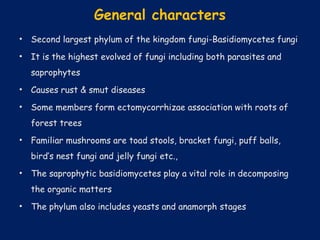
• Second largest phylum of the kingdom fungi-Basidiomycetes fungi
• It is the highest evolved of fungi including both parasites and
saprophytes
• Causes rust & smut diseases
• Some members form ectomycorrhizae association with roots of
forest trees
• Familiar mushrooms are toad stools, bracket fungi, puff balls,
bird’s nest fungi and jelly fungi etc.,
• The saprophytic basidiomycetes play a vital role in decomposing
the organic matters
• The phylum also includes yeasts and anamorph stages
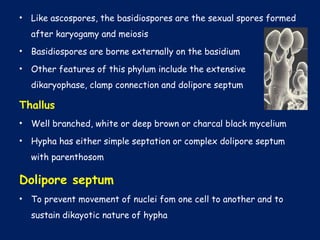
• Like ascospores, the basidiospores are the sexual spores formed
after karyogamy and meiosis
• Basidiospores are borne externally on the basidium
• Other features of this phylum include the extensive
dikaryophase, clamp connection and dolipore septum
Thallus
• Well branched, white or deep brown or charcal black mycelium
• Hypha has either simple septation or complex dolipore septum
with parenthosom
Dolipore septum
• To prevent movement of nuclei fom one cell to another and to
sustain dikayotic nature of hypha
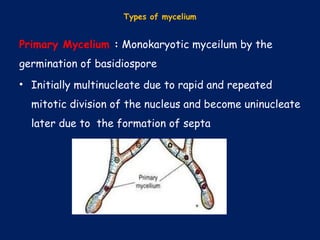
Types of mycelium
Primary Mycelium : Monokaryotic myceilum by the
germination of basidiospore
• Initially multinucleate due to rapid and repeated
mitotic division of the nucleus and become uninucleate
later due to the formation of septa
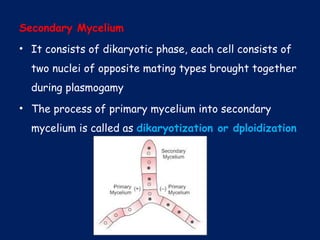
Secondary Mycelium
• It consists of dikaryotic phase, each cell consists of
two nuclei of opposite mating types brought together
during plasmogamy
• The process of primary mycelium into secondary
mycelium is called as dikaryotization or dploidization
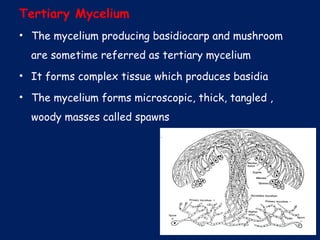
Tertiary Mycelium
• The mycelium producing basidiocarp and mushroom
are sometime referred as tertiary mycelium
• It forms complex tissue which produces basidia
• The mycelium forms microscopic, thick, tangled ,
woody masses called spawns
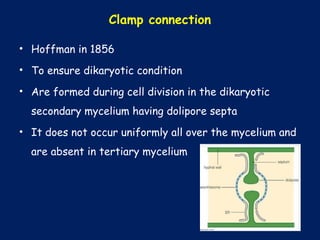
Clamp connection
• Hoffman in 1856
• To ensure dikaryotic condition
• Are formed during cell division in the dikaryotic
secondary mycelium having dolipore septa
• It does not occur uniformly all over the mycelium and
are absent in tertiary mycelium
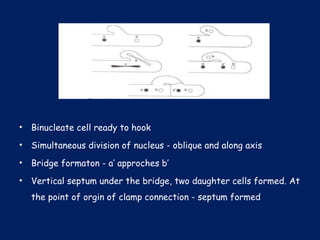
• Binucleate cell ready to hook
• Simultaneous division of nucleus - oblique and along axis
• Bridge formaton - a’ approches b’
• Vertical septum under the bridge, two daughter cells formed. At
the point of orgin of clamp connection - septum formed
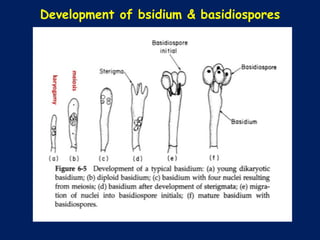
Development of bsidium & basidiospores
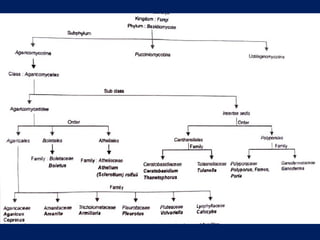
Symptoms and life cycles of Puccinia,
Uromyces, Hemileia and Ustilago
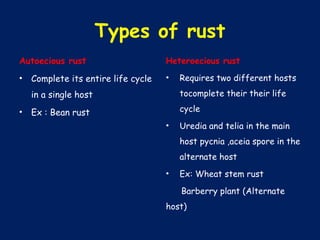
Types of rust
Autoecious rust
• Complete its entire life cycle
in a single host
• Ex : Bean rust
Heteroecious rust
• Requires two different hosts
tocomplete their their life
cycle
• Uredia and telia in the main
host pycnia ,aceia spore in the
alternate host
• Ex: Wheat stem rust
Barberry plant (Alternate
host)
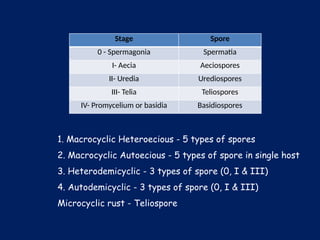
Stage Spore
0 - Spermagonia Spermatia
I- Aecia Aeciospores
II- Uredia Urediospores
III- Telia Teliospores
IV- Promycelium or basidia Basidiospores
1. Macrocyclic Heteroecious - 5 types of spores
2. Macrocyclic Autoecious - 5 types of spore in single host
3. Heterodemicyclic - 3 types of spore (0, I & III)
4. Autodemicyclic - 3 types of spore (0, I & III)
Microcyclic rust - Teliospore
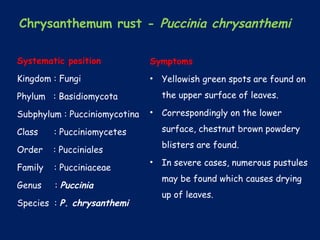
Chrysanthemum rust - Puccinia chrysanthemi
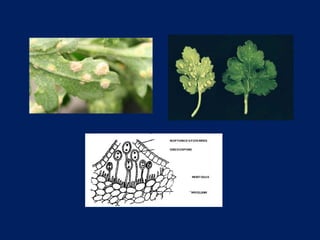
Symptoms
• Yellowish green spots are found on
the upper surface of leaves.
• Correspondingly on the lower
surface, chestnut brown powdery
blisters are found.
• In severe cases, numerous pustules
may be found which causes drying
up of leaves.
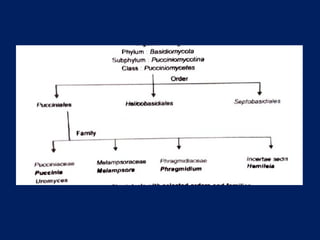
Systematic position
Kingdom : Fungi
Phylum : Basidiomycota
Subphylum : Pucciniomycotina
Class : Pucciniomycetes
Order : Pucciniales
Family : Pucciniaceae
Genus : Puccinia
Species : P. chrysanthemi
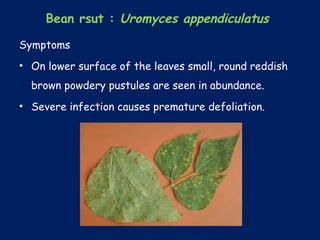
Bean rsut : Uromyces appendiculatus
Symptoms
• On lower surface of the leaves small, round reddish
brown powdery pustules are seen in abundance.
• Severe infection causes premature defoliation.
Fungal characters
• Parasitism: Obligate biotroph. It is a typical
macrocyclic (all five spore), Autocious rust (one
hosts)
• Mycelium – well branched, dikaryotic, intercellular,
produces haustoria
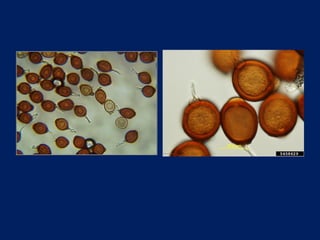
• Asexual reproduction : Urediospores are single celled,
oval shaped, yellowish brown, echinulated.
• Sexual reproduction : Teliospores oval, single celled,
brown/brownish orange, pedicellate.
• Basidiospores – Round and single celled
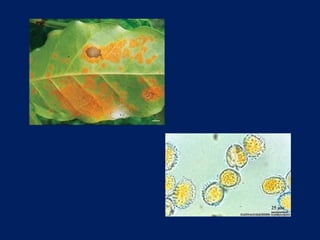
Coffee rust: Hemileia vastatrix
Symptoms
• Initially, pale yellow spot
appears on the upper surface of
the leaf
• Later orange yellow powdery
growth consisting of uredosori
develop on the corresponding
undersurface of the young leaf.
• Plants in all stages of growth
are affected.
Systematic position
Kingdom : Fungi
Phylum : Basidiomycota
Subphylum : Pucciniomycotina
Class : Pucciniomycetes
Order : Pucciniales
Family : Incertae sedis
Genus : Hemielia
Species : H. vastatrix
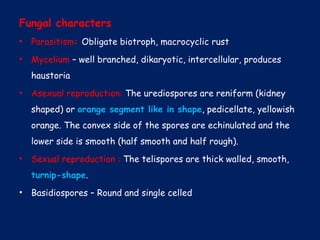
Fungal characters
• Parasitism: Obligate biotroph, macrocyclic rust
• Mycelium – well branched, dikaryotic, intercellular, produces
haustoria
• Asexual reproduction: The urediospores are reniform (kidney
shaped) or orange segment like in shape, pedicellate, yellowish
orange. The convex side of the spores are echinulated and the
lower side is smooth (half smooth and half rough).
• Sexual reproduction : The telispores are thick walled, smooth,
turnip-shape.
• Basidiospores – Round and single celled
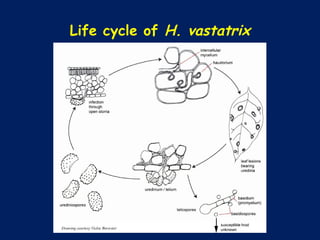
Life cycle of H. vastatrix
Ustilago
The important diseases caused by Genus Ustilago are
• Loose smut of wheat: Ustilago tritici
• Whip smut of sugarcane: Ustilago scitaminae
• Corn smut: Ustilago maydis
Loose smut of wheat - Ustilago nuda tritici
Symptoms
• The disease appears only at
ear head emergence.
Diseased ear heads emerge
out of the boot leaf earlier
than healthy ones. The
smutted spikelet is covered
by a silvery membrane which
contains black, dry powdery
mass of smut spores.
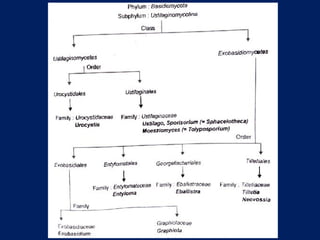
Systematic position
Kingdom : Fungi
Phylum : Basidiomycota
Subphylum : Ustilaginomycotina
Class : Ustilaginomycetes
Order : Ustilagniales
Family : Ustilaginaceae
Genus : Ustilago
Species : U. nuda tritici
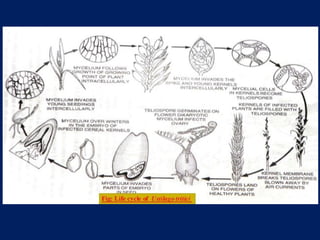
• The spores are blown off by the wind leaving the central rachis
alone.
Fungal characters
• The pathogen is internally seed borne and systemic in nature.
• Smut spores are pale, olive brown, spherical to oval in shape with
minute echinulations.
Basidiomycota.pptx pathology agriculture

Basidiomycota.pptx pathology agriculture

  • 1.
  • 5.
    General characters • Secondlargest phylum of the kingdom fungi-Basidiomycetes fungi • It is the highest evolved of fungi including both parasites and saprophytes • Causes rust & smut diseases • Some members form ectomycorrhizae association with roots of forest trees • Familiar mushrooms are toad stools, bracket fungi, puff balls, bird’s nest fungi and jelly fungi etc., • The saprophytic basidiomycetes play a vital role in decomposing the organic matters • The phylum also includes yeasts and anamorph stages
  • 6.
    • Like ascospores,the basidiospores are the sexual spores formed after karyogamy and meiosis • Basidiospores are borne externally on the basidium • Other features of this phylum include the extensive dikaryophase, clamp connection and dolipore septum Thallus • Well branched, white or deep brown or charcal black mycelium • Hypha has either simple septation or complex dolipore septum with parenthosom Dolipore septum • To prevent movement of nuclei fom one cell to another and to sustain dikayotic nature of hypha
  • 7.
    Types of mycelium PrimaryMycelium : Monokaryotic myceilum by the germination of basidiospore • Initially multinucleate due to rapid and repeated mitotic division of the nucleus and become uninucleate later due to the formation of septa
  • 8.
    Secondary Mycelium • Itconsists of dikaryotic phase, each cell consists of two nuclei of opposite mating types brought together during plasmogamy • The process of primary mycelium into secondary mycelium is called as dikaryotization or dploidization
  • 9.
    Tertiary Mycelium • Themycelium producing basidiocarp and mushroom are sometime referred as tertiary mycelium • It forms complex tissue which produces basidia • The mycelium forms microscopic, thick, tangled , woody masses called spawns
  • 10.
    Clamp connection • Hoffmanin 1856 • To ensure dikaryotic condition • Are formed during cell division in the dikaryotic secondary mycelium having dolipore septa • It does not occur uniformly all over the mycelium and are absent in tertiary mycelium
  • 11.
    • Binucleate cellready to hook • Simultaneous division of nucleus - oblique and along axis • Bridge formaton - a’ approches b’ • Vertical septum under the bridge, two daughter cells formed. At the point of orgin of clamp connection - septum formed
  • 12.
    Development of bsidium& basidiospores
  • 13.
    Symptoms and lifecycles of Puccinia, Uromyces, Hemileia and Ustilago
  • 14.
    Types of rust Autoeciousrust • Complete its entire life cycle in a single host • Ex : Bean rust Heteroecious rust • Requires two different hosts tocomplete their their life cycle • Uredia and telia in the main host pycnia ,aceia spore in the alternate host • Ex: Wheat stem rust Barberry plant (Alternate host)
  • 15.
    Stage Spore 0 -Spermagonia Spermatia I- Aecia Aeciospores II- Uredia Urediospores III- Telia Teliospores IV- Promycelium or basidia Basidiospores 1. Macrocyclic Heteroecious - 5 types of spores 2. Macrocyclic Autoecious - 5 types of spore in single host 3. Heterodemicyclic - 3 types of spore (0, I & III) 4. Autodemicyclic - 3 types of spore (0, I & III) Microcyclic rust - Teliospore
  • 16.
    Chrysanthemum rust -Puccinia chrysanthemi Symptoms • Yellowish green spots are found on the upper surface of leaves. • Correspondingly on the lower surface, chestnut brown powdery blisters are found. • In severe cases, numerous pustules may be found which causes drying up of leaves. Systematic position Kingdom : Fungi Phylum : Basidiomycota Subphylum : Pucciniomycotina Class : Pucciniomycetes Order : Pucciniales Family : Pucciniaceae Genus : Puccinia Species : P. chrysanthemi
  • 18.
    Bean rsut :Uromyces appendiculatus Symptoms • On lower surface of the leaves small, round reddish brown powdery pustules are seen in abundance. • Severe infection causes premature defoliation.
  • 19.
    Fungal characters • Parasitism:Obligate biotroph. It is a typical macrocyclic (all five spore), Autocious rust (one hosts) • Mycelium – well branched, dikaryotic, intercellular, produces haustoria • Asexual reproduction : Urediospores are single celled, oval shaped, yellowish brown, echinulated. • Sexual reproduction : Teliospores oval, single celled, brown/brownish orange, pedicellate. • Basidiospores – Round and single celled
  • 21.
    Coffee rust: Hemileiavastatrix Symptoms • Initially, pale yellow spot appears on the upper surface of the leaf • Later orange yellow powdery growth consisting of uredosori develop on the corresponding undersurface of the young leaf. • Plants in all stages of growth are affected. Systematic position Kingdom : Fungi Phylum : Basidiomycota Subphylum : Pucciniomycotina Class : Pucciniomycetes Order : Pucciniales Family : Incertae sedis Genus : Hemielia Species : H. vastatrix
  • 23.
    Fungal characters • Parasitism:Obligate biotroph, macrocyclic rust • Mycelium – well branched, dikaryotic, intercellular, produces haustoria • Asexual reproduction: The urediospores are reniform (kidney shaped) or orange segment like in shape, pedicellate, yellowish orange. The convex side of the spores are echinulated and the lower side is smooth (half smooth and half rough). • Sexual reproduction : The telispores are thick walled, smooth, turnip-shape. • Basidiospores – Round and single celled
  • 24.
    Life cycle ofH. vastatrix
  • 25.
    Ustilago The important diseasescaused by Genus Ustilago are • Loose smut of wheat: Ustilago tritici • Whip smut of sugarcane: Ustilago scitaminae • Corn smut: Ustilago maydis
  • 26.
    Loose smut ofwheat - Ustilago nuda tritici Symptoms • The disease appears only at ear head emergence. Diseased ear heads emerge out of the boot leaf earlier than healthy ones. The smutted spikelet is covered by a silvery membrane which contains black, dry powdery mass of smut spores. Systematic position Kingdom : Fungi Phylum : Basidiomycota Subphylum : Ustilaginomycotina Class : Ustilaginomycetes Order : Ustilagniales Family : Ustilaginaceae Genus : Ustilago Species : U. nuda tritici
  • 27.
    • The sporesare blown off by the wind leaving the central rachis alone. Fungal characters • The pathogen is internally seed borne and systemic in nature. • Smut spores are pale, olive brown, spherical to oval in shape with minute echinulations.