“The 1987 Montreal Protocol has been very effective in resolving the Ozone layer Depletion ?”

In 1974, Nobel Prize-winning scientists Sherwood Rowland and Mario Molina posited that Chlorofluorocarbons (CFCs)
could deplete the Stratospheric Ozone Layer. Subsequent research confirmed that commonly-used chemicals – many of
them components of everyday consumer products - were destroying the ozone layer. By 1985, scientists saw a drastic
thinning of the ozone layer over Antarctica, an annual phenomenon dubbed the “Ozone hole.” Research since then has
deepened the understanding of the causes and dangerous environmental and human health consequences of ozone
depletion, showing that effects appear not just at the poles, but all over the world.


What is 'Ozone layer' & what does it do for us?
Before we discuss Ozone layer, it is meaningful to mention that the Sun emits rays of varying wave length. The shorter
the wave length, the more is the penetrating power. Ultra-violet rays are high-energy electromagnetic (short wave-
length, i.e. high-frequency) rays emitted from Sun. UV radiation includes UV-A, UV-B & UV-C of which UV-A is the least
dangerous form of UV radiation.

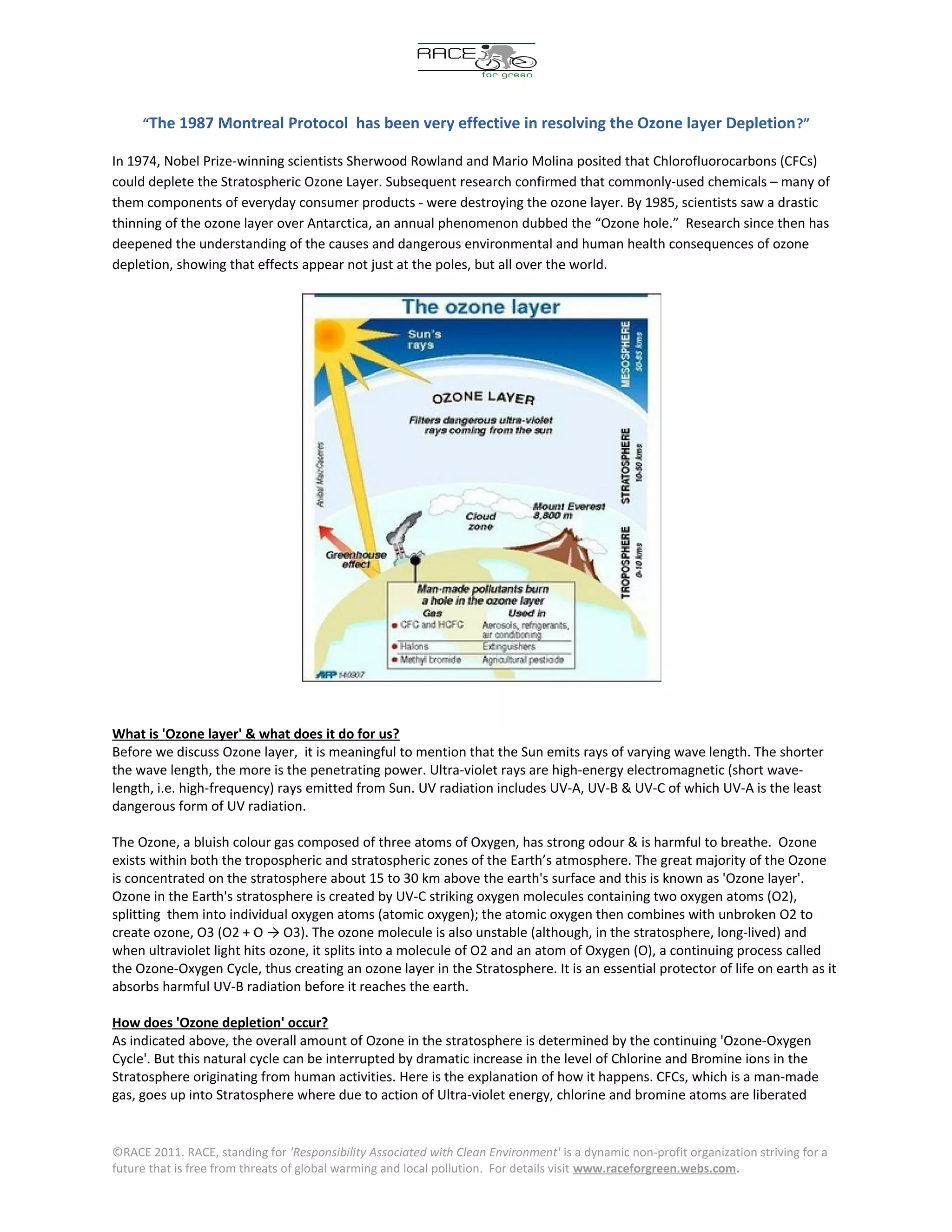
The Ozone, a bluish colour gas composed of three atoms of Oxygen, has strong odour & is harmful to breathe. Ozone
exists within both the tropospheric and stratospheric zones of the Earth’s atmosphere. The great majority of the Ozone
is concentrated on the stratosphere about 15 to 30 km above the earth's surface and this is known as 'Ozone layer'.
Ozone in the Earth's stratosphere is created by UV-C striking oxygen molecules containing two oxygen atoms (O2),
splitting them into individual oxygen atoms (atomic oxygen); the atomic oxygen then combines with unbroken O2 to
create ozone, O3 (O2 + O → O3). The ozone molecule is also unstable (although, in the stratosphere, long-lived) and
when ultraviolet light hits ozone, it splits into a molecule of O2 and an atom of Oxygen (O), a continuing process called
the Ozone-Oxygen Cycle, thus creating an ozone layer in the Stratosphere. It is an essential protector of life on earth as it
absorbs harmful UV-B radiation before it reaches the earth.

How does 'Ozone depletion' occur?
As indicated above, the overall amount of Ozone in the stratosphere is determined by the continuing 'Ozone-Oxygen
Cycle'. But this natural cycle can be interrupted by dramatic increase in the level of Chlorine and Bromine ions in the
Stratosphere originating from human activities. Here is the explanation of how it happens. CFCs, which is a man-made
gas, goes up into Stratosphere where due to action of Ultra-violet energy, chlorine and bromine atoms are liberated


©RACE 2011. RACE, standing for 'Responsibility Associated with Clean Environment' is a dynamic non-profit organization striving for a
future that is free from threats of global warming and local pollution. For details visit www.raceforgreen.webs.com.
from parent compounds. The chlorine and bromine atoms can destroy ozone molecules through a catalytic process due
to which Ozone is converted to Oxygen (while the chlorine & bromine atoms recover itself). The overall impact is the
decrease in Ozone. A single chlorine atom will keep on destroying Ozone for up to 2 years. Hence 'Ozone-depletion'
occurs.

Ozone-depleting substances (ODS) are those substances which deplete the Ozone layer and are widely used in
refrigerators, air-conditioners, fire-extinguishers and in dry cleaning etc. They include CFCs, Hydrochlorofluorocarbons
(HCFCs), Halon, HBFCs etc.

What is there to worry if Ozone-depletion occurs?
With Ozone-depletion, UV-B radiation reaches the earth. Some of the worrying consequences are as below -

     1.   Human Health – Skin Cancer, Premature ageing, Cataracts & Eye Disorders, damage to immune systems.
     2.   Damage to plants resulting in slower growth or smaller leaves.
     3.   Possible impact on crops and agriculture.
     4.   Decreasing Phytoplankton (in the aquatic ecosystems) and hence affecting fish production & impacting marine
          food chain. Reducing Phytoplankton also means reducing capacity to absorb CO2 (indirectly leading to global
          warming).
     5.   Ozone itself is a greenhouse gas and hence does influence Climate. Its imbalance can cause climatic
          aberrations.

While Ozone depletion can cause Climate Change, Climate Change can also have an impact on the Ozone hole recovery
process.

What is Montreal Protocol & has it helped?
Recognizing the dangers, on September 16, 1987, world leaders signed the Montreal Protocol. It is an international
treaty designed to protect the ozone layer by phasing out the production of numerous substances believed to be
responsible for ozone depletion. The treaty was opened for signature on September 16, 1987, and entered into force on
January 1, 1989. Since then, new scientific proofs of the urgency of ozone damage have led the world community to
strengthen the treaty repeatedly, in 1990 in London, in 1999 in Beijing etc. It is believed that if the international
agreement is adhered to, the ozone layer is expected to recover by 2050. Due to its widespread adoption and
implementation it has been hailed as an example of exceptional international co-operation, with Kofi Annan (former UN
Chief) quoted as saying that "perhaps the single most successful international agreement to date has been the Montreal
Protocol". It has been ratified by 196 states. The U.S., unlike in case of 'global warming', has been a leader in
reducing/ending use of ODS while at the same time developing and commercializing safer substitutes.

The latest scientific assessment of World Meteorological Organization (WMO) in 2010 identifies impact of climate
change on Ozone recovery process. Satellite images shows a slow recovery of Ozone layer and it is encouraging.

What can I do as an individual?
A common person like myself can do the following -
    1. Avoid using Air-conditioners (ACs). This helps reduce carbon emissions as well as reduce the usage of Ozone
        depleting substances.
    2. If you have to buy ACs, please ensure you buy one that does not use ODS (e.g. CFCs).
    3. Look for 'Does not contain CFCs' labels when you buy a Deodrant or hair spray (or other consumer items).
    4. Be aware and participate in the discussions.
    5. Do everything to reduce your carbon footprint. 'Climate Change' has a complex relationship to Ozone
        depletion. Besides many ODS are greenhouse gases and have significant global warming potential as well.

Further reading:
Only a few websites are mentioned here –
    1. http://www.indiaenvironmentportal.org.in
    2. http://www.epa.gov/ozone/strathome.html


©RACE 2011. RACE, standing for 'Responsibility Associated with Clean Environment' is a dynamic non-profit organization striving for a
future that is free from threats of global warming and local pollution. For details visit www.raceforgreen.webs.com.

RACE reading material series - Ozone depletion

  • 1.
    “The 1987 MontrealProtocol has been very effective in resolving the Ozone layer Depletion ?” In 1974, Nobel Prize-winning scientists Sherwood Rowland and Mario Molina posited that Chlorofluorocarbons (CFCs) could deplete the Stratospheric Ozone Layer. Subsequent research confirmed that commonly-used chemicals – many of them components of everyday consumer products - were destroying the ozone layer. By 1985, scientists saw a drastic thinning of the ozone layer over Antarctica, an annual phenomenon dubbed the “Ozone hole.” Research since then has deepened the understanding of the causes and dangerous environmental and human health consequences of ozone depletion, showing that effects appear not just at the poles, but all over the world. What is 'Ozone layer' & what does it do for us? Before we discuss Ozone layer, it is meaningful to mention that the Sun emits rays of varying wave length. The shorter the wave length, the more is the penetrating power. Ultra-violet rays are high-energy electromagnetic (short wave- length, i.e. high-frequency) rays emitted from Sun. UV radiation includes UV-A, UV-B & UV-C of which UV-A is the least dangerous form of UV radiation. The Ozone, a bluish colour gas composed of three atoms of Oxygen, has strong odour & is harmful to breathe. Ozone exists within both the tropospheric and stratospheric zones of the Earth’s atmosphere. The great majority of the Ozone is concentrated on the stratosphere about 15 to 30 km above the earth's surface and this is known as 'Ozone layer'. Ozone in the Earth's stratosphere is created by UV-C striking oxygen molecules containing two oxygen atoms (O2), splitting them into individual oxygen atoms (atomic oxygen); the atomic oxygen then combines with unbroken O2 to create ozone, O3 (O2 + O → O3). The ozone molecule is also unstable (although, in the stratosphere, long-lived) and when ultraviolet light hits ozone, it splits into a molecule of O2 and an atom of Oxygen (O), a continuing process called the Ozone-Oxygen Cycle, thus creating an ozone layer in the Stratosphere. It is an essential protector of life on earth as it absorbs harmful UV-B radiation before it reaches the earth. How does 'Ozone depletion' occur? As indicated above, the overall amount of Ozone in the stratosphere is determined by the continuing 'Ozone-Oxygen Cycle'. But this natural cycle can be interrupted by dramatic increase in the level of Chlorine and Bromine ions in the Stratosphere originating from human activities. Here is the explanation of how it happens. CFCs, which is a man-made gas, goes up into Stratosphere where due to action of Ultra-violet energy, chlorine and bromine atoms are liberated ©RACE 2011. RACE, standing for 'Responsibility Associated with Clean Environment' is a dynamic non-profit organization striving for a future that is free from threats of global warming and local pollution. For details visit www.raceforgreen.webs.com.
  • 2.
    from parent compounds.The chlorine and bromine atoms can destroy ozone molecules through a catalytic process due to which Ozone is converted to Oxygen (while the chlorine & bromine atoms recover itself). The overall impact is the decrease in Ozone. A single chlorine atom will keep on destroying Ozone for up to 2 years. Hence 'Ozone-depletion' occurs. Ozone-depleting substances (ODS) are those substances which deplete the Ozone layer and are widely used in refrigerators, air-conditioners, fire-extinguishers and in dry cleaning etc. They include CFCs, Hydrochlorofluorocarbons (HCFCs), Halon, HBFCs etc. What is there to worry if Ozone-depletion occurs? With Ozone-depletion, UV-B radiation reaches the earth. Some of the worrying consequences are as below - 1. Human Health – Skin Cancer, Premature ageing, Cataracts & Eye Disorders, damage to immune systems. 2. Damage to plants resulting in slower growth or smaller leaves. 3. Possible impact on crops and agriculture. 4. Decreasing Phytoplankton (in the aquatic ecosystems) and hence affecting fish production & impacting marine food chain. Reducing Phytoplankton also means reducing capacity to absorb CO2 (indirectly leading to global warming). 5. Ozone itself is a greenhouse gas and hence does influence Climate. Its imbalance can cause climatic aberrations. While Ozone depletion can cause Climate Change, Climate Change can also have an impact on the Ozone hole recovery process. What is Montreal Protocol & has it helped? Recognizing the dangers, on September 16, 1987, world leaders signed the Montreal Protocol. It is an international treaty designed to protect the ozone layer by phasing out the production of numerous substances believed to be responsible for ozone depletion. The treaty was opened for signature on September 16, 1987, and entered into force on January 1, 1989. Since then, new scientific proofs of the urgency of ozone damage have led the world community to strengthen the treaty repeatedly, in 1990 in London, in 1999 in Beijing etc. It is believed that if the international agreement is adhered to, the ozone layer is expected to recover by 2050. Due to its widespread adoption and implementation it has been hailed as an example of exceptional international co-operation, with Kofi Annan (former UN Chief) quoted as saying that "perhaps the single most successful international agreement to date has been the Montreal Protocol". It has been ratified by 196 states. The U.S., unlike in case of 'global warming', has been a leader in reducing/ending use of ODS while at the same time developing and commercializing safer substitutes. The latest scientific assessment of World Meteorological Organization (WMO) in 2010 identifies impact of climate change on Ozone recovery process. Satellite images shows a slow recovery of Ozone layer and it is encouraging. What can I do as an individual? A common person like myself can do the following - 1. Avoid using Air-conditioners (ACs). This helps reduce carbon emissions as well as reduce the usage of Ozone depleting substances. 2. If you have to buy ACs, please ensure you buy one that does not use ODS (e.g. CFCs). 3. Look for 'Does not contain CFCs' labels when you buy a Deodrant or hair spray (or other consumer items). 4. Be aware and participate in the discussions. 5. Do everything to reduce your carbon footprint. 'Climate Change' has a complex relationship to Ozone depletion. Besides many ODS are greenhouse gases and have significant global warming potential as well. Further reading: Only a few websites are mentioned here – 1. http://www.indiaenvironmentportal.org.in 2. http://www.epa.gov/ozone/strathome.html ©RACE 2011. RACE, standing for 'Responsibility Associated with Clean Environment' is a dynamic non-profit organization striving for a future that is free from threats of global warming and local pollution. For details visit www.raceforgreen.webs.com.